Nursing Care Plan: Polypharmacy Issues in Elderly Patients - CRC

Verified

Added on  2022/09/27

|7
|653
|44
Presentation
AI Summary
This presentation details a nursing care plan for an elderly patient experiencing polypharmacy, utilizing steps 5 through 8 of the Clinical Reasoning Cycle (CRC). It establishes SMART goals to address medication adherence and reduce risks associated with multiple medications. The plan proposes interventions such as behavioral modification, education and counseling, and reminder systems to improve patient outcomes. The evaluation section outlines expected outcomes, including enhanced medication adherence and reduced side effects. The reflection highlights key learnings, emphasizing the critical nature of polypharmacy in elderly patients and the effectiveness of combined interventions. References include relevant research articles supporting the proposed interventions and strategies.

Document Page
NAME OF THE STUDENT:
NAME OF THE UNIVERSITY:
NURSING CARE PLAN FOR
PATINET WITH POLYPHARMACY
ISSUE
tabler-icon-diamond-filled.svg

Paraphrase This Document

Need a fresh take? Get an instant paraphrase of this document with our AI Paraphraser
Document Page
CRC step 5: SMART goals of
nursing care
Specific
To address polypharmacy issue of Lina and address challenges
and risk to patient associated with multiple medication use
Measurable
To promote adherence to all medications and address risk of side
effects and other harms associated with each medication
Achievable
To implement patient education and therapeutic regimen for the
management of polypharmacy issue of Lina
Relevant
To address emotional distress for patient due to use of multiple
medication
Timely
To enable patient to effectively manage use of multiple
medications within 3 months
Document Page
CRC step 6: Detailed
intervention and rationales to
address the problem
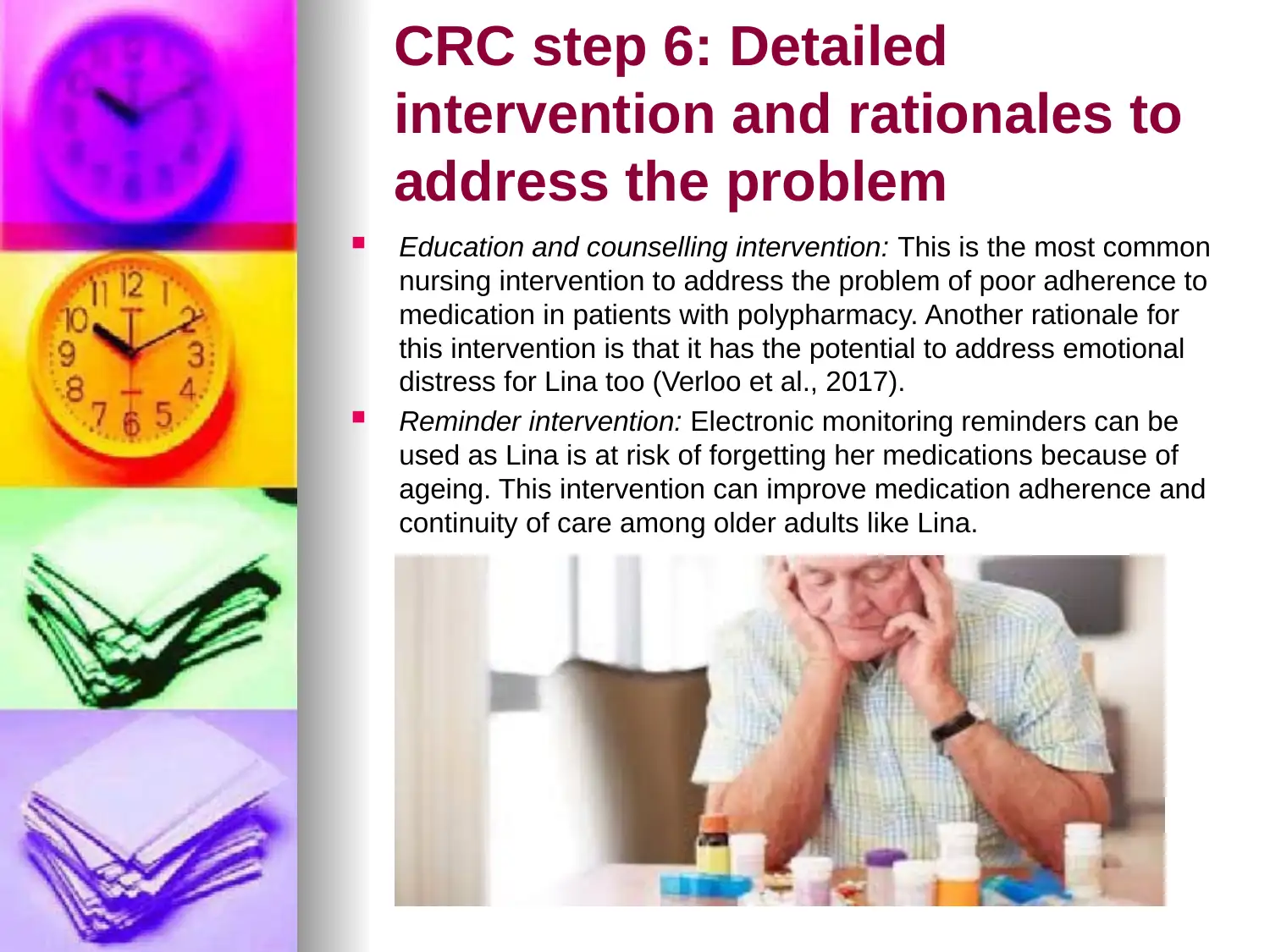
The following intervention is proposed to address the issue of
polypharmacy for Lina and achieve the SMART goals:
1. Behavioral modification strategy: It involves careful deliberation
by adjustment of treatment effects and changing conditions of
patient. The main rationale for implementing this intervention is
that it can address risk of side effects and emotional distress
associated with polypharmacy (Sinnige et al., 2016).
Document Page
CRC step 6: Detailed
intervention and rationales to
address the problem
Education and counselling intervention: This is the most common
nursing intervention to address the problem of poor adherence to
medication in patients with polypharmacy. Another rationale for
this intervention is that it has the potential to address emotional
distress for Lina too (Verloo et al., 2017).
Reminder intervention: Electronic monitoring reminders can be
used as Lina is at risk of forgetting her medications because of
ageing. This intervention can improve medication adherence and
continuity of care among older adults like Lina.
tabler-icon-diamond-filled.svg

Paraphrase This Document

Need a fresh take? Get an instant paraphrase of this document with our AI Paraphraser
Document Page
CRC step 7:EVALUATION
After the goals are achieved, it is expected to achieve
the following outcomes for Lina:
Improve self reported outcomes related to
medication adherence
Increase continuity of care and the burden of
multiple medication by decreasing multiple
medication use
Enhanced management of side effects related to
medication use
Document Page
CRC step 8: Reflection
Based on the experience of analyzing health issue of Lina and
providing proper care to her using the clinical reasoning cycle
process, the following lessons has been learned
Polypharmacy is critical issue for elderly patient which leads to
additional care burden
Forgetfulness and lack of awareness about medications create
barrier to polypharmacy
Combining education intervention with reminder tool is likely to
address risk of forgetfulness and medication adherence issue in
elderly patients like Lina
Document Page
REFERENCES:
Santos, N., Marengo, L. L., Moraes, F., & Barberato Filho, S. (2019). Interventions to
reduce the prescription of inappropriate medicines in older patients. Revista de saude
publica, 53, 7. doi:10.11606/S1518-8787.2019053000781
Sinnige, J., Korevaar, J. C., van Lieshout, J., Westert, G. P., Schellevis, F. G., &
Braspenning, J. C. (2016). Br J Gen Pract, 66(649), e540-e551. doi:
10.3399/bjgp16X685681..
Valenza, P. L., McGinley, T. C., Feldman, J., Patel, P., Cornejo, K., Liang, N., ... &
McNaughton, N. (2017). Dangers of Polypharmacy. In Vignettes in Patient Safety-
Volume 1. IntechOpen. DOI: 10.5772/intechopen.69169
Verloo, H., Chiolero, A., Kiszio, B., Kampel, T., & Santschi, V. (2017 Age and ageing, 46(5),
747-754. doi: 10.1093/ageing/afx076.
Zelko, E., Klemenc-Ketis, Z., & Tusek-Bunc, K. (2016). MEDICATION ADHERENCE IN
ELDERLY WITH POLYPHARMACY LIVING AT HOME: A SYSTEMATIC REVIEW OF
EXISTING STUDIES. Materia socio-medica, 28(2), 129–132.
doi:10.5455/msm.2016.28.129-132
chevron_up_icon
1 out of 7
circle_padding
hide_on_mobile
zoom_out_icon
[object Object]