Leadership and Management: Future Career Case Study Report

Verified

Added on  2022/09/12

|7
|1501
|18
Report
AI Summary
This report presents an analysis of a case study focused on a future career in nursing, examining the challenges of workplace adversity and the importance of resilience. The report begins with an introduction that highlights the significance of career stability and the selection of nursing as a resilient profession. It then provides an overview of the case study, emphasizing the concept of resilience in the context of nursing and its impact on organizational health. The analysis delves into human relation issues such as conflict management, safety, and wage issues, and their influence on organizational value. The report incorporates a literature review that explores the concept of workplace adversity, the role of resilience, and the challenges faced by nursing professionals. The report also provides recommendations for enhancing organizational resilience, including the importance of communication, self-awareness, and employee creativity. The conclusion summarizes the key findings, emphasizing the impact of nursing resilience on organizational outcomes. The report concludes with a list of cited references.
Document Page
Running head: Future Career
ASSESSMENT TASK 1: FUTURE CAREER
Student name
Student ID
tabler-icon-diamond-filled.svg

Paraphrase This Document

Need a fresh take? Get an instant paraphrase of this document with our AI Paraphraser
Document Page
2
Future Career
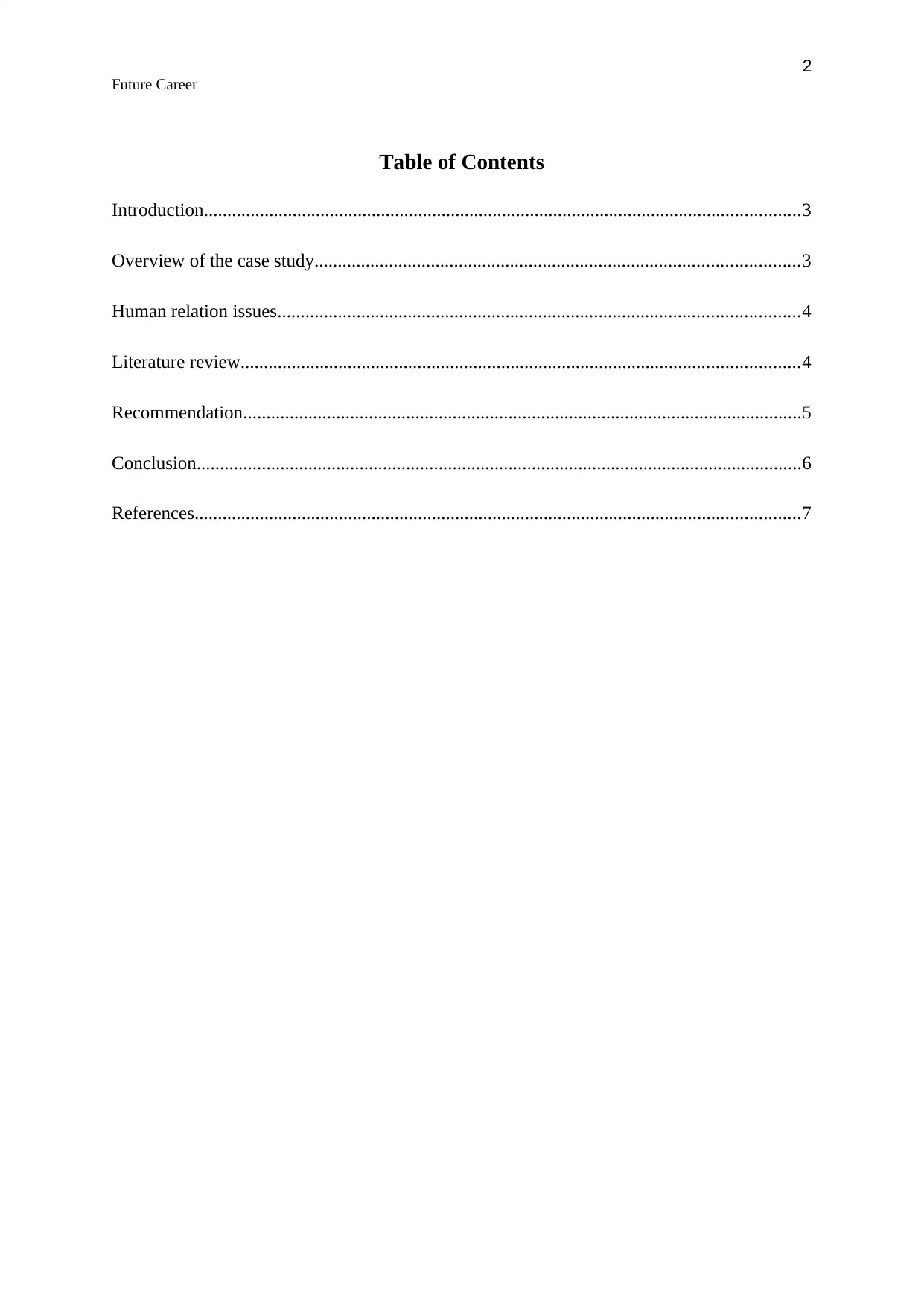
Table of Contents
Introduction................................................................................................................................3
Overview of the case study........................................................................................................3
Human relation issues................................................................................................................4
Literature review........................................................................................................................4
Recommendation........................................................................................................................5
Conclusion..................................................................................................................................6
References..................................................................................................................................7
Document Page
3
Future Career
Introduction
Future career had considered as the action and progress taken by an individual in his
lifetime and especially it is related to the individual occupation. The future career had
identified as a significant factor in life. Having career, referred to the stability in the lifestyle.
The case study which had been selected is based on the surviving workplace-adversity.
Nursing had been chosen as the future career who perceive as resilient. The potential
adversity had seemed to be significant in the nursing work. However, the nurses expose their
self-efficacy and sophisticated skills to develop workplace adversity.
Overview of the case study
Nurse’s sustainability is the pivotal interest of any healthy organization, clinician’s
performance, nursing researchers and so on. Resilience had considered as the basic concept to
influence the resolution in the workplace adversity. The study focused on the maintenance of
resilience in the study intervention (Mcdonald, Jackson, Vickers & Wilkes, 2016). The
nursing professional focus on the mental physical and emotional sustainability to evolve the
workplace adversity. The insights of the nursing professionals contributed a more developed
understanding of personal resilience.
The embracement of personal resilience assists to direct future initiatives. The
enhancement of personal resilience develops the other individual's ability to enhance the
value of the health organization. It had been observed; the nursing professionals faced various
challenges in the workplace (De Clercq & Belausteguigoitia, 2017). The integration of the
workplace adversity may lead o to reduce the severe challenges faced by the nurses. The
resilience had conceptualized from a unique perspective. The perspective is ecological-
perspective (Lawrence, 2017). The view used to expose resilience as the existing factor in
Document Page
4
Future Career
physical environments. The resilience had initiated as the prominent factor develop the
social-cultural level of the health care organization. The environmental quality had
inaugurated as the major aspect of resilience. The environmental factors incorporated with
the nursing resilience. It leads to influence the interpersonal communication, teamwork,
clinical supervision, mentoring and supporting.
Human relation issues
Some of the human relation issues included conflict management, adequate safety,
attendance issues, and wage issues. Involvement the workplace adversity influence the
human relation issues in the health care organization. The adequate maintenance of the
workplace sustainability had underpinned as the major aspect to demonstrate the human-
relation issues (Trounson & Pfeifer, 2017). The appropriate maintenance of human-relation
issues can expand organizational production. Hence, it can evolve the attendance of nursing
professionals. The resilience had obtained as the major perspective of the nursing profession
to intensify the workforce value. However, the integration of the organizational policy can
influence the nurse’s motivation. The enhancement of the nurse’s motivation lead to
influence the health caring process and thus it lead to enhance the suitability of the health
care organization. The human relation issues had to identify to influence the organizational
value. The hierarchical management needs to influence the organizational rules and
regulation as well as the salary system. The integration of the salary system and the
regulation lead the hierarchical management to intensify the value of human-relation issues in
the organizational context.
Literature review
Workplace adversity
tabler-icon-diamond-filled.svg

Paraphrase This Document

Need a fresh take? Get an instant paraphrase of this document with our AI Paraphraser
Document Page
5
Future Career
The study mainly focused on the nurse's resilience to integrate the workplace value.
Resilience had considered as the basic concept to influence the resolution in the workplace
adversity (Hazenberg, Seddon & Denny, 2015). The study focused on the maintenance of
resilience in the study intervention. The nurses mainly focused on the mental, physical, and
emotional sustainability to evolve the workplace adversity. The insights of the nursing
professionals contributed a more developed understanding of personal resilience (Trounson
& Pfeifer, 2017). The embracement of personal resilience assists to direct future initiatives.
The enhancement of personal resilience develops the other individual's ability to enhance the
value of the health organization (Zuchowski, 2019). It had been observed; the nursing
professionals faced various challenges in the workplace. The hierarchical management had to
take the effective action to reduce the workplace challenges. Thus the nursing staffs can feel
safe and secure. Hence it assists the nursing staffs to integrate the resilience. Hence it evolves
the value of the organizational adversity.
Recommendation
The anticipation of the nursing professional had identified as the major aspect to
evolve the organizational resilience. The acknowledgement of reality is the most
significant factor to evolve organizational resilience (Arslan, Tarba & Larimo, 2015).
Communication is the pivotal factor to evolve organizational resilience. The
integration of the communication involves the verbal-communication, written-
communication which intensifies the value of the organizational information towards
the organizational members. Hence it had obtained as the mesmerize factor to
influence the organizational resilience.
Document Page
6
Future Career
Self-awareness had sustained as another powerful tool to develop resilience
(Firmansyah, Djatmika & Hermawan, 2016). The self-awareness of nursing
professionals helps to influence the resilience of nursing professionals.
Encouragement of employee creativity can be recommended as a significant aspect to
develop organizational resilience. Hence it can be recommended as the most superior
tool o demonstrates the organizational resilience.
Maintenance of the external focus also can be recommended as the preliminary factor
to influence the organizational adversity. It used to develop the social value of the
organization. In order to influence the external focus the hierarchical management of
this organization need to maintain the enhanced organizational policies. The
integration of the organizational policies leads the organization to demonstrate its
adversity.
Conclusion
The study deduced the nursing resilience to impact on the organizational adversity.
Nurses’ sustainability is the pivotal interest of any healthy organization, clinician’s
performance, nursing researchers and so on. Resilience had considered as the basic concept to
influence the resolution in the workplace adversity. The study focused on the maintenance of
resilience in the study intervention. The resilience had initiated as the prominent factor
develop the social-cultural level of the health care organization. The environmental quality
had inaugurated as the major aspect of resilience. The environmental factors incorporated
with the nursing resilience. It leads to influence the interpersonal communication, teamwork,
clinical supervision, mentoring and supporting.
Document Page
7
Future Career
References
Arslan, A., Tarba, S. Y., & Larimo, J. (2015). FDI entry strategies and the impacts of
economic freedom distance: Evidence from Nordic FDIs in transitional periphery of
CIS and SEE. International Business Review, 24(6), 997-1008.
De Clercq, D., & Belausteguigoitia, I. (2017). The usefulness of tenacity in spurring problem-
focused voice: The moderating roles of workplace adversity. Journal of business and
psychology, 32(4), 479-493.
Firmansyah, A. H., Djatmika, E. T., & Hermawan, A. (2016). The Effect of Adversity
Quotient and Entrepreneurial Self Efficacy on Entrepreneurial Intention Through
Entrepreneurial Attitude. Journal of Business and Management, 18(5), 45-5.
Hazenberg, R., Seddon, F., & Denny, S. (2015). Intermediary perceptions of investment
readiness in the UK social investment market. VOLUNTAS: International Journal of
Voluntary and Nonprofit Organizations, 26(3), 846-871.
Lawrence, A. (2017). Adapting through practice: Silviculture, innovation and forest
governance for the age of extreme uncertainty. Forest Policy and Economics, 79, 50-
60.
Mcdonald, G., Jackson, D., Vickers, M. H., & Wilkes, L. (2016). Surviving workplace
adversity: a qualitative study of nurses and midwives and their strategies to increase
personal resilience. Journal of Nursing Management, 24(1), 123-131.
Trounson, J. S., & Pfeifer, J. E. (2017). Correctional Officers and Workplace Adversity:
Identifying Interpersonal, Cognitive, and Behavioral Response Tendencies. Journal of
Correctional Health Care, 23(4), 437-448.
Zuchowski, I. (2019). Five years after Carmody: practitioners’ views of changes, challenges
and research in child protection. Children Australia, 1-8.
chevron_up_icon
1 out of 7
circle_padding
hide_on_mobile
zoom_out_icon
[object Object]