International Trade Report: Poland, Paraguay, and Trade Theories
VerifiedAdded on  2020/07/22
|8
|1148
|56
Report
AI Summary
This report delves into the realm of international trade, commencing with an analysis of the correlation between the GINI index and the openness of economies in Poland and Paraguay. The report then elucidates the Stolper-Samuelson theorem, exploring the relationship between product prices and factors of production. The analysis extends to assessing the agreement of data with the theorem, considering the implications for labor-intensive products and trade dynamics. Furthermore, the report presents calculations of relative demand and supply curves for radios in home and foreign countries, followed by an evaluation of equilibrium prices and the impacts of free trade. The analysis also examines the gains and losses from trade, considering labor advantages and disadvantages in both nations. The report concludes with a comprehensive overview of the economic principles that govern international trade, providing a thorough understanding of the interplay of various factors and their effects on trade scenarios.

INTERNATIONAL TRADE
Paraphrase This Document
Need a fresh take? Get an instant paraphrase of this document with our AI Paraphraser

Contents
INTRODUCTION...........................................................................................................................1
QUESTION 1:.................................................................................................................................1
Report and interpret relationship between Openness and the GINI Index for each nation.........1
QUESTION 2:.................................................................................................................................2
Explain the Stolper-Samuelson theorem.....................................................................................2
QUESTION 3:.................................................................................................................................3
Explain whether data agree or disagree with the Stolper-Samuelson theorem...........................3
REFERNCES...................................................................................................................................4
INTRODUCTION...........................................................................................................................1
QUESTION 1:.................................................................................................................................1
Report and interpret relationship between Openness and the GINI Index for each nation.........1
QUESTION 2:.................................................................................................................................2
Explain the Stolper-Samuelson theorem.....................................................................................2
QUESTION 3:.................................................................................................................................3
Explain whether data agree or disagree with the Stolper-Samuelson theorem...........................3
REFERNCES...................................................................................................................................4

INTRODUCTION
In this current report we would be taking out correlation between GINI index and
Openness of two countris namely Poland and Paraguay. Then there would also be included
Stolper-Samuelson theorem which is telling about relative price of product with its price of other
factor of production.
QUESTION 1:
Report and interpret relationship between Openness and the GINI Index for each nation.
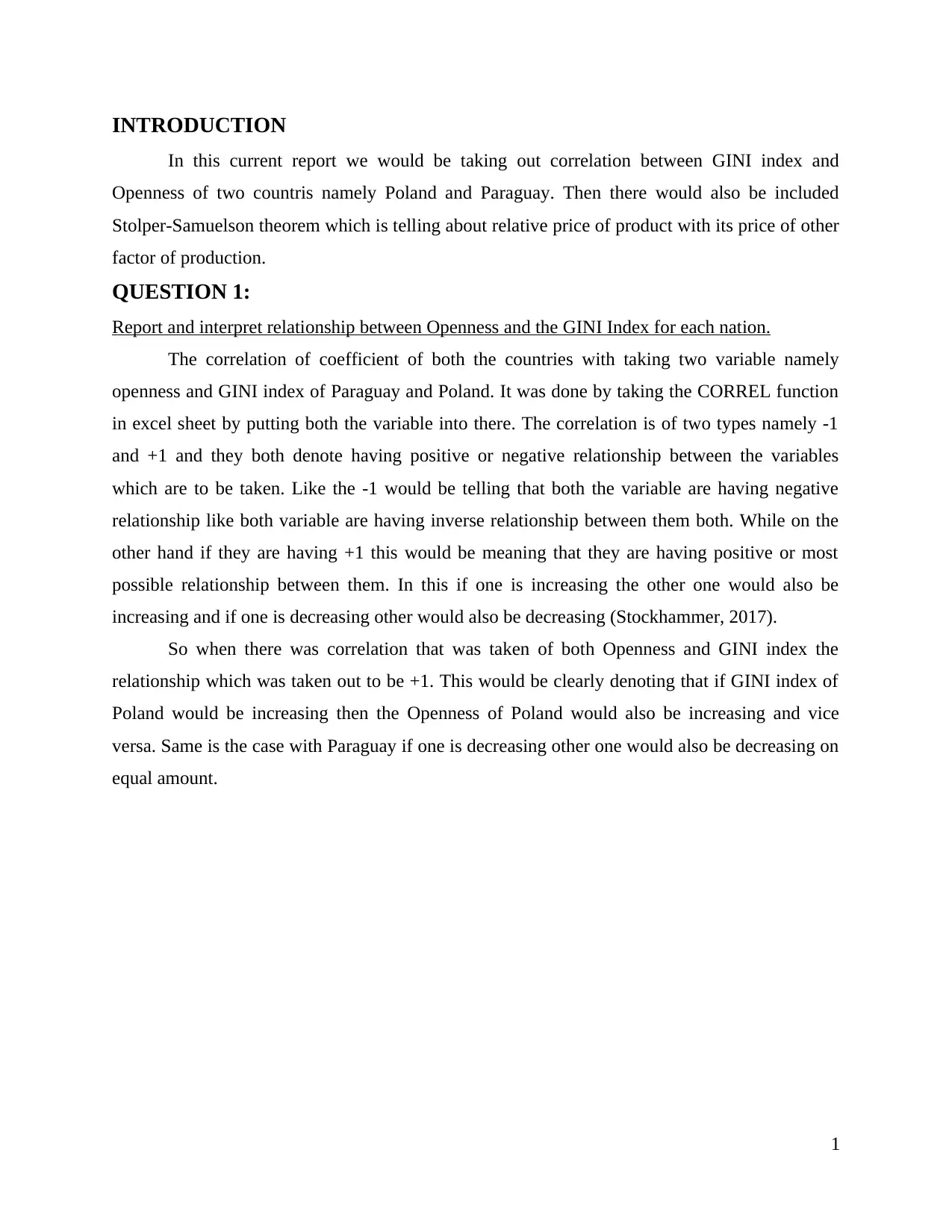
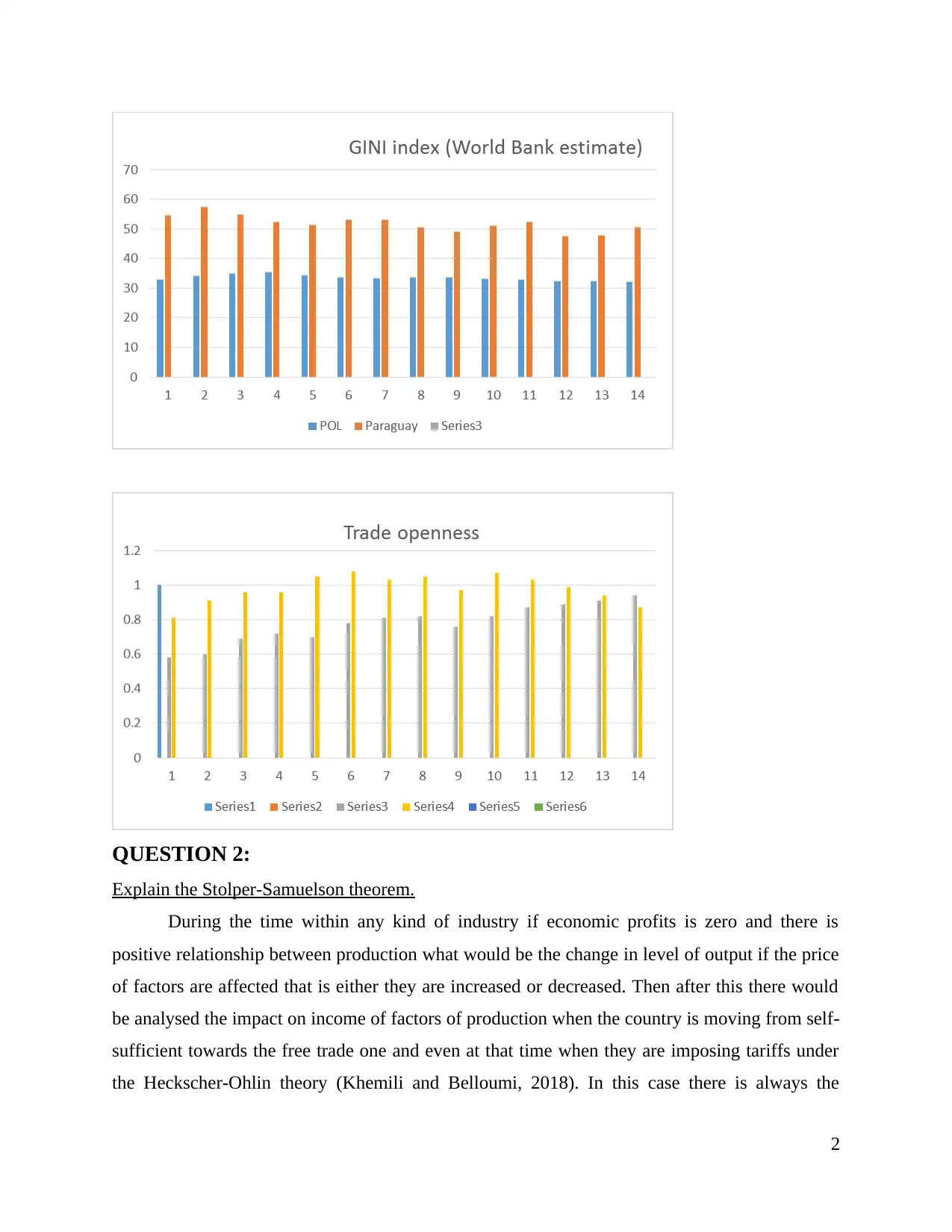
The correlation of coefficient of both the countries with taking two variable namely
openness and GINI index of Paraguay and Poland. It was done by taking the CORREL function
in excel sheet by putting both the variable into there. The correlation is of two types namely -1
and +1 and they both denote having positive or negative relationship between the variables
which are to be taken. Like the -1 would be telling that both the variable are having negative
relationship like both variable are having inverse relationship between them both. While on the
other hand if they are having +1 this would be meaning that they are having positive or most
possible relationship between them. In this if one is increasing the other one would also be
increasing and if one is decreasing other would also be decreasing (Stockhammer, 2017).
So when there was correlation that was taken of both Openness and GINI index the
relationship which was taken out to be +1. This would be clearly denoting that if GINI index of
Poland would be increasing then the Openness of Poland would also be increasing and vice
versa. Same is the case with Paraguay if one is decreasing other one would also be decreasing on
equal amount.
1
In this current report we would be taking out correlation between GINI index and
Openness of two countris namely Poland and Paraguay. Then there would also be included
Stolper-Samuelson theorem which is telling about relative price of product with its price of other
factor of production.
QUESTION 1:
Report and interpret relationship between Openness and the GINI Index for each nation.
The correlation of coefficient of both the countries with taking two variable namely
openness and GINI index of Paraguay and Poland. It was done by taking the CORREL function
in excel sheet by putting both the variable into there. The correlation is of two types namely -1
and +1 and they both denote having positive or negative relationship between the variables
which are to be taken. Like the -1 would be telling that both the variable are having negative
relationship like both variable are having inverse relationship between them both. While on the
other hand if they are having +1 this would be meaning that they are having positive or most
possible relationship between them. In this if one is increasing the other one would also be
increasing and if one is decreasing other would also be decreasing (Stockhammer, 2017).
So when there was correlation that was taken of both Openness and GINI index the
relationship which was taken out to be +1. This would be clearly denoting that if GINI index of
Poland would be increasing then the Openness of Poland would also be increasing and vice
versa. Same is the case with Paraguay if one is decreasing other one would also be decreasing on
equal amount.
1
⊘ This is a preview!⊘
Do you want full access?
Subscribe today to unlock all pages.

Trusted by 1+ million students worldwide

QUESTION 2:
Explain the Stolper-Samuelson theorem.
During the time within any kind of industry if economic profits is zero and there is
positive relationship between production what would be the change in level of output if the price
of factors are affected that is either they are increased or decreased. Then after this there would
be analysed the impact on income of factors of production when the country is moving from self-
sufficient towards the free trade one and even at that time when they are imposing tariffs under
the Heckscher-Ohlin theory (Khemili and Belloumi, 2018). In this case there is always the
2
Explain the Stolper-Samuelson theorem.
During the time within any kind of industry if economic profits is zero and there is
positive relationship between production what would be the change in level of output if the price
of factors are affected that is either they are increased or decreased. Then after this there would
be analysed the impact on income of factors of production when the country is moving from self-
sufficient towards the free trade one and even at that time when they are imposing tariffs under
the Heckscher-Ohlin theory (Khemili and Belloumi, 2018). In this case there is always the
2
Paraphrase This Document
Need a fresh take? Get an instant paraphrase of this document with our AI Paraphraser

assumption of perfect competition within markets and production is also occurring into industry
at this time the profit would be reaching to 0 this is known as Stolper- Samuelson theory.
Like in this case where there are two products which are steel and clothing and labour are
getting their respected wages and producer is also paying rent on capital. So the relationship
between relative prices with that of others factors of production like that of rental rates of capital
and real wages of labours would be included into this theory.
QUESTION 3:
Explain whether data agree or disagree with the Stolper-Samuelson theorem.
In this part it is to be assumed that both Poland and Paraguay are unskilled labour
abundant countries which mean that both nations are producing only labour intensive products
and exporting it. While on the other hand both of them are not producing any capital intensive
products and they are importing them from other nations. This means that that labour would be
more mobile and training could be there of them and they are supposed to earn wages in return to
their service provided (Chaudhuri and Biswas, 2018). So in both these countries there are
workers but they are all unskilled one so this would not certainly hurting any other country or
their workers which was included into Stolper-Samuelson theorem.
It was argued in this theory that if they are removing all sort if tariff on labour intensive
goods then this would intern be depressing wages than that of price of products. the correlation
between the GINI index and openness of economy of Poland and Paraguay was coming +1
which tells that if wages would be increasing this would be leading to more production and thus
the country would be able to trade with other countries of world.
QUESTION 4
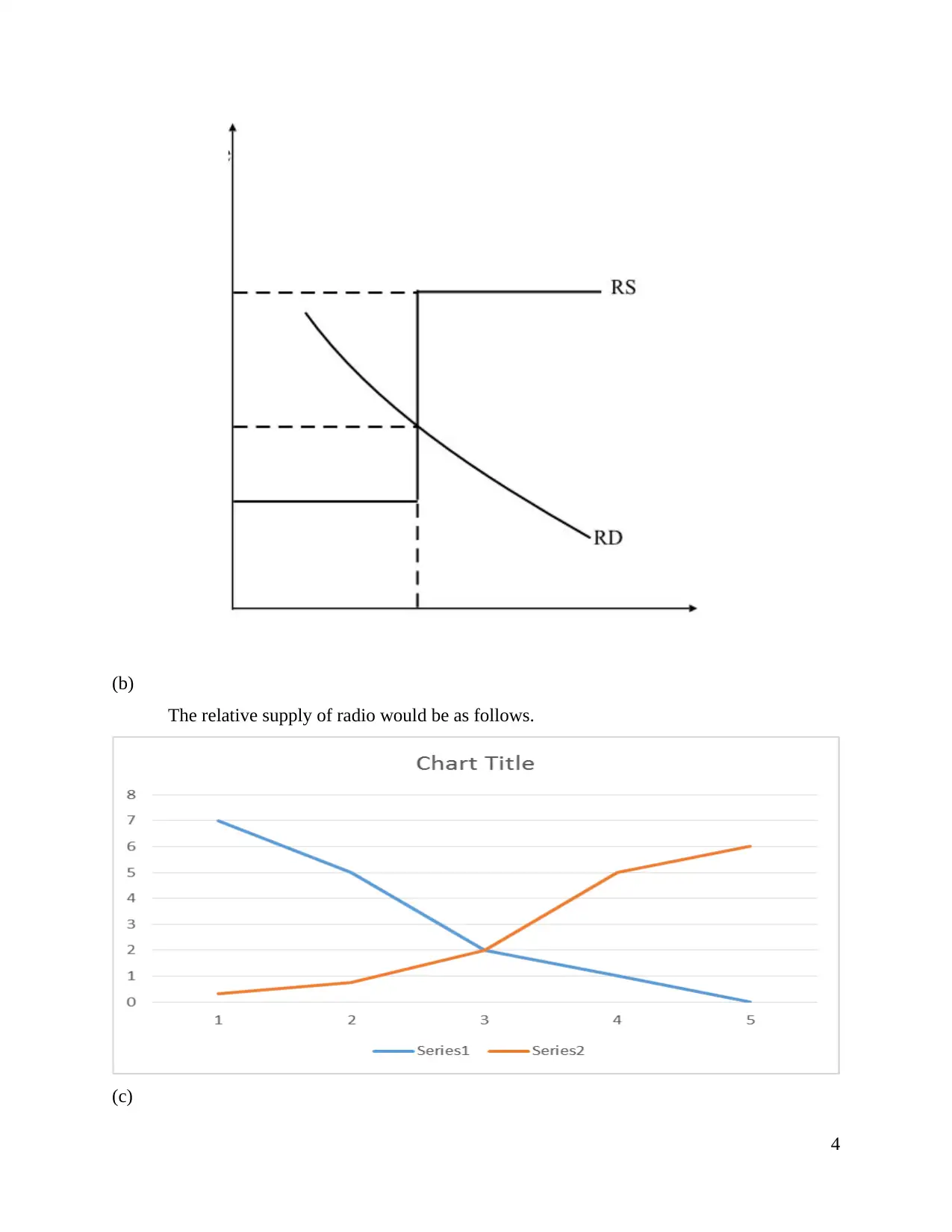
(a) Relative demand curve of radio
The home country is having about 30 workers and foreign is having 60 so total quantity
of radio in home would be 10= (30/3) and in foreign to would be 15= (60/4). So world relative
price of radio is 0.67= (10/15).
Relative demand of radio is equal to relative price of corn and relative demand of radio
would be 0.67 which is equal to relative price of corn 0.67 and relative price of radio would be
5.97= (4/0.67)
3
at this time the profit would be reaching to 0 this is known as Stolper- Samuelson theory.
Like in this case where there are two products which are steel and clothing and labour are
getting their respected wages and producer is also paying rent on capital. So the relationship
between relative prices with that of others factors of production like that of rental rates of capital
and real wages of labours would be included into this theory.
QUESTION 3:
Explain whether data agree or disagree with the Stolper-Samuelson theorem.
In this part it is to be assumed that both Poland and Paraguay are unskilled labour
abundant countries which mean that both nations are producing only labour intensive products
and exporting it. While on the other hand both of them are not producing any capital intensive
products and they are importing them from other nations. This means that that labour would be
more mobile and training could be there of them and they are supposed to earn wages in return to
their service provided (Chaudhuri and Biswas, 2018). So in both these countries there are
workers but they are all unskilled one so this would not certainly hurting any other country or
their workers which was included into Stolper-Samuelson theorem.
It was argued in this theory that if they are removing all sort if tariff on labour intensive
goods then this would intern be depressing wages than that of price of products. the correlation
between the GINI index and openness of economy of Poland and Paraguay was coming +1
which tells that if wages would be increasing this would be leading to more production and thus
the country would be able to trade with other countries of world.
QUESTION 4
(a) Relative demand curve of radio
The home country is having about 30 workers and foreign is having 60 so total quantity
of radio in home would be 10= (30/3) and in foreign to would be 15= (60/4). So world relative
price of radio is 0.67= (10/15).
Relative demand of radio is equal to relative price of corn and relative demand of radio
would be 0.67 which is equal to relative price of corn 0.67 and relative price of radio would be
5.97= (4/0.67)
3

(b)
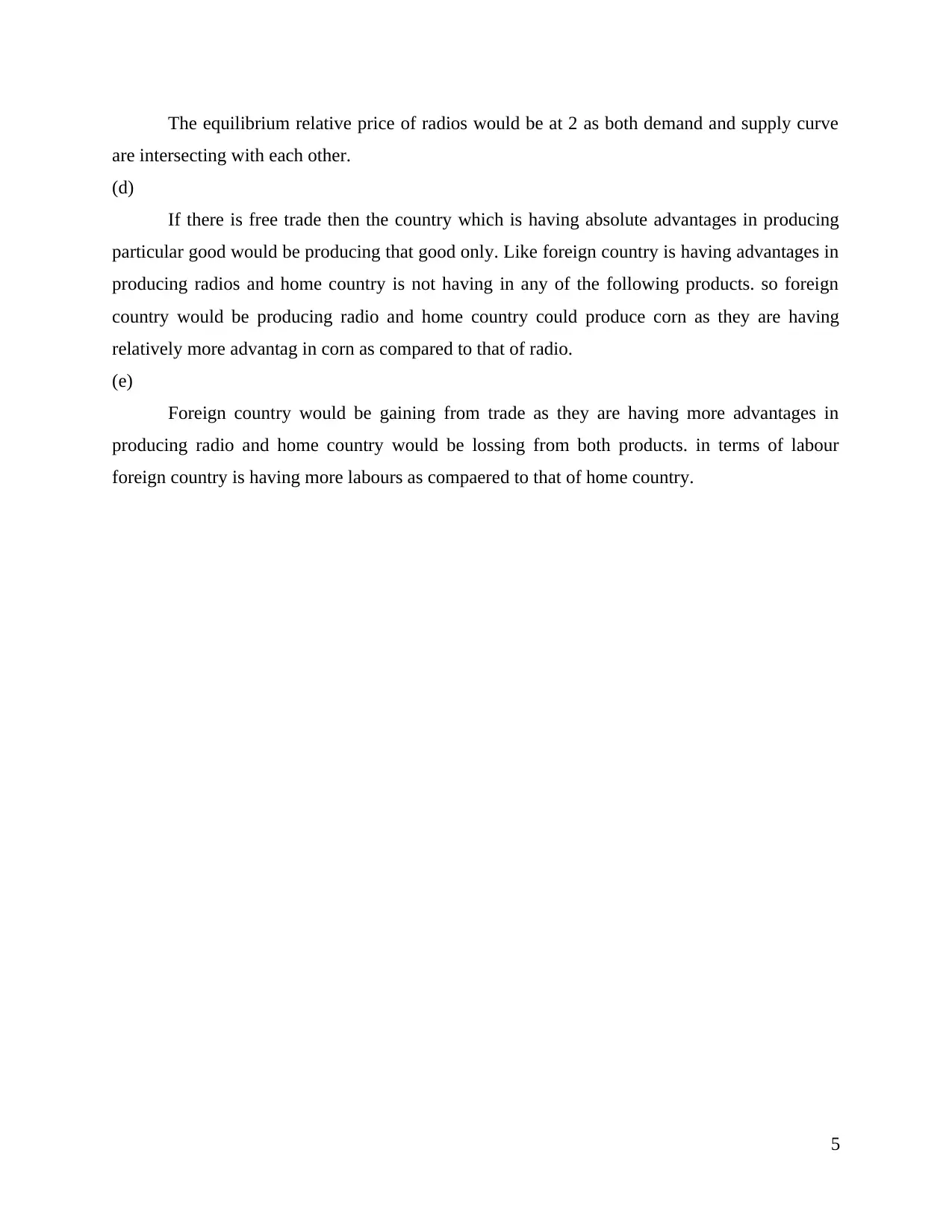
The relative supply of radio would be as follows.
(c)
4
The relative supply of radio would be as follows.
(c)
4
⊘ This is a preview!⊘
Do you want full access?
Subscribe today to unlock all pages.

Trusted by 1+ million students worldwide

The equilibrium relative price of radios would be at 2 as both demand and supply curve
are intersecting with each other.
(d)
If there is free trade then the country which is having absolute advantages in producing
particular good would be producing that good only. Like foreign country is having advantages in
producing radios and home country is not having in any of the following products. so foreign
country would be producing radio and home country could produce corn as they are having
relatively more advantag in corn as compared to that of radio.
(e)
Foreign country would be gaining from trade as they are having more advantages in
producing radio and home country would be lossing from both products. in terms of labour
foreign country is having more labours as compaered to that of home country.
5
are intersecting with each other.
(d)
If there is free trade then the country which is having absolute advantages in producing
particular good would be producing that good only. Like foreign country is having advantages in
producing radios and home country is not having in any of the following products. so foreign
country would be producing radio and home country could produce corn as they are having
relatively more advantag in corn as compared to that of radio.
(e)
Foreign country would be gaining from trade as they are having more advantages in
producing radio and home country would be lossing from both products. in terms of labour
foreign country is having more labours as compaered to that of home country.
5
Paraphrase This Document
Need a fresh take? Get an instant paraphrase of this document with our AI Paraphraser

REFERNCES
Books and Journals:
Chaudhuri, S. and Biswas, A., 2018. External terms-of-trade and labour market imperfections in
developing countries: Theory and evidence. Indian Growth and Development Review,
11(1), pp.22-33.
Khemili, H. and Belloumi, M., 2018. Cointegration Relationship between Growth, Inequality and
Poverty In Tunisia. International Journal of Applied Economics, Finance and Accounting,
2(1), pp.8-18.
Stockhammer, E., 2017. Determinants of the wage share: A panel analysis of advanced and
developing economies. British Journal of Industrial Relations, 55(1), pp.3-33.
6
Books and Journals:
Chaudhuri, S. and Biswas, A., 2018. External terms-of-trade and labour market imperfections in
developing countries: Theory and evidence. Indian Growth and Development Review,
11(1), pp.22-33.
Khemili, H. and Belloumi, M., 2018. Cointegration Relationship between Growth, Inequality and
Poverty In Tunisia. International Journal of Applied Economics, Finance and Accounting,
2(1), pp.8-18.
Stockhammer, E., 2017. Determinants of the wage share: A panel analysis of advanced and
developing economies. British Journal of Industrial Relations, 55(1), pp.3-33.
6
1 out of 8
Related Documents
Your All-in-One AI-Powered Toolkit for Academic Success.
 +13062052269
info@desklib.com
Available 24*7 on WhatsApp / Email
Unlock your academic potential
Copyright © 2020–2026 A2Z Services. All Rights Reserved. Developed and managed by ZUCOL.