Comprehensive Report on Sustainable Energy, Demand, and Alternatives
VerifiedAdded on 2020/10/05
|11
|2696
|308
Report
AI Summary
This report provides a comprehensive overview of sustainable energy, beginning with the definition and units of energy, and exploring the reasons behind the increasing global demand. It details the global variations in energy use, highlighting the correlation between energy consumption per capita and a country's economic development. The report further discusses the global shift in energy demand, emphasizing the role of developing economies and the impact of fossil fuels. It examines various types of energy sources, including renewable and non-renewable options, and analyzes their environmental impacts. The report also addresses the consequences of energy shortages in developing countries, the lack of access to energy services, and the importance of alternative energy sources. It concludes by discussing various types of renewable energy and their potential to address the challenges of energy sustainability.
Sustainable Energy

Paraphrase This Document
Need a fresh take? Get an instant paraphrase of this document with our AI Paraphraser
Table of Contents
1.Energy meaning.......................................................................................................................3
2. Units of Energy.......................................................................................................................3
3. Why we need energy...............................................................................................................3
4. Demand for Energy.................................................................................................................3
5. Reasons for increasing in demand...........................................................................................4
6. Global variations in energy use...............................................................................................4
7. Energy consumption per head is a reliable indicator of country's level of economic
development................................................................................................................................5
8. Global shift in energy demand................................................................................................6
10 impact on environment...........................................................................................................7
11. Global shift in economic output............................................................................................7
12. Energy shortages in developing countries can have major impacts- war in Iraq and Libya.7
13 Lack of access to energy services of adequate quantity and quality......................................7
14. Look for alternate energy sources- Renewable.....................................................................8
15. Types of Renewable..............................................................................................................8
16. Pros and cons.........................................................................................................................9
REFERENCES................................................................................................................................2
1.Energy meaning.......................................................................................................................3
2. Units of Energy.......................................................................................................................3
3. Why we need energy...............................................................................................................3
4. Demand for Energy.................................................................................................................3
5. Reasons for increasing in demand...........................................................................................4
6. Global variations in energy use...............................................................................................4
7. Energy consumption per head is a reliable indicator of country's level of economic
development................................................................................................................................5
8. Global shift in energy demand................................................................................................6
10 impact on environment...........................................................................................................7
11. Global shift in economic output............................................................................................7
12. Energy shortages in developing countries can have major impacts- war in Iraq and Libya.7
13 Lack of access to energy services of adequate quantity and quality......................................7
14. Look for alternate energy sources- Renewable.....................................................................8
15. Types of Renewable..............................................................................................................8
16. Pros and cons.........................................................................................................................9
REFERENCES................................................................................................................................2
1.Energy meaning
Energy may be defined as ability to do work, it can come in different forms like thermal
energy (heat), Motion energy (kinetic), radiant energy (light), chemical energy, Nuclear energy,
electrical energy and gravitational energy (Watkins and McKendry, 2015). In physics energy can
be defined as a quantitative property which is transferred to an object to perform work on or to
heat the object. According to the law conservation of energy, energy can not be created nor
destroyed but can be converted in one form to another form. People use energy for every thing
and in their every day lives sending people into space to walking. Energy is closely related to
mass and every living organism require energy in order to stay alive like the energy which
humans get from food.
2. Units of Energy
As energy is defined as work, so the international system of units commonly known as SI
unit of energy is Joule (J) which is the smaller quantity of an energy than calorie and is also
smaller than British Thermal Unit (BTU). Another form of the energy is Kilowatt hour (kwh),
which is an amount of energy from the consumption or a steady production one kilowatt of
power for one hour. Another unit of energy is Therm which is a unit that describes the energy
which contains in a natural gas.
3. Why we need energy
Energy is an important part of our life and for all living organisms which are present in
the world. Our decisions and choices towards the energy have a grave impact on our Earth's
natural system. In today's world energy is really important like we use different sources of
energy to generate electricity which is need by us to light our homes, businesses schools etc (Van
Der Schoor and Scholtens, 2015). Energy forms the most important element of the universe and
it is the key element in the absence of it we can not survive or can't do anything in our life. Every
state of energy which is present in the world is important for us we need energy to live, we need
energy to light our homes, all heating systems will not work in the absence of energy, we need
energy to cook, in the absence of energy there will exist no factories, no industries and no
agriculture can be done. So we need energy in the every aspect of or life.
4. Demand for Energy
In the present world there is a high demand for the energy and is increasing day by day.
The demand for the energy has increased because there is rise in population across the world and
Energy may be defined as ability to do work, it can come in different forms like thermal
energy (heat), Motion energy (kinetic), radiant energy (light), chemical energy, Nuclear energy,
electrical energy and gravitational energy (Watkins and McKendry, 2015). In physics energy can
be defined as a quantitative property which is transferred to an object to perform work on or to
heat the object. According to the law conservation of energy, energy can not be created nor
destroyed but can be converted in one form to another form. People use energy for every thing
and in their every day lives sending people into space to walking. Energy is closely related to
mass and every living organism require energy in order to stay alive like the energy which
humans get from food.
2. Units of Energy
As energy is defined as work, so the international system of units commonly known as SI
unit of energy is Joule (J) which is the smaller quantity of an energy than calorie and is also
smaller than British Thermal Unit (BTU). Another form of the energy is Kilowatt hour (kwh),
which is an amount of energy from the consumption or a steady production one kilowatt of
power for one hour. Another unit of energy is Therm which is a unit that describes the energy
which contains in a natural gas.
3. Why we need energy
Energy is an important part of our life and for all living organisms which are present in
the world. Our decisions and choices towards the energy have a grave impact on our Earth's
natural system. In today's world energy is really important like we use different sources of
energy to generate electricity which is need by us to light our homes, businesses schools etc (Van
Der Schoor and Scholtens, 2015). Energy forms the most important element of the universe and
it is the key element in the absence of it we can not survive or can't do anything in our life. Every
state of energy which is present in the world is important for us we need energy to live, we need
energy to light our homes, all heating systems will not work in the absence of energy, we need
energy to cook, in the absence of energy there will exist no factories, no industries and no
agriculture can be done. So we need energy in the every aspect of or life.
4. Demand for Energy
In the present world there is a high demand for the energy and is increasing day by day.
The demand for the energy has increased because there is rise in population across the world and
⊘ This is a preview!⊘
Do you want full access?
Subscribe today to unlock all pages.

Trusted by 1+ million students worldwide
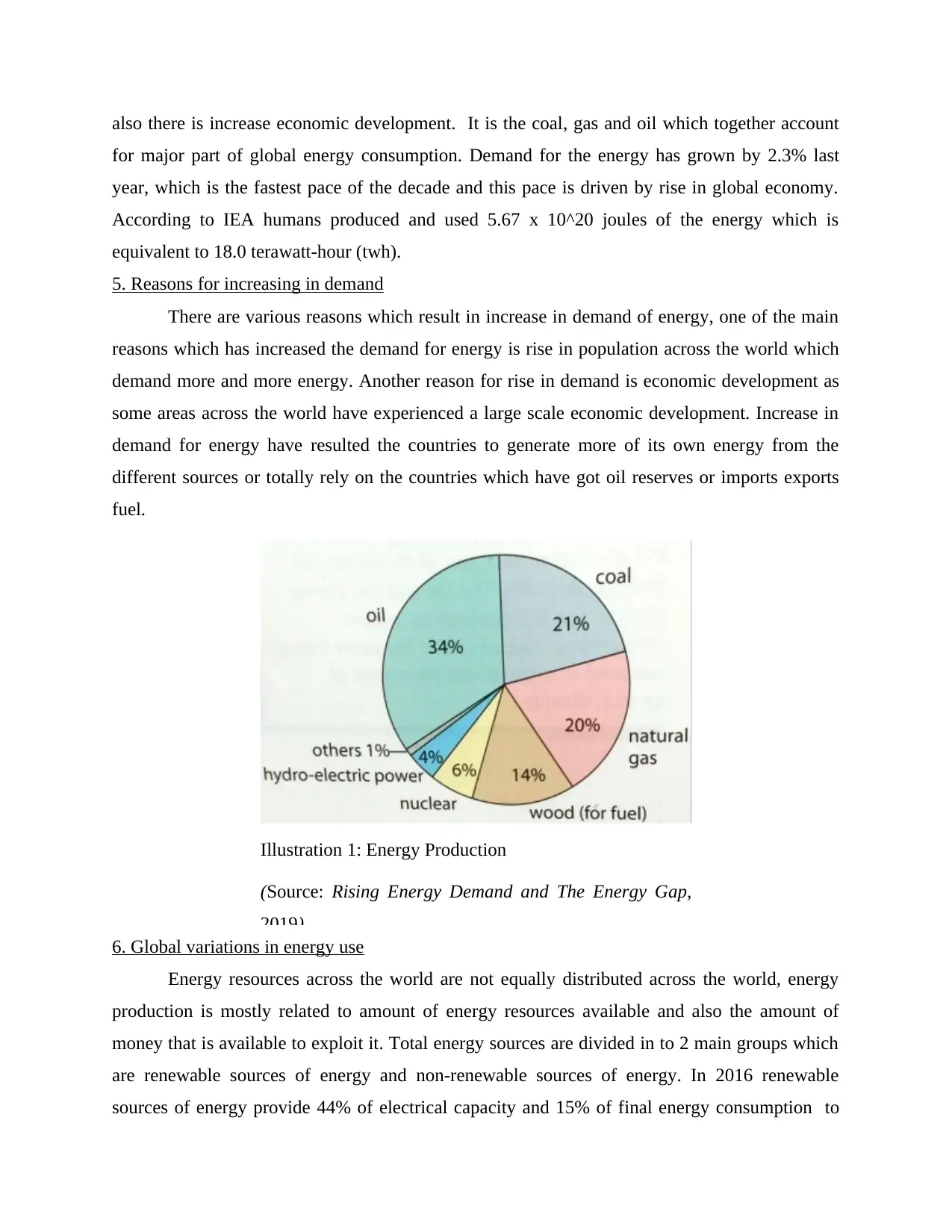
also there is increase economic development. It is the coal, gas and oil which together account
for major part of global energy consumption. Demand for the energy has grown by 2.3% last
year, which is the fastest pace of the decade and this pace is driven by rise in global economy.
According to IEA humans produced and used 5.67 x 10^20 joules of the energy which is
equivalent to 18.0 terawatt-hour (twh).
5. Reasons for increasing in demand
There are various reasons which result in increase in demand of energy, one of the main
reasons which has increased the demand for energy is rise in population across the world which
demand more and more energy. Another reason for rise in demand is economic development as
some areas across the world have experienced a large scale economic development. Increase in
demand for energy have resulted the countries to generate more of its own energy from the
different sources or totally rely on the countries which have got oil reserves or imports exports
fuel.
Illustration 1: Energy Production
(Source: Rising Energy Demand and The Energy Gap,
2019)
6. Global variations in energy use
Energy resources across the world are not equally distributed across the world, energy
production is mostly related to amount of energy resources available and also the amount of
money that is available to exploit it. Total energy sources are divided in to 2 main groups which
are renewable sources of energy and non-renewable sources of energy. In 2016 renewable
sources of energy provide 44% of electrical capacity and 15% of final energy consumption to
for major part of global energy consumption. Demand for the energy has grown by 2.3% last
year, which is the fastest pace of the decade and this pace is driven by rise in global economy.
According to IEA humans produced and used 5.67 x 10^20 joules of the energy which is
equivalent to 18.0 terawatt-hour (twh).
5. Reasons for increasing in demand
There are various reasons which result in increase in demand of energy, one of the main
reasons which has increased the demand for energy is rise in population across the world which
demand more and more energy. Another reason for rise in demand is economic development as
some areas across the world have experienced a large scale economic development. Increase in
demand for energy have resulted the countries to generate more of its own energy from the
different sources or totally rely on the countries which have got oil reserves or imports exports
fuel.
Illustration 1: Energy Production
(Source: Rising Energy Demand and The Energy Gap,
2019)
6. Global variations in energy use
Energy resources across the world are not equally distributed across the world, energy
production is mostly related to amount of energy resources available and also the amount of
money that is available to exploit it. Total energy sources are divided in to 2 main groups which
are renewable sources of energy and non-renewable sources of energy. In 2016 renewable
sources of energy provide 44% of electrical capacity and 15% of final energy consumption to
Paraphrase This Document
Need a fresh take? Get an instant paraphrase of this document with our AI Paraphraser
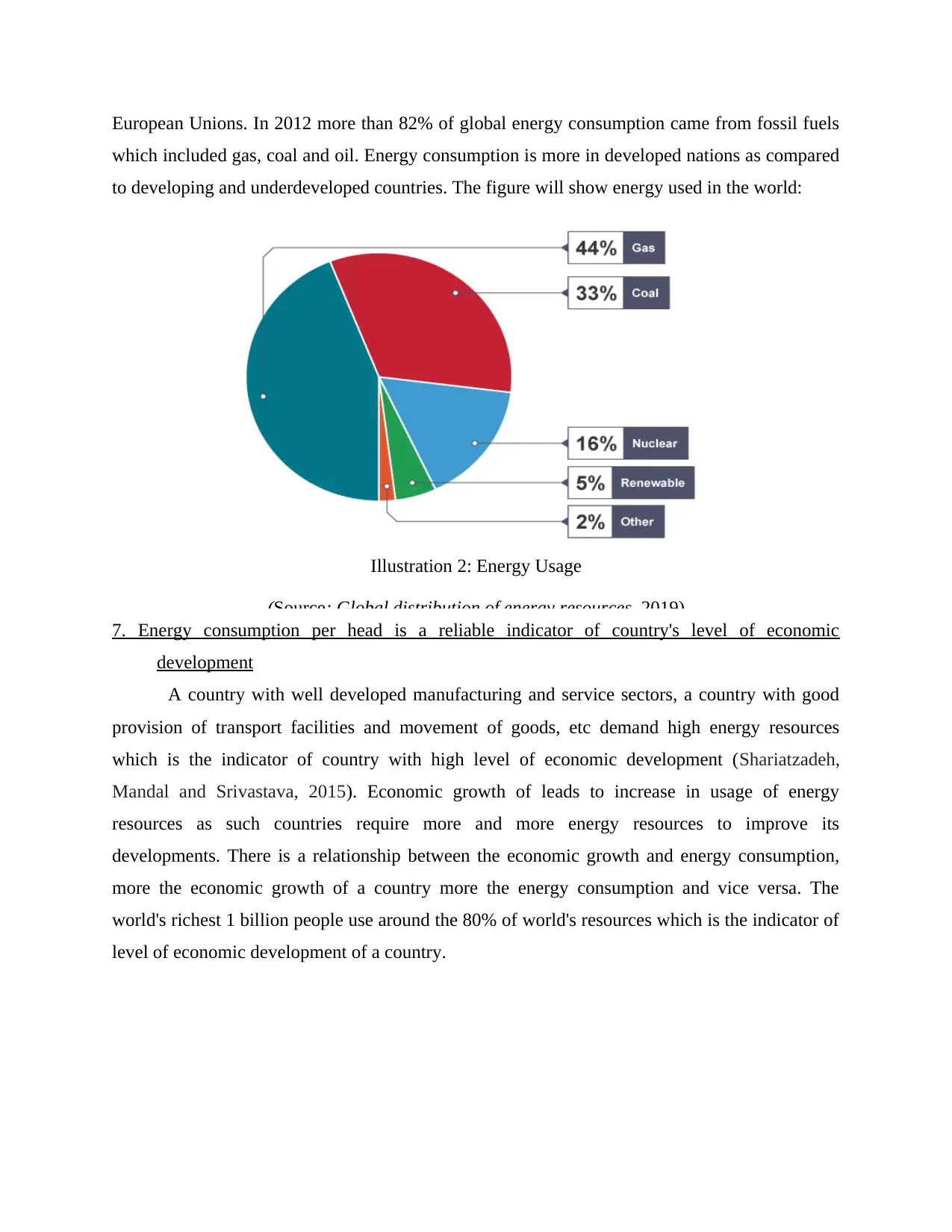
European Unions. In 2012 more than 82% of global energy consumption came from fossil fuels
which included gas, coal and oil. Energy consumption is more in developed nations as compared
to developing and underdeveloped countries. The figure will show energy used in the world:
Illustration 2: Energy Usage
(Source: Global distribution of energy resources, 2019)
7. Energy consumption per head is a reliable indicator of country's level of economic
development
A country with well developed manufacturing and service sectors, a country with good
provision of transport facilities and movement of goods, etc demand high energy resources
which is the indicator of country with high level of economic development (Shariatzadeh,
Mandal and Srivastava, 2015). Economic growth of leads to increase in usage of energy
resources as such countries require more and more energy resources to improve its
developments. There is a relationship between the economic growth and energy consumption,
more the economic growth of a country more the energy consumption and vice versa. The
world's richest 1 billion people use around the 80% of world's resources which is the indicator of
level of economic development of a country.
which included gas, coal and oil. Energy consumption is more in developed nations as compared
to developing and underdeveloped countries. The figure will show energy used in the world:
Illustration 2: Energy Usage
(Source: Global distribution of energy resources, 2019)
7. Energy consumption per head is a reliable indicator of country's level of economic
development
A country with well developed manufacturing and service sectors, a country with good
provision of transport facilities and movement of goods, etc demand high energy resources
which is the indicator of country with high level of economic development (Shariatzadeh,
Mandal and Srivastava, 2015). Economic growth of leads to increase in usage of energy
resources as such countries require more and more energy resources to improve its
developments. There is a relationship between the economic growth and energy consumption,
more the economic growth of a country more the energy consumption and vice versa. The
world's richest 1 billion people use around the 80% of world's resources which is the indicator of
level of economic development of a country.
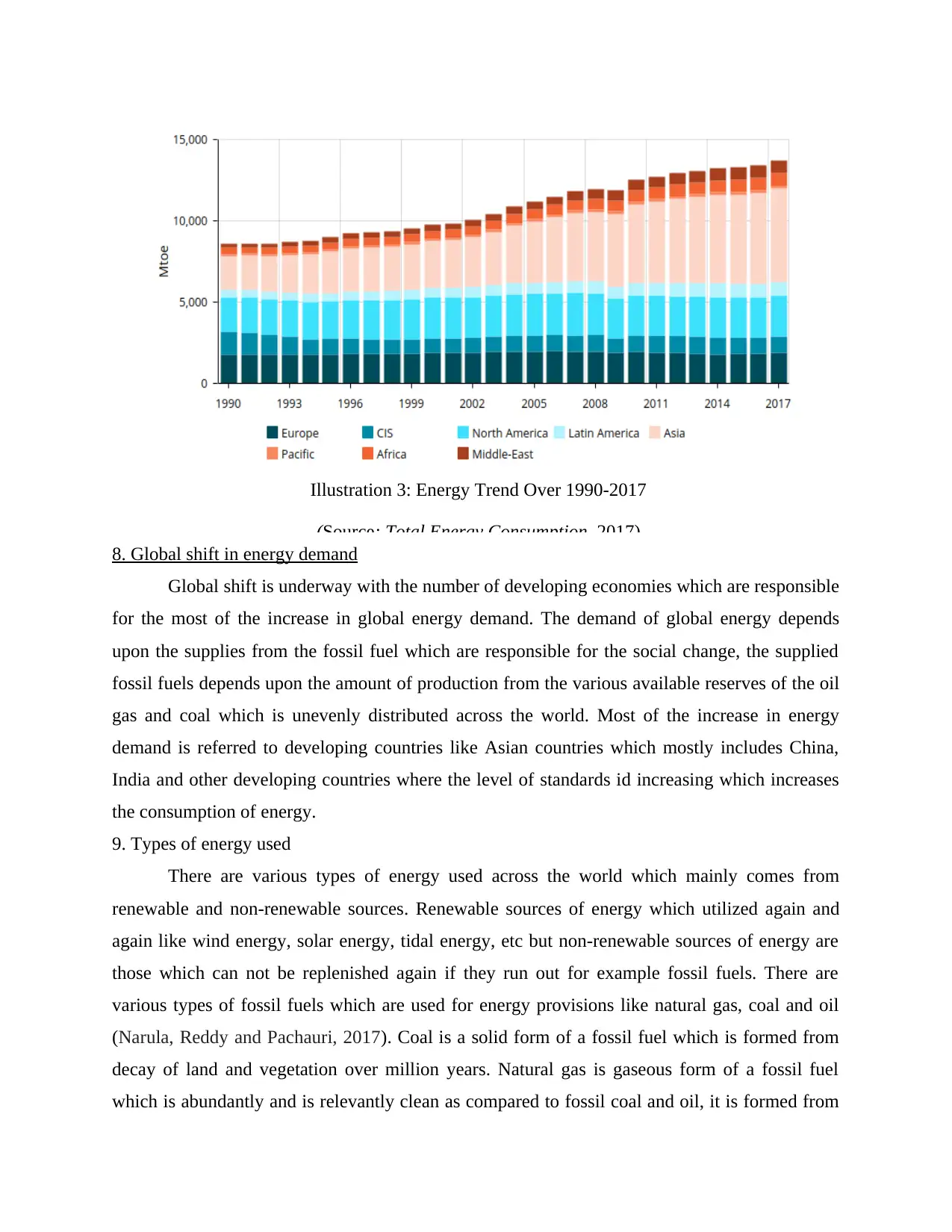
Illustration 3: Energy Trend Over 1990-2017
(Source: Total Energy Consumption, 2017)
8. Global shift in energy demand
Global shift is underway with the number of developing economies which are responsible
for the most of the increase in global energy demand. The demand of global energy depends
upon the supplies from the fossil fuel which are responsible for the social change, the supplied
fossil fuels depends upon the amount of production from the various available reserves of the oil
gas and coal which is unevenly distributed across the world. Most of the increase in energy
demand is referred to developing countries like Asian countries which mostly includes China,
India and other developing countries where the level of standards id increasing which increases
the consumption of energy.
9. Types of energy used
There are various types of energy used across the world which mainly comes from
renewable and non-renewable sources. Renewable sources of energy which utilized again and
again like wind energy, solar energy, tidal energy, etc but non-renewable sources of energy are
those which can not be replenished again if they run out for example fossil fuels. There are
various types of fossil fuels which are used for energy provisions like natural gas, coal and oil
(Narula, Reddy and Pachauri, 2017). Coal is a solid form of a fossil fuel which is formed from
decay of land and vegetation over million years. Natural gas is gaseous form of a fossil fuel
which is abundantly and is relevantly clean as compared to fossil coal and oil, it is formed from
(Source: Total Energy Consumption, 2017)
8. Global shift in energy demand
Global shift is underway with the number of developing economies which are responsible
for the most of the increase in global energy demand. The demand of global energy depends
upon the supplies from the fossil fuel which are responsible for the social change, the supplied
fossil fuels depends upon the amount of production from the various available reserves of the oil
gas and coal which is unevenly distributed across the world. Most of the increase in energy
demand is referred to developing countries like Asian countries which mostly includes China,
India and other developing countries where the level of standards id increasing which increases
the consumption of energy.
9. Types of energy used
There are various types of energy used across the world which mainly comes from
renewable and non-renewable sources. Renewable sources of energy which utilized again and
again like wind energy, solar energy, tidal energy, etc but non-renewable sources of energy are
those which can not be replenished again if they run out for example fossil fuels. There are
various types of fossil fuels which are used for energy provisions like natural gas, coal and oil
(Narula, Reddy and Pachauri, 2017). Coal is a solid form of a fossil fuel which is formed from
decay of land and vegetation over million years. Natural gas is gaseous form of a fossil fuel
which is abundantly and is relevantly clean as compared to fossil coal and oil, it is formed from
⊘ This is a preview!⊘
Do you want full access?
Subscribe today to unlock all pages.
Trusted by 1+ million students worldwide
remains of marine micro-organisms. Oil is a liquid form of fossil fuel which is also formed from
the remains of marine micro-organisms which are deposited on the floor of a sea.
10 impact on environment
Burning of the fossil fuels have the negative impact on the environment as they release
pollution in the Earth's Environment. Fossil fuels have a great impact on the environment as they
abundantly release huge carbon dioxide emissions which increase the global warming and make
adverse climate change (Li and et.al., 2017). Burning of fossil fuels also release number of
pollutants in the environment like Sulphur dioxide commissions contribute to acid rain and also
result in the formation of harmful particulate matter.
11. Global shift in economic output
A feature of globalisation is that many of the industrialising companies are raising the
share of the world trade as there economies are growing fast and are becoming rich developed
countries which has been possible only due to globalisation. There has been a special shift in the
balance of financial power and balance of economies in world economy. Developing and
emerging countries account for more than 57% of GDP of the world. USA, EU, Canada and
Japan account more than a half of total global GDP which has got only 13.3% of total world's
population. In 2023 the G7 countries will share total global GDP more than E7 countries.
12. Energy shortages in developing countries can have major impacts- war in Iraq and Libya
When there is a shortage of energy in major developing countries and they do not find
any sources of energy but they want to sustain their developments for which energy is important
especially fossil fuels. It is believed that most of the war which took place in Libya and Iraq is
because of taker over the oil reserves in Iraq and Libya. This has major impact on these countries
and also there has destabilising influences to the flow of oil to various international markets
from the middle east. Both the countries had to face negative consequences like deaths,
unemployment, loss of property, taking refugees in other countries. This also arose conflicts in
several other countries.
13 Lack of access to energy services of adequate quantity and quality
When there is lack of access to energy services of good quality and quantity it may
following impacts on the country:
the remains of marine micro-organisms which are deposited on the floor of a sea.
10 impact on environment
Burning of the fossil fuels have the negative impact on the environment as they release
pollution in the Earth's Environment. Fossil fuels have a great impact on the environment as they
abundantly release huge carbon dioxide emissions which increase the global warming and make
adverse climate change (Li and et.al., 2017). Burning of fossil fuels also release number of
pollutants in the environment like Sulphur dioxide commissions contribute to acid rain and also
result in the formation of harmful particulate matter.
11. Global shift in economic output
A feature of globalisation is that many of the industrialising companies are raising the
share of the world trade as there economies are growing fast and are becoming rich developed
countries which has been possible only due to globalisation. There has been a special shift in the
balance of financial power and balance of economies in world economy. Developing and
emerging countries account for more than 57% of GDP of the world. USA, EU, Canada and
Japan account more than a half of total global GDP which has got only 13.3% of total world's
population. In 2023 the G7 countries will share total global GDP more than E7 countries.
12. Energy shortages in developing countries can have major impacts- war in Iraq and Libya
When there is a shortage of energy in major developing countries and they do not find
any sources of energy but they want to sustain their developments for which energy is important
especially fossil fuels. It is believed that most of the war which took place in Libya and Iraq is
because of taker over the oil reserves in Iraq and Libya. This has major impact on these countries
and also there has destabilising influences to the flow of oil to various international markets
from the middle east. Both the countries had to face negative consequences like deaths,
unemployment, loss of property, taking refugees in other countries. This also arose conflicts in
several other countries.
13 Lack of access to energy services of adequate quantity and quality
When there is lack of access to energy services of good quality and quantity it may
following impacts on the country:
Paraphrase This Document
Need a fresh take? Get an instant paraphrase of this document with our AI Paraphraser
It may prevent a country from dynamic growth as for any type of growth for a country it
requires proper energy service of good quality and should also posses the energy
resources abundantly.
It also restricts building inclusive societies in a nation as most societies depend upon the
growth of the nations and the energy resources available, lack of access to energy
services can hamper the growth of societies.
It also hampers the progress towards eradicating poverty if the country does not have
enough energy services there may be fewer facilities available like electricity, petroleum
products, less development due to fewer factories and industries, etc which restricts the
economic development of a country.
It also restricts health service in providing curative and preventive service as this will
restrict health services to reach each and every corners of the nation this may also be due
to lack of access to energy services.
As lack of energy serves will hamper the growth and development of the country, this
will also decline the economic growth of a country so this will ultimately hamper the
development of schools and restricts the children's chances to escape from poverty.
14. Look for alternate energy sources- Renewable
We live in the world of scarce energy sources and fossil fuels are slowly and steady get
out so it is important to have substitute source of energy which can be easily replenished such as
renewable sources of energies. These are the energies which do not consume fossil fuels and are
widely available in an environment (Di Lecce, Verrelli and Hassoun, 2017). All the nations of
the world has to work collaborative for providing and look for various alternate sources of
energy so that they will able to produce substitute for non-renewable sources of energies. Now it
has become important for energy hungry countries of the world to start investing in various
alternative sources of energies in order to satisfy their need for the energy.
15. Types of Renewable
There are various renewable sources of energies which can be used as alternate for fossil
fuels which are solar energy, wind energy, wave energy, biomass energy, tidal energy, hydrogen
energy, etc. So, these are the renewable sources of energies which countries need to invest for
making them an efficient energy source in the future.
requires proper energy service of good quality and should also posses the energy
resources abundantly.
It also restricts building inclusive societies in a nation as most societies depend upon the
growth of the nations and the energy resources available, lack of access to energy
services can hamper the growth of societies.
It also hampers the progress towards eradicating poverty if the country does not have
enough energy services there may be fewer facilities available like electricity, petroleum
products, less development due to fewer factories and industries, etc which restricts the
economic development of a country.
It also restricts health service in providing curative and preventive service as this will
restrict health services to reach each and every corners of the nation this may also be due
to lack of access to energy services.
As lack of energy serves will hamper the growth and development of the country, this
will also decline the economic growth of a country so this will ultimately hamper the
development of schools and restricts the children's chances to escape from poverty.
14. Look for alternate energy sources- Renewable
We live in the world of scarce energy sources and fossil fuels are slowly and steady get
out so it is important to have substitute source of energy which can be easily replenished such as
renewable sources of energies. These are the energies which do not consume fossil fuels and are
widely available in an environment (Di Lecce, Verrelli and Hassoun, 2017). All the nations of
the world has to work collaborative for providing and look for various alternate sources of
energy so that they will able to produce substitute for non-renewable sources of energies. Now it
has become important for energy hungry countries of the world to start investing in various
alternative sources of energies in order to satisfy their need for the energy.
15. Types of Renewable
There are various renewable sources of energies which can be used as alternate for fossil
fuels which are solar energy, wind energy, wave energy, biomass energy, tidal energy, hydrogen
energy, etc. So, these are the renewable sources of energies which countries need to invest for
making them an efficient energy source in the future.
16. Pros and cons
Pros and cons of renewable sources of energy are as follows:
Pros:
Renewable energy won't run out.
Renewable energy requires low maintenance.
It also saves money.
It has also got various health and environmental benefits as it does not contribute to
pollutions.
Cons:
Renewable sources of are newest and there occurs the problems of consistency and
reliability.
The setup costs is very high and are difficult to install.
People are not fully satisfied with use of renewable source of energy.
Pros and cons of renewable sources of energy are as follows:
Pros:
Renewable energy won't run out.
Renewable energy requires low maintenance.
It also saves money.
It has also got various health and environmental benefits as it does not contribute to
pollutions.
Cons:
Renewable sources of are newest and there occurs the problems of consistency and
reliability.
The setup costs is very high and are difficult to install.
People are not fully satisfied with use of renewable source of energy.
⊘ This is a preview!⊘
Do you want full access?
Subscribe today to unlock all pages.
Trusted by 1+ million students worldwide

1
Paraphrase This Document
Need a fresh take? Get an instant paraphrase of this document with our AI Paraphraser
REFERENCES
Books and Journals
Di Lecce, D., Verrelli, R. and Hassoun, J., 2017. Lithium-ion batteries for sustainable energy
storage: recent advances towards new cell configurations. Green chemistry. 19(15),
pp.3442-3467.
Li, S et.al., 2017. Sustainable energy source for wearable electronics based on multilayer
elastomeric triboelectric nanogenerators. Advanced Energy Materials. 7(13), p.1602832.
Narula, K., Reddy, B. S. and Pachauri, S., 2017. Sustainable Energy Security for India: An
assessment of energy demand sub-system. Applied energy. 186. pp.126-139.
Narula, K., Reddy, B. S. and Pachauri, S., 2017. Sustainable Energy Security for India: An
assessment of energy demand sub-system. Applied energy. 186. pp.126-139.
Shariatzadeh, F., Mandal, P. and Srivastava, A. K., 2015. Demand response for sustainable
energy systems: A review, application and implementation strategy. Renewable and
Sustainable Energy Reviews. 45. pp.343-350.
Van Der Schoor, T. and Scholtens, B., 2015. Power to the people: Local community initiatives
and the transition to sustainable energy. Renewable and Sustainable Energy Reviews.
43. pp.666-675.
Watkins, P. and McKendry, P., 2015. Sustainable Energy Technologies and Assessments.
Online
Global distribution of energy resources, 2019. [Online]. Available Through:
<https://www.bbc.com/bitesize/guides/z3pppv4/revision/1>.
Rising Energy Demand and The Energy Gap. 2019. [Online]. Available Through:
<https://maxwatsongeography.wordpress.com/section-b/economic-activity-and-energy/
rising-energy-demands-and-the-energy-gap/>.
Total Energy Consumption. 2017. [Online]. Available Through:
<https://yearbook.enerdata.net/total-energy/world-consumption-statistics.html>.
2
Books and Journals
Di Lecce, D., Verrelli, R. and Hassoun, J., 2017. Lithium-ion batteries for sustainable energy
storage: recent advances towards new cell configurations. Green chemistry. 19(15),
pp.3442-3467.
Li, S et.al., 2017. Sustainable energy source for wearable electronics based on multilayer
elastomeric triboelectric nanogenerators. Advanced Energy Materials. 7(13), p.1602832.
Narula, K., Reddy, B. S. and Pachauri, S., 2017. Sustainable Energy Security for India: An
assessment of energy demand sub-system. Applied energy. 186. pp.126-139.
Narula, K., Reddy, B. S. and Pachauri, S., 2017. Sustainable Energy Security for India: An
assessment of energy demand sub-system. Applied energy. 186. pp.126-139.
Shariatzadeh, F., Mandal, P. and Srivastava, A. K., 2015. Demand response for sustainable
energy systems: A review, application and implementation strategy. Renewable and
Sustainable Energy Reviews. 45. pp.343-350.
Van Der Schoor, T. and Scholtens, B., 2015. Power to the people: Local community initiatives
and the transition to sustainable energy. Renewable and Sustainable Energy Reviews.
43. pp.666-675.
Watkins, P. and McKendry, P., 2015. Sustainable Energy Technologies and Assessments.
Online
Global distribution of energy resources, 2019. [Online]. Available Through:
<https://www.bbc.com/bitesize/guides/z3pppv4/revision/1>.
Rising Energy Demand and The Energy Gap. 2019. [Online]. Available Through:
<https://maxwatsongeography.wordpress.com/section-b/economic-activity-and-energy/
rising-energy-demands-and-the-energy-gap/>.
Total Energy Consumption. 2017. [Online]. Available Through:
<https://yearbook.enerdata.net/total-energy/world-consumption-statistics.html>.
2

1 out of 11


Related Documents


Your All-in-One AI-Powered Toolkit for Academic Success.
+13062052269
info@desklib.com
Available 24*7 on WhatsApp / Email
![[object Object]](/_next/static/media/star-bottom.7253800d.svg)
Unlock your academic potential
Copyright © 2020–2026 A2Z Services. All Rights Reserved. Developed and managed by ZUCOL.