The Awakening: Exploring Feminism and Societal Expectations of Women

Verified

Added on  2021/06/18

|6
|1742
|112
Essay
AI Summary
This essay provides a comprehensive analysis of Kate Chopin's novel, "The Awakening," examining the protagonist's journey towards self-discovery and independence within the context of late 19th-century societal expectations. It explores the evolution of women's roles from the Victorian era to the modern age, highlighting the constraints placed on women and their struggle for self-expression. The essay draws comparisons to other literary works and authors such as Charlotte Bronte, Emily Dickinson, and F. Scott Fitzgerald, to illustrate the changing portrayal of women in literature and the rise of feminist ideas. It delves into the protagonist's emotional and sexual awakening, her conflicts with societal norms, and the consequences of her pursuit of personal freedom. Furthermore, the essay discusses the concept of motherhood and its impact on the protagonist's identity, as well as the broader themes of solitude, self-identity, and the challenges faced by women in a patriarchal society. The essay also references other literary works like "Babylon Revisited" and "Flowering Judas", to illustrate the changing portrayal of women in literature and the rise of feminist ideas.
Document Page
Running head: THE AWAKENING
The awakening
Name of the student
Name of the university
Author note
tabler-icon-diamond-filled.svg

Paraphrase This Document

Need a fresh take? Get an instant paraphrase of this document with our AI Paraphraser
Document Page
1THE AWAKENING
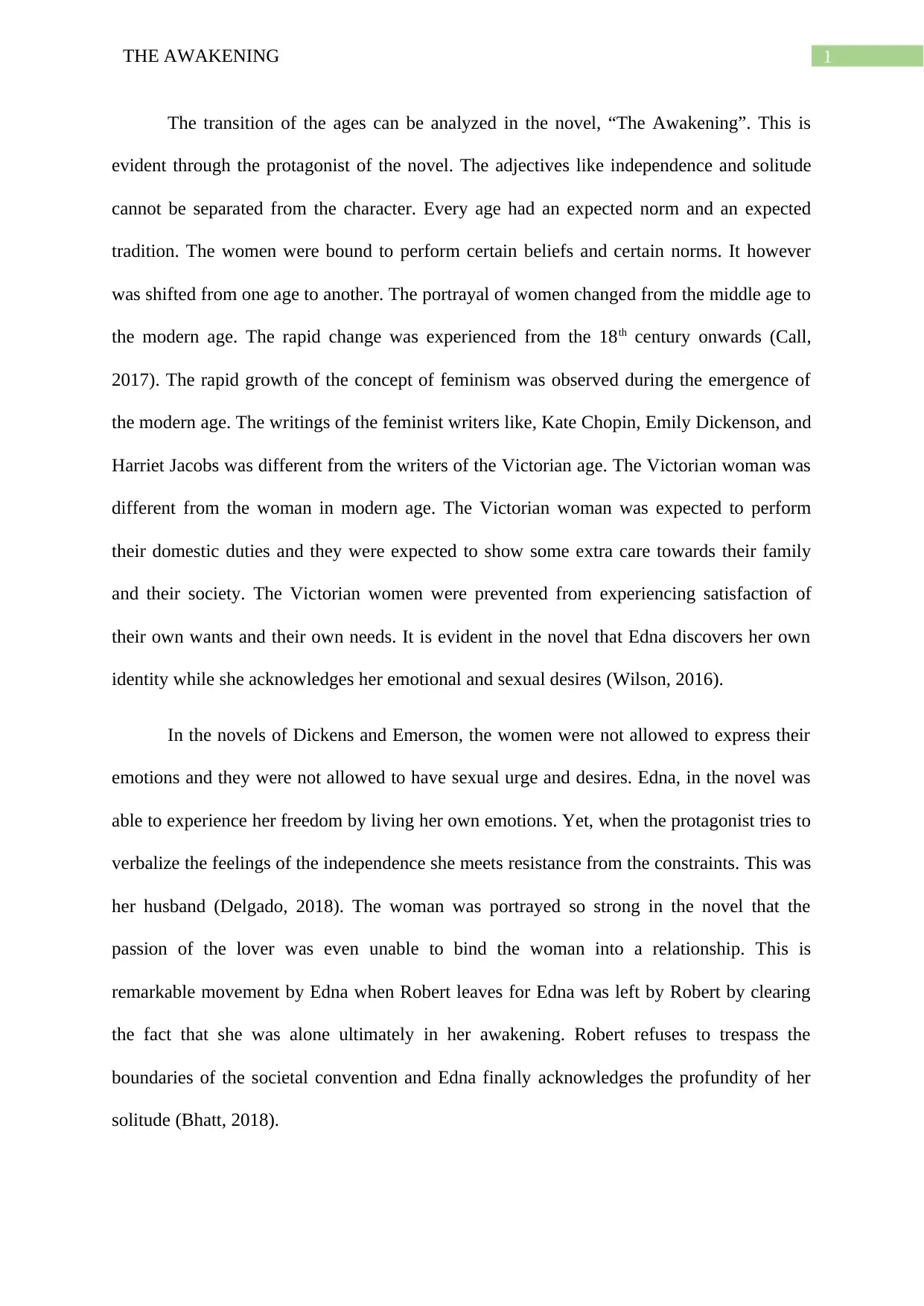
The transition of the ages can be analyzed in the novel, “The Awakening”. This is
evident through the protagonist of the novel. The adjectives like independence and solitude
cannot be separated from the character. Every age had an expected norm and an expected
tradition. The women were bound to perform certain beliefs and certain norms. It however
was shifted from one age to another. The portrayal of women changed from the middle age to
the modern age. The rapid change was experienced from the 18th century onwards (Call,
2017). The rapid growth of the concept of feminism was observed during the emergence of
the modern age. The writings of the feminist writers like, Kate Chopin, Emily Dickenson, and
Harriet Jacobs was different from the writers of the Victorian age. The Victorian woman was
different from the woman in modern age. The Victorian woman was expected to perform
their domestic duties and they were expected to show some extra care towards their family
and their society. The Victorian women were prevented from experiencing satisfaction of
their own wants and their own needs. It is evident in the novel that Edna discovers her own
identity while she acknowledges her emotional and sexual desires (Wilson, 2016).
In the novels of Dickens and Emerson, the women were not allowed to express their
emotions and they were not allowed to have sexual urge and desires. Edna, in the novel was
able to experience her freedom by living her own emotions. Yet, when the protagonist tries to
verbalize the feelings of the independence she meets resistance from the constraints. This was
her husband (Delgado, 2018). The woman was portrayed so strong in the novel that the
passion of the lover was even unable to bind the woman into a relationship. This is
remarkable movement by Edna when Robert leaves for Edna was left by Robert by clearing
the fact that she was alone ultimately in her awakening. Robert refuses to trespass the
boundaries of the societal convention and Edna finally acknowledges the profundity of her
solitude (Bhatt, 2018).
Document Page
2THE AWAKENING
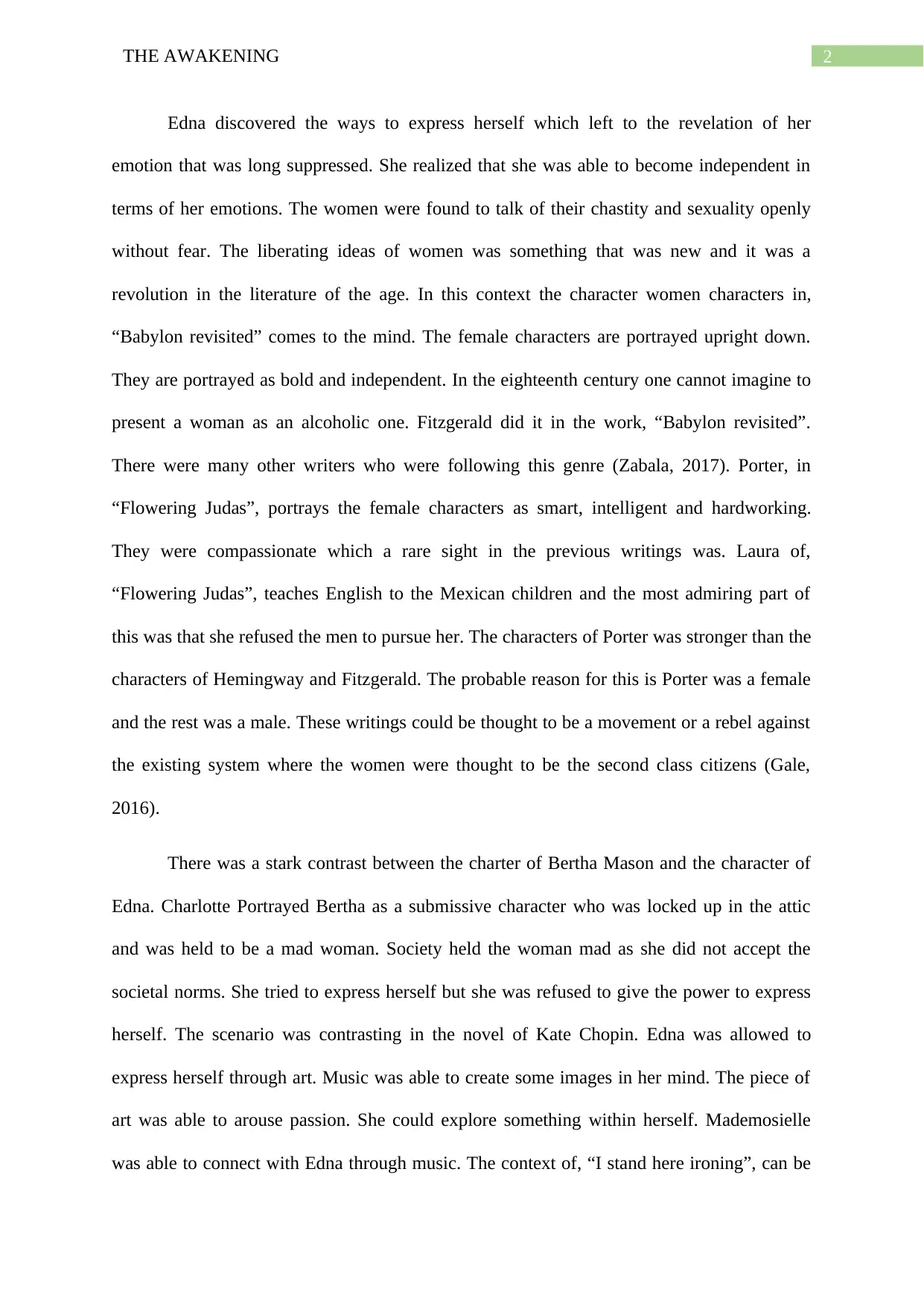
Edna discovered the ways to express herself which left to the revelation of her
emotion that was long suppressed. She realized that she was able to become independent in
terms of her emotions. The women were found to talk of their chastity and sexuality openly
without fear. The liberating ideas of women was something that was new and it was a
revolution in the literature of the age. In this context the character women characters in,
“Babylon revisited” comes to the mind. The female characters are portrayed upright down.
They are portrayed as bold and independent. In the eighteenth century one cannot imagine to
present a woman as an alcoholic one. Fitzgerald did it in the work, “Babylon revisited”.
There were many other writers who were following this genre (Zabala, 2017). Porter, in
“Flowering Judas”, portrays the female characters as smart, intelligent and hardworking.
They were compassionate which a rare sight in the previous writings was. Laura of,
“Flowering Judas”, teaches English to the Mexican children and the most admiring part of
this was that she refused the men to pursue her. The characters of Porter was stronger than the
characters of Hemingway and Fitzgerald. The probable reason for this is Porter was a female
and the rest was a male. These writings could be thought to be a movement or a rebel against
the existing system where the women were thought to be the second class citizens (Gale,
2016).
There was a stark contrast between the charter of Bertha Mason and the character of
Edna. Charlotte Portrayed Bertha as a submissive character who was locked up in the attic
and was held to be a mad woman. Society held the woman mad as she did not accept the
societal norms. She tried to express herself but she was refused to give the power to express
herself. The scenario was contrasting in the novel of Kate Chopin. Edna was allowed to
express herself through art. Music was able to create some images in her mind. The piece of
art was able to arouse passion. She could explore something within herself. Mademosielle
was able to connect with Edna through music. The context of, “I stand here ironing”, can be
Document Page
3THE AWAKENING
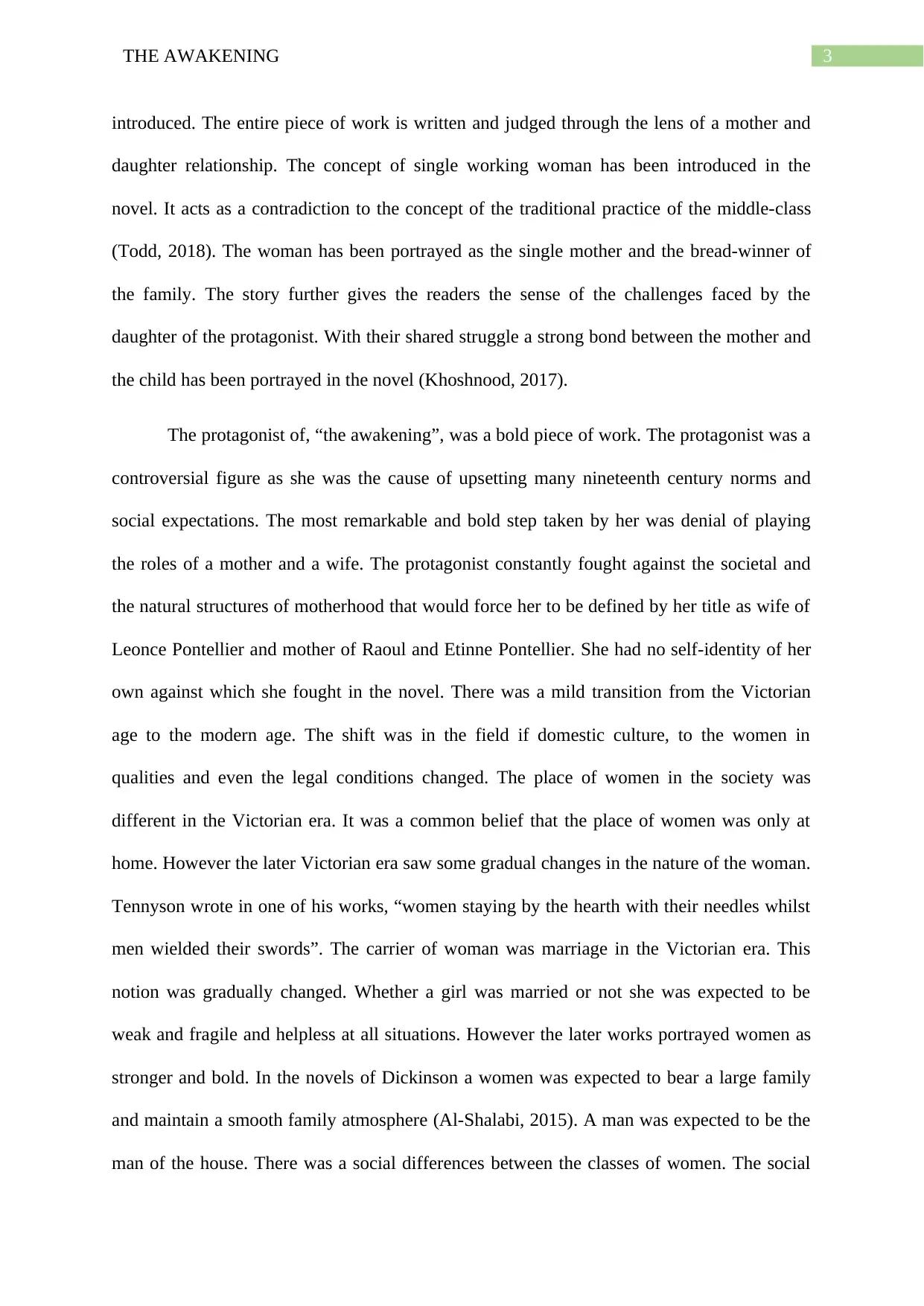
introduced. The entire piece of work is written and judged through the lens of a mother and
daughter relationship. The concept of single working woman has been introduced in the
novel. It acts as a contradiction to the concept of the traditional practice of the middle-class
(Todd, 2018). The woman has been portrayed as the single mother and the bread-winner of
the family. The story further gives the readers the sense of the challenges faced by the
daughter of the protagonist. With their shared struggle a strong bond between the mother and
the child has been portrayed in the novel (Khoshnood, 2017).
The protagonist of, “the awakening”, was a bold piece of work. The protagonist was a
controversial figure as she was the cause of upsetting many nineteenth century norms and
social expectations. The most remarkable and bold step taken by her was denial of playing
the roles of a mother and a wife. The protagonist constantly fought against the societal and
the natural structures of motherhood that would force her to be defined by her title as wife of
Leonce Pontellier and mother of Raoul and Etinne Pontellier. She had no self-identity of her
own against which she fought in the novel. There was a mild transition from the Victorian
age to the modern age. The shift was in the field if domestic culture, to the women in
qualities and even the legal conditions changed. The place of women in the society was
different in the Victorian era. It was a common belief that the place of women was only at
home. However the later Victorian era saw some gradual changes in the nature of the woman.
Tennyson wrote in one of his works, “women staying by the hearth with their needles whilst
men wielded their swords”. The carrier of woman was marriage in the Victorian era. This
notion was gradually changed. Whether a girl was married or not she was expected to be
weak and fragile and helpless at all situations. However the later works portrayed women as
stronger and bold. In the novels of Dickinson a women was expected to bear a large family
and maintain a smooth family atmosphere (Al-Shalabi, 2015). A man was expected to be the
man of the house. There was a social differences between the classes of women. The social
tabler-icon-diamond-filled.svg

Paraphrase This Document

Need a fresh take? Get an instant paraphrase of this document with our AI Paraphraser
Document Page
4THE AWAKENING
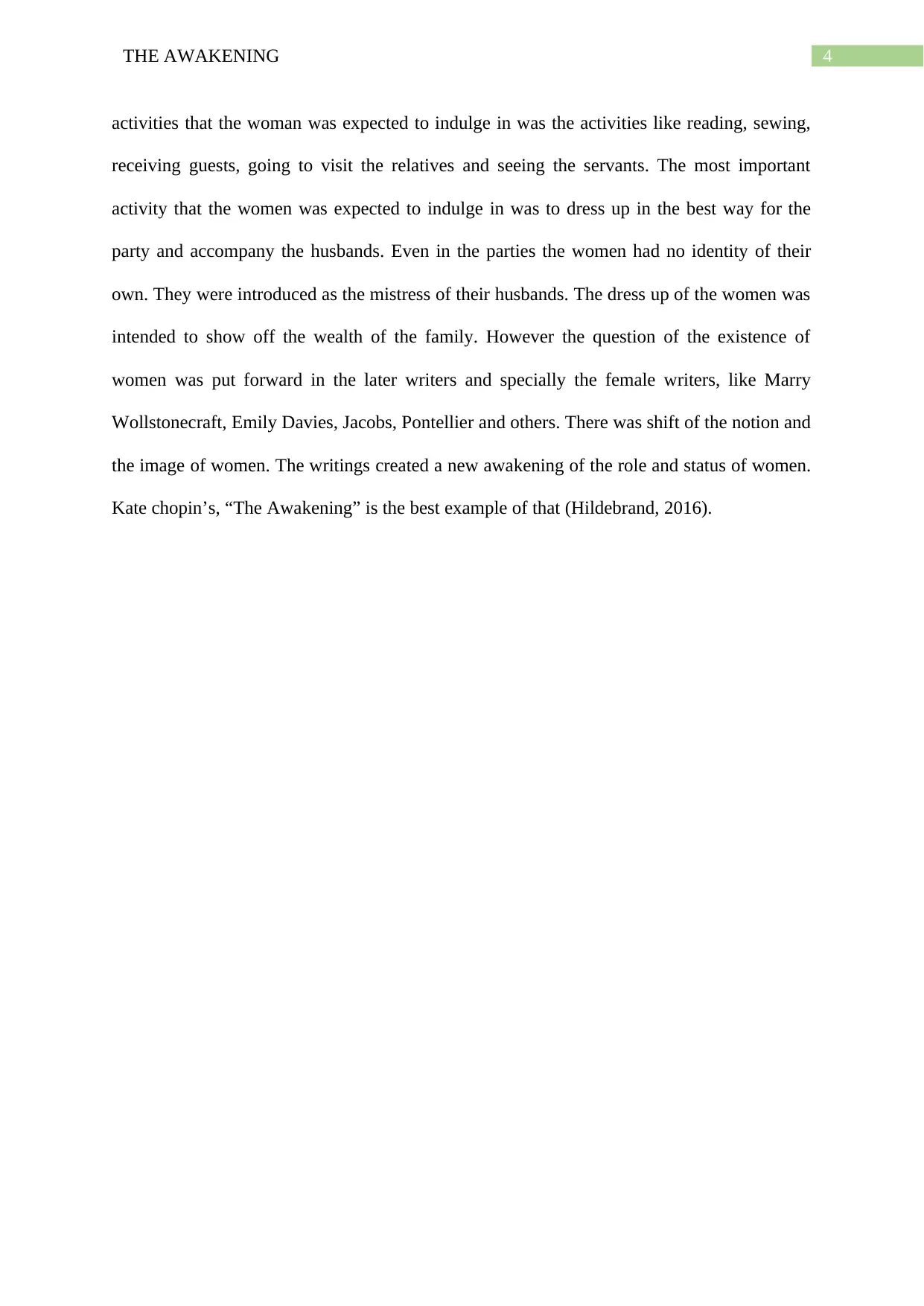
activities that the woman was expected to indulge in was the activities like reading, sewing,
receiving guests, going to visit the relatives and seeing the servants. The most important
activity that the women was expected to indulge in was to dress up in the best way for the
party and accompany the husbands. Even in the parties the women had no identity of their
own. They were introduced as the mistress of their husbands. The dress up of the women was
intended to show off the wealth of the family. However the question of the existence of
women was put forward in the later writers and specially the female writers, like Marry
Wollstonecraft, Emily Davies, Jacobs, Pontellier and others. There was shift of the notion and
the image of women. The writings created a new awakening of the role and status of women.
Kate chopin’s, “The Awakening” is the best example of that (Hildebrand, 2016).
Document Page
5THE AWAKENING
References
Bhatt, A. (2018). The New Woman and Her Doomed Fate in Thomas Hardy’s Jude the
Obscure and Kate Chopin’s the Awakening.
Call, T. (2017). Patriarchy & Feminism in the Early 20th Century: Finding Middle Ground
Through Kate Chopin.
Delgado, S. S. (2018). On Their Own Premises: Southern Women Writers and the
Homeplace. Constante González Groba. REVISTA ESTUDIOS
NORTEAMERICANOS, (13).
Gale, C. L. (2016). A Study Guide for Kate Chopin's" The Storm". Gale, Cengage Learning.
Hildebrand, M. J. (2016). The Masculine Sea: Gender, Art, and Suicide in Kate Chopin's The
Awakening. American Literary Realism, 48(3), 189-208.
Kate Chopin’s The Awakening: A Postmodernist Study. Mediterranean Journal of Social
Sciences, 6(5), 276.
Khoshnood, A. (2017). Kate Chopin’s The Awakening: an exploration of Edna Pontellier’s
transition during her Mid-Life Crisis. Neohelicon, 44(2), 563-581.
Todd, J. (2018). Feminist literary history. John Wiley & Sons.
Wilson, R. C. M. (2016). A Comparative Analysis of the Motives behind the Female Suicides
in" King Lear" by William Shakespeare and" The Awakening" by Kate Chopin.
Zabala, C. (2017). The Effects of Democracy’s Broken Promise in Kate Chopin, Charlotte
Perkins Gilman, Nella Larsen, and Virginia Woolf. Journal of Research on Women
and Gender, 7, 4-14.
chevron_up_icon
1 out of 6
circle_padding
hide_on_mobile
zoom_out_icon
[object Object]