Accounting Homework: Impairment Analysis and Journal Entries
VerifiedAdded on Ā 2020/02/23
|8
|1343
|238
Homework Assignment
AI Summary
This homework assignment delves into the core principles of impairment analysis within financial accounting, focusing on the concept that assets should not be reported above their recoverable amount. The solution outlines the process of comparing carrying values with recoverable amounts, which is the higher of fair value less costs to sell and value in use, to identify impairment losses. It addresses the testing of various assets, including goodwill and intangible assets, and explains the concept of cash-generating units. The assignment provides a detailed journal entry to account for an impairment loss, including specific calculations for patents, equipment, fittings, inventory, and goodwill. The document references relevant accounting standards, such as IAS 36, and includes a breakdown of the impairment loss allocation across different asset types. This solution offers a comprehensive understanding of the practical application of impairment accounting principles.

IMPAIRMENT 1
IMPAIRMENT
IMPAIRMENT
Paraphrase This Document
Need a fresh take? Get an instant paraphrase of this document with our AI Paraphraser

IMPAIRMENT 2
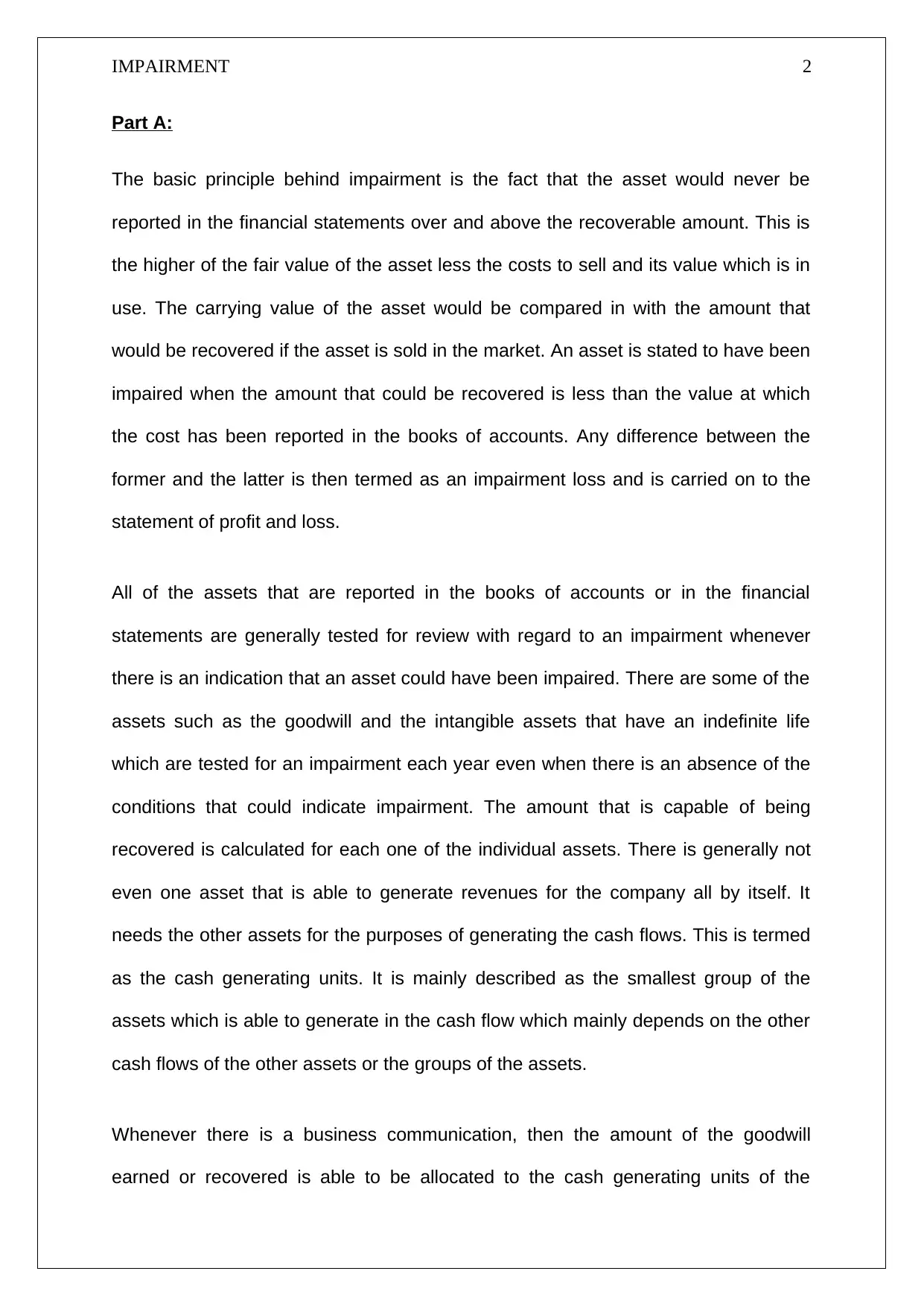
Part A:
The basic principle behind impairment is the fact that the asset would never be
reported in the financial statements over and above the recoverable amount. This is
the higher of the fair value of the asset less the costs to sell and its value which is in
use. The carrying value of the asset would be compared in with the amount that
would be recovered if the asset is sold in the market. An asset is stated to have been
impaired when the amount that could be recovered is less than the value at which
the cost has been reported in the books of accounts. Any difference between the
former and the latter is then termed as an impairment loss and is carried on to the
statement of profit and loss.
All of the assets that are reported in the books of accounts or in the financial
statements are generally tested for review with regard to an impairment whenever
there is an indication that an asset could have been impaired. There are some of the
assets such as the goodwill and the intangible assets that have an indefinite life
which are tested for an impairment each year even when there is an absence of the
conditions that could indicate impairment. The amount that is capable of being
recovered is calculated for each one of the individual assets. There is generally not
even one asset that is able to generate revenues for the company all by itself. It
needs the other assets for the purposes of generating the cash flows. This is termed
as the cash generating units. It is mainly described as the smallest group of the
assets which is able to generate in the cash flow which mainly depends on the other
cash flows of the other assets or the groups of the assets.
Whenever there is a business communication, then the amount of the goodwill
earned or recovered is able to be allocated to the cash generating units of the
Part A:
The basic principle behind impairment is the fact that the asset would never be
reported in the financial statements over and above the recoverable amount. This is
the higher of the fair value of the asset less the costs to sell and its value which is in
use. The carrying value of the asset would be compared in with the amount that
would be recovered if the asset is sold in the market. An asset is stated to have been
impaired when the amount that could be recovered is less than the value at which
the cost has been reported in the books of accounts. Any difference between the
former and the latter is then termed as an impairment loss and is carried on to the
statement of profit and loss.
All of the assets that are reported in the books of accounts or in the financial
statements are generally tested for review with regard to an impairment whenever
there is an indication that an asset could have been impaired. There are some of the
assets such as the goodwill and the intangible assets that have an indefinite life
which are tested for an impairment each year even when there is an absence of the
conditions that could indicate impairment. The amount that is capable of being
recovered is calculated for each one of the individual assets. There is generally not
even one asset that is able to generate revenues for the company all by itself. It
needs the other assets for the purposes of generating the cash flows. This is termed
as the cash generating units. It is mainly described as the smallest group of the
assets which is able to generate in the cash flow which mainly depends on the other
cash flows of the other assets or the groups of the assets.
Whenever there is a business communication, then the amount of the goodwill
earned or recovered is able to be allocated to the cash generating units of the

IMPAIRMENT 3
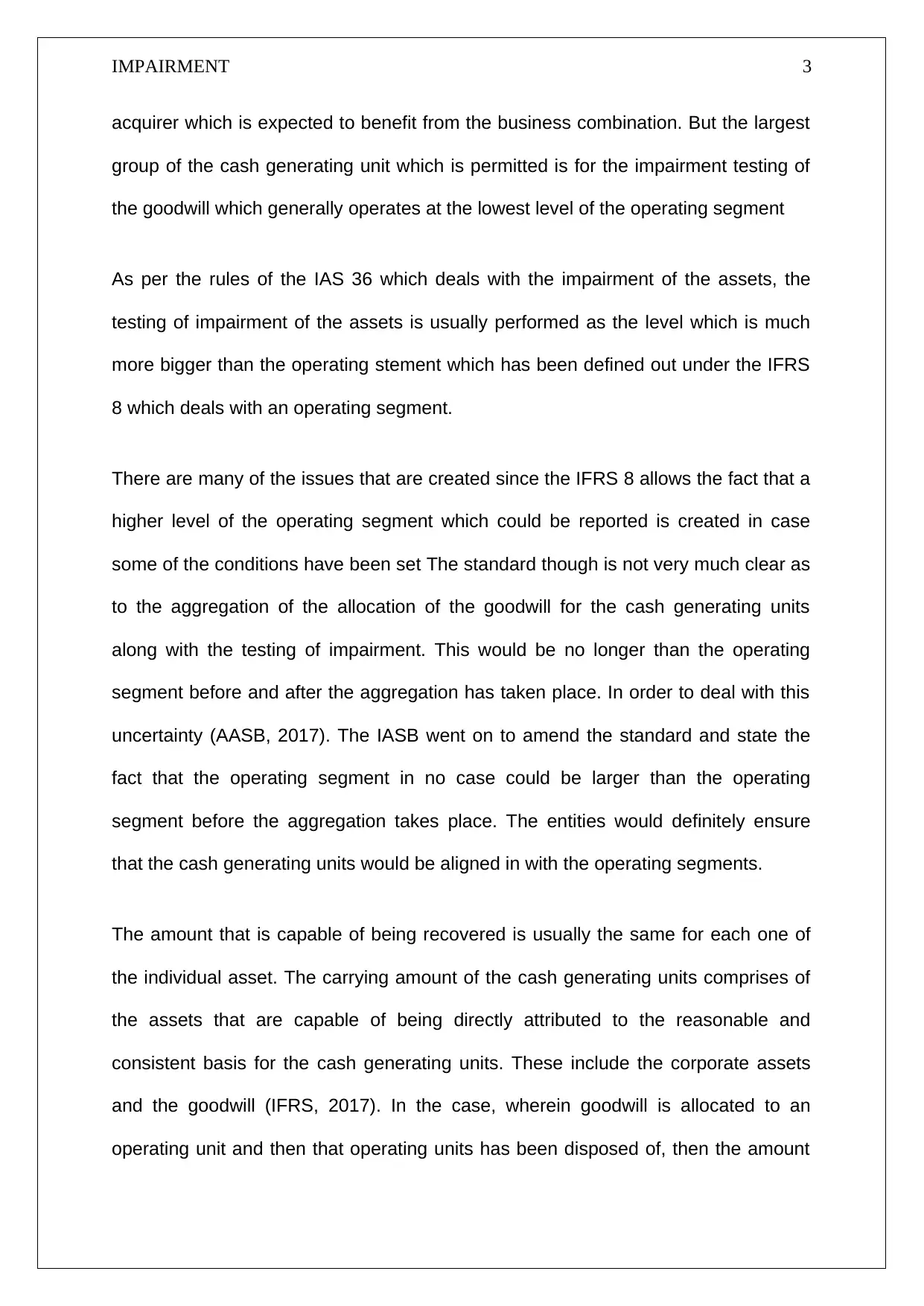
acquirer which is expected to benefit from the business combination. But the largest
group of the cash generating unit which is permitted is for the impairment testing of
the goodwill which generally operates at the lowest level of the operating segment
As per the rules of the IAS 36 which deals with the impairment of the assets, the
testing of impairment of the assets is usually performed as the level which is much
more bigger than the operating stement which has been defined out under the IFRS
8 which deals with an operating segment.
There are many of the issues that are created since the IFRS 8 allows the fact that a
higher level of the operating segment which could be reported is created in case
some of the conditions have been set The standard though is not very much clear as
to the aggregation of the allocation of the goodwill for the cash generating units
along with the testing of impairment. This would be no longer than the operating
segment before and after the aggregation has taken place. In order to deal with this
uncertainty (AASB, 2017). The IASB went on to amend the standard and state the
fact that the operating segment in no case could be larger than the operating
segment before the aggregation takes place. The entities would definitely ensure
that the cash generating units would be aligned in with the operating segments.
The amount that is capable of being recovered is usually the same for each one of
the individual asset. The carrying amount of the cash generating units comprises of
the assets that are capable of being directly attributed to the reasonable and
consistent basis for the cash generating units. These include the corporate assets
and the goodwill (IFRS, 2017). In the case, wherein goodwill is allocated to an
operating unit and then that operating units has been disposed of, then the amount
acquirer which is expected to benefit from the business combination. But the largest
group of the cash generating unit which is permitted is for the impairment testing of
the goodwill which generally operates at the lowest level of the operating segment
As per the rules of the IAS 36 which deals with the impairment of the assets, the
testing of impairment of the assets is usually performed as the level which is much
more bigger than the operating stement which has been defined out under the IFRS
8 which deals with an operating segment.
There are many of the issues that are created since the IFRS 8 allows the fact that a
higher level of the operating segment which could be reported is created in case
some of the conditions have been set The standard though is not very much clear as
to the aggregation of the allocation of the goodwill for the cash generating units
along with the testing of impairment. This would be no longer than the operating
segment before and after the aggregation has taken place. In order to deal with this
uncertainty (AASB, 2017). The IASB went on to amend the standard and state the
fact that the operating segment in no case could be larger than the operating
segment before the aggregation takes place. The entities would definitely ensure
that the cash generating units would be aligned in with the operating segments.
The amount that is capable of being recovered is usually the same for each one of
the individual asset. The carrying amount of the cash generating units comprises of
the assets that are capable of being directly attributed to the reasonable and
consistent basis for the cash generating units. These include the corporate assets
and the goodwill (IFRS, 2017). In the case, wherein goodwill is allocated to an
operating unit and then that operating units has been disposed of, then the amount
ā This is a preview!ā
Do you want full access?
Subscribe today to unlock all pages.

Trusted by 1+ million students worldwide

IMPAIRMENT 4
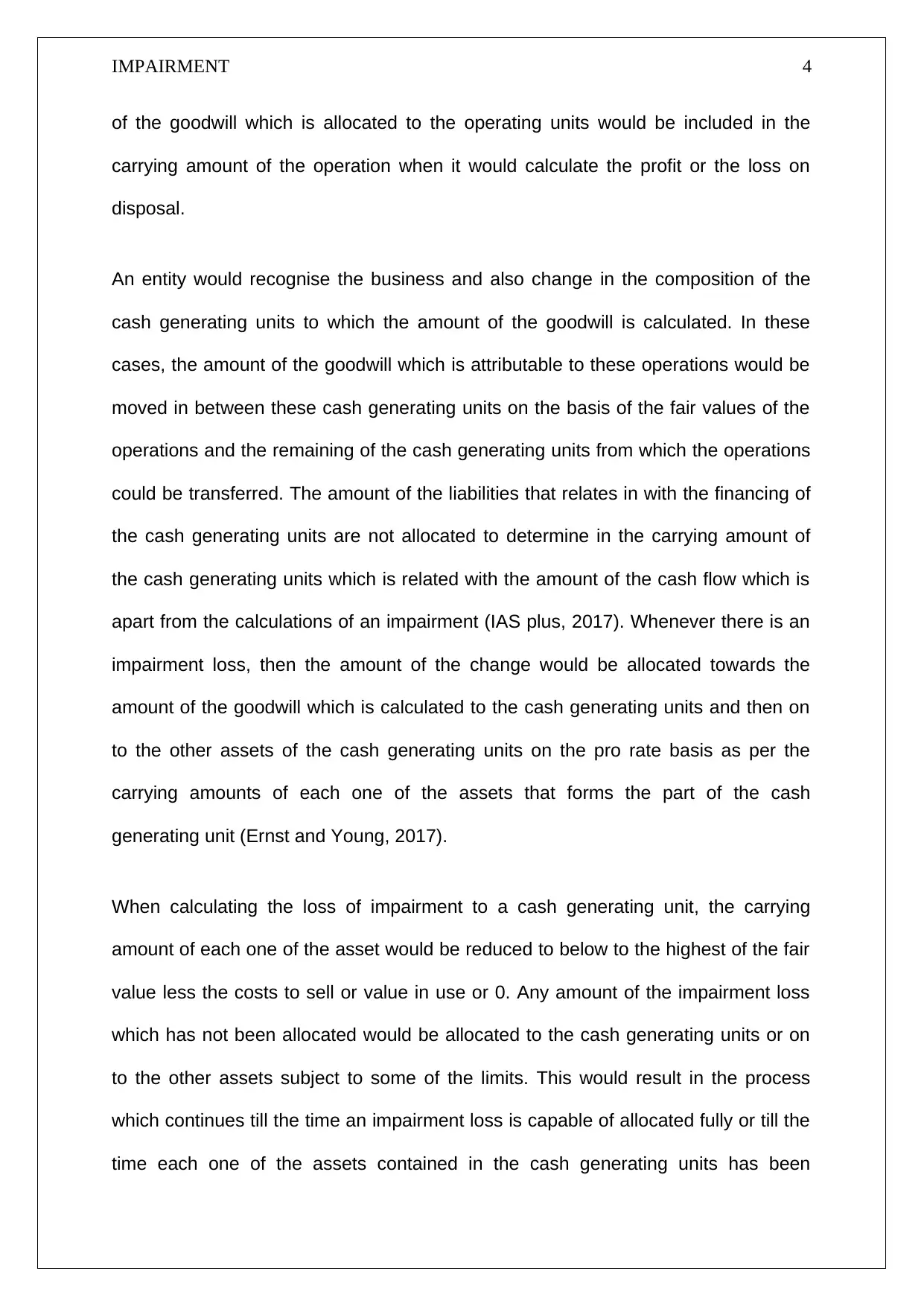
of the goodwill which is allocated to the operating units would be included in the
carrying amount of the operation when it would calculate the profit or the loss on
disposal.
An entity would recognise the business and also change in the composition of the
cash generating units to which the amount of the goodwill is calculated. In these
cases, the amount of the goodwill which is attributable to these operations would be
moved in between these cash generating units on the basis of the fair values of the
operations and the remaining of the cash generating units from which the operations
could be transferred. The amount of the liabilities that relates in with the financing of
the cash generating units are not allocated to determine in the carrying amount of
the cash generating units which is related with the amount of the cash flow which is
apart from the calculations of an impairment (IAS plus, 2017). Whenever there is an
impairment loss, then the amount of the change would be allocated towards the
amount of the goodwill which is calculated to the cash generating units and then on
to the other assets of the cash generating units on the pro rate basis as per the
carrying amounts of each one of the assets that forms the part of the cash
generating unit (Ernst and Young, 2017).
When calculating the loss of impairment to a cash generating unit, the carrying
amount of each one of the asset would be reduced to below to the highest of the fair
value less the costs to sell or value in use or 0. Any amount of the impairment loss
which has not been allocated would be allocated to the cash generating units or on
to the other assets subject to some of the limits. This would result in the process
which continues till the time an impairment loss is capable of allocated fully or till the
time each one of the assets contained in the cash generating units has been
of the goodwill which is allocated to the operating units would be included in the
carrying amount of the operation when it would calculate the profit or the loss on
disposal.
An entity would recognise the business and also change in the composition of the
cash generating units to which the amount of the goodwill is calculated. In these
cases, the amount of the goodwill which is attributable to these operations would be
moved in between these cash generating units on the basis of the fair values of the
operations and the remaining of the cash generating units from which the operations
could be transferred. The amount of the liabilities that relates in with the financing of
the cash generating units are not allocated to determine in the carrying amount of
the cash generating units which is related with the amount of the cash flow which is
apart from the calculations of an impairment (IAS plus, 2017). Whenever there is an
impairment loss, then the amount of the change would be allocated towards the
amount of the goodwill which is calculated to the cash generating units and then on
to the other assets of the cash generating units on the pro rate basis as per the
carrying amounts of each one of the assets that forms the part of the cash
generating unit (Ernst and Young, 2017).
When calculating the loss of impairment to a cash generating unit, the carrying
amount of each one of the asset would be reduced to below to the highest of the fair
value less the costs to sell or value in use or 0. Any amount of the impairment loss
which has not been allocated would be allocated to the cash generating units or on
to the other assets subject to some of the limits. This would result in the process
which continues till the time an impairment loss is capable of allocated fully or till the
time each one of the assets contained in the cash generating units has been
Paraphrase This Document
Need a fresh take? Get an instant paraphrase of this document with our AI Paraphraser

IMPAIRMENT 5
reduced to the highest of the fair value of the each asset less the costs to sell, value
or 0 (ACCA global, 2017).
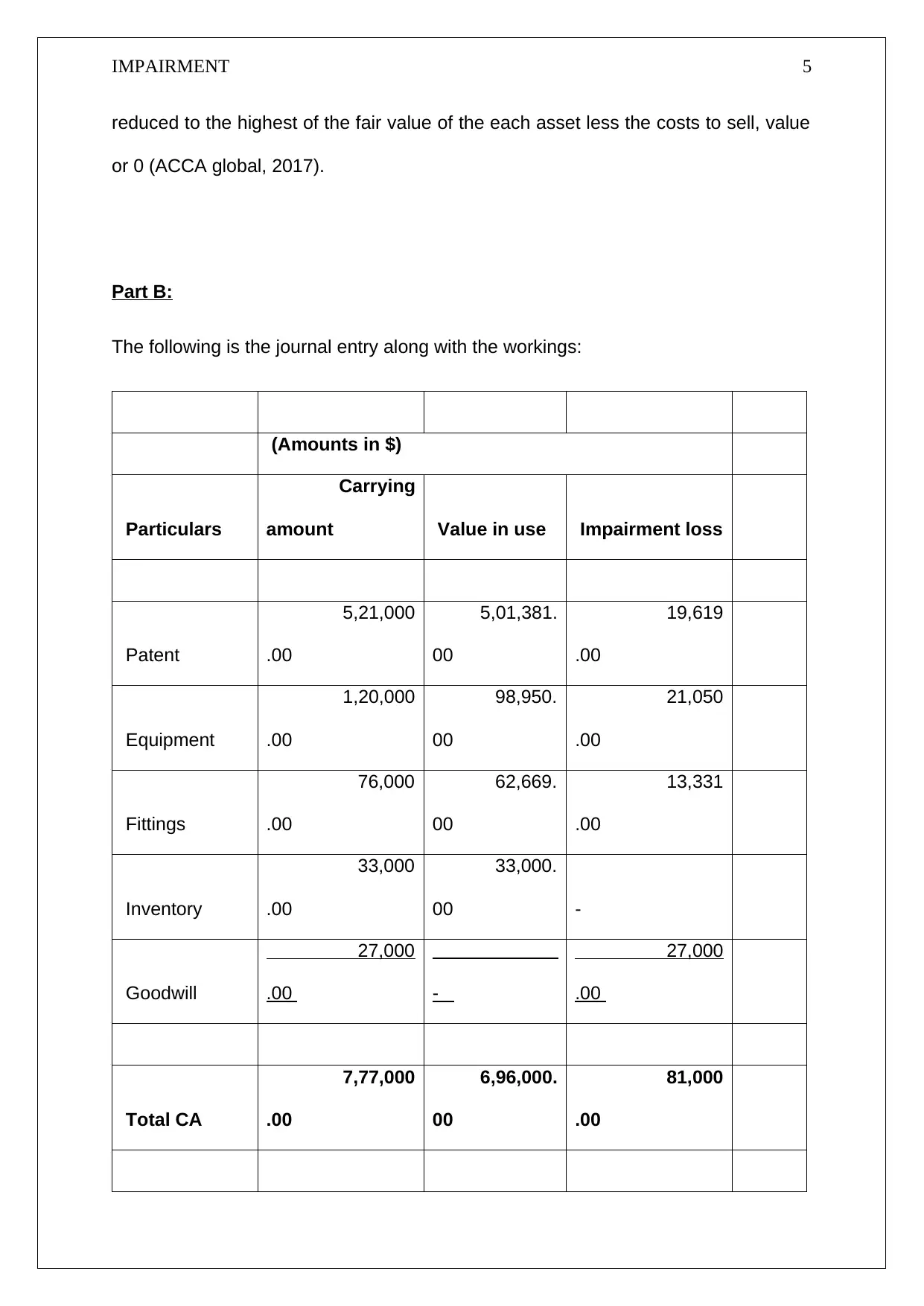
Part B:
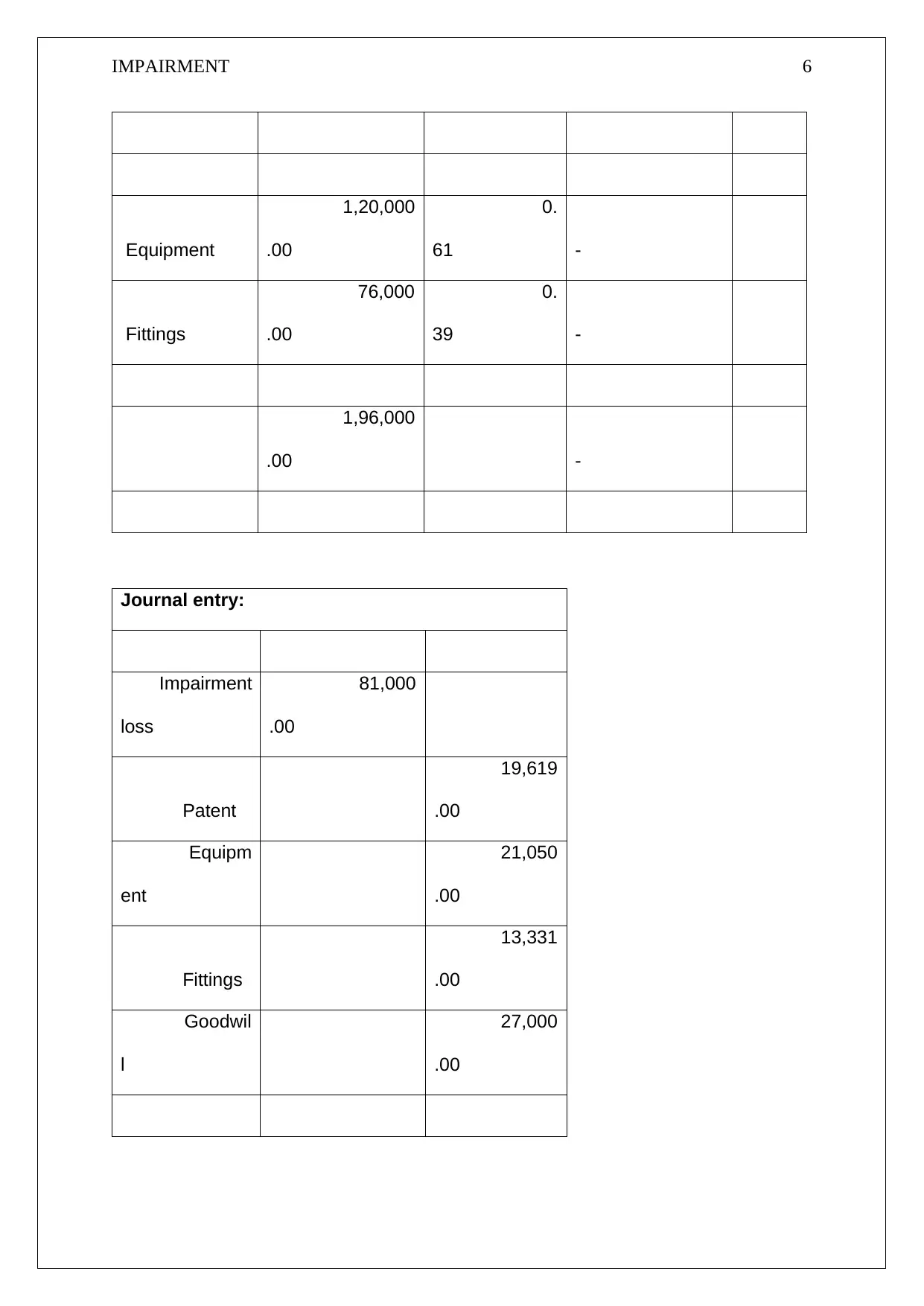
The following is the journal entry along with the workings:
(Amounts in $)
Particulars
Carrying
amount Value in use Impairment loss
Patent
5,21,000
.00
5,01,381.
00
19,619
.00
Equipment
1,20,000
.00
98,950.
00
21,050
.00
Fittings
76,000
.00
62,669.
00
13,331
.00
Inventory
33,000
.00
33,000.
00 -
Goodwill
27,000
.00 -
27,000
.00
Total CA
7,77,000
.00
6,96,000.
00
81,000
.00
reduced to the highest of the fair value of the each asset less the costs to sell, value
or 0 (ACCA global, 2017).
Part B:
The following is the journal entry along with the workings:
(Amounts in $)
Particulars
Carrying
amount Value in use Impairment loss
Patent
5,21,000
.00
5,01,381.
00
19,619
.00
Equipment
1,20,000
.00
98,950.
00
21,050
.00
Fittings
76,000
.00
62,669.
00
13,331
.00
Inventory
33,000
.00
33,000.
00 -
Goodwill
27,000
.00 -
27,000
.00
Total CA
7,77,000
.00
6,96,000.
00
81,000
.00

IMPAIRMENT 6
Equipment
1,20,000
.00
0.
61 -
Fittings
76,000
.00
0.
39 -
1,96,000
.00 -
Journal entry:
Impairment
loss
81,000
.00
Patent
19,619
.00
Equipm
ent
21,050
.00
Fittings
13,331
.00
Goodwil
l
27,000
.00
Equipment
1,20,000
.00
0.
61 -
Fittings
76,000
.00
0.
39 -
1,96,000
.00 -
Journal entry:
Impairment
loss
81,000
.00
Patent
19,619
.00
Equipm
ent
21,050
.00
Fittings
13,331
.00
Goodwil
l
27,000
.00
ā This is a preview!ā
Do you want full access?
Subscribe today to unlock all pages.

Trusted by 1+ million students worldwide

IMPAIRMENT 7
Paraphrase This Document
Need a fresh take? Get an instant paraphrase of this document with our AI Paraphraser

IMPAIRMENT 8
References:
http://www.accaglobal.com, A. (2017). Impairment of goodwill and CGUs | ACCA
Global. [online] Accaglobal.com. Available at:
http://www.accaglobal.com/in/en/member/discover/cpd-articles/corporate-reporting/
goodwill-cgus.html [Accessed 12 Sep. 2017].
Iasplus.com. (2017). Goodwill and other intangible assets ā Key differences
between U.S. GAAP and IFRSs. [online] Available at: https://www.iasplus.com/en-
us/standards/ifrs-usgaap/goodwill [Accessed 12 Sep. 2017].
Ifrs.com. (2017). International Financial Reporting Standards - Questions and
Answers. [online] Available at: http://www.ifrs.com/updates/aicpa/ifrs_faq.html
[Accessed 11 Sep. 2017].
www.aasb.gov.au. (2017). ED 30. [online] Available at:
http://www.aasb.gov.au/admin/file/content105/c9/IPSASB_ED30.pdf [Accessed 15
Sep. 2017].
www.asb.co.za. (2017). Executive summary ā Impairment of Cash-generating
Assets. [online] Available at:
http://www.asb.co.za/asb_dev/Portals/0/Documents/GRAP/standards/approved_effe
ctive/GRAP26/GRAP_26_FAQS.pdf [Accessed 15 Sep. 2017].
www.ey.com. (2017). Impairment accounting ā the basics of IAS 36 Impairment of
Assets. [online] Available at:
http://www.ey.com/Publication/vwLUAssets/Impairment_accounting_the_basics_of_I
AS_36_Impairment_of_Assets/$FILE/Impairment_accounting_IAS_36.pdf [Accessed
15 Sep. 2017].
References:
http://www.accaglobal.com, A. (2017). Impairment of goodwill and CGUs | ACCA
Global. [online] Accaglobal.com. Available at:
http://www.accaglobal.com/in/en/member/discover/cpd-articles/corporate-reporting/
goodwill-cgus.html [Accessed 12 Sep. 2017].
Iasplus.com. (2017). Goodwill and other intangible assets ā Key differences
between U.S. GAAP and IFRSs. [online] Available at: https://www.iasplus.com/en-
us/standards/ifrs-usgaap/goodwill [Accessed 12 Sep. 2017].
Ifrs.com. (2017). International Financial Reporting Standards - Questions and
Answers. [online] Available at: http://www.ifrs.com/updates/aicpa/ifrs_faq.html
[Accessed 11 Sep. 2017].
www.aasb.gov.au. (2017). ED 30. [online] Available at:
http://www.aasb.gov.au/admin/file/content105/c9/IPSASB_ED30.pdf [Accessed 15
Sep. 2017].
www.asb.co.za. (2017). Executive summary ā Impairment of Cash-generating
Assets. [online] Available at:
http://www.asb.co.za/asb_dev/Portals/0/Documents/GRAP/standards/approved_effe
ctive/GRAP26/GRAP_26_FAQS.pdf [Accessed 15 Sep. 2017].
www.ey.com. (2017). Impairment accounting ā the basics of IAS 36 Impairment of
Assets. [online] Available at:
http://www.ey.com/Publication/vwLUAssets/Impairment_accounting_the_basics_of_I
AS_36_Impairment_of_Assets/$FILE/Impairment_accounting_IAS_36.pdf [Accessed
15 Sep. 2017].
1 out of 8
Related Documents
Your All-in-One AI-Powered Toolkit for Academic Success.
Ā +13062052269
info@desklib.com
Available 24*7 on WhatsApp / Email
Unlock your academic potential
Copyright Ā© 2020ā2026 A2Z Services. All Rights Reserved. Developed and managed by ZUCOL.