Strategic Management's Relevance Across Sectors: A Comparison

Verified

Added on  2020/01/15

|5
|694
|300
Essay
AI Summary
This essay examines the relevance of strategic management across public, private, and third sectors. It begins by defining strategic management as a crucial process for formulating plans to achieve organizational goals. The essay traces the historical development of strategic management, initially focused on private organizations, and discusses its application in the public and third sectors, including non-profit organizations. It highlights the importance of strategic planning for handling dynamic business contexts, particularly in light of the five-year plans of governmental bodies like the UK. The essay emphasizes the role of strategic administration in adapting to evolving market conditions and political environments, concluding that strategic management is equally applicable and necessary for all three sectors to ensure profitability and effective performance. References from scholarly sources support the arguments presented.

Document Page
ASSIGNMENT
tabler-icon-diamond-filled.svg

Paraphrase This Document

Need a fresh take? Get an instant paraphrase of this document with our AI Paraphraser
Document Page
TABLE OF CONTENTS
Is strategic management just as relevant to the public and third sectors as the private sector?.......1
REFERENCES................................................................................................................................3
Document Page
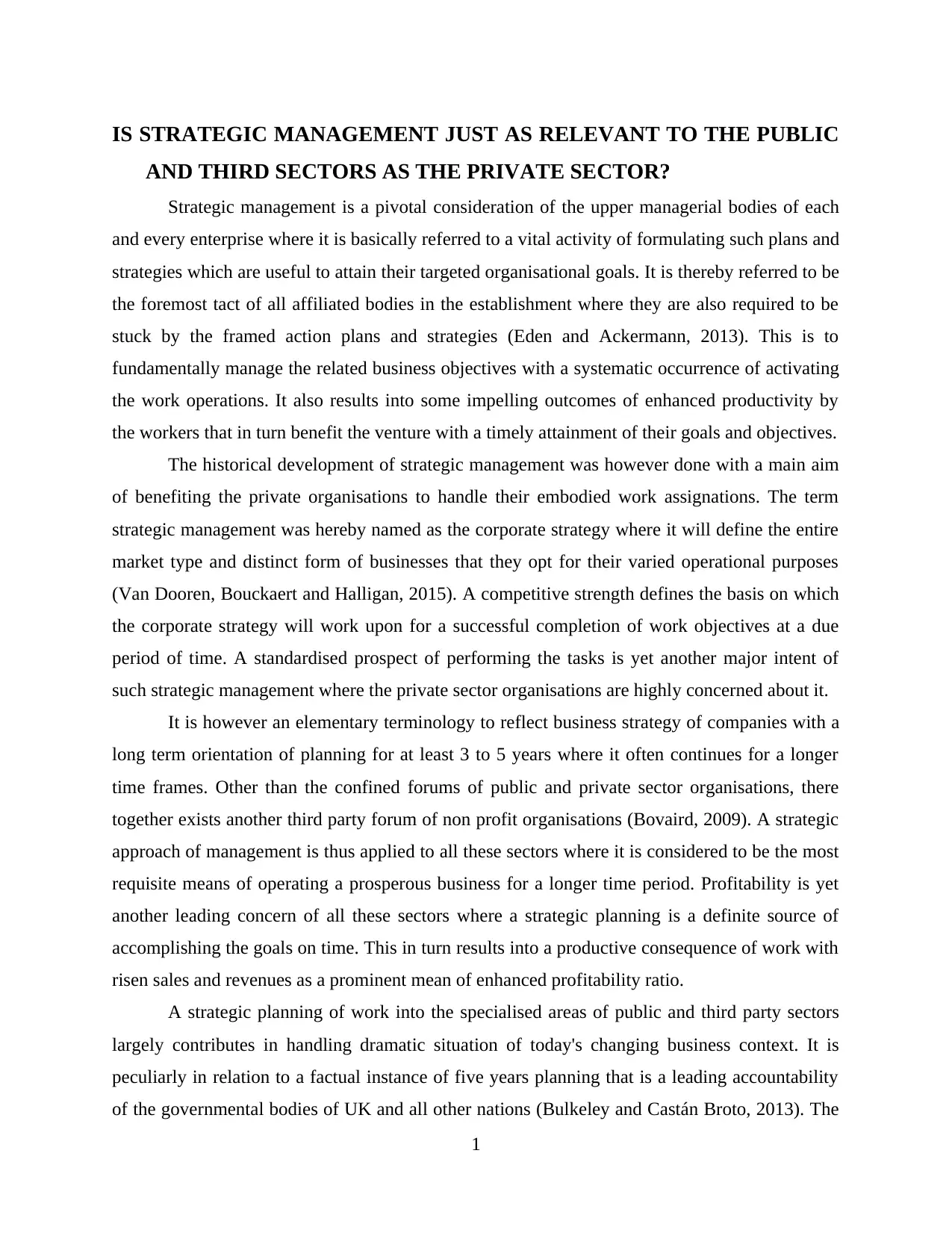
IS STRATEGIC MANAGEMENT JUST AS RELEVANT TO THE PUBLIC
AND THIRD SECTORS AS THE PRIVATE SECTOR?
Strategic management is a pivotal consideration of the upper managerial bodies of each
and every enterprise where it is basically referred to a vital activity of formulating such plans and
strategies which are useful to attain their targeted organisational goals. It is thereby referred to be
the foremost tact of all affiliated bodies in the establishment where they are also required to be
stuck by the framed action plans and strategies (Eden and Ackermann, 2013). This is to
fundamentally manage the related business objectives with a systematic occurrence of activating
the work operations. It also results into some impelling outcomes of enhanced productivity by
the workers that in turn benefit the venture with a timely attainment of their goals and objectives.
The historical development of strategic management was however done with a main aim
of benefiting the private organisations to handle their embodied work assignations. The term
strategic management was hereby named as the corporate strategy where it will define the entire
market type and distinct form of businesses that they opt for their varied operational purposes
(Van Dooren, Bouckaert and Halligan, 2015). A competitive strength defines the basis on which
the corporate strategy will work upon for a successful completion of work objectives at a due
period of time. A standardised prospect of performing the tasks is yet another major intent of
such strategic management where the private sector organisations are highly concerned about it.
It is however an elementary terminology to reflect business strategy of companies with a
long term orientation of planning for at least 3 to 5 years where it often continues for a longer
time frames. Other than the confined forums of public and private sector organisations, there
together exists another third party forum of non profit organisations (Bovaird, 2009). A strategic
approach of management is thus applied to all these sectors where it is considered to be the most
requisite means of operating a prosperous business for a longer time period. Profitability is yet
another leading concern of all these sectors where a strategic planning is a definite source of
accomplishing the goals on time. This in turn results into a productive consequence of work with
risen sales and revenues as a prominent mean of enhanced profitability ratio.
A strategic planning of work into the specialised areas of public and third party sectors
largely contributes in handling dramatic situation of today's changing business context. It is
peculiarly in relation to a factual instance of five years planning that is a leading accountability
of the governmental bodies of UK and all other nations (Bulkeley and Castán Broto, 2013). The
1
Document Page
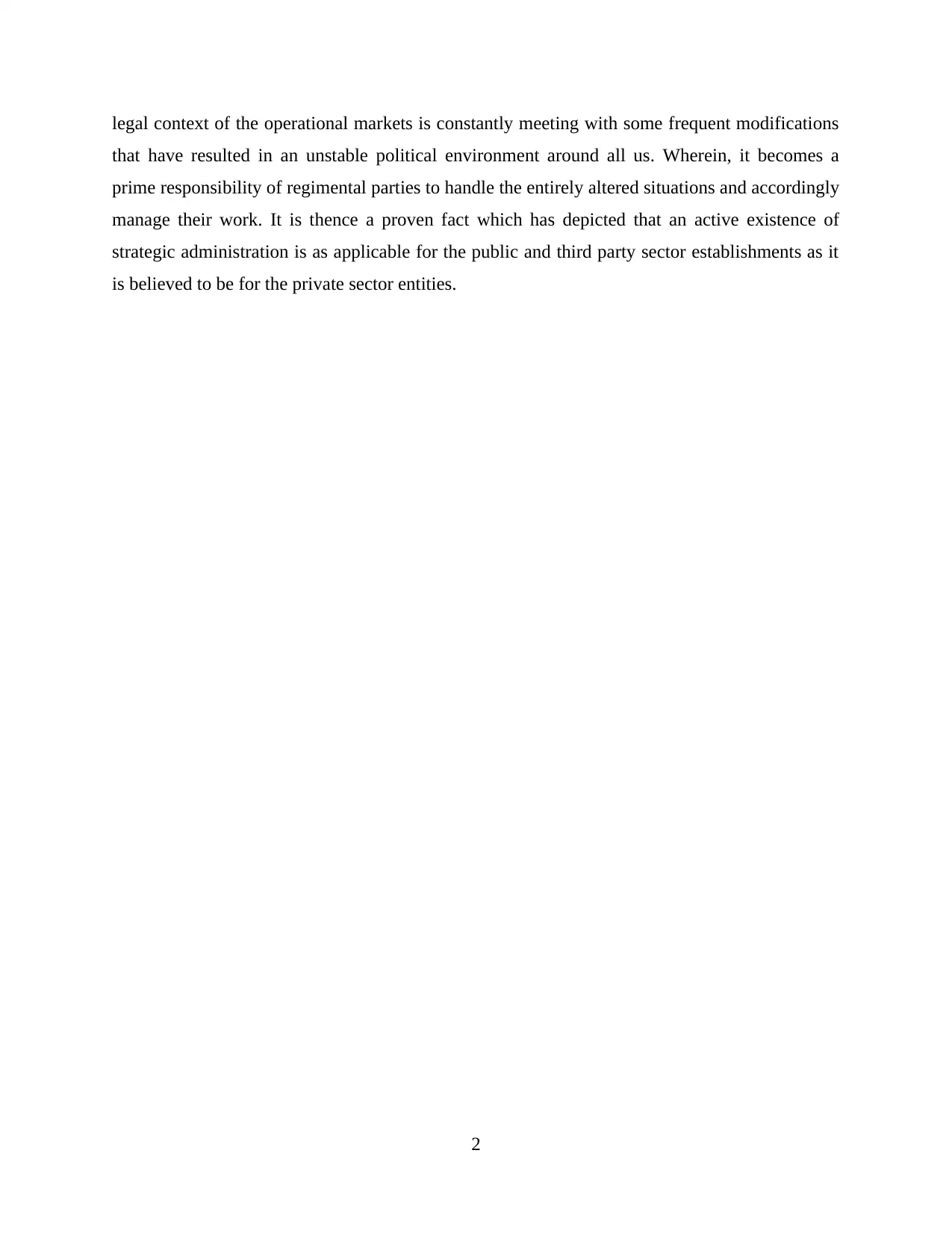
legal context of the operational markets is constantly meeting with some frequent modifications
that have resulted in an unstable political environment around all us. Wherein, it becomes a
prime responsibility of regimental parties to handle the entirely altered situations and accordingly
manage their work. It is thence a proven fact which has depicted that an active existence of
strategic administration is as applicable for the public and third party sector establishments as it
is believed to be for the private sector entities.
2
tabler-icon-diamond-filled.svg

Paraphrase This Document

Need a fresh take? Get an instant paraphrase of this document with our AI Paraphraser
Document Page
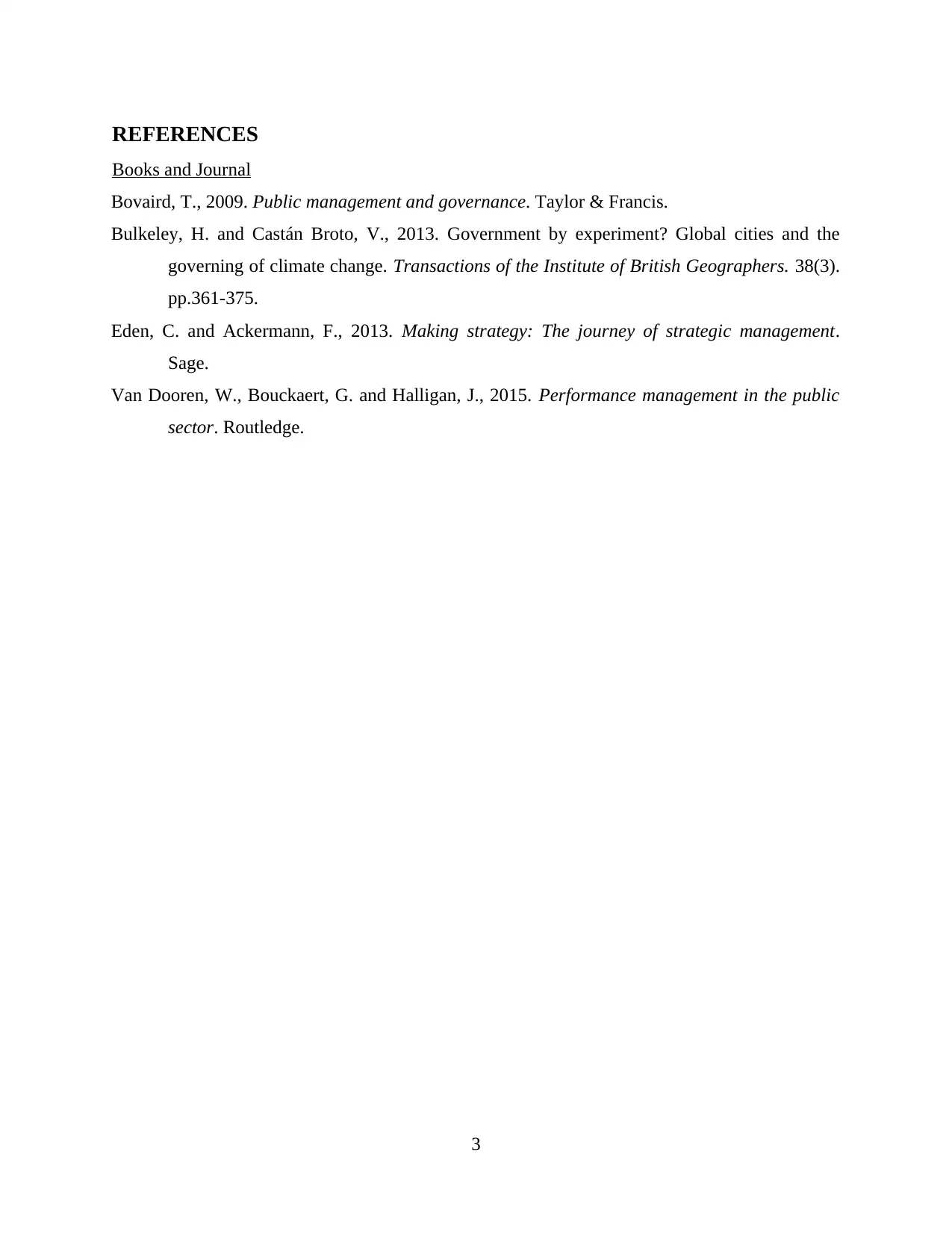
REFERENCES
Books and Journal
Bovaird, T., 2009. Public management and governance. Taylor & Francis.
Bulkeley, H. and Castán Broto, V., 2013. Government by experiment? Global cities and the
governing of climate change. Transactions of the Institute of British Geographers. 38(3).
pp.361-375.
Eden, C. and Ackermann, F., 2013. Making strategy: The journey of strategic management.
Sage.
Van Dooren, W., Bouckaert, G. and Halligan, J., 2015. Performance management in the public
sector. Routledge.
3
chevron_up_icon
1 out of 5
circle_padding
hide_on_mobile
zoom_out_icon
[object Object]