Al Ain Water Marketing Plan Report

Verified

Added on  2019/09/16

|5
|1686
|379
Report
AI Summary
This assignment requires the creation of a comprehensive marketing plan report for Al Ain Water, a company operating in the UAE. The report involves a detailed situational analysis and marketing audit, including a PESTEL analysis to assess macro-environmental factors, an overview of the company's mission and performance, an examination of its social responsibility, a definition of its target market and competitive landscape, a SWOT analysis, and a brand positioning strategy. The report also includes an executive summary, table of contents, introduction, analysis, and conclusion. The student is expected to use various sources, including textbooks, journal articles, and case studies, to complete the assignment.
Document Page
Assume that you are the new Marketing Manager of a Al Ain water company that
operates in UAE. providing a key product or service that has been customized, adapted,
or localized specifically to suit the MENA/UAE market; or which is specifically produced
locally in the UAE for the Arab market only. You have been asked to familiarise yourself
with the corporate objectives of the organisation, and to contribute towards the
marketing strategies for achieving those corporate objectives for a specific product of
the company. The focus of this assignment is on the steps preceding the formulation of
the marketing strategies in a Marketing Plan - namely Situational Analyses and Marketing
Audit for Al AIN WATER Company.
Company: Al Ain water in U.A.E
Task 1:
Analyse the context and environments in which your organisation operates. Quantify and explain the
implications of the trends identified. The environment refers to the macro-environmental forces
impacting on the industry, namely, political, economic, social, technological, environmental, and legal
factors/dimensions (PESTEL analysis). Contexts normally associated with macro-environment analysis
include a company looking at industry trends; a business looking at product trends driven by consumer
preference; evaluation of a brand’s market position relative to competition; a geographically defined
business such as the subsidiary of an overseas company; a company needing to identify opportunities
for entering a foreign market; and a business seeking to identify opportunities and threats in acquiring
another company. To quantify the trends identified, use impact-weights for each PESTEL dimension by
rating its marketing impact on the company’s operations. Rating/weighing increases the usefulness of
the information, as it attaches importance to its overall impact on the company’s marketing operations.
Use a positive-negative scale to rate your estimated assessment of each factor in order to better explain
its impact. Rate each macro-environmental factor with impact-weights of -4 to +4, with the maximum
possible sum of the 6 factors’ ratings being 24 (i.e., 4 x 6). Derive a final index for the overall impact of
PESTEL on your company by dividing the sum of the 6 ratings with 24. The decision rule is that the
overall macro-environment in which a company operates is favourable if its composite PESTEL index is
greater than 0.45 (i.e., > 0.45).
Task 2:
Provide a brief overview of the organisation in terms of what it markets; analyze its mission
statement; and how its history has shaped the organisation’s development of core
competencies. Review the organization’s performance in the last few years from both financial
and marketing perspectives. Then, identify and evaluate the organization’s present marketing
goals and objectives.
Task 3:
Using the Pyramid of Corporate Social Responsibility, examine the social responsibility and
marketing ethics issues that are relevant for the company and the chosen product. How
effectively has the company addressed the issues? What could they be doing better?
tabler-icon-diamond-filled.svg

Paraphrase This Document

Need a fresh take? Get an instant paraphrase of this document with our AI Paraphraser
Document Page
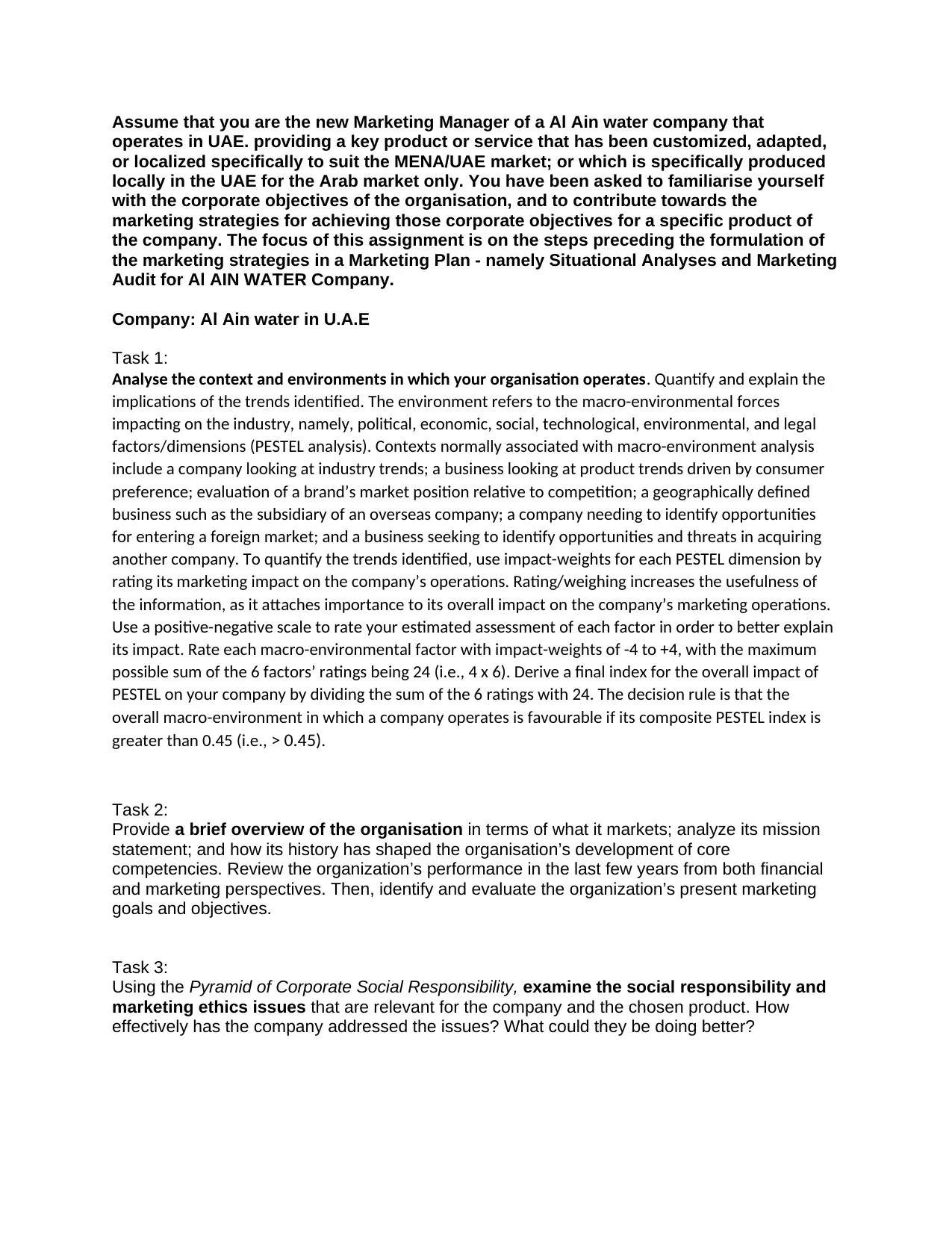
Task 4:
Define the core target profile the organization’s key target market for the specific product
you chose. What are their needs and benefits sought? Identify the major competitors and
their characteristics in terms of size, growth, market share, profitability and marketing
capabilities. What factors have contributed to their success or decline? What are their major
strengths and weaknesses? What is the organisation’s competitive strategy within the market?
Are they a market leader, follower, or niche? Discuss the implications of their position.
Task 5:
Identify the critical success factors within the market. What things must be done
exceptionally well in order to succeed in the industry? What factors could cause organizations in
the industry to underperform? What is the organisation’s position with respect to the critical
success factors? Conduct a SWOT analysis and explain the key points. Then, assess
whether the organisation has the strengths to capitalize on the opportunities. Are there
threats which the organisation needs to address? Does the organisation need to turn any
weaknesses into strengths? How realistic are the organisation’s marketing objectives, given the
anticipated environment, including the actions of competitors and the organisation’s core
competencies? Evaluate the organisation’s existing value proposition. What relevant marketing
issues face the organisation?
Task 6:
How does the company want the specific chosen product and its associated brand to be
perceived by its target market when compared to its major competitors? How does the target
market actually perceive the selected company's product and its associated brand with respect
to competition? How strong, favourable, and unique are the brand associations? Present and
explain both a positioning map and a perceptual map to show the position where the
company wants the product to be perceived, and also where the product actually stands
in the market compared to competition. Include a positioning statement.
Lecturer’s Expectations on Research to Address the Assignment Questions:
Complete this assignment using material from the textbooks, journal articles, lectures,
case studies, your experience in organisation(s)/markets, and other sources such as
newspapers, magazines, and websites. You may conduct informal observation or discussions
with friends and relatives who know about the company and product chosen. However, no
formal primary data collection research is necessary for this class work. You must acknowledge
all sources of any information and ideas which are not your own as in-work citations and in a list
Document Page
of references at the end of your report. Please place tables, charts, graphs, pictures,
histograms, and matrices in the appendix section.
Document Page
Your report MUST include of the following:
1. A Well-designed Title/Cover Page (different from the UOWD assignment submission
sheet). Immediately following the assignment submission sheet should be the well-designed
title/cover page. The designed title/cover page must consist of a report title, company and brand
logos, any other illustration you would like to include, and the date of submission.
2. Executive Summary (1 page; on a separate page of the report before the Table of Contents
page).
3. Table of contents (on a separate page of the report). Include a table of contents with
headings, sub-headings and page numbers.
4. Introduction (1/2 page); the introduction should introduce all aspects of the report questions
and preview the content of the report. Specifically, the introduction should include: (a) general
lead-in information about the report topic including why you chose this company and product for
your assignment, by way of providing rational (e.g., market share, profit, new product, most
advertised product) and other reasons for your selection of the product; (b) a statement of the
main aim(s) and objective(s); (c) method(s) of approach; (d) indications of the scope and
limitations of the report; (e) a preview of material presented in the body of the report.
5. Analysis (main body of the report) – containing subtitles and subsections of the main
analyses of the 6 tasks above (page 7); detailed discussions of your findings and inferences;
and then your recommendations.
6. Conclusion (1/2 page); conclusions are quite often read by managers before the main text of the
report and hence should summarise the main points clearly.
tabler-icon-diamond-filled.svg

Paraphrase This Document

Need a fresh take? Get an instant paraphrase of this document with our AI Paraphraser
Document Page
Your report MUST include of the following:
1. A Well-designed Title/Cover Page (different from the UOWD assignment submission
sheet). Immediately following the assignment submission sheet should be the well-designed
title/cover page. The designed title/cover page must consist of a report title, company and brand
logos, any other illustration you would like to include, and the date of submission.
2. Executive Summary (1 page; on a separate page of the report before the Table of Contents
page).
3. Table of contents (on a separate page of the report). Include a table of contents with
headings, sub-headings and page numbers.
4. Introduction (1/2 page); the introduction should introduce all aspects of the report questions
and preview the content of the report. Specifically, the introduction should include: (a) general
lead-in information about the report topic including why you chose this company and product for
your assignment, by way of providing rational (e.g., market share, profit, new product, most
advertised product) and other reasons for your selection of the product; (b) a statement of the
main aim(s) and objective(s); (c) method(s) of approach; (d) indications of the scope and
limitations of the report; (e) a preview of material presented in the body of the report.
5. Analysis (main body of the report) – containing subtitles and subsections of the main
analyses of the 6 tasks above (page 7); detailed discussions of your findings and inferences;
and then your recommendations.
6. Conclusion (1/2 page); conclusions are quite often read by managers before the main text of the
report and hence should summarise the main points clearly.
chevron_up_icon
1 out of 5
circle_padding
hide_on_mobile
zoom_out_icon
[object Object]