BAO3306 - Auditing: Financial Audit Planning for Monash IVF Group
VerifiedAdded on 2023/06/05
|19
|4235
|270
Report
AI Summary
This report provides a comprehensive audit planning and risk assessment for Monash IVF Group, focusing on the identification of significant accounts and the evaluation of potential risks. It begins with an introduction to Monash IVF Group, highlighting its core business and competitive landscape. The report identifies five significant accounts—intangible assets, borrowings, contingent considerations, revenue, and income tax—and explains the rationale for their detailed assessment. Analytical procedures, including ratio analysis, are applied to assess the risk of going concern and understand key areas requiring in-depth analysis. The report also discusses the concept of materiality, its importance in auditing, and the calculation of the materiality limit for Monash IVF Group, using the revenue method. Finally, it provides a detailed audit risk assessment for each of the selected significant accounts, emphasizing potential misstatements and areas requiring further investigation. Desklib offers a wide range of solved assignments and past papers to support students in their studies.
BAO3306 Auditing

Paraphrase This Document
Need a fresh take? Get an instant paraphrase of this document with our AI Paraphraser
Table of Contents
Executive summary.........................................................................................................................3
Introduction......................................................................................................................................4
Key information...............................................................................................................................4
Understanding of client................................................................................................................4
Identification of the five significant accounts.............................................................................5
Planning materiality level............................................................................................................6
Identification of the audit risk assessment of the selected 5 significant accounts.......................8
Conclusion.....................................................................................................................................13
Appendices....................................................................................................................................14
References......................................................................................................................................17
Executive summary.........................................................................................................................3
Introduction......................................................................................................................................4
Key information...............................................................................................................................4
Understanding of client................................................................................................................4
Identification of the five significant accounts.............................................................................5
Planning materiality level............................................................................................................6
Identification of the audit risk assessment of the selected 5 significant accounts.......................8
Conclusion.....................................................................................................................................13
Appendices....................................................................................................................................14
References......................................................................................................................................17
EXECUTIVE SUMMARY
Audit planning is referred to as the most crucial area of the entire audit that is performed at the
beginning of the audit process in order to make sure that suitable consideration is provided to the
most significant areas. The main objective behind the same is the prompt identification of
possible problems so that the whole audit procedure can be conducted in a coordinated and
expeditious manner. The present report is based on providing full and meaningful audit aspects
with the proper identification of potential risks and assessment of the same. Further, the report
covers the insights of the Monash IVF Group to reach the identification of the main five accounts
inclusive of audit assessment risks and processes relating to same. Along with this, the Monash
IVF Group’s performance and progress will be analyzed through the analytical procedure, which
will help in facilitating calculations and to reach the objective of the study that is to help the
client in conducting audit planning and preparing audit reports effectively.
Audit planning is referred to as the most crucial area of the entire audit that is performed at the
beginning of the audit process in order to make sure that suitable consideration is provided to the
most significant areas. The main objective behind the same is the prompt identification of
possible problems so that the whole audit procedure can be conducted in a coordinated and
expeditious manner. The present report is based on providing full and meaningful audit aspects
with the proper identification of potential risks and assessment of the same. Further, the report
covers the insights of the Monash IVF Group to reach the identification of the main five accounts
inclusive of audit assessment risks and processes relating to same. Along with this, the Monash
IVF Group’s performance and progress will be analyzed through the analytical procedure, which
will help in facilitating calculations and to reach the objective of the study that is to help the
client in conducting audit planning and preparing audit reports effectively.
⊘ This is a preview!⊘
Do you want full access?
Subscribe today to unlock all pages.

Trusted by 1+ million students worldwide
INTRODUCTION
The prevailing study aims to support the auditors in making effective decisions in auditing and
offering them the appropriate and justifiable information regarding the financial performance and
needs of clients. It concentrates on those improvement areas that are required to be handled in
depth. The concerned auditing planning process will make a contribution by establishing
significant accounts that are most expected to possess materialistic misstatement risks, along
with the audit risks assessments. The entire study and audit plan will be based in accordance with
the ASA 300 Planning an Audit of a Financial Report, plus full consideration will be given
towards ethical standards and auditor professionalism and client satisfaction.
KEY INFORMATION
Understanding of client
Monash IVF Group Limited is based in Australia and Malaysia engaged in offering assistive
reproductive and professional women services. It offers quality services such as tertiary level
prenatal diagnostic, fertility research, diagnostic ultrasound and low intervention IVF
respectively. The company was established in 2014 and now is a key leader in the in the Assisted
Reproductive Services provisions in the based countries (Monash IVF Group, 2018).
Richard has been engaged in working for InvoCare for twenty years till 2018. For most of the
time, the position of CEO belonged to him and management of the business growth was in his
hand via a number of ownership changes and more than 200 acquisitions, inclusive of offshore
within Singapore (Monash IVF Group, 2018). On the other hand, the joining of Mr James
Thiedeman in the Group was in the year 2009, 25 years have been spent by James in working
with the company healthcare department in public as well as private sector. Finding a new CEO
as well as a managing director for the Group can be a challenging task, and it is anticipated that
the company shall make an announcement regarding the same in upcoming months.
With the experience of 40 years, the Group has developed into professional fertility as well as
women’s imaging group and gained a global identification for scientific and innovative purposes.
The Group is a driver in the development force of assisted reproductive technologies; they are
The prevailing study aims to support the auditors in making effective decisions in auditing and
offering them the appropriate and justifiable information regarding the financial performance and
needs of clients. It concentrates on those improvement areas that are required to be handled in
depth. The concerned auditing planning process will make a contribution by establishing
significant accounts that are most expected to possess materialistic misstatement risks, along
with the audit risks assessments. The entire study and audit plan will be based in accordance with
the ASA 300 Planning an Audit of a Financial Report, plus full consideration will be given
towards ethical standards and auditor professionalism and client satisfaction.
KEY INFORMATION
Understanding of client
Monash IVF Group Limited is based in Australia and Malaysia engaged in offering assistive
reproductive and professional women services. It offers quality services such as tertiary level
prenatal diagnostic, fertility research, diagnostic ultrasound and low intervention IVF
respectively. The company was established in 2014 and now is a key leader in the in the Assisted
Reproductive Services provisions in the based countries (Monash IVF Group, 2018).
Richard has been engaged in working for InvoCare for twenty years till 2018. For most of the
time, the position of CEO belonged to him and management of the business growth was in his
hand via a number of ownership changes and more than 200 acquisitions, inclusive of offshore
within Singapore (Monash IVF Group, 2018). On the other hand, the joining of Mr James
Thiedeman in the Group was in the year 2009, 25 years have been spent by James in working
with the company healthcare department in public as well as private sector. Finding a new CEO
as well as a managing director for the Group can be a challenging task, and it is anticipated that
the company shall make an announcement regarding the same in upcoming months.
With the experience of 40 years, the Group has developed into professional fertility as well as
women’s imaging group and gained a global identification for scientific and innovative purposes.
The Group is a driver in the development force of assisted reproductive technologies; they are
Paraphrase This Document
Need a fresh take? Get an instant paraphrase of this document with our AI Paraphraser
involved in offering a variety of treatments and services with the goal to provide the utmost care
to the patient (AnnualReports.com, 2018). Their services are served in a specialized and caring
manner, with the help of the specialized team, scientists, nurses, doctors and the leading pursuits
in this field.
The Monash IVF Group has positioned considerable significance on the collaboration based in
operations, science and clinics. Further, this collaboration generally takes place in a formal
manner in their medical advisory committee, and research meetings, wherein the scientists and
professionals consider the success rates and make discussion on the insights based on new
treatments and emerging opportunities related with the research and any other mutual projects
(Bloomberg, 2018).
Competitors of company
The major competitor of Monash IVF Group is the provider of the reproductive treatment and
services which is Virtus Health, and it is an ASX listed leading company
Identification of the five significant accounts
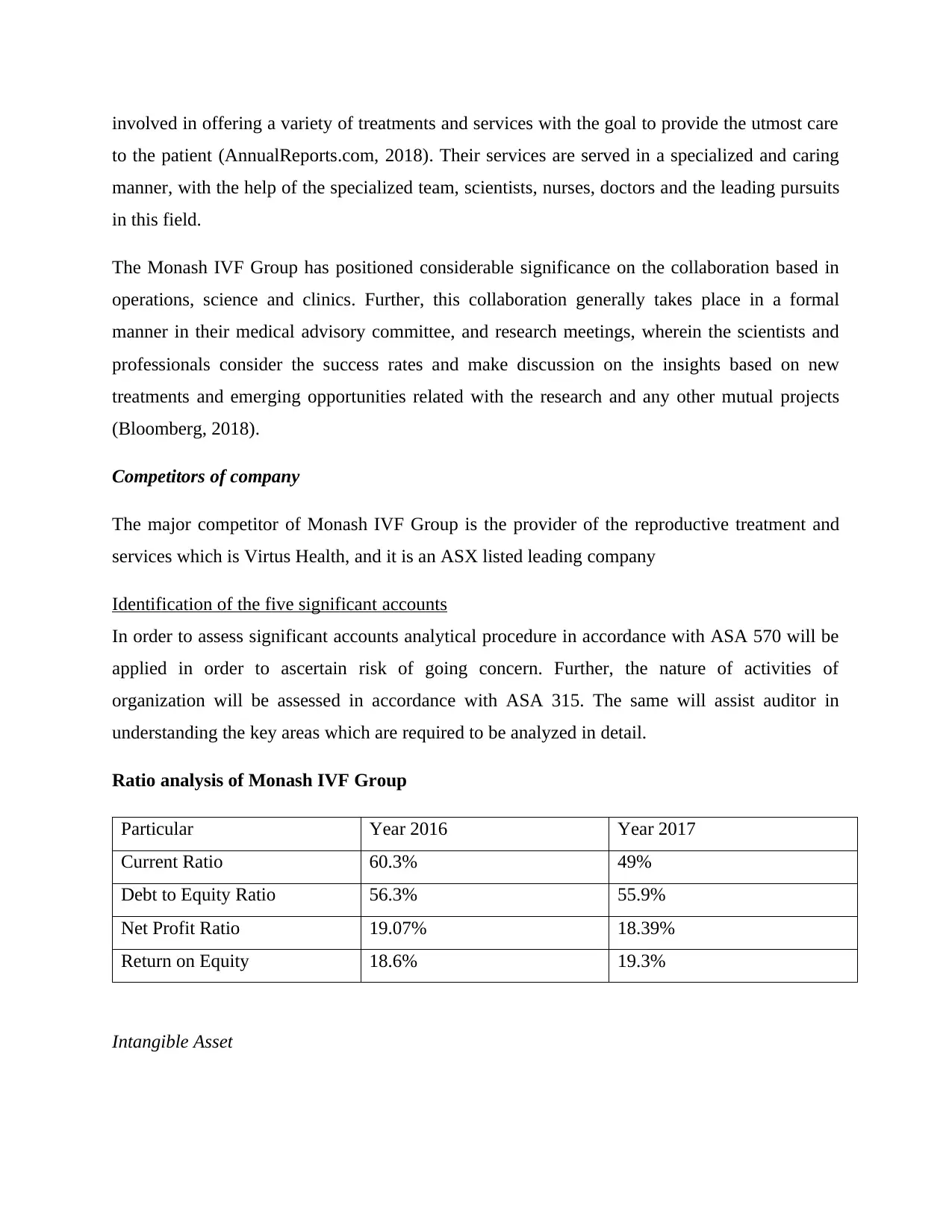
In order to assess significant accounts analytical procedure in accordance with ASA 570 will be
applied in order to ascertain risk of going concern. Further, the nature of activities of
organization will be assessed in accordance with ASA 315. The same will assist auditor in
understanding the key areas which are required to be analyzed in detail.
Ratio analysis of Monash IVF Group
Particular Year 2016 Year 2017
Current Ratio 60.3% 49%
Debt to Equity Ratio 56.3% 55.9%
Net Profit Ratio 19.07% 18.39%
Return on Equity 18.6% 19.3%
Intangible Asset
to the patient (AnnualReports.com, 2018). Their services are served in a specialized and caring
manner, with the help of the specialized team, scientists, nurses, doctors and the leading pursuits
in this field.
The Monash IVF Group has positioned considerable significance on the collaboration based in
operations, science and clinics. Further, this collaboration generally takes place in a formal
manner in their medical advisory committee, and research meetings, wherein the scientists and
professionals consider the success rates and make discussion on the insights based on new
treatments and emerging opportunities related with the research and any other mutual projects
(Bloomberg, 2018).
Competitors of company
The major competitor of Monash IVF Group is the provider of the reproductive treatment and
services which is Virtus Health, and it is an ASX listed leading company
Identification of the five significant accounts
In order to assess significant accounts analytical procedure in accordance with ASA 570 will be
applied in order to ascertain risk of going concern. Further, the nature of activities of
organization will be assessed in accordance with ASA 315. The same will assist auditor in
understanding the key areas which are required to be analyzed in detail.
Ratio analysis of Monash IVF Group
Particular Year 2016 Year 2017
Current Ratio 60.3% 49%
Debt to Equity Ratio 56.3% 55.9%
Net Profit Ratio 19.07% 18.39%
Return on Equity 18.6% 19.3%
Intangible Asset
Intangible asset comprises goodwill, software, trademark and others. In the year 2017, an
addition of $134000 has been done in software through acquisition and $3823000 through
business combinations. The company recognizes impairment loss relating to intangible asset in
case carrying the amount of an asset or CGU is more than its recoverable value. Further, the loss
is reversed only to the extent to which the carrying amount of asset does not exceed net carrying
amount in case no impairment loss has been accounted in books of accounts.
Borrowings
The company follows the policy of recognizing loan and borrowing at fair value of the
consideration which is amount received reduced by transaction cost. Further the same are
amortized by application of effective interest method. Loans and borrowing are considered as
non-current liability only in case same can be deferred for a period of twelve months or more.
Current Borrowings of Monash IVF Group comprises derivates and capitalised finance facility
fees. In order to provide that whether classification of current and non-current liabilities have
been appropriately or not both of these accounts required to be assessed in detail.
Contingent considerations
The financial report of the company has been conducted on the basis of accrual and is totally
related on the historical costs (unless and until it is mentioned specifically) exclusive of the
derivative financial instruments and the assumption of the contingent consideration in the
business combination, that is done on fair value measurement. The fair value gaining or loss held
on the contingent consideration is categorized as a financial liability (Chen and et al., 2015). The
contingent consideration was accounted at 150 in the year 2017, which is lower than the previous
year which was 500 in 2016, indicating that contingent payment is a further consideration
(Griffiths, 2016).
Revenue
Monash IVF Group has performed effectively in revenues in FY17, regardless of this fact there
is a reduction in the revenues in the patient treatment and their related revenues. In addition, the
net profit after tax rises by 2.9% or $0.8m to $29.6million in opposition to the past year.
Furthermore, the revenues of Group were declined by 0.9% at $155.2m for the year-end (Chan
addition of $134000 has been done in software through acquisition and $3823000 through
business combinations. The company recognizes impairment loss relating to intangible asset in
case carrying the amount of an asset or CGU is more than its recoverable value. Further, the loss
is reversed only to the extent to which the carrying amount of asset does not exceed net carrying
amount in case no impairment loss has been accounted in books of accounts.
Borrowings
The company follows the policy of recognizing loan and borrowing at fair value of the
consideration which is amount received reduced by transaction cost. Further the same are
amortized by application of effective interest method. Loans and borrowing are considered as
non-current liability only in case same can be deferred for a period of twelve months or more.
Current Borrowings of Monash IVF Group comprises derivates and capitalised finance facility
fees. In order to provide that whether classification of current and non-current liabilities have
been appropriately or not both of these accounts required to be assessed in detail.
Contingent considerations
The financial report of the company has been conducted on the basis of accrual and is totally
related on the historical costs (unless and until it is mentioned specifically) exclusive of the
derivative financial instruments and the assumption of the contingent consideration in the
business combination, that is done on fair value measurement. The fair value gaining or loss held
on the contingent consideration is categorized as a financial liability (Chen and et al., 2015). The
contingent consideration was accounted at 150 in the year 2017, which is lower than the previous
year which was 500 in 2016, indicating that contingent payment is a further consideration
(Griffiths, 2016).
Revenue
Monash IVF Group has performed effectively in revenues in FY17, regardless of this fact there
is a reduction in the revenues in the patient treatment and their related revenues. In addition, the
net profit after tax rises by 2.9% or $0.8m to $29.6million in opposition to the past year.
Furthermore, the revenues of Group were declined by 0.9% at $155.2m for the year-end (Chan
⊘ This is a preview!⊘
Do you want full access?
Subscribe today to unlock all pages.
Trusted by 1+ million students worldwide
and Vasarhelyi, 2018). The revenues down by $1.4m by 0.9% to $155.2 million in comparison to
FY16 Revenue which is gauged at fair value measurement of the concern received or receivable.
Income tax
The income tax was reported at $20.1m in the financial year 2017; the income tax expense
includes existing as well as deferred tax. The income tax is held in profit or loss, exclusive of an
extent that it is related with the business combination or to the aspects realized in equity in a
direct manner. Although, the Group is subjected to income tax within Australia as well as its
jurisdiction where it is conducting is foreign operations. Judgement is needed while identifying
the global provision meant for income taxes and while considering if or if not deferred tax
balances is realized on the financial position statements. Also, the changes held in the events will
make modification in expectations, which might affect the extent of provision for the
recognizable income taxes and deferred tax balances (Louwers and et al., 2015).
FY16 Revenue which is gauged at fair value measurement of the concern received or receivable.
Income tax
The income tax was reported at $20.1m in the financial year 2017; the income tax expense
includes existing as well as deferred tax. The income tax is held in profit or loss, exclusive of an
extent that it is related with the business combination or to the aspects realized in equity in a
direct manner. Although, the Group is subjected to income tax within Australia as well as its
jurisdiction where it is conducting is foreign operations. Judgement is needed while identifying
the global provision meant for income taxes and while considering if or if not deferred tax
balances is realized on the financial position statements. Also, the changes held in the events will
make modification in expectations, which might affect the extent of provision for the
recognizable income taxes and deferred tax balances (Louwers and et al., 2015).
Paraphrase This Document
Need a fresh take? Get an instant paraphrase of this document with our AI Paraphraser
Planning materiality level
The core concept of materiality
Materiality is known as, in regards to the information, that the information that is misstated, non-
disclosed or omitted to have the chances to adversely impact the decisions regarding the scares
resources allocation by the financial report users or the discharging of the responsibility by the
Group’s managerial authority and the enterprise’s governing and regulatory bodies.
Specification available in auditing standard of Australia as well as International Standards of
Auditing relating to materiality
The materiality is the prime aspect when it comes to financial reporting, instead of auditing
theory. Although it is not mentioned under ISA 320 Materiality in planning and performing an
audit but some core characteristics have been highlighted by the ISA regarding the same which
are; misstatements are stated to be material if they can impact the financial statement users
(Lakis and Masiulevičius, 2017). The judgement regarding the materiality is based on the
environmental events, inclusive of the nature and extent of the misstatements. It has also been
stated that the judgement is conducted on the basis of the common requirements of the users as a
group. By considering this aspect, compulsory requirements have been established by the
Auditing Standard ASA 320 Materiality and Audit Adjustments to offer descriptive guidance on
the materiality and related relationship on the audit risk. By considering and planning for the
materiality level of the Monash IVF Group, the auditor might assess the materiality and related
relationship on the audit risk in full.
Materiality as mentioned under Accounting Standard AASB 1031 Materiality, possess a
significant role in making decisions which the preparation and representation of financial reports
are done by the business entities. This auditing standard states the materiality role in terms of
audit planning and in the evaluation of the audit evidence (Baldauf, Steller and Steckel, 2015).
The materiality decision of the auditor is considered as a multi-factor engaging quantitative as
well as qualitative terms.
By considering the financial reports of the Group and its performance, it can be cited that the
most appropriate method to assess the risk of material misstatement for the auditor is to evaluate
The core concept of materiality
Materiality is known as, in regards to the information, that the information that is misstated, non-
disclosed or omitted to have the chances to adversely impact the decisions regarding the scares
resources allocation by the financial report users or the discharging of the responsibility by the
Group’s managerial authority and the enterprise’s governing and regulatory bodies.
Specification available in auditing standard of Australia as well as International Standards of
Auditing relating to materiality
The materiality is the prime aspect when it comes to financial reporting, instead of auditing
theory. Although it is not mentioned under ISA 320 Materiality in planning and performing an
audit but some core characteristics have been highlighted by the ISA regarding the same which
are; misstatements are stated to be material if they can impact the financial statement users
(Lakis and Masiulevičius, 2017). The judgement regarding the materiality is based on the
environmental events, inclusive of the nature and extent of the misstatements. It has also been
stated that the judgement is conducted on the basis of the common requirements of the users as a
group. By considering this aspect, compulsory requirements have been established by the
Auditing Standard ASA 320 Materiality and Audit Adjustments to offer descriptive guidance on
the materiality and related relationship on the audit risk. By considering and planning for the
materiality level of the Monash IVF Group, the auditor might assess the materiality and related
relationship on the audit risk in full.
Materiality as mentioned under Accounting Standard AASB 1031 Materiality, possess a
significant role in making decisions which the preparation and representation of financial reports
are done by the business entities. This auditing standard states the materiality role in terms of
audit planning and in the evaluation of the audit evidence (Baldauf, Steller and Steckel, 2015).
The materiality decision of the auditor is considered as a multi-factor engaging quantitative as
well as qualitative terms.
By considering the financial reports of the Group and its performance, it can be cited that the
most appropriate method to assess the risk of material misstatement for the auditor is to evaluate
the historical financial statements and the perspective and judgements of the auditor. Thus, the
assessment of the historic statements might permit the auditor to make a perfect judgment by
which the financial statements can do material misstatements while assisting the auditor in
setting a threshold for examining the potential misstatements (Graham, Bedard and Dutta, 2018).
Hence, the threshold can be implemented by the auditors of the Group in determining the risk
acceptance level or less materiality threshold held for auditors.
Calculation of Materiality limit
The calculation of the Group’s materiality amounts will be derived by making use of the
quantitative approaches that might be increased or reduced on the basis of the professional
judgement of the auditor regarding the potential impacts of the qualitative factors, for example,
risk of gaining manipulations, potential impacts of the misstatements of the patterns, limited debt
covenants, expanding impact of misstatement for the manipulation of share prices, possible
effects of the misstatements held in the segments based information, fraud detection or signs in
historic period, misstatements regarding achievement of project earnings, validity and reliability
of accounting systems(Eilifsen and Messier Jr, 2014). In the present case of Monash IVF Group
Ltd. revenue method has been applied in order to compute the level of materiality. Thus the
materiality level is .5% of total revenue.
Total revenue for the year 2017 is $155182000
Material level =$155182000*.2%
= $310364
Thus, the transaction which is individually or accumulated above the specified materiality limit
is required to be analyzed in detail in order to provide an opinion relating to the existence of a
risk of material misstatement in books of Monash IVF Group Ltd.
Identification of the audit risk assessment of the selected 5 significant accounts
Intangible Asset
Reason due to which specified account require detail assessment
assessment of the historic statements might permit the auditor to make a perfect judgment by
which the financial statements can do material misstatements while assisting the auditor in
setting a threshold for examining the potential misstatements (Graham, Bedard and Dutta, 2018).
Hence, the threshold can be implemented by the auditors of the Group in determining the risk
acceptance level or less materiality threshold held for auditors.
Calculation of Materiality limit
The calculation of the Group’s materiality amounts will be derived by making use of the
quantitative approaches that might be increased or reduced on the basis of the professional
judgement of the auditor regarding the potential impacts of the qualitative factors, for example,
risk of gaining manipulations, potential impacts of the misstatements of the patterns, limited debt
covenants, expanding impact of misstatement for the manipulation of share prices, possible
effects of the misstatements held in the segments based information, fraud detection or signs in
historic period, misstatements regarding achievement of project earnings, validity and reliability
of accounting systems(Eilifsen and Messier Jr, 2014). In the present case of Monash IVF Group
Ltd. revenue method has been applied in order to compute the level of materiality. Thus the
materiality level is .5% of total revenue.
Total revenue for the year 2017 is $155182000
Material level =$155182000*.2%
= $310364
Thus, the transaction which is individually or accumulated above the specified materiality limit
is required to be analyzed in detail in order to provide an opinion relating to the existence of a
risk of material misstatement in books of Monash IVF Group Ltd.
Identification of the audit risk assessment of the selected 5 significant accounts
Intangible Asset
Reason due to which specified account require detail assessment
⊘ This is a preview!⊘
Do you want full access?
Subscribe today to unlock all pages.
Trusted by 1+ million students worldwide
The intangible asset of Monash IVF Group Ltd comprises a significant part of the total asset, i.e.
$254688000 approximately 90% of the total asset. Thus, it is covered under to material level
applied in order to assess the risk of materiality. An intangible asset is believed as a crucial part
of a financial asset as the same required to be assessed with more concern and effectiveness in
comparison to other accounts. Moreover, as in the present case, it covers a major portion of the
total asset. Thus a detailed analysis is mandatorily required to assert opinion of the risk of
material misstatement.
Significant Assertion
The key assertion required in the present case is relating to valuation and amortization policies
followed by the company. As amortization of same is a tax-deductible expenditure thus, it is
necessary to assess that whether a specific provision of AASB 138 Intangible asset has been
followed or not.
Steps to be followed for Auditing
Initially, a schedule of al intangible asset should be developed and compared with
previous year balance in order to ascertain the changes.
Accounting entries relating to amortization should be analysed in detail in order to assess
whether amortization has been done in accordance with provision specified in AASB 138
‘Intangibles Asset’ or not.
The analytical procedure should be carried down in order to ascertain whether an
intangible asset is valued at fair market value or not.
Borrowing
Reason due to which specified account require detail assessment
A significant change in current borrowing of Monash IVF group Ltd have been assessed as same
were having a positive balance of $453000 at the end of year 2016 and same have been turned to
$-116000 at the end of year 2017. The reason behind same is that derivates which were available
previous year are now no available. The derivative financial instruments which have been held
by the group are hedged with floating interest exposure rate. Company follows the procedure to
recognize them at fair value along with considering transaction cost which is recognized in profit
$254688000 approximately 90% of the total asset. Thus, it is covered under to material level
applied in order to assess the risk of materiality. An intangible asset is believed as a crucial part
of a financial asset as the same required to be assessed with more concern and effectiveness in
comparison to other accounts. Moreover, as in the present case, it covers a major portion of the
total asset. Thus a detailed analysis is mandatorily required to assert opinion of the risk of
material misstatement.
Significant Assertion
The key assertion required in the present case is relating to valuation and amortization policies
followed by the company. As amortization of same is a tax-deductible expenditure thus, it is
necessary to assess that whether a specific provision of AASB 138 Intangible asset has been
followed or not.
Steps to be followed for Auditing
Initially, a schedule of al intangible asset should be developed and compared with
previous year balance in order to ascertain the changes.
Accounting entries relating to amortization should be analysed in detail in order to assess
whether amortization has been done in accordance with provision specified in AASB 138
‘Intangibles Asset’ or not.
The analytical procedure should be carried down in order to ascertain whether an
intangible asset is valued at fair market value or not.
Borrowing
Reason due to which specified account require detail assessment
A significant change in current borrowing of Monash IVF group Ltd have been assessed as same
were having a positive balance of $453000 at the end of year 2016 and same have been turned to
$-116000 at the end of year 2017. The reason behind same is that derivates which were available
previous year are now no available. The derivative financial instruments which have been held
by the group are hedged with floating interest exposure rate. Company follows the procedure to
recognize them at fair value along with considering transaction cost which is recognized in profit
Paraphrase This Document
Need a fresh take? Get an instant paraphrase of this document with our AI Paraphraser
and loss while it has been incurred. Thus, all these transaction require detail analysis to provide
specific appropriate opinion. Hence same has been considered significant account.
Significant Assertion
Appropriate recognition and valuation are the two key assertions required to be ascertained.
Procedure of Auditing
The audit procedure should be initiated by assessing the method of valuation of
derivatives
Moreover, emphasis should be made on reasonableness on management evaluation of the
fair value of other assets, liabilities along with borrowings.
The efficient substantive procedure should be applied to assess the availability of material
risk.
Finally, compliance provision of ASA 520 ‘Analytical procedures’ should be applied in
order to assess the viability of accounting treatment applied for recognition of
borrowings.
Contingent considerations
Reason due to which specified account require detail assessment
A significant decrease in account balance of contingent consideration has been assessed, i.e.
from $500000 to $150000 (Annual report of Monash IVF Group, 2017). Thus, the reason behind
is required to be assessed in detail. It might be possible that a part of revenue might be
recognized as contingent consideration and same will eventually lead to a present unfair position
of books of accounts.
Significant Assertion
The key assertion to be assessed that whether same has been valuing on fair value method or not.
Further, the validity of transaction affected by this account required to be asserted.
Procedure of Auditing
specific appropriate opinion. Hence same has been considered significant account.
Significant Assertion
Appropriate recognition and valuation are the two key assertions required to be ascertained.
Procedure of Auditing
The audit procedure should be initiated by assessing the method of valuation of
derivatives
Moreover, emphasis should be made on reasonableness on management evaluation of the
fair value of other assets, liabilities along with borrowings.
The efficient substantive procedure should be applied to assess the availability of material
risk.
Finally, compliance provision of ASA 520 ‘Analytical procedures’ should be applied in
order to assess the viability of accounting treatment applied for recognition of
borrowings.
Contingent considerations
Reason due to which specified account require detail assessment
A significant decrease in account balance of contingent consideration has been assessed, i.e.
from $500000 to $150000 (Annual report of Monash IVF Group, 2017). Thus, the reason behind
is required to be assessed in detail. It might be possible that a part of revenue might be
recognized as contingent consideration and same will eventually lead to a present unfair position
of books of accounts.
Significant Assertion
The key assertion to be assessed that whether same has been valuing on fair value method or not.
Further, the validity of transaction affected by this account required to be asserted.
Procedure of Auditing
Checking compliance with para 24 and 25 of FASB statement no. 141 which specifies
that contingency consideration should be accounted when contingency issue becomes
issuable.
Further compliance with the provision of AASB 137 ‘Provision for contingent liabilities’
is required to be assessed to verify the appropriateness of its recognition.
The policy followed by the company to evaluate contingent consideration is required to
be assessed in order to ascertain whether transaction have been valued in accordance with
fair valuation method or not.
Revenue
Reason due to which specified account require detail assessment
A decrease of 0.9% in revenue of Monash Group IVF Ltd., i.e. from $156.6 million to $155.2
can be assessed in comparison to the revenue of the previous year 2016. However, the change in
net profit after tax is 2.9% as it has enhanced from $28.8 million to $29.6 million (Annual report
of Monash IVF Group, 2017). The contradiction requires to be assessed in detail because in
general circumstances profit and revenue have a positive relation. Thus, the unusual scenario is
the reason that account might consist of risk of materiality. Moreover, income is having a
significant impact on other vital accounts such as income tax, Net profit etc. Thus it requires to
be assessed in detail.
Significant Assertion
The two assertions which required to be assessed are occurrence and accuracy.
Procedure of Auditing
General ledgers are assessed in detail in order to assess the manner of accounting.
Sample method can be applied to review specific details relating to revenue such as date
of delivery, date of payment and other information relating to the transaction.
The trend of sales of present year can be compared with previous year trend to ascertain
any significant variance exists (Chan and Vasarhelyi, 2018).
It is necessary to be assured that information of general ledger should be in accordance
with the figure of actual sales.
that contingency consideration should be accounted when contingency issue becomes
issuable.
Further compliance with the provision of AASB 137 ‘Provision for contingent liabilities’
is required to be assessed to verify the appropriateness of its recognition.
The policy followed by the company to evaluate contingent consideration is required to
be assessed in order to ascertain whether transaction have been valued in accordance with
fair valuation method or not.
Revenue
Reason due to which specified account require detail assessment
A decrease of 0.9% in revenue of Monash Group IVF Ltd., i.e. from $156.6 million to $155.2
can be assessed in comparison to the revenue of the previous year 2016. However, the change in
net profit after tax is 2.9% as it has enhanced from $28.8 million to $29.6 million (Annual report
of Monash IVF Group, 2017). The contradiction requires to be assessed in detail because in
general circumstances profit and revenue have a positive relation. Thus, the unusual scenario is
the reason that account might consist of risk of materiality. Moreover, income is having a
significant impact on other vital accounts such as income tax, Net profit etc. Thus it requires to
be assessed in detail.
Significant Assertion
The two assertions which required to be assessed are occurrence and accuracy.
Procedure of Auditing
General ledgers are assessed in detail in order to assess the manner of accounting.
Sample method can be applied to review specific details relating to revenue such as date
of delivery, date of payment and other information relating to the transaction.
The trend of sales of present year can be compared with previous year trend to ascertain
any significant variance exists (Chan and Vasarhelyi, 2018).
It is necessary to be assured that information of general ledger should be in accordance
with the figure of actual sales.
⊘ This is a preview!⊘
Do you want full access?
Subscribe today to unlock all pages.
Trusted by 1+ million students worldwide

1 out of 19


Related Documents


Your All-in-One AI-Powered Toolkit for Academic Success.
+13062052269
info@desklib.com
Available 24*7 on WhatsApp / Email
![[object Object]](/_next/static/media/star-bottom.7253800d.svg)
Unlock your academic potential
Copyright © 2020–2026 A2Z Services. All Rights Reserved. Developed and managed by ZUCOL.