HI6026 - DIPL Audit Case Study: Materiality Factors & Expert Use
VerifiedAdded on 2023/06/15
|11
|2997
|136
Case Study
AI Summary
This case study provides an in-depth analysis of the Double Ink Printers Ltd (DIPL) audit, examining the factors influencing the preliminary materiality figure and the need for expert auditor services. It discusses the importance of expert auditors in providing assurance regarding financial performance and position, referencing Auditing Standard 620. The analysis covers factors affecting overall materiality, including the relative nature of materiality, qualitative factors, expected financial statement distribution, and acceptable audit risk. It also identifies specific factors in the DIPL case, such as changes in accounting policies, implementation of a new IT system, management changes, internal auditing implementation, and fluctuations in account balances. The study highlights the relevance of these factors in determining the nature, timing, and extent of audit procedures, emphasizing the interplay between quantitative and qualitative aspects of materiality and their impact on audit risk and the reliability of financial statements.
AUDITING AND
ASSURANCE
ASSURANCE

Paraphrase This Document
Need a fresh take? Get an instant paraphrase of this document with our AI Paraphraser
Auditing and Assurance 1
Table of Contents
Introduction......................................................................................................................................2
Need for the Services of an Expert Auditor.....................................................................................2
Five Factors Influencing Overall Materiality of DIPL....................................................................4
Relevancy of the Factors.................................................................................................................5
Material Factors...........................................................................................................................5
Quantitative factors......................................................................................................................5
Qualitative Factors.......................................................................................................................7
Factors influencing Preliminary Figure...........................................................................................7
References........................................................................................................................................9
Table of Contents
Introduction......................................................................................................................................2
Need for the Services of an Expert Auditor.....................................................................................2
Five Factors Influencing Overall Materiality of DIPL....................................................................4
Relevancy of the Factors.................................................................................................................5
Material Factors...........................................................................................................................5
Quantitative factors......................................................................................................................5
Qualitative Factors.......................................................................................................................7
Factors influencing Preliminary Figure...........................................................................................7
References........................................................................................................................................9
Auditing and Assurance 2
Introduction
This report contains the analysis of the case study given for DIPL where the services of an expert
is used by the company to collect evidences for material misstatements which was founded in
financial reports. It is important for a company to prevent material misstatements in the financial
records and statements. For this purpose company conduct internal and external audit depending
on the demand needed for the type of auditing required. The questions been asked in the case
study in relation to the factors which influence the preliminary figure determined for materiality
in the audit of DIPL. The factors which are being identified are explained well to showcase the
relevancy in calculating the materiality in the audit planning process.
Need for the Services of an Expert Auditor
On the basis of the case study given for the company DIPL, it is necessary to conduct audit from
an expert for the sole purpose that it provides assurance to the management that presents a true
and fair picture of the financial performance and position. There is an auditing standard 620
which explains the guidance to use the work of an expert in audit as evidence (Auasb.gov.au,
2009). An expert here means a person or a firm who possess some special skills and expertise in
their particular field (Accaglobal.com, 2011).
As per the case of DIPL, where few issues were arising in the accounting department and auditor
fails to maintain the financial ratios under the provided benchmarks. The new CEO William
Jackson pounded a recommendation to introduce a new internal control system in the department
to resolve the issues arising in the financial statement and also decides to invest in IT system
which will automate the whole process of finance and accounting and integrate the current
accounting process within the organization. But the IT manager had issues in implementing the
IT system installation and the way it was handled. It was found out that there was not enough
staff available to do the required reconciliation and testing. The testing which was conducted
before implementing IT system into the accounting process various errors are found out in the
transactions and its value allocation. Though there were staff appointed at each stage in the
department but it happens to be showing non reliable results. Due to such weak system of
finance and accounting department the need for the use of expert in audit is highly required
where the expert will collect audit evidences of the company as per the new internal control
system introduced it will be helpful for expert. The auditor must have to rely on the audit
Introduction
This report contains the analysis of the case study given for DIPL where the services of an expert
is used by the company to collect evidences for material misstatements which was founded in
financial reports. It is important for a company to prevent material misstatements in the financial
records and statements. For this purpose company conduct internal and external audit depending
on the demand needed for the type of auditing required. The questions been asked in the case
study in relation to the factors which influence the preliminary figure determined for materiality
in the audit of DIPL. The factors which are being identified are explained well to showcase the
relevancy in calculating the materiality in the audit planning process.
Need for the Services of an Expert Auditor
On the basis of the case study given for the company DIPL, it is necessary to conduct audit from
an expert for the sole purpose that it provides assurance to the management that presents a true
and fair picture of the financial performance and position. There is an auditing standard 620
which explains the guidance to use the work of an expert in audit as evidence (Auasb.gov.au,
2009). An expert here means a person or a firm who possess some special skills and expertise in
their particular field (Accaglobal.com, 2011).
As per the case of DIPL, where few issues were arising in the accounting department and auditor
fails to maintain the financial ratios under the provided benchmarks. The new CEO William
Jackson pounded a recommendation to introduce a new internal control system in the department
to resolve the issues arising in the financial statement and also decides to invest in IT system
which will automate the whole process of finance and accounting and integrate the current
accounting process within the organization. But the IT manager had issues in implementing the
IT system installation and the way it was handled. It was found out that there was not enough
staff available to do the required reconciliation and testing. The testing which was conducted
before implementing IT system into the accounting process various errors are found out in the
transactions and its value allocation. Though there were staff appointed at each stage in the
department but it happens to be showing non reliable results. Due to such weak system of
finance and accounting department the need for the use of expert in audit is highly required
where the expert will collect audit evidences of the company as per the new internal control
system introduced it will be helpful for expert. The auditor must have to rely on the audit
⊘ This is a preview!⊘
Do you want full access?
Subscribe today to unlock all pages.

Trusted by 1+ million students worldwide
Auditing and Assurance 3
evidences given by expert. To be ensured about the qualification and expertise that an expert
must consist and align the whole procedure with the new IT system introduced in the company
and a complete study should be conducted about the assurance of expert’s qualifications (Boritz,
Robinson, Wong, and Kochetova-Kozloski, 2014).
In the given case study, auditor will determine the need first to use the work of an expert while
considering:
The company’s team knowledge and the past experiences of the matter of the company
here is being considered.
The risk involve of material misstatement in the financial report of DIPL is considered
where complexity, nature and materiality will be taken.
Obtaining the quality and quantity of audit evidence which has been expected are done.
There is a need to obtain the understanding of DIPL and perform the procedure further in
assessment of risk, the auditor requires in combined with company and individually the audit
evidences that consists of reports, valuations, opinions and statements of an expert. For example
the evidences must include the following:
- The valuations required of various type of assets of the company including ink, printers,
property, plant and equipment;
- The condition of assets physically or quantities available and the useful life of fixed
assets which is remaining;
- The type of valuation that has been followed to determine amounts and what techniques
or methods have been used while valuation for example DIPL is following actuarial
valuation;
- Work is measured to see if completed or in progress and take advice accordingly;
(Messier, and Schmidt, 2017.).
- The opinions in concern with interpretations of agreements, statutes and regulation been
followed by the company (Ifac.org, 2017).
While planning to use the work of expert in audit of the DIPL, it is the responsibility of
auditor to look out for the competence of the expert in profession. The auditor of the
company must consider that an expert carries a professional certification, licensed or acquire
evidences given by expert. To be ensured about the qualification and expertise that an expert
must consist and align the whole procedure with the new IT system introduced in the company
and a complete study should be conducted about the assurance of expert’s qualifications (Boritz,
Robinson, Wong, and Kochetova-Kozloski, 2014).
In the given case study, auditor will determine the need first to use the work of an expert while
considering:
The company’s team knowledge and the past experiences of the matter of the company
here is being considered.
The risk involve of material misstatement in the financial report of DIPL is considered
where complexity, nature and materiality will be taken.
Obtaining the quality and quantity of audit evidence which has been expected are done.
There is a need to obtain the understanding of DIPL and perform the procedure further in
assessment of risk, the auditor requires in combined with company and individually the audit
evidences that consists of reports, valuations, opinions and statements of an expert. For example
the evidences must include the following:
- The valuations required of various type of assets of the company including ink, printers,
property, plant and equipment;
- The condition of assets physically or quantities available and the useful life of fixed
assets which is remaining;
- The type of valuation that has been followed to determine amounts and what techniques
or methods have been used while valuation for example DIPL is following actuarial
valuation;
- Work is measured to see if completed or in progress and take advice accordingly;
(Messier, and Schmidt, 2017.).
- The opinions in concern with interpretations of agreements, statutes and regulation been
followed by the company (Ifac.org, 2017).
While planning to use the work of expert in audit of the DIPL, it is the responsibility of
auditor to look out for the competence of the expert in profession. The auditor of the
company must consider that an expert carries a professional certification, licensed or acquire
Paraphrase This Document
Need a fresh take? Get an instant paraphrase of this document with our AI Paraphraser
Auditing and Assurance 4
a membership in a professional body. The experience and reputation an expert is having in
the field where the auditor requires audit evidence. Also the objectivity of the expert is being
evaluated that an expert must not be related to entity by way of employment or dependent
financially, having an investment in the same company. After the evaluation done the auditor
will discuss with management whatever is required and then it is decided to use the work of
an expert.
Five Factors Influencing Overall Materiality of DIPL
The preliminary figure for overall materiality are the maximum amount from which financial
statements could be misstated. There are factors which will affect the preliminary figure about
the overall materiality of DIPL:
One of the main factor is the materiality is more of relative rather than an absolute
concept because to check if the misstatement found out are material or not there should
have been a base for the same. The base can be used by auditor namely net income before
taxes, current assets, and working capital and total assets.
Another factor that might influence preliminary judgment for overall materiality is the
bases, which is explained above and are needed to support the relative concept of
materiality.
There are few qualitative factors that affect materiality decisions in various manner. As
few types of misstatement are significant for users than others.
Preliminary judgment is affected by the expected distribution of the financial statements.
The preliminary figure is set low in case the financial statements are not widely
distributed as expected.
The preliminary judgment of materiality is affected by the level of acceptable audit risk
(Lakis, and Masiulevičius, 2017).
The factors that are affecting the preliminary figure of overall materiality in the audit of
DIPL are given hereunder:
Changes in the accounting policies and estimates
The new IT system has been implemented in the company
Top management changes
a membership in a professional body. The experience and reputation an expert is having in
the field where the auditor requires audit evidence. Also the objectivity of the expert is being
evaluated that an expert must not be related to entity by way of employment or dependent
financially, having an investment in the same company. After the evaluation done the auditor
will discuss with management whatever is required and then it is decided to use the work of
an expert.
Five Factors Influencing Overall Materiality of DIPL
The preliminary figure for overall materiality are the maximum amount from which financial
statements could be misstated. There are factors which will affect the preliminary figure about
the overall materiality of DIPL:
One of the main factor is the materiality is more of relative rather than an absolute
concept because to check if the misstatement found out are material or not there should
have been a base for the same. The base can be used by auditor namely net income before
taxes, current assets, and working capital and total assets.
Another factor that might influence preliminary judgment for overall materiality is the
bases, which is explained above and are needed to support the relative concept of
materiality.
There are few qualitative factors that affect materiality decisions in various manner. As
few types of misstatement are significant for users than others.
Preliminary judgment is affected by the expected distribution of the financial statements.
The preliminary figure is set low in case the financial statements are not widely
distributed as expected.
The preliminary judgment of materiality is affected by the level of acceptable audit risk
(Lakis, and Masiulevičius, 2017).
The factors that are affecting the preliminary figure of overall materiality in the audit of
DIPL are given hereunder:
Changes in the accounting policies and estimates
The new IT system has been implemented in the company
Top management changes
Auditing and Assurance 5
Internal auditing implementation in company.
The fluctuations in over past three years of account receivables, inventory and cash
balance are severe.
Relevancy of the Factors
The key purpose of preliminary materiality judgment is to determine the nature, timing and
extent of procedures of audit and guide the auditor. The judgment will include the materiality of
management’s financial statement where amounts may be higher or lower according to the risk
and needs of the audit process. The factors mentioned above for determining the preliminary
judgment which influence overall materiality have relevancy in calculating the preliminary
figures that are explained below:
Material Factors
Materiality is not an absolute concept but more of a relative concept. It basically means material
for one company may not be material for another company. The amount of information that is
omitted, undisclosed or misstated affects economic decisions taken by users of financial
statements or the management who discharge their accountability (Edgley, Jones, and Atkins,
2015). While evaluating materiality of the company the base is needed and the primary base for
the same would be net income before taxes and bases will come under quantitative factors. While
determining overall materiality there are some questions that need to be answered for example
the major users of financial report, the use of information to make economic decisions and
discharge their responsibilities on it. The factor of materiality is relevant for calculating
preliminary figure for overall materiality as the relationship between materiality and the level of
audit risk contrary (Asare, Majoor, and Wright, 2017). If materiality decreases then audit risk
will increase and vice versa, for example if there is a decrease found out in materiality amount
from $100,000 to $10,000 and same audit evidence has been collected then audit risk will
increase. Low level of misstatements are difficult to detect so it is hard enough to rely on
evidences. An auditor must collect additional audit evidence if the level of audit risk and
materiality levels are same. The materiality factors contains both the quantitative and qualitative
aspects with it (Hux, 2017).
Internal auditing implementation in company.
The fluctuations in over past three years of account receivables, inventory and cash
balance are severe.
Relevancy of the Factors
The key purpose of preliminary materiality judgment is to determine the nature, timing and
extent of procedures of audit and guide the auditor. The judgment will include the materiality of
management’s financial statement where amounts may be higher or lower according to the risk
and needs of the audit process. The factors mentioned above for determining the preliminary
judgment which influence overall materiality have relevancy in calculating the preliminary
figures that are explained below:
Material Factors
Materiality is not an absolute concept but more of a relative concept. It basically means material
for one company may not be material for another company. The amount of information that is
omitted, undisclosed or misstated affects economic decisions taken by users of financial
statements or the management who discharge their accountability (Edgley, Jones, and Atkins,
2015). While evaluating materiality of the company the base is needed and the primary base for
the same would be net income before taxes and bases will come under quantitative factors. While
determining overall materiality there are some questions that need to be answered for example
the major users of financial report, the use of information to make economic decisions and
discharge their responsibilities on it. The factor of materiality is relevant for calculating
preliminary figure for overall materiality as the relationship between materiality and the level of
audit risk contrary (Asare, Majoor, and Wright, 2017). If materiality decreases then audit risk
will increase and vice versa, for example if there is a decrease found out in materiality amount
from $100,000 to $10,000 and same audit evidence has been collected then audit risk will
increase. Low level of misstatements are difficult to detect so it is hard enough to rely on
evidences. An auditor must collect additional audit evidence if the level of audit risk and
materiality levels are same. The materiality factors contains both the quantitative and qualitative
aspects with it (Hux, 2017).
⊘ This is a preview!⊘
Do you want full access?
Subscribe today to unlock all pages.
Trusted by 1+ million students worldwide
Auditing and Assurance 6
Quantitative factors
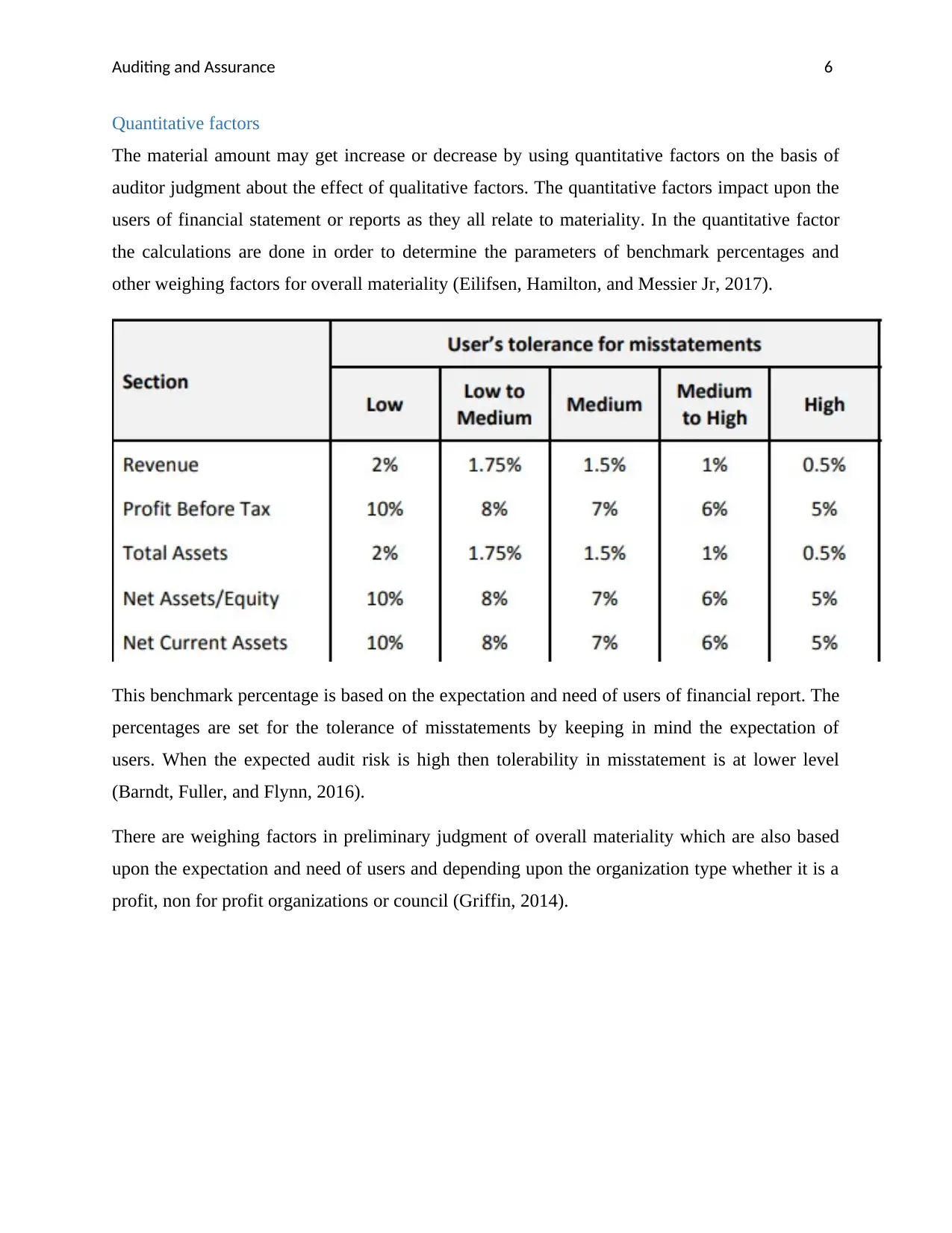
The material amount may get increase or decrease by using quantitative factors on the basis of
auditor judgment about the effect of qualitative factors. The quantitative factors impact upon the
users of financial statement or reports as they all relate to materiality. In the quantitative factor
the calculations are done in order to determine the parameters of benchmark percentages and
other weighing factors for overall materiality (Eilifsen, Hamilton, and Messier Jr, 2017).
This benchmark percentage is based on the expectation and need of users of financial report. The
percentages are set for the tolerance of misstatements by keeping in mind the expectation of
users. When the expected audit risk is high then tolerability in misstatement is at lower level
(Barndt, Fuller, and Flynn, 2016).
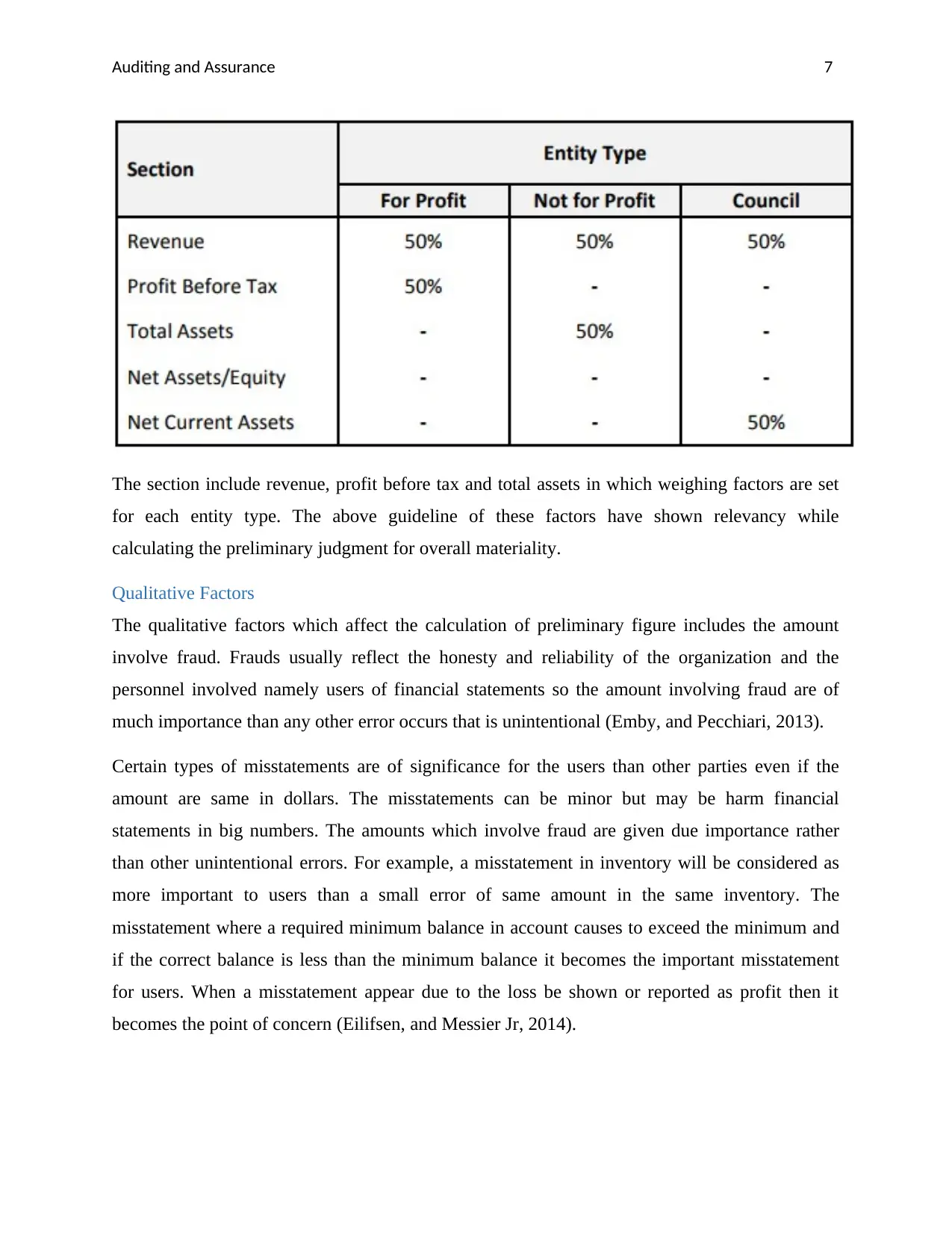
There are weighing factors in preliminary judgment of overall materiality which are also based
upon the expectation and need of users and depending upon the organization type whether it is a
profit, non for profit organizations or council (Griffin, 2014).
Quantitative factors
The material amount may get increase or decrease by using quantitative factors on the basis of
auditor judgment about the effect of qualitative factors. The quantitative factors impact upon the
users of financial statement or reports as they all relate to materiality. In the quantitative factor
the calculations are done in order to determine the parameters of benchmark percentages and
other weighing factors for overall materiality (Eilifsen, Hamilton, and Messier Jr, 2017).
This benchmark percentage is based on the expectation and need of users of financial report. The
percentages are set for the tolerance of misstatements by keeping in mind the expectation of
users. When the expected audit risk is high then tolerability in misstatement is at lower level
(Barndt, Fuller, and Flynn, 2016).
There are weighing factors in preliminary judgment of overall materiality which are also based
upon the expectation and need of users and depending upon the organization type whether it is a
profit, non for profit organizations or council (Griffin, 2014).
Paraphrase This Document
Need a fresh take? Get an instant paraphrase of this document with our AI Paraphraser
Auditing and Assurance 7
The section include revenue, profit before tax and total assets in which weighing factors are set
for each entity type. The above guideline of these factors have shown relevancy while
calculating the preliminary judgment for overall materiality.
Qualitative Factors
The qualitative factors which affect the calculation of preliminary figure includes the amount
involve fraud. Frauds usually reflect the honesty and reliability of the organization and the
personnel involved namely users of financial statements so the amount involving fraud are of
much importance than any other error occurs that is unintentional (Emby, and Pecchiari, 2013).
Certain types of misstatements are of significance for the users than other parties even if the
amount are same in dollars. The misstatements can be minor but may be harm financial
statements in big numbers. The amounts which involve fraud are given due importance rather
than other unintentional errors. For example, a misstatement in inventory will be considered as
more important to users than a small error of same amount in the same inventory. The
misstatement where a required minimum balance in account causes to exceed the minimum and
if the correct balance is less than the minimum balance it becomes the important misstatement
for users. When a misstatement appear due to the loss be shown or reported as profit then it
becomes the point of concern (Eilifsen, and Messier Jr, 2014).
The section include revenue, profit before tax and total assets in which weighing factors are set
for each entity type. The above guideline of these factors have shown relevancy while
calculating the preliminary judgment for overall materiality.
Qualitative Factors
The qualitative factors which affect the calculation of preliminary figure includes the amount
involve fraud. Frauds usually reflect the honesty and reliability of the organization and the
personnel involved namely users of financial statements so the amount involving fraud are of
much importance than any other error occurs that is unintentional (Emby, and Pecchiari, 2013).
Certain types of misstatements are of significance for the users than other parties even if the
amount are same in dollars. The misstatements can be minor but may be harm financial
statements in big numbers. The amounts which involve fraud are given due importance rather
than other unintentional errors. For example, a misstatement in inventory will be considered as
more important to users than a small error of same amount in the same inventory. The
misstatement where a required minimum balance in account causes to exceed the minimum and
if the correct balance is less than the minimum balance it becomes the important misstatement
for users. When a misstatement appear due to the loss be shown or reported as profit then it
becomes the point of concern (Eilifsen, and Messier Jr, 2014).
Auditing and Assurance 8
Factors influencing Preliminary Figure
The five factors that are being identified in the case study of DIPL which would affect the
preliminary figure of overall materiality in audit planning process of the company. The first
factor which is change in accounting policies and estimates where the change in the valuation of
inventory, provision for inventory obsolesces and the life of printing machine. It creates the
situation where auditor needs to check in detail, the areas where changes has taken place and the
materiality level will be set by auditor at low level so as to make the checking extended.
Therefore, the depreciation on machinery, closing inventory and provision for obsolescence will
cause the auditor to set their preliminary figure of overall materiality at low (Saha, and Roy,
2017).
The second factor is the new IT system implementation and it causes the audit risk to go high so
that the amount of materiality will be set at low level. The auditor is required to check all the
classes of accounting transactions in order to ensure that risk of material misstatement is
reduced. Another factor where the change in top management happened and it made the auditor
to materiality level at low stage. When auditor believes the management honesty then the
assessment of risk is low therefore, materiality level is also set at low level and the extent of
checking can be increased (Ruhnke, Pronobis, and Michel, 2014). The implementation of
internal audit reduces the risk of material misstatement which further reduces audit risk. It cause
the auditor to reduce the level of materiality because an auditor can rely upon internal audit and
allowed to reduce the extent of checking on his/her side.
The fluctuations in the amount of account receivables, inventory and cash balance will be taken
into account by auditor while determining materiality amount. These severe fluctuations depicts
manipulations and the risk of material misstatement. It made auditor to check in more detail with
a purpose to collect evidences therefore, materiality level would be set low.
Factors influencing Preliminary Figure
The five factors that are being identified in the case study of DIPL which would affect the
preliminary figure of overall materiality in audit planning process of the company. The first
factor which is change in accounting policies and estimates where the change in the valuation of
inventory, provision for inventory obsolesces and the life of printing machine. It creates the
situation where auditor needs to check in detail, the areas where changes has taken place and the
materiality level will be set by auditor at low level so as to make the checking extended.
Therefore, the depreciation on machinery, closing inventory and provision for obsolescence will
cause the auditor to set their preliminary figure of overall materiality at low (Saha, and Roy,
2017).
The second factor is the new IT system implementation and it causes the audit risk to go high so
that the amount of materiality will be set at low level. The auditor is required to check all the
classes of accounting transactions in order to ensure that risk of material misstatement is
reduced. Another factor where the change in top management happened and it made the auditor
to materiality level at low stage. When auditor believes the management honesty then the
assessment of risk is low therefore, materiality level is also set at low level and the extent of
checking can be increased (Ruhnke, Pronobis, and Michel, 2014). The implementation of
internal audit reduces the risk of material misstatement which further reduces audit risk. It cause
the auditor to reduce the level of materiality because an auditor can rely upon internal audit and
allowed to reduce the extent of checking on his/her side.
The fluctuations in the amount of account receivables, inventory and cash balance will be taken
into account by auditor while determining materiality amount. These severe fluctuations depicts
manipulations and the risk of material misstatement. It made auditor to check in more detail with
a purpose to collect evidences therefore, materiality level would be set low.
⊘ This is a preview!⊘
Do you want full access?
Subscribe today to unlock all pages.
Trusted by 1+ million students worldwide
Auditing and Assurance 9
References
Accaglobal.com. 2011. Using the work of an auditor’s expert. [Online] Available at:
http://www.accaglobal.com/content/dam/acca/global/PDF-students/2012s/
sa_may11_cat8_fau_expert.pdf [Accessed 11 December. 2017].
Asare, S.K., Majoor, B. and Wright, A., 2017. The occurrence and awareness of a misstatement
effect in auditors' internal control severity judgments. International Journal of Auditing.
Auasb.gov.au. 2009. Auditing Standard ASA 620 Using the Work of an Auditor's Expert.
[Online]. Available at: http://www.auasb.gov.au/admin/file/content102/c3/ASA_620_27-10-
09.pdf [Accessed 11 December. 2017].
Barndt, R.J., Fuller, L.R. and Flynn, K.E., 2016. Teaching Inherent Risk and Tolerable
Misstatement in Auditing: A Modified Delphi Method as a Teaching Tool. In Advances in
Accounting Education: Teaching and Curriculum Innovations (pp. 125-140). Emerald Group
Publishing Limited.
Boritz, J.E., Robinson, L.A., Wong, C. and Kochetova-Kozloski, N., 2014. Auditors’ and
specialists’ views about the use of specialists during an audit.
Edgley, C., Jones, M.J. and Atkins, J., 2015. The adoption of the materiality concept in social
and environmental reporting assurance: A field study approach. The British Accounting Review,
47(1), pp.1-18.
Eilifsen, A. and Messier Jr, W.F., 2014. Materiality guidance of the major public accounting
firms. Auditing: A Journal of Practice & Theory, 34(2), pp.3-26.
Eilifsen, A., Hamilton, E.L. and Messier Jr, W.F., 2017. The Importance of Quantifying
Uncertainty: Examining the Effect of Audit Materiality and Sensitivity Analysis Disclosures on
Investors’ Judgments and Decisions.
Emby, C. and Pecchiari, N., 2013. An Empirical Investigation of the Influence of Qualitative
Risk Factors on Canadian Auditors’ Determination of Performance Materiality. Accounting
Perspectives, 12(4), pp.281-299.
References
Accaglobal.com. 2011. Using the work of an auditor’s expert. [Online] Available at:
http://www.accaglobal.com/content/dam/acca/global/PDF-students/2012s/
sa_may11_cat8_fau_expert.pdf [Accessed 11 December. 2017].
Asare, S.K., Majoor, B. and Wright, A., 2017. The occurrence and awareness of a misstatement
effect in auditors' internal control severity judgments. International Journal of Auditing.
Auasb.gov.au. 2009. Auditing Standard ASA 620 Using the Work of an Auditor's Expert.
[Online]. Available at: http://www.auasb.gov.au/admin/file/content102/c3/ASA_620_27-10-
09.pdf [Accessed 11 December. 2017].
Barndt, R.J., Fuller, L.R. and Flynn, K.E., 2016. Teaching Inherent Risk and Tolerable
Misstatement in Auditing: A Modified Delphi Method as a Teaching Tool. In Advances in
Accounting Education: Teaching and Curriculum Innovations (pp. 125-140). Emerald Group
Publishing Limited.
Boritz, J.E., Robinson, L.A., Wong, C. and Kochetova-Kozloski, N., 2014. Auditors’ and
specialists’ views about the use of specialists during an audit.
Edgley, C., Jones, M.J. and Atkins, J., 2015. The adoption of the materiality concept in social
and environmental reporting assurance: A field study approach. The British Accounting Review,
47(1), pp.1-18.
Eilifsen, A. and Messier Jr, W.F., 2014. Materiality guidance of the major public accounting
firms. Auditing: A Journal of Practice & Theory, 34(2), pp.3-26.
Eilifsen, A., Hamilton, E.L. and Messier Jr, W.F., 2017. The Importance of Quantifying
Uncertainty: Examining the Effect of Audit Materiality and Sensitivity Analysis Disclosures on
Investors’ Judgments and Decisions.
Emby, C. and Pecchiari, N., 2013. An Empirical Investigation of the Influence of Qualitative
Risk Factors on Canadian Auditors’ Determination of Performance Materiality. Accounting
Perspectives, 12(4), pp.281-299.
Paraphrase This Document
Need a fresh take? Get an instant paraphrase of this document with our AI Paraphraser
Auditing and Assurance
10
Griffin, J.B., 2014. The effects of uncertainty and disclosure on auditors' fair value materiality
decisions. Journal of Accounting Research, 52(5), pp.1165-1193.
Hux, C.T., 2017. Use of specialists on audit engagements: A research synthesis and directions
for future research. Journal of Accounting Literature, 39, pp.23-51.
Ifac.org. 2017. International Standard on Auditing 620 Using the Work of an Expert. [Online]
Available at:
http://www.ifac.org/system/files/downloads/2008_Auditing_Handbook_A190_ISA_620.pdf
[Accessed 11 December. 2017].
Lakis, V. and Masiulevičius, A., 2017. ACCEPTABLE AUDIT MATERIALITY FOR USERS
OF FINANCIAL STATEMENTS. Journal of Management, 2(31).
Messier, Jr, W.F. and Schmidt, M., 2017. Offsetting Misstatements: The Effect of Misstatement
Distribution, Quantitative Materiality and Client Pressure on Auditors' Judgments. The
Accounting Review.
Ruhnke, K., Pronobis, P. and Michel, M., 2014. Audit materiality disclosures and credit lending
decisions.
Saha, S.S. and Roy, M.N., 2017. Quality Control Procedure for Statutory Financial Audit: An
Empirical Study.
10
Griffin, J.B., 2014. The effects of uncertainty and disclosure on auditors' fair value materiality
decisions. Journal of Accounting Research, 52(5), pp.1165-1193.
Hux, C.T., 2017. Use of specialists on audit engagements: A research synthesis and directions
for future research. Journal of Accounting Literature, 39, pp.23-51.
Ifac.org. 2017. International Standard on Auditing 620 Using the Work of an Expert. [Online]
Available at:
http://www.ifac.org/system/files/downloads/2008_Auditing_Handbook_A190_ISA_620.pdf
[Accessed 11 December. 2017].
Lakis, V. and Masiulevičius, A., 2017. ACCEPTABLE AUDIT MATERIALITY FOR USERS
OF FINANCIAL STATEMENTS. Journal of Management, 2(31).
Messier, Jr, W.F. and Schmidt, M., 2017. Offsetting Misstatements: The Effect of Misstatement
Distribution, Quantitative Materiality and Client Pressure on Auditors' Judgments. The
Accounting Review.
Ruhnke, K., Pronobis, P. and Michel, M., 2014. Audit materiality disclosures and credit lending
decisions.
Saha, S.S. and Roy, M.N., 2017. Quality Control Procedure for Statutory Financial Audit: An
Empirical Study.

1 out of 11


Related Documents


Your All-in-One AI-Powered Toolkit for Academic Success.
+13062052269
info@desklib.com
Available 24*7 on WhatsApp / Email
![[object Object]](/_next/static/media/star-bottom.7253800d.svg)
Unlock your academic potential
Copyright © 2020–2026 A2Z Services. All Rights Reserved. Developed and managed by ZUCOL.