ACC3005/ACC304: Case Study Report on Australian Taxation Law

Verified

Added on  2024/05/23

|9
|1616
|202
Report
AI Summary
This assignment provides detailed case analyses related to Australian taxation law, utilizing the ILAC (Issue, Law, Application, Conclusion) approach. It covers various scenarios, including deductible travel expenses for dual-income earners, deductibility of business-related expenses paid to employees, deductions for home office expenses, and the deductibility of interest expenses on loans taken to cover business losses. The analyses are based on the Income Tax Assessment Act 1997 (ITAA97), relevant case law such as Payne (2001), Magna Alloys (1980), British Insulated & Helsby Cables v Atherton (1926), Hatchett (1971), and Snowden Wilson (1958), and interpretations of positive and negative limbs under Section 8-1 of ITAA97. The assignment concludes that understanding ITAA97 and past case references is crucial for resolving taxation issues effectively.
Document Page
ACC3005/ACC304
1
tabler-icon-diamond-filled.svg

Paraphrase This Document

Need a fresh take? Get an instant paraphrase of this document with our AI Paraphraser
Document Page
Contents
Introduction...........................................................................................................................................3
Question 1.............................................................................................................................................4
Part A.................................................................................................................................................4
Part B.................................................................................................................................................5
Part C.................................................................................................................................................6
Part D.................................................................................................................................................7
Conclusion.............................................................................................................................................8
References.............................................................................................................................................9
2
Document Page
Introduction
This assignment includes the details of the various cases in relation to the Australian
taxation law. The cases are discussed using the ILAC approach in which the issue is
discussed with regards to the case and the legal principles, laws ad case references
are discussed and applied to the issues in order to arrive at the conclusion of the
case. The decisions held by the court in various past cases are used as the basis to
discuss the cases in his assignment.
3
Document Page
Question 1
Part A
Issue: In the given case the taxpayer is deriving income from two sources as he is a
lawyer and also a potential football player playing for Hawthorn AFL club. He
incurred travelling expenses amounting to $2,000 for travel from Bendigo, where he
works as a lawyer to Melbourne where he plays football. The positive limb u/s 8(1)
of ITAA97 is that the outgoings incurred for work related travel are deductible. The
expense is not private expense and therefore no negative limb exists.
Law: As per the decision issued in Payne (2001) and the amended legislation of
section 25-100 of ITAA97, the expenses which are incurred by the taxpayer for travel
between two places of work are deductible expenses whether the two work activities
earning income are related or not. The expenses of travel incurred for travelling from
home to work are not deductible but those incurred for travel between alternate
workplace and home are deductible (Woellner, 2012).
Application: The travel expense of the taxpayer relates to travel between alternate
workplace to his resident at Bendigo where he also works as a lawyer. Thus the
principle which allows the travel expenses between two alternate work places to be
deductible on the basis of Payne (2010) decision will be applicable. The taxpayer will
be to claim deduction of $2,000 from his taxable income for the period.
Conclusion: The decision of Payne and the amended legislation states that the
travel expenses between two work places are deductible whether or not the two
income sources are related. Thus, the expenses incurred by the taxpayer amounting
to $2,000 are deductible.
4
tabler-icon-diamond-filled.svg

Paraphrase This Document

Need a fresh take? Get an instant paraphrase of this document with our AI Paraphraser
Document Page
Part B
Issue: In this case the expense amounting to $14,000 is paid by a large accounting
firm to one of its employee who is also an administration manager for the travel by
the manager to USA. The expenses include $4,000 for return air ticket and
remaining $10,000 for the purchase of new computer for the office. The positive limb
u/s 8(1b) of ITAA97 in relation to this case is that the general business expenses
related to work travel are deductible. The negative limb relates to the amount
incurred for purchase of office computer which will disallow the capital expenses for
business.
Law: According to the second limb of s 8-1 and the decision of Magna Alloys (1980),
the expenses which are incurred for carrying on the business are deductible
expenses. The Otherwise Deductible Rule states that if an employee is paid for the
expense which is deductible, then the value of such expense will not be included in
the taxable value of fringe benefits (Officer, 2017). Also the case law of British
Insulated & Helsby Cables v Atherton (1926) states that the expenses which are
incurred by the business for enduring long term benefits are capital in nature and not
deductible.
Application: The expenses amounting to $4,000 are the deductible expenses as the
general business deductions and not taxable in the hands of employee in
accordance with the ODR rule. The expenses amounting to $10,000 are incurred for
the purchase of computer which is likely to endure long term benefits and therefore it
satisfies the enduring benefits test under the negative limb of Section 8-1(2). Thus,
the expense of $10,000 will be capital expenses.
Conclusion: It can be concluded that out of the expense of $14,000 paid by the
accounting firm to the manager, the expenses of $10,000 will be non0deductible
expenses and the expense amounting to $4,000 will be deductible from his
assessable income.
5
Document Page
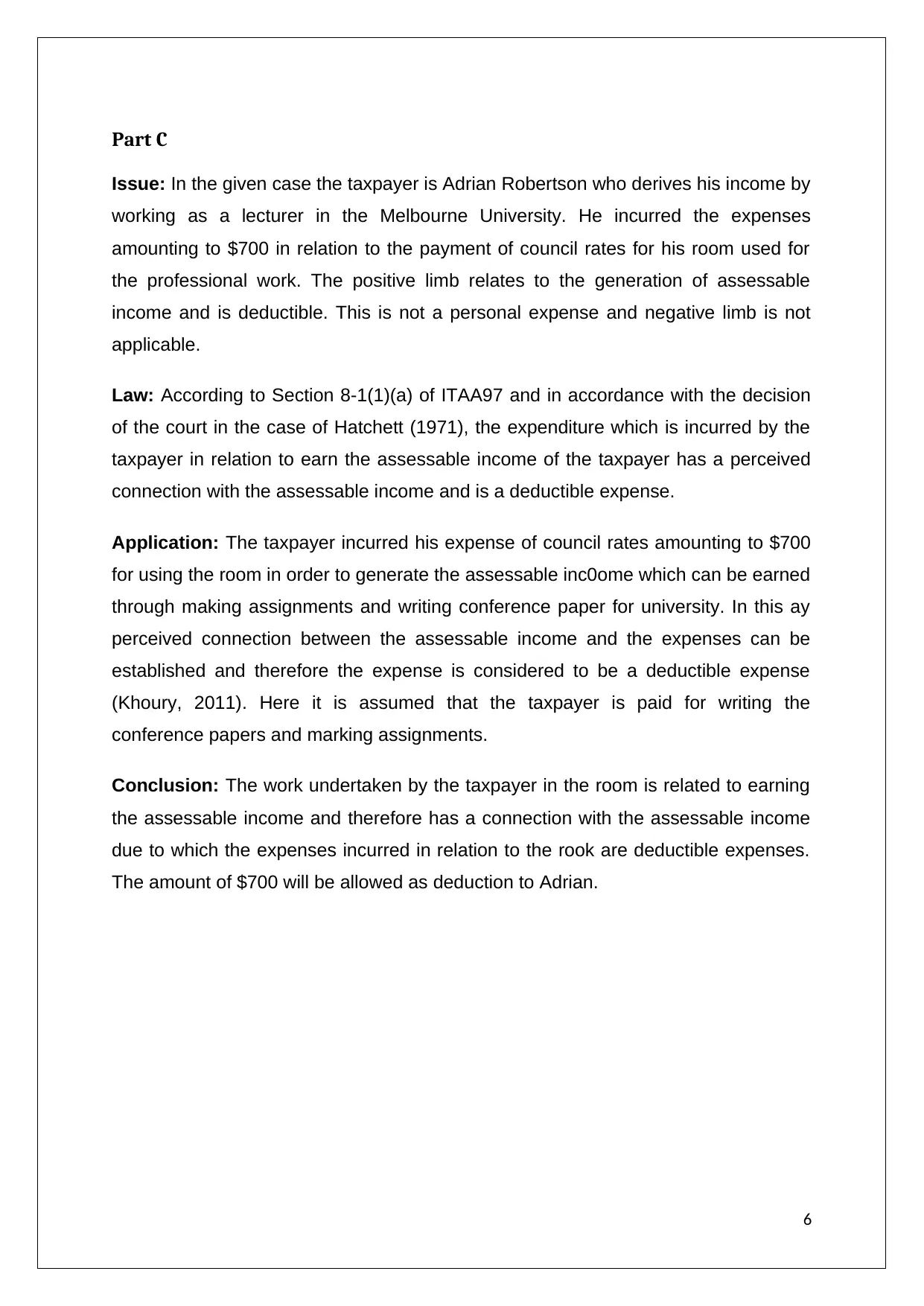
Part C
Issue: In the given case the taxpayer is Adrian Robertson who derives his income by
working as a lecturer in the Melbourne University. He incurred the expenses
amounting to $700 in relation to the payment of council rates for his room used for
the professional work. The positive limb relates to the generation of assessable
income and is deductible. This is not a personal expense and negative limb is not
applicable.
Law: According to Section 8-1(1)(a) of ITAA97 and in accordance with the decision
of the court in the case of Hatchett (1971), the expenditure which is incurred by the
taxpayer in relation to earn the assessable income of the taxpayer has a perceived
connection with the assessable income and is a deductible expense.
Application: The taxpayer incurred his expense of council rates amounting to $700
for using the room in order to generate the assessable inc0ome which can be earned
through making assignments and writing conference paper for university. In this ay
perceived connection between the assessable income and the expenses can be
established and therefore the expense is considered to be a deductible expense
(Khoury, 2011). Here it is assumed that the taxpayer is paid for writing the
conference papers and marking assignments.
Conclusion: The work undertaken by the taxpayer in the room is related to earning
the assessable income and therefore has a connection with the assessable income
due to which the expenses incurred in relation to the rook are deductible expenses.
The amount of $700 will be allowed as deduction to Adrian.
6
Document Page
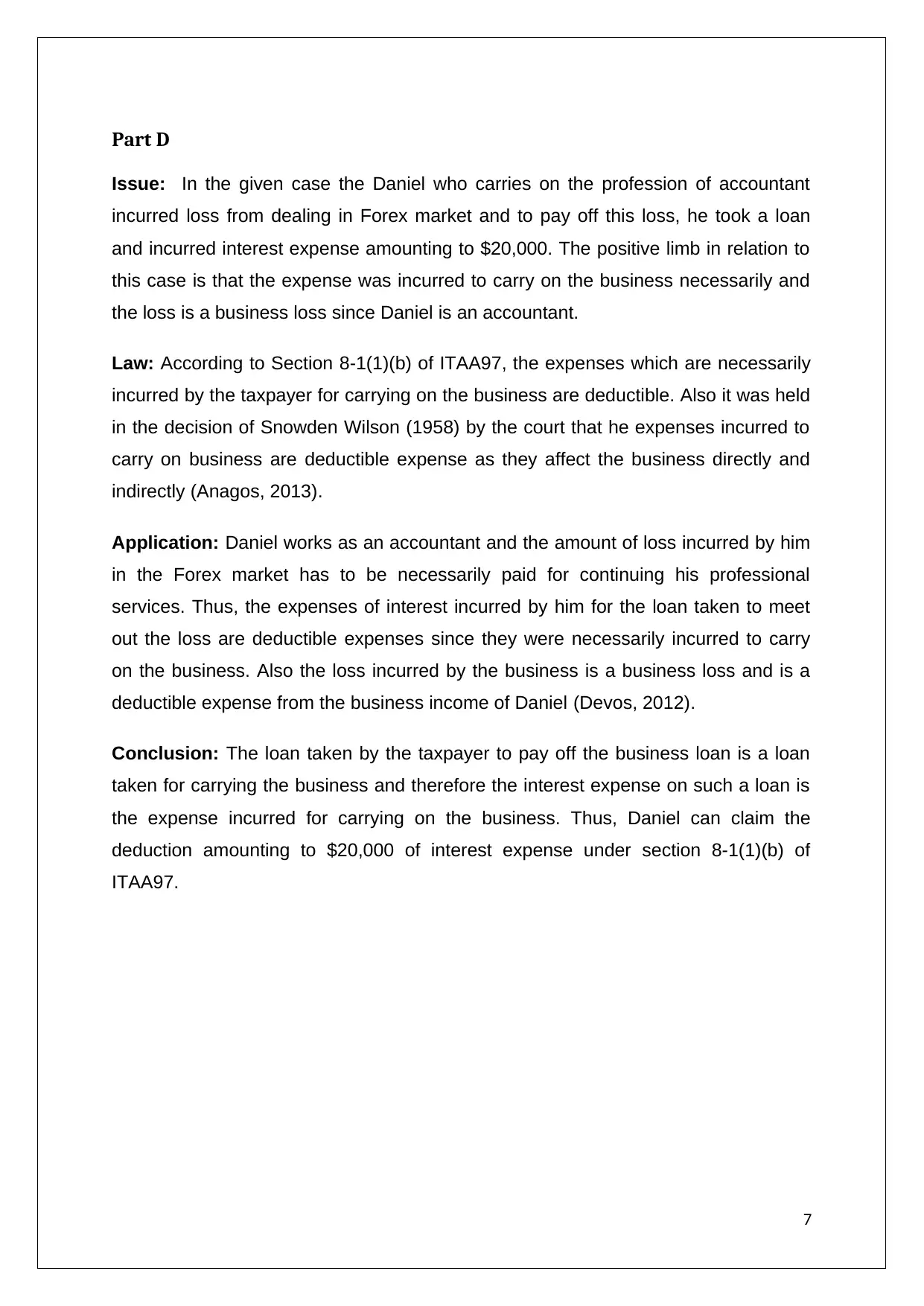
Part D
Issue: In the given case the Daniel who carries on the profession of accountant
incurred loss from dealing in Forex market and to pay off this loss, he took a loan
and incurred interest expense amounting to $20,000. The positive limb in relation to
this case is that the expense was incurred to carry on the business necessarily and
the loss is a business loss since Daniel is an accountant.
Law: According to Section 8-1(1)(b) of ITAA97, the expenses which are necessarily
incurred by the taxpayer for carrying on the business are deductible. Also it was held
in the decision of Snowden Wilson (1958) by the court that he expenses incurred to
carry on business are deductible expense as they affect the business directly and
indirectly (Anagos, 2013).
Application: Daniel works as an accountant and the amount of loss incurred by him
in the Forex market has to be necessarily paid for continuing his professional
services. Thus, the expenses of interest incurred by him for the loan taken to meet
out the loss are deductible expenses since they were necessarily incurred to carry
on the business. Also the loss incurred by the business is a business loss and is a
deductible expense from the business income of Daniel (Devos, 2012).
Conclusion: The loan taken by the taxpayer to pay off the business loan is a loan
taken for carrying the business and therefore the interest expense on such a loan is
the expense incurred for carrying on the business. Thus, Daniel can claim the
deduction amounting to $20,000 of interest expense under section 8-1(1)(b) of
ITAA97.
7
tabler-icon-diamond-filled.svg

Paraphrase This Document

Need a fresh take? Get an instant paraphrase of this document with our AI Paraphraser
Document Page
Conclusion
From the discussion of the cases in relation to Australian taxation law, it can be
concluded that the taxation law ITAA97 and the past case references can be used as
a basis to decide upon the issues and problems of the cases. It can be further
concluded that the positive limbs and negative limbs defined under section 8-1 of
ITAA97 help to understand the tax problems in a better manner and with a mre
efficient approach.
8
Document Page
Bibliography
Anagos, D. (2013). Carer payment: Calculation of 'orddinary income', whether legal costs are an
allowable deduction from income derived from a business:YCWS and secretary to the
DFHCSIA. Social Security Reporter, 15(3), 9.
Devos, K. (2012). The impact of tax professionals upon the compliance behaviour of Australian
individual taxpayers. Revenue Law Journal, 22(1), 31.
Khoury, D. (2011). Widening the availability of deductions under Australian Taxation Law. Tax
Specialist, 14(4), 207.
Norbury, M. (2013). Tax cases. Taxation in Australia, 48(5), 280-285.
Officer, F. (2017). Otherwise Deductible Rule. BP2017.
Woellner, R. B. (2012). Australian Taxation Law. CCH Australia.
9
chevron_up_icon
1 out of 9
circle_padding
hide_on_mobile
zoom_out_icon
[object Object]