Case Study Analysis: Axel Springer's Digital Strategy Evolution

Verified

Added on  2023/06/03

|4
|1267
|491
Case Study
AI Summary
This case study examines Axel Springer's digital transformation journey, a major publishing house in Germany. Faced with the digital revolution, Axel Springer adopted a two-stage strategy. The first stage focused on organic growth and late-stage digital acquisitions, while the second aimed to become a leading digital publisher. The study analyzes the evolution of these strategies, including the integration of key brands like Bild and Bild.de, and the adoption of various business models for revenue generation through marketing, paid content, and classified advertising. The case explores strategic alternatives such as expansion via acquisition and establishing the firm's identity, considering industry evolution, changing customer needs, internal competencies, and competitor actions. The study recommends strategies for future digital transformation, addressing challenges like data security and plagiarism, and emphasizes the importance of adapting to the evolving digital landscape.

Document Page
Running Head: CASE STUDY OF AXEL SPRINGER
Case Study of Axel Springer
Name of the Student
Name of the University
Author Note
tabler-icon-diamond-filled.svg

Paraphrase This Document

Need a fresh take? Get an instant paraphrase of this document with our AI Paraphraser
Document Page
1CASE STUDY OF AXEL SPRINGER
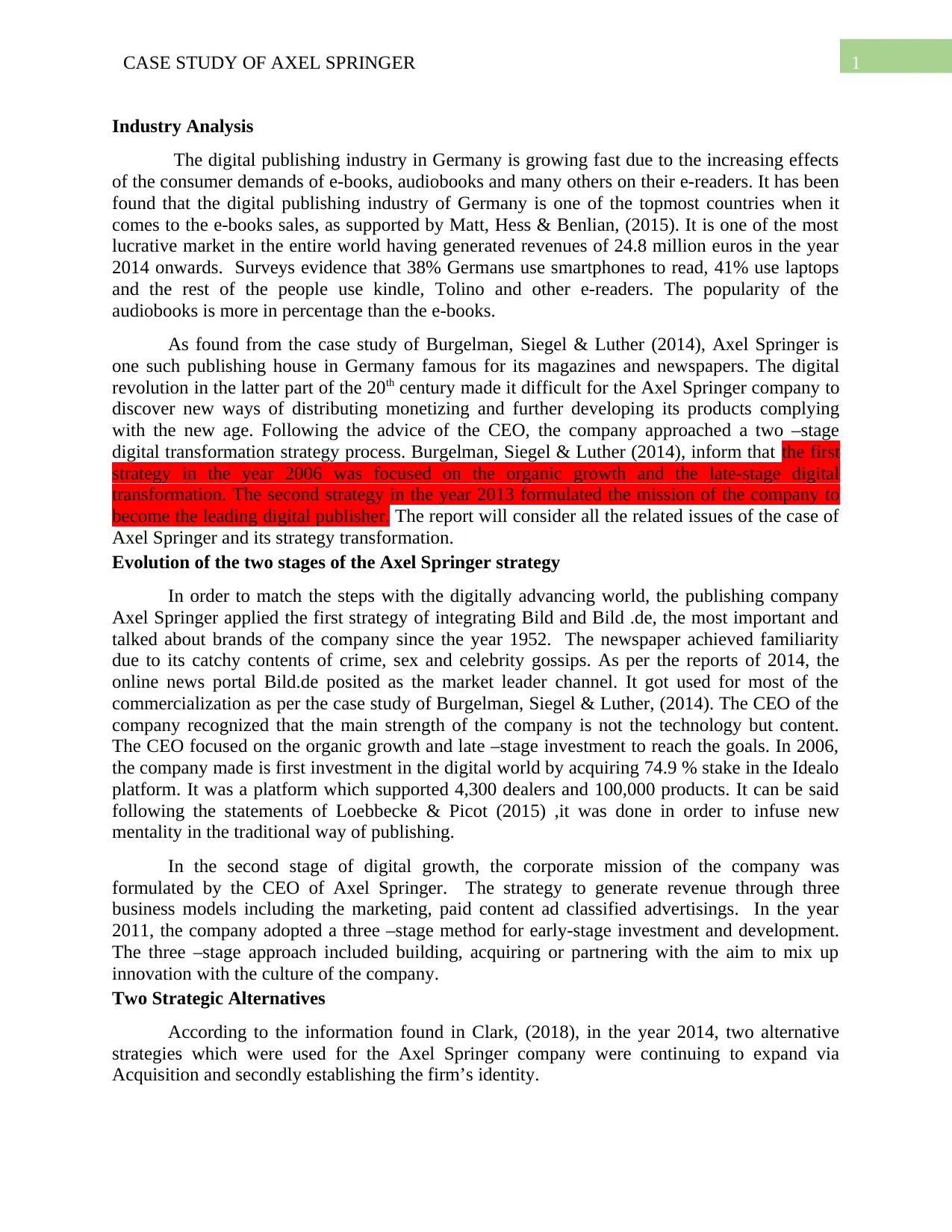
Industry Analysis
The digital publishing industry in Germany is growing fast due to the increasing effects
of the consumer demands of e-books, audiobooks and many others on their e-readers. It has been
found that the digital publishing industry of Germany is one of the topmost countries when it
comes to the e-books sales, as supported by Matt, Hess & Benlian, (2015). It is one of the most
lucrative market in the entire world having generated revenues of 24.8 million euros in the year
2014 onwards. Surveys evidence that 38% Germans use smartphones to read, 41% use laptops
and the rest of the people use kindle, Tolino and other e-readers. The popularity of the
audiobooks is more in percentage than the e-books.
As found from the case study of Burgelman, Siegel & Luther (2014), Axel Springer is
one such publishing house in Germany famous for its magazines and newspapers. The digital
revolution in the latter part of the 20th century made it difficult for the Axel Springer company to
discover new ways of distributing monetizing and further developing its products complying
with the new age. Following the advice of the CEO, the company approached a two –stage
digital transformation strategy process. Burgelman, Siegel & Luther (2014), inform that the first
strategy in the year 2006 was focused on the organic growth and the late-stage digital
transformation. The second strategy in the year 2013 formulated the mission of the company to
become the leading digital publisher. The report will consider all the related issues of the case of
Axel Springer and its strategy transformation.
Evolution of the two stages of the Axel Springer strategy
In order to match the steps with the digitally advancing world, the publishing company
Axel Springer applied the first strategy of integrating Bild and Bild .de, the most important and
talked about brands of the company since the year 1952. The newspaper achieved familiarity
due to its catchy contents of crime, sex and celebrity gossips. As per the reports of 2014, the
online news portal Bild.de posited as the market leader channel. It got used for most of the
commercialization as per the case study of Burgelman, Siegel & Luther, (2014). The CEO of the
company recognized that the main strength of the company is not the technology but content.
The CEO focused on the organic growth and late –stage investment to reach the goals. In 2006,
the company made is first investment in the digital world by acquiring 74.9 % stake in the Idealo
platform. It was a platform which supported 4,300 dealers and 100,000 products. It can be said
following the statements of Loebbecke & Picot (2015) ,it was done in order to infuse new
mentality in the traditional way of publishing.
In the second stage of digital growth, the corporate mission of the company was
formulated by the CEO of Axel Springer. The strategy to generate revenue through three
business models including the marketing, paid content ad classified advertisings. In the year
2011, the company adopted a three –stage method for early-stage investment and development.
The three –stage approach included building, acquiring or partnering with the aim to mix up
innovation with the culture of the company.
Two Strategic Alternatives
According to the information found in Clark, (2018), in the year 2014, two alternative
strategies which were used for the Axel Springer company were continuing to expand via
Acquisition and secondly establishing the firm’s identity.
Document Page
2CASE STUDY OF AXEL SPRINGER
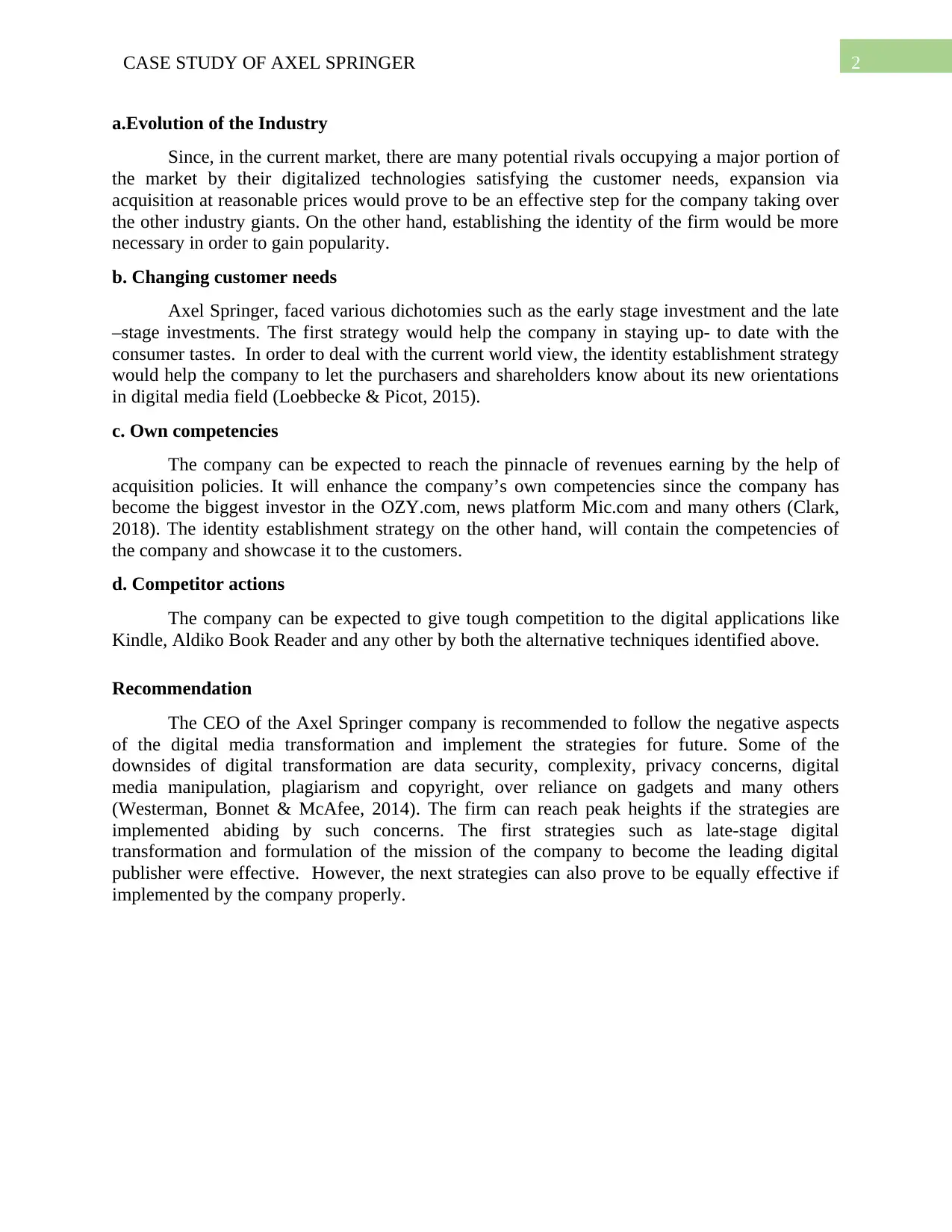
a.Evolution of the Industry
Since, in the current market, there are many potential rivals occupying a major portion of
the market by their digitalized technologies satisfying the customer needs, expansion via
acquisition at reasonable prices would prove to be an effective step for the company taking over
the other industry giants. On the other hand, establishing the identity of the firm would be more
necessary in order to gain popularity.
b. Changing customer needs
Axel Springer, faced various dichotomies such as the early stage investment and the late
–stage investments. The first strategy would help the company in staying up- to date with the
consumer tastes. In order to deal with the current world view, the identity establishment strategy
would help the company to let the purchasers and shareholders know about its new orientations
in digital media field (Loebbecke & Picot, 2015).
c. Own competencies
The company can be expected to reach the pinnacle of revenues earning by the help of
acquisition policies. It will enhance the company’s own competencies since the company has
become the biggest investor in the OZY.com, news platform Mic.com and many others (Clark,
2018). The identity establishment strategy on the other hand, will contain the competencies of
the company and showcase it to the customers.
d. Competitor actions
The company can be expected to give tough competition to the digital applications like
Kindle, Aldiko Book Reader and any other by both the alternative techniques identified above.
Recommendation
The CEO of the Axel Springer company is recommended to follow the negative aspects
of the digital media transformation and implement the strategies for future. Some of the
downsides of digital transformation are data security, complexity, privacy concerns, digital
media manipulation, plagiarism and copyright, over reliance on gadgets and many others
(Westerman, Bonnet & McAfee, 2014). The firm can reach peak heights if the strategies are
implemented abiding by such concerns. The first strategies such as late-stage digital
transformation and formulation of the mission of the company to become the leading digital
publisher were effective. However, the next strategies can also prove to be equally effective if
implemented by the company properly.
Document Page
3CASE STUDY OF AXEL SPRINGER
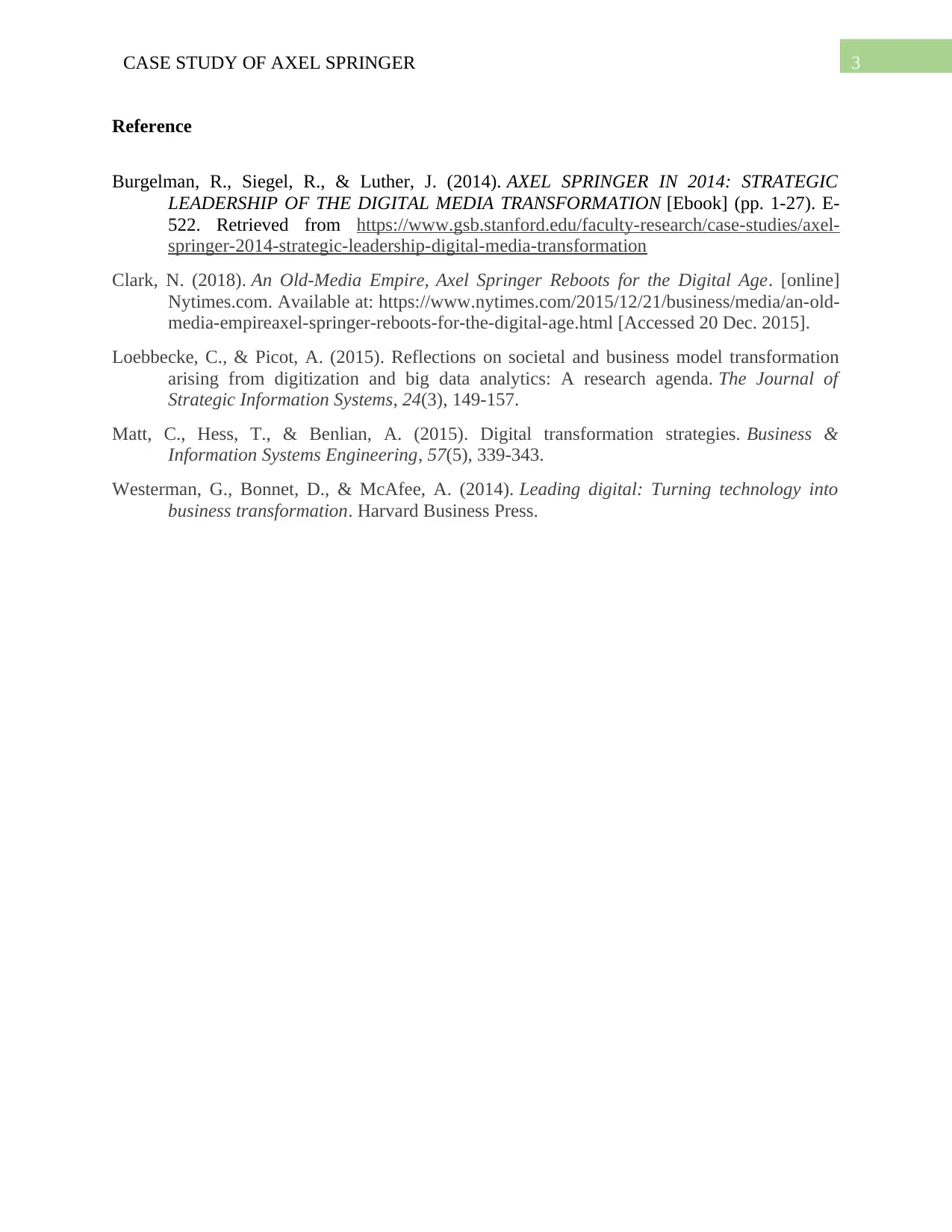
Reference
Burgelman, R., Siegel, R., & Luther, J. (2014). AXEL SPRINGER IN 2014: STRATEGIC
LEADERSHIP OF THE DIGITAL MEDIA TRANSFORMATION [Ebook] (pp. 1-27). E-
522. Retrieved from https://www.gsb.stanford.edu/faculty-research/case-studies/axel-
springer-2014-strategic-leadership-digital-media-transformation
Clark, N. (2018). An Old-Media Empire, Axel Springer Reboots for the Digital Age. [online]
Nytimes.com. Available at: https://www.nytimes.com/2015/12/21/business/media/an-old-
media-empireaxel-springer-reboots-for-the-digital-age.html [Accessed 20 Dec. 2015].
Loebbecke, C., & Picot, A. (2015). Reflections on societal and business model transformation
arising from digitization and big data analytics: A research agenda. The Journal of
Strategic Information Systems, 24(3), 149-157.
Matt, C., Hess, T., & Benlian, A. (2015). Digital transformation strategies. Business &
Information Systems Engineering, 57(5), 339-343.
Westerman, G., Bonnet, D., & McAfee, A. (2014). Leading digital: Turning technology into
business transformation. Harvard Business Press.
chevron_up_icon
1 out of 4
circle_padding
hide_on_mobile
zoom_out_icon
[object Object]