Strategic HRM & Balanced Scorecard: Enhancing Quality in Healthcare
VerifiedAdded on 2023/06/18
|10
|3103
|330
Essay
AI Summary
This essay examines the role of strategic Human Resource Management (HRM) in health and social care sectors, utilizing the Balanced Scorecard (BSC) model. It highlights the importance of HRM in improving services, maximizing profit, and ensuring sustainability within healthcare organizations like the NHS. The BSC model, with its four strategic perspectives—financial, customer, internal business processes, and learning & growth—is presented as a framework for planning, evaluating, and achieving organizational goals. The essay also discusses specific HRM strategies such as recruitment, training, and retention, emphasizing their impact on employee performance and the overall quality of care provided. It concludes that effective HRM strategies, guided by the BSC model, are crucial for healthcare organizations to thrive in a competitive environment, enhance customer satisfaction, and ensure long-term sustainability.
HRM Strategies

Paraphrase This Document
Need a fresh take? Get an instant paraphrase of this document with our AI Paraphraser
INTRODUCTION
The main goal of an organisation in health care sectors is to improve services, maximise
profit and sustainability, in which, HR management plays a significant role in managing system
(Ahmad and Umrani, 2019). Human resource management is considered as practice of enlistee,
hiring, positioning as well as managing staff members within organisation, for that, they require
human resource professionals. HR professionals also have other responsibilities such as
developing effective strategies for improvement, encouraging staff and so on (Almaskari and
Marni, 2020). There are healthcare organisations such as NHS, which make an organisation to
work on their strategic management system for their long-time sustainability and profitability. It
has been found that working on such areas can facilitate them to improve their quality of care
and services.
In recent times, due to strong competition in health care organisation, is being
pressurising organisations to work on their strategic system in order to improve internal and
external factors like growth, services. In 1990s, Kaplan and Norton introduced the Balance
Scoreboard (BSC) model that is a main strategic framework and it allows organisations to plan
and evaluate and can provide effective results (Li and et. al., 2019). This essay underpins the
role of strategic HRM system in health and social care sectors by the use of balance scorecard
(BSC) model. It also depicted the considered strategies which are considered to provide quality
of services and care to the service seekers within health care sectors.
According to the views of (Lim, Wang and Lee, 2017), it has been identified that Human
Resource Management plays an essential role within health care sectors. HRM not only aims on
implementation of policies and frameworks but also, focus on research, analysation and
enforcement of new strategic plans in an organisation . There are three basic models which are
consider as base of HRM, which are inputs, physical & capital. Studies concluded that there is
correlation between health system inputs, budget elements and also expenditure categories.
Moreover, as per another study, when penetrating to health care sectors also the role of HRM,
can be termed as the several types of clinical and non-clinical staff are responsible for service
seeker's health interventions (Omar, Ali and Masrom, 2020).
Also, HR managers in health care sectors ensure that services are efficient for
stakeholders like administrative staff, clinicians and service seekers. If not, then it’s their duty to
develop interventions which can fulfil the needs and demands.(Ahmad and Umrani, 2019). They
The main goal of an organisation in health care sectors is to improve services, maximise
profit and sustainability, in which, HR management plays a significant role in managing system
(Ahmad and Umrani, 2019). Human resource management is considered as practice of enlistee,
hiring, positioning as well as managing staff members within organisation, for that, they require
human resource professionals. HR professionals also have other responsibilities such as
developing effective strategies for improvement, encouraging staff and so on (Almaskari and
Marni, 2020). There are healthcare organisations such as NHS, which make an organisation to
work on their strategic management system for their long-time sustainability and profitability. It
has been found that working on such areas can facilitate them to improve their quality of care
and services.
In recent times, due to strong competition in health care organisation, is being
pressurising organisations to work on their strategic system in order to improve internal and
external factors like growth, services. In 1990s, Kaplan and Norton introduced the Balance
Scoreboard (BSC) model that is a main strategic framework and it allows organisations to plan
and evaluate and can provide effective results (Li and et. al., 2019). This essay underpins the
role of strategic HRM system in health and social care sectors by the use of balance scorecard
(BSC) model. It also depicted the considered strategies which are considered to provide quality
of services and care to the service seekers within health care sectors.
According to the views of (Lim, Wang and Lee, 2017), it has been identified that Human
Resource Management plays an essential role within health care sectors. HRM not only aims on
implementation of policies and frameworks but also, focus on research, analysation and
enforcement of new strategic plans in an organisation . There are three basic models which are
consider as base of HRM, which are inputs, physical & capital. Studies concluded that there is
correlation between health system inputs, budget elements and also expenditure categories.
Moreover, as per another study, when penetrating to health care sectors also the role of HRM,
can be termed as the several types of clinical and non-clinical staff are responsible for service
seeker's health interventions (Omar, Ali and Masrom, 2020).
Also, HR managers in health care sectors ensure that services are efficient for
stakeholders like administrative staff, clinicians and service seekers. If not, then it’s their duty to
develop interventions which can fulfil the needs and demands.(Ahmad and Umrani, 2019). They
also work on other areas of organisation, like balancing financials, promoting employee retention
and assuring that health care regulation are being achieved by an organisation. The strategic
human resource management is most important for an organisation in order to achieve various
organisational goals and objectives. In the development of business companies, strategic human
resource management play a vital role by increasing overall productivity of the organisation and
employees. The strategic human resource management play a crucial role by developing a
systematic business planning in order to achieve major company goals.
One of the most important health system inputs, the performance and benefits are
directly proportional to the knowledge, skills and motivation of health practitioners for
delivering quality of services (Almaskari and Marni, 2020). The use of BSC can provide four
strategic perspectives within organisation. The use of balance scorecard model leads to ethical
decision making and can help company to attain stakeholder perspectives. Managers and
employee work effectively and strive to conduct ethical environment to work. In order to
conduct such an environment, employees require to be knowledge organisational ethical
standards.
A balance score cards model helps to understand organisation's obligations. For example,
in NHS, the model used to establish ethical environment which helps to improve their quality of
services which is being provided to service seekers (Ranjhan, and Mallick, 2018). In which, first
of these, is the financial perspective. The financial perspective can allow firms to attain returns
higher than investment made. Through this, financial goal can be determined of organisation
which can be explicit. It can also allow to establish appropriate financial strategy. Studies further
concluded that financial perceptive is a type of metric that had historically established by
company in order to evaluate performance.
For example, studies reported in 2018 -2019, as a result of alteration in the funding
balance of CGC, NHS failed to achieve financial balance (ROPRET and et. al., 2021). In order
to overcome, they established financial strategy such as growth and diversification ( new
services, pricing strategies, use of assets, cash conservation cycle etc. Another perspective is
termed as customer perspective. In the health sector, service seekers are essential stakeholder.
Studies stated that the basic principle of this perceptive is to identify how well are organisation
meeting the demands of service seekers and how can organisation improve their service to make
customers more satisfied It is compulsory to keep their needs fulfilled.
and assuring that health care regulation are being achieved by an organisation. The strategic
human resource management is most important for an organisation in order to achieve various
organisational goals and objectives. In the development of business companies, strategic human
resource management play a vital role by increasing overall productivity of the organisation and
employees. The strategic human resource management play a crucial role by developing a
systematic business planning in order to achieve major company goals.
One of the most important health system inputs, the performance and benefits are
directly proportional to the knowledge, skills and motivation of health practitioners for
delivering quality of services (Almaskari and Marni, 2020). The use of BSC can provide four
strategic perspectives within organisation. The use of balance scorecard model leads to ethical
decision making and can help company to attain stakeholder perspectives. Managers and
employee work effectively and strive to conduct ethical environment to work. In order to
conduct such an environment, employees require to be knowledge organisational ethical
standards.
A balance score cards model helps to understand organisation's obligations. For example,
in NHS, the model used to establish ethical environment which helps to improve their quality of
services which is being provided to service seekers (Ranjhan, and Mallick, 2018). In which, first
of these, is the financial perspective. The financial perspective can allow firms to attain returns
higher than investment made. Through this, financial goal can be determined of organisation
which can be explicit. It can also allow to establish appropriate financial strategy. Studies further
concluded that financial perceptive is a type of metric that had historically established by
company in order to evaluate performance.
For example, studies reported in 2018 -2019, as a result of alteration in the funding
balance of CGC, NHS failed to achieve financial balance (ROPRET and et. al., 2021). In order
to overcome, they established financial strategy such as growth and diversification ( new
services, pricing strategies, use of assets, cash conservation cycle etc. Another perspective is
termed as customer perspective. In the health sector, service seekers are essential stakeholder.
Studies stated that the basic principle of this perceptive is to identify how well are organisation
meeting the demands of service seekers and how can organisation improve their service to make
customers more satisfied It is compulsory to keep their needs fulfilled.
⊘ This is a preview!⊘
Do you want full access?
Subscribe today to unlock all pages.

Trusted by 1+ million students worldwide
Balance scorecard includes questionnaire method into action. It includes surveys that can
help practitioners to attain feedbacks of service seekers. For example: In NHS, frequent surveys
are conducted in order to identify working areas (Omar, Ali and Masrom, 2020). This strategy
can help to improvise quality of services, which can also make large amount of population
satisfied and foster profitability of organisation.
Another perspective internal business processes or workflows of the organisations are
determined to improve and should incline each steps towards excellence, with a considered aim
to satisfy the health requirements of both internal as well as external service seekers (Yamo,
2020). For example, NHS, earlier found to be dealing with issues of lack of motivation within
staff, that also considered as a barrier that interrupted quality of care and services. HRM
established strategies such as incentives for staff members for doing long working hours and
bonus system in order to motivate their staff to practice effectively.
The fourth and the final perspective is determine as basic fundamental which can lead to
success as well as sustainability factor. As per the studies, it has been refer as it can be explicitly
to the mandatory of human resource in gaining considered goals and objectives of business. It
mainly focuses on key aspects of all three perspectives (Ranjhan, and Mallick, 2018). In this
first step, is to identify ideas of improvement which are commonly collected to those who are
close to organisational processes and suggestions are also considered which are attained through
service seekers feedbacks. Second step, firm should be equipped by the system in providing
information of customers contentment, diligence and retention. Third step is to analyse each
member should feel motivated, and also should debits freedom to determine decisions and can
able to act. This model facilitate in evaluation process (Lim, Wang and Lee, 2017). Furthermore,
studies concluded that due to its positive influence, Strategic Human Resources Management has
determined in tremendous progress in health care sectors recent years. The Balanced scorecard
is used by many famous companies of UK like Tesco and Marks and Spencer to gain competitive
advantage. Balanced scorecard is also used by companies like HSBC, Oxfam international and
H&M clothing to increase employee performance.
Strategy is termed as unified, comprehensive and integrated plan that can relates the
strategic benefits of the organisation to the challenges of the environment. It is structured in way,
that can facilitate to ensure basic goals of the enterprise which should be attained through
definite execution plan by an organisation (Omar, Ali and Masrom, 2020). The strategic process
help practitioners to attain feedbacks of service seekers. For example: In NHS, frequent surveys
are conducted in order to identify working areas (Omar, Ali and Masrom, 2020). This strategy
can help to improvise quality of services, which can also make large amount of population
satisfied and foster profitability of organisation.
Another perspective internal business processes or workflows of the organisations are
determined to improve and should incline each steps towards excellence, with a considered aim
to satisfy the health requirements of both internal as well as external service seekers (Yamo,
2020). For example, NHS, earlier found to be dealing with issues of lack of motivation within
staff, that also considered as a barrier that interrupted quality of care and services. HRM
established strategies such as incentives for staff members for doing long working hours and
bonus system in order to motivate their staff to practice effectively.
The fourth and the final perspective is determine as basic fundamental which can lead to
success as well as sustainability factor. As per the studies, it has been refer as it can be explicitly
to the mandatory of human resource in gaining considered goals and objectives of business. It
mainly focuses on key aspects of all three perspectives (Ranjhan, and Mallick, 2018). In this
first step, is to identify ideas of improvement which are commonly collected to those who are
close to organisational processes and suggestions are also considered which are attained through
service seekers feedbacks. Second step, firm should be equipped by the system in providing
information of customers contentment, diligence and retention. Third step is to analyse each
member should feel motivated, and also should debits freedom to determine decisions and can
able to act. This model facilitate in evaluation process (Lim, Wang and Lee, 2017). Furthermore,
studies concluded that due to its positive influence, Strategic Human Resources Management has
determined in tremendous progress in health care sectors recent years. The Balanced scorecard
is used by many famous companies of UK like Tesco and Marks and Spencer to gain competitive
advantage. Balanced scorecard is also used by companies like HSBC, Oxfam international and
H&M clothing to increase employee performance.
Strategy is termed as unified, comprehensive and integrated plan that can relates the
strategic benefits of the organisation to the challenges of the environment. It is structured in way,
that can facilitate to ensure basic goals of the enterprise which should be attained through
definite execution plan by an organisation (Omar, Ali and Masrom, 2020). The strategic process
Paraphrase This Document
Need a fresh take? Get an instant paraphrase of this document with our AI Paraphraser
is mainly divided into two phases that are formulation and implementation. As per the studies, it
has been determined that HRM strategies is a set of managerial actions and considered decisions
which can assure long term performance.
It involves strategic formulation, implementation, environmental scanning, evaluation
and also control. It also consist monitoring and evaluation environmental possibilities and
threats, which can also help in determining strength and weakness of organisation. In health care
sectors, as it might help in determining where an organisation is unable to give their best care to
patients and what are the areas of an organisation requires improvisation (Oakman, and Bartram,
2017). The strategic human resource management includes a procedure which is future oriented
and can help them to deliver quality of care and best assistance to patients, which helps in
developing and application of HR programs that can be helpful to address lacking areas of
healthcare organisation.
Nearly all HR leaders globally are involved in the strategic decision making as well as
participate particularly on organisation's strategy team. As the broad management strategies
includes strategies for increasing sustainability of firm, strategies for avoiding cost and
disruptive surprise which interrupt in achieving goal, addressing key issues frequently in order to
halt crises, recruitment, training of staff, retention, promotes productivity and overall
performance of organisation, indicating sense of positive working culture, keeping each staff
members goal oriented, promoting a significant strategic focus in order to guide training as well
as development and providing leadership qualities that can help them to focus and be able to
implement their particular strategic initiatives etc. (Lim, Wang and Lee, 2017)
It has been observed that strategies such as recruitment, training and retention can help
staff to work effectively and efficiently, which affects directly to the performance of
organisation. Hiring people in heath care sectors can be complicated, due to job requirement. The
job role of health practitioners consist several duties and responsibilities, flexibility, skills and
knowledge.(Ahmad and Umrani, 2019). For that, it is critical to select new practitioners who can
be fit for the job role. After recruitment it is beneficial for them to provide effective training to
foster their skills.
In order to provide best training, HRM strategies are used to train new practitioners for
effective practice. Retention is a process which involves sustainability of positive environment,
so that each employee can help them to work effectively. These strategies considered, due to its
has been determined that HRM strategies is a set of managerial actions and considered decisions
which can assure long term performance.
It involves strategic formulation, implementation, environmental scanning, evaluation
and also control. It also consist monitoring and evaluation environmental possibilities and
threats, which can also help in determining strength and weakness of organisation. In health care
sectors, as it might help in determining where an organisation is unable to give their best care to
patients and what are the areas of an organisation requires improvisation (Oakman, and Bartram,
2017). The strategic human resource management includes a procedure which is future oriented
and can help them to deliver quality of care and best assistance to patients, which helps in
developing and application of HR programs that can be helpful to address lacking areas of
healthcare organisation.
Nearly all HR leaders globally are involved in the strategic decision making as well as
participate particularly on organisation's strategy team. As the broad management strategies
includes strategies for increasing sustainability of firm, strategies for avoiding cost and
disruptive surprise which interrupt in achieving goal, addressing key issues frequently in order to
halt crises, recruitment, training of staff, retention, promotes productivity and overall
performance of organisation, indicating sense of positive working culture, keeping each staff
members goal oriented, promoting a significant strategic focus in order to guide training as well
as development and providing leadership qualities that can help them to focus and be able to
implement their particular strategic initiatives etc. (Lim, Wang and Lee, 2017)
It has been observed that strategies such as recruitment, training and retention can help
staff to work effectively and efficiently, which affects directly to the performance of
organisation. Hiring people in heath care sectors can be complicated, due to job requirement. The
job role of health practitioners consist several duties and responsibilities, flexibility, skills and
knowledge.(Ahmad and Umrani, 2019). For that, it is critical to select new practitioners who can
be fit for the job role. After recruitment it is beneficial for them to provide effective training to
foster their skills.
In order to provide best training, HRM strategies are used to train new practitioners for
effective practice. Retention is a process which involves sustainability of positive environment,
so that each employee can help them to work effectively. These strategies considered, due to its
positive impact on the organisation, as they can utilise for increasing productivity, sustainability
and can also beneficial to each staff members in order to work effectively and systematically
together (Yamo, 2020).
This effective working pattern can lead them, to enhance their reputation, customer
satisfaction, profitability and sustainability in the current stiff competition in health care sectors.
Working effectively can also facilitates them to improve delivering quality of services. The
success of an organisation count on the people who are working in an organisation. This relates
to how they are being acquired, developed, retained and also retained within organisation that
plays an vital role in the success of organisation (ROPRET and et. al., 2021).
As it has been considered as presupposes an definite integral intervention in regards with
human resource functioning system. Hence, it means a strategic appearance at HR functioning
system within line along with functions of business. Studies concluded these strategies can help
to analyse the opportunities as well as threats that can be termed to be barrier, while promoting
growth and productivity.
In heath care sectors, as there is strong competition in providing facilities, services,
assistance and care to each service user, which can help to them enhance their health factor and
also mould their health into lead to positivism.(Ranjhan, and Mallick, 2018) It can also facilities
in formulating effective strategies that will meet the organisation's strength (internal) and
weakness along with atmosphere (external) threats as well as opportunities, which can allows
identification, prioritisation and also exploitation of multiple opportunities which can help health
care organisation to develop their internal and external working areas (Almaskari and Marni,
2020)
These can help to provide an objective view point to managerial complication or
problems. It can help to determined a framework that can help to improve, control activities as
well as coordination. (Ropret and et. al., 2016) It helps in minimising the effects of negative or
adverse changes, which allows more efficient allocation of time and also resources in order to
identify several opportunities. Many companies like Walmart and future group deploy
professional strategic human resource management to deal with organisational goals. With the
application of organisational goals, companies prepare precise business strategy to achieve them
in a set time frame. Companies like HSBC and H&M deploy skilled and trained HR management
to develop business operations.
and can also beneficial to each staff members in order to work effectively and systematically
together (Yamo, 2020).
This effective working pattern can lead them, to enhance their reputation, customer
satisfaction, profitability and sustainability in the current stiff competition in health care sectors.
Working effectively can also facilitates them to improve delivering quality of services. The
success of an organisation count on the people who are working in an organisation. This relates
to how they are being acquired, developed, retained and also retained within organisation that
plays an vital role in the success of organisation (ROPRET and et. al., 2021).
As it has been considered as presupposes an definite integral intervention in regards with
human resource functioning system. Hence, it means a strategic appearance at HR functioning
system within line along with functions of business. Studies concluded these strategies can help
to analyse the opportunities as well as threats that can be termed to be barrier, while promoting
growth and productivity.
In heath care sectors, as there is strong competition in providing facilities, services,
assistance and care to each service user, which can help to them enhance their health factor and
also mould their health into lead to positivism.(Ranjhan, and Mallick, 2018) It can also facilities
in formulating effective strategies that will meet the organisation's strength (internal) and
weakness along with atmosphere (external) threats as well as opportunities, which can allows
identification, prioritisation and also exploitation of multiple opportunities which can help health
care organisation to develop their internal and external working areas (Almaskari and Marni,
2020)
These can help to provide an objective view point to managerial complication or
problems. It can help to determined a framework that can help to improve, control activities as
well as coordination. (Ropret and et. al., 2016) It helps in minimising the effects of negative or
adverse changes, which allows more efficient allocation of time and also resources in order to
identify several opportunities. Many companies like Walmart and future group deploy
professional strategic human resource management to deal with organisational goals. With the
application of organisational goals, companies prepare precise business strategy to achieve them
in a set time frame. Companies like HSBC and H&M deploy skilled and trained HR management
to develop business operations.
⊘ This is a preview!⊘
Do you want full access?
Subscribe today to unlock all pages.
Trusted by 1+ million students worldwide
Addition to this, in health care sectors it might helps in coordination along with tea
members. In health care sectors, it provides encouragement to employees to work in system that
can help them to aid service users effectively and be able to minimize their illness(Yamo, 2020).
Through these strategies, a cooperative, integrated as well as enthusiastic approach that can be
attained which can help to tackle problems.
members. In health care sectors, it provides encouragement to employees to work in system that
can help them to aid service users effectively and be able to minimize their illness(Yamo, 2020).
Through these strategies, a cooperative, integrated as well as enthusiastic approach that can be
attained which can help to tackle problems.
Paraphrase This Document
Need a fresh take? Get an instant paraphrase of this document with our AI Paraphraser
CONCLUSION
Overall, it has been concluded that HRM is managerial practices which plays an essential
role in management. In health care sectors, it can help to improve services which are being
provided to an individuals, helps in recruitment, training, retaining and so on. The role of HR
professionals plays an essential role in developing strategies which can foster sustainability and
productivity of firm. The balanced scorecard model is implemented to attain stakeholders
perspectives. In which, under health care sectors, the most important perspective which is
considered as customer perspective. The topmost priority of health organisation is to provide
satisfaction to their service seekers. Moreover, HRM strategies are directly proportional to the
performance of organisation, as these strategies are considered to conduct positive environment,
effective working of employees and so on. It provides encouragement to favourable attitude in
regards with organisational change and also can promotes a degree of discipline and formality in
respect to the working culture and its duties of practitioners.
Overall, it has been concluded that HRM is managerial practices which plays an essential
role in management. In health care sectors, it can help to improve services which are being
provided to an individuals, helps in recruitment, training, retaining and so on. The role of HR
professionals plays an essential role in developing strategies which can foster sustainability and
productivity of firm. The balanced scorecard model is implemented to attain stakeholders
perspectives. In which, under health care sectors, the most important perspective which is
considered as customer perspective. The topmost priority of health organisation is to provide
satisfaction to their service seekers. Moreover, HRM strategies are directly proportional to the
performance of organisation, as these strategies are considered to conduct positive environment,
effective working of employees and so on. It provides encouragement to favourable attitude in
regards with organisational change and also can promotes a degree of discipline and formality in
respect to the working culture and its duties of practitioners.
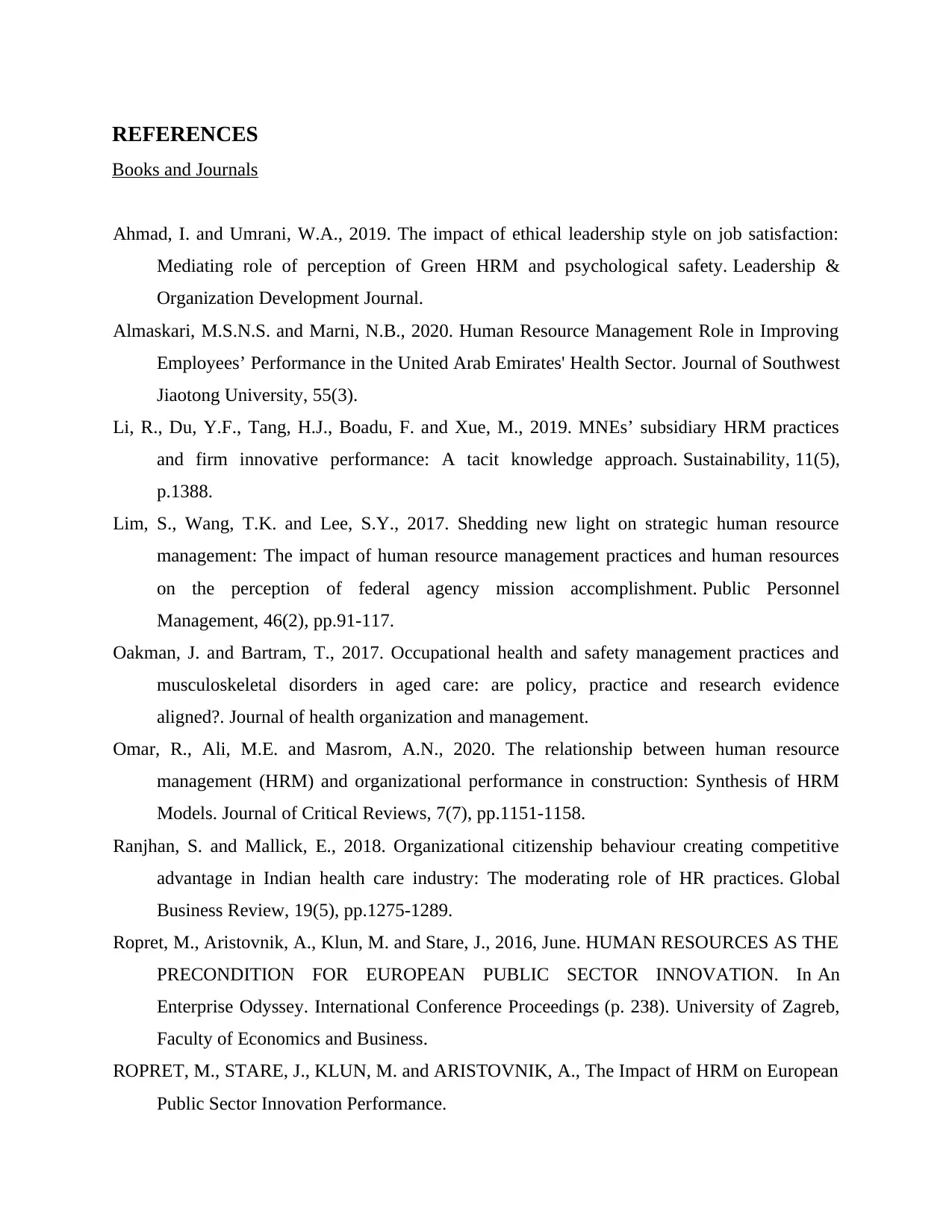
REFERENCES
Books and Journals
Ahmad, I. and Umrani, W.A., 2019. The impact of ethical leadership style on job satisfaction:
Mediating role of perception of Green HRM and psychological safety. Leadership &
Organization Development Journal.
Almaskari, M.S.N.S. and Marni, N.B., 2020. Human Resource Management Role in Improving
Employees’ Performance in the United Arab Emirates' Health Sector. Journal of Southwest
Jiaotong University, 55(3).
Li, R., Du, Y.F., Tang, H.J., Boadu, F. and Xue, M., 2019. MNEs’ subsidiary HRM practices
and firm innovative performance: A tacit knowledge approach. Sustainability, 11(5),
p.1388.
Lim, S., Wang, T.K. and Lee, S.Y., 2017. Shedding new light on strategic human resource
management: The impact of human resource management practices and human resources
on the perception of federal agency mission accomplishment. Public Personnel
Management, 46(2), pp.91-117.
Oakman, J. and Bartram, T., 2017. Occupational health and safety management practices and
musculoskeletal disorders in aged care: are policy, practice and research evidence
aligned?. Journal of health organization and management.
Omar, R., Ali, M.E. and Masrom, A.N., 2020. The relationship between human resource
management (HRM) and organizational performance in construction: Synthesis of HRM
Models. Journal of Critical Reviews, 7(7), pp.1151-1158.
Ranjhan, S. and Mallick, E., 2018. Organizational citizenship behaviour creating competitive
advantage in Indian health care industry: The moderating role of HR practices. Global
Business Review, 19(5), pp.1275-1289.
Ropret, M., Aristovnik, A., Klun, M. and Stare, J., 2016, June. HUMAN RESOURCES AS THE
PRECONDITION FOR EUROPEAN PUBLIC SECTOR INNOVATION. In An
Enterprise Odyssey. International Conference Proceedings (p. 238). University of Zagreb,
Faculty of Economics and Business.
ROPRET, M., STARE, J., KLUN, M. and ARISTOVNIK, A., The Impact of HRM on European
Public Sector Innovation Performance.
Books and Journals
Ahmad, I. and Umrani, W.A., 2019. The impact of ethical leadership style on job satisfaction:
Mediating role of perception of Green HRM and psychological safety. Leadership &
Organization Development Journal.
Almaskari, M.S.N.S. and Marni, N.B., 2020. Human Resource Management Role in Improving
Employees’ Performance in the United Arab Emirates' Health Sector. Journal of Southwest
Jiaotong University, 55(3).
Li, R., Du, Y.F., Tang, H.J., Boadu, F. and Xue, M., 2019. MNEs’ subsidiary HRM practices
and firm innovative performance: A tacit knowledge approach. Sustainability, 11(5),
p.1388.
Lim, S., Wang, T.K. and Lee, S.Y., 2017. Shedding new light on strategic human resource
management: The impact of human resource management practices and human resources
on the perception of federal agency mission accomplishment. Public Personnel
Management, 46(2), pp.91-117.
Oakman, J. and Bartram, T., 2017. Occupational health and safety management practices and
musculoskeletal disorders in aged care: are policy, practice and research evidence
aligned?. Journal of health organization and management.
Omar, R., Ali, M.E. and Masrom, A.N., 2020. The relationship between human resource
management (HRM) and organizational performance in construction: Synthesis of HRM
Models. Journal of Critical Reviews, 7(7), pp.1151-1158.
Ranjhan, S. and Mallick, E., 2018. Organizational citizenship behaviour creating competitive
advantage in Indian health care industry: The moderating role of HR practices. Global
Business Review, 19(5), pp.1275-1289.
Ropret, M., Aristovnik, A., Klun, M. and Stare, J., 2016, June. HUMAN RESOURCES AS THE
PRECONDITION FOR EUROPEAN PUBLIC SECTOR INNOVATION. In An
Enterprise Odyssey. International Conference Proceedings (p. 238). University of Zagreb,
Faculty of Economics and Business.
ROPRET, M., STARE, J., KLUN, M. and ARISTOVNIK, A., The Impact of HRM on European
Public Sector Innovation Performance.
⊘ This is a preview!⊘
Do you want full access?
Subscribe today to unlock all pages.
Trusted by 1+ million students worldwide
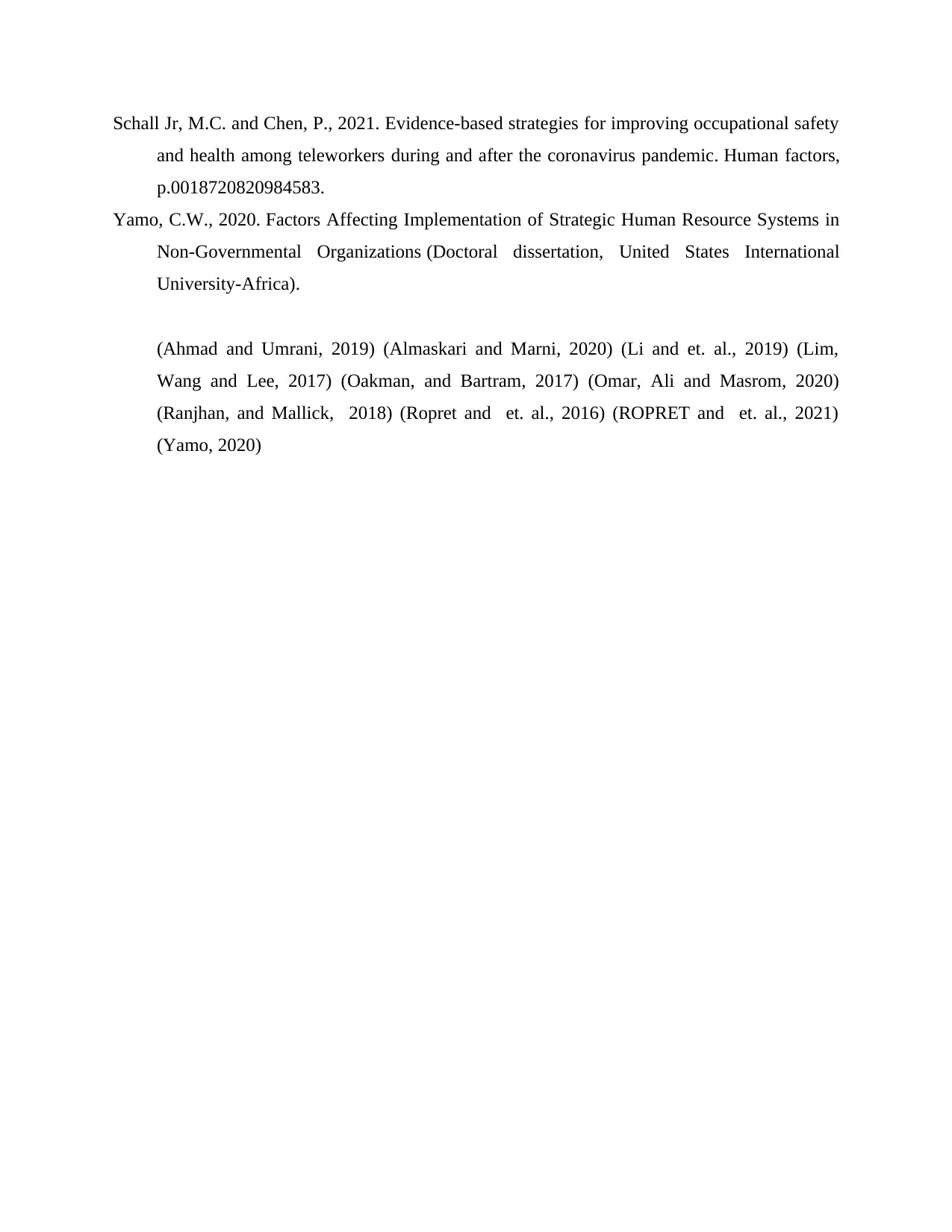
Schall Jr, M.C. and Chen, P., 2021. Evidence-based strategies for improving occupational safety
and health among teleworkers during and after the coronavirus pandemic. Human factors,
p.0018720820984583.
Yamo, C.W., 2020. Factors Affecting Implementation of Strategic Human Resource Systems in
Non-Governmental Organizations (Doctoral dissertation, United States International
University-Africa).
(Ahmad and Umrani, 2019) (Almaskari and Marni, 2020) (Li and et. al., 2019) (Lim,
Wang and Lee, 2017) (Oakman, and Bartram, 2017) (Omar, Ali and Masrom, 2020)
(Ranjhan, and Mallick, 2018) (Ropret and et. al., 2016) (ROPRET and et. al., 2021)
(Yamo, 2020)
and health among teleworkers during and after the coronavirus pandemic. Human factors,
p.0018720820984583.
Yamo, C.W., 2020. Factors Affecting Implementation of Strategic Human Resource Systems in
Non-Governmental Organizations (Doctoral dissertation, United States International
University-Africa).
(Ahmad and Umrani, 2019) (Almaskari and Marni, 2020) (Li and et. al., 2019) (Lim,
Wang and Lee, 2017) (Oakman, and Bartram, 2017) (Omar, Ali and Masrom, 2020)
(Ranjhan, and Mallick, 2018) (Ropret and et. al., 2016) (ROPRET and et. al., 2021)
(Yamo, 2020)

1 out of 10


Related Documents


Your All-in-One AI-Powered Toolkit for Academic Success.
+13062052269
info@desklib.com
Available 24*7 on WhatsApp / Email
![[object Object]](/_next/static/media/star-bottom.7253800d.svg)
Unlock your academic potential
Copyright © 2020–2025 A2Z Services. All Rights Reserved. Developed and managed by ZUCOL.