Business Communication and CSR: Sustainable Strategies and Analysis
VerifiedAdded on 2023/01/13
|14
|4270
|67
Report
AI Summary
This report, focusing on the foundations of business communication, explores sustainable approaches to business strategy and management, emphasizing the importance of ethical practices and corporate social responsibility (CSR). It analyzes various CSR approaches adopted by different organizations, including micro and small companies, and provides examples such as Tesco plc, Derwent London plc, and Argos Ltd. The report examines how these companies integrate sustainable principles into their operations to enhance brand image, productivity, and stakeholder relationships. It also highlights the benefits of CSR, such as improved brand awareness, cost savings, and employee relations. Furthermore, the report includes a reflective section on key skills developed during the module to increase employability. This report is a valuable resource for students studying business communication and corporate social responsibility, providing insights into real-world applications and strategic approaches.
Foundations of Business
Communication
Communication

Paraphrase This Document
Need a fresh take? Get an instant paraphrase of this document with our AI Paraphraser

Table of Contents
INTRODUCTION...........................................................................................................................3
PART 1............................................................................................................................................3
Sustainable approach to business strategy and management.................................................3
Analysis of different approaches of CSR followed in different organisations.......................6
CONCLUSION................................................................................................................................9
REFERENCES..............................................................................................................................10
PART 2 REFLECTIVE REPORT ON KEY SKILLS AND DEVELOPMENT............................1
INTRODUCTION...........................................................................................................................3
PART 1............................................................................................................................................3
Sustainable approach to business strategy and management.................................................3
Analysis of different approaches of CSR followed in different organisations.......................6
CONCLUSION................................................................................................................................9
REFERENCES..............................................................................................................................10
PART 2 REFLECTIVE REPORT ON KEY SKILLS AND DEVELOPMENT............................1
INTRODUCTION
Business communication is related to the flow of information in business so that all the
people who are associated with business can help in achieving company goals and objectives.
Effective business communication help in building strong relations with employees, managers,
customers, suppliers, government etc. so that their trust in business activities can be gained
which will help in supporting the growth of business (Bannier and Walter, 2019).
Communication also help in making the employees understand about their roles and
responsibilities so that they can perform their work in the most efficient manner so that overall
business productivity can increase. CSR communication relates to transferring of information to
all the business stakeholders in the most transparent manner so that their expectations can be
fulfilled by gaining their trust. In this report the sustainable approaches of business strategy and
management that are used in various types of organisations will be discussed along with an
analysis of different approaches to CSR adopted by them. Further in this report a reflection will
be made so that the key skills developed during this module can be analysed which can help in
increasing their employability in businesses.
PART 1
Sustainable approach to business strategy and management
In the contemporary business era it is important that business strategies are both ethical
and sustainable so that they can continue to achieve their goals and objectives in market which
can help them in increasing their profits and maintain the trust of all stakeholders in business
activities. The management of business needs to formulate such strategies which can help
business to grow and prosper in the market while simultaneously providing economic, social and
environmental benefits. Corporate Social responsibility must be followed by company so that
sustainable economic values can be created which will benefit both the business and society as a
whole. Sustainable principles must form the core of business strategies so that opportunities can
be maximised while minimising the negative impact of business activities on environment,
communities and economies of place where they operate. Ethical practices in business can help
in maintaining a good image of business in market along with avoiding the risk of financial and
legal issues so that its profits can continue to increase. There are various advantages of following
Business communication is related to the flow of information in business so that all the
people who are associated with business can help in achieving company goals and objectives.
Effective business communication help in building strong relations with employees, managers,
customers, suppliers, government etc. so that their trust in business activities can be gained
which will help in supporting the growth of business (Bannier and Walter, 2019).
Communication also help in making the employees understand about their roles and
responsibilities so that they can perform their work in the most efficient manner so that overall
business productivity can increase. CSR communication relates to transferring of information to
all the business stakeholders in the most transparent manner so that their expectations can be
fulfilled by gaining their trust. In this report the sustainable approaches of business strategy and
management that are used in various types of organisations will be discussed along with an
analysis of different approaches to CSR adopted by them. Further in this report a reflection will
be made so that the key skills developed during this module can be analysed which can help in
increasing their employability in businesses.
PART 1
Sustainable approach to business strategy and management
In the contemporary business era it is important that business strategies are both ethical
and sustainable so that they can continue to achieve their goals and objectives in market which
can help them in increasing their profits and maintain the trust of all stakeholders in business
activities. The management of business needs to formulate such strategies which can help
business to grow and prosper in the market while simultaneously providing economic, social and
environmental benefits. Corporate Social responsibility must be followed by company so that
sustainable economic values can be created which will benefit both the business and society as a
whole. Sustainable principles must form the core of business strategies so that opportunities can
be maximised while minimising the negative impact of business activities on environment,
communities and economies of place where they operate. Ethical practices in business can help
in maintaining a good image of business in market along with avoiding the risk of financial and
legal issues so that its profits can continue to increase. There are various advantages of following
⊘ This is a preview!⊘
Do you want full access?
Subscribe today to unlock all pages.

Trusted by 1+ million students worldwide
a sustainable approach of business like increased brand image in market, increase in its
productivity and reduction of costs, attract employees and investors, reduction of waste etc.
Sustainable development in businesses mean that such strategies are followed by business
which can help in meeting the expectations of business and its stakeholders while protecting,
sustaining and enhancing the limited resources so that they can be available in future.
Sustainable management is related with managers making sustainable policies, leadership,
promoting sustainability awareness programmes in business etc. so that the importance of
sustainability can increase in business (Cardon and Power, 2019). It also help in making
employees of company to work ethically so that their actions can help in providing maximum
benefits to stakeholders and environment. Following are the examples of businesses that are
successful in market due to their ethical and sustainable business strategies and management:
Tesco plc: Tesco is a British multinational grocery and general merchandise store
headquartered in UK and is the third largest retailer in the world. The mission of company is
create highest value for its customers by providing them with high quality of goods and services
so that their trust in company can be gained. The company make sustainable and ethical
decisions so that maximum benefits can be given to its stakeholders and the society as a whole.
There are various strategies that are followed by company so that its responsibility towards its
stakeholders can increase like providing good job and career options. It employs over 285,000
employees and help in their personal and professional development through its policies and
strategies. Tesco is committed towards protecting environment from any negative impacts due to
its activities like reducing carbon emissions in all its stores, encouraging environment friendly
production by its suppliers so that least harm can be caused to environment etc. Also the
company operates various training programmes so that their skills can be used in gaining
company goals on time. The company formulate its strategies and policies by following CSR so
that all its actions are responsible and accountable to its stakeholders. Thus it can be seen that in
order to become successful in the market and to grow and develop it is important that companies
make strategies and policies which are sustainable and ethical in nature (Clevenger and
MacGregor, 2019).
Derwent London plc: The company is a British based property investment and
development business which is headquartered in London, UK and is constituent to FTSE 250
Index. There are various strategies and management policies which help it in being ethically and
productivity and reduction of costs, attract employees and investors, reduction of waste etc.
Sustainable development in businesses mean that such strategies are followed by business
which can help in meeting the expectations of business and its stakeholders while protecting,
sustaining and enhancing the limited resources so that they can be available in future.
Sustainable management is related with managers making sustainable policies, leadership,
promoting sustainability awareness programmes in business etc. so that the importance of
sustainability can increase in business (Cardon and Power, 2019). It also help in making
employees of company to work ethically so that their actions can help in providing maximum
benefits to stakeholders and environment. Following are the examples of businesses that are
successful in market due to their ethical and sustainable business strategies and management:
Tesco plc: Tesco is a British multinational grocery and general merchandise store
headquartered in UK and is the third largest retailer in the world. The mission of company is
create highest value for its customers by providing them with high quality of goods and services
so that their trust in company can be gained. The company make sustainable and ethical
decisions so that maximum benefits can be given to its stakeholders and the society as a whole.
There are various strategies that are followed by company so that its responsibility towards its
stakeholders can increase like providing good job and career options. It employs over 285,000
employees and help in their personal and professional development through its policies and
strategies. Tesco is committed towards protecting environment from any negative impacts due to
its activities like reducing carbon emissions in all its stores, encouraging environment friendly
production by its suppliers so that least harm can be caused to environment etc. Also the
company operates various training programmes so that their skills can be used in gaining
company goals on time. The company formulate its strategies and policies by following CSR so
that all its actions are responsible and accountable to its stakeholders. Thus it can be seen that in
order to become successful in the market and to grow and develop it is important that companies
make strategies and policies which are sustainable and ethical in nature (Clevenger and
MacGregor, 2019).
Derwent London plc: The company is a British based property investment and
development business which is headquartered in London, UK and is constituent to FTSE 250
Index. There are various strategies and management policies which help it in being ethically and
Paraphrase This Document
Need a fresh take? Get an instant paraphrase of this document with our AI Paraphraser
sustainably responsible towards its stakeholders and society. The company has established
procedures which help it in preventing bribery and corruption practices in company. The
company also follow such approaches which help it in preventing the environment from negative
impacts of its business activities.
Argos Ltd.: The company is a British catalogue retailer which operate in UK and Ireland
and trades both through physical shops and online shopping apps so that customers can be given
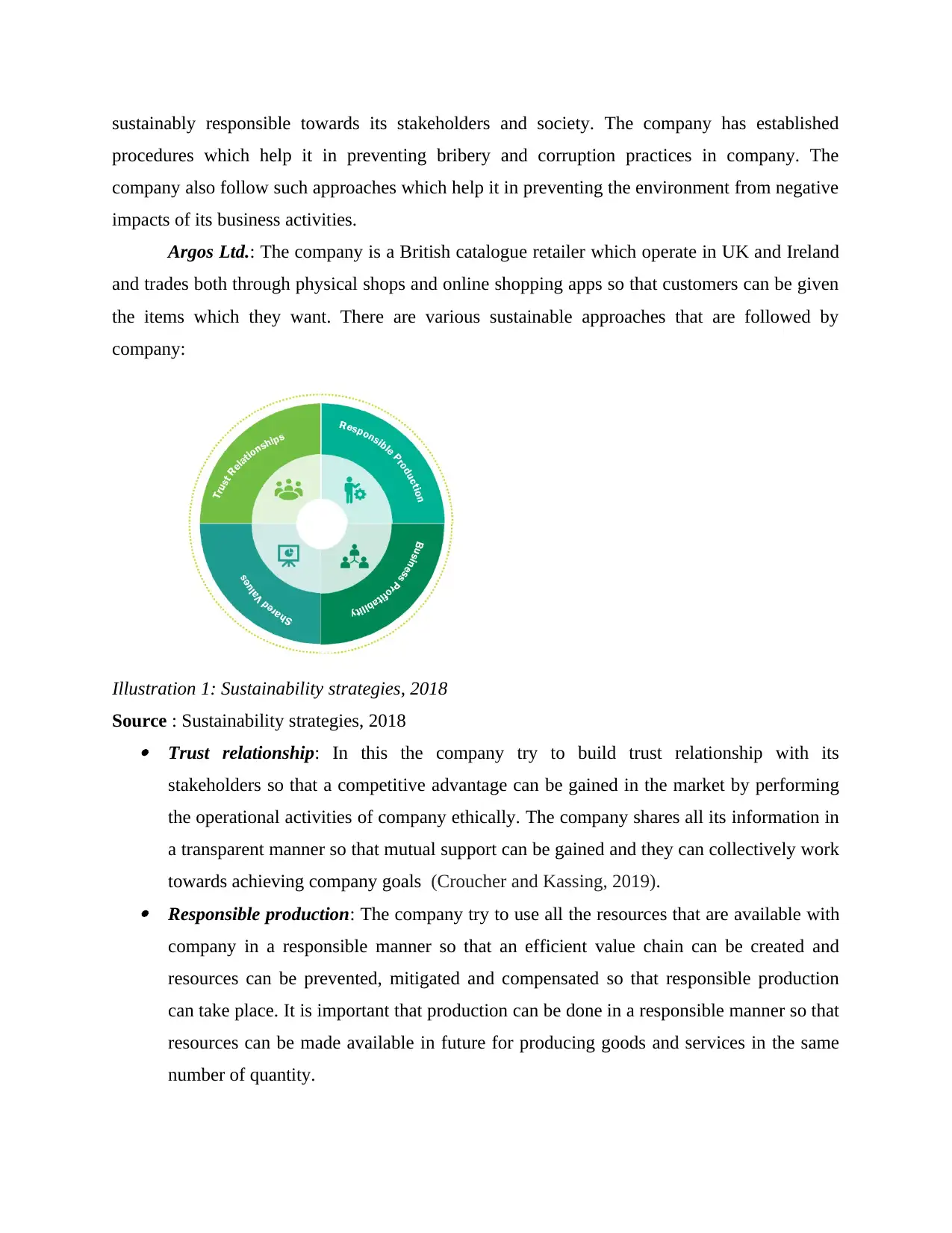
the items which they want. There are various sustainable approaches that are followed by
company:
Illustration 1: Sustainability strategies, 2018
Source : Sustainability strategies, 2018 Trust relationship: In this the company try to build trust relationship with its
stakeholders so that a competitive advantage can be gained in the market by performing
the operational activities of company ethically. The company shares all its information in
a transparent manner so that mutual support can be gained and they can collectively work
towards achieving company goals (Croucher and Kassing, 2019). Responsible production: The company try to use all the resources that are available with
company in a responsible manner so that an efficient value chain can be created and
resources can be prevented, mitigated and compensated so that responsible production
can take place. It is important that production can be done in a responsible manner so that
resources can be made available in future for producing goods and services in the same
number of quantity.
procedures which help it in preventing bribery and corruption practices in company. The
company also follow such approaches which help it in preventing the environment from negative
impacts of its business activities.
Argos Ltd.: The company is a British catalogue retailer which operate in UK and Ireland
and trades both through physical shops and online shopping apps so that customers can be given
the items which they want. There are various sustainable approaches that are followed by
company:
Illustration 1: Sustainability strategies, 2018
Source : Sustainability strategies, 2018 Trust relationship: In this the company try to build trust relationship with its
stakeholders so that a competitive advantage can be gained in the market by performing
the operational activities of company ethically. The company shares all its information in
a transparent manner so that mutual support can be gained and they can collectively work
towards achieving company goals (Croucher and Kassing, 2019). Responsible production: The company try to use all the resources that are available with
company in a responsible manner so that an efficient value chain can be created and
resources can be prevented, mitigated and compensated so that responsible production
can take place. It is important that production can be done in a responsible manner so that
resources can be made available in future for producing goods and services in the same
number of quantity.
Shared values: This means that company functions in such a manner that the shared
values and interests of all its stakeholders can be achieved. For achieving the shared
values it is important that the company follow ethical and sustainable strategies so that its
actions are accountable to all its stakeholders. This help in managing the resources of
company in an efficient manner so that the company can achieve the shared values of
company.
Business profitability: In order to increase the business profitability the company focuses
on bringing innovation and effective solutions in the market. This help in reducing its
costs and bringing cost-efficient solutions in market which help it in dealing with
changing market conditions. Innovation also help in creating high value for their
customers by providing them with goods and services that can help in dealing with their
demands. This increase company profits by bringing innovation in market (Dwyer and
Hopwood, 2019).
From the above discussion it can be seen that in order to succeed in market it is important
that companies follow ethical and sustainable strategies so that their activities can be made
accountable to all the interested stakeholders. Following are the other strategies with which
practices of companies can be made more sustainable and ethical: Developmental goals: Companies can help in development and growth of its employees
so that overall growth of company can be achieved. This can be done by involving
various kind of training and development programmes, performance appraisals, reward
systems so that the performance of employees can be improved. This will help companies
in achieving their goals in a manner which are also beneficial to their employees.
Reduction of CO2 emission: It is important that businesses follow such strategies which
can help in reducing the CO2 emission so that minimum harm is caused to the
environment. This can be done by limiting the number of ACs in company, limiting the
number of private cabins and bringing employees under one roof which will help in
effective team work and will also help saving electricity and CO2 emissions by AC.
Analysis of different approaches of CSR followed in different organisations
Corporate Social Responsibility (CSR) is a self regulating business model which help the
business in being socially, environmentally and economically responsible so that maximum
benefit can be given to all its stakeholders. CSR also help businesses in operating in such a
values and interests of all its stakeholders can be achieved. For achieving the shared
values it is important that the company follow ethical and sustainable strategies so that its
actions are accountable to all its stakeholders. This help in managing the resources of
company in an efficient manner so that the company can achieve the shared values of
company.
Business profitability: In order to increase the business profitability the company focuses
on bringing innovation and effective solutions in the market. This help in reducing its
costs and bringing cost-efficient solutions in market which help it in dealing with
changing market conditions. Innovation also help in creating high value for their
customers by providing them with goods and services that can help in dealing with their
demands. This increase company profits by bringing innovation in market (Dwyer and
Hopwood, 2019).
From the above discussion it can be seen that in order to succeed in market it is important
that companies follow ethical and sustainable strategies so that their activities can be made
accountable to all the interested stakeholders. Following are the other strategies with which
practices of companies can be made more sustainable and ethical: Developmental goals: Companies can help in development and growth of its employees
so that overall growth of company can be achieved. This can be done by involving
various kind of training and development programmes, performance appraisals, reward
systems so that the performance of employees can be improved. This will help companies
in achieving their goals in a manner which are also beneficial to their employees.
Reduction of CO2 emission: It is important that businesses follow such strategies which
can help in reducing the CO2 emission so that minimum harm is caused to the
environment. This can be done by limiting the number of ACs in company, limiting the
number of private cabins and bringing employees under one roof which will help in
effective team work and will also help saving electricity and CO2 emissions by AC.
Analysis of different approaches of CSR followed in different organisations
Corporate Social Responsibility (CSR) is a self regulating business model which help the
business in being socially, environmentally and economically responsible so that maximum
benefit can be given to all its stakeholders. CSR also help businesses in operating in such a
⊘ This is a preview!⊘
Do you want full access?
Subscribe today to unlock all pages.
Trusted by 1+ million students worldwide
manner that their activities are legal and ethical which make businesses accountable towards all
their actions and activities. CSR are important for both the customers and the companies as they
help in providing customers wit goods and services which do not create any harm to them while
the companies can save themselves from financial and legal issues by following CSR in their
business activities. These also help in motivating the employees and lifting their morale so that
they can utilise their complete potential in achieving company goals. The employees are most
important resources of company who must be kept motivated so that they can perform their work
in the desired manner which help in achieving company goals on time. CSR also help the
company in maintaining strong relations with their suppliers so that the supply chain can be
managed in an efficient manner ( Ganapathi, 2019). This helps businesses in making goods and
services available to customers on real time which is important to achieve maximum customer
satisfaction. CSR help businesses in gaining other benefits like improved brand image of
company, increased brand awareness which can help in increasing company sales, cost savings,
gain a competitive advantage in market, improved employee relations etc. Following are the
various approaches of CSR which are followed by different organisations:
Micro company: These are very small businesses that operate in UK and have
10employees or less working in the company. Also the turnover of company is £2 million or less
and the number of companies that are operating currently in UK are about 76% of total number
of businesses. It is important that in order to grow and develop in the market and to gain the
confidence of customers, suppliers etc. CSR approaches are followed by company. Castle Hill
Fire Protection Ltd. Is a micro company which is based in East Anglia and specialises in
installing passive fire protection products and systems for major construction projects. It is
important that the company follows CSR practices so that the trust of customers can be gained
which can help in protecting them from fire mishaps. The company follows the approach of
providing complete information to customers about how their products work so that high value
can be created for customers (Getchell and Lentz, 2019).
Small company: These are the businesses which employ less than 50 employees and the
turnover earned by them is under £10 million. These businesses operate at a bigger scale than
micro businesses but at a lower scale than large companies. It is important that CSR strategies
are followed in company so that profit can be earned and customers can be attracted which can
help in increasing its sales. CafePod Coffee Co. is a small business that works in UK in a
their actions and activities. CSR are important for both the customers and the companies as they
help in providing customers wit goods and services which do not create any harm to them while
the companies can save themselves from financial and legal issues by following CSR in their
business activities. These also help in motivating the employees and lifting their morale so that
they can utilise their complete potential in achieving company goals. The employees are most
important resources of company who must be kept motivated so that they can perform their work
in the desired manner which help in achieving company goals on time. CSR also help the
company in maintaining strong relations with their suppliers so that the supply chain can be
managed in an efficient manner ( Ganapathi, 2019). This helps businesses in making goods and
services available to customers on real time which is important to achieve maximum customer
satisfaction. CSR help businesses in gaining other benefits like improved brand image of
company, increased brand awareness which can help in increasing company sales, cost savings,
gain a competitive advantage in market, improved employee relations etc. Following are the
various approaches of CSR which are followed by different organisations:
Micro company: These are very small businesses that operate in UK and have
10employees or less working in the company. Also the turnover of company is £2 million or less
and the number of companies that are operating currently in UK are about 76% of total number
of businesses. It is important that in order to grow and develop in the market and to gain the
confidence of customers, suppliers etc. CSR approaches are followed by company. Castle Hill
Fire Protection Ltd. Is a micro company which is based in East Anglia and specialises in
installing passive fire protection products and systems for major construction projects. It is
important that the company follows CSR practices so that the trust of customers can be gained
which can help in protecting them from fire mishaps. The company follows the approach of
providing complete information to customers about how their products work so that high value
can be created for customers (Getchell and Lentz, 2019).
Small company: These are the businesses which employ less than 50 employees and the
turnover earned by them is under £10 million. These businesses operate at a bigger scale than
micro businesses but at a lower scale than large companies. It is important that CSR strategies
are followed in company so that profit can be earned and customers can be attracted which can
help in increasing its sales. CafePod Coffee Co. is a small business that works in UK in a
Paraphrase This Document
Need a fresh take? Get an instant paraphrase of this document with our AI Paraphraser
competitive market and is determined to become the best coffee shop in the world. The company
follows certain CSR approaches which help it in increasing its sales like increasing the quality of
coffee that it provides to its customers. Also the company tries to improve its service so that
customers can be attracted which can help in maximising the interests of all its stakeholders
(Kopaneva, 2019).
Corporate companies: These are the companies which employ more than 250 employees
and the turnover is over £50 million. These businesses help in providing employment
opportunities to a large number of people and help in the economic development of a place.
These businesses majorly contribute towards the overall development of society and so it is
important that they follow CSR in their practices which can help them in increasing the interests
of all its stakeholders. Tesco is an example of corporate business which needs to follow CSR
approaches so that it can acquire the trust of all its stakeholders which can help it in increasing
company profits. The main objective of business is to earn high profits by providing high quality
goods and services to its customers so that its brand image can improve and it can gain a
competitive advantage in the market. The approaches which are followed by the company are
that it manages its supply chain so that high quality of goods and services can be made available
to customer,. This also help in increasing the safety and health benefits of using Tesco products.
The company also follow various employee development programmes so that the skills and
talents of employees can be used in order to achieve company goals on time (Mediyawati,
2019).
From the above discussion it can be seen that there are differences in the CSR approaches
which are chosen by all the different types of businesses so that they can survive sustainably in
the market. For applying CSR approaches the size of business plays an important role as these
practices are to be followed in each and every activities of business which involves integrating
the functions of all the departments so that desired results can be achieved. It can be seen that the
micro business works at a small level which makes it easier to follow CSR approaches in
company so that interests of their stakeholders can be achieved (Oliveira and Handfield, 2019) .
Also as there is less government intervention its help these businesses to follow some rules and
neglect some other. In case of micro companies the CSR approaches that are followed help them
in gaining a strong brand image in market so that their sales can increase. It is important that they
follow ethical business practices so that the trust of all its stakeholders can be gained which can
follows certain CSR approaches which help it in increasing its sales like increasing the quality of
coffee that it provides to its customers. Also the company tries to improve its service so that
customers can be attracted which can help in maximising the interests of all its stakeholders
(Kopaneva, 2019).
Corporate companies: These are the companies which employ more than 250 employees
and the turnover is over £50 million. These businesses help in providing employment
opportunities to a large number of people and help in the economic development of a place.
These businesses majorly contribute towards the overall development of society and so it is
important that they follow CSR in their practices which can help them in increasing the interests
of all its stakeholders. Tesco is an example of corporate business which needs to follow CSR
approaches so that it can acquire the trust of all its stakeholders which can help it in increasing
company profits. The main objective of business is to earn high profits by providing high quality
goods and services to its customers so that its brand image can improve and it can gain a
competitive advantage in the market. The approaches which are followed by the company are
that it manages its supply chain so that high quality of goods and services can be made available
to customer,. This also help in increasing the safety and health benefits of using Tesco products.
The company also follow various employee development programmes so that the skills and
talents of employees can be used in order to achieve company goals on time (Mediyawati,
2019).
From the above discussion it can be seen that there are differences in the CSR approaches
which are chosen by all the different types of businesses so that they can survive sustainably in
the market. For applying CSR approaches the size of business plays an important role as these
practices are to be followed in each and every activities of business which involves integrating
the functions of all the departments so that desired results can be achieved. It can be seen that the
micro business works at a small level which makes it easier to follow CSR approaches in
company so that interests of their stakeholders can be achieved (Oliveira and Handfield, 2019) .
Also as there is less government intervention its help these businesses to follow some rules and
neglect some other. In case of micro companies the CSR approaches that are followed help them
in gaining a strong brand image in market so that their sales can increase. It is important that they
follow ethical business practices so that the trust of all its stakeholders can be gained which can
help it in its growth and development in market. Further as the large companies work on a large
level it is important that the company follows such approaches which can be easily implemented
in the overall organisation. The company thus follows approaches such as training and
development, reduction of CO2 emission etc. which can be easily applied in all its units and can
help it in achieving its CSR targets.
CONCLUSION
From this report it can be concluded that in order to grow and expand business in
competitive market it is important that CSR policies are adopted by the company so that they can
become responsible towards all its stakeholders. This help in gaining their trust and support so
that the company expansion can be easily done and a strong brand image can be created in
market. CSR also help businesses in preventing themselves from legal and financial issues as all
the activities of business will be ethically and responsibly done. All the businesses needs to
follow ethics in formulating their strategies and management so that high benefits can be gained
for all their stakeholders.
level it is important that the company follows such approaches which can be easily implemented
in the overall organisation. The company thus follows approaches such as training and
development, reduction of CO2 emission etc. which can be easily applied in all its units and can
help it in achieving its CSR targets.
CONCLUSION
From this report it can be concluded that in order to grow and expand business in
competitive market it is important that CSR policies are adopted by the company so that they can
become responsible towards all its stakeholders. This help in gaining their trust and support so
that the company expansion can be easily done and a strong brand image can be created in
market. CSR also help businesses in preventing themselves from legal and financial issues as all
the activities of business will be ethically and responsibly done. All the businesses needs to
follow ethics in formulating their strategies and management so that high benefits can be gained
for all their stakeholders.
⊘ This is a preview!⊘
Do you want full access?
Subscribe today to unlock all pages.
Trusted by 1+ million students worldwide
REFERENCES
Books and Journals
Bannier, C., Pauls, T. and Walter, A., 2019. Content analysis of business communication:
introducing a German dictionary. Journal of Business Economics. 89(1). pp.79-123.
Cardon, P. W., Huang, Y. and Power, G., 2019. Leadership communication on internal digital
platforms, emotional capital, and corporate performance: the case for leader-centric
listening. International Journal of Business Communication, p.2329488419828808.
Clevenger, M. R. and MacGregor, C. J., 2019. Business and Corporation Engagement with
Higher Education: Models, Theories and Best Practices. Emerald Group Publishing.
Croucher, S. M., Zeng, C. and Kassing, J., 2019. Learning to contradict and standing up for the
company: An exploration of the relationship between organizational dissent,
organizational assimilation, and organizational reputation. International Journal of
Business Communication. 56(3). pp.349-367.
Dwyer, J. and Hopwood, N., 2019. The business communication handbook. Cengage AU.
Ganapathi, N., 2019. The need for Intercultural Communication Skills in the Multicultural
Settings. Symbiosis Centre for Management Studies.
Getchell, K. M. and Lentz, P. eds., 2019. Rhetorical Theory and Praxis in the Business
Communication Classroom. Routledge.
Kopaneva, I. M., 2019. Left in the dust: Employee constructions of mission and vision
ownership. International Journal of Business Communication. 56(1). pp.122-145.
Mediyawati, N., 2019. MEDI a: Designing a Model of Ifl Learning Materials for Foreign
Workers. Cakrawala Pendidikan, 38(1), pp.75-89.
Oliveira, M. P. V. D. and Handfield, R., 2019. Analytical foundations for development of real-
time supply chain capabilities. International Journal of Production Research. 57(5).
pp.1571-1589.
Sahuichenko, V., 2019. Communication in education: reforms and risks. Dilemas
Contemporáneos: Educación, Política y Valores. 7(1).
Online
Sustainability Strategy. 2018. [Online] Available through: <https://argos.co/en/Integrated-
Report/bck-Sustainability-Strategy>.
Books and Journals
Bannier, C., Pauls, T. and Walter, A., 2019. Content analysis of business communication:
introducing a German dictionary. Journal of Business Economics. 89(1). pp.79-123.
Cardon, P. W., Huang, Y. and Power, G., 2019. Leadership communication on internal digital
platforms, emotional capital, and corporate performance: the case for leader-centric
listening. International Journal of Business Communication, p.2329488419828808.
Clevenger, M. R. and MacGregor, C. J., 2019. Business and Corporation Engagement with
Higher Education: Models, Theories and Best Practices. Emerald Group Publishing.
Croucher, S. M., Zeng, C. and Kassing, J., 2019. Learning to contradict and standing up for the
company: An exploration of the relationship between organizational dissent,
organizational assimilation, and organizational reputation. International Journal of
Business Communication. 56(3). pp.349-367.
Dwyer, J. and Hopwood, N., 2019. The business communication handbook. Cengage AU.
Ganapathi, N., 2019. The need for Intercultural Communication Skills in the Multicultural
Settings. Symbiosis Centre for Management Studies.
Getchell, K. M. and Lentz, P. eds., 2019. Rhetorical Theory and Praxis in the Business
Communication Classroom. Routledge.
Kopaneva, I. M., 2019. Left in the dust: Employee constructions of mission and vision
ownership. International Journal of Business Communication. 56(1). pp.122-145.
Mediyawati, N., 2019. MEDI a: Designing a Model of Ifl Learning Materials for Foreign
Workers. Cakrawala Pendidikan, 38(1), pp.75-89.
Oliveira, M. P. V. D. and Handfield, R., 2019. Analytical foundations for development of real-
time supply chain capabilities. International Journal of Production Research. 57(5).
pp.1571-1589.
Sahuichenko, V., 2019. Communication in education: reforms and risks. Dilemas
Contemporáneos: Educación, Política y Valores. 7(1).
Online
Sustainability Strategy. 2018. [Online] Available through: <https://argos.co/en/Integrated-
Report/bck-Sustainability-Strategy>.
Paraphrase This Document
Need a fresh take? Get an instant paraphrase of this document with our AI Paraphraser

PART 2 REFLECTIVE REPORT ON KEY SKILLS AND DEVELOPMENT
Learning is the life long process which is useful in shaping and forming things which is
based on the education, experience, training and so on. Individuals has their own preferred way
to learn things during the course of their lifetime. For instance, individuals can prefer class room
learning when they are young and want theoretical knowledge but when they want practical
knowledge they want formal training and it is done when they grow old. Above using VARK
model, it is analysed that communication, problem solving and ICT skills are those in which I am
lack and need improvement as this model refers to the suitable way by which student absorbs,
process and retain their information. This model is preferred in class room lectures as it is useful
in gaining widespread knowledge and recognition in education theory. In order to describe
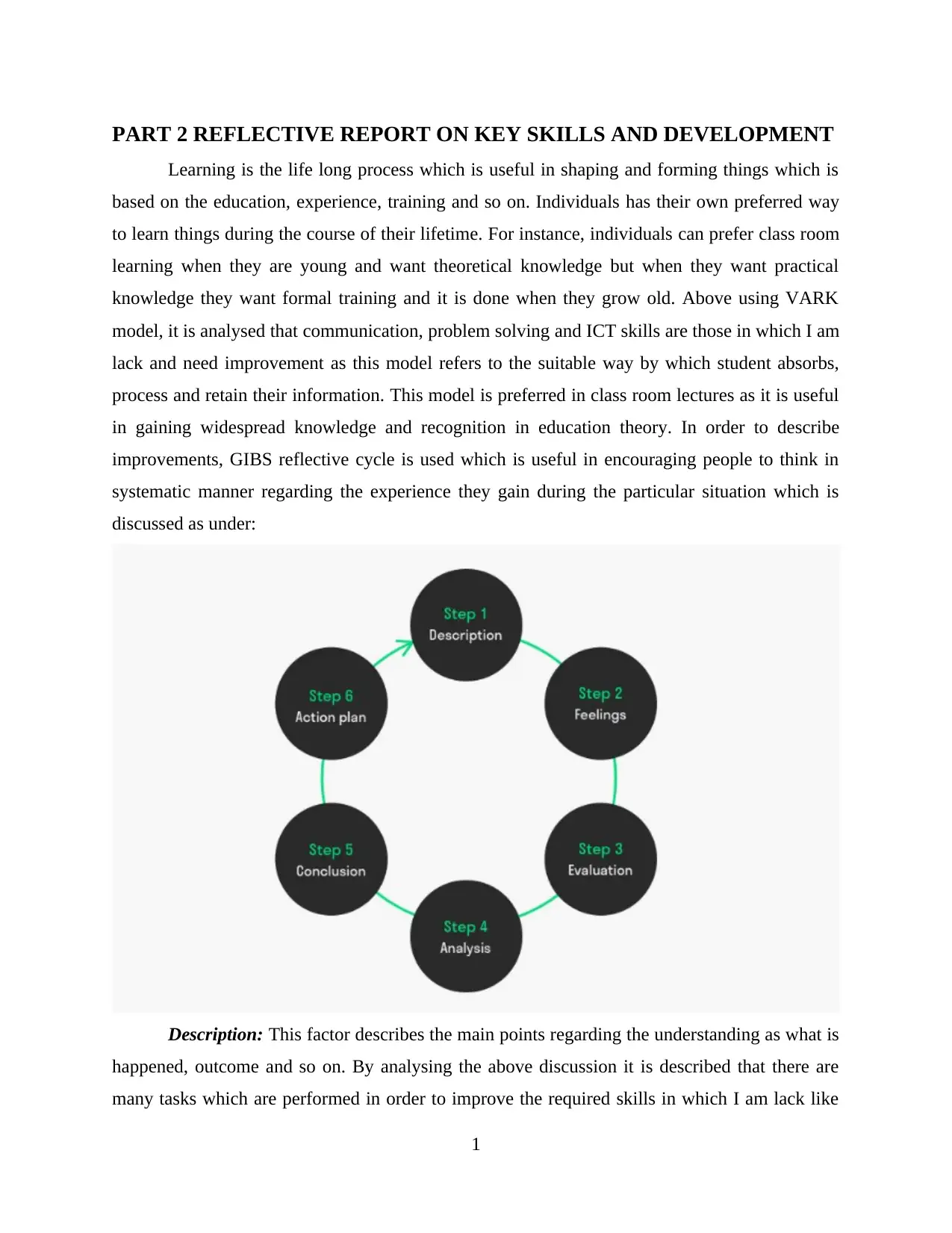
improvements, GIBS reflective cycle is used which is useful in encouraging people to think in
systematic manner regarding the experience they gain during the particular situation which is
discussed as under:
Description: This factor describes the main points regarding the understanding as what is
happened, outcome and so on. By analysing the above discussion it is described that there are
many tasks which are performed in order to improve the required skills in which I am lack like
1
Learning is the life long process which is useful in shaping and forming things which is
based on the education, experience, training and so on. Individuals has their own preferred way
to learn things during the course of their lifetime. For instance, individuals can prefer class room
learning when they are young and want theoretical knowledge but when they want practical
knowledge they want formal training and it is done when they grow old. Above using VARK
model, it is analysed that communication, problem solving and ICT skills are those in which I am
lack and need improvement as this model refers to the suitable way by which student absorbs,
process and retain their information. This model is preferred in class room lectures as it is useful
in gaining widespread knowledge and recognition in education theory. In order to describe
improvements, GIBS reflective cycle is used which is useful in encouraging people to think in
systematic manner regarding the experience they gain during the particular situation which is
discussed as under:
Description: This factor describes the main points regarding the understanding as what is
happened, outcome and so on. By analysing the above discussion it is described that there are
many tasks which are performed in order to improve the required skills in which I am lack like
1
⊘ This is a preview!⊘
Do you want full access?
Subscribe today to unlock all pages.
Trusted by 1+ million students worldwide

1 out of 14


Related Documents


Your All-in-One AI-Powered Toolkit for Academic Success.
+13062052269
info@desklib.com
Available 24*7 on WhatsApp / Email
![[object Object]](/_next/static/media/star-bottom.7253800d.svg)
Unlock your academic potential
Copyright © 2020–2026 A2Z Services. All Rights Reserved. Developed and managed by ZUCOL.