XNB375 Applied Psychology: Behaviour Change in Cardiac Rehab

Verified

Added on  2023/06/04

|6
|477
|61
Presentation
AI Summary
This presentation addresses the implementation and measurement of behaviour change techniques within cardiac rehabilitation, specifically focusing on a 52-year-old male, Michael, recovering from cardiovascular disease. It highlights the importance of cardiac rehabilitation in supporting patients to return to an active lifestyle and prevent further cardiovascular events. The presentation discusses various considerations for exercise psychologists, including medication adherence, smoking cessation, diet and nutrition, weight management, and psychological status. It emphasizes the role of a multi-disciplinary team and the application of behaviour change theories, such as using mobile applications to encourage physical activity and measuring behavioural change through methods like Item Response Theory and qualitative assessments involving tracking activity and self-perception. The presentation also references key research articles related to behaviour change interventions and the use of technology in promoting physical activity.

Document Page
Implementation and measurement of behavioural
change technique
tabler-icon-diamond-filled.svg

Paraphrase This Document

Need a fresh take? Get an instant paraphrase of this document with our AI Paraphraser
Document Page
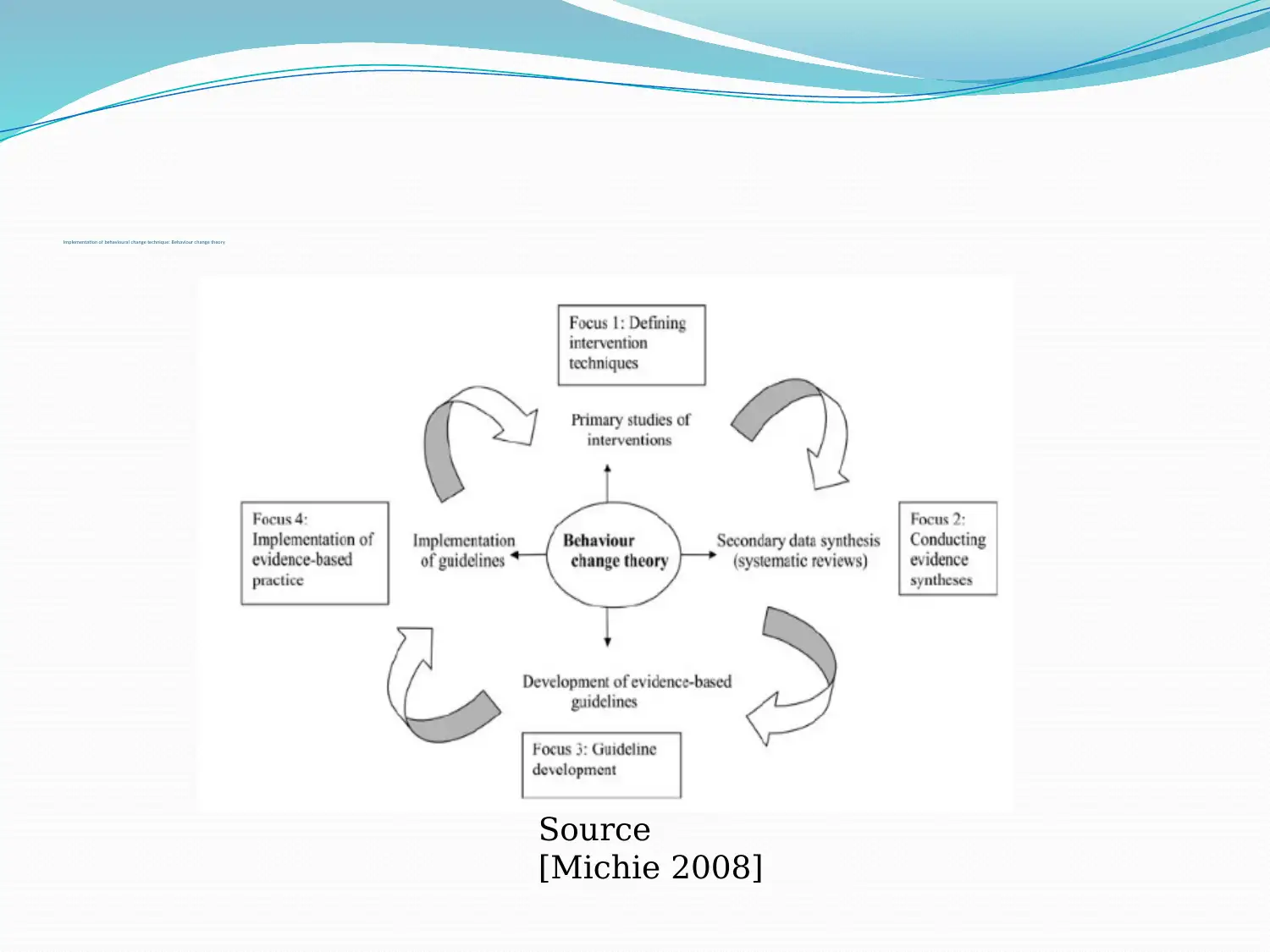
Implementation of behavioural change technique: Behaviour change theory
Source
[Michie 2008]
Document Page
Example of behavioural change technique according to behavioural change theory
Focus 1 Mobile application for encouraging
physical activity
Focus 2 Conducting evidence based
synthesis regarding the impact of mobile
application in internal motivation for physical
activity
Focus 3 Installation of an appropriate mobile
application for encouraging physical activity
Focus 4 Using of the mobile application for
increased internal motivation
Document Page
Measurement of behavioural change technique
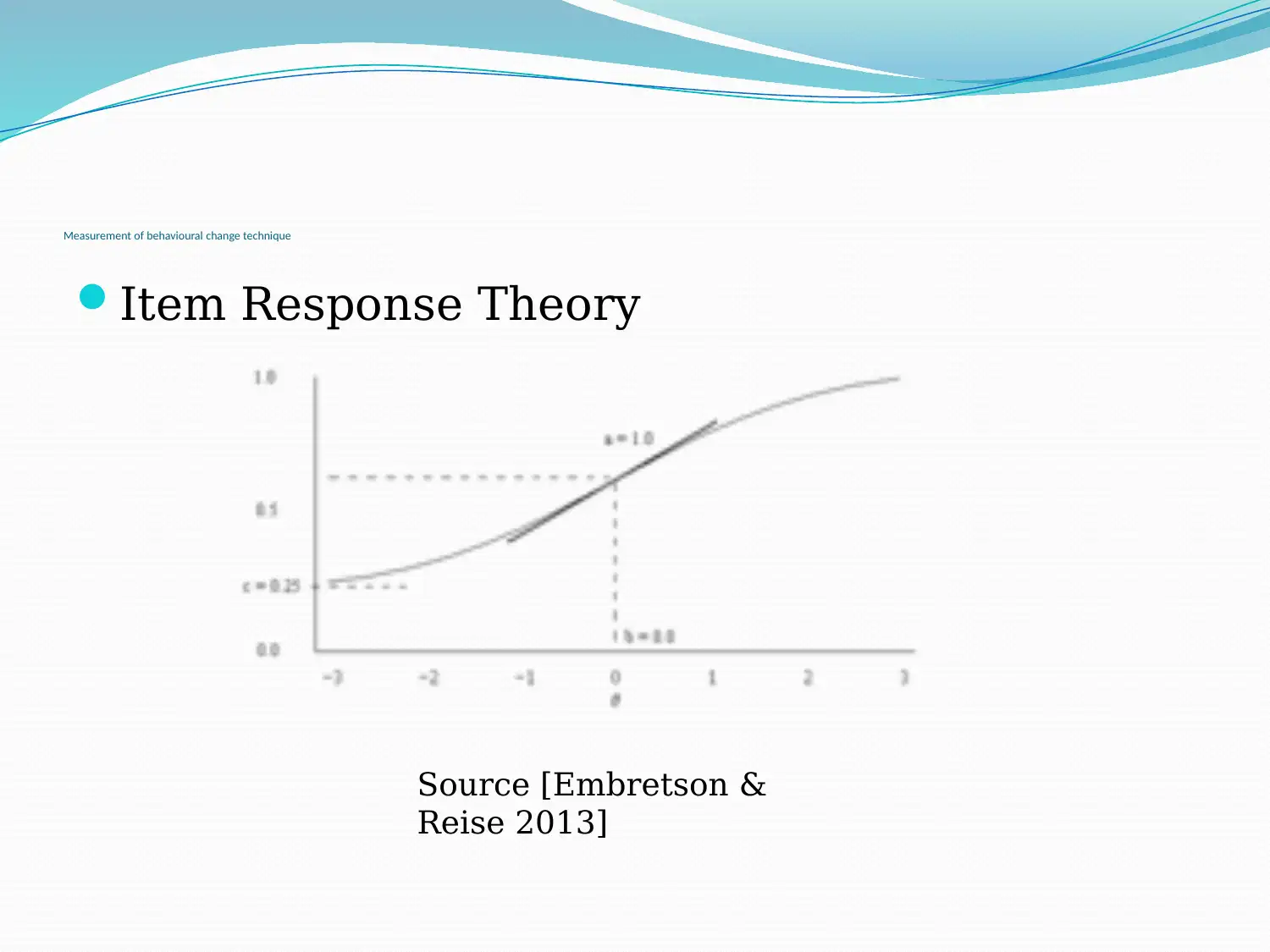
Item Response Theory
Source [Embretson &
Reise 2013]
tabler-icon-diamond-filled.svg

Paraphrase This Document

Need a fresh take? Get an instant paraphrase of this document with our AI Paraphraser
Document Page
Qualitative method of measurement of behavioral change
There are qualitative methods of measuring
the success of the application of an
intervention theory. This method involve
Tracking activity
Self perception of behavioural change
Others perception of behavioural change
Document Page
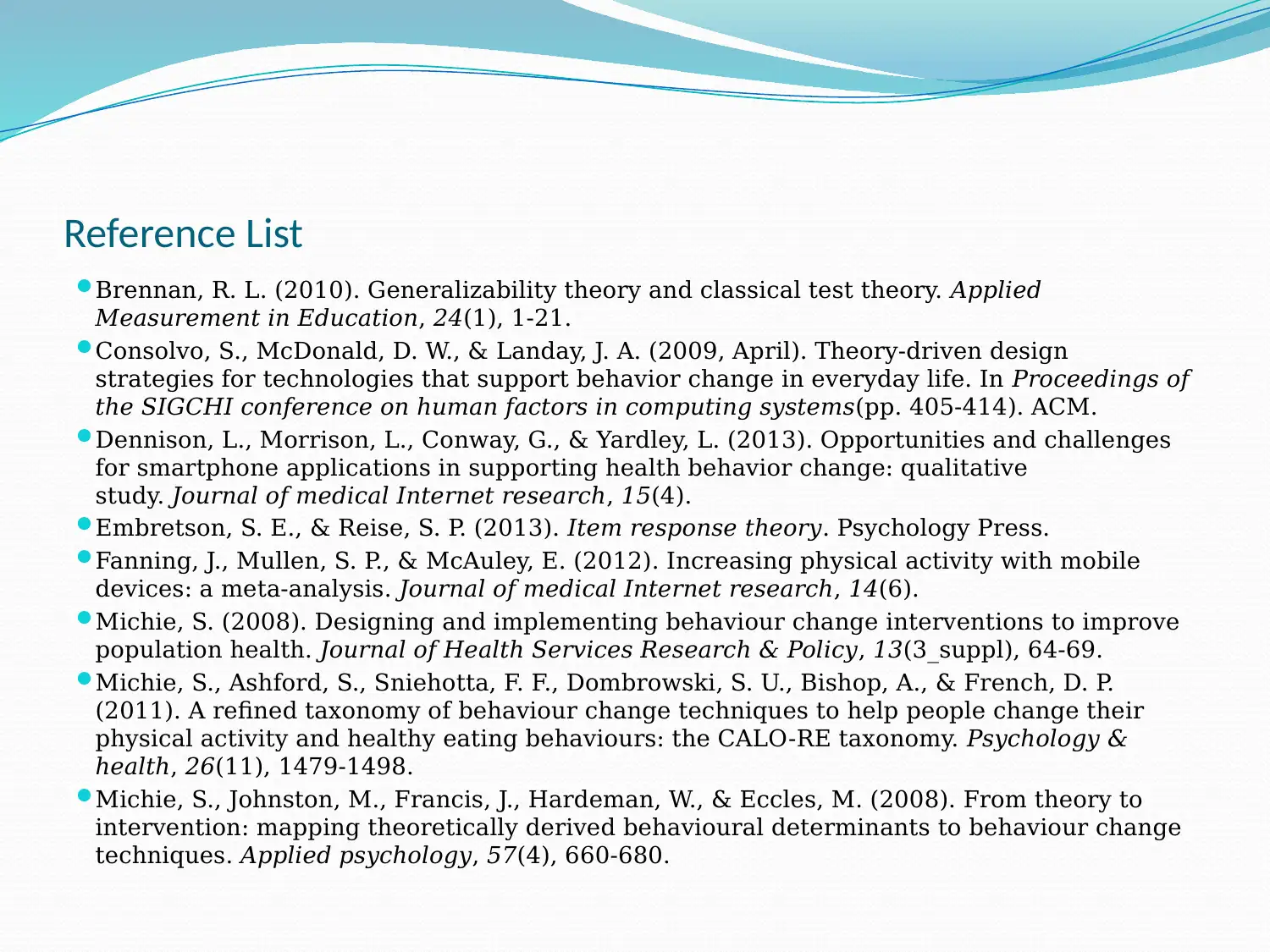
Reference List
Brennan, R. L. (2010). Generalizability theory and classical test theory. Applied
Measurement in Education, 24(1), 1-21.
Consolvo, S., McDonald, D. W., & Landay, J. A. (2009, April). Theory-driven design
strategies for technologies that support behavior change in everyday life. In Proceedings of
the SIGCHI conference on human factors in computing systems(pp. 405-414). ACM.
Dennison, L., Morrison, L., Conway, G., & Yardley, L. (2013). Opportunities and challenges
for smartphone applications in supporting health behavior change: qualitative
study. Journal of medical Internet research, 15(4).
Embretson, S. E., & Reise, S. P. (2013). Item response theory. Psychology Press.
Fanning, J., Mullen, S. P., & McAuley, E. (2012). Increasing physical activity with mobile
devices: a meta-analysis. Journal of medical Internet research, 14(6).
Michie, S. (2008). Designing and implementing behaviour change interventions to improve
population health. Journal of Health Services Research & Policy, 13(3_suppl), 64-69.
Michie, S., Ashford, S., Sniehotta, F. F., Dombrowski, S. U., Bishop, A., & French, D. P.
(2011). A refined taxonomy of behaviour change techniques to help people change their
physical activity and healthy eating behaviours: the CALO-RE taxonomy. Psychology &
health, 26(11), 1479-1498.
Michie, S., Johnston, M., Francis, J., Hardeman, W., & Eccles, M. (2008). From theory to
intervention: mapping theoretically derived behavioural determinants to behaviour change
techniques. Applied psychology, 57(4), 660-680.
chevron_up_icon
1 out of 6
circle_padding
hide_on_mobile
zoom_out_icon
[object Object]