MS FM Behavioral Finance Report: Prospect Theory and Biases Analysis
VerifiedAdded on 2022/10/11
|20
|4631
|29
Report
AI Summary
This report, prepared for Shefrain Consulting, delves into behavioral finance, examining prospect theory and its contrast with expected utility theory. It identifies various cognitive biases, including hindsight bias, and explores their impact on investment decisions and corporate finance. The report provides a detailed analysis of prospect theory's value function, loss aversion, and the equity premium puzzle. Furthermore, it explores the application of behavioral finance in investment strategies and portfolio allocation, considering the influence of behavioral factors on key financial decisions. The report also discusses the implications of behavioral finance on the author's career and the prospects for Shefrain Consulting, offering a comprehensive understanding of the field.

Running head : BEHAVIOURAL FINANCE
BEHAVIOURAL FINANCE
Name of the Student
Name of the University
Author Note
BEHAVIOURAL FINANCE
Name of the Student
Name of the University
Author Note

Paraphrase This Document
Need a fresh take? Get an instant paraphrase of this document with our AI Paraphraser
BEHAVIOURAL FINANCE
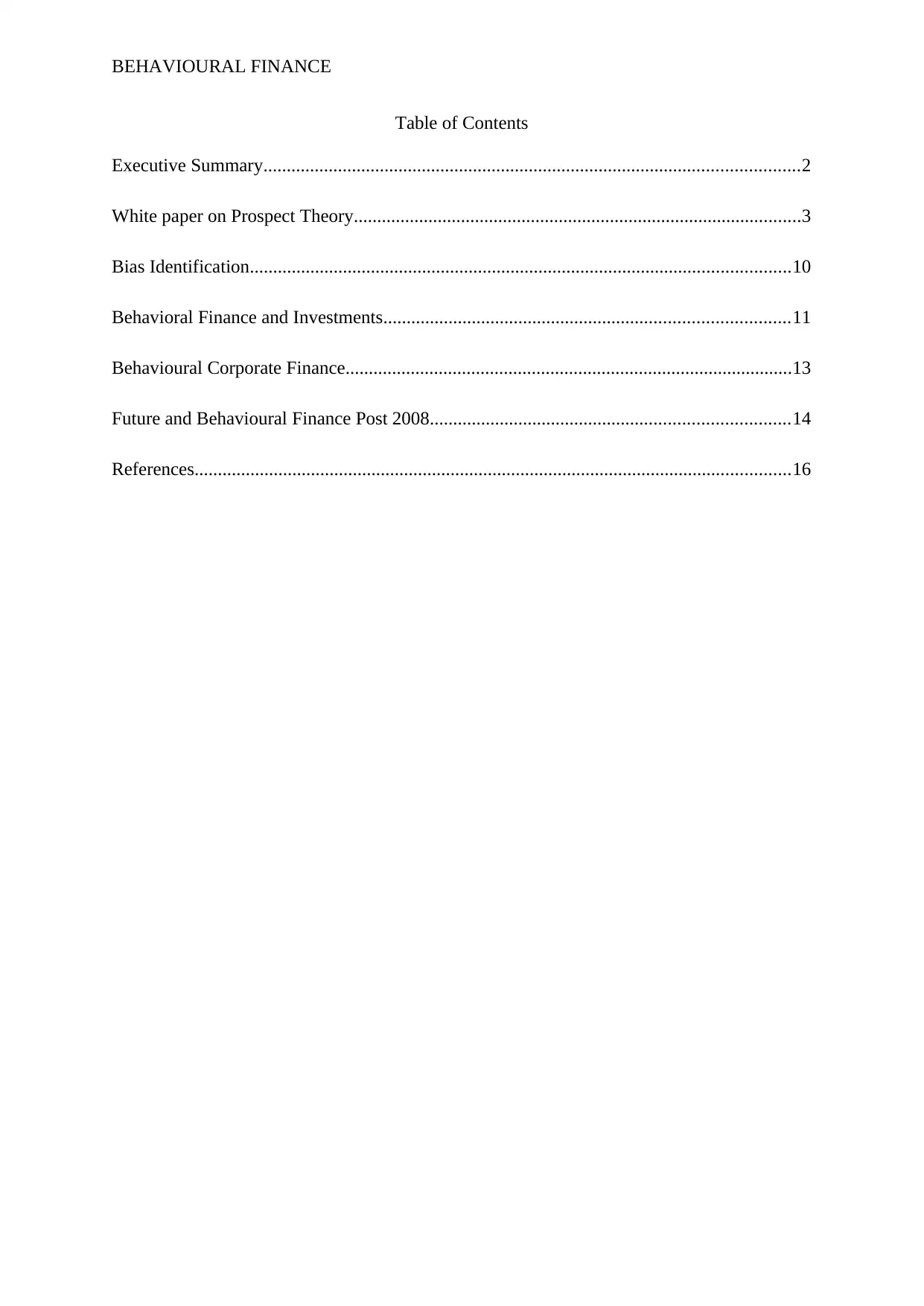
Table of Contents
Executive Summary...................................................................................................................2
White paper on Prospect Theory................................................................................................3
Bias Identification....................................................................................................................10
Behavioral Finance and Investments.......................................................................................11
Behavioural Corporate Finance................................................................................................13
Future and Behavioural Finance Post 2008.............................................................................14
References................................................................................................................................16
Table of Contents
Executive Summary...................................................................................................................2
White paper on Prospect Theory................................................................................................3
Bias Identification....................................................................................................................10
Behavioral Finance and Investments.......................................................................................11
Behavioural Corporate Finance................................................................................................13
Future and Behavioural Finance Post 2008.............................................................................14
References................................................................................................................................16

BEHAVIOURAL FINANCE
Executive Summary
The aim of the study is to deliver six parts for the new employer, Shefrain Consulting
for the purpose of demonstration of the competence in the area of the Behavioural Finance.
The report further aims towards a matured knowledge regarding the Prospect theory and the
areas where it implies, on the traditional theory of making of decisions. Apart from that, the
report gives knowledge on the various behaviour biases, and where can they be implemented.
It provides a brief demonstration on the theory of behaviour finance with respect to an
investment decision of a particular client as well as the allocation of its portfolio. The various
essential financial decisions, which may be impacted by the behavioural factors, are also
taken into consideration. It articulates the essential aspects of behaviour finance that may
have an impact on my career plus prospects for Shefrain Consulting.
Executive Summary
The aim of the study is to deliver six parts for the new employer, Shefrain Consulting
for the purpose of demonstration of the competence in the area of the Behavioural Finance.
The report further aims towards a matured knowledge regarding the Prospect theory and the
areas where it implies, on the traditional theory of making of decisions. Apart from that, the
report gives knowledge on the various behaviour biases, and where can they be implemented.
It provides a brief demonstration on the theory of behaviour finance with respect to an
investment decision of a particular client as well as the allocation of its portfolio. The various
essential financial decisions, which may be impacted by the behavioural factors, are also
taken into consideration. It articulates the essential aspects of behaviour finance that may
have an impact on my career plus prospects for Shefrain Consulting.
⊘ This is a preview!⊘
Do you want full access?
Subscribe today to unlock all pages.

Trusted by 1+ million students worldwide
BEHAVIOURAL FINANCE
White paper on Prospect Theory
1. Prospect theory vs. expected utility theory
Prospect Theory
(Barberis, Nicholas, Abhiroop Mukherjee, and Baolian Wang 2016)Prospect Theory
goes on an assumption that losses and the gains are estimated on the distinctly and
therefore the making of an individual’s decisions, which are on the basis of perceived
profits in place of the perceived losses(Deshmukh, G. K., and Sanskrity Joseph 2016).
The Prospect Theory is also called as the Loss Aversion theory( Ramiah, V., Zhao, Y.,
Moosa, I., & Graham, M. 2016). The general conception behind the Prospect theory is
that of two alternatives are taken together in front of a particular individual, both having
equality in the presentation in terms of the possible profits and the rest in terms of
potential losses, the first alternative being taken into consideration (Joo, Bashir Ahmad,
and Kokab Durri.2015).
The working of the Prospect theory
According to Baker, H. Kent, Greg Filbeck, and Victor Ricciardi (2017) The
Prospect theory can be defined as the theory which is a part of subgroup of Behavioural
Economics, which describes how the individuals can make a choice between the
probabilistic Alternative, which involves risks, and the possibility of distinct outputs id
not known to the individual. The underlying explanation for the behaviour of an
individual under the Behavioural Finance theory or the Prospect theory can be that due to
the choices that are independent and singular, the possibility of the profit or losses is
reasonably taken into the assumption as being the half possibility that is actually
presented. Significantly, the possibility of the profit is generally taken into perception as
much greater (Hsu, Dan K., Johan Wiklund, and Richard D. Cotton 2017). A proposal
White paper on Prospect Theory
1. Prospect theory vs. expected utility theory
Prospect Theory
(Barberis, Nicholas, Abhiroop Mukherjee, and Baolian Wang 2016)Prospect Theory
goes on an assumption that losses and the gains are estimated on the distinctly and
therefore the making of an individual’s decisions, which are on the basis of perceived
profits in place of the perceived losses(Deshmukh, G. K., and Sanskrity Joseph 2016).
The Prospect Theory is also called as the Loss Aversion theory( Ramiah, V., Zhao, Y.,
Moosa, I., & Graham, M. 2016). The general conception behind the Prospect theory is
that of two alternatives are taken together in front of a particular individual, both having
equality in the presentation in terms of the possible profits and the rest in terms of
potential losses, the first alternative being taken into consideration (Joo, Bashir Ahmad,
and Kokab Durri.2015).
The working of the Prospect theory
According to Baker, H. Kent, Greg Filbeck, and Victor Ricciardi (2017) The
Prospect theory can be defined as the theory which is a part of subgroup of Behavioural
Economics, which describes how the individuals can make a choice between the
probabilistic Alternative, which involves risks, and the possibility of distinct outputs id
not known to the individual. The underlying explanation for the behaviour of an
individual under the Behavioural Finance theory or the Prospect theory can be that due to
the choices that are independent and singular, the possibility of the profit or losses is
reasonably taken into the assumption as being the half possibility that is actually
presented. Significantly, the possibility of the profit is generally taken into perception as
much greater (Hsu, Dan K., Johan Wiklund, and Richard D. Cotton 2017). A proposal
Paraphrase This Document
Need a fresh take? Get an instant paraphrase of this document with our AI Paraphraser
BEHAVIOURAL FINANCE
from Tversky and Kahneman came that losses may lead to a greater emotional influence
on an individual compared to the one who does an equivalent amount of gain so given
alternatives presented in two ways. One with both offering the same outputs- an
individuals will choose the option which offers perceived profits (Tuyon, Jasman, and
Zamri Ahmad 2016 : Clark, William AV, and William Lisowski 2017).
Utility Theory
The utility theory is the theory which talks about the utility that is derived from a
certain commodity (goods or services). However, it is not possible to evaluate the amount
of utility that can be derived from a certain commodity. Therefore, in the utility theory the
alternatives are ordered in the ranks of their preferences to the consumer. As this
alternative, is limited by the price and the earnings of the consumers, the rational
consumer will not be spending the amount on an additional unit of the certain commodity
unless and until he receives the marginal or the additional utility from the consumption of
that commodity. Hence there is a relation to the marginal utility and the consumer will be
ranking the his or her preferences in accordance with that (Baddeley, Michelle 2018).
The utility theory in economics refers to the concept of the utility that can be derived
from the usage of a product. The moral philosophers like Jeremy Bentham and John
Stuart Mill also know it as the theory of Utilitarianism (Raj, and Supriya Maheshwari
2016).
Application
The application of Utility is where the economists undergo the construction of the
indifference curve that plot the bundles of the goods and services that an individual or a
society would take into acceptance the satisfaction at a given level. Indifferences and
utility curves are used by the economists for the understanding of the underpinnings of
from Tversky and Kahneman came that losses may lead to a greater emotional influence
on an individual compared to the one who does an equivalent amount of gain so given
alternatives presented in two ways. One with both offering the same outputs- an
individuals will choose the option which offers perceived profits (Tuyon, Jasman, and
Zamri Ahmad 2016 : Clark, William AV, and William Lisowski 2017).
Utility Theory
The utility theory is the theory which talks about the utility that is derived from a
certain commodity (goods or services). However, it is not possible to evaluate the amount
of utility that can be derived from a certain commodity. Therefore, in the utility theory the
alternatives are ordered in the ranks of their preferences to the consumer. As this
alternative, is limited by the price and the earnings of the consumers, the rational
consumer will not be spending the amount on an additional unit of the certain commodity
unless and until he receives the marginal or the additional utility from the consumption of
that commodity. Hence there is a relation to the marginal utility and the consumer will be
ranking the his or her preferences in accordance with that (Baddeley, Michelle 2018).
The utility theory in economics refers to the concept of the utility that can be derived
from the usage of a product. The moral philosophers like Jeremy Bentham and John
Stuart Mill also know it as the theory of Utilitarianism (Raj, and Supriya Maheshwari
2016).
Application
The application of Utility is where the economists undergo the construction of the
indifference curve that plot the bundles of the goods and services that an individual or a
society would take into acceptance the satisfaction at a given level. Indifferences and
utility curves are used by the economists for the understanding of the underpinnings of
BEHAVIOURAL FINANCE
the demand curves, that are half of the supply and demand analysis that is used for the
analysis of the workings of the good markets (Prashanth, L. A., et al 2016).
Prospect theory versus Utility theory
Utility Theory is considered one of the best normative theory in which it provides the
description on how the people are supposed to behave. It refers to the branch of homo
economics, which is the rationale, that is taken into assumption, as the consumer of the
classical economic theory. The theory also takes into assumptions the final results and the
of the wealth condition regarding risks that are linked to the proposed results (Kumar,
Satish, and Nisha Goyal 2015).
Contrasting to the Utility theory, the Prospect theory is a theory which is explanatory
in nature (Ebert, Sebastian, and Philipp Strack 2015). It seeks to provide description on
how the people actually behave, if they are given their bounds of rationality as well as the
calculations which are perfectly cognitive. It takes into assumptions which the individuals
take decision that are based on the profits and losses though some imaginary starting
points rather than the final outcomes that are obtained from those profits and losses.
The performances of trials by Tversky and Kahneman in developing of the prospect
theory showed that the tendency of people is to limitlessly weight the results with the
small possibilities and the underweight higher possible results (Li, Yongjian, and
Chengqing Wang 2017).
2. Example of the violation of Utility theory
Independent axiom
The derivation of the Von Neumann and Morgenstern’s utility theory refers to the
theory that is taken from three axioms, which are order, independence and continuity. The
the demand curves, that are half of the supply and demand analysis that is used for the
analysis of the workings of the good markets (Prashanth, L. A., et al 2016).
Prospect theory versus Utility theory
Utility Theory is considered one of the best normative theory in which it provides the
description on how the people are supposed to behave. It refers to the branch of homo
economics, which is the rationale, that is taken into assumption, as the consumer of the
classical economic theory. The theory also takes into assumptions the final results and the
of the wealth condition regarding risks that are linked to the proposed results (Kumar,
Satish, and Nisha Goyal 2015).
Contrasting to the Utility theory, the Prospect theory is a theory which is explanatory
in nature (Ebert, Sebastian, and Philipp Strack 2015). It seeks to provide description on
how the people actually behave, if they are given their bounds of rationality as well as the
calculations which are perfectly cognitive. It takes into assumptions which the individuals
take decision that are based on the profits and losses though some imaginary starting
points rather than the final outcomes that are obtained from those profits and losses.
The performances of trials by Tversky and Kahneman in developing of the prospect
theory showed that the tendency of people is to limitlessly weight the results with the
small possibilities and the underweight higher possible results (Li, Yongjian, and
Chengqing Wang 2017).
2. Example of the violation of Utility theory
Independent axiom
The derivation of the Von Neumann and Morgenstern’s utility theory refers to the
theory that is taken from three axioms, which are order, independence and continuity. The
⊘ This is a preview!⊘
Do you want full access?
Subscribe today to unlock all pages.
Trusted by 1+ million students worldwide
BEHAVIOURAL FINANCE
independent axiom states, “if an alternative is non optimal for a leadership decision
problem, it cannot be made optimal by adding new alternatives to the problem.” The
independent axiom, which is also called the “principle of independence of irrelevant
alternatives” (LTUNTAŞ, Semra T., Vedat Sarikovanlik, and Nertil Mera 2017).
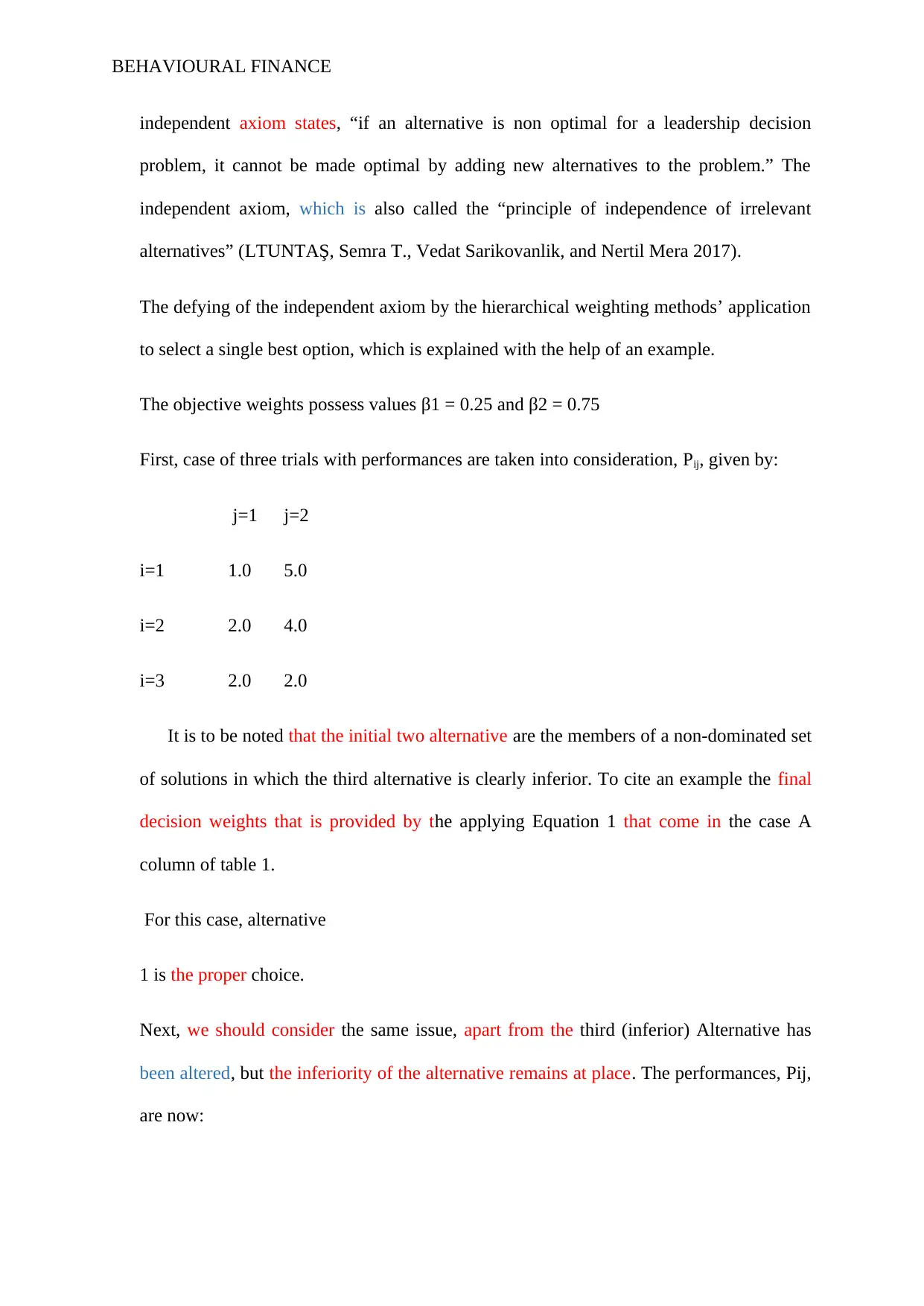
The defying of the independent axiom by the hierarchical weighting methods’ application
to select a single best option, which is explained with the help of an example.
The objective weights possess values β1 = 0.25 and β2 = 0.75
First, case of three trials with performances are taken into consideration, Pij, given by:
j=1 j=2
i=1 1.0 5.0
i=2 2.0 4.0
i=3 2.0 2.0
It is to be noted that the initial two alternative are the members of a non-dominated set
of solutions in which the third alternative is clearly inferior. To cite an example the final
decision weights that is provided by the applying Equation 1 that come in the case A
column of table 1.
For this case, alternative
1 is the proper choice.
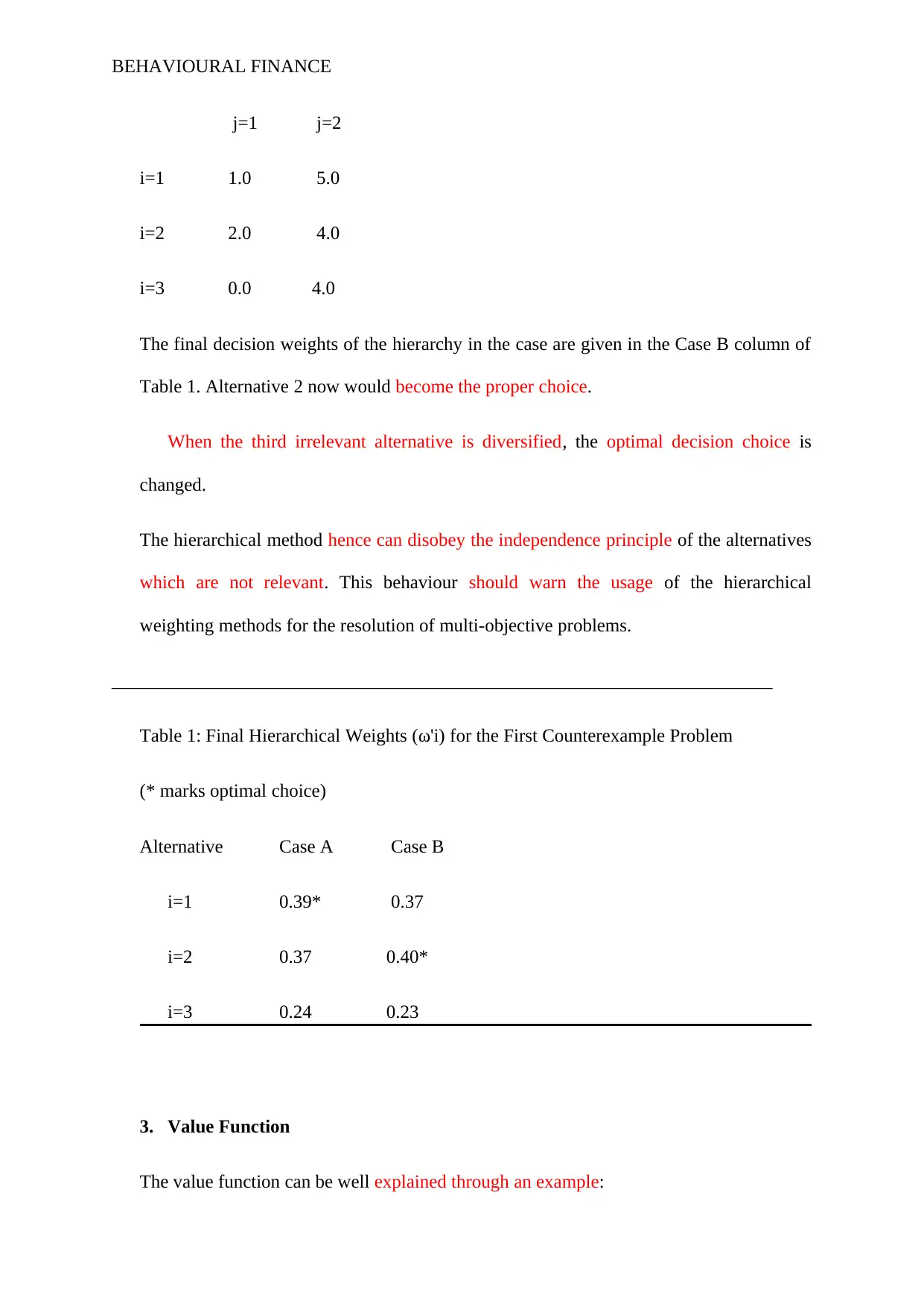
Next, we should consider the same issue, apart from the third (inferior) Alternative has
been altered, but the inferiority of the alternative remains at place. The performances, Pij,
are now:
independent axiom states, “if an alternative is non optimal for a leadership decision
problem, it cannot be made optimal by adding new alternatives to the problem.” The
independent axiom, which is also called the “principle of independence of irrelevant
alternatives” (LTUNTAŞ, Semra T., Vedat Sarikovanlik, and Nertil Mera 2017).
The defying of the independent axiom by the hierarchical weighting methods’ application
to select a single best option, which is explained with the help of an example.
The objective weights possess values β1 = 0.25 and β2 = 0.75
First, case of three trials with performances are taken into consideration, Pij, given by:
j=1 j=2
i=1 1.0 5.0
i=2 2.0 4.0
i=3 2.0 2.0
It is to be noted that the initial two alternative are the members of a non-dominated set
of solutions in which the third alternative is clearly inferior. To cite an example the final
decision weights that is provided by the applying Equation 1 that come in the case A
column of table 1.
For this case, alternative
1 is the proper choice.
Next, we should consider the same issue, apart from the third (inferior) Alternative has
been altered, but the inferiority of the alternative remains at place. The performances, Pij,
are now:
Paraphrase This Document
Need a fresh take? Get an instant paraphrase of this document with our AI Paraphraser
BEHAVIOURAL FINANCE
j=1 j=2
i=1 1.0 5.0
i=2 2.0 4.0
i=3 0.0 4.0
The final decision weights of the hierarchy in the case are given in the Case B column of
Table 1. Alternative 2 now would become the proper choice.
When the third irrelevant alternative is diversified, the optimal decision choice is
changed.
The hierarchical method hence can disobey the independence principle of the alternatives
which are not relevant. This behaviour should warn the usage of the hierarchical
weighting methods for the resolution of multi-objective problems.
_______________________________________________________________________
Table 1: Final Hierarchical Weights (ω'i) for the First Counterexample Problem
(* marks optimal choice)
Alternative Case A Case B
i=1 0.39* 0.37
i=2 0.37 0.40*
i=3 0.24 0.23
3. Value Function
The value function can be well explained through an example:
j=1 j=2
i=1 1.0 5.0
i=2 2.0 4.0
i=3 0.0 4.0
The final decision weights of the hierarchy in the case are given in the Case B column of
Table 1. Alternative 2 now would become the proper choice.
When the third irrelevant alternative is diversified, the optimal decision choice is
changed.
The hierarchical method hence can disobey the independence principle of the alternatives
which are not relevant. This behaviour should warn the usage of the hierarchical
weighting methods for the resolution of multi-objective problems.
_______________________________________________________________________
Table 1: Final Hierarchical Weights (ω'i) for the First Counterexample Problem
(* marks optimal choice)
Alternative Case A Case B
i=1 0.39* 0.37
i=2 0.37 0.40*
i=3 0.24 0.23
3. Value Function
The value function can be well explained through an example:
BEHAVIOURAL FINANCE
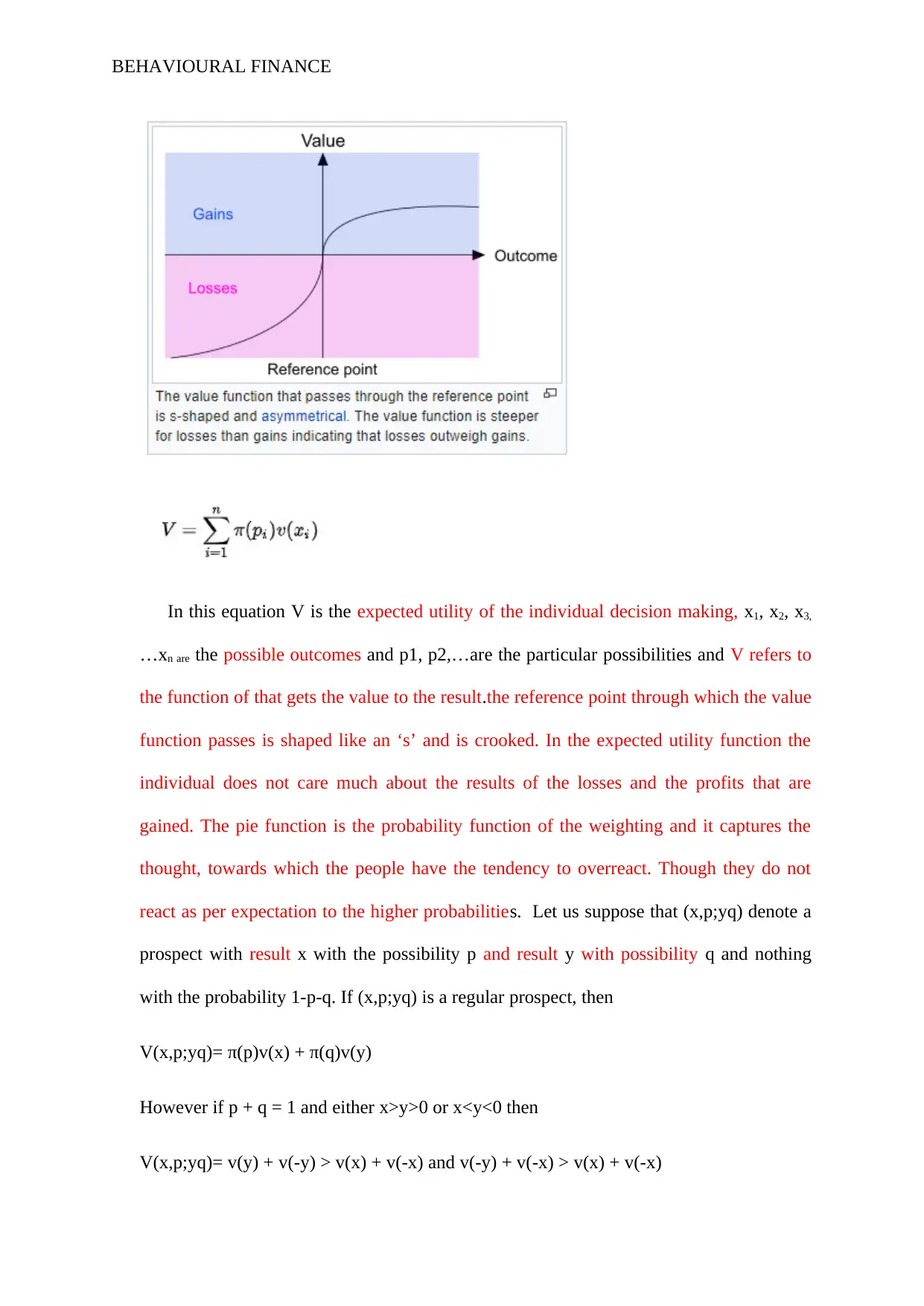
In this equation V is the expected utility of the individual decision making, x1, x2, x3,
…xn are the possible outcomes and p1, p2,…are the particular possibilities and V refers to
the function of that gets the value to the result.the reference point through which the value
function passes is shaped like an ‘s’ and is crooked. In the expected utility function the
individual does not care much about the results of the losses and the profits that are
gained. The pie function is the probability function of the weighting and it captures the
thought, towards which the people have the tendency to overreact. Though they do not
react as per expectation to the higher probabilities. Let us suppose that (x,p;yq) denote a
prospect with result x with the possibility p and result y with possibility q and nothing
with the probability 1-p-q. If (x,p;yq) is a regular prospect, then
V(x,p;yq)= π(p)v(x) + π(q)v(y)
However if p + q = 1 and either x>y>0 or x<y<0 then
V(x,p;yq)= v(y) + v(-y) > v(x) + v(-x) and v(-y) + v(-x) > v(x) + v(-x)
In this equation V is the expected utility of the individual decision making, x1, x2, x3,
…xn are the possible outcomes and p1, p2,…are the particular possibilities and V refers to
the function of that gets the value to the result.the reference point through which the value
function passes is shaped like an ‘s’ and is crooked. In the expected utility function the
individual does not care much about the results of the losses and the profits that are
gained. The pie function is the probability function of the weighting and it captures the
thought, towards which the people have the tendency to overreact. Though they do not
react as per expectation to the higher probabilities. Let us suppose that (x,p;yq) denote a
prospect with result x with the possibility p and result y with possibility q and nothing
with the probability 1-p-q. If (x,p;yq) is a regular prospect, then
V(x,p;yq)= π(p)v(x) + π(q)v(y)
However if p + q = 1 and either x>y>0 or x<y<0 then
V(x,p;yq)= v(y) + v(-y) > v(x) + v(-x) and v(-y) + v(-x) > v(x) + v(-x)
⊘ This is a preview!⊘
Do you want full access?
Subscribe today to unlock all pages.
Trusted by 1+ million students worldwide
BEHAVIOURAL FINANCE
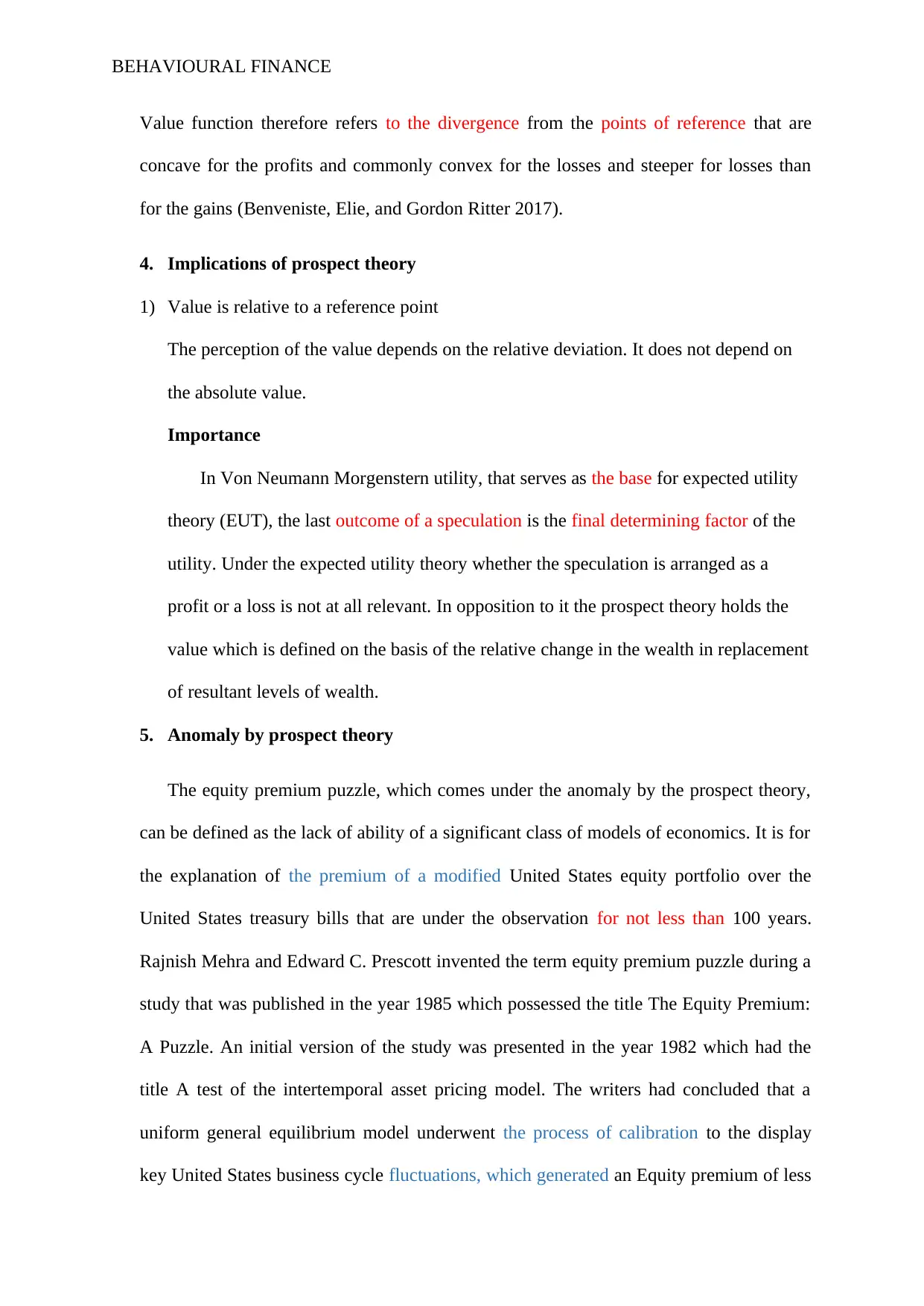
Value function therefore refers to the divergence from the points of reference that are
concave for the profits and commonly convex for the losses and steeper for losses than
for the gains (Benveniste, Elie, and Gordon Ritter 2017).
4. Implications of prospect theory
1) Value is relative to a reference point
The perception of the value depends on the relative deviation. It does not depend on
the absolute value.
Importance
In Von Neumann Morgenstern utility, that serves as the base for expected utility
theory (EUT), the last outcome of a speculation is the final determining factor of the
utility. Under the expected utility theory whether the speculation is arranged as a
profit or a loss is not at all relevant. In opposition to it the prospect theory holds the
value which is defined on the basis of the relative change in the wealth in replacement
of resultant levels of wealth.
5. Anomaly by prospect theory
The equity premium puzzle, which comes under the anomaly by the prospect theory,
can be defined as the lack of ability of a significant class of models of economics. It is for
the explanation of the premium of a modified United States equity portfolio over the
United States treasury bills that are under the observation for not less than 100 years.
Rajnish Mehra and Edward C. Prescott invented the term equity premium puzzle during a
study that was published in the year 1985 which possessed the title The Equity Premium:
A Puzzle. An initial version of the study was presented in the year 1982 which had the
title A test of the intertemporal asset pricing model. The writers had concluded that a
uniform general equilibrium model underwent the process of calibration to the display
key United States business cycle fluctuations, which generated an Equity premium of less
Value function therefore refers to the divergence from the points of reference that are
concave for the profits and commonly convex for the losses and steeper for losses than
for the gains (Benveniste, Elie, and Gordon Ritter 2017).
4. Implications of prospect theory
1) Value is relative to a reference point
The perception of the value depends on the relative deviation. It does not depend on
the absolute value.
Importance
In Von Neumann Morgenstern utility, that serves as the base for expected utility
theory (EUT), the last outcome of a speculation is the final determining factor of the
utility. Under the expected utility theory whether the speculation is arranged as a
profit or a loss is not at all relevant. In opposition to it the prospect theory holds the
value which is defined on the basis of the relative change in the wealth in replacement
of resultant levels of wealth.
5. Anomaly by prospect theory
The equity premium puzzle, which comes under the anomaly by the prospect theory,
can be defined as the lack of ability of a significant class of models of economics. It is for
the explanation of the premium of a modified United States equity portfolio over the
United States treasury bills that are under the observation for not less than 100 years.
Rajnish Mehra and Edward C. Prescott invented the term equity premium puzzle during a
study that was published in the year 1985 which possessed the title The Equity Premium:
A Puzzle. An initial version of the study was presented in the year 1982 which had the
title A test of the intertemporal asset pricing model. The writers had concluded that a
uniform general equilibrium model underwent the process of calibration to the display
key United States business cycle fluctuations, which generated an Equity premium of less
Paraphrase This Document
Need a fresh take? Get an instant paraphrase of this document with our AI Paraphraser

BEHAVIOURAL FINANCE
than 1 % for an answerable risk aversion levels. This outcome stood in sharp opposition
with the average equity premium of six percent that was observed during the historical
period (Dickason-Koekemoer, Z., and S. J. Ferreira. 2018).
Bias Identification
The concept for the first conversation
The concept of behavioural finance that is followed in the first conversation is the
hindsight Bias. In this concept the people are more likely to make predictions. If they find
out that, their prediction is coming true they would stick to the same decision making in the
next investment (Heaton, J. B.2019). However no one is confident of the future possibilities.
They tend to make decisions based on predictions. In this model, just because he knows the
industry well, he thinks that whatever predictions he would make, will fetch him better
returns, which is absolutely a sign of poor decision making skills(Lane, Anthony, et al 2016).
The concept for the second conversation
The concept of behavioural finance that is followed in the second conversation is the
Illusion of Control. There are many investors, who make their decision under the illusion of
control. In this concept if a person had invested some amount in stocks or shares and earns
profits thereafter, he goes on an assumption that the strategy that he uses to get the profits
year after year is the only strategy that exists in order to earn the similar amounts of profits
for the subsequent years. They consider themselves very superior. They have a thought
procedure that taking assistance from the external sources is not of much help.
With reference to the case, the person takes undue advantage of the losses, that are not
being showcased. He thinks that the way he is carrying on his operations is right. However he
refuses to take opinions from others. Therefore Illusion of Control concept is appropriate for
this case.
than 1 % for an answerable risk aversion levels. This outcome stood in sharp opposition
with the average equity premium of six percent that was observed during the historical
period (Dickason-Koekemoer, Z., and S. J. Ferreira. 2018).
Bias Identification
The concept for the first conversation
The concept of behavioural finance that is followed in the first conversation is the
hindsight Bias. In this concept the people are more likely to make predictions. If they find
out that, their prediction is coming true they would stick to the same decision making in the
next investment (Heaton, J. B.2019). However no one is confident of the future possibilities.
They tend to make decisions based on predictions. In this model, just because he knows the
industry well, he thinks that whatever predictions he would make, will fetch him better
returns, which is absolutely a sign of poor decision making skills(Lane, Anthony, et al 2016).
The concept for the second conversation
The concept of behavioural finance that is followed in the second conversation is the
Illusion of Control. There are many investors, who make their decision under the illusion of
control. In this concept if a person had invested some amount in stocks or shares and earns
profits thereafter, he goes on an assumption that the strategy that he uses to get the profits
year after year is the only strategy that exists in order to earn the similar amounts of profits
for the subsequent years. They consider themselves very superior. They have a thought
procedure that taking assistance from the external sources is not of much help.
With reference to the case, the person takes undue advantage of the losses, that are not
being showcased. He thinks that the way he is carrying on his operations is right. However he
refuses to take opinions from others. Therefore Illusion of Control concept is appropriate for
this case.
BEHAVIOURAL FINANCE
The concept for the third conversation
The concept of behavioural finance that has been used in the third conversation is the
confirmation Bias. In this concept, they have their inclination towards a specific information
that they have in their mind. These people do perform research works, and if the research that
they preform passes by them, they believe that the decision that they took is the one and only
decision that can be taken ion such an occurrence. They don’t do any kind of further research
work regarding the matter.
Behavioral Finance and Investments
1) Siosan’s Utility Function
The Siosan’s utility function can be defined as the combination of investments, which
will be generating maximum returns to her investment portfolio. It can be observed that, she
is a risk-averse investor and makes an optimum combination of short-term money market and
security market instruments in her investment portfolio. Therefore, she constructs and defines
all her investment and debt combinations, which will maximize her return with a lower risk
assumption.
Contrastingly, the traditional finance theory has two concepts and the most important
of them is the wealth maximization approach. In traditional finance theory, more focus is
given on the pay-outs or the return from an investment and less focus is given on the risk
aspect of the investment. The wealth maximization concept of traditional finance theory
requires making such investment strategies, which will maximize the value of the investment
or the overall wealth of the investor. In this case study, if Siosan follows the traditional
finance approach, then she would have constructed her investment portfolio with an objective
of increasing the value of total investment. In achieving such target, more growth securities
could have been included in her investment portfolio.
The concept for the third conversation
The concept of behavioural finance that has been used in the third conversation is the
confirmation Bias. In this concept, they have their inclination towards a specific information
that they have in their mind. These people do perform research works, and if the research that
they preform passes by them, they believe that the decision that they took is the one and only
decision that can be taken ion such an occurrence. They don’t do any kind of further research
work regarding the matter.
Behavioral Finance and Investments
1) Siosan’s Utility Function
The Siosan’s utility function can be defined as the combination of investments, which
will be generating maximum returns to her investment portfolio. It can be observed that, she
is a risk-averse investor and makes an optimum combination of short-term money market and
security market instruments in her investment portfolio. Therefore, she constructs and defines
all her investment and debt combinations, which will maximize her return with a lower risk
assumption.
Contrastingly, the traditional finance theory has two concepts and the most important
of them is the wealth maximization approach. In traditional finance theory, more focus is
given on the pay-outs or the return from an investment and less focus is given on the risk
aspect of the investment. The wealth maximization concept of traditional finance theory
requires making such investment strategies, which will maximize the value of the investment
or the overall wealth of the investor. In this case study, if Siosan follows the traditional
finance approach, then she would have constructed her investment portfolio with an objective
of increasing the value of total investment. In achieving such target, more growth securities
could have been included in her investment portfolio.
⊘ This is a preview!⊘
Do you want full access?
Subscribe today to unlock all pages.
Trusted by 1+ million students worldwide

1 out of 20


Related Documents


Your All-in-One AI-Powered Toolkit for Academic Success.
+13062052269
info@desklib.com
Available 24*7 on WhatsApp / Email
![[object Object]](/_next/static/media/star-bottom.7253800d.svg)
Unlock your academic potential
Copyright © 2020–2026 A2Z Services. All Rights Reserved. Developed and managed by ZUCOL.