ITC571 Emerging Tech: Project Plan on Big Data Analytics in Retail

Verified

Added on  2023/06/16

|7
|1435
|91
Project
AI Summary
This project plan delves into the impact of big data analytics within the retail sector. It outlines the aims and objectives of the study, focusing on how retailers can leverage big data for informed decision-making and competitive advantage. The research methodology involves both primary data collection through interviews with retail managers and secondary data analysis from annual reports and academic journals. The plan anticipates positive outcomes from adopting big data analytics, including enhanced customer preference understanding and improved decision-making processes, while also acknowledging potential challenges in implementation. A timeline is provided for task completion, encompassing knowledge acquisition, literature review, data collection, analysis, and final report submission. Desklib provides access to similar project plans and solved assignments.
Document Page
Running head: PROJECT PLAN
Impact of Big data Analytics in retail
Name of the Student
Name of the University
Author Note
tabler-icon-diamond-filled.svg

Paraphrase This Document

Need a fresh take? Get an instant paraphrase of this document with our AI Paraphraser
Document Page
1
PROJECT PLAN
Table of Contents
Title:.....................................................................................................................................2
1. Introduction......................................................................................................................2
1.1. Aims of the Study.....................................................................................................2
1.2. Objectives of the Research Study.............................................................................2
2. Materials and Methods....................................................................................................3
2.1. Research Methodology.............................................................................................3
2.2. Materials...................................................................................................................3
3. Results..............................................................................................................................4
3.1. Expected Outcome....................................................................................................5
4. Timeline...........................................................................................................................5
References............................................................................................................................6
Document Page
2
PROJECT PLAN
Title: Impact of Big data Analytics in retail
1. Introduction
Big data analytics generally concerns the idea of going through an enormous amount of
variable data set with an aim to uncover many hidden information, unknown correlations and the
preferences of the customers that would be useful in for taking business decisions. This
information generally helps an organization in understanding the market trends that in turn helps
the organization in improving their business processes and operation for gaining a competitive
advantage over their rivals. It has a large-scale usage and impact in the retail business. The
retailers gain a comprehensive understanding by leveraging the collected information from their
customers. It is a process used by which retailers connect to their consumers in a meaningful way
in order to gain information about their preferences. The big data analytics concept is not new;
however, research about the big data application and usage in retail is needed in order to
understand to what extent the retailers can use the big data for gaining a competitive advantage
in the market place.
1.1. Aims of the Study
The research proposal aims at analyzing the impact of big data in retail sectors for
making proper business related decisions. The research will focus on role of big data in fetching
some crucial information that can be used by the retailers for taking certain business decisions.
Retailers leverage their information assets in order to gain a comprehensive advantage in market.
The research focuses on the challenges that the retailers might face in order to do so.
1.2. Objectives of the Research Study
Document Page
3
PROJECT PLAN
Identified objectives of the research are as follows-
To understand the use of big data analytics in retail sector
To understand the impact of big data in retail sector
To identify the challenges that retail sector might face while leveraging their
information assts
2. Materials and Methods
2.1. Research Methodology
The research will be conducted by collecting both primary and secondary data associated
the use and impact of big data analytics in retail sector. The data types will be both qualitative
and quantitative in nature. The primary data collection is an important part of this research, as it
focuses on interviewing the managers of the some retail sectors that has recently embarked on
the usage of big data in order to improve their business processes. The secondary data will be
collected from different sources such as company’s annual report that has been making use of the
big data, peer reviewed journals and news.
2.2. Materials
The materials that will be required for conducting the primary research includes survey
questionnaire, Google forms circulated over the internet and face to face interview. The primary
data is to be collected from at least 50 employees who work on the retail sectors in order to gain
the information about how big data analytics are used in order to enhance the quality of their
daily work. At least three retail organizations are to be chosen that have recently embarked on
use of big data analytics in their retail business. The managers of these organizations are to be
tabler-icon-diamond-filled.svg

Paraphrase This Document

Need a fresh take? Get an instant paraphrase of this document with our AI Paraphraser
Document Page
4
PROJECT PLAN
interviewed in the primary data collection method for gaining information about the impact of
big data in their retail business.
3. Results
Researches prove that 62 percent of the retailers’ report that makes use of big data has a
competitive advantage in the market in comparison to the retailers that does not make use of big
data [6]. According to Gandomi and Haider [3], big data refers to the high volume and high
velocity of the information assets that can be used to demand certain cost effective as well as
informative information processing that can further help in enhanced decision-making. The data
sets are generally heterogeneous in nature and the technological advances are helping the
different retail sectors in making use of large amount of data in order to enhance their business
decisions. The easy access to the information is a major fuel to the big data trend, which in turn
is used by the retailers in understanding the recent market values and customer preferences [5].
The use of big data analytics is proven to be a considerable help in any type of business.
According to Chen, Chiang and Storey [1], use of big data analytics have a large impact
on business communities that have led to the introduction to the concept of business intelligence.
The data management and warehousing of the big data is considered to be the base of business
intelligence. These tools are considerably helping the retail sector in collecting a huge amount of
data that is further evaluated according to the business requirements [2]. However, there are
certain issues that a retail organization might face while leveraging the big data. In big data
analytics, the information related to users is collected and analyzed. While leveraging this
information the user may not know how this data is to be used, which is a challenge that is faced
in big data analytics [4].
Document Page
5
PROJECT PLAN
3.1. Expected Outcome
By interviewing the employees of the retail sectors, the expected outcome is to receive a
positive response about the usage of big data in their daily operations. Adoption of big data
analytics in business is expected to make yield a positive result in terms of understanding the
customers’ preferences that might further enhance the process of decision-making. However,
chances of the employees and the managers facing some technical difficulties in incorporating
big data in their daily operations are not at all negligible.
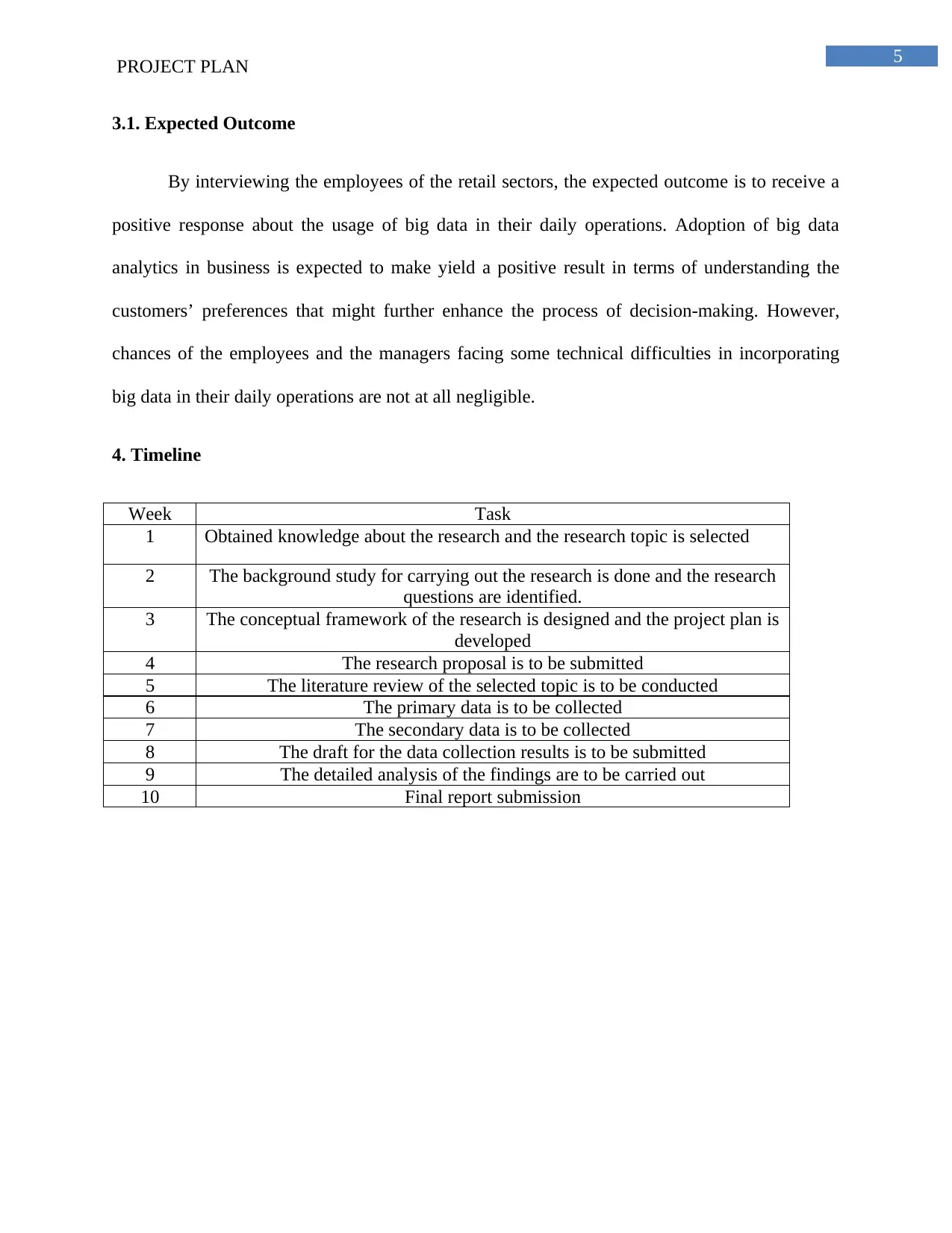
4. Timeline
Week Task
1 Obtained knowledge about the research and the research topic is selected
2 The background study for carrying out the research is done and the research
questions are identified.
3 The conceptual framework of the research is designed and the project plan is
developed
4 The research proposal is to be submitted
5 The literature review of the selected topic is to be conducted
6 The primary data is to be collected
7 The secondary data is to be collected
8 The draft for the data collection results is to be submitted
9 The detailed analysis of the findings are to be carried out
10 Final report submission
Document Page
6
PROJECT PLAN
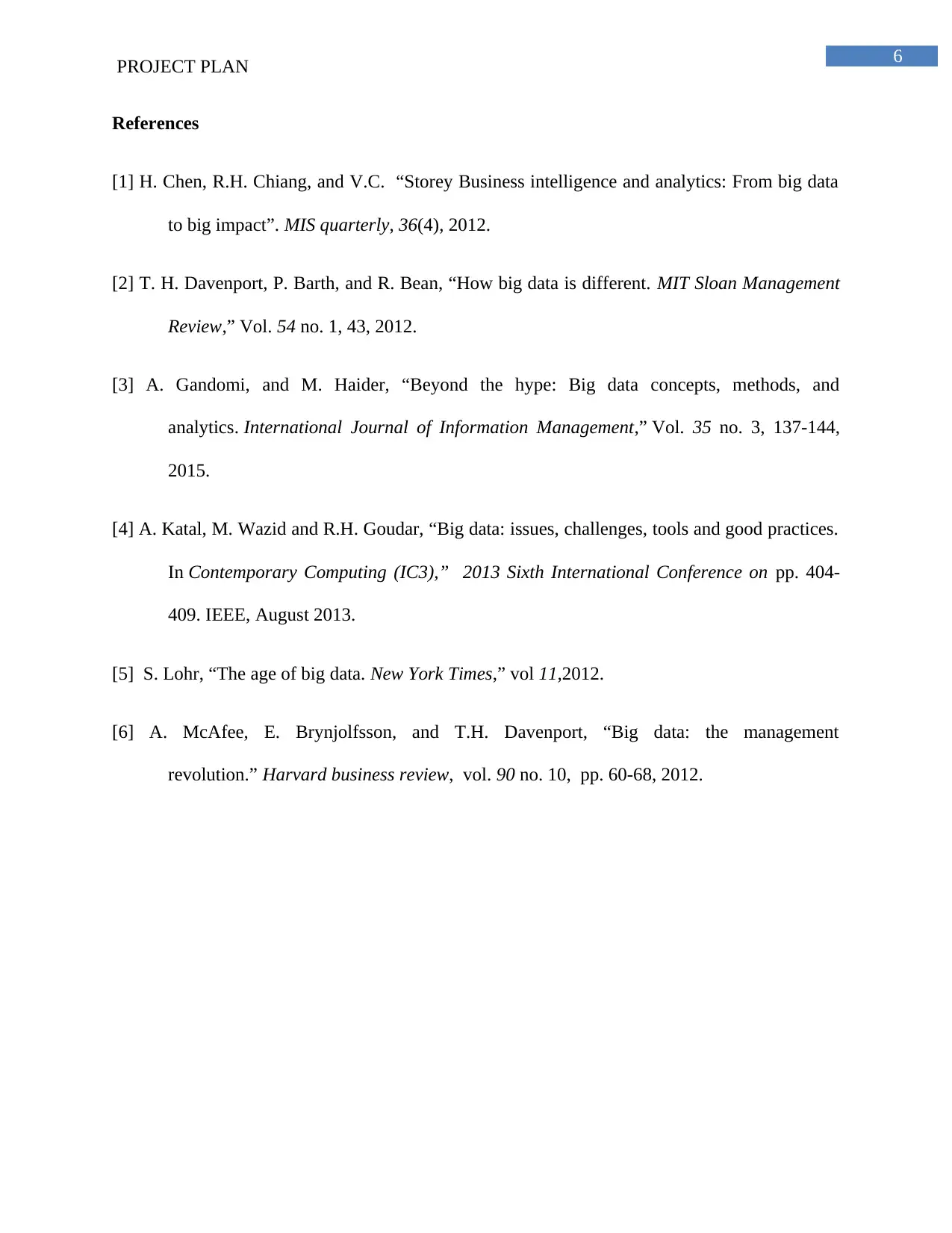
References
[1] H. Chen, R.H. Chiang, and V.C. “Storey Business intelligence and analytics: From big data
to big impact”. MIS quarterly, 36(4), 2012.
[2] T. H. Davenport, P. Barth, and R. Bean, “How big data is different. MIT Sloan Management
Review,” Vol. 54 no. 1, 43, 2012.
[3] A. Gandomi, and M. Haider, “Beyond the hype: Big data concepts, methods, and
analytics. International Journal of Information Management,” Vol. 35 no. 3, 137-144,
2015.
[4] A. Katal, M. Wazid and R.H. Goudar, “Big data: issues, challenges, tools and good practices.
In Contemporary Computing (IC3),” 2013 Sixth International Conference on pp. 404-
409. IEEE, August 2013.
[5] S. Lohr, “The age of big data. New York Times,” vol 11,2012.
[6] A. McAfee, E. Brynjolfsson, and T.H. Davenport, “Big data: the management
revolution.” Harvard business review, vol. 90 no. 10, pp. 60-68, 2012.
chevron_up_icon
1 out of 7
circle_padding
hide_on_mobile
zoom_out_icon
[object Object]