NIT6130 - Comprehensive Analysis of Research Methodology in Big Data
VerifiedAdded on 2023/06/11
|13
|2601
|162
Report
AI Summary
This report provides a detailed analysis of research methodologies applicable to big data analytics, contrasting traditional quantitative and qualitative methods with modern computer simulation techniques. It addresses the challenges in analyzing large datasets and proposes computer simulation as a more efficient alternative. The report includes a comparison of the methodologies, highlighting their strengths and weaknesses, and presents a framework for applying computer simulation in big data research, using a population census as a sample problem. The analysis emphasizes the importance of data validity and the role of the researcher in ensuring unbiased results, ultimately recommending computer simulation for its ability to handle massive data volumes, automate analysis, and maintain data integrity. Desklib provides access to this and other solved assignments.
Big Data Analytics Research Methodology 1
BIG DATA ANALYTICS RESEARCH METHODOLOGY
By [Name]
Course
Professor’s Name
Location of Institution
Date
BIG DATA ANALYTICS RESEARCH METHODOLOGY
By [Name]
Course
Professor’s Name
Location of Institution
Date

Paraphrase This Document
Need a fresh take? Get an instant paraphrase of this document with our AI Paraphraser
Big Data Analytics Research Methodology 2
Table of Contents
1.0 Introduction………………………………………………………………………………...…3
2.0 Methodology……………………………………………………………………………….....4
2.1Research Problem…………………………………………………….............…….4
2.2 Research Problem
statement………………………………………………………..4
2.3 Literature Review……………………………………………………………….….4
3.0 Types of Methodologies……………………………………………………….…..….
……….5
3.1 Quantitative and qualitative methods………………………………………………….6
3.2 Selected Methodology……………………………………………………………...
….6
4.0 Review of Selected Methodology…………………………………………………………...…
7
4.1 Sample Problem…………………………………………………………………..…...7
4.2 How Selected Methodology can solve the sample problem………………………...
….7
4.3 The relevance of the Selected Methodology to Selected Research Problem……..…...7
5.0 Comparison between the two Methodologies……………………………………………..
…...8
6.0 Proposed Methodology Analysis…………………………………………………………..
…..9
Table of Contents
1.0 Introduction………………………………………………………………………………...…3
2.0 Methodology……………………………………………………………………………….....4
2.1Research Problem…………………………………………………….............…….4
2.2 Research Problem
statement………………………………………………………..4
2.3 Literature Review……………………………………………………………….….4
3.0 Types of Methodologies……………………………………………………….…..….
……….5
3.1 Quantitative and qualitative methods………………………………………………….6
3.2 Selected Methodology……………………………………………………………...
….6
4.0 Review of Selected Methodology…………………………………………………………...…
7
4.1 Sample Problem…………………………………………………………………..…...7
4.2 How Selected Methodology can solve the sample problem………………………...
….7
4.3 The relevance of the Selected Methodology to Selected Research Problem……..…...7
5.0 Comparison between the two Methodologies……………………………………………..
…...8
6.0 Proposed Methodology Analysis…………………………………………………………..
…..9
Big Data Analytics Research Methodology 3
6.1 Justification………………………………………………………………….…..…...10
6.2 Strength and Weaknesses…………………………………………………………….10
6.3 Framework……………………………………………………………………...……10
Conclusion……………………………………………………………………………………….11
Recommendations……………………………………………………………………………..…11
1.0 Introduction
The current society has been surrounded by so many problems, some which can be
solved easily, others need a keen analysis and others which cannot be solved. Scholars have
come up in the event of trying to look for clear routes of solving the many existing problems
which come up on day to day basis. Many research methodologies have been proposed,
therefore, some which are still under investigations(Denzin, 2017). However, everything that is
introduced must always have pros and cons, so the existing methodologies have.
In this research paper, we have analyzed a sample of existing research methodology and
how it can be used to solve the various research problem. We have also selected a proposed
methodology which seems to be more efficient and explained how it can be used to solve a
sample problem. Lastly, a comparison of the two strategies has been contrasted to identify their
strengths and weakness and a conclusion of why the chosen methodology tends to be the most
efficient research methodology.
6.1 Justification………………………………………………………………….…..…...10
6.2 Strength and Weaknesses…………………………………………………………….10
6.3 Framework……………………………………………………………………...……10
Conclusion……………………………………………………………………………………….11
Recommendations……………………………………………………………………………..…11
1.0 Introduction
The current society has been surrounded by so many problems, some which can be
solved easily, others need a keen analysis and others which cannot be solved. Scholars have
come up in the event of trying to look for clear routes of solving the many existing problems
which come up on day to day basis. Many research methodologies have been proposed,
therefore, some which are still under investigations(Denzin, 2017). However, everything that is
introduced must always have pros and cons, so the existing methodologies have.
In this research paper, we have analyzed a sample of existing research methodology and
how it can be used to solve the various research problem. We have also selected a proposed
methodology which seems to be more efficient and explained how it can be used to solve a
sample problem. Lastly, a comparison of the two strategies has been contrasted to identify their
strengths and weakness and a conclusion of why the chosen methodology tends to be the most
efficient research methodology.
⊘ This is a preview!⊘
Do you want full access?
Subscribe today to unlock all pages.

Trusted by 1+ million students worldwide
Big Data Analytics Research Methodology 4
There exists traditional and modern research methodology, however, traditional
methodologies cannot be used to solve big data analytics(Bryman, 2016, p.4). Therefore, the
purpose of this paper is to identify an appropriate methodology to big data analytics.
2.0 Methodology
A methodology is simply a system of methods used to a particular area of study in
solving the existing problems. A sample of well-known methodology is Quantitative and
qualitative analysis. Some other methodologies that have been used by scholars in research
include case study, archival research, content analysis and event sampling methodologies(Dawn,
2018, p.95). This methods are used for various problems depending on the nature of the problem.
In our work, we will concentrate on quantitative and qualitative analysis.
2.1 Research problem
According to(Chen, and Zhang, 2014), big data is the application of specialized methods
and technologies in the processing of large sets of data. These datasets are very cumbersome and
cannot be analyzed by traditional methods of analysis. Examples are web blogs, call records
military surveillance, video archives and medical records. The analysis of these data has been an
There exists traditional and modern research methodology, however, traditional
methodologies cannot be used to solve big data analytics(Bryman, 2016, p.4). Therefore, the
purpose of this paper is to identify an appropriate methodology to big data analytics.
2.0 Methodology
A methodology is simply a system of methods used to a particular area of study in
solving the existing problems. A sample of well-known methodology is Quantitative and
qualitative analysis. Some other methodologies that have been used by scholars in research
include case study, archival research, content analysis and event sampling methodologies(Dawn,
2018, p.95). This methods are used for various problems depending on the nature of the problem.
In our work, we will concentrate on quantitative and qualitative analysis.
2.1 Research problem
According to(Chen, and Zhang, 2014), big data is the application of specialized methods
and technologies in the processing of large sets of data. These datasets are very cumbersome and
cannot be analyzed by traditional methods of analysis. Examples are web blogs, call records
military surveillance, video archives and medical records. The analysis of these data has been an
Paraphrase This Document
Need a fresh take? Get an instant paraphrase of this document with our AI Paraphraser
Big Data Analytics Research Methodology 5
existing problem to scholars since their study usually has a lot of information which can cause a
lot of confusion and time consuming.
2.1 Research problem statement
Computer simulation which is a modern research method is more efficient that quantitative and
qualitative analysis which are traditional data analysis methods
2.2 Literature review
Many scholars have come to conclusion that big data analysis has grown to be a current
problem over the past years, traditional methods of data analysis have failed to a big extent to
substantiate some of the data analyzed. This has raised a major concern leading to introduction of
modern methods which are computer generated. These modern methods only need filling of data
in computer then all the tasks are completed. This makes the entire task simple and can be
completed only by a mouse click. It also saves time since a lot of data can be analyzed, charts
constructed within microseconds. However, these methods requires experts who have done a lot
of study in modern technology, information systems and with computer programing skills. As a
matter of fact, the computer simulation strategy has also had some disadvantages. It has costed
organization a lot of resources just to analyze single sets of data. As compared to traditional data
analysis methods which analyze data manually, the modern computer simulation strategies frees
organization with the number of employees who have to be employed to analyze the specific
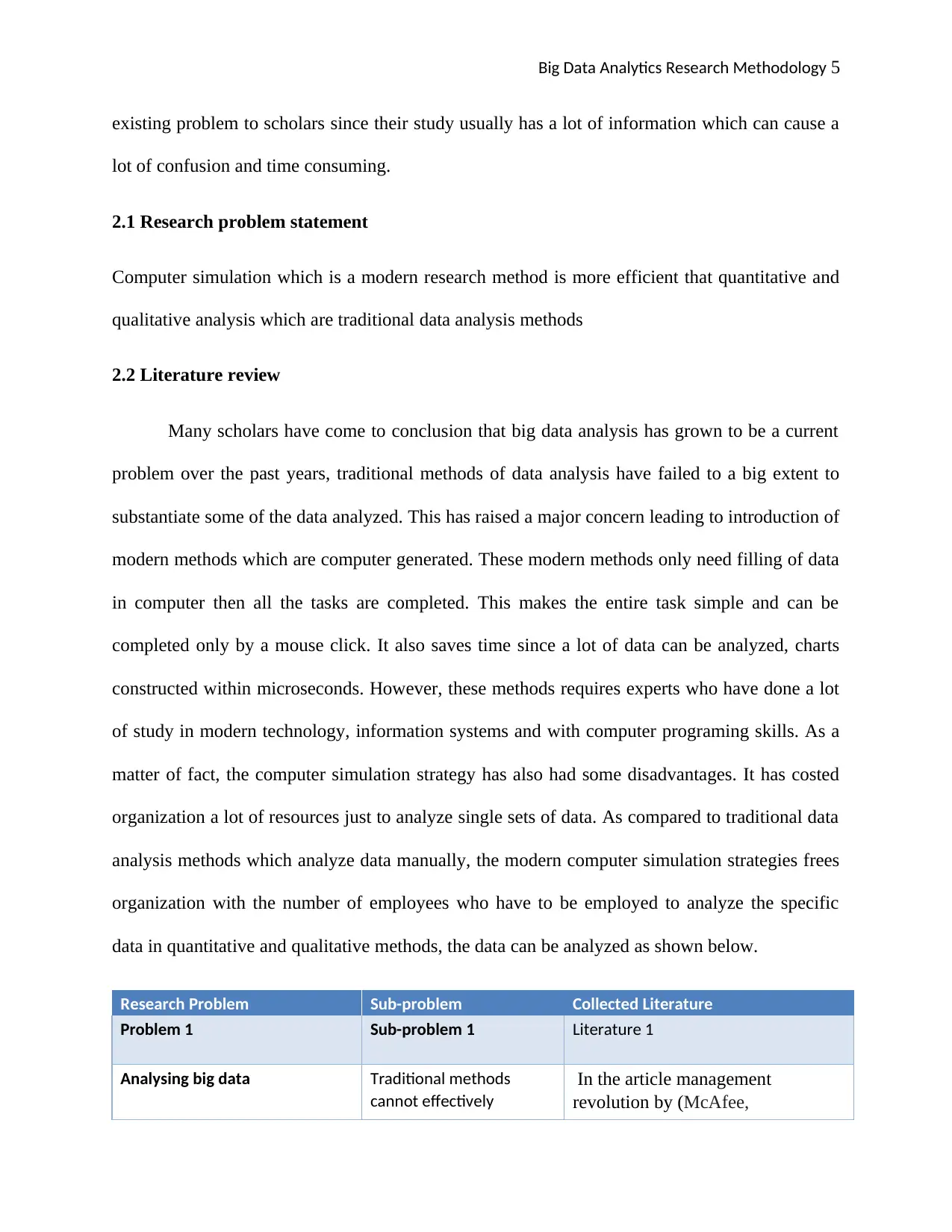
data in quantitative and qualitative methods, the data can be analyzed as shown below.
Research Problem Sub-problem Collected Literature
Problem 1 Sub-problem 1 Literature 1
Analysing big data Traditional methods
cannot effectively
In the article management
revolution by (McAfee,
existing problem to scholars since their study usually has a lot of information which can cause a
lot of confusion and time consuming.
2.1 Research problem statement
Computer simulation which is a modern research method is more efficient that quantitative and
qualitative analysis which are traditional data analysis methods
2.2 Literature review
Many scholars have come to conclusion that big data analysis has grown to be a current
problem over the past years, traditional methods of data analysis have failed to a big extent to
substantiate some of the data analyzed. This has raised a major concern leading to introduction of
modern methods which are computer generated. These modern methods only need filling of data
in computer then all the tasks are completed. This makes the entire task simple and can be
completed only by a mouse click. It also saves time since a lot of data can be analyzed, charts
constructed within microseconds. However, these methods requires experts who have done a lot
of study in modern technology, information systems and with computer programing skills. As a
matter of fact, the computer simulation strategy has also had some disadvantages. It has costed
organization a lot of resources just to analyze single sets of data. As compared to traditional data
analysis methods which analyze data manually, the modern computer simulation strategies frees
organization with the number of employees who have to be employed to analyze the specific
data in quantitative and qualitative methods, the data can be analyzed as shown below.
Research Problem Sub-problem Collected Literature
Problem 1 Sub-problem 1 Literature 1
Analysing big data Traditional methods
cannot effectively
In the article management
revolution by (McAfee,
Big Data Analytics Research Methodology 6
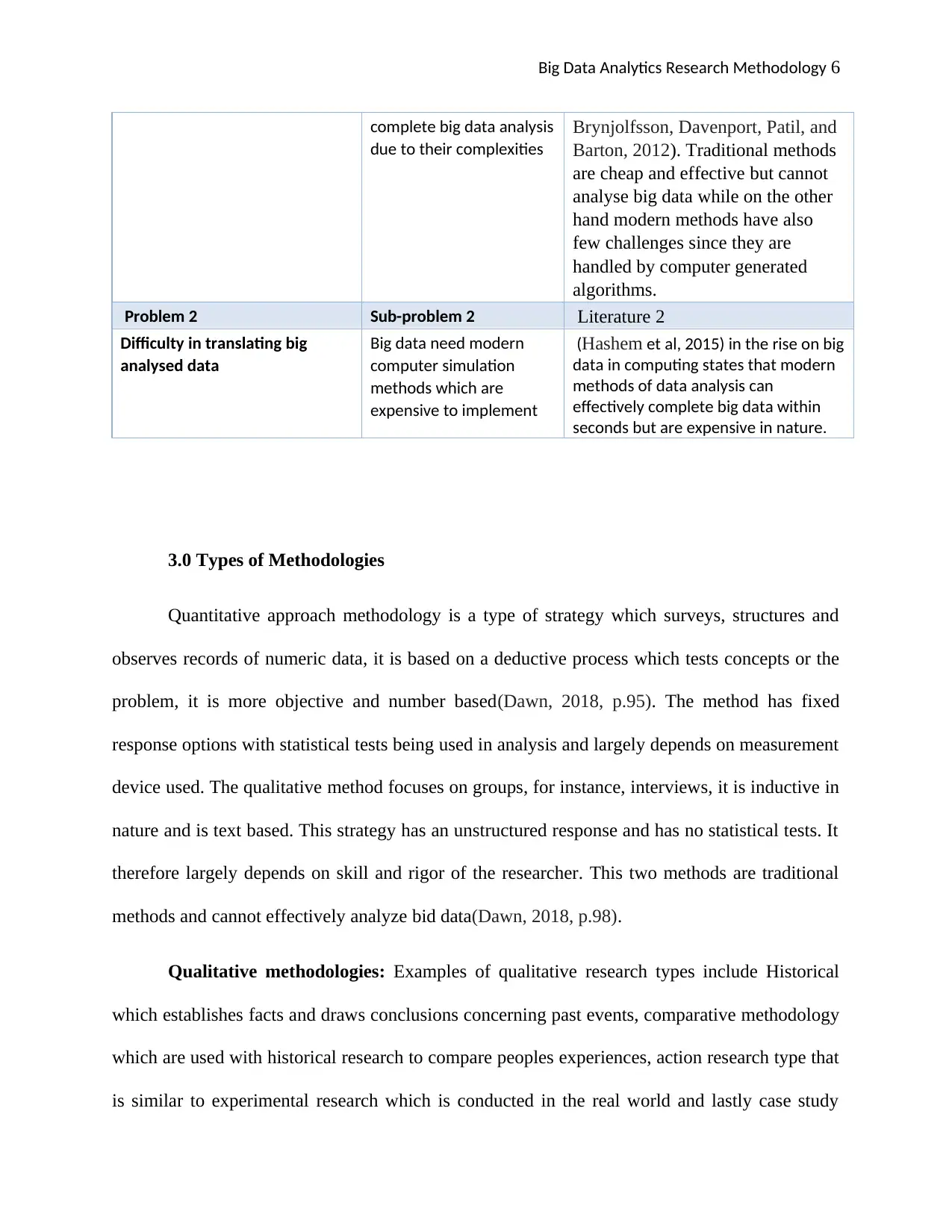
complete big data analysis
due to their complexities
Brynjolfsson, Davenport, Patil, and
Barton, 2012). Traditional methods
are cheap and effective but cannot
analyse big data while on the other
hand modern methods have also
few challenges since they are
handled by computer generated
algorithms.
Problem 2 Sub-problem 2 Literature 2
Difficulty in translating big
analysed data
Big data need modern
computer simulation
methods which are
expensive to implement
(Hashem et al, 2015) in the rise on big
data in computing states that modern
methods of data analysis can
effectively complete big data within
seconds but are expensive in nature.
3.0 Types of Methodologies
Quantitative approach methodology is a type of strategy which surveys, structures and
observes records of numeric data, it is based on a deductive process which tests concepts or the
problem, it is more objective and number based(Dawn, 2018, p.95). The method has fixed
response options with statistical tests being used in analysis and largely depends on measurement
device used. The qualitative method focuses on groups, for instance, interviews, it is inductive in
nature and is text based. This strategy has an unstructured response and has no statistical tests. It
therefore largely depends on skill and rigor of the researcher. This two methods are traditional
methods and cannot effectively analyze bid data(Dawn, 2018, p.98).
Qualitative methodologies: Examples of qualitative research types include Historical
which establishes facts and draws conclusions concerning past events, comparative methodology
which are used with historical research to compare peoples experiences, action research type that
is similar to experimental research which is conducted in the real world and lastly case study
complete big data analysis
due to their complexities
Brynjolfsson, Davenport, Patil, and
Barton, 2012). Traditional methods
are cheap and effective but cannot
analyse big data while on the other
hand modern methods have also
few challenges since they are
handled by computer generated
algorithms.
Problem 2 Sub-problem 2 Literature 2
Difficulty in translating big
analysed data
Big data need modern
computer simulation
methods which are
expensive to implement
(Hashem et al, 2015) in the rise on big
data in computing states that modern
methods of data analysis can
effectively complete big data within
seconds but are expensive in nature.
3.0 Types of Methodologies
Quantitative approach methodology is a type of strategy which surveys, structures and
observes records of numeric data, it is based on a deductive process which tests concepts or the
problem, it is more objective and number based(Dawn, 2018, p.95). The method has fixed
response options with statistical tests being used in analysis and largely depends on measurement
device used. The qualitative method focuses on groups, for instance, interviews, it is inductive in
nature and is text based. This strategy has an unstructured response and has no statistical tests. It
therefore largely depends on skill and rigor of the researcher. This two methods are traditional
methods and cannot effectively analyze bid data(Dawn, 2018, p.98).
Qualitative methodologies: Examples of qualitative research types include Historical
which establishes facts and draws conclusions concerning past events, comparative methodology
which are used with historical research to compare peoples experiences, action research type that
is similar to experimental research which is conducted in the real world and lastly case study
⊘ This is a preview!⊘
Do you want full access?
Subscribe today to unlock all pages.
Trusted by 1+ million students worldwide
Big Data Analytics Research Methodology 7
research methods entailing an empirical inquiry which investigates a contemporary problem in-
depth
Quantitative methodologies: On the other hand, quantitative methods include
correlation research types which describe statistical measures association and relationships
between different phenomena, experimental type, this isolates, and controls relevant conditions
which determine the investigated event. Lastly, in this category we have evaluation research
approach, this makes judgments concerning the merit or worth of educational programs or
products.
3.1 Selected Methodology
Since big data needs modern methods of data analysis, Computer simulation can
effectively serve this purpose. This is because the researcher despite having a lot of information,
only needs to fill in the details and the computers arrange, analyses, interprets and draws tables
and charts for the submitted data.
4.0 Review of Selected Methodology
Computer simulation is system based algorithms used to compute data by producing the
behavior of systems using mathematical models. They can run both on small and large scale
basis depending on the data provided(Hertz, 2018, p.54). These systems can analyze millions of
information by just having a mouse clicked, drawing data tables and interpreting the data for the
researcher. The types of models used to compute data include stochastic steady state, continuous
research methods entailing an empirical inquiry which investigates a contemporary problem in-
depth
Quantitative methodologies: On the other hand, quantitative methods include
correlation research types which describe statistical measures association and relationships
between different phenomena, experimental type, this isolates, and controls relevant conditions
which determine the investigated event. Lastly, in this category we have evaluation research
approach, this makes judgments concerning the merit or worth of educational programs or
products.
3.1 Selected Methodology
Since big data needs modern methods of data analysis, Computer simulation can
effectively serve this purpose. This is because the researcher despite having a lot of information,
only needs to fill in the details and the computers arrange, analyses, interprets and draws tables
and charts for the submitted data.
4.0 Review of Selected Methodology
Computer simulation is system based algorithms used to compute data by producing the
behavior of systems using mathematical models. They can run both on small and large scale
basis depending on the data provided(Hertz, 2018, p.54). These systems can analyze millions of
information by just having a mouse clicked, drawing data tables and interpreting the data for the
researcher. The types of models used to compute data include stochastic steady state, continuous
Paraphrase This Document
Need a fresh take? Get an instant paraphrase of this document with our AI Paraphraser
Big Data Analytics Research Methodology 8
or desecrate and dynamic system simulation. The computer-based algorithms in this modern
method can explore massive input spaces, uncover interesting features of complex variables in
response surfaces and explicitly identify cause-and-effect of data relationships.
4.1 Sample Problem
The population census is conducted in many countries, Australia is one of them. The data
generated from counting is always cumbersome and cannot be analyzed manually.
4.2 How Selected Problem can Solve sample problem
After counting the number of people, the data can be analyzed by computer simulation
strategy by just filling in the results. The computer will count total populations in all regions and
give figures which can be compared with previous years and analyzed. With this, it is easy to get
the trend in population for the current year.
4.3 Relevance of selected Methodology to the selected research problem
Computer simulation does not only analyses the data but also interprets them, draws
graphs, compares data and most importantly keeps the information for future references,
something that the traditional methods cannot do.
5.0 Comparison between the two Methodologies
Quantitative and qualitative methods Vs Computer simulation: The main difference
between this two approaches is very clear. Computer simulation can do all the task that
quantitative and qualitative analysis can do but the later cannot do what computer simulation
canthus includes completion of massive data analysis within seconds as well as keeping records
or desecrate and dynamic system simulation. The computer-based algorithms in this modern
method can explore massive input spaces, uncover interesting features of complex variables in
response surfaces and explicitly identify cause-and-effect of data relationships.
4.1 Sample Problem
The population census is conducted in many countries, Australia is one of them. The data
generated from counting is always cumbersome and cannot be analyzed manually.
4.2 How Selected Problem can Solve sample problem
After counting the number of people, the data can be analyzed by computer simulation
strategy by just filling in the results. The computer will count total populations in all regions and
give figures which can be compared with previous years and analyzed. With this, it is easy to get
the trend in population for the current year.
4.3 Relevance of selected Methodology to the selected research problem
Computer simulation does not only analyses the data but also interprets them, draws
graphs, compares data and most importantly keeps the information for future references,
something that the traditional methods cannot do.
5.0 Comparison between the two Methodologies
Quantitative and qualitative methods Vs Computer simulation: The main difference
between this two approaches is very clear. Computer simulation can do all the task that
quantitative and qualitative analysis can do but the later cannot do what computer simulation
canthus includes completion of massive data analysis within seconds as well as keeping records
Big Data Analytics Research Methodology 9
for future references (Chambers, 2017, p.34). Additionally, computer simulation is less biased as
compared to what the other methods can be.
6.0 Proposed Methodology analysis
Computer simulation can effectively conduct massive data research analysis within a few
time. This strategy of the data analysis(Hashem et al, 2015). The strategy involves the following
generic steps. Research question identification, a model design where the target is specified,
model building and model verification. After the model has been verified, the simulation is run
after which model validation is used. The following chart shows this basic steps.
for future references (Chambers, 2017, p.34). Additionally, computer simulation is less biased as
compared to what the other methods can be.
6.0 Proposed Methodology analysis
Computer simulation can effectively conduct massive data research analysis within a few
time. This strategy of the data analysis(Hashem et al, 2015). The strategy involves the following
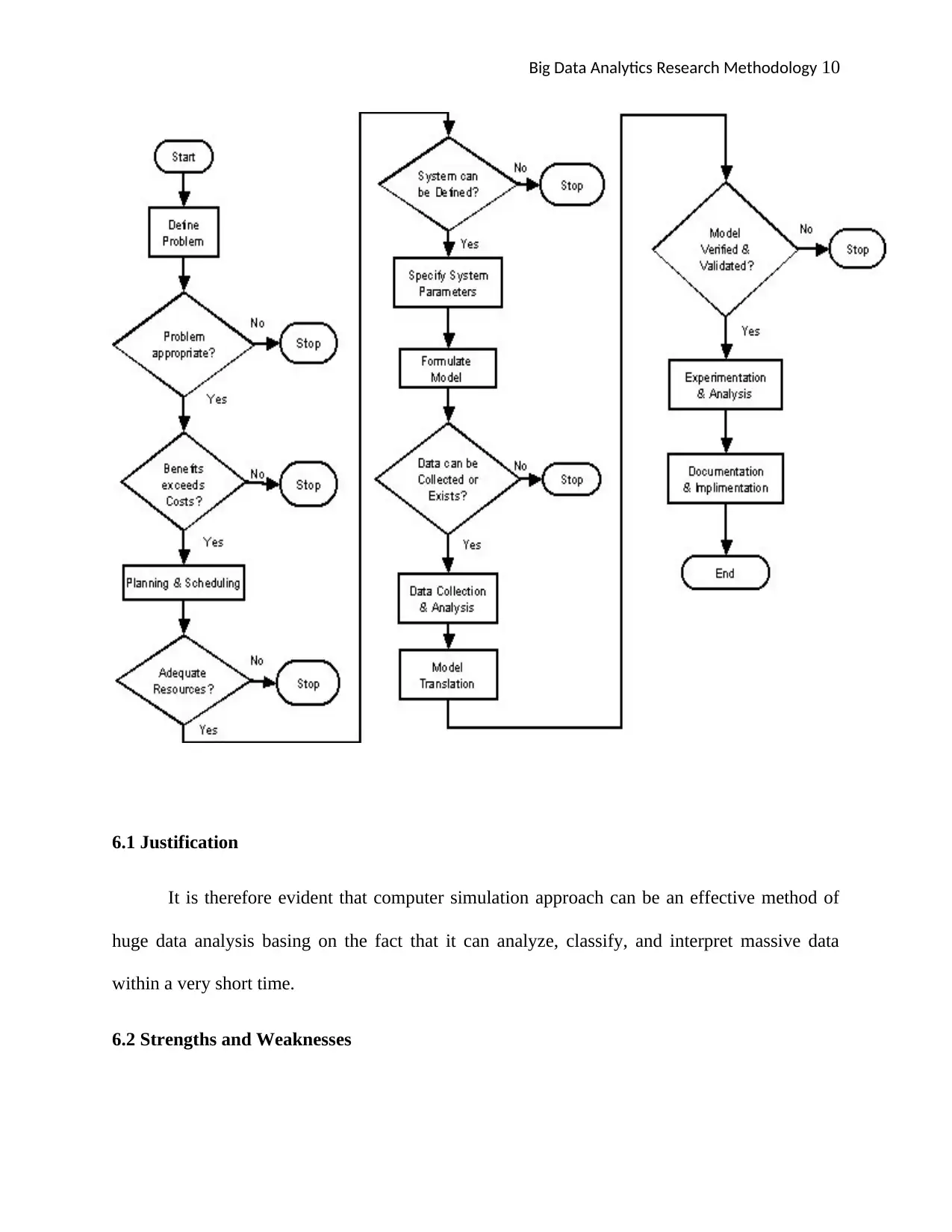
generic steps. Research question identification, a model design where the target is specified,
model building and model verification. After the model has been verified, the simulation is run
after which model validation is used. The following chart shows this basic steps.
⊘ This is a preview!⊘
Do you want full access?
Subscribe today to unlock all pages.
Trusted by 1+ million students worldwide
Big Data Analytics Research Methodology 10
6.1 Justification
It is therefore evident that computer simulation approach can be an effective method of
huge data analysis basing on the fact that it can analyze, classify, and interpret massive data
within a very short time.
6.2 Strengths and Weaknesses
6.1 Justification
It is therefore evident that computer simulation approach can be an effective method of
huge data analysis basing on the fact that it can analyze, classify, and interpret massive data
within a very short time.
6.2 Strengths and Weaknesses
Paraphrase This Document
Need a fresh take? Get an instant paraphrase of this document with our AI Paraphraser
Big Data Analytics Research Methodology 11
This methodology saves time and resources needed to hire human personnel to analyze
the data since all analysis is done on a computer. Additionally, the data ones entered in the
system is secure and can be preserved for future references. The computer-based analysis also
reduces chances of the data being manipulated due to self-interests of researchers. However, the
strategy needs qualified personnel who have skills in computer programming and information
technology and acquiring such people is also expensive. In the event that the system breaks down
due to hackers' activities, a lot of data is lost(Mandrà, Zhu, Wang, Perdomo and Katzgraber,
2016). Lastly, computers entirely depend on the programmers who are people and have the
power to manipulate figures.
6.3 Framework
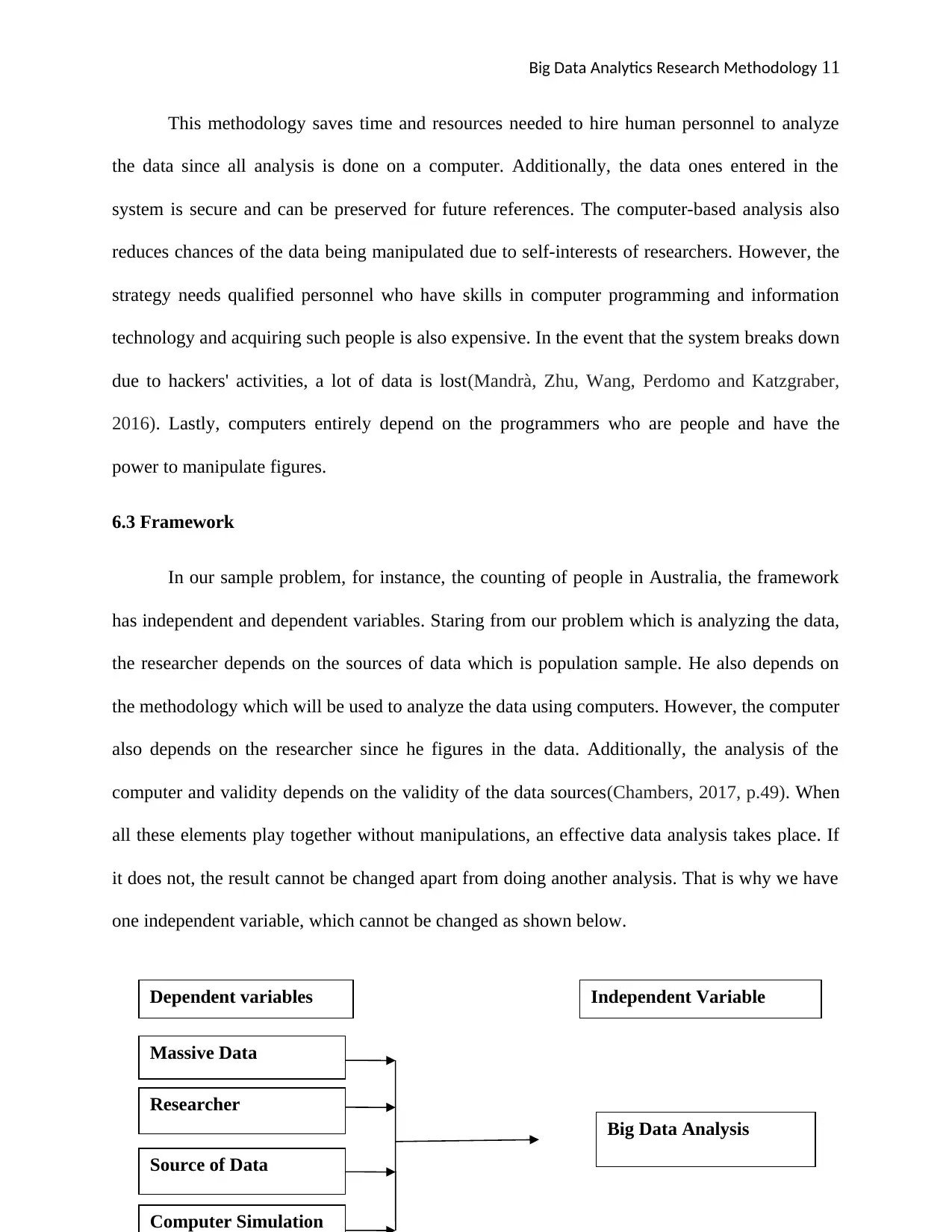
In our sample problem, for instance, the counting of people in Australia, the framework
has independent and dependent variables. Staring from our problem which is analyzing the data,
the researcher depends on the sources of data which is population sample. He also depends on
the methodology which will be used to analyze the data using computers. However, the computer
also depends on the researcher since he figures in the data. Additionally, the analysis of the
computer and validity depends on the validity of the data sources(Chambers, 2017, p.49). When
all these elements play together without manipulations, an effective data analysis takes place. If
it does not, the result cannot be changed apart from doing another analysis. That is why we have
one independent variable, which cannot be changed as shown below.
Massive Data
Researcher
Computer Simulation
Source of Data
Big Data Analysis
Dependent variables Independent Variable
This methodology saves time and resources needed to hire human personnel to analyze
the data since all analysis is done on a computer. Additionally, the data ones entered in the
system is secure and can be preserved for future references. The computer-based analysis also
reduces chances of the data being manipulated due to self-interests of researchers. However, the
strategy needs qualified personnel who have skills in computer programming and information
technology and acquiring such people is also expensive. In the event that the system breaks down
due to hackers' activities, a lot of data is lost(Mandrà, Zhu, Wang, Perdomo and Katzgraber,
2016). Lastly, computers entirely depend on the programmers who are people and have the
power to manipulate figures.
6.3 Framework
In our sample problem, for instance, the counting of people in Australia, the framework
has independent and dependent variables. Staring from our problem which is analyzing the data,
the researcher depends on the sources of data which is population sample. He also depends on
the methodology which will be used to analyze the data using computers. However, the computer
also depends on the researcher since he figures in the data. Additionally, the analysis of the
computer and validity depends on the validity of the data sources(Chambers, 2017, p.49). When
all these elements play together without manipulations, an effective data analysis takes place. If
it does not, the result cannot be changed apart from doing another analysis. That is why we have
one independent variable, which cannot be changed as shown below.
Massive Data
Researcher
Computer Simulation
Source of Data
Big Data Analysis
Dependent variables Independent Variable
Big Data Analytics Research Methodology 12
Conclusion
Big data can be studied with the help of computer simulation methodology as opposed to
other traditional methods of data analysis. The strategy has though some weaknesses which
exposes data to threats for instance hackers. Additionally, the efficiency of the analysis in
computer simulation entirely depends on the model used in analyzing the data(Chambers, 2017,
p.48). Various elements of research affect the validity of data, it is the role of the researcher to
control all the dependent variables in order to ensure the result projected are not biased.
Recommendations
This study, however, has only analyzed two methods of data analysis. There are other
methods which can as well work better with big data analysis. Additionally, this study does not
imply that qualitative and quantitative approaches cannot manage massive data analysis at all.
The differences between the two approaches and computer simulation are only efficiency and
reference in future.
References
Bryman, A., 2016. Social research methods. Oxford university press.
Chambers, J.M., 2017. Graphical Methods for Data Analysis: 0. Chapman and Hall/CRC.
Chen, C.P., and Zhang, C.Y., 2014. Data-intensive applications, challenges, techniques, and
technologies: A survey on Big Data. Information Sciences, 275, pp.314-347.
Conclusion
Big data can be studied with the help of computer simulation methodology as opposed to
other traditional methods of data analysis. The strategy has though some weaknesses which
exposes data to threats for instance hackers. Additionally, the efficiency of the analysis in
computer simulation entirely depends on the model used in analyzing the data(Chambers, 2017,
p.48). Various elements of research affect the validity of data, it is the role of the researcher to
control all the dependent variables in order to ensure the result projected are not biased.
Recommendations
This study, however, has only analyzed two methods of data analysis. There are other
methods which can as well work better with big data analysis. Additionally, this study does not
imply that qualitative and quantitative approaches cannot manage massive data analysis at all.
The differences between the two approaches and computer simulation are only efficiency and
reference in future.
References
Bryman, A., 2016. Social research methods. Oxford university press.
Chambers, J.M., 2017. Graphical Methods for Data Analysis: 0. Chapman and Hall/CRC.
Chen, C.P., and Zhang, C.Y., 2014. Data-intensive applications, challenges, techniques, and
technologies: A survey on Big Data. Information Sciences, 275, pp.314-347.
⊘ This is a preview!⊘
Do you want full access?
Subscribe today to unlock all pages.
Trusted by 1+ million students worldwide

1 out of 13


Related Documents


Your All-in-One AI-Powered Toolkit for Academic Success.
+13062052269
info@desklib.com
Available 24*7 on WhatsApp / Email
![[object Object]](/_next/static/media/star-bottom.7253800d.svg)
Unlock your academic potential
Copyright © 2020–2026 A2Z Services. All Rights Reserved. Developed and managed by ZUCOL.