Analyzing Power Usage: A Big Data and Analytics Report on Solar Cities

Verified

Added on  2023/06/11

|9
|1895
|436
Report
AI Summary
This report, based on the Solar Cities Project by the University of Ballarat, investigates power consumption patterns in the Loddon Mallee and Grampians regions over a four-year period. The project analyzed various factors influencing power usage, including building characteristics like roof color, age, and window type, as well as PV capacity and insulation. Using IBM Watson Analytics, the report visualizes the collected data, revealing key findings such as the impact of roof color and PV capacity on power consumption. Dark and intermediate colored roofs were found to contribute to lower power usage, while light colored roofs and lower PV capacity correlated with higher consumption. The report also examines the cyclical nature of power usage, the influence of tenure type, and regional variations. Based on these findings, the report recommends the use of dark-colored roofs and windows with blinds to reduce power consumption and improve energy efficiency. The report concludes with a reflection on the use of IBM Watson Analytics, highlighting its ease of use and analytical capabilities.
Document Page
Running Head: BIG DATA AND ANALYTICS
Big Data and Analytics
Name of the Student
Name of the University
Author Note
tabler-icon-diamond-filled.svg

Paraphrase This Document

Need a fresh take? Get an instant paraphrase of this document with our AI Paraphraser
Document Page
1BIG DATA AND ANALYTICS
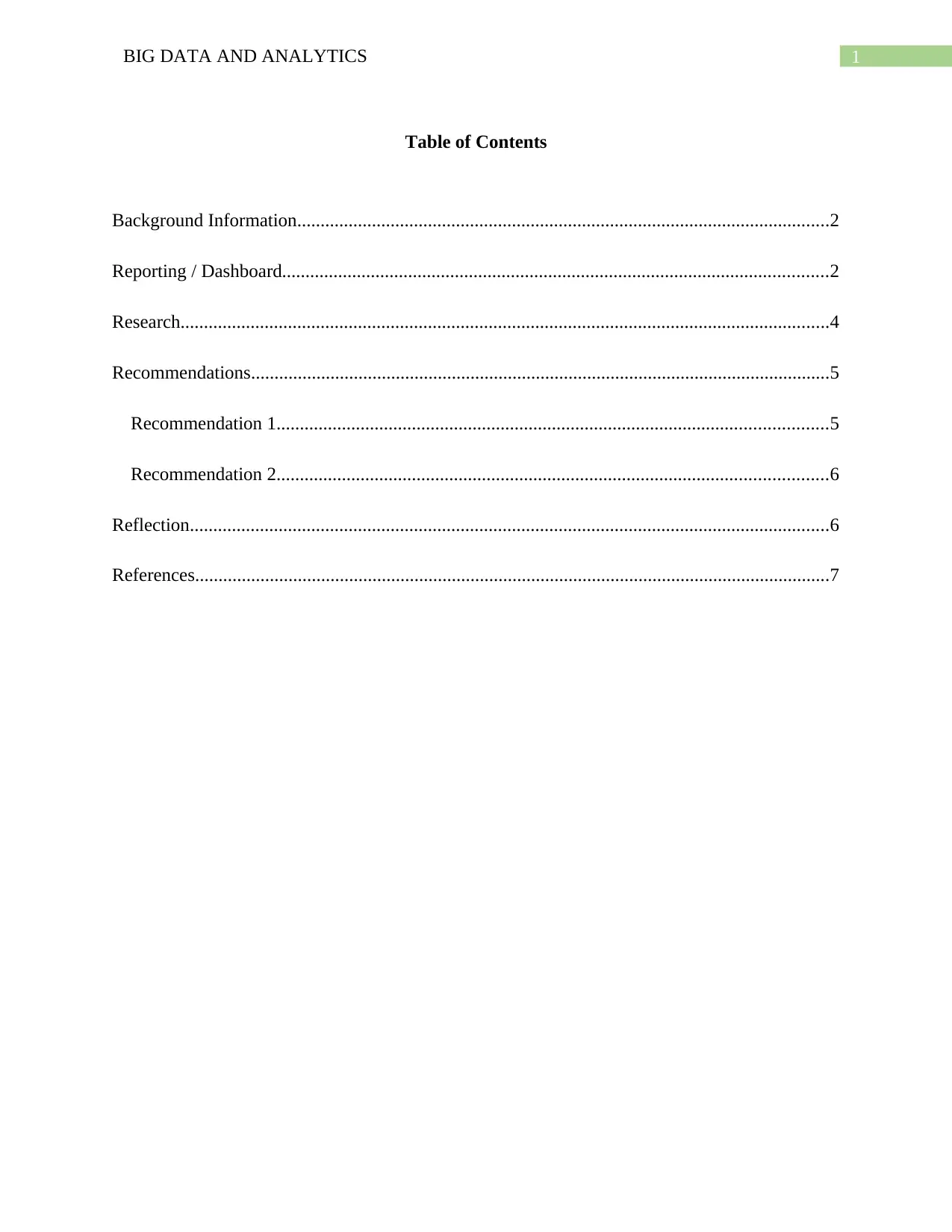
Table of Contents
Background Information..................................................................................................................2
Reporting / Dashboard.....................................................................................................................2
Research...........................................................................................................................................4
Recommendations............................................................................................................................5
Recommendation 1......................................................................................................................5
Recommendation 2......................................................................................................................6
Reflection.........................................................................................................................................6
References........................................................................................................................................7
Document Page
2BIG DATA AND ANALYTICS
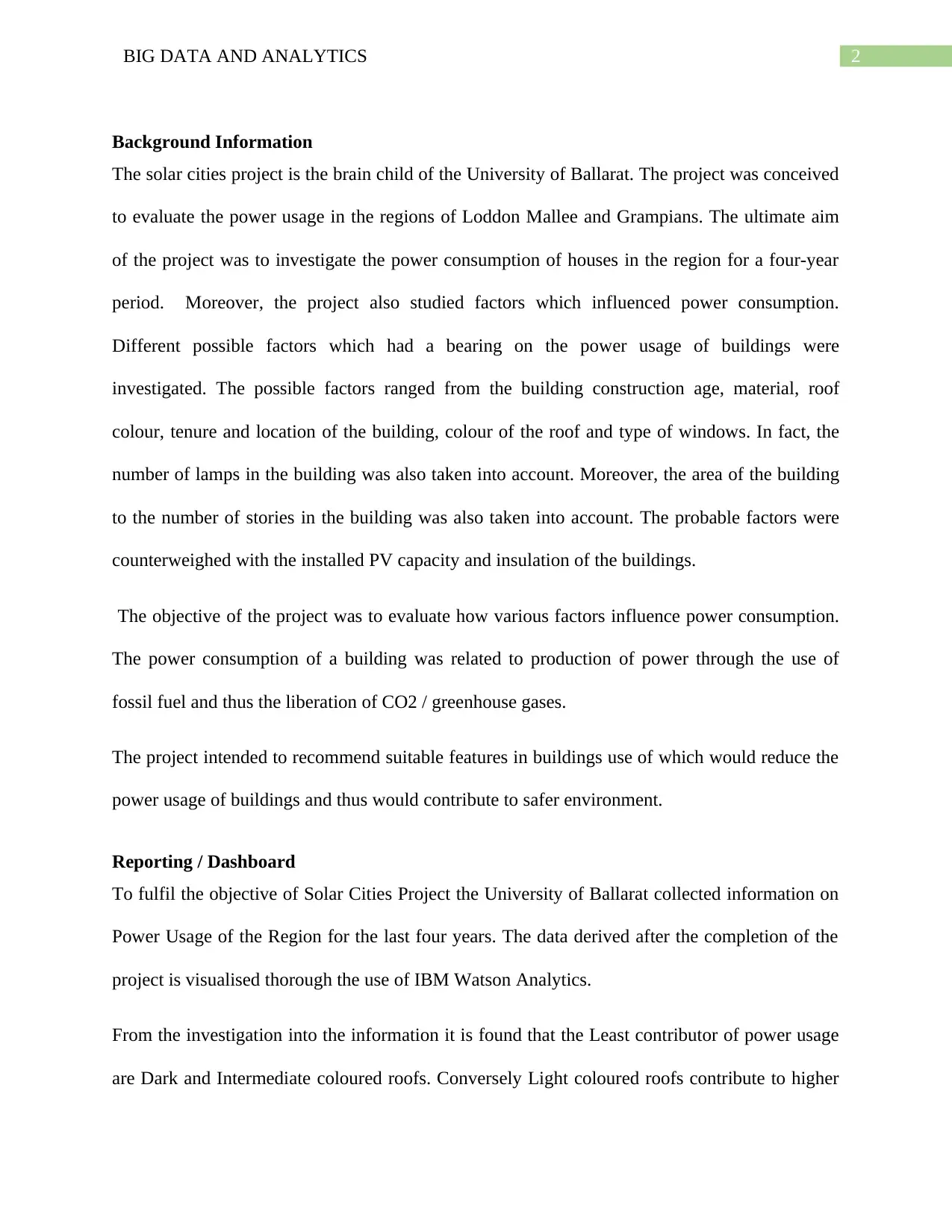
Background Information
The solar cities project is the brain child of the University of Ballarat. The project was conceived
to evaluate the power usage in the regions of Loddon Mallee and Grampians. The ultimate aim
of the project was to investigate the power consumption of houses in the region for a four-year
period. Moreover, the project also studied factors which influenced power consumption.
Different possible factors which had a bearing on the power usage of buildings were
investigated. The possible factors ranged from the building construction age, material, roof
colour, tenure and location of the building, colour of the roof and type of windows. In fact, the
number of lamps in the building was also taken into account. Moreover, the area of the building
to the number of stories in the building was also taken into account. The probable factors were
counterweighed with the installed PV capacity and insulation of the buildings.
The objective of the project was to evaluate how various factors influence power consumption.
The power consumption of a building was related to production of power through the use of
fossil fuel and thus the liberation of CO2 / greenhouse gases.
The project intended to recommend suitable features in buildings use of which would reduce the
power usage of buildings and thus would contribute to safer environment.
Reporting / Dashboard
To fulfil the objective of Solar Cities Project the University of Ballarat collected information on
Power Usage of the Region for the last four years. The data derived after the completion of the
project is visualised thorough the use of IBM Watson Analytics.
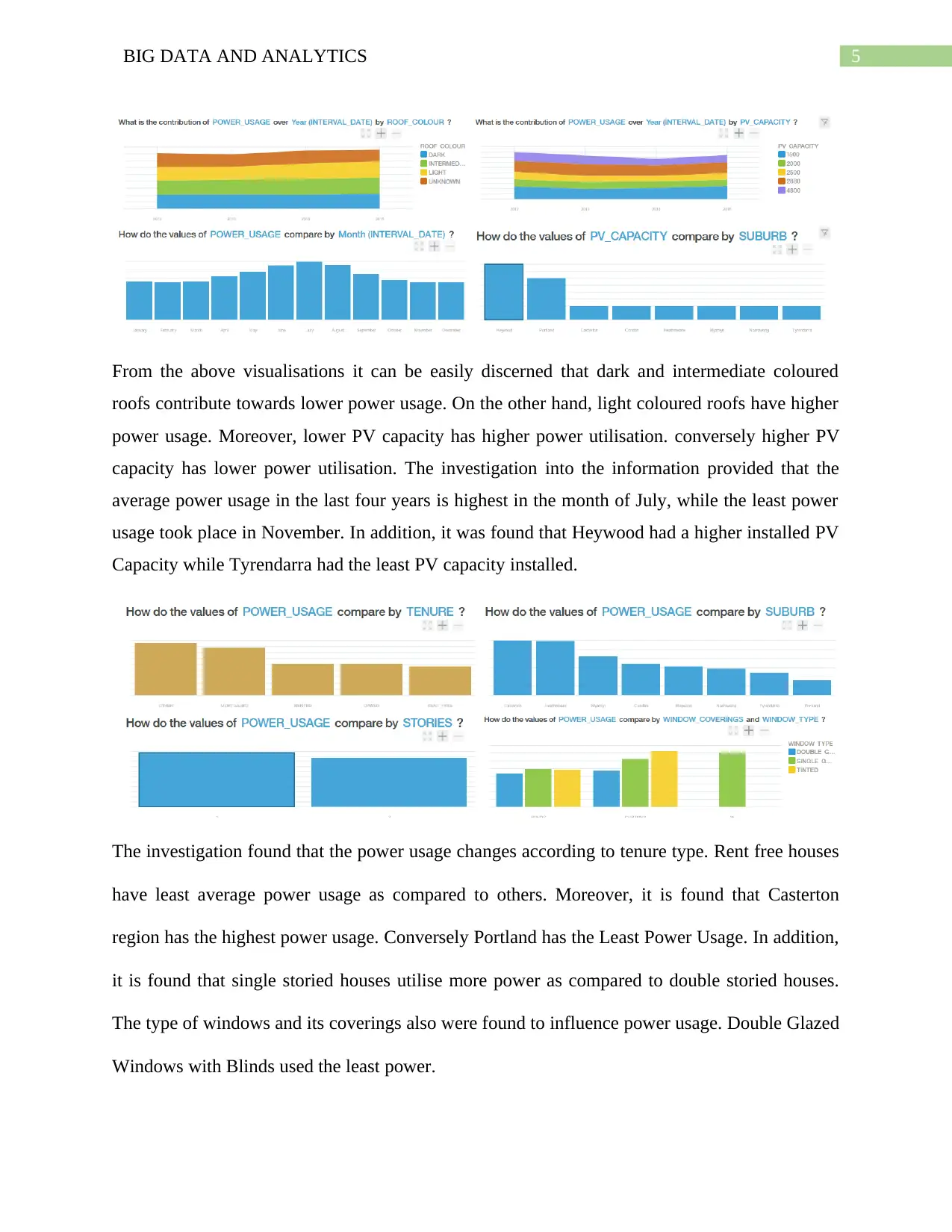
From the investigation into the information it is found that the Least contributor of power usage
are Dark and Intermediate coloured roofs. Conversely Light coloured roofs contribute to higher
Document Page
3BIG DATA AND ANALYTICS
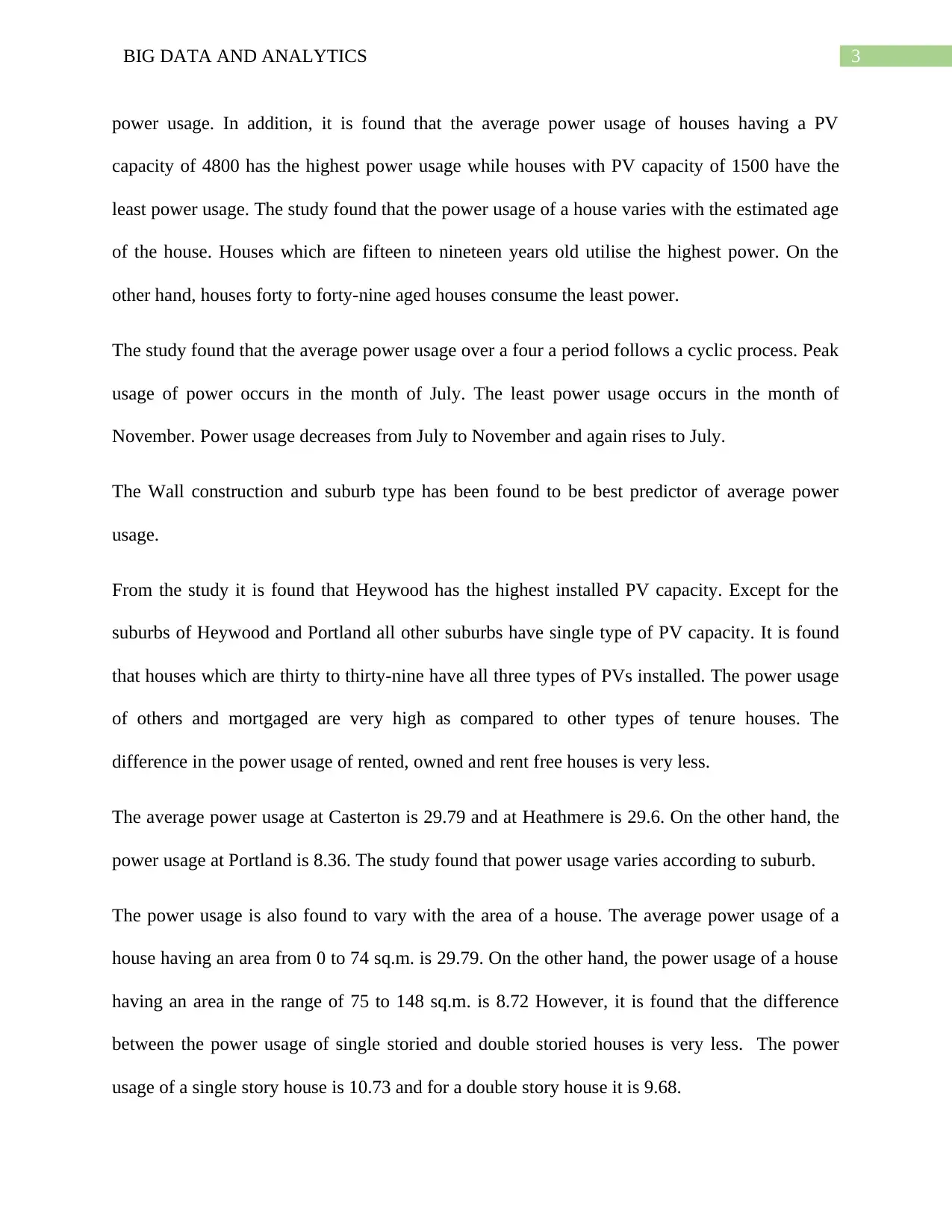
power usage. In addition, it is found that the average power usage of houses having a PV
capacity of 4800 has the highest power usage while houses with PV capacity of 1500 have the
least power usage. The study found that the power usage of a house varies with the estimated age
of the house. Houses which are fifteen to nineteen years old utilise the highest power. On the
other hand, houses forty to forty-nine aged houses consume the least power.
The study found that the average power usage over a four a period follows a cyclic process. Peak
usage of power occurs in the month of July. The least power usage occurs in the month of
November. Power usage decreases from July to November and again rises to July.
The Wall construction and suburb type has been found to be best predictor of average power
usage.
From the study it is found that Heywood has the highest installed PV capacity. Except for the
suburbs of Heywood and Portland all other suburbs have single type of PV capacity. It is found
that houses which are thirty to thirty-nine have all three types of PVs installed. The power usage
of others and mortgaged are very high as compared to other types of tenure houses. The
difference in the power usage of rented, owned and rent free houses is very less.
The average power usage at Casterton is 29.79 and at Heathmere is 29.6. On the other hand, the
power usage at Portland is 8.36. The study found that power usage varies according to suburb.
The power usage is also found to vary with the area of a house. The average power usage of a
house having an area from 0 to 74 sq.m. is 29.79. On the other hand, the power usage of a house
having an area in the range of 75 to 148 sq.m. is 8.72 However, it is found that the difference
between the power usage of single storied and double storied houses is very less. The power
usage of a single story house is 10.73 and for a double story house it is 9.68.
tabler-icon-diamond-filled.svg

Paraphrase This Document

Need a fresh take? Get an instant paraphrase of this document with our AI Paraphraser
Document Page
4BIG DATA AND ANALYTICS
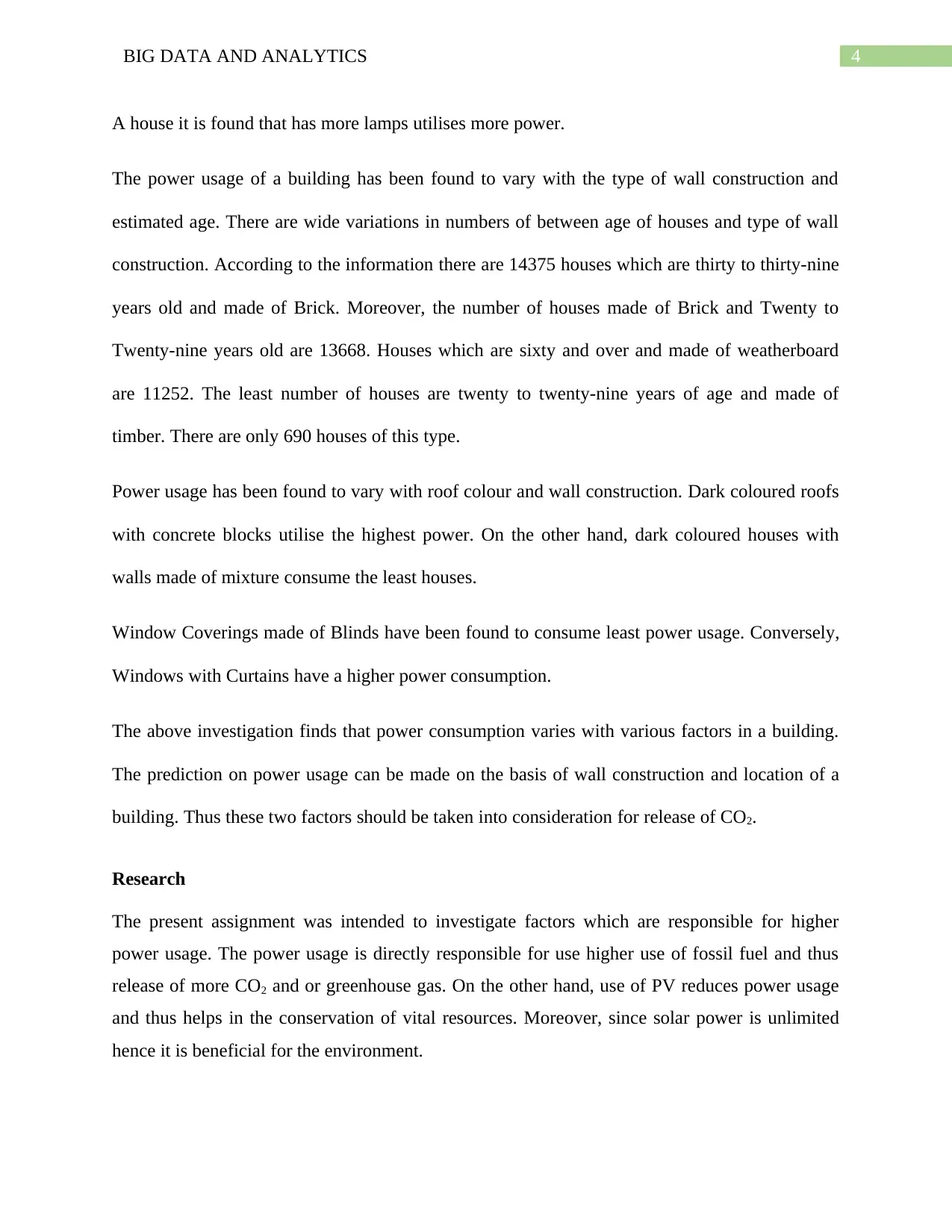
A house it is found that has more lamps utilises more power.
The power usage of a building has been found to vary with the type of wall construction and
estimated age. There are wide variations in numbers of between age of houses and type of wall
construction. According to the information there are 14375 houses which are thirty to thirty-nine
years old and made of Brick. Moreover, the number of houses made of Brick and Twenty to
Twenty-nine years old are 13668. Houses which are sixty and over and made of weatherboard
are 11252. The least number of houses are twenty to twenty-nine years of age and made of
timber. There are only 690 houses of this type.
Power usage has been found to vary with roof colour and wall construction. Dark coloured roofs
with concrete blocks utilise the highest power. On the other hand, dark coloured houses with
walls made of mixture consume the least houses.
Window Coverings made of Blinds have been found to consume least power usage. Conversely,
Windows with Curtains have a higher power consumption.
The above investigation finds that power consumption varies with various factors in a building.
The prediction on power usage can be made on the basis of wall construction and location of a
building. Thus these two factors should be taken into consideration for release of CO2.
Research
The present assignment was intended to investigate factors which are responsible for higher
power usage. The power usage is directly responsible for use higher use of fossil fuel and thus
release of more CO2 and or greenhouse gas. On the other hand, use of PV reduces power usage
and thus helps in the conservation of vital resources. Moreover, since solar power is unlimited
hence it is beneficial for the environment.
Document Page
5BIG DATA AND ANALYTICS
From the above visualisations it can be easily discerned that dark and intermediate coloured
roofs contribute towards lower power usage. On the other hand, light coloured roofs have higher
power usage. Moreover, lower PV capacity has higher power utilisation. conversely higher PV
capacity has lower power utilisation. The investigation into the information provided that the
average power usage in the last four years is highest in the month of July, while the least power
usage took place in November. In addition, it was found that Heywood had a higher installed PV
Capacity while Tyrendarra had the least PV capacity installed.
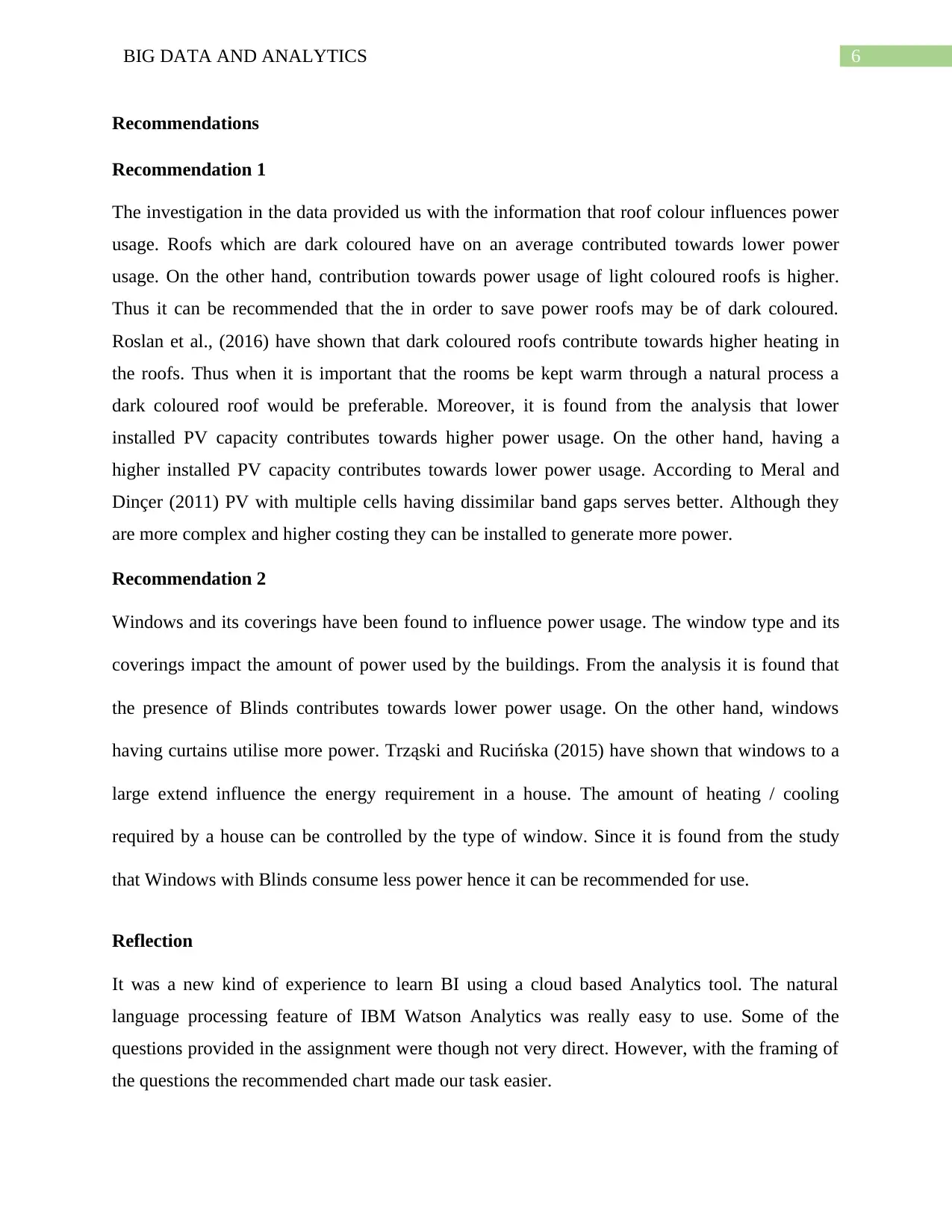
The investigation found that the power usage changes according to tenure type. Rent free houses
have least average power usage as compared to others. Moreover, it is found that Casterton
region has the highest power usage. Conversely Portland has the Least Power Usage. In addition,
it is found that single storied houses utilise more power as compared to double storied houses.
The type of windows and its coverings also were found to influence power usage. Double Glazed
Windows with Blinds used the least power.
Document Page
6BIG DATA AND ANALYTICS
Recommendations
Recommendation 1
The investigation in the data provided us with the information that roof colour influences power
usage. Roofs which are dark coloured have on an average contributed towards lower power
usage. On the other hand, contribution towards power usage of light coloured roofs is higher.
Thus it can be recommended that the in order to save power roofs may be of dark coloured.
Roslan et al., (2016) have shown that dark coloured roofs contribute towards higher heating in
the roofs. Thus when it is important that the rooms be kept warm through a natural process a
dark coloured roof would be preferable. Moreover, it is found from the analysis that lower
installed PV capacity contributes towards higher power usage. On the other hand, having a
higher installed PV capacity contributes towards lower power usage. According to Meral and
Dinçer (2011) PV with multiple cells having dissimilar band gaps serves better. Although they
are more complex and higher costing they can be installed to generate more power.
Recommendation 2
Windows and its coverings have been found to influence power usage. The window type and its
coverings impact the amount of power used by the buildings. From the analysis it is found that
the presence of Blinds contributes towards lower power usage. On the other hand, windows
having curtains utilise more power. Trząski and Rucińska (2015) have shown that windows to a
large extend influence the energy requirement in a house. The amount of heating / cooling
required by a house can be controlled by the type of window. Since it is found from the study
that Windows with Blinds consume less power hence it can be recommended for use.
Reflection
It was a new kind of experience to learn BI using a cloud based Analytics tool. The natural
language processing feature of IBM Watson Analytics was really easy to use. Some of the
questions provided in the assignment were though not very direct. However, with the framing of
the questions the recommended chart made our task easier.
tabler-icon-diamond-filled.svg

Paraphrase This Document

Need a fresh take? Get an instant paraphrase of this document with our AI Paraphraser
Document Page
7BIG DATA AND ANALYTICS
The analytical tool helped us to create new columns thorough calculations. We could change
shapes at some of the charts to provide a better visualisation. The colours of the charts could be
changed to provide a better visual impact. The filtering ability of the BI tool provided advantage
to the visualisation.
We could change the type of chart to suite our needs.
Document Page
8BIG DATA AND ANALYTICS
References
Meral, M. E., & Dinçer, F. (2011). A review of the factors affecting operation and efficiency of
photovoltaic based electricity generation systems. Renewable and Sustainable Energy
Reviews, 15(5), 2176-2184.
Roslan, Q., Ibrahim, S. H., Affandi, R., Nawi, M. N. M., & Baharun, A. (2016). A literature
review on the improvement strategies of passive design for the roofing system of the
modern house in a hot and humid climate region. Frontiers of Architectural Research,
5(1), 126-133.
Trząski, A., & Rucińska, J. (2015). Energy labeling of windows–Possibilities and limitations.
Solar Energy, 120, 158-174.
chevron_up_icon
1 out of 9
circle_padding
hide_on_mobile
zoom_out_icon
[object Object]