Big Data and Analytics: Analyzing Power Usage in Victorian Suburbs

Verified

Added on  2021/06/17

|8
|1869
|77
Report
AI Summary
This report analyzes the power consumption data from the University of Ballarat's Solar Cities Project, which involved households and businesses in Victorian suburbs. The study investigates factors influencing energy usage, including roof color, PV panel installation, building age, and suburb location. Using IBM Watson Analytics, the analysis reveals that roof color, PV panel capacity, and suburb significantly impact power consumption. The report highlights a cyclic pattern in power usage, with peaks in July and lows in November. Recommendations include using light-colored roofs, installing higher PV panels, and expanding PV panel installation to all suburbs. The analysis also emphasizes the importance of wall construction and suburb location in predicting power usage and CO2 emissions, offering valuable insights for energy efficiency and sustainability.
Document Page
Running Head: BIG DATA AND ANALYTICS
Big Data and Analytics
Name of the Student
Name of the University
Author Note
tabler-icon-diamond-filled.svg

Paraphrase This Document

Need a fresh take? Get an instant paraphrase of this document with our AI Paraphraser
Document Page
1BIG DATA AND ANALYTICS
Table of Contents
Background Information..................................................................................................................2
Reporting / Dashboard.....................................................................................................................2
Research...........................................................................................................................................4
Recommendations............................................................................................................................5
Recommendation 1......................................................................................................................5
Recommendation 2......................................................................................................................6
Reflection.........................................................................................................................................6
References........................................................................................................................................7
Document Page
2BIG DATA AND ANALYTICS
Background Information
The University of Ballarat created the Solar Cities Project. The project involved the
Victorian Suburbs of Loddon Mallee and Grampians. As part of the project, households and
businesses in the region were involved. The project required that the households and businesses
houses monitor their power consumptions. On the basis of type of dwellings data was collected
on parameters of estimated age of their houses, type of wall construction, roof colour, number of
stories in the building and square area of the dwelling. Further, information on the number of
bedrooms, bathrooms and living rooms was also collected. Moreover, the owners had to provide
information regarding the type and number of lamps used.
Most importantly information on amount of power being created by solar panels installed
on rooftops was gathered. The most important purpose of the project was to get information on
features of a building which determines the energy consumption of a building. Since energy
production is dependent on fossil fuel there the consumption of power was related to the release
of CO2.
The project intended to relate the drivers of power consumption in a building with the
release of CO2. As a result of the analysis the project envisioned to modify, make changes in a
building so as to reduce the energy need of the building.
Reporting / Dashboard
In order to understand the power usage of the region investigation was done into the given
dataset.
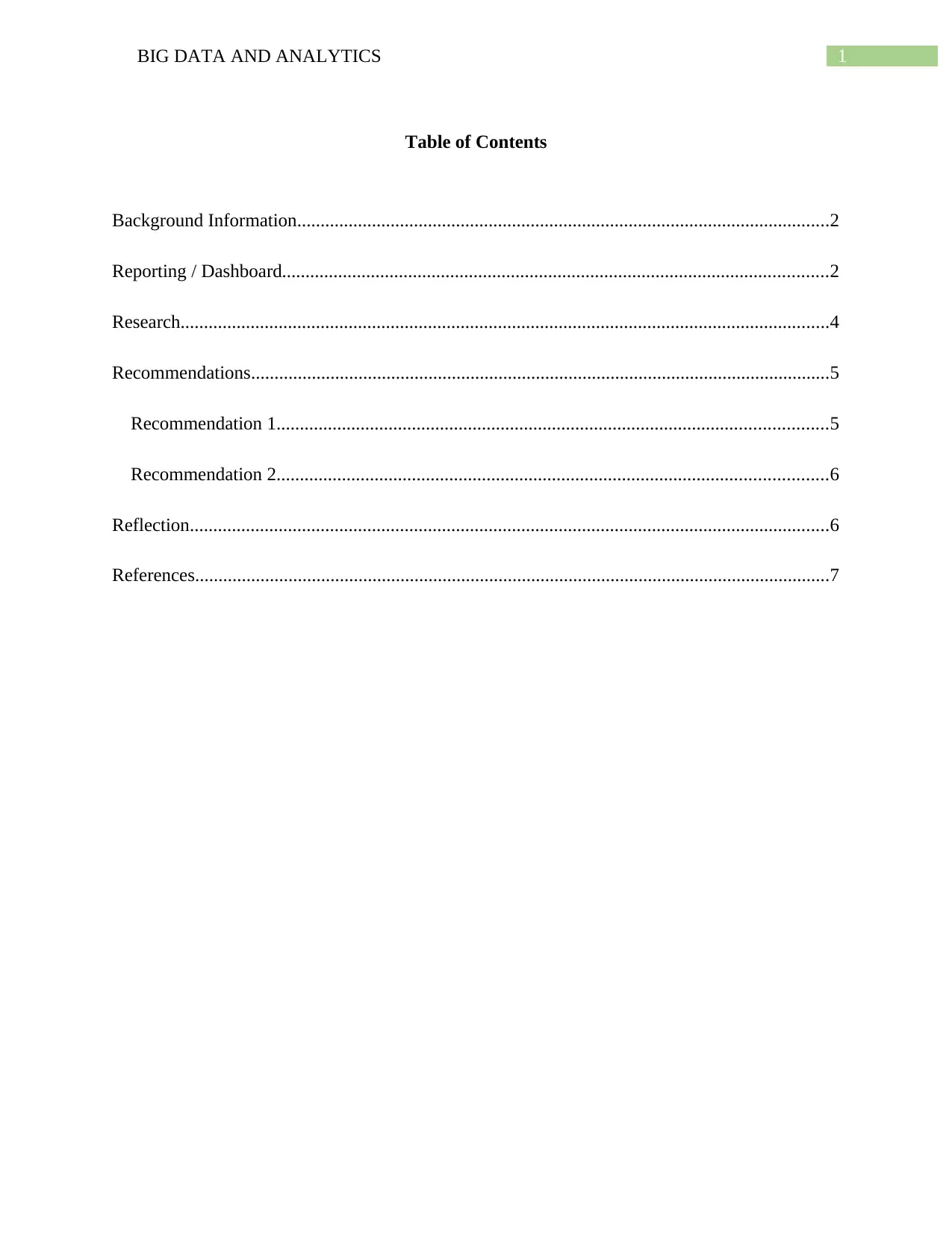
The investigation shows that power usage for dark or intermediate coloured roofs is higher than
light coloured roofs. In fact, the power usage has steadily grown over the period of 2012 – 15. It
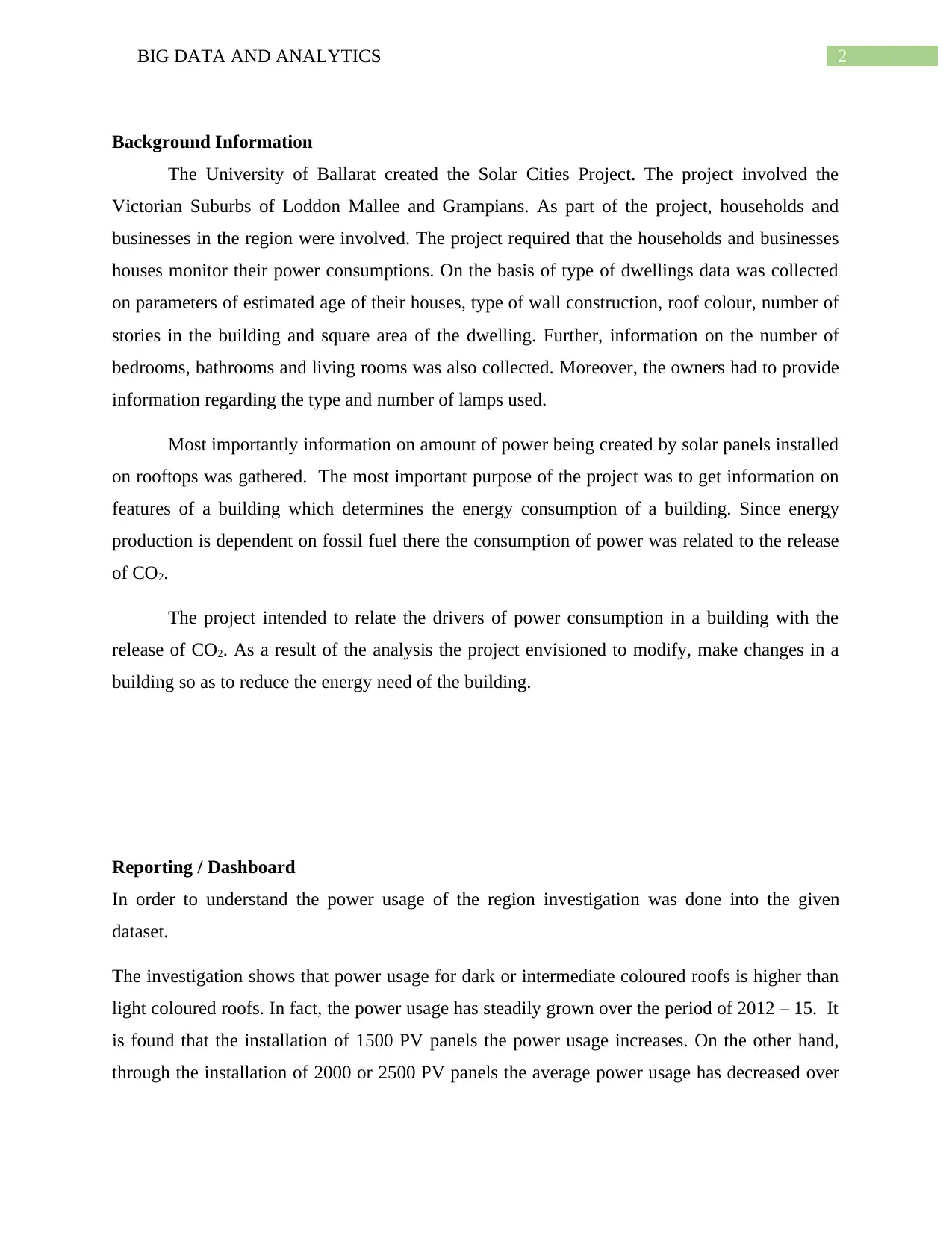
is found that the installation of 1500 PV panels the power usage increases. On the other hand,
through the installation of 2000 or 2500 PV panels the average power usage has decreased over
Document Page
3BIG DATA AND ANALYTICS
the years from 2012 to 15. In addition, when the installed PV capacity was 4800 panels then
there was a drastic decrease in average power usage.
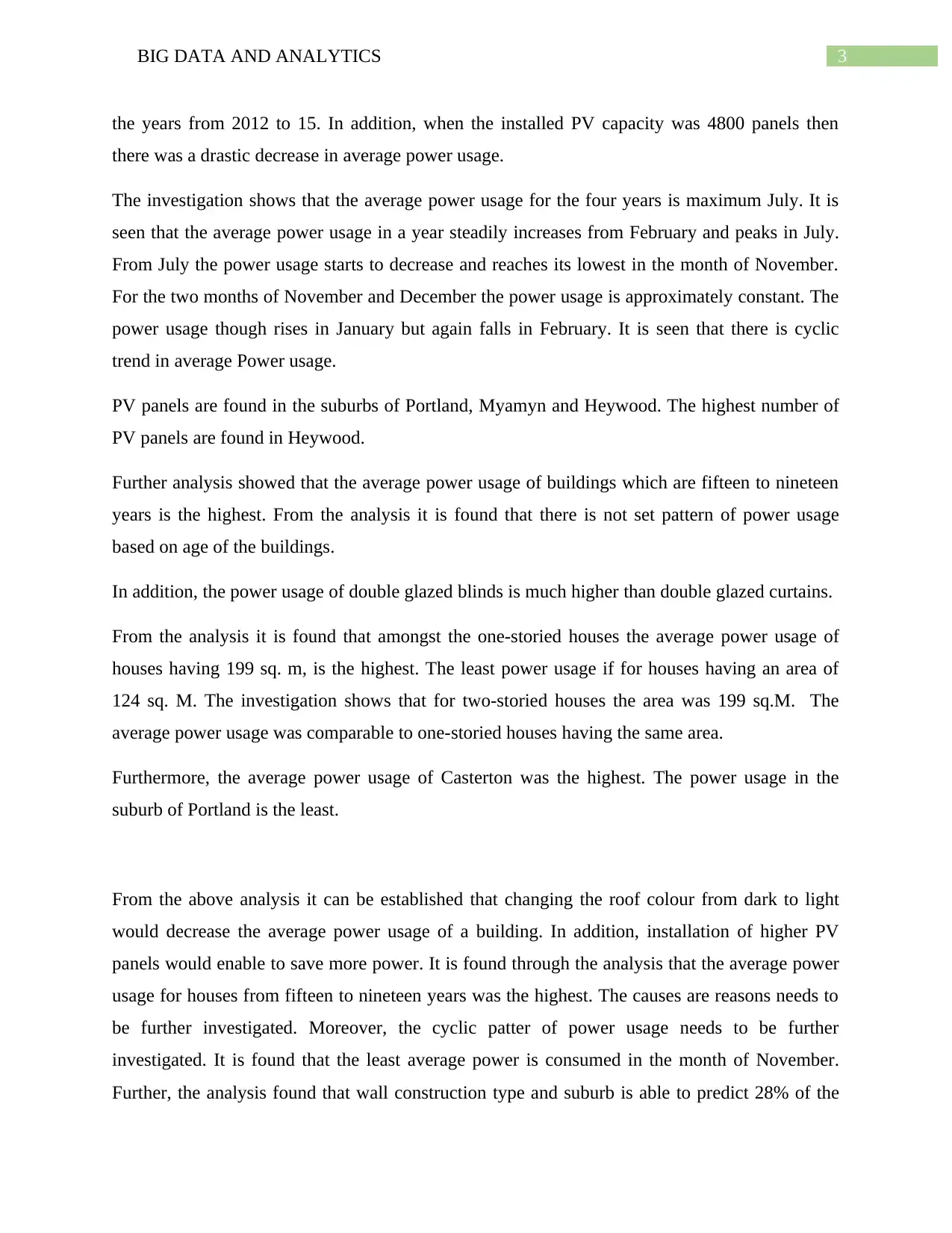
The investigation shows that the average power usage for the four years is maximum July. It is
seen that the average power usage in a year steadily increases from February and peaks in July.
From July the power usage starts to decrease and reaches its lowest in the month of November.
For the two months of November and December the power usage is approximately constant. The
power usage though rises in January but again falls in February. It is seen that there is cyclic
trend in average Power usage.
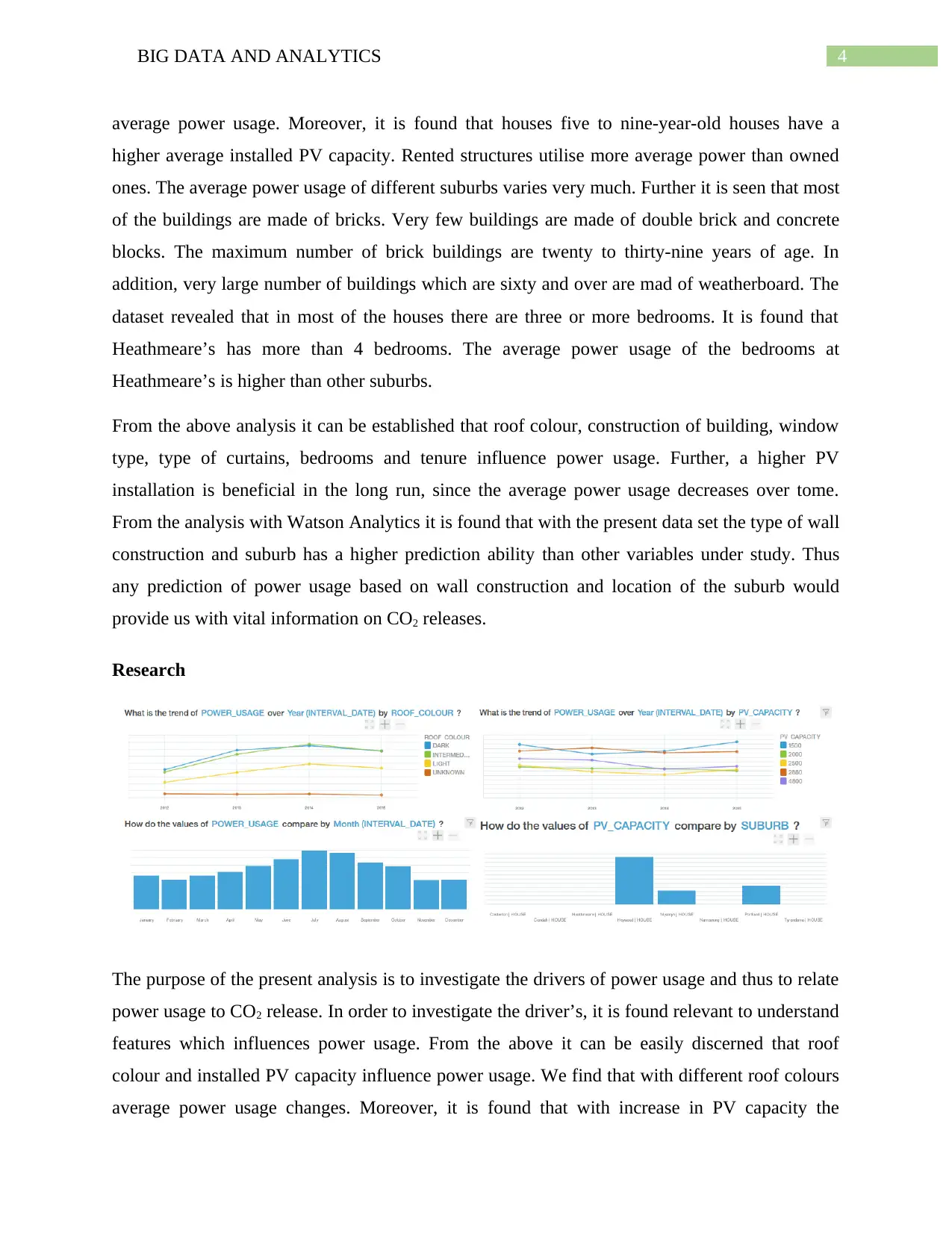
PV panels are found in the suburbs of Portland, Myamyn and Heywood. The highest number of
PV panels are found in Heywood.
Further analysis showed that the average power usage of buildings which are fifteen to nineteen
years is the highest. From the analysis it is found that there is not set pattern of power usage
based on age of the buildings.
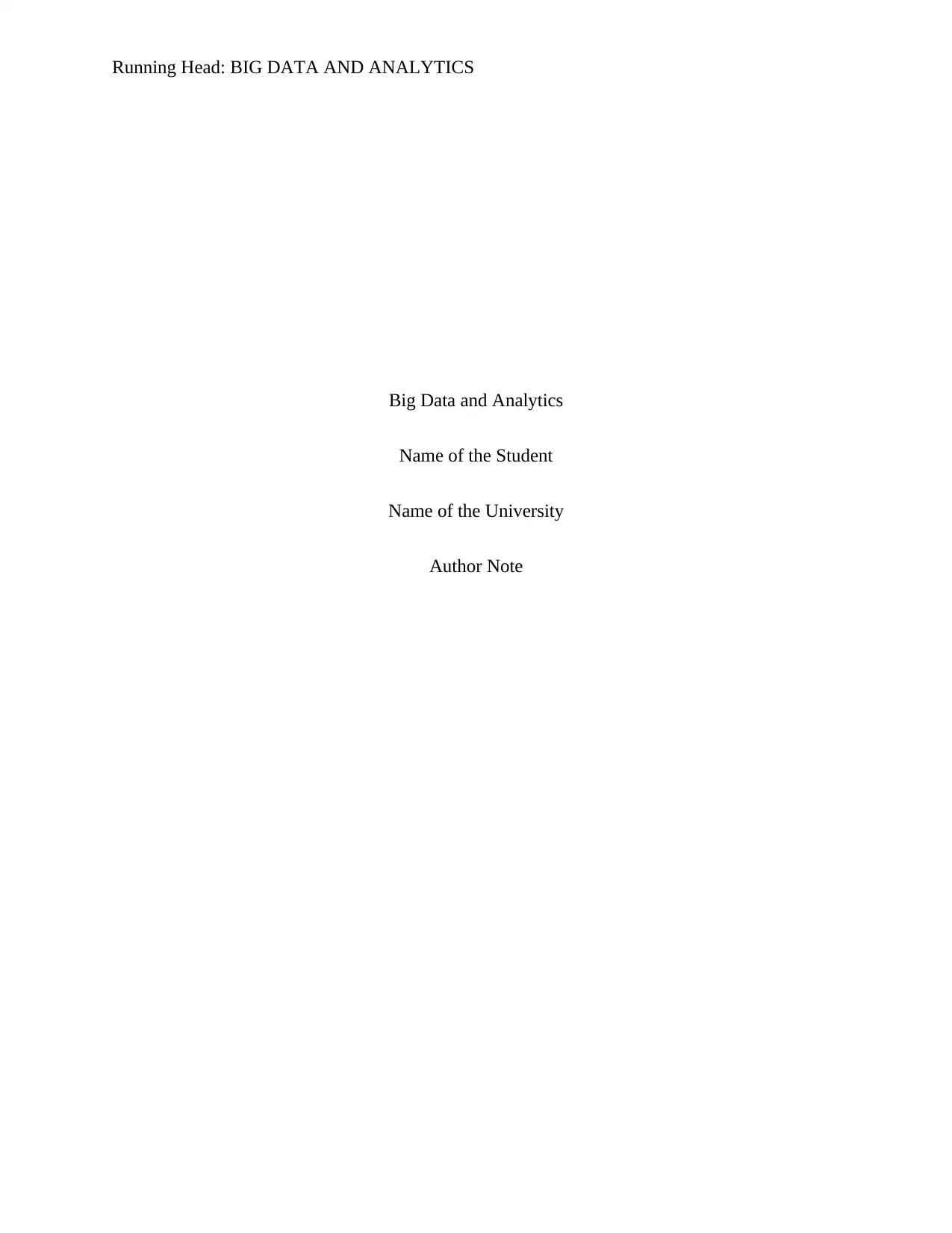
In addition, the power usage of double glazed blinds is much higher than double glazed curtains.
From the analysis it is found that amongst the one-storied houses the average power usage of
houses having 199 sq. m, is the highest. The least power usage if for houses having an area of
124 sq. M. The investigation shows that for two-storied houses the area was 199 sq.M. The
average power usage was comparable to one-storied houses having the same area.
Furthermore, the average power usage of Casterton was the highest. The power usage in the
suburb of Portland is the least.
From the above analysis it can be established that changing the roof colour from dark to light
would decrease the average power usage of a building. In addition, installation of higher PV
panels would enable to save more power. It is found through the analysis that the average power
usage for houses from fifteen to nineteen years was the highest. The causes are reasons needs to
be further investigated. Moreover, the cyclic patter of power usage needs to be further
investigated. It is found that the least average power is consumed in the month of November.
Further, the analysis found that wall construction type and suburb is able to predict 28% of the
tabler-icon-diamond-filled.svg

Paraphrase This Document

Need a fresh take? Get an instant paraphrase of this document with our AI Paraphraser
Document Page
4BIG DATA AND ANALYTICS
average power usage. Moreover, it is found that houses five to nine-year-old houses have a
higher average installed PV capacity. Rented structures utilise more average power than owned
ones. The average power usage of different suburbs varies very much. Further it is seen that most
of the buildings are made of bricks. Very few buildings are made of double brick and concrete
blocks. The maximum number of brick buildings are twenty to thirty-nine years of age. In
addition, very large number of buildings which are sixty and over are mad of weatherboard. The
dataset revealed that in most of the houses there are three or more bedrooms. It is found that
Heathmeare’s has more than 4 bedrooms. The average power usage of the bedrooms at
Heathmeare’s is higher than other suburbs.
From the above analysis it can be established that roof colour, construction of building, window
type, type of curtains, bedrooms and tenure influence power usage. Further, a higher PV
installation is beneficial in the long run, since the average power usage decreases over tome.
From the analysis with Watson Analytics it is found that with the present data set the type of wall
construction and suburb has a higher prediction ability than other variables under study. Thus
any prediction of power usage based on wall construction and location of the suburb would
provide us with vital information on CO2 releases.
Research
The purpose of the present analysis is to investigate the drivers of power usage and thus to relate
power usage to CO2 release. In order to investigate the driver’s, it is found relevant to understand
features which influences power usage. From the above it can be easily discerned that roof
colour and installed PV capacity influence power usage. We find that with different roof colours
average power usage changes. Moreover, it is found that with increase in PV capacity the
Document Page
5BIG DATA AND ANALYTICS
average power usage decreases. In addition, it is also found that the usage of power follows a
cyclic pattern in a year. It can be discerned that during winter months there is more utilisation of
power while the opposite occurs in summer months. It was very surprising to note that PV panels
were not installed in all suburbs.
It is also found that the power usage has a very poor relation to the estimated age of the house.
Though, it is found that window coverings influence power usage. Moreover, there are very few
house which are two storied. Power usage is very poorly related to the area of the house. Further,
it can be seen that some suburbs utilise more power than others.
Recommendations
Recommendation 1
Since it is found that the average power usage is higher dark and intermediate coloured roofs and
lower for light coloured roofs hence it is recommended that the roofs of the houses by light
coloured. Reflective roofs would help in reducing power usage (Al-Obaidi, 2014). Moreover,
installing a higher PV panel would enable a reduction in power usage. Higher PV panels in the
long run are more beneficial than lower panels (Singh, 2013). In addition, it is found that PV
panels are not installed in most of the suburbs. Thus it can be suggested that PV panels needs to
be installed in other suburbs. This would ensure a reduction of power usage in other suburbs also
(Li and Yi, 2014).
Document Page
6BIG DATA AND ANALYTICS
Recommendation 2
The analysis shows that power usage varies across suburbs. It is found that Portland, where PV
panels are installed uses less power. Similarly, for other suburbs also which have PV panels
utilise less power. Thus, it can be recommended that installation of PV panels in other suburbs
would ensure a decrease in power usage (Yi, 2015).
The power requirements of buildings can be managed though the use of smart technology. The
PV panel can be integrated with main power source enabling efficient management of power
(Sehar et al., 2016).
Reflection
It was a great learning experience. Most importantly I learnt the use of an important BI tool like
IBM Watson Analytics. The BI tools is complete cloud based technology grounded on the
principles of natural language processing (NLP). Due to NLP as soon as data is uploaded the BI
tool was able to frame relevant questions. As soon as I viewed the answer to the question the tool
presented a relevant chart. Thus, with simple clicks I was able to generate important insights into
the data. In addition, the tool allowed easy replacement / addition of variables which made the
task easier. Some of the questions were though very tricky, wherein the proper questions had to
be framed. Moreover, since, the BI tool provided only its version of chart changing to a more
relevant chart was challenging.
tabler-icon-diamond-filled.svg

Paraphrase This Document

Need a fresh take? Get an instant paraphrase of this document with our AI Paraphraser
Document Page
7BIG DATA AND ANALYTICS
References
Al-Obaidi, K. M., Ismail, M., & Rahman, A. M. A. (2014). Passive cooling techniques through
reflective and radiative roofs in tropical houses in Southeast Asia: A literature review.
Frontiers of Architectural Research, 3(3), 283-297.
Li, H., & Yi, H. (2014). Multilevel governance and deployment of solar PV panels in US cities.
Energy Policy, 69, 19-27.
Sehar, F., Pipattanasomporn, M., & Rahman, S. (2016). An energy management model to study
energy and peak power savings from PV and storage in demand responsive buildings.
Applied energy, 173, 406-417.
Singh, G. K. (2013). Solar power generation by PV (photovoltaic) technology: A review.
Energy, 53, 1-13.
Yi, H. (2015). Clean-energy policies and electricity sector carbon emissions in the US states.
Utilities Policy, 34, 19-29.
chevron_up_icon
1 out of 8
circle_padding
hide_on_mobile
zoom_out_icon
[object Object]