Analyzing the Role of Big Data in Transforming the Medical Industry
VerifiedAdded on 2023/06/10
|11
|3026
|315
Report
AI Summary
This report provides an overview of the role of big data in the medical industry, focusing on the 5 V's: Volume, Velocity, Variety, Veracity, and Value. It discusses how big data aids in better health profiles, diagnosis, and understanding of diseases by storing and analyzing vast amounts of data, including DNA, tissues, and metabolites. The report highlights the value of big data in research, the importance of data scientists, and the shift towards value-based healthcare. It also addresses the challenges and advantages of using big data, such as improving the quality of care, early intervention, and fraud detection, while acknowledging privacy concerns. The use of a centralized system can help every sector of medical industry like the hospitals, pharmacies and pathologies. Desklib offers resources for further study.

Running head: BIG DATA IN MEDICAL INDUSTRY
Big Data in Medical Industry
Name of the student
Name of the university
Author note
Big Data in Medical Industry
Name of the student
Name of the university
Author note

Paraphrase This Document
Need a fresh take? Get an instant paraphrase of this document with our AI Paraphraser
1BIG DATA IN MEDICAL INDUSTRY
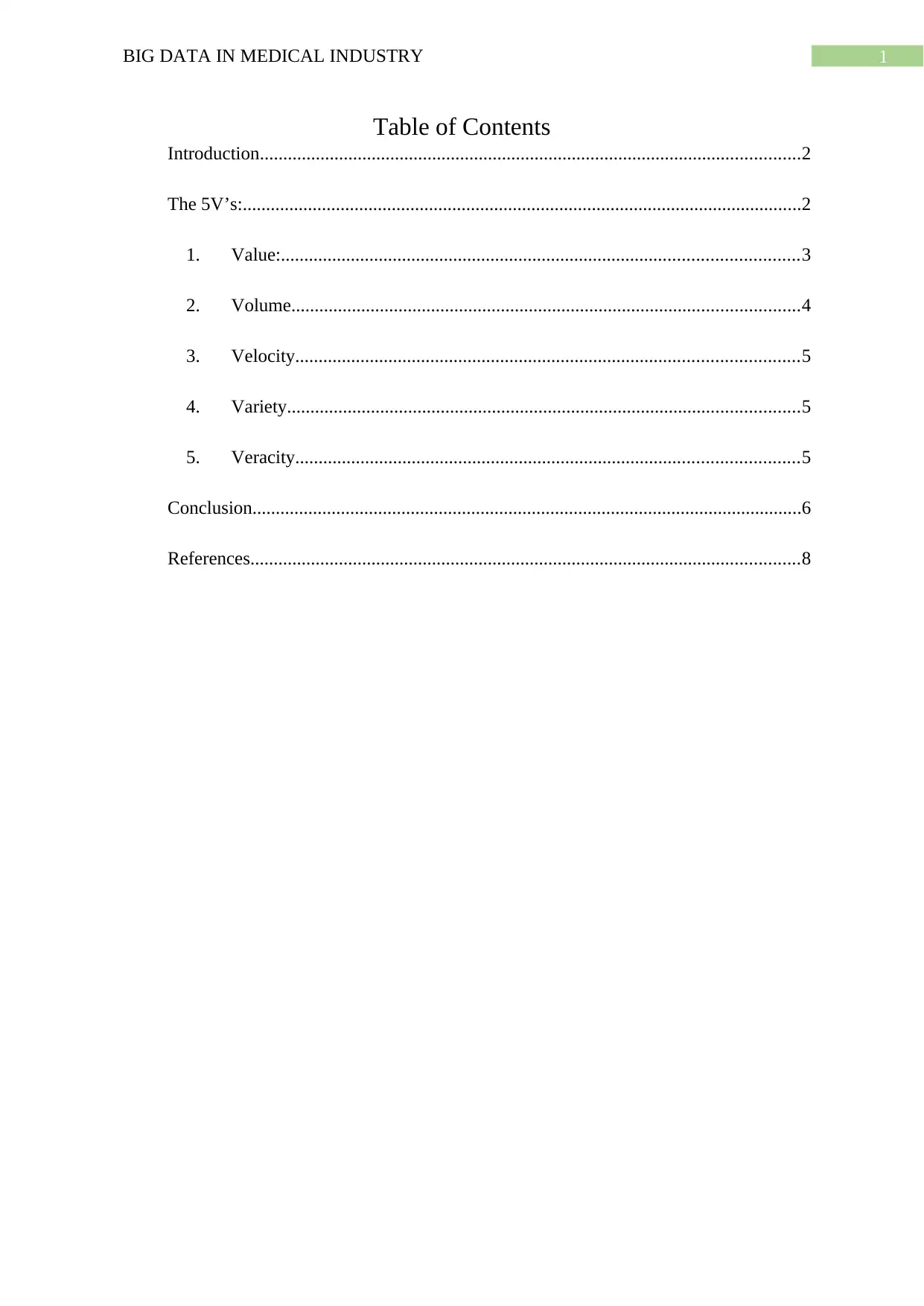
Table of Contents
Introduction....................................................................................................................2
The 5V’s:........................................................................................................................2
1. Value:...............................................................................................................3
2. Volume.............................................................................................................4
3. Velocity............................................................................................................5
4. Variety..............................................................................................................5
5. Veracity............................................................................................................5
Conclusion......................................................................................................................6
References......................................................................................................................8
Table of Contents
Introduction....................................................................................................................2
The 5V’s:........................................................................................................................2
1. Value:...............................................................................................................3
2. Volume.............................................................................................................4
3. Velocity............................................................................................................5
4. Variety..............................................................................................................5
5. Veracity............................................................................................................5
Conclusion......................................................................................................................6
References......................................................................................................................8
2BIG DATA IN MEDICAL INDUSTRY
Introduction
Big data can be explained as a very huge sets of figures that are not possible to
analyse humanly and the machine or computer system help is taken to reveal patterns and of
any data set. The big data can play one of the major role in the field of the medicine, with
introduction of big data in the field of medicines one can help in building up better health
profiles and better diagnosis of the patient in recent futures. Further some of the major back
logs that lies in the field of medicine today is the understanding of the disease and the
syndromes of the same. Big data comes in action as it helps in storing huge amount of the
data like the information about the DNA, tissues, proteins, and metabolites to cells, organs,
and organisms (Gandomi, Amir and Murtaza Haider 2015). This paper mainly focuses in the
five main factors of the big data that have been helpful in understanding the mission of the
big data in medical industry namely the Volume, Velocity, Variety, Veracity, Value. This
paper explains in detail about the five major V’s of which are proven to be very much useful
for the medicine industry.
The 5V’s:
The five V’s. of the big data that is volume that is the quantity of the data that is
stored in the computer, the velocity that is speed of the data in which it gets stored and are
used. While the veracity can be said as the accuracy of the data that is stockpiled in the
systems while value of the big data is measured as the how much the data is important for a
specific task (Gray, Muir 2017). The big data can be one of the most useful technology that
can help medical industry to develop a lot in the future. As the health care industry has
already generated a huge amount of data in the past years and much of which is stored in the
hard copy. With digitalisation of the world these data are stockpiled in the softcopy and has
Introduction
Big data can be explained as a very huge sets of figures that are not possible to
analyse humanly and the machine or computer system help is taken to reveal patterns and of
any data set. The big data can play one of the major role in the field of the medicine, with
introduction of big data in the field of medicines one can help in building up better health
profiles and better diagnosis of the patient in recent futures. Further some of the major back
logs that lies in the field of medicine today is the understanding of the disease and the
syndromes of the same. Big data comes in action as it helps in storing huge amount of the
data like the information about the DNA, tissues, proteins, and metabolites to cells, organs,
and organisms (Gandomi, Amir and Murtaza Haider 2015). This paper mainly focuses in the
five main factors of the big data that have been helpful in understanding the mission of the
big data in medical industry namely the Volume, Velocity, Variety, Veracity, Value. This
paper explains in detail about the five major V’s of which are proven to be very much useful
for the medicine industry.
The 5V’s:
The five V’s. of the big data that is volume that is the quantity of the data that is
stored in the computer, the velocity that is speed of the data in which it gets stored and are
used. While the veracity can be said as the accuracy of the data that is stockpiled in the
systems while value of the big data is measured as the how much the data is important for a
specific task (Gray, Muir 2017). The big data can be one of the most useful technology that
can help medical industry to develop a lot in the future. As the health care industry has
already generated a huge amount of data in the past years and much of which is stored in the
hard copy. With digitalisation of the world these data are stockpiled in the softcopy and has
⊘ This is a preview!⊘
Do you want full access?
Subscribe today to unlock all pages.

Trusted by 1+ million students worldwide
3BIG DATA IN MEDICAL INDUSTRY
become a huge task to decode all the files. The use of the big data can help in analysing of
these raw data file and use them for the betterment of the treatment of the patients (Groves et
al. 2013). The major factors that can be helpful in understanding the use of the big data are:
1. Value:
The primary value for the use of big data within the healthcare sector is mainly
limited to the field of research. The technology of big data requires the use of a specialized
form of skill set. Most of the organizations based on healthcare require the use of data
scientists in order to manipulate the data and extract the useful data from a vast library of the
environment of big data. There is a vast demand of the use of data scientists across the sector
of healthcare. The value based healthcare is capable of putting higher value of demand on the
ability of recording and monitoring the use of data (Radaelli et al. 2014). This data is mainly
regarding the specific symptoms, conditions, procedures and the quality of the result. As the
traditional methods have become outdated in the recent times, hence the modern technology
has largely created the need to progress towards a value based perspective within the
healthcare sector. The value based system would mainly focus on the outcome of the health
of the patients depending on the amount of the money spent (Raghupathi, Wullianallur and
Raghupathi, 2014). This kind of system encourages the approach, increase of the satisfaction
and the quality within the healthcare sector. The value based healthcare system would be
helpful in putting a higher demand on the ability to keep a track of the record and thus would
be able to monitor the use of the data. This data would be in relation with the symptoms and
specific conditions. The use of big data would help in adjusting the various accounts of
several patients for different results that would depend on the health and age of the patient
among several other factors. With the successful introduction of the big data within the
healthcare sector, there would be more level of positive benefits beyond the domain of
medical care. The clinical based researchers that would include the medical technologies and
become a huge task to decode all the files. The use of the big data can help in analysing of
these raw data file and use them for the betterment of the treatment of the patients (Groves et
al. 2013). The major factors that can be helpful in understanding the use of the big data are:
1. Value:
The primary value for the use of big data within the healthcare sector is mainly
limited to the field of research. The technology of big data requires the use of a specialized
form of skill set. Most of the organizations based on healthcare require the use of data
scientists in order to manipulate the data and extract the useful data from a vast library of the
environment of big data. There is a vast demand of the use of data scientists across the sector
of healthcare. The value based healthcare is capable of putting higher value of demand on the
ability of recording and monitoring the use of data (Radaelli et al. 2014). This data is mainly
regarding the specific symptoms, conditions, procedures and the quality of the result. As the
traditional methods have become outdated in the recent times, hence the modern technology
has largely created the need to progress towards a value based perspective within the
healthcare sector. The value based system would mainly focus on the outcome of the health
of the patients depending on the amount of the money spent (Raghupathi, Wullianallur and
Raghupathi, 2014). This kind of system encourages the approach, increase of the satisfaction
and the quality within the healthcare sector. The value based healthcare system would be
helpful in putting a higher demand on the ability to keep a track of the record and thus would
be able to monitor the use of the data. This data would be in relation with the symptoms and
specific conditions. The use of big data would help in adjusting the various accounts of
several patients for different results that would depend on the health and age of the patient
among several other factors. With the successful introduction of the big data within the
healthcare sector, there would be more level of positive benefits beyond the domain of
medical care. The clinical based researchers that would include the medical technologies and
Paraphrase This Document
Need a fresh take? Get an instant paraphrase of this document with our AI Paraphraser
4BIG DATA IN MEDICAL INDUSTRY
the use of pharmaceuticals would have several benefits based on the value based approach of
big data within the industry of healthcare (Uddin, Fahim and Gupta 2015). The use of the
applications of big data would help in registering the historical data of the patients in relation
with the patient based on a specific condition and diagnosis of their health.
2. Volume
As mentioned above in this paper, medical industries have already stored huge
amount of data in the recent past and with the coming time amount of data are increasing as
knowledge about the human bodies, medicines, structure of the bio ticks are incising. The use
of the technology like the robots and the artificial intelligence are coming into existence are
also increasing the amount of data. All these data can be very usefully stored by with help of
the concept of big data. The volume of data can really important as because big data has huge
volume of the data can be properly analysed and more accurate results can be made which are
not possible for the human beings. Such as using the technology certain syndromes of a
patient can be better analysed as the information are taken from huge clusters of data, that are
not possible for the human beings to store or memorise in mind. This is one of the major
factor where it has helped the medical industry (Patil, Kupwade and Seshadri 2015). Other
than this the data are automatically stored automatically which reduces the human efforts and
the errors that are made by the humans. Also the storage space and cost are reduced. Further
the use of a centralised system can help every sector of medical industry like the hospitals,
pharmacies and pathologies. The aggregate of the collected data of the patients would lead to
clinical based improvements. Additionally they would also withdraw the ability to understand
effectiveness use of big data within healthcare (Belle et al. 2018). With the help of the use of
big data, the people would be able to access records of data of their health. Since the people
would be able to access the information, hence this would help in providing a better incentive
for gaining much better results. The use of big data would also play a major role to increase
the use of pharmaceuticals would have several benefits based on the value based approach of
big data within the industry of healthcare (Uddin, Fahim and Gupta 2015). The use of the
applications of big data would help in registering the historical data of the patients in relation
with the patient based on a specific condition and diagnosis of their health.
2. Volume
As mentioned above in this paper, medical industries have already stored huge
amount of data in the recent past and with the coming time amount of data are increasing as
knowledge about the human bodies, medicines, structure of the bio ticks are incising. The use
of the technology like the robots and the artificial intelligence are coming into existence are
also increasing the amount of data. All these data can be very usefully stored by with help of
the concept of big data. The volume of data can really important as because big data has huge
volume of the data can be properly analysed and more accurate results can be made which are
not possible for the human beings. Such as using the technology certain syndromes of a
patient can be better analysed as the information are taken from huge clusters of data, that are
not possible for the human beings to store or memorise in mind. This is one of the major
factor where it has helped the medical industry (Patil, Kupwade and Seshadri 2015). Other
than this the data are automatically stored automatically which reduces the human efforts and
the errors that are made by the humans. Also the storage space and cost are reduced. Further
the use of a centralised system can help every sector of medical industry like the hospitals,
pharmacies and pathologies. The aggregate of the collected data of the patients would lead to
clinical based improvements. Additionally they would also withdraw the ability to understand
effectiveness use of big data within healthcare (Belle et al. 2018). With the help of the use of
big data, the people would be able to access records of data of their health. Since the people
would be able to access the information, hence this would help in providing a better incentive
for gaining much better results. The use of big data would also play a major role to increase
5BIG DATA IN MEDICAL INDUSTRY
the quality of healthcare of patient, minimize losses within the industry and thus reducing the
various costs of healthcare.
3. Velocity:
Velocity one of the other major plus point of the system of big data in field of the big
data. The speed of the uploading and downloading the huge amount of data matters a lot
in the field of the medical industry (Thota et al. 2014). Even a fraction of second can be
helpful for the medical industry. Velocity is one of the defining point of big data. Suppose
example a patient’s data is uploaded from various hospitals and of various symptom
(Srinivasan, Uma and Arunasalam 2015). At a time of emergency with the use of the big
data all the information from different sources can be merged up together and the most
accurate result gathered with the assistance of the big data (Wang et al. 2018). The use of
the Artificial intelligence and internet of things can also be helpful as it can process the
big data in small amount of time with proper accuracy.
4. Variety:
Varity of data are the toughest thing to be calculated by the humans in the field of the
medical industry. It can be tough for anyone to handle huge verity of data. Also one of the
major problem is that the variety of the data are not always right and are sometimes
wrong. While the meaning full data comes in different shapes and sizes (Archenaa and
Anita 2014). It becomes at ease with big data to calculate the amount of data effectively
(Bates et al. 2013). When data are not stored in a centralized system it becomes harder to
analyse all data accurately. But with help of big data concept and using same with
centralised database system, all the data can be used and processed at same time and
hence not only reduces space of storing data but also increases efficiency of data.
the quality of healthcare of patient, minimize losses within the industry and thus reducing the
various costs of healthcare.
3. Velocity:
Velocity one of the other major plus point of the system of big data in field of the big
data. The speed of the uploading and downloading the huge amount of data matters a lot
in the field of the medical industry (Thota et al. 2014). Even a fraction of second can be
helpful for the medical industry. Velocity is one of the defining point of big data. Suppose
example a patient’s data is uploaded from various hospitals and of various symptom
(Srinivasan, Uma and Arunasalam 2015). At a time of emergency with the use of the big
data all the information from different sources can be merged up together and the most
accurate result gathered with the assistance of the big data (Wang et al. 2018). The use of
the Artificial intelligence and internet of things can also be helpful as it can process the
big data in small amount of time with proper accuracy.
4. Variety:
Varity of data are the toughest thing to be calculated by the humans in the field of the
medical industry. It can be tough for anyone to handle huge verity of data. Also one of the
major problem is that the variety of the data are not always right and are sometimes
wrong. While the meaning full data comes in different shapes and sizes (Archenaa and
Anita 2014). It becomes at ease with big data to calculate the amount of data effectively
(Bates et al. 2013). When data are not stored in a centralized system it becomes harder to
analyse all data accurately. But with help of big data concept and using same with
centralised database system, all the data can be used and processed at same time and
hence not only reduces space of storing data but also increases efficiency of data.
⊘ This is a preview!⊘
Do you want full access?
Subscribe today to unlock all pages.
Trusted by 1+ million students worldwide
6BIG DATA IN MEDICAL INDUSTRY
Although many professionals debate that the actual meaning of big data is not really
related to its bulkiness, at all but can help in the process of analysing variety of the data.
5. Veracity:
Veracity is considered to be one of the five V’s that is mainly used for the description
of the use of big data in healthcare sector (Murdoch et al. 2014). This term refers to the
preconceptions, abnormality and the noises within the data. The veracity of the data could be
simply understood as the truthfulness of the data. The veracity, which could also be referred
to as the quality of the data, normally refers to the fact that the analysis on the provided data
would be free of any kind of errors and highly credible (Sun et al. 2014). This data should be
reliable, trustworthy and accurate. The normal meaning of the term veracity is accuracy. Thus
in terms of big data, veracity can enlightened as the amount of raw data which is accurate.
The correctness of the data is one of the major factor in terms of big data. If wrong data is
processed then it can be very much dangerous and can become fatal for the students. The
machines plays an important role in this part (Heitmueller et al. 2014 ). The machines are
coded in such a way that it uses the knowledge of machine learning to better understand the
idea of correct data.
In order to improve the veracity of the data, the clinical approach should be able to
focus on the use of the various methods, results and the discussion of the data within the
healthcare sector. Different kinds of the data of the same patient might be able to specify that
veracity within the data is deficient and there could be a fault within the analysis of the
information.
Conclusion:
Thus concluding the topic it can be said that big data is one of the most advanced and
important technology that is being used in the medical filed. There lies some of major
Although many professionals debate that the actual meaning of big data is not really
related to its bulkiness, at all but can help in the process of analysing variety of the data.
5. Veracity:
Veracity is considered to be one of the five V’s that is mainly used for the description
of the use of big data in healthcare sector (Murdoch et al. 2014). This term refers to the
preconceptions, abnormality and the noises within the data. The veracity of the data could be
simply understood as the truthfulness of the data. The veracity, which could also be referred
to as the quality of the data, normally refers to the fact that the analysis on the provided data
would be free of any kind of errors and highly credible (Sun et al. 2014). This data should be
reliable, trustworthy and accurate. The normal meaning of the term veracity is accuracy. Thus
in terms of big data, veracity can enlightened as the amount of raw data which is accurate.
The correctness of the data is one of the major factor in terms of big data. If wrong data is
processed then it can be very much dangerous and can become fatal for the students. The
machines plays an important role in this part (Heitmueller et al. 2014 ). The machines are
coded in such a way that it uses the knowledge of machine learning to better understand the
idea of correct data.
In order to improve the veracity of the data, the clinical approach should be able to
focus on the use of the various methods, results and the discussion of the data within the
healthcare sector. Different kinds of the data of the same patient might be able to specify that
veracity within the data is deficient and there could be a fault within the analysis of the
information.
Conclusion:
Thus concluding the topic it can be said that big data is one of the most advanced and
important technology that is being used in the medical filed. There lies some of major
Paraphrase This Document
Need a fresh take? Get an instant paraphrase of this document with our AI Paraphraser
7BIG DATA IN MEDICAL INDUSTRY
advantages as well as disadvantages of the system. Some of the major advantages of the
system are:
Higher quality care: The major advantage of using big data is because it draws a various
number of sources, which includes number of doctors, previous diagnoses and other outside
source systems. With all the data merged up in one place it can help in better analysing of
data.
Early intervention: With better diagnosis, diseases can easily be diagnosed and major
diseases can be prevented in an early phase of the disease.
Fraud detection: If there is any case where doctors are making error in treating a patient can
easily be diagnosed with help of big data.
Some of the major disadvantages of using big data in medical industry are:
Privacy: As all the data are centralised hence a simple breach can publicize all the data.
Lack of technicians: Big data needs a lot of technical knowledge and hence a need of
technician is a mist and hence can be a disadvantage at certain point if no technician is
present.
advantages as well as disadvantages of the system. Some of the major advantages of the
system are:
Higher quality care: The major advantage of using big data is because it draws a various
number of sources, which includes number of doctors, previous diagnoses and other outside
source systems. With all the data merged up in one place it can help in better analysing of
data.
Early intervention: With better diagnosis, diseases can easily be diagnosed and major
diseases can be prevented in an early phase of the disease.
Fraud detection: If there is any case where doctors are making error in treating a patient can
easily be diagnosed with help of big data.
Some of the major disadvantages of using big data in medical industry are:
Privacy: As all the data are centralised hence a simple breach can publicize all the data.
Lack of technicians: Big data needs a lot of technical knowledge and hence a need of
technician is a mist and hence can be a disadvantage at certain point if no technician is
present.
8BIG DATA IN MEDICAL INDUSTRY
References
Archenaa, J., and EA Mary Anita. "A survey of big data analytics in healthcare and
government." Procedia Computer Science 50 (2015): 408-413.
Bates, David W., Suchi Saria, Lucila Ohno-Machado, Anand Shah, and Gabriel Escobar.
"Big data in health care: using analytics to identify and manage high-risk and high-
cost patients." Health Affairs 33, no. 7 (2014): 1123-1131.
Belle, Ashwin, Raghuram Thiagarajan, S. M. Soroushmehr, Fatemeh Navidi, Daniel A.
Beard, and Kayvan Najarian. "Big data analytics in healthcare." BioMed research
international2015 (2015).
Davenport, Thomas H., Paul Barth, and Randy Bean. How'big data'is different. MIT Sloan
Management Review, 2012.
Gandomi, Amir, and Murtaza Haider. "Beyond the hype: Big data concepts, methods, and
analytics." International Journal of Information Management 35, no. 2 (2015): 137-
144.
Ghani, Khurshid R., Kai Zheng, John T. Wei, and Charles P. Friedman. "Harnessing big data
for health care and research: are urologists ready?." European urology 66, no. 6
(2014): 975-977.
Gray, Muir. "Value based healthcare." BMJ: British Medical Journal (Online) 356 (2017).
Groves, Peter, Basel Kayyali, David Knott, and Steve Van Kuiken. "The ‘big data’revolution
in healthcare." McKinsey Quarterly 2, no. 3 (2013).
Heitmueller, Axel, Sarah Henderson, Will Warburton, Ahmed Elmagarmid, Alex “Sandy
Pentland, and Ara Darzi. "Developing public policy to advance the use of big data in
health care." Health Affairs 33, no. 9 (2014): 1523-1530.
References
Archenaa, J., and EA Mary Anita. "A survey of big data analytics in healthcare and
government." Procedia Computer Science 50 (2015): 408-413.
Bates, David W., Suchi Saria, Lucila Ohno-Machado, Anand Shah, and Gabriel Escobar.
"Big data in health care: using analytics to identify and manage high-risk and high-
cost patients." Health Affairs 33, no. 7 (2014): 1123-1131.
Belle, Ashwin, Raghuram Thiagarajan, S. M. Soroushmehr, Fatemeh Navidi, Daniel A.
Beard, and Kayvan Najarian. "Big data analytics in healthcare." BioMed research
international2015 (2015).
Davenport, Thomas H., Paul Barth, and Randy Bean. How'big data'is different. MIT Sloan
Management Review, 2012.
Gandomi, Amir, and Murtaza Haider. "Beyond the hype: Big data concepts, methods, and
analytics." International Journal of Information Management 35, no. 2 (2015): 137-
144.
Ghani, Khurshid R., Kai Zheng, John T. Wei, and Charles P. Friedman. "Harnessing big data
for health care and research: are urologists ready?." European urology 66, no. 6
(2014): 975-977.
Gray, Muir. "Value based healthcare." BMJ: British Medical Journal (Online) 356 (2017).
Groves, Peter, Basel Kayyali, David Knott, and Steve Van Kuiken. "The ‘big data’revolution
in healthcare." McKinsey Quarterly 2, no. 3 (2013).
Heitmueller, Axel, Sarah Henderson, Will Warburton, Ahmed Elmagarmid, Alex “Sandy
Pentland, and Ara Darzi. "Developing public policy to advance the use of big data in
health care." Health Affairs 33, no. 9 (2014): 1523-1530.
⊘ This is a preview!⊘
Do you want full access?
Subscribe today to unlock all pages.
Trusted by 1+ million students worldwide
9BIG DATA IN MEDICAL INDUSTRY
Murdoch, Travis B., and Allan S. Detsky. "The inevitable application of big data to health
care." Jama 309, no. 13 (2013): 1351-1352.
Patil, Harsh Kupwade, and Ravi Seshadri. "Big data security and privacy issues in
healthcare." In Big Data (BigData Congress), 2014 IEEE International Congress on,
pp. 762-765. IEEE, 2014.
Radaelli, Giovanni, Emanuele Lettieri, Matteo Mura, and Nicola Spiller. "Knowledge sharing
and innovative work behaviour in healthcare: A micro‐level investigation of direct
and indirect effects." Creativity and Innovation Management23, no. 4 (2014): 400-
414.
Raghupathi, Wullianallur, and Viju Raghupathi. "Big data analytics in healthcare: promise
and potential." Health information science and systems 2, no. 1 (2014): 3.
Srinivasan, Uma, and Bavani Arunasalam. "Leveraging big data analytics to reduce
healthcare costs." IT professional 15, no. 6 (2013): 21-28.
Steinbrook, Robert. "Personally controlled online health data-the next big thing in medical
care?." New England Journal of Medicine 358, no. 16 (2018): 1653.
Sun, Jimeng, and Chandan K. Reddy. "Big data analytics for healthcare." In Proceedings of
the 19th ACM SIGKDD international conference on Knowledge discovery and data
mining, pp. 1525-1525. ACM, 2013.
Thota, Chandu, Revathi Sundarasekar, Gunasekaran Manogaran, R. Varatharajan, and M. K.
Priyan. "Centralized fog computing security platform for IoT and cloud in healthcare
system." In Exploring the convergence of big data and the internet of things, pp. 141-
154. IGI Global, 2018.
Murdoch, Travis B., and Allan S. Detsky. "The inevitable application of big data to health
care." Jama 309, no. 13 (2013): 1351-1352.
Patil, Harsh Kupwade, and Ravi Seshadri. "Big data security and privacy issues in
healthcare." In Big Data (BigData Congress), 2014 IEEE International Congress on,
pp. 762-765. IEEE, 2014.
Radaelli, Giovanni, Emanuele Lettieri, Matteo Mura, and Nicola Spiller. "Knowledge sharing
and innovative work behaviour in healthcare: A micro‐level investigation of direct
and indirect effects." Creativity and Innovation Management23, no. 4 (2014): 400-
414.
Raghupathi, Wullianallur, and Viju Raghupathi. "Big data analytics in healthcare: promise
and potential." Health information science and systems 2, no. 1 (2014): 3.
Srinivasan, Uma, and Bavani Arunasalam. "Leveraging big data analytics to reduce
healthcare costs." IT professional 15, no. 6 (2013): 21-28.
Steinbrook, Robert. "Personally controlled online health data-the next big thing in medical
care?." New England Journal of Medicine 358, no. 16 (2018): 1653.
Sun, Jimeng, and Chandan K. Reddy. "Big data analytics for healthcare." In Proceedings of
the 19th ACM SIGKDD international conference on Knowledge discovery and data
mining, pp. 1525-1525. ACM, 2013.
Thota, Chandu, Revathi Sundarasekar, Gunasekaran Manogaran, R. Varatharajan, and M. K.
Priyan. "Centralized fog computing security platform for IoT and cloud in healthcare
system." In Exploring the convergence of big data and the internet of things, pp. 141-
154. IGI Global, 2018.
Paraphrase This Document
Need a fresh take? Get an instant paraphrase of this document with our AI Paraphraser
10BIG DATA IN MEDICAL INDUSTRY
Uddin, Muhammad Fahim, and Navarun Gupta. "Seven V's of Big Data understanding Big
Data to extract value." In American Society for Engineering Education (ASEE Zone
1), 2014 Zone 1 Conference of the, pp. 1-5. IEEE, 2014.
Wang, Yichuan, LeeAnn Kung, and Terry Anthony Byrd. "Big data analytics: Understanding
its capabilities and potential benefits for healthcare organizations." Technological
Forecasting and Social Change 126 (2018): 3-13.
Uddin, Muhammad Fahim, and Navarun Gupta. "Seven V's of Big Data understanding Big
Data to extract value." In American Society for Engineering Education (ASEE Zone
1), 2014 Zone 1 Conference of the, pp. 1-5. IEEE, 2014.
Wang, Yichuan, LeeAnn Kung, and Terry Anthony Byrd. "Big data analytics: Understanding
its capabilities and potential benefits for healthcare organizations." Technological
Forecasting and Social Change 126 (2018): 3-13.

1 out of 11


Related Documents


Your All-in-One AI-Powered Toolkit for Academic Success.
+13062052269
info@desklib.com
Available 24*7 on WhatsApp / Email
![[object Object]](/_next/static/media/star-bottom.7253800d.svg)
Unlock your academic potential
Copyright © 2020–2026 A2Z Services. All Rights Reserved. Developed and managed by ZUCOL.