Biostatistics 2: Analysis of Sample Data and Frequency Tables

Verified

Added on  2022/08/20

|12
|1505
|19
Report
AI Summary
This Biostatistics report presents an analysis of a given dataset, focusing on frequency tables, histograms, and data distributions. The report begins with an examination of a frequency table, calculating the sample size and percentages related to falls in nursing home residents. It then explores the superimposition of a normal distribution on a histogram, describing the shape of the frequency distribution. Part B delves into specific variables, comparing tables and graphs, and analyzing variables like 'racethn' and 'higrade'. The analysis includes calculating percentages, identifying missing values, and interpreting the normality of distributions based on histograms. The report concludes with an examination of background variables, using frequency tables to illustrate demographic information such as education, marital status, and employment. The report also provides a bibliography of relevant sources.
Document Page
Running head: BIOSTATISTICS
Biostatistics
tabler-icon-diamond-filled.svg

Paraphrase This Document

Need a fresh take? Get an instant paraphrase of this document with our AI Paraphraser
Document Page
1BIOSTATISTICS
Table of Contents
A1.C...........................................................................................................................................2
A2: Answering the following questions using the above table..................................................2
A3. Superimposing of a normal distribution on the histogram..................................................4
a. Histogram...........................................................................................................................4
b. Description of the shape of frequency distribution............................................................5
Part B: Exercise..........................................................................................................................5
B1. Variable used: racethn.....................................................................................................5
B2: Comparison of table and graph.......................................................................................6
B3: Variable used: higrade.....................................................................................................6
B4: Variable used: higrade.....................................................................................................7
B5: Rerunning variable higrade.............................................................................................8
B6: Background variables of the data set...............................................................................9
Bibliography.............................................................................................................................11
Document Page
2BIOSTATISTICS
PART A: EXERCISES
A1.C
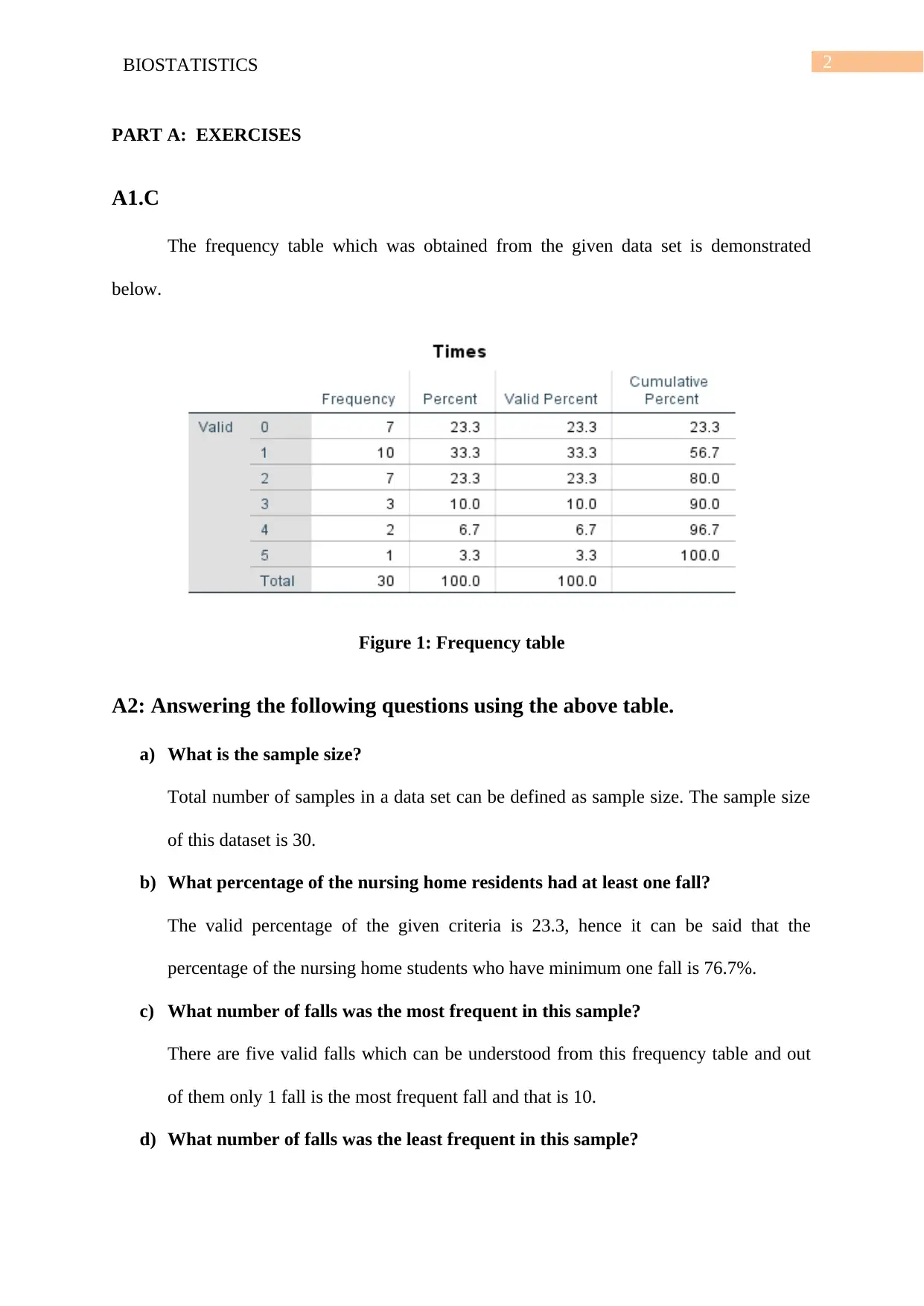
The frequency table which was obtained from the given data set is demonstrated
below.
Figure 1: Frequency table
A2: Answering the following questions using the above table.
a) What is the sample size?
Total number of samples in a data set can be defined as sample size. The sample size
of this dataset is 30.
b) What percentage of the nursing home residents had at least one fall?
The valid percentage of the given criteria is 23.3, hence it can be said that the
percentage of the nursing home students who have minimum one fall is 76.7%.
c) What number of falls was the most frequent in this sample?
There are five valid falls which can be understood from this frequency table and out
of them only 1 fall is the most frequent fall and that is 10.
d) What number of falls was the least frequent in this sample?
Document Page
3BIOSTATISTICS
In this sample the 5th fall has the least frequency and it is 1.
e) What percentage of residents had 2 or fewer falls?
The sample size of this data set is 30 and the total number of frequencies in this
sample data set is 24. Hence, it can be said that the 80% of the residents had 2 or
fewer falls.
f) Are there any outliers in this data set?
There are no outliners in this data set as all the data are very much similar to each
other. The overall pattern of the data is similar and there are no real discrepancies in
this data set.
A3. Superimposing of a normal distribution on the histogram
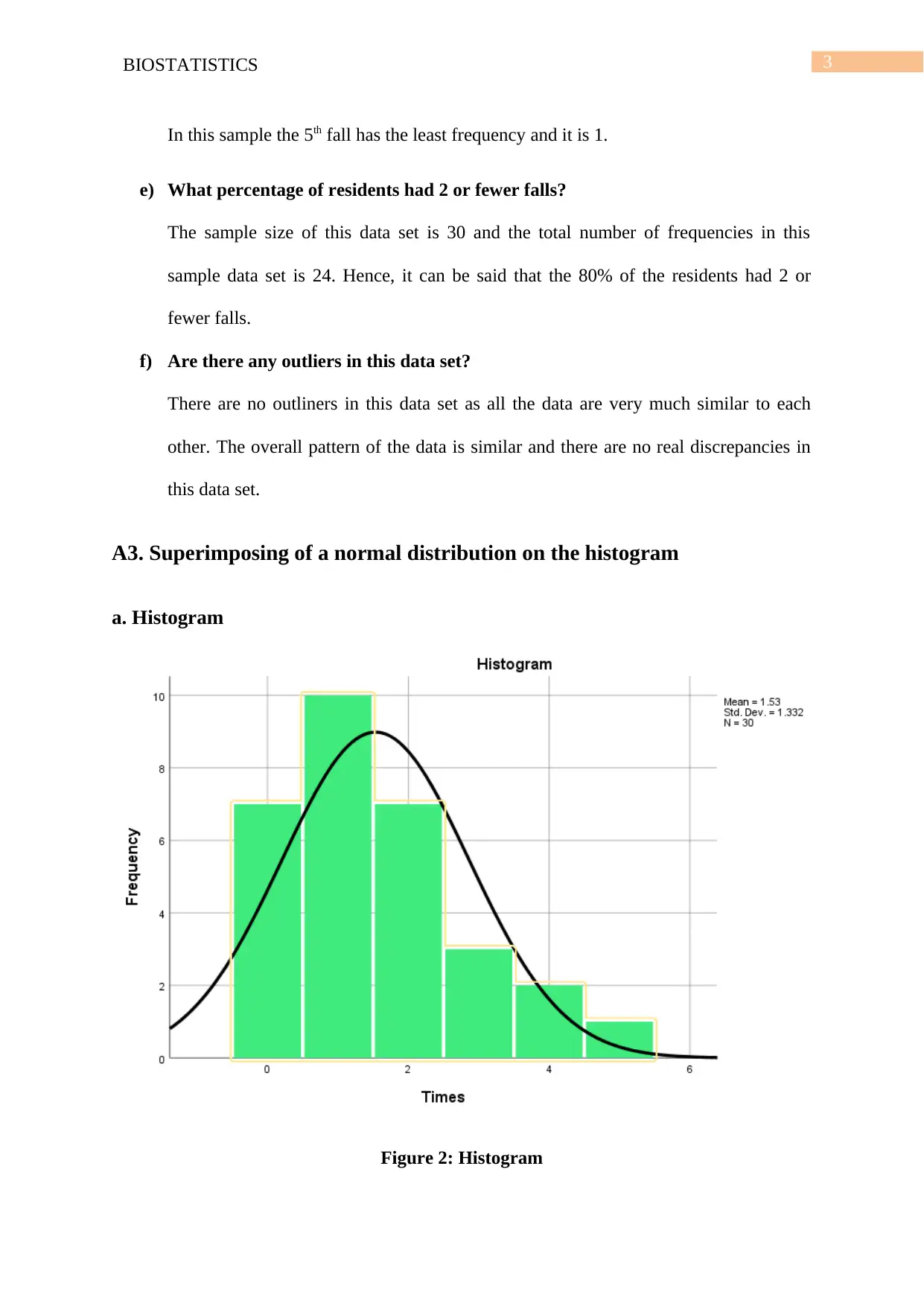
a. Histogram
Figure 2: Histogram
tabler-icon-diamond-filled.svg

Paraphrase This Document

Need a fresh take? Get an instant paraphrase of this document with our AI Paraphraser
Document Page
4BIOSTATISTICS
b. Description of the shape of frequency distribution
Only one clear peak can be observed from the above histogram, hence it can be
termed as the unimodal distribution. If one peak can be seen from a histogram it can be
termed as a unimodal distribution. The above histogram also helps in understanding that it is
right skewed. If the tail of the histogram is one the right side then it can be termed as the
right skewed distribution. From the eyeball inspection, it can be said that the number of falls
in this dataset is not normally distributed.
Part B: Exercise
B1. Variable used: racethn
a) What percentages of women in this study were “White, not Hispanic”?
5.3% of women are white and not Hispanic.
Document Page
5BIOSTATISTICS
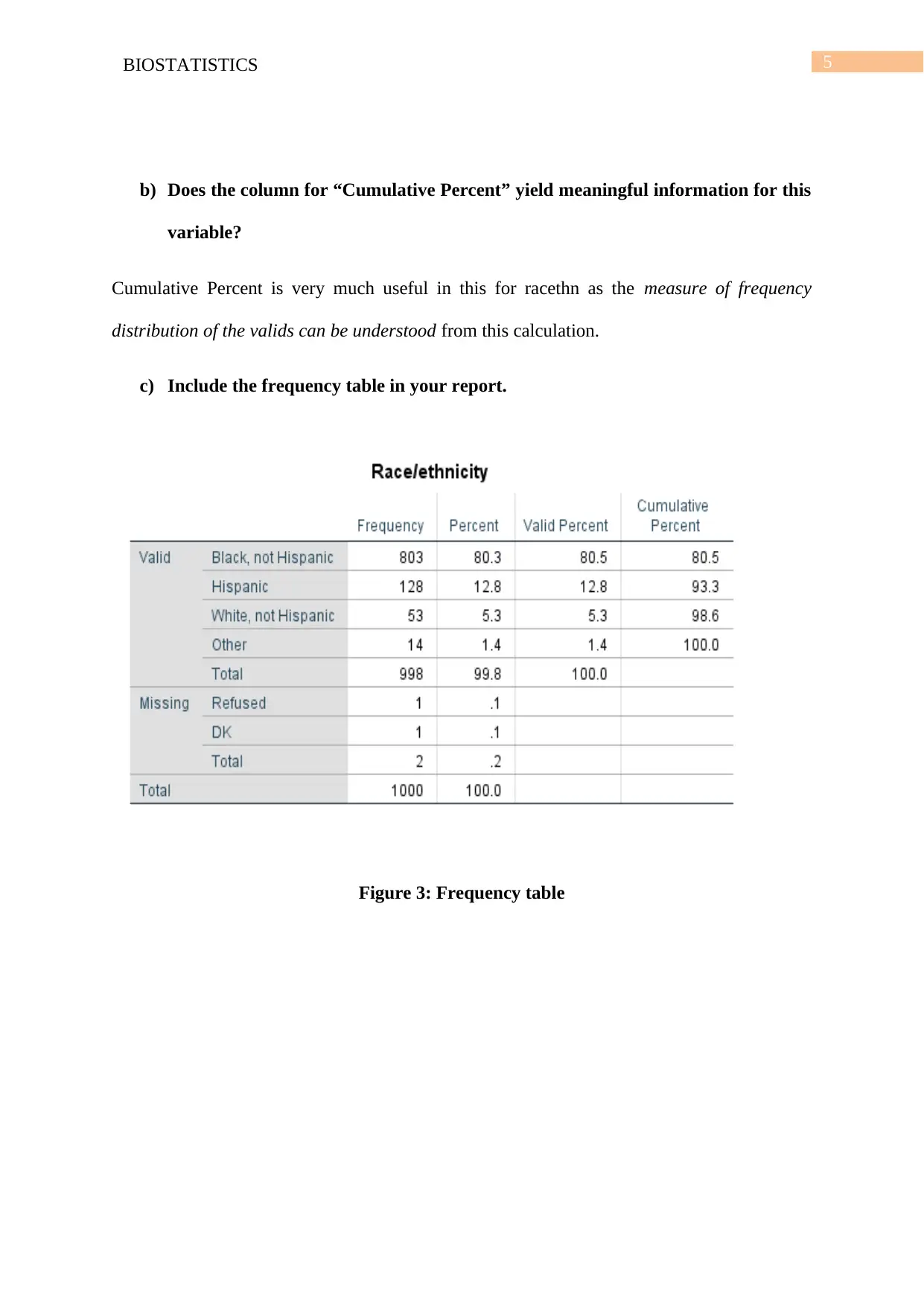
b) Does the column for “Cumulative Percent” yield meaningful information for this
variable?
Cumulative Percent is very much useful in this for racethn as the measure of frequency
distribution of the valids can be understood from this calculation.
c) Include the frequency table in your report.
Figure 3: Frequency table
Document Page
6BIOSTATISTICS
B2: Comparison of table and graph
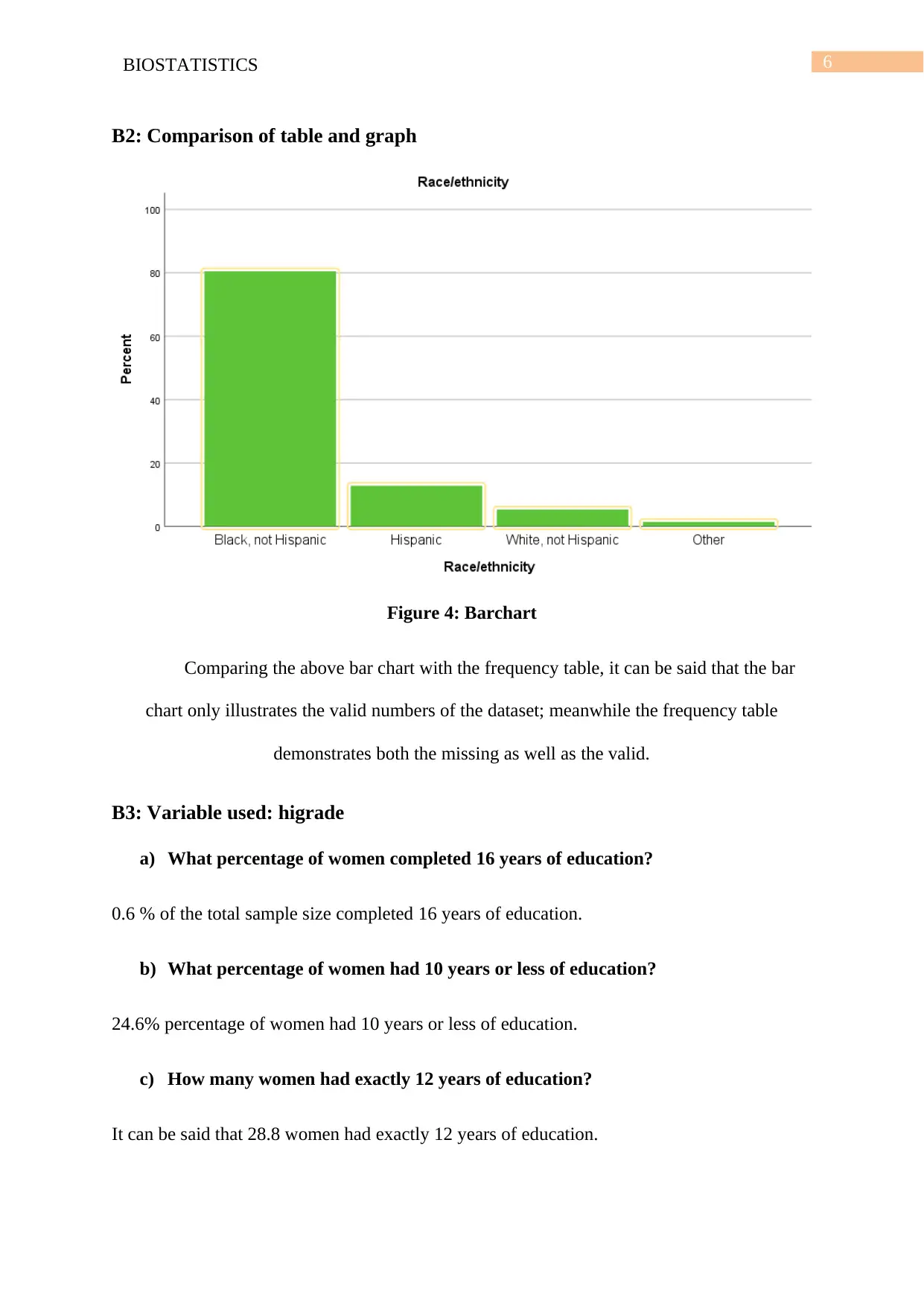
Figure 4: Barchart
Comparing the above bar chart with the frequency table, it can be said that the bar
chart only illustrates the valid numbers of the dataset; meanwhile the frequency table
demonstrates both the missing as well as the valid.
B3: Variable used: higrade
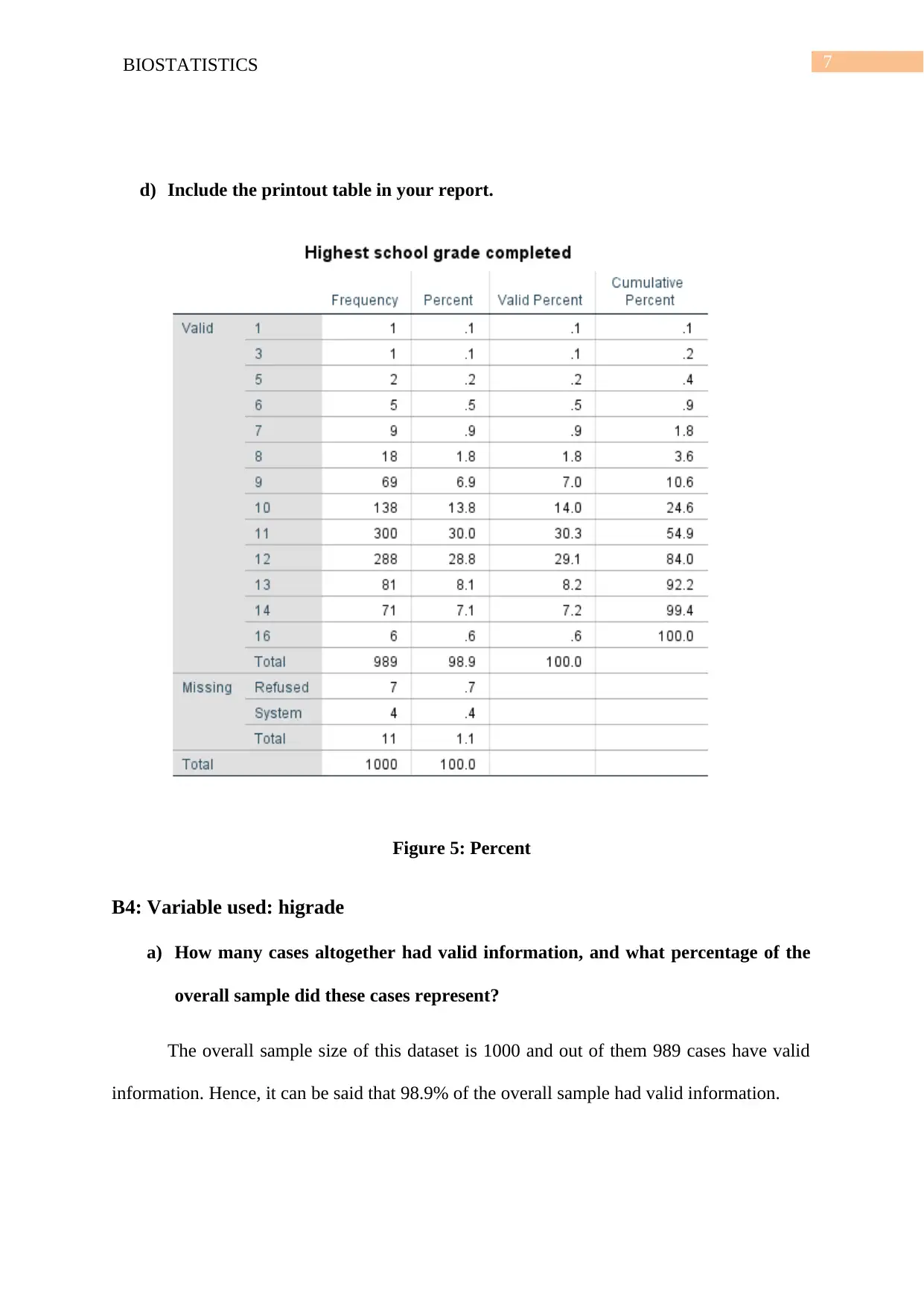
a) What percentage of women completed 16 years of education?
0.6 % of the total sample size completed 16 years of education.
b) What percentage of women had 10 years or less of education?
24.6% percentage of women had 10 years or less of education.
c) How many women had exactly 12 years of education?
It can be said that 28.8 women had exactly 12 years of education.
tabler-icon-diamond-filled.svg

Paraphrase This Document

Need a fresh take? Get an instant paraphrase of this document with our AI Paraphraser
Document Page
7BIOSTATISTICS
d) Include the printout table in your report.
Figure 5: Percent
B4: Variable used: higrade
a) How many cases altogether had valid information, and what percentage of the
overall sample did these cases represent?
The overall sample size of this dataset is 1000 and out of them 989 cases have valid
information. Hence, it can be said that 98.9% of the overall sample had valid information.
Document Page
8BIOSTATISTICS
b) How many different types of missing values were there?
Considering the variable higrade, it can be said that there are two different categories of
missing values in this data set.
c) What were the missing value codes?
The value codes which can be identified from the code book are 98 and 95.
d) What do these missing values codes mean?
The meanings of the missing codes can be understood from the following table.
Codes Meaning
98 Don’t know
95 Refused
Table 1: Meaning of the codes
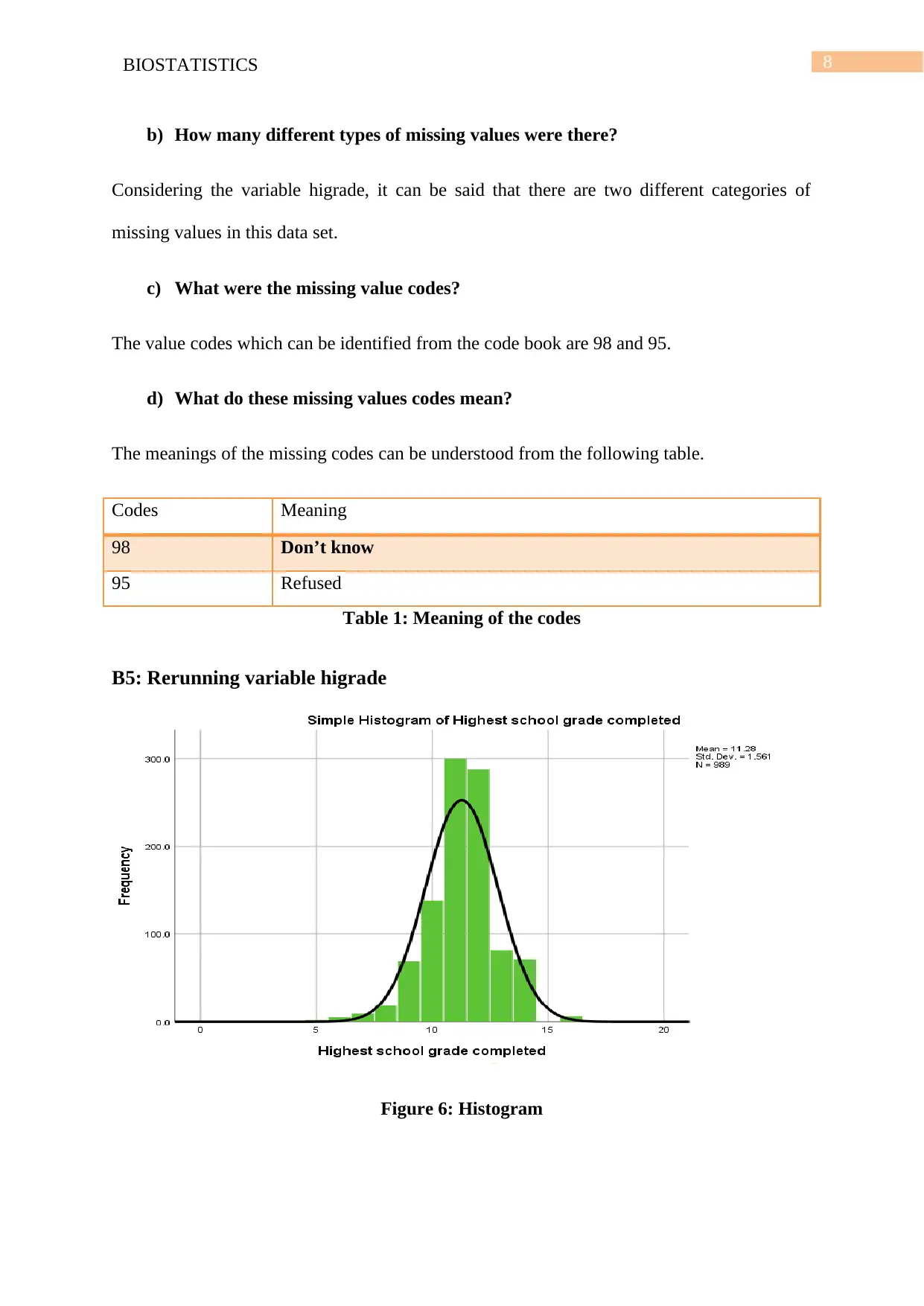
B5: Rerunning variable higrade
Figure 6: Histogram
Document Page
9BIOSTATISTICS
e) Based on the graph, what is the normality of the distribution?
The normality of the distribution is as follows:
Normality = (11.28 ± 1.561) = 9.7 or 12.8
B6: Background variables of the data set
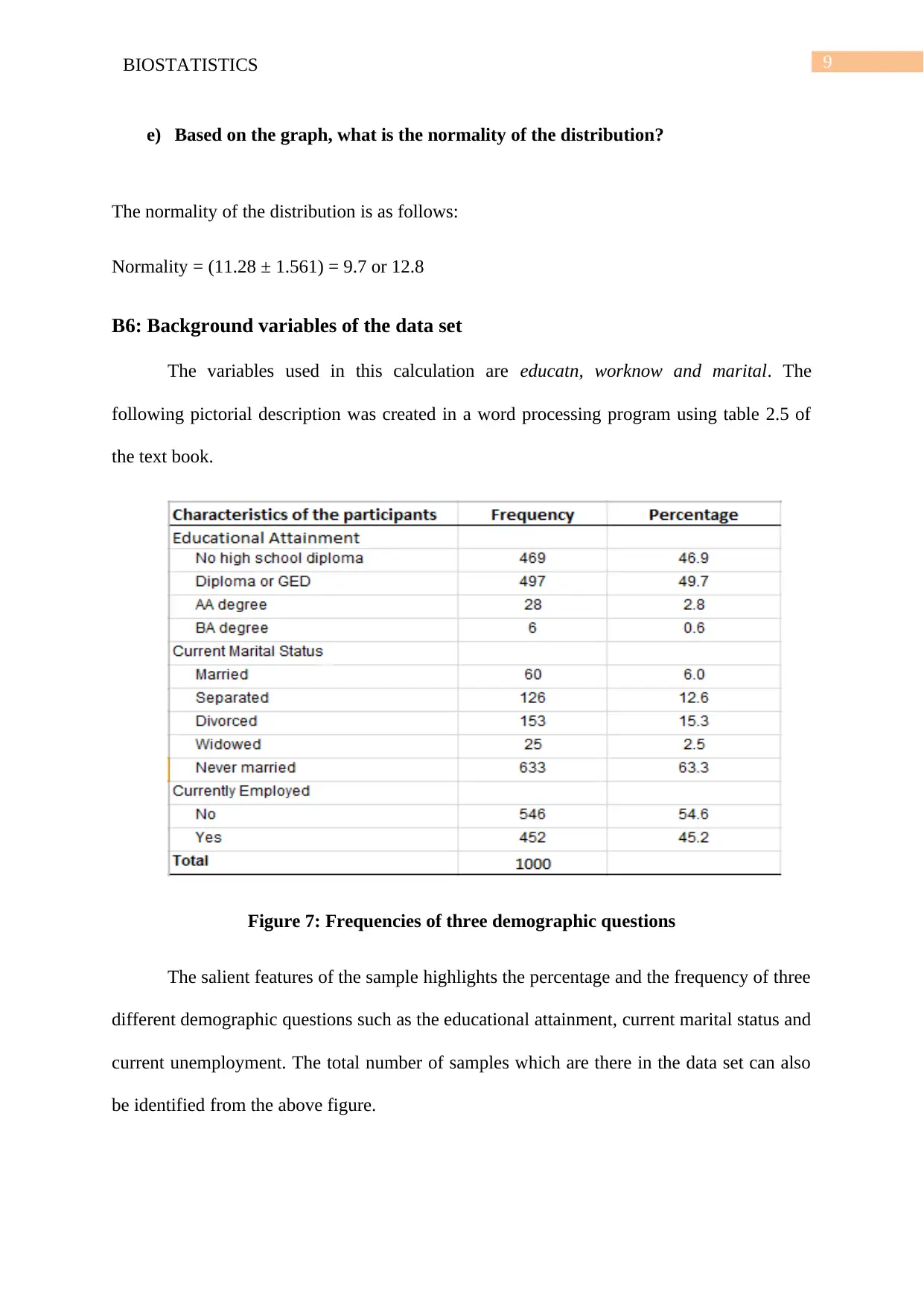
The variables used in this calculation are educatn, worknow and marital. The
following pictorial description was created in a word processing program using table 2.5 of
the text book.
Figure 7: Frequencies of three demographic questions
The salient features of the sample highlights the percentage and the frequency of three
different demographic questions such as the educational attainment, current marital status and
current unemployment. The total number of samples which are there in the data set can also
be identified from the above figure.
tabler-icon-diamond-filled.svg

Paraphrase This Document

Need a fresh take? Get an instant paraphrase of this document with our AI Paraphraser
Document Page
10BIOSTATISTICS
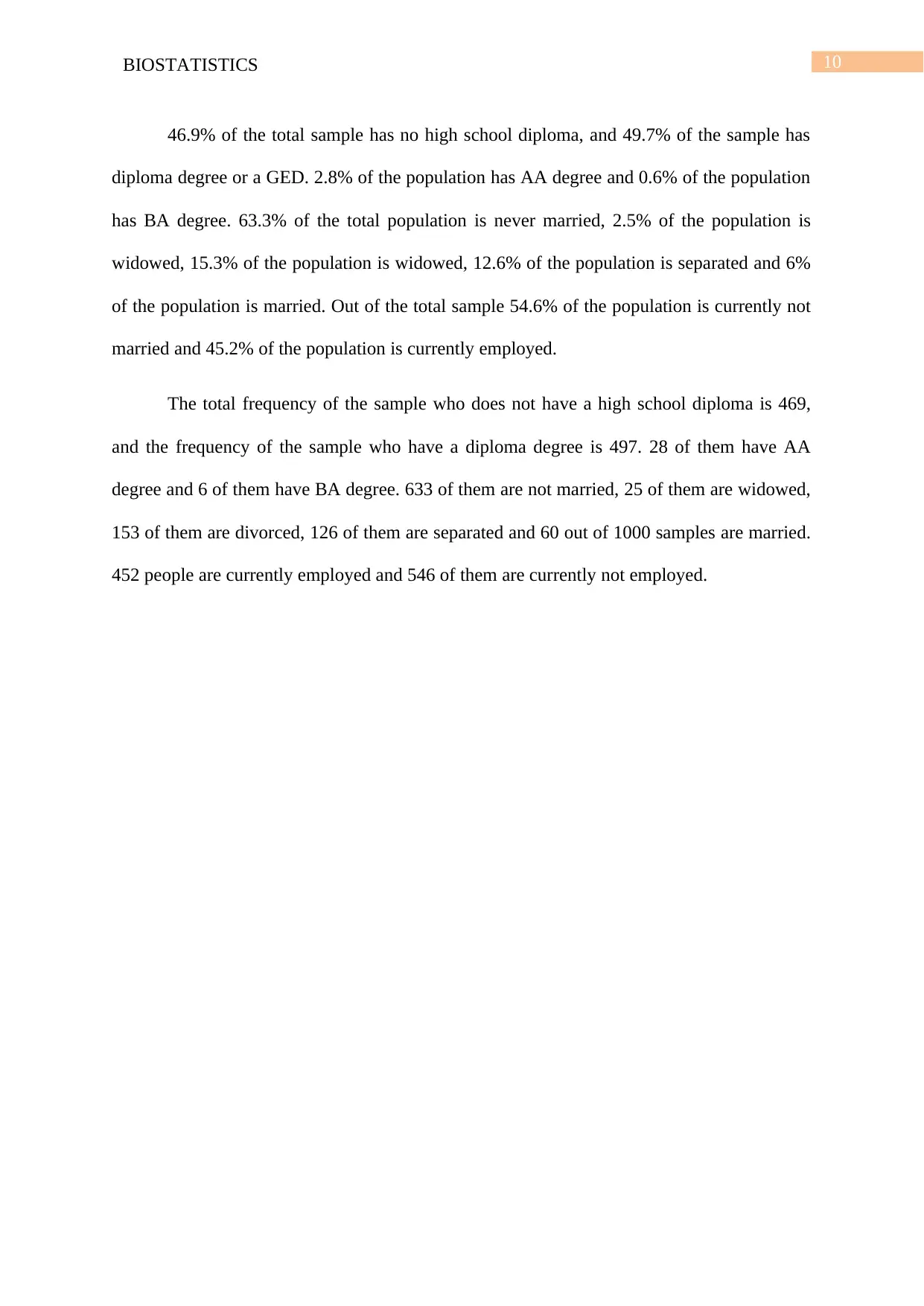
46.9% of the total sample has no high school diploma, and 49.7% of the sample has
diploma degree or a GED. 2.8% of the population has AA degree and 0.6% of the population
has BA degree. 63.3% of the total population is never married, 2.5% of the population is
widowed, 15.3% of the population is widowed, 12.6% of the population is separated and 6%
of the population is married. Out of the total sample 54.6% of the population is currently not
married and 45.2% of the population is currently employed.
The total frequency of the sample who does not have a high school diploma is 469,
and the frequency of the sample who have a diploma degree is 497. 28 of them have AA
degree and 6 of them have BA degree. 633 of them are not married, 25 of them are widowed,
153 of them are divorced, 126 of them are separated and 60 out of 1000 samples are married.
452 people are currently employed and 546 of them are currently not employed.
Document Page
11BIOSTATISTICS
Bibliography
Asthana, H. S., & Bhushan, B. (2016). Statistics for social sciences (with SPSS applications).
PHI Learning Pvt. Ltd..
Daniel, W. W., & Cross, C. L. (2018). Biostatistics: a foundation for analysis in the health
sciences. Wiley.
Homer, M. S. (2018). An introduction to secondary data analysis with IBM SPSS statistics.
Educational Review, 70(2), 251-252.
Jayakumar, M., & Rajalingam, S. (2019). Effective Evaluation of Students Attainment in
Assessment Components for the Unit Taught in Large Classes by Using SPSS v17. Asian
Journal of Education and Social Studies, 1-8.
Miller, R. L. (2017). SPSS for social scientists. Macmillan International Higher Education.
Song, D., Zhao, X., Yang, Q., & Tan, F. (2019). An Analysis of the Relations between
Mental Health Cognition and Nutritional Behavior of Pre-school Children by Using SPSS
Software.
Subramani, T., & Arsath, M. (2018). Evaluation of Quality Management System by
Implementing Quality Matrix in Residential Projects Using SPSS. International Journal of
Engineering & Technology, 7(3.10), 5-9.
Wathan, J., Higgins, V., Elliot, M., Browne, W., Carlton, C., Morales Gomez, A., & Buckley,
J. (2019). Examining Continuous Variables in SPSS (Quiz and Practical).
chevron_up_icon
1 out of 12
circle_padding
hide_on_mobile
zoom_out_icon
[object Object]