Bipolar Disorder Program Analysis and Recommendations: Healthcare

Verified

Added on  2022/12/19

|3
|452
|97
Report
AI Summary
This report analyzes a bipolar disorder support program, focusing on its strengths, weaknesses, and potential for improvement. The program, operating since 2006, provides emotional support and a platform for individuals with bipolar disorder to share experiences. It utilizes bi-monthly Cognitive Bipolar Therapy (CBT), which has shown to enhance medication adherence and improve mental functions. However, the program faces limitations due to a lack of sponsorship. The report suggests enhancing media visibility, securing funding, and incorporating a more holistic approach, including medication, and collaboration with hospitals to reach more individuals. The analysis references relevant research on the effectiveness of CBT and the challenges faced by the program. The report concludes with recommendations to optimize the program's impact and reach within the healthcare landscape.
Document Page
Running head: HEALTH SCIENCE 1
Health Science
Student’s Name
Institutional Affiliation
tabler-icon-diamond-filled.svg

Paraphrase This Document

Need a fresh take? Get an instant paraphrase of this document with our AI Paraphraser
Document Page
HEALTH SCIENCE 2
Health Science
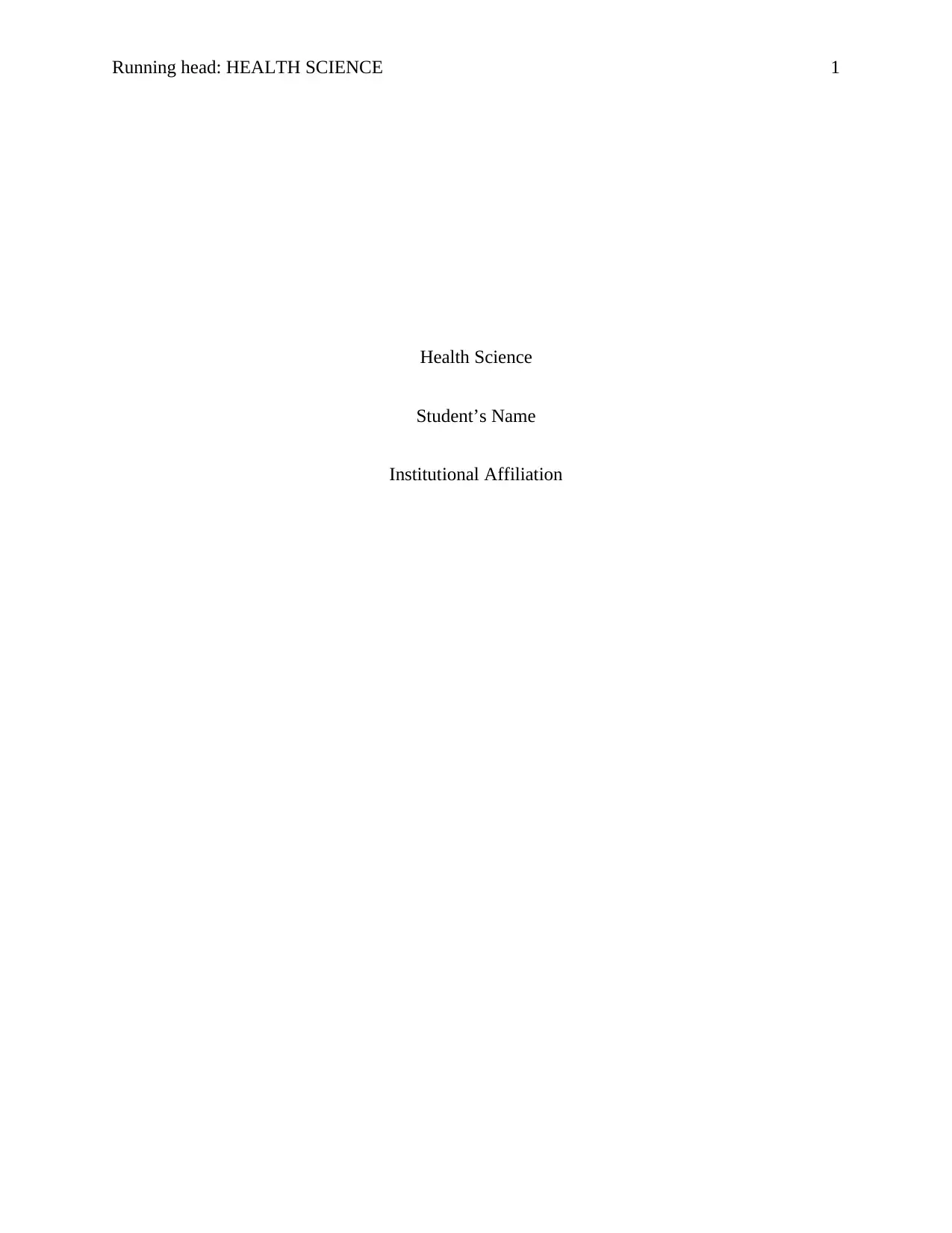
Bipolar life is a program targeting people dealing with bipolar disorders. According to
bipolarlife.org, the program has been in operation since 2006. It offers emotional support to the
victims and a platform for them to express themselves without any prejudice or fear. As a result,
it facilitates information sharing among people struggling with bipolar disorders.
The program is funded by volunteers who generously give to support the work of the
program. With the high number of people with bipolar disorders, this program can meet this
increasing demand by having different support groups who meet at different places. Members
meet in rooms to discuss their struggles, success stories and any new ways of dealing with their
challenges.
One of the strengths of this program is that it provides a bi-monthly therapy for
individuals with bipolar disorder for six weeks. Available research has shown that Cognitive
Bipolar Therapy (CBT) enhances adherence to medication and lowers the rate of hospitalization
(Richards et al., 2016). Besides, it suppresses depression rates and enhances the overall mental
functions (Chatterton et al., 2017). Going by the success stories, it is apparent that its effects in
society conform to literature. However, the lack of sponsorship limits the operations of the
program making it difficult to explore a larger niche.
The program can be improved by enhancing its media visibility to reach many people and
identifying donors. Moreover, the program can incorporate medication alongside CBT to provide
a more holistic approach to reducing the effects of bipolar disorders. Besides, working together
with hospitals can help this program reach more victims of bipolar disorder.
Document Page
HEALTH SCIENCE 3
References
Bipolarlife.org.Retrieved from https://bipolarlife.org.au/help-us/
Chatterton, M. L., Stockings, E., Berk, M., Barendregt, J. J., Carter, R., & Mihalopoulos, C.
(2017). Psychosocial therapies for the adjunctive treatment of bipolar disorder in adults:
network meta-analysis. The British Journal of Psychiatry, 210(5), 333-341.
Richards, D. A., Ekers, D., McMillan, D., Taylor, R. S., Byford, S., Warren, F. C., ... &
O'Mahen, H. (2016). Cost and Outcome of Behavioural Activation versus Cognitive
Behavioural Therapy for Depression (COBRA): a randomised, controlled, non-inferiority
trial. The Lancet, 388(10047), 871-880.
chevron_up_icon
1 out of 3
circle_padding
hide_on_mobile
zoom_out_icon
[object Object]