HY101: Analysis of Jean de Venette's 'The Black Death' Essay

Verified

Added on  2023/05/30

|4
|880
|283
Essay
AI Summary
This essay analyzes Jean de Venette's chronicle of the Black Death, examining his first-hand account of the plague that devastated Europe in the late 1340s. The essay explores Venette's observations, including the attribution of the plague to sailors and nonbelievers, and contrasts his perspective with that of modern scholars like Cole and Ortega, who offer alternative explanations for the plague's spread, such as population growth, trade, and the rise of the Mongol Empire. The essay also discusses the historical context, including the preceding famine and the societal impact of the Black Death, such as labor shortages and changes in social dynamics. It concludes by highlighting the value of Venette's primary source as a historical document while acknowledging the complexities of interpreting historical events through different lenses.
Document Page
1
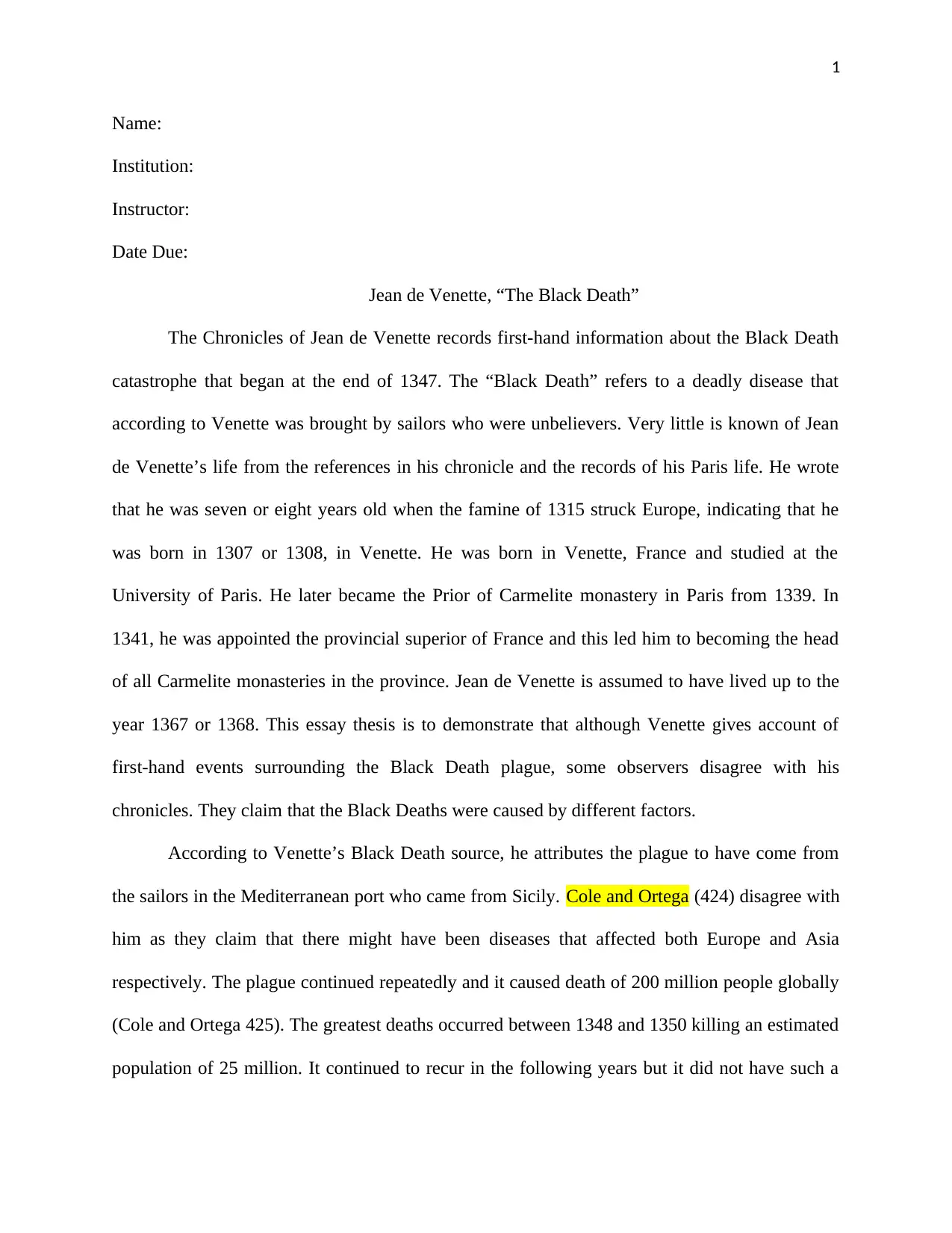
Name:
Institution:
Instructor:
Date Due:
Jean de Venette, “The Black Death”
The Chronicles of Jean de Venette records first-hand information about the Black Death
catastrophe that began at the end of 1347. The “Black Death” refers to a deadly disease that
according to Venette was brought by sailors who were unbelievers. Very little is known of Jean
de Venette’s life from the references in his chronicle and the records of his Paris life. He wrote
that he was seven or eight years old when the famine of 1315 struck Europe, indicating that he
was born in 1307 or 1308, in Venette. He was born in Venette, France and studied at the
University of Paris. He later became the Prior of Carmelite monastery in Paris from 1339. In
1341, he was appointed the provincial superior of France and this led him to becoming the head
of all Carmelite monasteries in the province. Jean de Venette is assumed to have lived up to the
year 1367 or 1368. This essay thesis is to demonstrate that although Venette gives account of
first-hand events surrounding the Black Death plague, some observers disagree with his
chronicles. They claim that the Black Deaths were caused by different factors.
According to Venette’s Black Death source, he attributes the plague to have come from
the sailors in the Mediterranean port who came from Sicily. Cole and Ortega (424) disagree with
him as they claim that there might have been diseases that affected both Europe and Asia
respectively. The plague continued repeatedly and it caused death of 200 million people globally
(Cole and Ortega 425). The greatest deaths occurred between 1348 and 1350 killing an estimated
population of 25 million. It continued to recur in the following years but it did not have such a
tabler-icon-diamond-filled.svg

Paraphrase This Document

Need a fresh take? Get an instant paraphrase of this document with our AI Paraphraser
Document Page
2
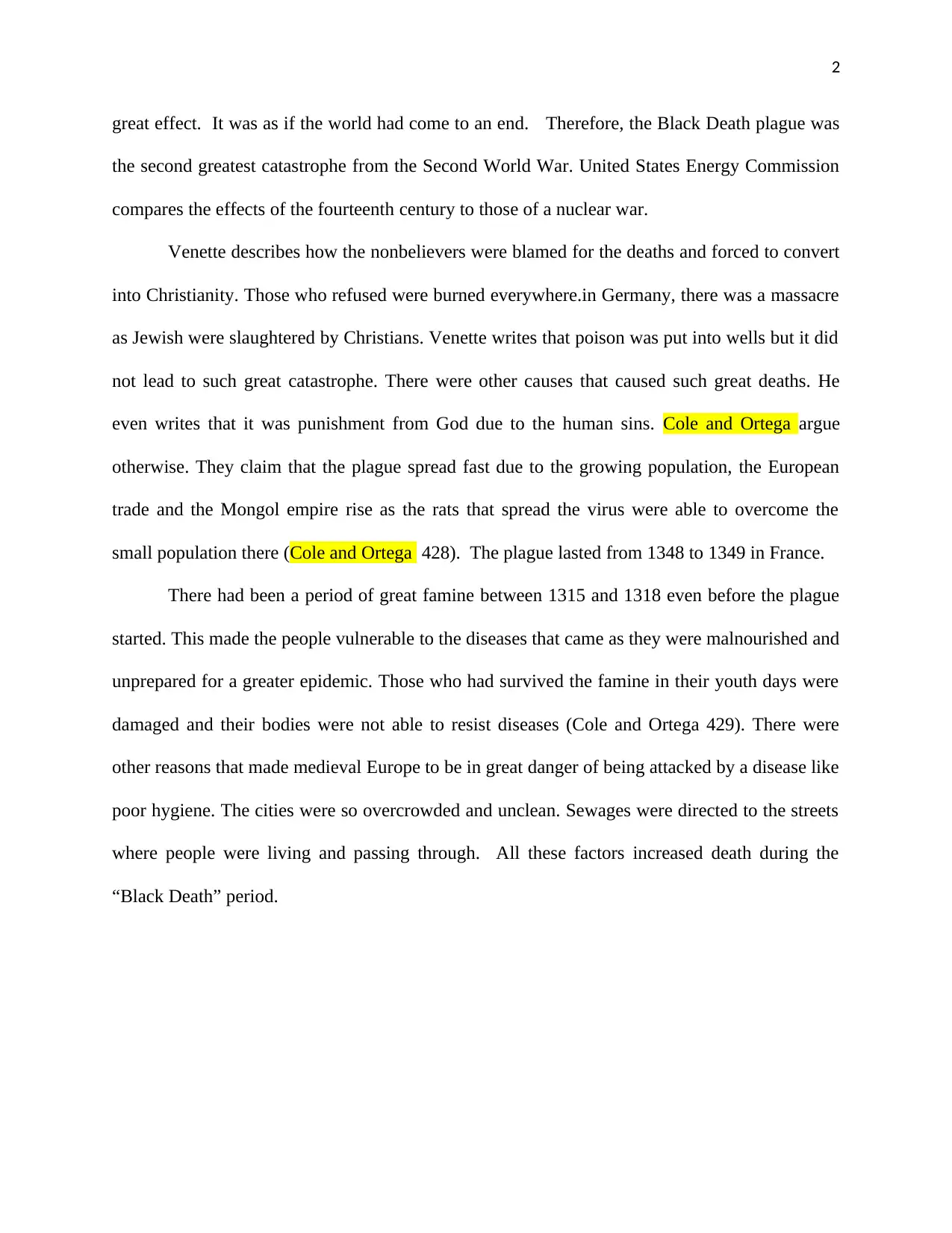
great effect. It was as if the world had come to an end. Therefore, the Black Death plague was
the second greatest catastrophe from the Second World War. United States Energy Commission
compares the effects of the fourteenth century to those of a nuclear war.
Venette describes how the nonbelievers were blamed for the deaths and forced to convert
into Christianity. Those who refused were burned everywhere.in Germany, there was a massacre
as Jewish were slaughtered by Christians. Venette writes that poison was put into wells but it did
not lead to such great catastrophe. There were other causes that caused such great deaths. He
even writes that it was punishment from God due to the human sins. Cole and Ortega argue
otherwise. They claim that the plague spread fast due to the growing population, the European
trade and the Mongol empire rise as the rats that spread the virus were able to overcome the
small population there (Cole and Ortega 428). The plague lasted from 1348 to 1349 in France.
There had been a period of great famine between 1315 and 1318 even before the plague
started. This made the people vulnerable to the diseases that came as they were malnourished and
unprepared for a greater epidemic. Those who had survived the famine in their youth days were
damaged and their bodies were not able to resist diseases (Cole and Ortega 429). There were
other reasons that made medieval Europe to be in great danger of being attacked by a disease like
poor hygiene. The cities were so overcrowded and unclean. Sewages were directed to the streets
where people were living and passing through. All these factors increased death during the
“Black Death” period.
Document Page
3
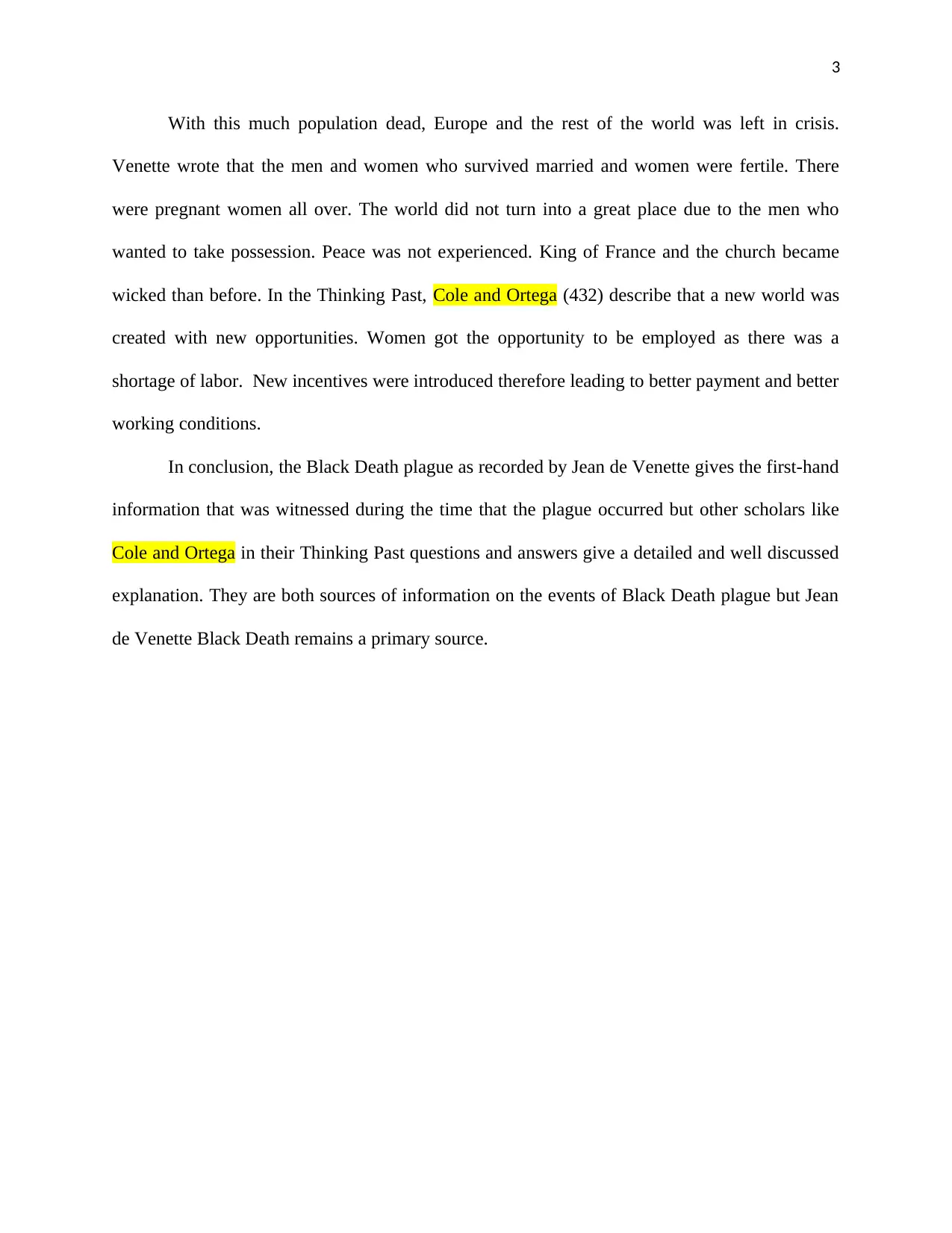
With this much population dead, Europe and the rest of the world was left in crisis.
Venette wrote that the men and women who survived married and women were fertile. There
were pregnant women all over. The world did not turn into a great place due to the men who
wanted to take possession. Peace was not experienced. King of France and the church became
wicked than before. In the Thinking Past, Cole and Ortega (432) describe that a new world was
created with new opportunities. Women got the opportunity to be employed as there was a
shortage of labor. New incentives were introduced therefore leading to better payment and better
working conditions.
In conclusion, the Black Death plague as recorded by Jean de Venette gives the first-hand
information that was witnessed during the time that the plague occurred but other scholars like
Cole and Ortega in their Thinking Past questions and answers give a detailed and well discussed
explanation. They are both sources of information on the events of Black Death plague but Jean
de Venette Black Death remains a primary source.
Document Page
4
Works cited
Cole, Adrian, and Stephen Ortega. The Thinking Past: Questions and Problems in World History
to 1750. Oxford University Press, USA, 2014.
chevron_up_icon
1 out of 4
circle_padding
hide_on_mobile
zoom_out_icon
[object Object]