Blood Test Case Study: Analysis, Interpretation, and Management Plan
VerifiedAdded on 2023/06/18
|10
|2731
|377
Case Study
AI Summary
This case study analyzes the blood test results and clinical features of a 39-year-old female, Sandra, who presents with symptoms of tiredness, palpitations, and weight loss. The analysis reveals that Sandra is suffering from hyperthyroidism, exacerbated by her pre-existing type 2 diabetes and rheumatoid arthritis. The report interprets Sandra's blood test results, identifying risk factors such as family history, lifestyle, and smoking. It explains the pathophysiology of hyperthyroidism and its complications, including heart problems, eye issues, and unintentional weight loss. The report also discusses the medications prescribed, their actions, potential complications, and nursing considerations. Furthermore, it outlines preventive measures Sandra can take to reduce the risk of complications related to type 2 diabetes, such as controlling blood sugar, monitoring blood pressure, regular checkups, and quitting smoking. This document is available on Desklib, a platform offering a wealth of study resources for students.
BLOOD TEST

Paraphrase This Document
Need a fresh take? Get an instant paraphrase of this document with our AI Paraphraser
TABLE OF CONTENTS
INTRODUCTION...........................................................................................................................1
PART 1 QUESTIONS.....................................................................................................................1
1.1 Underlying condition.............................................................................................................1
1.2 Interpretation of Sandra’s blood test results and clinical features and linking it back to
Sandra..........................................................................................................................................1
1.3 4 risk factors relevant to Sandra............................................................................................2
1.4 Explanation of pathophysiology of the specific condition Sandra is suffering from and
inking it to Sandra........................................................................................................................2
1.5 At least 5 complications of this condition that are relevant to Sandra..................................3
PART 2 Questions...........................................................................................................................3
2.1................................................................................................................................................3
2.2................................................................................................................................................4
2.3................................................................................................................................................5
2.4................................................................................................................................................6
CONCLUSION................................................................................................................................6
REFERENCES................................................................................................................................8
INTRODUCTION...........................................................................................................................1
PART 1 QUESTIONS.....................................................................................................................1
1.1 Underlying condition.............................................................................................................1
1.2 Interpretation of Sandra’s blood test results and clinical features and linking it back to
Sandra..........................................................................................................................................1
1.3 4 risk factors relevant to Sandra............................................................................................2
1.4 Explanation of pathophysiology of the specific condition Sandra is suffering from and
inking it to Sandra........................................................................................................................2
1.5 At least 5 complications of this condition that are relevant to Sandra..................................3
PART 2 Questions...........................................................................................................................3
2.1................................................................................................................................................3
2.2................................................................................................................................................4
2.3................................................................................................................................................5
2.4................................................................................................................................................6
CONCLUSION................................................................................................................................6
REFERENCES................................................................................................................................8
INTRODUCTION
Blood test is a kind of scientific examination of blood sample of an individual that helps
in diagnosing illness suffered by a person or detection of drug or alcohol abuse (Scappaticcio and
et. al., 2021). This report will lay emphasis upon a case study of Sandra Bullock who is a 39
years old lady ad mother of 5 children. She recently noticed significant tiredness, palpitations,
and tremor, feeling hot even in cold temperature, lost 5 kg of her weight, swelling in front neck.
She many times forget to take her medicines, do not exercise much, smoke 5-6 cigarettes daily.
This report will explain endocrine condition indicated by Sandra’s blood test, risk factors causing
high BGL and HbA1c, medication prescribed by Endocrinologist, complications due to BGL and
preventive measures.
PART 1 QUESTIONS
1.1 Underlying condition
Sandra is seeing a GP because from past 3 weeks she was having significant tiredness,
palpitations, and tremor. She always felt a bit hot as compared to others, and in pat 2 weeks she
had lost approximately 4 Kgs of her weight. From past 2 years she is suffering from type 2
Diabetes and rheumatoid arthritis. Due to her busy schedule, she mostly has takeaway for her
lunch, do not exercise daily, and most often she forgets to take her medicine. Her mother and
sister both were suffering from T2DM and her mother rom Hashimoto thyroiditis. This family
history of Sandra increases her hances of her suffering from thyroid problems. Her current
symptoms such as swollen front of throat where thyroid is present, weight loss, increased
heartbeat, tiredness etc. are symptoms that she is suffering from Hyperthyroidism problem.
1.2 Interpretation of Sandra’s blood test results and clinical features and linking it back to Sandra
Interpretation of Clinical features and blood test results of Sandra clearly helps in
understanding her main problem from which she is suffering from.
Blood test of Sandra clearly helped in understanding that she was suffering from
hyperthyroidism as she was having low TSH that caused weight loss, increased fatigue,
increased heart rate and high T3 and T4. This low TSH and high T3, T4 clearly helps in
understanding that she is suffering from hyperthyroidism. Hyperthyroidism is a kind of infection
that causes inflammation of the thyroid gland. Due to this infection, neutrophil of Sandra was
high and in order to fight from this infection White cell count of Sandra was also high but due to
lower lymphocytes it was becoming a bit hard for immune system of Sandra to fight from this
1
Blood test is a kind of scientific examination of blood sample of an individual that helps
in diagnosing illness suffered by a person or detection of drug or alcohol abuse (Scappaticcio and
et. al., 2021). This report will lay emphasis upon a case study of Sandra Bullock who is a 39
years old lady ad mother of 5 children. She recently noticed significant tiredness, palpitations,
and tremor, feeling hot even in cold temperature, lost 5 kg of her weight, swelling in front neck.
She many times forget to take her medicines, do not exercise much, smoke 5-6 cigarettes daily.
This report will explain endocrine condition indicated by Sandra’s blood test, risk factors causing
high BGL and HbA1c, medication prescribed by Endocrinologist, complications due to BGL and
preventive measures.
PART 1 QUESTIONS
1.1 Underlying condition
Sandra is seeing a GP because from past 3 weeks she was having significant tiredness,
palpitations, and tremor. She always felt a bit hot as compared to others, and in pat 2 weeks she
had lost approximately 4 Kgs of her weight. From past 2 years she is suffering from type 2
Diabetes and rheumatoid arthritis. Due to her busy schedule, she mostly has takeaway for her
lunch, do not exercise daily, and most often she forgets to take her medicine. Her mother and
sister both were suffering from T2DM and her mother rom Hashimoto thyroiditis. This family
history of Sandra increases her hances of her suffering from thyroid problems. Her current
symptoms such as swollen front of throat where thyroid is present, weight loss, increased
heartbeat, tiredness etc. are symptoms that she is suffering from Hyperthyroidism problem.
1.2 Interpretation of Sandra’s blood test results and clinical features and linking it back to Sandra
Interpretation of Clinical features and blood test results of Sandra clearly helps in
understanding her main problem from which she is suffering from.
Blood test of Sandra clearly helped in understanding that she was suffering from
hyperthyroidism as she was having low TSH that caused weight loss, increased fatigue,
increased heart rate and high T3 and T4. This low TSH and high T3, T4 clearly helps in
understanding that she is suffering from hyperthyroidism. Hyperthyroidism is a kind of infection
that causes inflammation of the thyroid gland. Due to this infection, neutrophil of Sandra was
high and in order to fight from this infection White cell count of Sandra was also high but due to
lower lymphocytes it was becoming a bit hard for immune system of Sandra to fight from this
1
⊘ This is a preview!⊘
Do you want full access?
Subscribe today to unlock all pages.

Trusted by 1+ million students worldwide
infection. As a result, her throat was a bit swollen. Her TSH-Receptor antibody test ws also
positive that depicts that her thyroid kept releasing hormone that her body did nor require. It was
one of the main reason because she was experiencing all the other symptoms.
Her clinical result further helped in interpreting that her BMI was 29 m2 /kg which was a
bit high and makes her fall in category of over weight people. She also had high pulse rare as
compared to normal pulse rate because of which she was feeling a tired and felt fatigue. She was
a smoker who used to smoke 5-6 cigarettes daily and this smoking has direct impact upon
thyroid glands. On further examination it was found that thyroid gland was mildly enlarged with
a bruit.
1.3 4 risk factors relevant to Sandra
Thyroid dysfunction can directly affect diabetes control. Hyperthyroidism can directly
worsen glycaemic control and increases overall insulin requirement (Lu and et. al., 2020). So
due to Hyperthyroidism it can be said that type 2 diabetes can worsen. Vice versa it can also
be said that type 2 diabetes can cause Hyperthyroidism.
Family history of thyroid is another risk factor that can increase risk factor of development of
Hyperthyroidism. Syndra’s mother had Hashimoto thyroiditis and because of which her
chances of suffering from thyroid increased.
One of the mot common risk factor is being a female because being a female increases
chances of suffering from Hyperthyroidism and having a family history of same increases its
chances (Wang and et. al., 2017).
Inappropriate diet can further increase chances of suffering from Hyperthyroidism because as
per the cause study Sandra had a busy lifestyle and because of which she mostly had
takeaway for her food and did not exercise.
1.4 Explanation of pathophysiology of the specific condition Sandra is suffering from and inking
it to Sandra
Sandra is suffering from Hyperthyroidism that normally occurs when T3 within body is
more than its normal range and more than T4. This normally happens when T3 is more thanT4
and when T4 get converted into T3 in peripheral tissues. Hyperthyroidism occurs when body
loses normal regulatory control of thyroid hormonal sections. Thyroid hormonal sections actions
on body is stimulatory that can further increase nervous system activity (Wafa and et. al., 2020).
Excessive secretion of thyroid hormone can stimulate cardiac system and can increase adrenergic
2
positive that depicts that her thyroid kept releasing hormone that her body did nor require. It was
one of the main reason because she was experiencing all the other symptoms.
Her clinical result further helped in interpreting that her BMI was 29 m2 /kg which was a
bit high and makes her fall in category of over weight people. She also had high pulse rare as
compared to normal pulse rate because of which she was feeling a tired and felt fatigue. She was
a smoker who used to smoke 5-6 cigarettes daily and this smoking has direct impact upon
thyroid glands. On further examination it was found that thyroid gland was mildly enlarged with
a bruit.
1.3 4 risk factors relevant to Sandra
Thyroid dysfunction can directly affect diabetes control. Hyperthyroidism can directly
worsen glycaemic control and increases overall insulin requirement (Lu and et. al., 2020). So
due to Hyperthyroidism it can be said that type 2 diabetes can worsen. Vice versa it can also
be said that type 2 diabetes can cause Hyperthyroidism.
Family history of thyroid is another risk factor that can increase risk factor of development of
Hyperthyroidism. Syndra’s mother had Hashimoto thyroiditis and because of which her
chances of suffering from thyroid increased.
One of the mot common risk factor is being a female because being a female increases
chances of suffering from Hyperthyroidism and having a family history of same increases its
chances (Wang and et. al., 2017).
Inappropriate diet can further increase chances of suffering from Hyperthyroidism because as
per the cause study Sandra had a busy lifestyle and because of which she mostly had
takeaway for her food and did not exercise.
1.4 Explanation of pathophysiology of the specific condition Sandra is suffering from and inking
it to Sandra
Sandra is suffering from Hyperthyroidism that normally occurs when T3 within body is
more than its normal range and more than T4. This normally happens when T3 is more thanT4
and when T4 get converted into T3 in peripheral tissues. Hyperthyroidism occurs when body
loses normal regulatory control of thyroid hormonal sections. Thyroid hormonal sections actions
on body is stimulatory that can further increase nervous system activity (Wafa and et. al., 2020).
Excessive secretion of thyroid hormone can stimulate cardiac system and can increase adrenergic
2
Paraphrase This Document
Need a fresh take? Get an instant paraphrase of this document with our AI Paraphraser
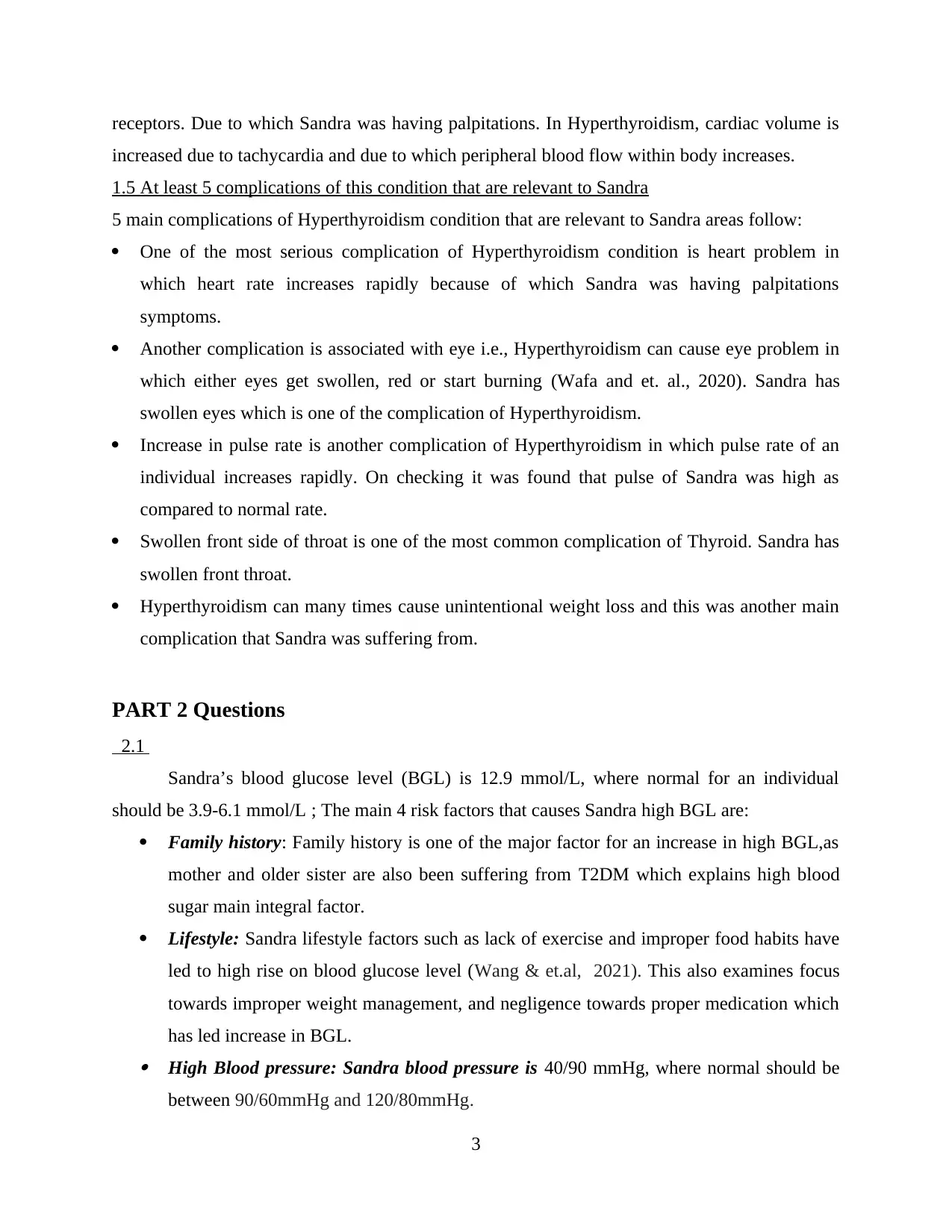
receptors. Due to which Sandra was having palpitations. In Hyperthyroidism, cardiac volume is
increased due to tachycardia and due to which peripheral blood flow within body increases.
1.5 At least 5 complications of this condition that are relevant to Sandra
5 main complications of Hyperthyroidism condition that are relevant to Sandra areas follow:
One of the most serious complication of Hyperthyroidism condition is heart problem in
which heart rate increases rapidly because of which Sandra was having palpitations
symptoms.
Another complication is associated with eye i.e., Hyperthyroidism can cause eye problem in
which either eyes get swollen, red or start burning (Wafa and et. al., 2020). Sandra has
swollen eyes which is one of the complication of Hyperthyroidism.
Increase in pulse rate is another complication of Hyperthyroidism in which pulse rate of an
individual increases rapidly. On checking it was found that pulse of Sandra was high as
compared to normal rate.
Swollen front side of throat is one of the most common complication of Thyroid. Sandra has
swollen front throat.
Hyperthyroidism can many times cause unintentional weight loss and this was another main
complication that Sandra was suffering from.
PART 2 Questions
2.1
Sandra’s blood glucose level (BGL) is 12.9 mmol/L, where normal for an individual
should be 3.9-6.1 mmol/L ; The main 4 risk factors that causes Sandra high BGL are:
Family history: Family history is one of the major factor for an increase in high BGL,as
mother and older sister are also been suffering from T2DM which explains high blood
sugar main integral factor.
Lifestyle: Sandra lifestyle factors such as lack of exercise and improper food habits have
led to high rise on blood glucose level (Wang & et.al, 2021). This also examines focus
towards improper weight management, and negligence towards proper medication which
has led increase in BGL. High Blood pressure: Sandra blood pressure is 40/90 mmHg, where normal should be
between 90/60mmHg and 120/80mmHg.
3
increased due to tachycardia and due to which peripheral blood flow within body increases.
1.5 At least 5 complications of this condition that are relevant to Sandra
5 main complications of Hyperthyroidism condition that are relevant to Sandra areas follow:
One of the most serious complication of Hyperthyroidism condition is heart problem in
which heart rate increases rapidly because of which Sandra was having palpitations
symptoms.
Another complication is associated with eye i.e., Hyperthyroidism can cause eye problem in
which either eyes get swollen, red or start burning (Wafa and et. al., 2020). Sandra has
swollen eyes which is one of the complication of Hyperthyroidism.
Increase in pulse rate is another complication of Hyperthyroidism in which pulse rate of an
individual increases rapidly. On checking it was found that pulse of Sandra was high as
compared to normal rate.
Swollen front side of throat is one of the most common complication of Thyroid. Sandra has
swollen front throat.
Hyperthyroidism can many times cause unintentional weight loss and this was another main
complication that Sandra was suffering from.
PART 2 Questions
2.1
Sandra’s blood glucose level (BGL) is 12.9 mmol/L, where normal for an individual
should be 3.9-6.1 mmol/L ; The main 4 risk factors that causes Sandra high BGL are:
Family history: Family history is one of the major factor for an increase in high BGL,as
mother and older sister are also been suffering from T2DM which explains high blood
sugar main integral factor.
Lifestyle: Sandra lifestyle factors such as lack of exercise and improper food habits have
led to high rise on blood glucose level (Wang & et.al, 2021). This also examines focus
towards improper weight management, and negligence towards proper medication which
has led increase in BGL. High Blood pressure: Sandra blood pressure is 40/90 mmHg, where normal should be
between 90/60mmHg and 120/80mmHg.
3
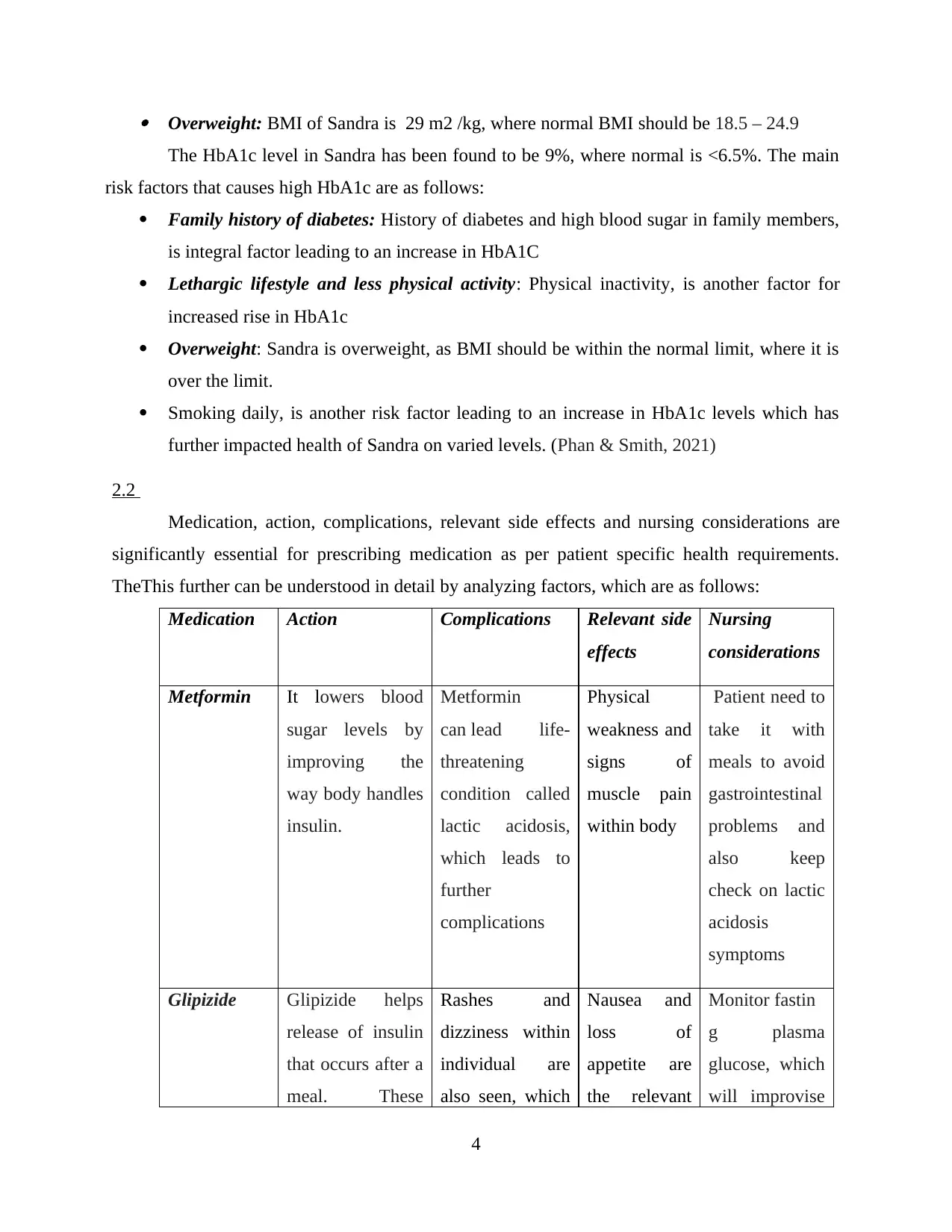
Overweight: BMI of Sandra is 29 m2 /kg, where normal BMI should be 18.5 – 24.9
The HbA1c level in Sandra has been found to be 9%, where normal is <6.5%. The main
risk factors that causes high HbA1c are as follows:
Family history of diabetes: History of diabetes and high blood sugar in family members,
is integral factor leading to an increase in HbA1C
Lethargic lifestyle and less physical activity: Physical inactivity, is another factor for
increased rise in HbA1c
Overweight: Sandra is overweight, as BMI should be within the normal limit, where it is
over the limit.
Smoking daily, is another risk factor leading to an increase in HbA1c levels which has
further impacted health of Sandra on varied levels. (Phan & Smith, 2021)
2.2
Medication, action, complications, relevant side effects and nursing considerations are
significantly essential for prescribing medication as per patient specific health requirements.
TheThis further can be understood in detail by analyzing factors, which are as follows:
Medication Action Complications Relevant side
effects
Nursing
considerations
Metformin It lowers blood
sugar levels by
improving the
way body handles
insulin.
Metformin
can lead life-
threatening
condition called
lactic acidosis,
which leads to
further
complications
Physical
weakness and
signs of
muscle pain
within body
Patient need to
take it with
meals to avoid
gastrointestinal
problems and
also keep
check on lactic
acidosis
symptoms
Glipizide Glipizide helps
release of insulin
that occurs after a
meal. These
Rashes and
dizziness within
individual are
also seen, which
Nausea and
loss of
appetite are
the relevant
Monitor fastin
g plasma
glucose, which
will improvise
4
The HbA1c level in Sandra has been found to be 9%, where normal is <6.5%. The main
risk factors that causes high HbA1c are as follows:
Family history of diabetes: History of diabetes and high blood sugar in family members,
is integral factor leading to an increase in HbA1C
Lethargic lifestyle and less physical activity: Physical inactivity, is another factor for
increased rise in HbA1c
Overweight: Sandra is overweight, as BMI should be within the normal limit, where it is
over the limit.
Smoking daily, is another risk factor leading to an increase in HbA1c levels which has
further impacted health of Sandra on varied levels. (Phan & Smith, 2021)
2.2
Medication, action, complications, relevant side effects and nursing considerations are
significantly essential for prescribing medication as per patient specific health requirements.
TheThis further can be understood in detail by analyzing factors, which are as follows:
Medication Action Complications Relevant side
effects
Nursing
considerations
Metformin It lowers blood
sugar levels by
improving the
way body handles
insulin.
Metformin
can lead life-
threatening
condition called
lactic acidosis,
which leads to
further
complications
Physical
weakness and
signs of
muscle pain
within body
Patient need to
take it with
meals to avoid
gastrointestinal
problems and
also keep
check on lactic
acidosis
symptoms
Glipizide Glipizide helps
release of insulin
that occurs after a
meal. These
Rashes and
dizziness within
individual are
also seen, which
Nausea and
loss of
appetite are
the relevant
Monitor fastin
g plasma
glucose, which
will improvise
4
⊘ This is a preview!⊘
Do you want full access?
Subscribe today to unlock all pages.
Trusted by 1+ million students worldwide
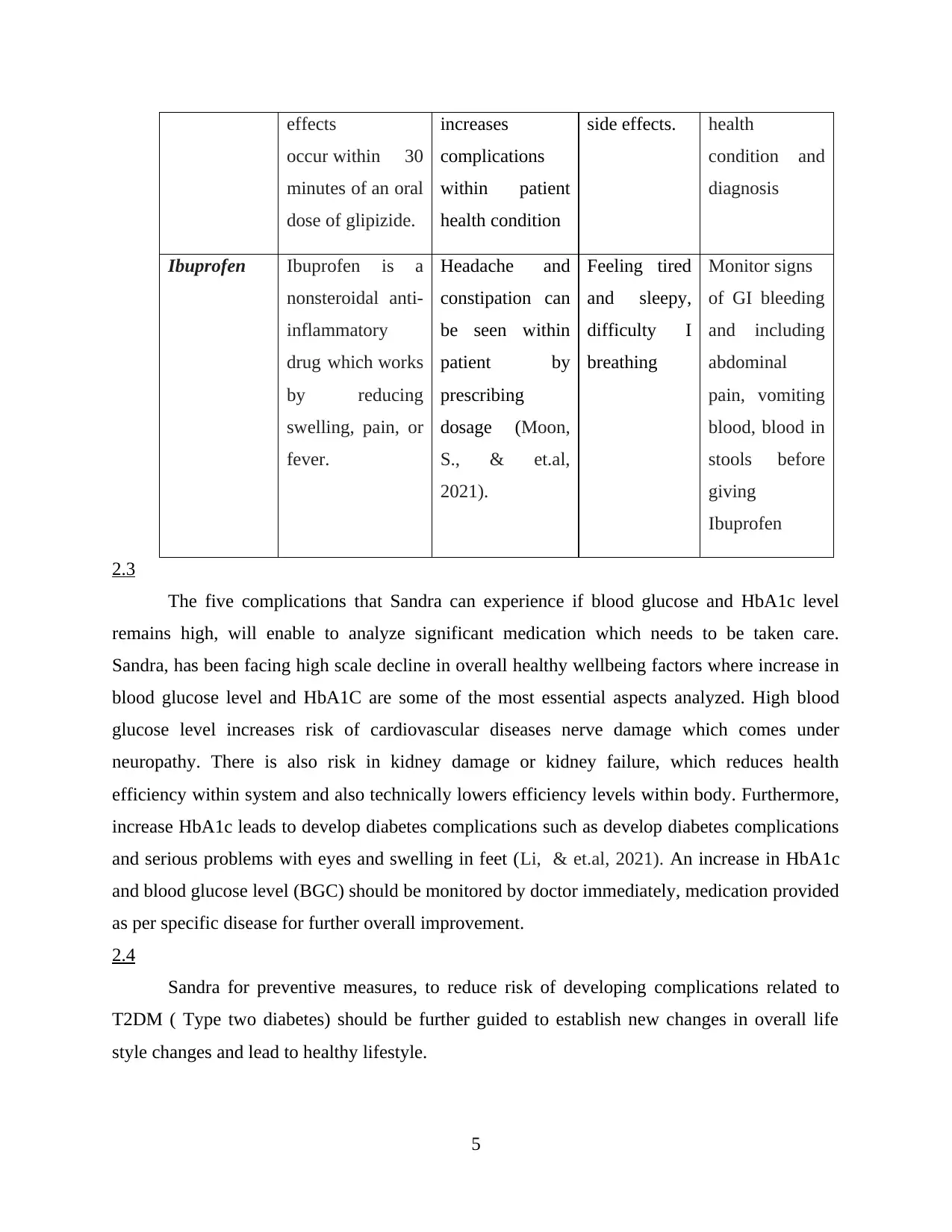
effects
occur within 30
minutes of an oral
dose of glipizide.
increases
complications
within patient
health condition
side effects. health
condition and
diagnosis
Ibuprofen Ibuprofen is a
nonsteroidal anti-
inflammatory
drug which works
by reducing
swelling, pain, or
fever.
Headache and
constipation can
be seen within
patient by
prescribing
dosage (Moon,
S., & et.al,
2021).
Feeling tired
and sleepy,
difficulty I
breathing
Monitor signs
of GI bleeding
and including
abdominal
pain, vomiting
blood, blood in
stools before
giving
Ibuprofen
2.3
The five complications that Sandra can experience if blood glucose and HbA1c level
remains high, will enable to analyze significant medication which needs to be taken care.
Sandra, has been facing high scale decline in overall healthy wellbeing factors where increase in
blood glucose level and HbA1C are some of the most essential aspects analyzed. High blood
glucose level increases risk of cardiovascular diseases nerve damage which comes under
neuropathy. There is also risk in kidney damage or kidney failure, which reduces health
efficiency within system and also technically lowers efficiency levels within body. Furthermore,
increase HbA1c leads to develop diabetes complications such as develop diabetes complications
and serious problems with eyes and swelling in feet (Li, & et.al, 2021). An increase in HbA1c
and blood glucose level (BGC) should be monitored by doctor immediately, medication provided
as per specific disease for further overall improvement.
2.4
Sandra for preventive measures, to reduce risk of developing complications related to
T2DM ( Type two diabetes) should be further guided to establish new changes in overall life
style changes and lead to healthy lifestyle.
5
occur within 30
minutes of an oral
dose of glipizide.
increases
complications
within patient
health condition
side effects. health
condition and
diagnosis
Ibuprofen Ibuprofen is a
nonsteroidal anti-
inflammatory
drug which works
by reducing
swelling, pain, or
fever.
Headache and
constipation can
be seen within
patient by
prescribing
dosage (Moon,
S., & et.al,
2021).
Feeling tired
and sleepy,
difficulty I
breathing
Monitor signs
of GI bleeding
and including
abdominal
pain, vomiting
blood, blood in
stools before
giving
Ibuprofen
2.3
The five complications that Sandra can experience if blood glucose and HbA1c level
remains high, will enable to analyze significant medication which needs to be taken care.
Sandra, has been facing high scale decline in overall healthy wellbeing factors where increase in
blood glucose level and HbA1C are some of the most essential aspects analyzed. High blood
glucose level increases risk of cardiovascular diseases nerve damage which comes under
neuropathy. There is also risk in kidney damage or kidney failure, which reduces health
efficiency within system and also technically lowers efficiency levels within body. Furthermore,
increase HbA1c leads to develop diabetes complications such as develop diabetes complications
and serious problems with eyes and swelling in feet (Li, & et.al, 2021). An increase in HbA1c
and blood glucose level (BGC) should be monitored by doctor immediately, medication provided
as per specific disease for further overall improvement.
2.4
Sandra for preventive measures, to reduce risk of developing complications related to
T2DM ( Type two diabetes) should be further guided to establish new changes in overall life
style changes and lead to healthy lifestyle.
5
Paraphrase This Document
Need a fresh take? Get an instant paraphrase of this document with our AI Paraphraser
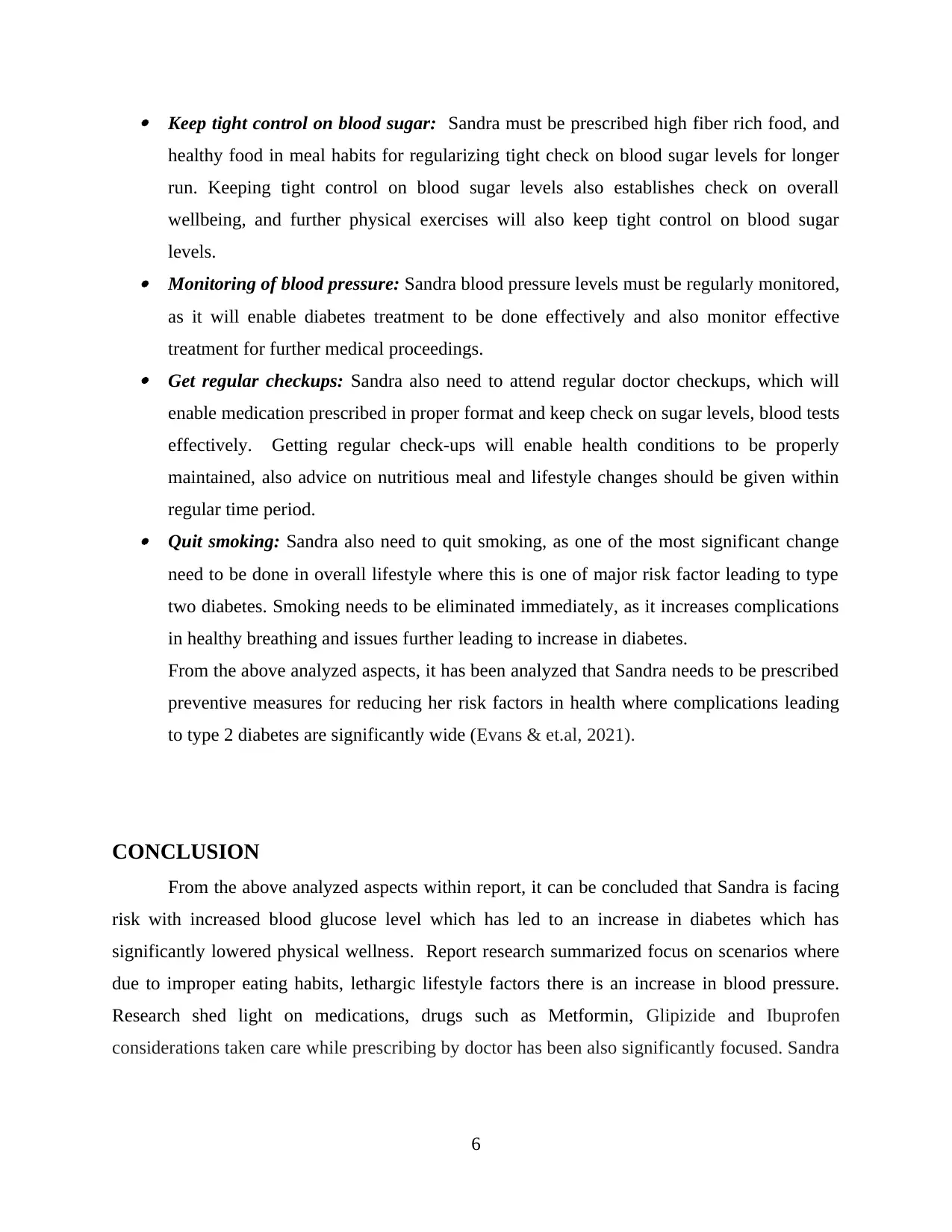
Keep tight control on blood sugar: Sandra must be prescribed high fiber rich food, and
healthy food in meal habits for regularizing tight check on blood sugar levels for longer
run. Keeping tight control on blood sugar levels also establishes check on overall
wellbeing, and further physical exercises will also keep tight control on blood sugar
levels. Monitoring of blood pressure: Sandra blood pressure levels must be regularly monitored,
as it will enable diabetes treatment to be done effectively and also monitor effective
treatment for further medical proceedings. Get regular checkups: Sandra also need to attend regular doctor checkups, which will
enable medication prescribed in proper format and keep check on sugar levels, blood tests
effectively. Getting regular check-ups will enable health conditions to be properly
maintained, also advice on nutritious meal and lifestyle changes should be given within
regular time period. Quit smoking: Sandra also need to quit smoking, as one of the most significant change
need to be done in overall lifestyle where this is one of major risk factor leading to type
two diabetes. Smoking needs to be eliminated immediately, as it increases complications
in healthy breathing and issues further leading to increase in diabetes.
From the above analyzed aspects, it has been analyzed that Sandra needs to be prescribed
preventive measures for reducing her risk factors in health where complications leading
to type 2 diabetes are significantly wide (Evans & et.al, 2021).
CONCLUSION
From the above analyzed aspects within report, it can be concluded that Sandra is facing
risk with increased blood glucose level which has led to an increase in diabetes which has
significantly lowered physical wellness. Report research summarized focus on scenarios where
due to improper eating habits, lethargic lifestyle factors there is an increase in blood pressure.
Research shed light on medications, drugs such as Metformin, Glipizide and Ibuprofen
considerations taken care while prescribing by doctor has been also significantly focused. Sandra
6
healthy food in meal habits for regularizing tight check on blood sugar levels for longer
run. Keeping tight control on blood sugar levels also establishes check on overall
wellbeing, and further physical exercises will also keep tight control on blood sugar
levels. Monitoring of blood pressure: Sandra blood pressure levels must be regularly monitored,
as it will enable diabetes treatment to be done effectively and also monitor effective
treatment for further medical proceedings. Get regular checkups: Sandra also need to attend regular doctor checkups, which will
enable medication prescribed in proper format and keep check on sugar levels, blood tests
effectively. Getting regular check-ups will enable health conditions to be properly
maintained, also advice on nutritious meal and lifestyle changes should be given within
regular time period. Quit smoking: Sandra also need to quit smoking, as one of the most significant change
need to be done in overall lifestyle where this is one of major risk factor leading to type
two diabetes. Smoking needs to be eliminated immediately, as it increases complications
in healthy breathing and issues further leading to increase in diabetes.
From the above analyzed aspects, it has been analyzed that Sandra needs to be prescribed
preventive measures for reducing her risk factors in health where complications leading
to type 2 diabetes are significantly wide (Evans & et.al, 2021).
CONCLUSION
From the above analyzed aspects within report, it can be concluded that Sandra is facing
risk with increased blood glucose level which has led to an increase in diabetes which has
significantly lowered physical wellness. Report research summarized focus on scenarios where
due to improper eating habits, lethargic lifestyle factors there is an increase in blood pressure.
Research shed light on medications, drugs such as Metformin, Glipizide and Ibuprofen
considerations taken care while prescribing by doctor has been also significantly focused. Sandra
6

need to change lifestyle habits, include proper nutritious diet along with regular check-ups to
maintain proper ideal health conditions.
7
maintain proper ideal health conditions.
7
⊘ This is a preview!⊘
Do you want full access?
Subscribe today to unlock all pages.
Trusted by 1+ million students worldwide
REFERENCES
Books and Journals
Evans, M. & et.al, (2021). Risk prediction of the diabetes missing million: identifying
individuals at high risk of diabetes and related complications. Diabetes Therapy. 12(1).
87-105.
Li, N., & et.al, (2021). Effects of lifestyle intervention on long‐term risk of diabetes in women
with prior gestational diabetes: A systematic review and meta‐analysis of randomized
controlled trials. Obesity Reviews. 22(1). e13122.
Lu, H., & et. al., (2020), August. Hyperthyroidism Progress Prediction with Enhanced LSTM.
In Asia-Pacific Web (APWeb) and Web-Age Information Management (WAIM) Joint
International Conference on Web and Big Data (pp. 209-217). Springer, Cham.
Moon, S., Jang, J. Y., Kim, Y., & Oh, C. M. (2021). Development and validation of a new
diabetes index for the risk classification of present and new-onset diabetes: multicohort
study. Scientific reports.11(1). 1-10.
Phan, K., & Smith, S. D. (2021). Topical corticosteroids and risk of diabetes mellitus: systematic
review and meta-analysis. Journal of Dermatological Treatment. 32(3). 345-349.
Scappaticcio, L., & et. al., (2021). Abnormal liver blood tests in patients with hyperthyroidism:
Systematic review and meta-analysis. Thyroid. 31(6). pp.884-894.
Wafa, B., & et. al., (2020). Hyperthyroidism and hepatic dysfunction: Report of 17 cases. JGH
Open. 4(5). pp.876-879.
Wang, L., & et.al, (2021). Trends in prevalence of diabetes and control of risk factors in
diabetes among US adults, 1999-2018. JAMA. 326(8). 704-716.
Wang, R., & et. al., (2017). Risk factors of hepatic dysfunction in patients with Graves’
hyperthyroidism and the efficacy of 131iodine treatment. Medicine. 96(5).
8
Books and Journals
Evans, M. & et.al, (2021). Risk prediction of the diabetes missing million: identifying
individuals at high risk of diabetes and related complications. Diabetes Therapy. 12(1).
87-105.
Li, N., & et.al, (2021). Effects of lifestyle intervention on long‐term risk of diabetes in women
with prior gestational diabetes: A systematic review and meta‐analysis of randomized
controlled trials. Obesity Reviews. 22(1). e13122.
Lu, H., & et. al., (2020), August. Hyperthyroidism Progress Prediction with Enhanced LSTM.
In Asia-Pacific Web (APWeb) and Web-Age Information Management (WAIM) Joint
International Conference on Web and Big Data (pp. 209-217). Springer, Cham.
Moon, S., Jang, J. Y., Kim, Y., & Oh, C. M. (2021). Development and validation of a new
diabetes index for the risk classification of present and new-onset diabetes: multicohort
study. Scientific reports.11(1). 1-10.
Phan, K., & Smith, S. D. (2021). Topical corticosteroids and risk of diabetes mellitus: systematic
review and meta-analysis. Journal of Dermatological Treatment. 32(3). 345-349.
Scappaticcio, L., & et. al., (2021). Abnormal liver blood tests in patients with hyperthyroidism:
Systematic review and meta-analysis. Thyroid. 31(6). pp.884-894.
Wafa, B., & et. al., (2020). Hyperthyroidism and hepatic dysfunction: Report of 17 cases. JGH
Open. 4(5). pp.876-879.
Wang, L., & et.al, (2021). Trends in prevalence of diabetes and control of risk factors in
diabetes among US adults, 1999-2018. JAMA. 326(8). 704-716.
Wang, R., & et. al., (2017). Risk factors of hepatic dysfunction in patients with Graves’
hyperthyroidism and the efficacy of 131iodine treatment. Medicine. 96(5).
8

1 out of 10


Related Documents


Your All-in-One AI-Powered Toolkit for Academic Success.
+13062052269
info@desklib.com
Available 24*7 on WhatsApp / Email
![[object Object]](/_next/static/media/star-bottom.7253800d.svg)
Unlock your academic potential
Copyright © 2020–2026 A2Z Services. All Rights Reserved. Developed and managed by ZUCOL.