BSc Business Management: IT Solutions & Big Data Analysis 2020
VerifiedAdded on 2023/06/15
|10
|2980
|250
Report
AI Summary
This report provides an analysis of information systems and big data, focusing on IT solutions like Canvas and MS Office. It explains systems such as DSS, ESS, TPS, MIS, and KSM, providing relevant examples for each. The report further discusses the effects of IT on globalization, defining digital infrastructure with its advantages and disadvantages, and highlighting the risks associated with information systems outsourcing. It concludes by emphasizing the critical role of IT infrastructure in digital transformation. This document is available on Desklib, a platform offering a wealth of study resources including past papers and solved assignments.
BSc (Hons) Business Management
Cohort 2
BMP4005
Information Systems and Big Data
Analysis
Information Systems & IT Solution
February 2020/Semester 1
Submitted by:
Name:
ID:
Contents
0
Cohort 2
BMP4005
Information Systems and Big Data
Analysis
Information Systems & IT Solution
February 2020/Semester 1
Submitted by:
Name:
ID:
Contents
0

Paraphrase This Document
Need a fresh take? Get an instant paraphrase of this document with our AI Paraphraser
Introduction 2
Task 1: Theories, methods and techniques which relate to
the design and development for TWO of the IT solutions
listed here: (i) McAfee; (ii) Moodle; (iii) Canvas; (iv) MS
Office 2
Task 2: Explanation of the systems below with relevant
examples 3
Task 3: Globalisation and the effects of IT on globalisation
4
Task 4: Definition, example, advantages and
disadvantages of digital infrastructure 5
Task 5: Risks associated with information systems
outsourcing and why is IT infrastructure so critical to
digital transformation! 6
Conclusion 7
References 8
1
Task 1: Theories, methods and techniques which relate to
the design and development for TWO of the IT solutions
listed here: (i) McAfee; (ii) Moodle; (iii) Canvas; (iv) MS
Office 2
Task 2: Explanation of the systems below with relevant
examples 3
Task 3: Globalisation and the effects of IT on globalisation
4
Task 4: Definition, example, advantages and
disadvantages of digital infrastructure 5
Task 5: Risks associated with information systems
outsourcing and why is IT infrastructure so critical to
digital transformation! 6
Conclusion 7
References 8
1
Introduction
Information system refers to the group of elements which is used by the organization
for maintaining the quality of supply chain management digitally. The element includes
processing and storing data, collecting, sharing information and selling of product through
online mode. But the ultimate purpose of using technological equipment’s in by any firm is to
maintain effective communication with customers in long term (Chen and et.al., 2020). This
report will be prepared on the basis of evaluating the effects of the IT on globalization. This
report will also have covered the advantages and disadvantages of digital infrastructure which
was faced by many organizations. The report is prepared on the secondary information which
includes magazines, newspapers and from other sources.
Task 1: Theories, methods and techniques which relate to
the design and development for TWO of the IT solutions
listed here: (i) McAfee; (ii) Moodle; (iii) Canvas; (iv) MS
Office
1. Canvas: Canvas is a company that deals in technology and consulting range which
prioritizes in serving best and unique experience. It possesses capabilities on a larger
scale over a comparison if done with other industries and an opportunity pool. It
works in combination with client expectation to their employee performance in
reference to business with focusing on business growth as well. It also focuses on
building good relations with growing companies and enterprises and improve their
working with different types and sizes of organization (Nikhade, 2021).
2. MS Office – MS office is a pool considering many applications such as Word,
PowerPoint, Excel which helps in preparing reports and presentations which would
serve as a guide for executives and managers. It helps them to sort complex data into
a simplified version. It makes the data ready, useful and improve the range of
understanding and be helpful to the people who want to make and keep data safe and
secure. It is useful in every organization due to the reason of it being the software
used everywhere. It is easy to access anywhere and everywhere which makes it more
popular and reliable. It is considered a software which is easier to manage in
comparison with other applications as well. It also helps to improve working of
organization and also contributes in growth of business too.
2
Information system refers to the group of elements which is used by the organization
for maintaining the quality of supply chain management digitally. The element includes
processing and storing data, collecting, sharing information and selling of product through
online mode. But the ultimate purpose of using technological equipment’s in by any firm is to
maintain effective communication with customers in long term (Chen and et.al., 2020). This
report will be prepared on the basis of evaluating the effects of the IT on globalization. This
report will also have covered the advantages and disadvantages of digital infrastructure which
was faced by many organizations. The report is prepared on the secondary information which
includes magazines, newspapers and from other sources.
Task 1: Theories, methods and techniques which relate to
the design and development for TWO of the IT solutions
listed here: (i) McAfee; (ii) Moodle; (iii) Canvas; (iv) MS
Office
1. Canvas: Canvas is a company that deals in technology and consulting range which
prioritizes in serving best and unique experience. It possesses capabilities on a larger
scale over a comparison if done with other industries and an opportunity pool. It
works in combination with client expectation to their employee performance in
reference to business with focusing on business growth as well. It also focuses on
building good relations with growing companies and enterprises and improve their
working with different types and sizes of organization (Nikhade, 2021).
2. MS Office – MS office is a pool considering many applications such as Word,
PowerPoint, Excel which helps in preparing reports and presentations which would
serve as a guide for executives and managers. It helps them to sort complex data into
a simplified version. It makes the data ready, useful and improve the range of
understanding and be helpful to the people who want to make and keep data safe and
secure. It is useful in every organization due to the reason of it being the software
used everywhere. It is easy to access anywhere and everywhere which makes it more
popular and reliable. It is considered a software which is easier to manage in
comparison with other applications as well. It also helps to improve working of
organization and also contributes in growth of business too.
2
⊘ This is a preview!⊘
Do you want full access?
Subscribe today to unlock all pages.

Trusted by 1+ million students worldwide
Task 2: Explanation of the systems below with relevant
examples
DSS (Decision Support System)
DSS is a computer based program which not only collects data but also produce meaningful
decisions required to undertake in a business. It can be either manual which is controlled by
human and also computerized or combining the both. It is used in forecasting sales in
managing inventory. Techniques such as just in time can be easily carried out by using DSS.
This improves interpersonal relations in the enterprise. Several types of DSS are driven by
communication, model, knowledge, document and data driven (Tapia-Repetto, Gutierrez and
Tremillo-Maldonado, 2019). Examples of the same are GPS route planning which aids in
finding shortest route and crop planning used by farmers to know about suitable timing for
harvesting of crops.
ESS (Executive Support System)
It is a system used to prepare reports in a summarized format by the data available. This
helps top level managers to easily interpret the data and finding conclusions from the same.
It delivers the required information on time so decisions can be taken out smoothly. It is also
known as executive information system(EIS). This is designed in a versatile form which
means that its features vary according to distinct industry. By adopting this technique, it
delivers better quality of services. Examples of ESS are Cambridge systematics for guiding in
planning of investment process.
TPS (Transaction Processing System)
In every organization there are numerous transaction takes place those events are not rigid in
nature and also requires some modification. TSS enables to generate, store and acquire data.
Some of the characteristics of TPS are reliability that means data is safe and can be found
again. Output is generated very promptly after giving input. There is a standard set for each
event which maintains its uniformity (Zhou and et.al., 2020). Input given be supported by
controlled processing. Payroll, record keeping of employees, shipping, sales order entry and
reservation system of hotels are examples of TSS.
3
examples
DSS (Decision Support System)
DSS is a computer based program which not only collects data but also produce meaningful
decisions required to undertake in a business. It can be either manual which is controlled by
human and also computerized or combining the both. It is used in forecasting sales in
managing inventory. Techniques such as just in time can be easily carried out by using DSS.
This improves interpersonal relations in the enterprise. Several types of DSS are driven by
communication, model, knowledge, document and data driven (Tapia-Repetto, Gutierrez and
Tremillo-Maldonado, 2019). Examples of the same are GPS route planning which aids in
finding shortest route and crop planning used by farmers to know about suitable timing for
harvesting of crops.
ESS (Executive Support System)
It is a system used to prepare reports in a summarized format by the data available. This
helps top level managers to easily interpret the data and finding conclusions from the same.
It delivers the required information on time so decisions can be taken out smoothly. It is also
known as executive information system(EIS). This is designed in a versatile form which
means that its features vary according to distinct industry. By adopting this technique, it
delivers better quality of services. Examples of ESS are Cambridge systematics for guiding in
planning of investment process.
TPS (Transaction Processing System)
In every organization there are numerous transaction takes place those events are not rigid in
nature and also requires some modification. TSS enables to generate, store and acquire data.
Some of the characteristics of TPS are reliability that means data is safe and can be found
again. Output is generated very promptly after giving input. There is a standard set for each
event which maintains its uniformity (Zhou and et.al., 2020). Input given be supported by
controlled processing. Payroll, record keeping of employees, shipping, sales order entry and
reservation system of hotels are examples of TSS.
3
Paraphrase This Document
Need a fresh take? Get an instant paraphrase of this document with our AI Paraphraser
MIS (Management Information System)
It is a system used to collect data from various sources and integrate in such way that it is
clear in format and used to analyze various important aspects of an organization. It is
commonly used by several nonprofit organizations to create their reports and it save time and
cost of volunteers. It also focuses on the quality and areas which require improvement for
deviations (Barik and et.al., 2018). This takes into account both software and hardware to
arrange the information in a proper manner. Microsoft dynamics, Fleetmatics work, clarity
professional MIS are few examples of MIS.
KSM (Knowledge Management System)
This system enables with the correct knowledge to the right people, at the correct time. It is
beneficial for integrating and mutually usage of true knowledge which helps to answer all the
questions which are frequently asked. Users of KSM are both external and internal, external
users include competitors, government and investors whereas internal users include
employees. Examples of KSM are Tableau's knowledge base.
Task 3: Globalisation and the effects of IT on globalisation
Globalization basically refers to the changes which are made within organization at the time
of expanding their activities digitally or non-digitally at global level. It includes cultures,
technology, services and goods, information, investment and so on.
Effects of IT on globalization are -
Use of latest equipment’s – It means that in today's time trends and preference of the
customers and employees are changing day by day. It means that in the aspect
employees and organization they highly focused on that equipment’s which are
essential for run their business smoothly. Due to increasing of demand of good by
users many organizations are started to use artificial intelligence technology for
increasing the work efficiency of employee. AI technology are also important for
manufacturing best quality product (Qu and et.al., 2019).
Increased use of internet – It means that in present scenario utilization of internet are
highly increased by the public especially young generations. The internet is basically
a set of networks and with the help of these networks the information’s are shared
with multiple users in fast manner. Due to this many organizations are highly focused
4
It is a system used to collect data from various sources and integrate in such way that it is
clear in format and used to analyze various important aspects of an organization. It is
commonly used by several nonprofit organizations to create their reports and it save time and
cost of volunteers. It also focuses on the quality and areas which require improvement for
deviations (Barik and et.al., 2018). This takes into account both software and hardware to
arrange the information in a proper manner. Microsoft dynamics, Fleetmatics work, clarity
professional MIS are few examples of MIS.
KSM (Knowledge Management System)
This system enables with the correct knowledge to the right people, at the correct time. It is
beneficial for integrating and mutually usage of true knowledge which helps to answer all the
questions which are frequently asked. Users of KSM are both external and internal, external
users include competitors, government and investors whereas internal users include
employees. Examples of KSM are Tableau's knowledge base.
Task 3: Globalisation and the effects of IT on globalisation
Globalization basically refers to the changes which are made within organization at the time
of expanding their activities digitally or non-digitally at global level. It includes cultures,
technology, services and goods, information, investment and so on.
Effects of IT on globalization are -
Use of latest equipment’s – It means that in today's time trends and preference of the
customers and employees are changing day by day. It means that in the aspect
employees and organization they highly focused on that equipment’s which are
essential for run their business smoothly. Due to increasing of demand of good by
users many organizations are started to use artificial intelligence technology for
increasing the work efficiency of employee. AI technology are also important for
manufacturing best quality product (Qu and et.al., 2019).
Increased use of internet – It means that in present scenario utilization of internet are
highly increased by the public especially young generations. The internet is basically
a set of networks and with the help of these networks the information’s are shared
with multiple users in fast manner. Due to this many organizations are highly focused
4
IT department employees. Because only IT field employees are responsible for
managing effective coordination between all levels of employees through online
mode. This type of network is easily accessed by mobiles, laptops and from other
devices.
Development of software – It refers to that software which are installed by IT
employees in the automated equipment’s. The main motive of using various by
different companies is to managing the workflow of employees in work place areas.
But in workflow software played the major role for running the equipment’s
systematically. Due to globalization many organizations are stated to use the software
at global level which includes email and programming software's (Mengelkamp,
Gärttner and Weinhardt, 2018). Because with help of these software's communication
with new and old customers are established in positive manner.
Task 4: Definition, example, advantages and
disadvantages of digital infrastructure
Digital infrastructure refers to various technologies which are used by organization to create
effective foundation for executing the operational activities systematically. It includes
broadband, digital communications with facilitating with using of apps and so on.
Cloud computing is such a type of software where different types of services are
facilitating to consumers effectively. It includes servers, networking, data storage, databases
and other software's. Due to the use of cloud base storage the confidential information’s of
customers and organizations are easily stored in large amount. The other feature of this
software is to sharing the files easily in multiple locations at one time.
Advantages of cloud computing
Flexibility in work – It means that due to the use cloud computing software
accessibility convenience increased easily for customers and employees. With help of
this software employees easily do their office work from any location. Because in this
facility effective internet connection are provided company at low cost (Kernecker
and et.al., 2020).
Smooth flow of business – It means due to this software official and non-official
work are done systematically or in correct time in any situation. It includes power
failure, natural disaster and others. The other reason which is applicable for the
5
managing effective coordination between all levels of employees through online
mode. This type of network is easily accessed by mobiles, laptops and from other
devices.
Development of software – It refers to that software which are installed by IT
employees in the automated equipment’s. The main motive of using various by
different companies is to managing the workflow of employees in work place areas.
But in workflow software played the major role for running the equipment’s
systematically. Due to globalization many organizations are stated to use the software
at global level which includes email and programming software's (Mengelkamp,
Gärttner and Weinhardt, 2018). Because with help of these software's communication
with new and old customers are established in positive manner.
Task 4: Definition, example, advantages and
disadvantages of digital infrastructure
Digital infrastructure refers to various technologies which are used by organization to create
effective foundation for executing the operational activities systematically. It includes
broadband, digital communications with facilitating with using of apps and so on.
Cloud computing is such a type of software where different types of services are
facilitating to consumers effectively. It includes servers, networking, data storage, databases
and other software's. Due to the use of cloud base storage the confidential information’s of
customers and organizations are easily stored in large amount. The other feature of this
software is to sharing the files easily in multiple locations at one time.
Advantages of cloud computing
Flexibility in work – It means that due to the use cloud computing software
accessibility convenience increased easily for customers and employees. With help of
this software employees easily do their office work from any location. Because in this
facility effective internet connection are provided company at low cost (Kernecker
and et.al., 2020).
Smooth flow of business – It means due to this software official and non-official
work are done systematically or in correct time in any situation. It includes power
failure, natural disaster and others. The other reason which is applicable for the
5
⊘ This is a preview!⊘
Do you want full access?
Subscribe today to unlock all pages.
Trusted by 1+ million students worldwide
smooth function of the business are storage facility of this software. Because in this
facility files are not erased without the permission of user in difficult situation also.
Disadvantages of cloud computing
Internet connectivity – It means that the performance of the cloud computing
software are mostly depends on internet connectivity. Because in this software some
files are not effectively stored if connection is braked due to any reason. Files
includes audio, image, video and others. It creates negative impact in the minds of the
customer and due to this negative effect the relations between the service provider and
user get damaged. Due to this the profit of the organization also get decreased at high
rate (Leopold, van der Aa and Reijers, 2018).
Lack of security – Definitely it is a secured software but in this process the third
party involvement are there which creates threats for customer’s information. Here
third party refers to the service providers. For the purpose of taking the service of
cloud security, a business organization is required to share all the private information
of the organization with the third party i.e. Cloud computing service provider. It leads
to the leakage of personal information of organisation which result in the disturbance
of security.
Task 5: Risks associated with information systems
outsourcing and why is IT infrastructure so critical to
digital transformation!
Risks associated with information systems outsourcing
There are many risks associated with information system outsourcing some could be
highlighted such as -
1. Leakage of important and useful data from organization due to the reason of lack of
proper management and safe keeping of records.
2. It also explains the problems rising due to unskilled and inexperienced staff.
3. It results in loss of creativity, innovation and technology related useful information.
4. It involves uncertainty in business and no assurance in efficient working of company.
5. It involves risk and higher incurring costs due to outdated technology.
6. It also results in poor quality outputs which are not easy to manage and understand.
7. Companies lack control on outsourcing as they cannot find reason behind the issues
due to which company is lagging behind (Wang and Jones, 2021).
6
facility files are not erased without the permission of user in difficult situation also.
Disadvantages of cloud computing
Internet connectivity – It means that the performance of the cloud computing
software are mostly depends on internet connectivity. Because in this software some
files are not effectively stored if connection is braked due to any reason. Files
includes audio, image, video and others. It creates negative impact in the minds of the
customer and due to this negative effect the relations between the service provider and
user get damaged. Due to this the profit of the organization also get decreased at high
rate (Leopold, van der Aa and Reijers, 2018).
Lack of security – Definitely it is a secured software but in this process the third
party involvement are there which creates threats for customer’s information. Here
third party refers to the service providers. For the purpose of taking the service of
cloud security, a business organization is required to share all the private information
of the organization with the third party i.e. Cloud computing service provider. It leads
to the leakage of personal information of organisation which result in the disturbance
of security.
Task 5: Risks associated with information systems
outsourcing and why is IT infrastructure so critical to
digital transformation!
Risks associated with information systems outsourcing
There are many risks associated with information system outsourcing some could be
highlighted such as -
1. Leakage of important and useful data from organization due to the reason of lack of
proper management and safe keeping of records.
2. It also explains the problems rising due to unskilled and inexperienced staff.
3. It results in loss of creativity, innovation and technology related useful information.
4. It involves uncertainty in business and no assurance in efficient working of company.
5. It involves risk and higher incurring costs due to outdated technology.
6. It also results in poor quality outputs which are not easy to manage and understand.
7. Companies lack control on outsourcing as they cannot find reason behind the issues
due to which company is lagging behind (Wang and Jones, 2021).
6
Paraphrase This Document
Need a fresh take? Get an instant paraphrase of this document with our AI Paraphraser
8. Internet is a wide range of network which cannot be controlled through any process
and which leads to high probability of risks.
9. Important Information so collected can then be used against the company for causing
hurdles in the way.
10. It also results in lack of operational control as company has no access towards
information so leaked.
11. It results in increasing costs and lowering revenues.
12. Clients would be less interested as they would be facing trust issues and lack of
security.
13. Quality of service and products fall down at the time of final product as well.
Why is IT infrastructure so critical to digital transformation!
IT infrastructure is critical as well as important because it would help to adapt to fast
changing needs and requirements. Create new, innovative data, product and provide service
according to the changing environment and taste & preferences which helps to connect places
and people. When we arrange and network properly technology can be improved and put into
best use possible. IT infrastructure must be reliable, up to date, of latest version, provide
security and match expectations of users so that it could help business to meet its objectives
and provide a tough competition in market. It is defined as a key objective that would help to
serve customers with engagement and loyalty & better experience. It also helps to respond to
changing preferences of environment and company (Racolţă, 2019). It also helps in better
coordination and collaboration between organization also building a competitive image in
market which would engage more customers just by the name. It explains the process of
using technologies to reinvent, change, innovate existing services, products, culture, client
experiences as well.
Conclusion
After the evaluation of above information, it concluded that information system played
critical role in for completing the work fast way. Because in IT field advanced and automatic
equipment’s are used for doing the production and other work systematically. In organization
talented and skilled workers are utilized by higher authorities because the effective functions of
the equipment’s are totally depending on that employees. The main reason for hiring the qualified
candidate in organization is that the equipment’s which are used in systems have a limited life.
Due to this reason the maintenance of machines is necessary on daily and monthly basis.
7
and which leads to high probability of risks.
9. Important Information so collected can then be used against the company for causing
hurdles in the way.
10. It also results in lack of operational control as company has no access towards
information so leaked.
11. It results in increasing costs and lowering revenues.
12. Clients would be less interested as they would be facing trust issues and lack of
security.
13. Quality of service and products fall down at the time of final product as well.
Why is IT infrastructure so critical to digital transformation!
IT infrastructure is critical as well as important because it would help to adapt to fast
changing needs and requirements. Create new, innovative data, product and provide service
according to the changing environment and taste & preferences which helps to connect places
and people. When we arrange and network properly technology can be improved and put into
best use possible. IT infrastructure must be reliable, up to date, of latest version, provide
security and match expectations of users so that it could help business to meet its objectives
and provide a tough competition in market. It is defined as a key objective that would help to
serve customers with engagement and loyalty & better experience. It also helps to respond to
changing preferences of environment and company (Racolţă, 2019). It also helps in better
coordination and collaboration between organization also building a competitive image in
market which would engage more customers just by the name. It explains the process of
using technologies to reinvent, change, innovate existing services, products, culture, client
experiences as well.
Conclusion
After the evaluation of above information, it concluded that information system played
critical role in for completing the work fast way. Because in IT field advanced and automatic
equipment’s are used for doing the production and other work systematically. In organization
talented and skilled workers are utilized by higher authorities because the effective functions of
the equipment’s are totally depending on that employees. The main reason for hiring the qualified
candidate in organization is that the equipment’s which are used in systems have a limited life.
Due to this reason the maintenance of machines is necessary on daily and monthly basis.
7

8
⊘ This is a preview!⊘
Do you want full access?
Subscribe today to unlock all pages.
Trusted by 1+ million students worldwide
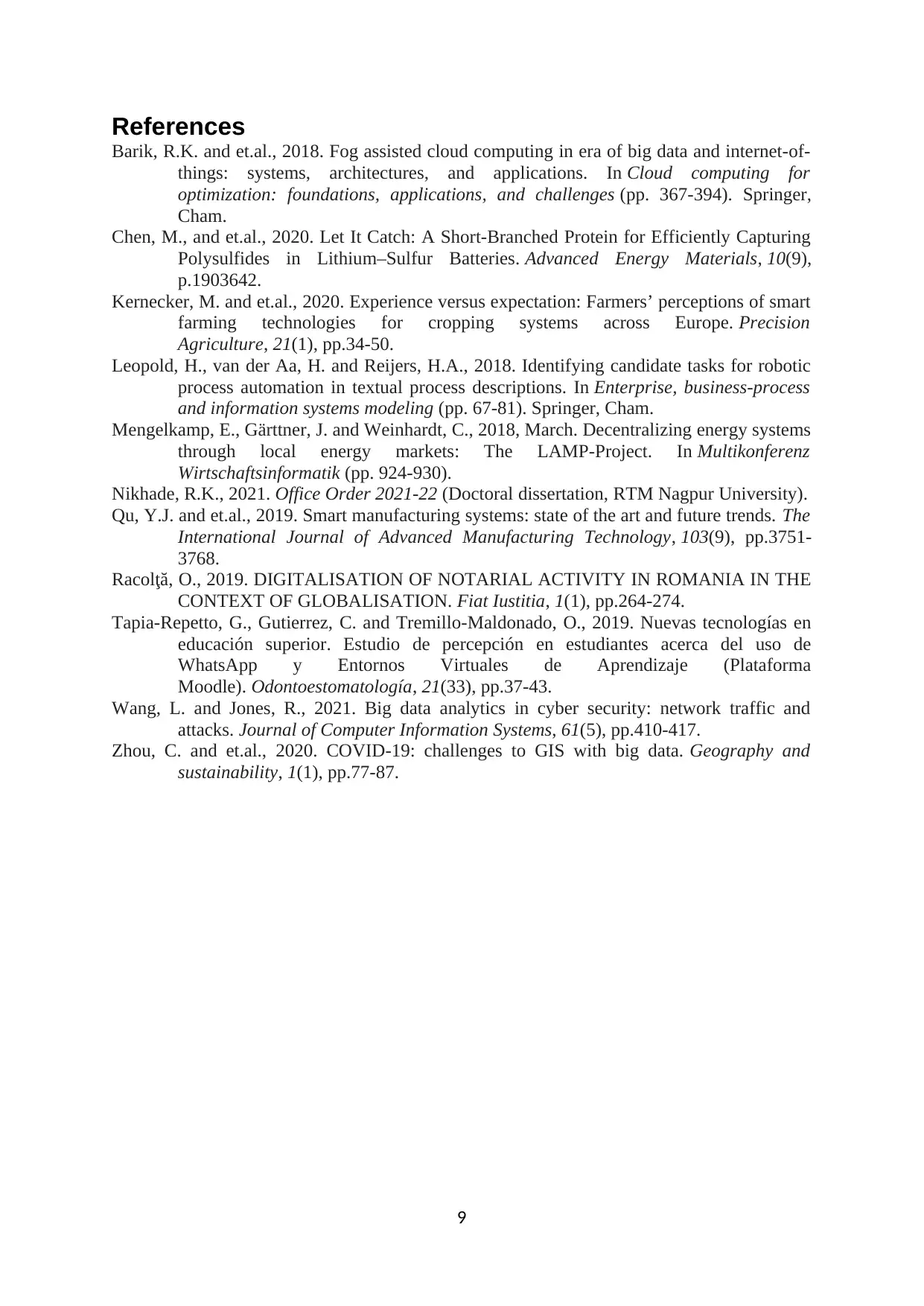
References
Barik, R.K. and et.al., 2018. Fog assisted cloud computing in era of big data and internet-of-
things: systems, architectures, and applications. In Cloud computing for
optimization: foundations, applications, and challenges (pp. 367-394). Springer,
Cham.
Chen, M., and et.al., 2020. Let It Catch: A Short‐Branched Protein for Efficiently Capturing
Polysulfides in Lithium–Sulfur Batteries. Advanced Energy Materials, 10(9),
p.1903642.
Kernecker, M. and et.al., 2020. Experience versus expectation: Farmers’ perceptions of smart
farming technologies for cropping systems across Europe. Precision
Agriculture, 21(1), pp.34-50.
Leopold, H., van der Aa, H. and Reijers, H.A., 2018. Identifying candidate tasks for robotic
process automation in textual process descriptions. In Enterprise, business-process
and information systems modeling (pp. 67-81). Springer, Cham.
Mengelkamp, E., Gärttner, J. and Weinhardt, C., 2018, March. Decentralizing energy systems
through local energy markets: The LAMP-Project. In Multikonferenz
Wirtschaftsinformatik (pp. 924-930).
Nikhade, R.K., 2021. Office Order 2021-22 (Doctoral dissertation, RTM Nagpur University).
Qu, Y.J. and et.al., 2019. Smart manufacturing systems: state of the art and future trends. The
International Journal of Advanced Manufacturing Technology, 103(9), pp.3751-
3768.
Racolţă, O., 2019. DIGITALISATION OF NOTARIAL ACTIVITY IN ROMANIA IN THE
CONTEXT OF GLOBALISATION. Fiat Iustitia, 1(1), pp.264-274.
Tapia-Repetto, G., Gutierrez, C. and Tremillo-Maldonado, O., 2019. Nuevas tecnologías en
educación superior. Estudio de percepción en estudiantes acerca del uso de
WhatsApp y Entornos Virtuales de Aprendizaje (Plataforma
Moodle). Odontoestomatología, 21(33), pp.37-43.
Wang, L. and Jones, R., 2021. Big data analytics in cyber security: network traffic and
attacks. Journal of Computer Information Systems, 61(5), pp.410-417.
Zhou, C. and et.al., 2020. COVID-19: challenges to GIS with big data. Geography and
sustainability, 1(1), pp.77-87.
9
Barik, R.K. and et.al., 2018. Fog assisted cloud computing in era of big data and internet-of-
things: systems, architectures, and applications. In Cloud computing for
optimization: foundations, applications, and challenges (pp. 367-394). Springer,
Cham.
Chen, M., and et.al., 2020. Let It Catch: A Short‐Branched Protein for Efficiently Capturing
Polysulfides in Lithium–Sulfur Batteries. Advanced Energy Materials, 10(9),
p.1903642.
Kernecker, M. and et.al., 2020. Experience versus expectation: Farmers’ perceptions of smart
farming technologies for cropping systems across Europe. Precision
Agriculture, 21(1), pp.34-50.
Leopold, H., van der Aa, H. and Reijers, H.A., 2018. Identifying candidate tasks for robotic
process automation in textual process descriptions. In Enterprise, business-process
and information systems modeling (pp. 67-81). Springer, Cham.
Mengelkamp, E., Gärttner, J. and Weinhardt, C., 2018, March. Decentralizing energy systems
through local energy markets: The LAMP-Project. In Multikonferenz
Wirtschaftsinformatik (pp. 924-930).
Nikhade, R.K., 2021. Office Order 2021-22 (Doctoral dissertation, RTM Nagpur University).
Qu, Y.J. and et.al., 2019. Smart manufacturing systems: state of the art and future trends. The
International Journal of Advanced Manufacturing Technology, 103(9), pp.3751-
3768.
Racolţă, O., 2019. DIGITALISATION OF NOTARIAL ACTIVITY IN ROMANIA IN THE
CONTEXT OF GLOBALISATION. Fiat Iustitia, 1(1), pp.264-274.
Tapia-Repetto, G., Gutierrez, C. and Tremillo-Maldonado, O., 2019. Nuevas tecnologías en
educación superior. Estudio de percepción en estudiantes acerca del uso de
WhatsApp y Entornos Virtuales de Aprendizaje (Plataforma
Moodle). Odontoestomatología, 21(33), pp.37-43.
Wang, L. and Jones, R., 2021. Big data analytics in cyber security: network traffic and
attacks. Journal of Computer Information Systems, 61(5), pp.410-417.
Zhou, C. and et.al., 2020. COVID-19: challenges to GIS with big data. Geography and
sustainability, 1(1), pp.77-87.
9

1 out of 10


Related Documents


Your All-in-One AI-Powered Toolkit for Academic Success.
+13062052269
info@desklib.com
Available 24*7 on WhatsApp / Email
![[object Object]](/_next/static/media/star-bottom.7253800d.svg)
Unlock your academic potential
Copyright © 2020–2026 A2Z Services. All Rights Reserved. Developed and managed by ZUCOL.