Body and Media: Case Study
VerifiedAdded on 2019/09/16
|9
|2984
|316
Case Study
AI Summary
This case study explores the complex relationship between body image and media influence. It examines how factors like media, culture, and society shape an individual's perception of their body. The report delves into the discourse of the body, analyzing how it is experienced, defined, measured, controlled, and represented. It also discusses the concept of a 'sporting body' and a 'normal' body. Furthermore, the study applies theoretical frameworks such as 'body-projects,' 'impression management,' and 'disciplined bodies' to analyze the author's own body image. The conclusion emphasizes the significant role of media in shaping body image perceptions and the need for responsible media communication.
BODY AND MEDIA: CASE STUDY

Paraphrase This Document
Need a fresh take? Get an instant paraphrase of this document with our AI Paraphraser
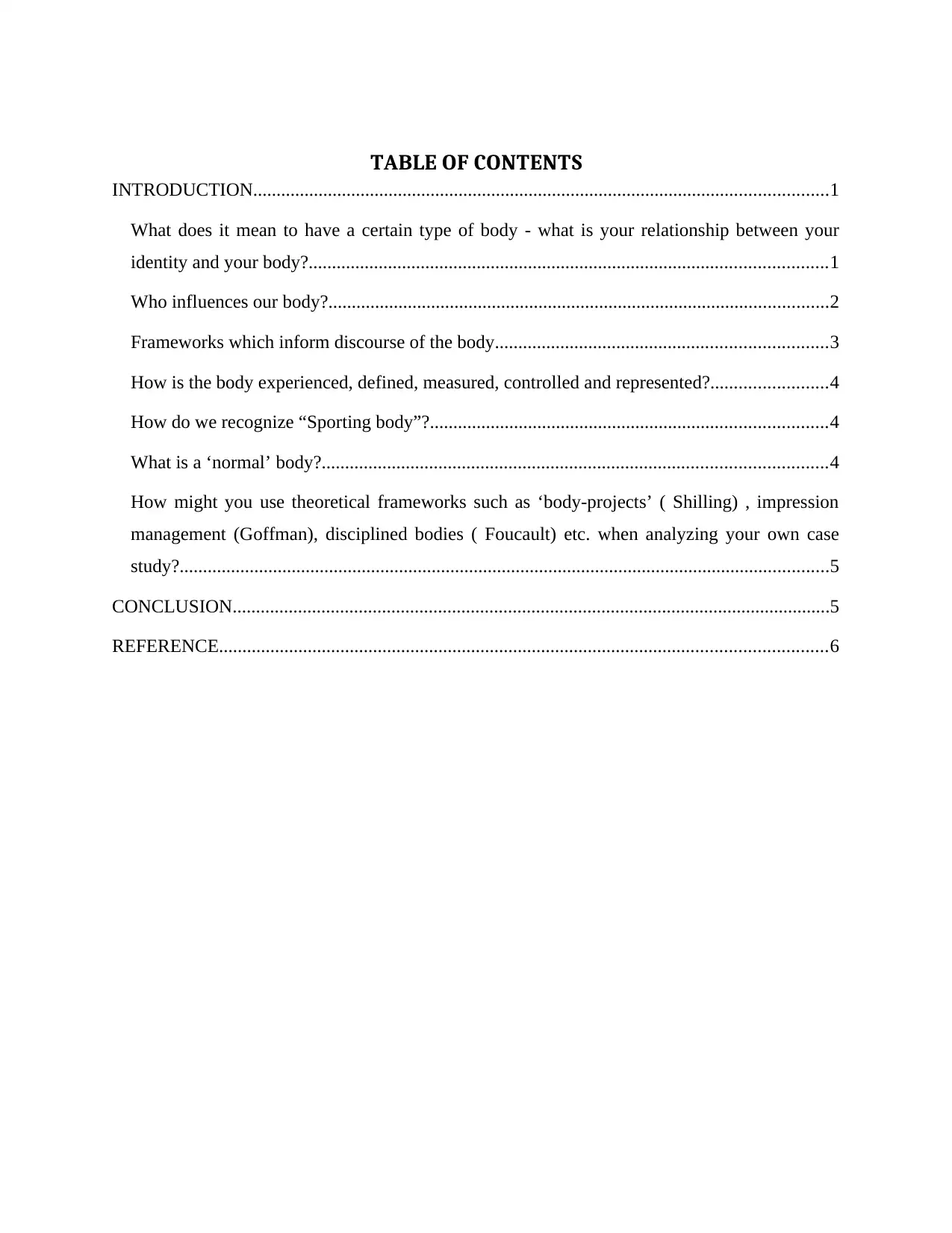
TABLE OF CONTENTS
INTRODUCTION...........................................................................................................................1
What does it mean to have a certain type of body - what is your relationship between your
identity and your body?...............................................................................................................1
Who influences our body?...........................................................................................................2
Frameworks which inform discourse of the body.......................................................................3
How is the body experienced, defined, measured, controlled and represented?.........................4
How do we recognize “Sporting body”?.....................................................................................4
What is a ‘normal’ body?............................................................................................................4
How might you use theoretical frameworks such as ‘body-projects’ ( Shilling) , impression
management (Goffman), disciplined bodies ( Foucault) etc. when analyzing your own case
study?...........................................................................................................................................5
CONCLUSION................................................................................................................................5
REFERENCE..................................................................................................................................6
INTRODUCTION...........................................................................................................................1
What does it mean to have a certain type of body - what is your relationship between your
identity and your body?...............................................................................................................1
Who influences our body?...........................................................................................................2
Frameworks which inform discourse of the body.......................................................................3
How is the body experienced, defined, measured, controlled and represented?.........................4
How do we recognize “Sporting body”?.....................................................................................4
What is a ‘normal’ body?............................................................................................................4
How might you use theoretical frameworks such as ‘body-projects’ ( Shilling) , impression
management (Goffman), disciplined bodies ( Foucault) etc. when analyzing your own case
study?...........................................................................................................................................5
CONCLUSION................................................................................................................................5
REFERENCE..................................................................................................................................6
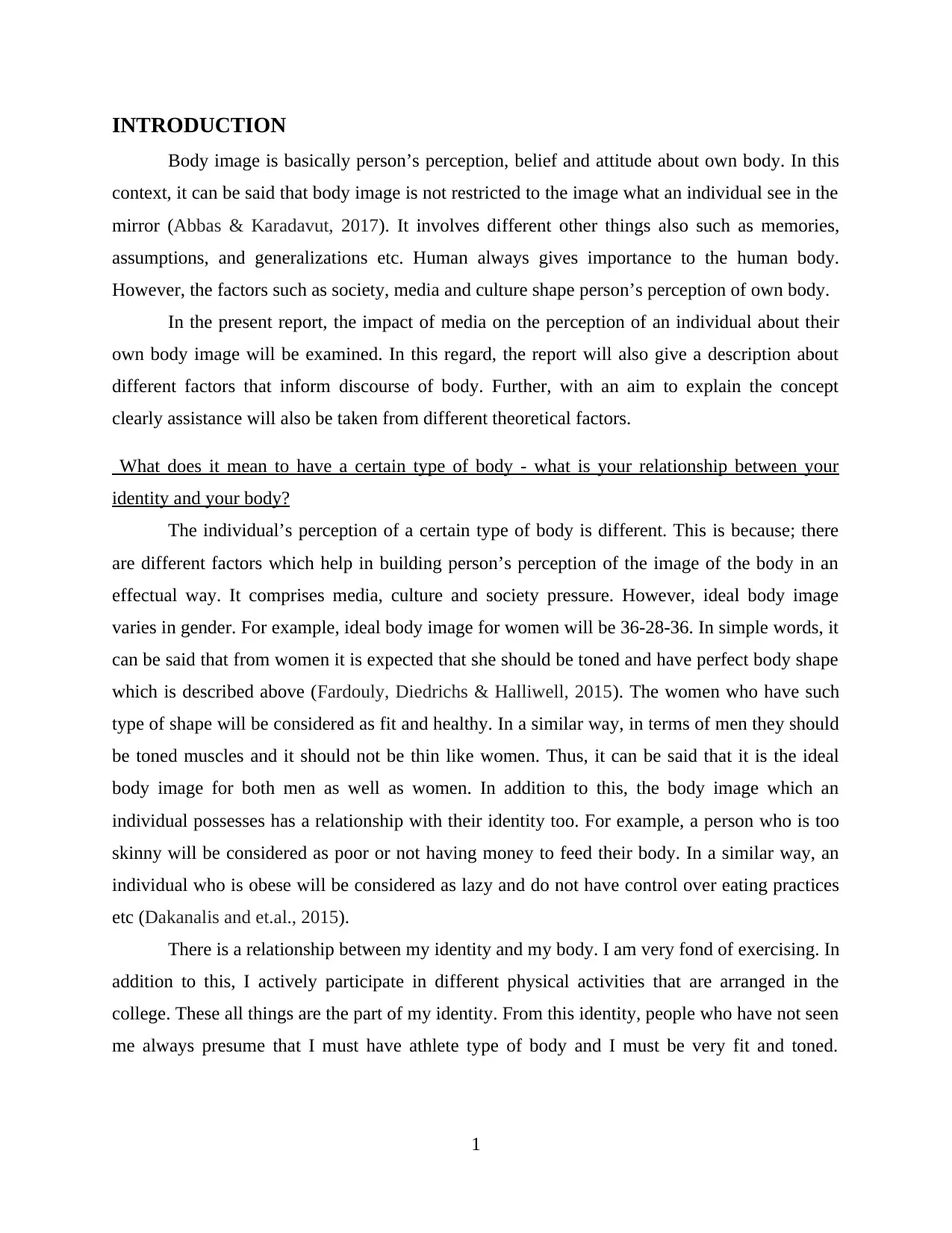
INTRODUCTION
Body image is basically person’s perception, belief and attitude about own body. In this
context, it can be said that body image is not restricted to the image what an individual see in the
mirror (Abbas & Karadavut, 2017). It involves different other things also such as memories,
assumptions, and generalizations etc. Human always gives importance to the human body.
However, the factors such as society, media and culture shape person’s perception of own body.
In the present report, the impact of media on the perception of an individual about their
own body image will be examined. In this regard, the report will also give a description about
different factors that inform discourse of body. Further, with an aim to explain the concept
clearly assistance will also be taken from different theoretical factors.
What does it mean to have a certain type of body - what is your relationship between your
identity and your body?
The individual’s perception of a certain type of body is different. This is because; there
are different factors which help in building person’s perception of the image of the body in an
effectual way. It comprises media, culture and society pressure. However, ideal body image
varies in gender. For example, ideal body image for women will be 36-28-36. In simple words, it
can be said that from women it is expected that she should be toned and have perfect body shape
which is described above (Fardouly, Diedrichs & Halliwell, 2015). The women who have such
type of shape will be considered as fit and healthy. In a similar way, in terms of men they should
be toned muscles and it should not be thin like women. Thus, it can be said that it is the ideal
body image for both men as well as women. In addition to this, the body image which an
individual possesses has a relationship with their identity too. For example, a person who is too
skinny will be considered as poor or not having money to feed their body. In a similar way, an
individual who is obese will be considered as lazy and do not have control over eating practices
etc (Dakanalis and et.al., 2015).
There is a relationship between my identity and my body. I am very fond of exercising. In
addition to this, I actively participate in different physical activities that are arranged in the
college. These all things are the part of my identity. From this identity, people who have not seen
me always presume that I must have athlete type of body and I must be very fit and toned.
1
Body image is basically person’s perception, belief and attitude about own body. In this
context, it can be said that body image is not restricted to the image what an individual see in the
mirror (Abbas & Karadavut, 2017). It involves different other things also such as memories,
assumptions, and generalizations etc. Human always gives importance to the human body.
However, the factors such as society, media and culture shape person’s perception of own body.
In the present report, the impact of media on the perception of an individual about their
own body image will be examined. In this regard, the report will also give a description about
different factors that inform discourse of body. Further, with an aim to explain the concept
clearly assistance will also be taken from different theoretical factors.
What does it mean to have a certain type of body - what is your relationship between your
identity and your body?
The individual’s perception of a certain type of body is different. This is because; there
are different factors which help in building person’s perception of the image of the body in an
effectual way. It comprises media, culture and society pressure. However, ideal body image
varies in gender. For example, ideal body image for women will be 36-28-36. In simple words, it
can be said that from women it is expected that she should be toned and have perfect body shape
which is described above (Fardouly, Diedrichs & Halliwell, 2015). The women who have such
type of shape will be considered as fit and healthy. In a similar way, in terms of men they should
be toned muscles and it should not be thin like women. Thus, it can be said that it is the ideal
body image for both men as well as women. In addition to this, the body image which an
individual possesses has a relationship with their identity too. For example, a person who is too
skinny will be considered as poor or not having money to feed their body. In a similar way, an
individual who is obese will be considered as lazy and do not have control over eating practices
etc (Dakanalis and et.al., 2015).
There is a relationship between my identity and my body. I am very fond of exercising. In
addition to this, I actively participate in different physical activities that are arranged in the
college. These all things are the part of my identity. From this identity, people who have not seen
me always presume that I must have athlete type of body and I must be very fit and toned.
1
⊘ This is a preview!⊘
Do you want full access?
Subscribe today to unlock all pages.

Trusted by 1+ million students worldwide
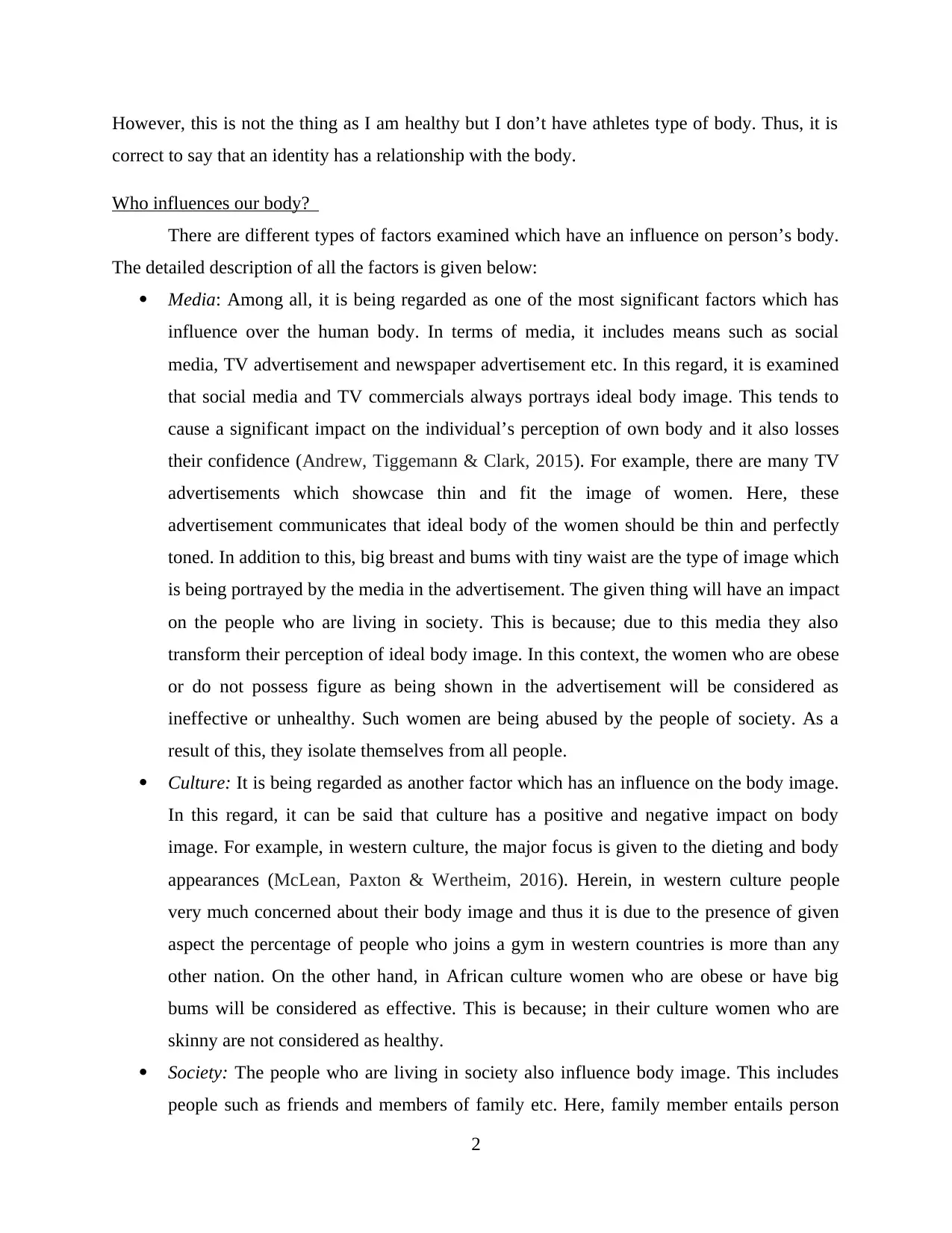
However, this is not the thing as I am healthy but I don’t have athletes type of body. Thus, it is
correct to say that an identity has a relationship with the body.
Who influences our body?
There are different types of factors examined which have an influence on person’s body.
The detailed description of all the factors is given below:
Media: Among all, it is being regarded as one of the most significant factors which has
influence over the human body. In terms of media, it includes means such as social
media, TV advertisement and newspaper advertisement etc. In this regard, it is examined
that social media and TV commercials always portrays ideal body image. This tends to
cause a significant impact on the individual’s perception of own body and it also losses
their confidence (Andrew, Tiggemann & Clark, 2015). For example, there are many TV
advertisements which showcase thin and fit the image of women. Here, these
advertisement communicates that ideal body of the women should be thin and perfectly
toned. In addition to this, big breast and bums with tiny waist are the type of image which
is being portrayed by the media in the advertisement. The given thing will have an impact
on the people who are living in society. This is because; due to this media they also
transform their perception of ideal body image. In this context, the women who are obese
or do not possess figure as being shown in the advertisement will be considered as
ineffective or unhealthy. Such women are being abused by the people of society. As a
result of this, they isolate themselves from all people.
Culture: It is being regarded as another factor which has an influence on the body image.
In this regard, it can be said that culture has a positive and negative impact on body
image. For example, in western culture, the major focus is given to the dieting and body
appearances (McLean, Paxton & Wertheim, 2016). Herein, in western culture people
very much concerned about their body image and thus it is due to the presence of given
aspect the percentage of people who joins a gym in western countries is more than any
other nation. On the other hand, in African culture women who are obese or have big
bums will be considered as effective. This is because; in their culture women who are
skinny are not considered as healthy.
Society: The people who are living in society also influence body image. This includes
people such as friends and members of family etc. Here, family member entails person
2
correct to say that an identity has a relationship with the body.
Who influences our body?
There are different types of factors examined which have an influence on person’s body.
The detailed description of all the factors is given below:
Media: Among all, it is being regarded as one of the most significant factors which has
influence over the human body. In terms of media, it includes means such as social
media, TV advertisement and newspaper advertisement etc. In this regard, it is examined
that social media and TV commercials always portrays ideal body image. This tends to
cause a significant impact on the individual’s perception of own body and it also losses
their confidence (Andrew, Tiggemann & Clark, 2015). For example, there are many TV
advertisements which showcase thin and fit the image of women. Here, these
advertisement communicates that ideal body of the women should be thin and perfectly
toned. In addition to this, big breast and bums with tiny waist are the type of image which
is being portrayed by the media in the advertisement. The given thing will have an impact
on the people who are living in society. This is because; due to this media they also
transform their perception of ideal body image. In this context, the women who are obese
or do not possess figure as being shown in the advertisement will be considered as
ineffective or unhealthy. Such women are being abused by the people of society. As a
result of this, they isolate themselves from all people.
Culture: It is being regarded as another factor which has an influence on the body image.
In this regard, it can be said that culture has a positive and negative impact on body
image. For example, in western culture, the major focus is given to the dieting and body
appearances (McLean, Paxton & Wertheim, 2016). Herein, in western culture people
very much concerned about their body image and thus it is due to the presence of given
aspect the percentage of people who joins a gym in western countries is more than any
other nation. On the other hand, in African culture women who are obese or have big
bums will be considered as effective. This is because; in their culture women who are
skinny are not considered as healthy.
Society: The people who are living in society also influence body image. This includes
people such as friends and members of family etc. Here, family member entails person
2
Paraphrase This Document
Need a fresh take? Get an instant paraphrase of this document with our AI Paraphraser
about what is good for our family and what is bad in our family in terms of body image.
For example, if all the family members are very conscious about their health and have
joined a gym for a toned body. Then in the given situation person who is part of such
type of family will have a perception of the image of its own body on the basis of given
aspect only. Thus, people of society also shape individual’s perception of own body
image in an effectual way (McLean, Paxton & Wertheim, 2016).
Frameworks which inform discourse of the body
Following are the framework which informs about the discourse of the body. Here, the discourse
of body is those individuals who shape the ideal image of the body. Science: In the respective field discourse of body could be a scientist who performs a
different type of experiments with an aim to examine the perfect body shape for an
individual. Here, with the help of experiments these individuals identify specific criteria
which entail the body shape of both men and women which is considered as healthy. Education: In the respective field, the teacher could be the discourse of body. This is
because it is the teacher only which makes a decision that which students should
participate in sports on the basis of their body image. This thing will have a direct impact
on the motivation of students. This is because in case if a student who is very much
interested in sports and rejected just because of the shape of his/her body will feel highly
demotivated and dissatisfied. Sports: Here, the sports authority that makes the selection of team will be considered as a
discourse of body. Here, they use of set different fitness parameters for sports person in
terms of body shape. The selection of sportsperson depends on given aspect (Fardouly &
Vartanian, 2016). Psychology: For example, people who are old will be considered as unhealthy and not
much fit. In a similar way, people who are young should be correlated with fit and
healthy feature. If any variation is being found in the specific aspect then in terms of
psychology the given thing will be considered as ineffective or inappropriate. Medicine: Here, the doctors will be considered as a discourse of body. In medical science
also, there are some set parameters for body image. It is for both men and women. In case
if an individual does not fulfill the respective parameters then in the given situation
respective person will be considered as unhealthy.
3
For example, if all the family members are very conscious about their health and have
joined a gym for a toned body. Then in the given situation person who is part of such
type of family will have a perception of the image of its own body on the basis of given
aspect only. Thus, people of society also shape individual’s perception of own body
image in an effectual way (McLean, Paxton & Wertheim, 2016).
Frameworks which inform discourse of the body
Following are the framework which informs about the discourse of the body. Here, the discourse
of body is those individuals who shape the ideal image of the body. Science: In the respective field discourse of body could be a scientist who performs a
different type of experiments with an aim to examine the perfect body shape for an
individual. Here, with the help of experiments these individuals identify specific criteria
which entail the body shape of both men and women which is considered as healthy. Education: In the respective field, the teacher could be the discourse of body. This is
because it is the teacher only which makes a decision that which students should
participate in sports on the basis of their body image. This thing will have a direct impact
on the motivation of students. This is because in case if a student who is very much
interested in sports and rejected just because of the shape of his/her body will feel highly
demotivated and dissatisfied. Sports: Here, the sports authority that makes the selection of team will be considered as a
discourse of body. Here, they use of set different fitness parameters for sports person in
terms of body shape. The selection of sportsperson depends on given aspect (Fardouly &
Vartanian, 2016). Psychology: For example, people who are old will be considered as unhealthy and not
much fit. In a similar way, people who are young should be correlated with fit and
healthy feature. If any variation is being found in the specific aspect then in terms of
psychology the given thing will be considered as ineffective or inappropriate. Medicine: Here, the doctors will be considered as a discourse of body. In medical science
also, there are some set parameters for body image. It is for both men and women. In case
if an individual does not fulfill the respective parameters then in the given situation
respective person will be considered as unhealthy.
3
Religion: The priest will be considered as a discourse of body. Here, priest
communicates the body image on the basis of the people’s religion. The given thing also
has an impact on the perception of people about body image in an effectual way.
How is the body experienced, defined, measured, controlled and represented?
The body of a human is defined on the basis of structure. The body of a human comprises
different cells, tissues and organ system etc. If these all systems work well then the body tends to
perform a healthy function. In addition to this, both men and women have different measurement
about the body (Grogan, 2016). For example, 36-28-36 is the ideal body measurement for
women. However, it is expected that men should have a chest of 45 inches. Here, these
parameters depict about the effective shape of a human. In addition to this, the human body can
be controlled through the gym and excessive exercises. Here, through this way an individual can
get perfect body shape.
How do we recognize “Sporting body”?
With an aim to set image of the sporting body, media has played a very significant role.
Here, it is with the help of media only an individual will be able to recognize the shape of the
sporting body. For example, the sports magazines always showcase a skinny but fit body of a
sports person. Here, it is also examined that sportsperson whether it is of men or women both
have six-pack abs. In addition to this, the body which is very much flexible is always related to
the sports person body (Ghaznavi & Taylor, 2015). This is because; the type of sports which an
individual plays makes a different type of changes in an individual’s body. In accordance with
the given context, one of the most significant changes which occur in the human body is related
with flexibility. Herein, sports person can move its body direction very easily. Thus, these all
things give an indication about the sporting body.
What is a ‘normal’ body?
The people who are overweight and underweight both don’t come under the category of a
normal body. Here, by the normal body, it does not mean that an individual should have six-pack
abs and should have a flexible bodies like athletes or the sportsperson. Here, the normal body is
something which makes a person looks healthy and he/she does not affect with any kind of
diseases. In addition to this, it can also be said that an individual who is able to so all type of
4
communicates the body image on the basis of the people’s religion. The given thing also
has an impact on the perception of people about body image in an effectual way.
How is the body experienced, defined, measured, controlled and represented?
The body of a human is defined on the basis of structure. The body of a human comprises
different cells, tissues and organ system etc. If these all systems work well then the body tends to
perform a healthy function. In addition to this, both men and women have different measurement
about the body (Grogan, 2016). For example, 36-28-36 is the ideal body measurement for
women. However, it is expected that men should have a chest of 45 inches. Here, these
parameters depict about the effective shape of a human. In addition to this, the human body can
be controlled through the gym and excessive exercises. Here, through this way an individual can
get perfect body shape.
How do we recognize “Sporting body”?
With an aim to set image of the sporting body, media has played a very significant role.
Here, it is with the help of media only an individual will be able to recognize the shape of the
sporting body. For example, the sports magazines always showcase a skinny but fit body of a
sports person. Here, it is also examined that sportsperson whether it is of men or women both
have six-pack abs. In addition to this, the body which is very much flexible is always related to
the sports person body (Ghaznavi & Taylor, 2015). This is because; the type of sports which an
individual plays makes a different type of changes in an individual’s body. In accordance with
the given context, one of the most significant changes which occur in the human body is related
with flexibility. Herein, sports person can move its body direction very easily. Thus, these all
things give an indication about the sporting body.
What is a ‘normal’ body?
The people who are overweight and underweight both don’t come under the category of a
normal body. Here, by the normal body, it does not mean that an individual should have six-pack
abs and should have a flexible bodies like athletes or the sportsperson. Here, the normal body is
something which makes a person looks healthy and he/she does not affect with any kind of
diseases. In addition to this, it can also be said that an individual who is able to so all type of
4
⊘ This is a preview!⊘
Do you want full access?
Subscribe today to unlock all pages.
Trusted by 1+ million students worldwide
work in the current body image will be considered as normal body. However, rest of the things
comes under the category of overweight and underweight (Perloff, 2014).
How might you use theoretical frameworks such as ‘body-projects’ ( Shilling) , impression
management (Goffman), disciplined bodies ( Foucault) etc. when analyzing your own case
study?
I have examined my own body image with the help of different type of frameworks. The
first framework is of body project by Shilling. This concept describe the ways in which
individual relates their body in post modern era. This framework entails that an individual
constantly works on their own body with an aim to make it as per own identity. I will take
assistance from the given framework with an aim to examine my own identity. For example, I
have an identity that I am very much fond of tennis sports. Thus, on the basis of this I will shape
my body. For example, people who play tennis have good muscle in leg.
On the other hand, impression management (Goffman) is another theoretical framework.
In this regard, the perception of an individual regarding any aspect is influenced by other people.
With the help of given approach, I can gather the perception of other people about my body
image. Thus, on the basis of given aspect only I will try to work on my body shape.
Furthermore, disciplined bodies ( Foucault) is another framework. The author entails that
the behavior of an individual that are associated with femininity and physical fitness contributes
towards docile bodies. Here, with an aim to transform my own body I will perform more fitness
related works.
CONCLUSION
From the whole report, it can be said that different type of media plays very important
role in shaping the perception of individual about their own and other body image. Thus, it is
required that the media should communicate good information about person’s body image. This
is because; if it is not done then people who do not have perfect body will be bullied by other.
5
comes under the category of overweight and underweight (Perloff, 2014).
How might you use theoretical frameworks such as ‘body-projects’ ( Shilling) , impression
management (Goffman), disciplined bodies ( Foucault) etc. when analyzing your own case
study?
I have examined my own body image with the help of different type of frameworks. The
first framework is of body project by Shilling. This concept describe the ways in which
individual relates their body in post modern era. This framework entails that an individual
constantly works on their own body with an aim to make it as per own identity. I will take
assistance from the given framework with an aim to examine my own identity. For example, I
have an identity that I am very much fond of tennis sports. Thus, on the basis of this I will shape
my body. For example, people who play tennis have good muscle in leg.
On the other hand, impression management (Goffman) is another theoretical framework.
In this regard, the perception of an individual regarding any aspect is influenced by other people.
With the help of given approach, I can gather the perception of other people about my body
image. Thus, on the basis of given aspect only I will try to work on my body shape.
Furthermore, disciplined bodies ( Foucault) is another framework. The author entails that
the behavior of an individual that are associated with femininity and physical fitness contributes
towards docile bodies. Here, with an aim to transform my own body I will perform more fitness
related works.
CONCLUSION
From the whole report, it can be said that different type of media plays very important
role in shaping the perception of individual about their own and other body image. Thus, it is
required that the media should communicate good information about person’s body image. This
is because; if it is not done then people who do not have perfect body will be bullied by other.
5
Paraphrase This Document
Need a fresh take? Get an instant paraphrase of this document with our AI Paraphraser
REFERENCE
Abbas, O. L., & Karadavut, U. (2017). Analysis of the Factors Affecting Men’s Attitudes
Toward Cosmetic Surgery: Body Image, Media Exposure, Social Network Use,
Masculine Gender Role Stress and Religious Attitudes. Aesthetic plastic surgery, 41(6),
1454-1462.
Andrew, R., Tiggemann, M., & Clark, L. (2015). The protective role of body appreciation
against media-induced body dissatisfaction. Body image, 15, 98-104.
Dakanalis, A. and et.al. (2015). The developmental effects of media-ideal internalization and
self-objectification processes on adolescents’ negative body-feelings, dietary restraint,
and binge eating. European child & adolescent psychiatry, 24(8), 997-1010.
Fardouly, J., & Vartanian, L. R. (2016). Social media and body image concerns: Current research
and future directions. Current opinion in psychology, 9, 1-5.
Fardouly, J., Diedrichs, P. C. & Halliwell, E. (2015). Social comparisons on social media: The
impact of Facebook on young women's body image concerns and mood. Body Image, 13,
38-45.
Ferguson, C. J., Muñoz, M. E. & Galindo, M. (2014). Concurrent and prospective analyses of
peer, television and social media influences on body dissatisfaction, eating disorder
symptoms and life satisfaction in adolescent girls. Journal of youth and
adolescence, 43(1), 1-14.
Ghaznavi, J., & Taylor, L. D. (2015). Bones, body parts, and sex appeal: An analysis of#
thinspiration images on popular social media. Body Image, 14, 54-61.
Grogan, S. (2016). Body image: Understanding body dissatisfaction in men, women and
children. Taylor & Francis.
McLean, S. A., Paxton, S. J., & Wertheim, E. H. (2016). Does media literacy mitigate risk for
reduced body satisfaction following exposure to thin-ideal media?. Journal of youth and
adolescence, 45(8), 1678-1695.
6
Abbas, O. L., & Karadavut, U. (2017). Analysis of the Factors Affecting Men’s Attitudes
Toward Cosmetic Surgery: Body Image, Media Exposure, Social Network Use,
Masculine Gender Role Stress and Religious Attitudes. Aesthetic plastic surgery, 41(6),
1454-1462.
Andrew, R., Tiggemann, M., & Clark, L. (2015). The protective role of body appreciation
against media-induced body dissatisfaction. Body image, 15, 98-104.
Dakanalis, A. and et.al. (2015). The developmental effects of media-ideal internalization and
self-objectification processes on adolescents’ negative body-feelings, dietary restraint,
and binge eating. European child & adolescent psychiatry, 24(8), 997-1010.
Fardouly, J., & Vartanian, L. R. (2016). Social media and body image concerns: Current research
and future directions. Current opinion in psychology, 9, 1-5.
Fardouly, J., Diedrichs, P. C. & Halliwell, E. (2015). Social comparisons on social media: The
impact of Facebook on young women's body image concerns and mood. Body Image, 13,
38-45.
Ferguson, C. J., Muñoz, M. E. & Galindo, M. (2014). Concurrent and prospective analyses of
peer, television and social media influences on body dissatisfaction, eating disorder
symptoms and life satisfaction in adolescent girls. Journal of youth and
adolescence, 43(1), 1-14.
Ghaznavi, J., & Taylor, L. D. (2015). Bones, body parts, and sex appeal: An analysis of#
thinspiration images on popular social media. Body Image, 14, 54-61.
Grogan, S. (2016). Body image: Understanding body dissatisfaction in men, women and
children. Taylor & Francis.
McLean, S. A., Paxton, S. J., & Wertheim, E. H. (2016). Does media literacy mitigate risk for
reduced body satisfaction following exposure to thin-ideal media?. Journal of youth and
adolescence, 45(8), 1678-1695.
6
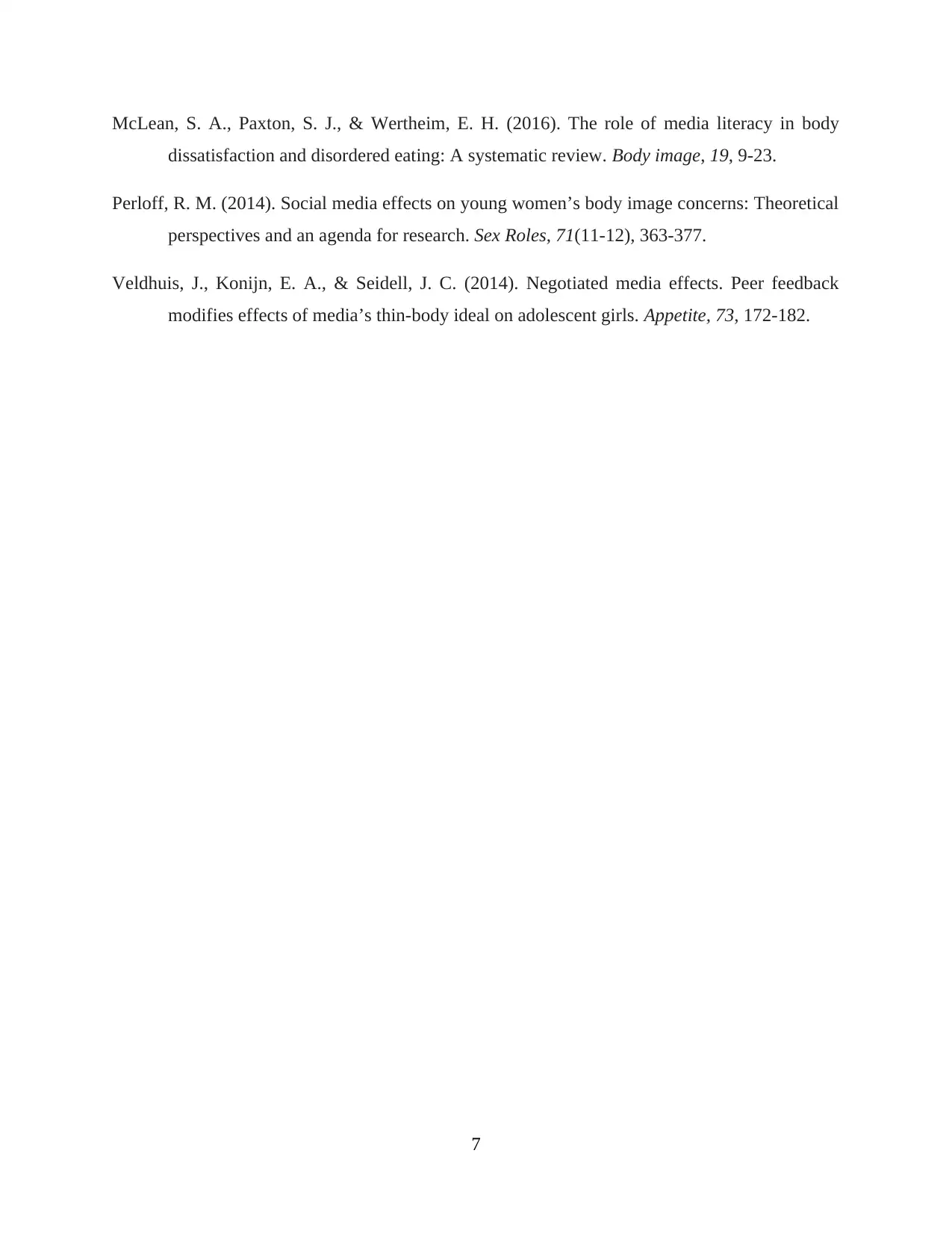
McLean, S. A., Paxton, S. J., & Wertheim, E. H. (2016). The role of media literacy in body
dissatisfaction and disordered eating: A systematic review. Body image, 19, 9-23.
Perloff, R. M. (2014). Social media effects on young women’s body image concerns: Theoretical
perspectives and an agenda for research. Sex Roles, 71(11-12), 363-377.
Veldhuis, J., Konijn, E. A., & Seidell, J. C. (2014). Negotiated media effects. Peer feedback
modifies effects of media’s thin-body ideal on adolescent girls. Appetite, 73, 172-182.
7
dissatisfaction and disordered eating: A systematic review. Body image, 19, 9-23.
Perloff, R. M. (2014). Social media effects on young women’s body image concerns: Theoretical
perspectives and an agenda for research. Sex Roles, 71(11-12), 363-377.
Veldhuis, J., Konijn, E. A., & Seidell, J. C. (2014). Negotiated media effects. Peer feedback
modifies effects of media’s thin-body ideal on adolescent girls. Appetite, 73, 172-182.
7
⊘ This is a preview!⊘
Do you want full access?
Subscribe today to unlock all pages.
Trusted by 1+ million students worldwide

1 out of 9


Related Documents


Your All-in-One AI-Powered Toolkit for Academic Success.
+13062052269
info@desklib.com
Available 24*7 on WhatsApp / Email
![[object Object]](/_next/static/media/star-bottom.7253800d.svg)
Unlock your academic potential
Copyright © 2020–2025 A2Z Services. All Rights Reserved. Developed and managed by ZUCOL.