Nursing Assignment: Case Study of a Patient with Schizophrenia

Verified

Added on  2022/10/06

|4
|560
|49
Report
AI Summary
This nursing assignment analyzes a case study of a patient diagnosed with schizophrenia. The assignment explores the patient's symptoms, including hallucinations and altered perceptions, referencing relevant research. The first part of the assignment highlights the patient's reported experiences and the nature of their hallucinations, drawing on the work of Lim et al. (2016) and Cachia et al. (2015) to contextualize these symptoms within the broader framework of schizophrenia. The second part of the assignment outlines a nursing approach to patient care, emphasizing the importance of patience, understanding, and encouraging constructive thinking. The assignment also references Dyck et al. (2016) and Valton et al. (2019) to support the discussion of treatment and monitoring strategies. The assignment aims to provide a comprehensive understanding of schizophrenia and effective patient management within a nursing context.
Document Page
Running head: NURSING ASSIGNMENT
NURSING ASSIGNMENT
Name of the student
Name of the university
Author note
tabler-icon-diamond-filled.svg

Paraphrase This Document

Need a fresh take? Get an instant paraphrase of this document with our AI Paraphraser
Document Page
1NURSING ASSIGNMENT
Answer 1
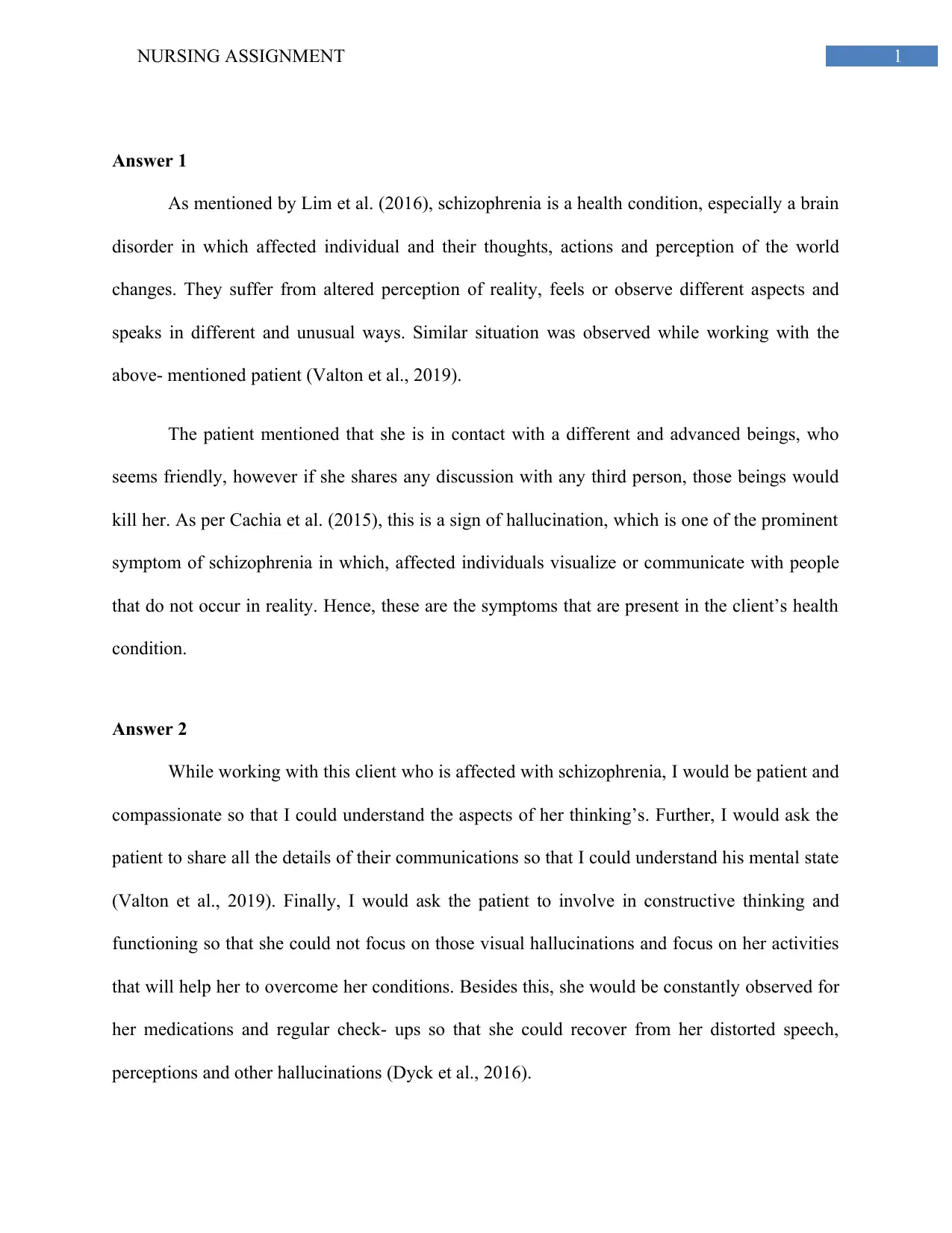
As mentioned by Lim et al. (2016), schizophrenia is a health condition, especially a brain
disorder in which affected individual and their thoughts, actions and perception of the world
changes. They suffer from altered perception of reality, feels or observe different aspects and
speaks in different and unusual ways. Similar situation was observed while working with the
above- mentioned patient (Valton et al., 2019).
The patient mentioned that she is in contact with a different and advanced beings, who
seems friendly, however if she shares any discussion with any third person, those beings would
kill her. As per Cachia et al. (2015), this is a sign of hallucination, which is one of the prominent
symptom of schizophrenia in which, affected individuals visualize or communicate with people
that do not occur in reality. Hence, these are the symptoms that are present in the client’s health
condition.
Answer 2
While working with this client who is affected with schizophrenia, I would be patient and
compassionate so that I could understand the aspects of her thinking’s. Further, I would ask the
patient to share all the details of their communications so that I could understand his mental state
(Valton et al., 2019). Finally, I would ask the patient to involve in constructive thinking and
functioning so that she could not focus on those visual hallucinations and focus on her activities
that will help her to overcome her conditions. Besides this, she would be constantly observed for
her medications and regular check- ups so that she could recover from her distorted speech,
perceptions and other hallucinations (Dyck et al., 2016).
Document Page
2NURSING ASSIGNMENT
Document Page
3NURSING ASSIGNMENT
References
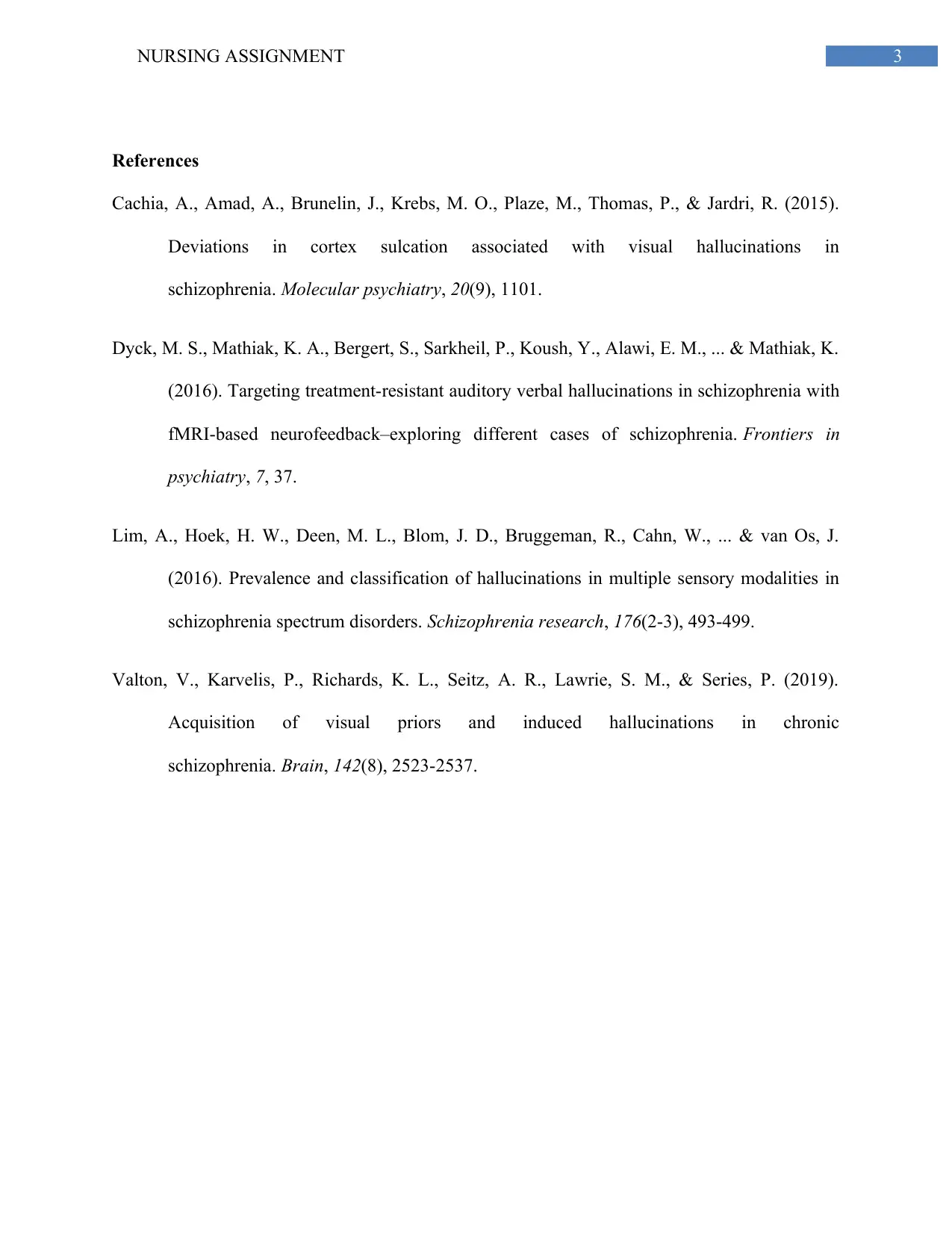
Cachia, A., Amad, A., Brunelin, J., Krebs, M. O., Plaze, M., Thomas, P., & Jardri, R. (2015).
Deviations in cortex sulcation associated with visual hallucinations in
schizophrenia. Molecular psychiatry, 20(9), 1101.
Dyck, M. S., Mathiak, K. A., Bergert, S., Sarkheil, P., Koush, Y., Alawi, E. M., ... & Mathiak, K.
(2016). Targeting treatment-resistant auditory verbal hallucinations in schizophrenia with
fMRI-based neurofeedback–exploring different cases of schizophrenia. Frontiers in
psychiatry, 7, 37.
Lim, A., Hoek, H. W., Deen, M. L., Blom, J. D., Bruggeman, R., Cahn, W., ... & van Os, J.
(2016). Prevalence and classification of hallucinations in multiple sensory modalities in
schizophrenia spectrum disorders. Schizophrenia research, 176(2-3), 493-499.
Valton, V., Karvelis, P., Richards, K. L., Seitz, A. R., Lawrie, S. M., & Series, P. (2019).
Acquisition of visual priors and induced hallucinations in chronic
schizophrenia. Brain, 142(8), 2523-2537.
chevron_up_icon
1 out of 4
circle_padding
hide_on_mobile
zoom_out_icon
[object Object]