CM220 Module 2 Competency Assessment: Brain Drain and Persuasion
VerifiedAdded on 2023/06/04
|3
|1210
|471
Homework Assignment
AI Summary
This assignment is a competency assessment for Module 2, focusing on the issue of "brain drain," or the migration of skilled workers from developing to developed nations. The student begins by creating a persuasive, problem-solving thesis statement addressing this issue, emphasizing the need for countries to incentivize professionals to stay. The student then analyzes the rhetorical situation, considering the purpose (explaining brain drain and proposing solutions), the target audience (those affected by the issue), and the setting (the context of immigration policies in the USA). The assignment further evaluates the argument using the rhetorical triangle, exploring the appeals to logos (facts and reasoning, exemplified by Walmart's hiring practices), ethos (credibility and ethical considerations, emphasizing the need for aid to developing nations), and pathos (emotional appeals, focusing on the impact of brain drain). The student also acknowledges the paradoxical situation where even developed countries face challenges due to brain drain. The document incorporates relevant sources to support the arguments and analysis.
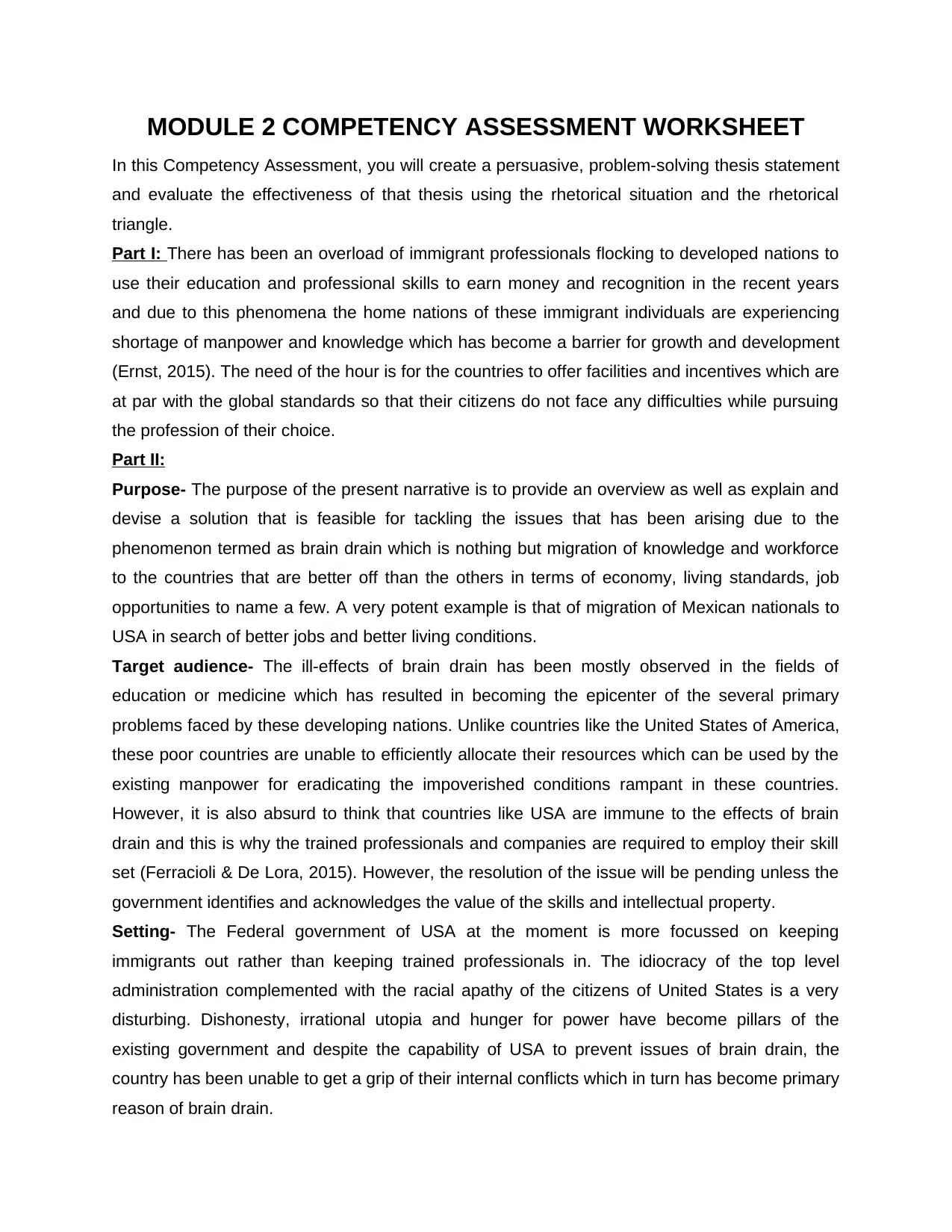
MODULE 2 COMPETENCY ASSESSMENT WORKSHEET
In this Competency Assessment, you will create a persuasive, problem-solving thesis statement
and evaluate the effectiveness of that thesis using the rhetorical situation and the rhetorical
triangle.
Part I: There has been an overload of immigrant professionals flocking to developed nations to
use their education and professional skills to earn money and recognition in the recent years
and due to this phenomena the home nations of these immigrant individuals are experiencing
shortage of manpower and knowledge which has become a barrier for growth and development
(Ernst, 2015). The need of the hour is for the countries to offer facilities and incentives which are
at par with the global standards so that their citizens do not face any difficulties while pursuing
the profession of their choice.
Part II:
Purpose- The purpose of the present narrative is to provide an overview as well as explain and
devise a solution that is feasible for tackling the issues that has been arising due to the
phenomenon termed as brain drain which is nothing but migration of knowledge and workforce
to the countries that are better off than the others in terms of economy, living standards, job
opportunities to name a few. A very potent example is that of migration of Mexican nationals to
USA in search of better jobs and better living conditions.
Target audience- The ill-effects of brain drain has been mostly observed in the fields of
education or medicine which has resulted in becoming the epicenter of the several primary
problems faced by these developing nations. Unlike countries like the United States of America,
these poor countries are unable to efficiently allocate their resources which can be used by the
existing manpower for eradicating the impoverished conditions rampant in these countries.
However, it is also absurd to think that countries like USA are immune to the effects of brain
drain and this is why the trained professionals and companies are required to employ their skill
set (Ferracioli & De Lora, 2015). However, the resolution of the issue will be pending unless the
government identifies and acknowledges the value of the skills and intellectual property.
Setting- The Federal government of USA at the moment is more focussed on keeping
immigrants out rather than keeping trained professionals in. The idiocracy of the top level
administration complemented with the racial apathy of the citizens of United States is a very
disturbing. Dishonesty, irrational utopia and hunger for power have become pillars of the
existing government and despite the capability of USA to prevent issues of brain drain, the
country has been unable to get a grip of their internal conflicts which in turn has become primary
reason of brain drain.
In this Competency Assessment, you will create a persuasive, problem-solving thesis statement
and evaluate the effectiveness of that thesis using the rhetorical situation and the rhetorical
triangle.
Part I: There has been an overload of immigrant professionals flocking to developed nations to
use their education and professional skills to earn money and recognition in the recent years
and due to this phenomena the home nations of these immigrant individuals are experiencing
shortage of manpower and knowledge which has become a barrier for growth and development
(Ernst, 2015). The need of the hour is for the countries to offer facilities and incentives which are
at par with the global standards so that their citizens do not face any difficulties while pursuing
the profession of their choice.
Part II:
Purpose- The purpose of the present narrative is to provide an overview as well as explain and
devise a solution that is feasible for tackling the issues that has been arising due to the
phenomenon termed as brain drain which is nothing but migration of knowledge and workforce
to the countries that are better off than the others in terms of economy, living standards, job
opportunities to name a few. A very potent example is that of migration of Mexican nationals to
USA in search of better jobs and better living conditions.
Target audience- The ill-effects of brain drain has been mostly observed in the fields of
education or medicine which has resulted in becoming the epicenter of the several primary
problems faced by these developing nations. Unlike countries like the United States of America,
these poor countries are unable to efficiently allocate their resources which can be used by the
existing manpower for eradicating the impoverished conditions rampant in these countries.
However, it is also absurd to think that countries like USA are immune to the effects of brain
drain and this is why the trained professionals and companies are required to employ their skill
set (Ferracioli & De Lora, 2015). However, the resolution of the issue will be pending unless the
government identifies and acknowledges the value of the skills and intellectual property.
Setting- The Federal government of USA at the moment is more focussed on keeping
immigrants out rather than keeping trained professionals in. The idiocracy of the top level
administration complemented with the racial apathy of the citizens of United States is a very
disturbing. Dishonesty, irrational utopia and hunger for power have become pillars of the
existing government and despite the capability of USA to prevent issues of brain drain, the
country has been unable to get a grip of their internal conflicts which in turn has become primary
reason of brain drain.
Paraphrase This Document
Need a fresh take? Get an instant paraphrase of this document with our AI Paraphraser

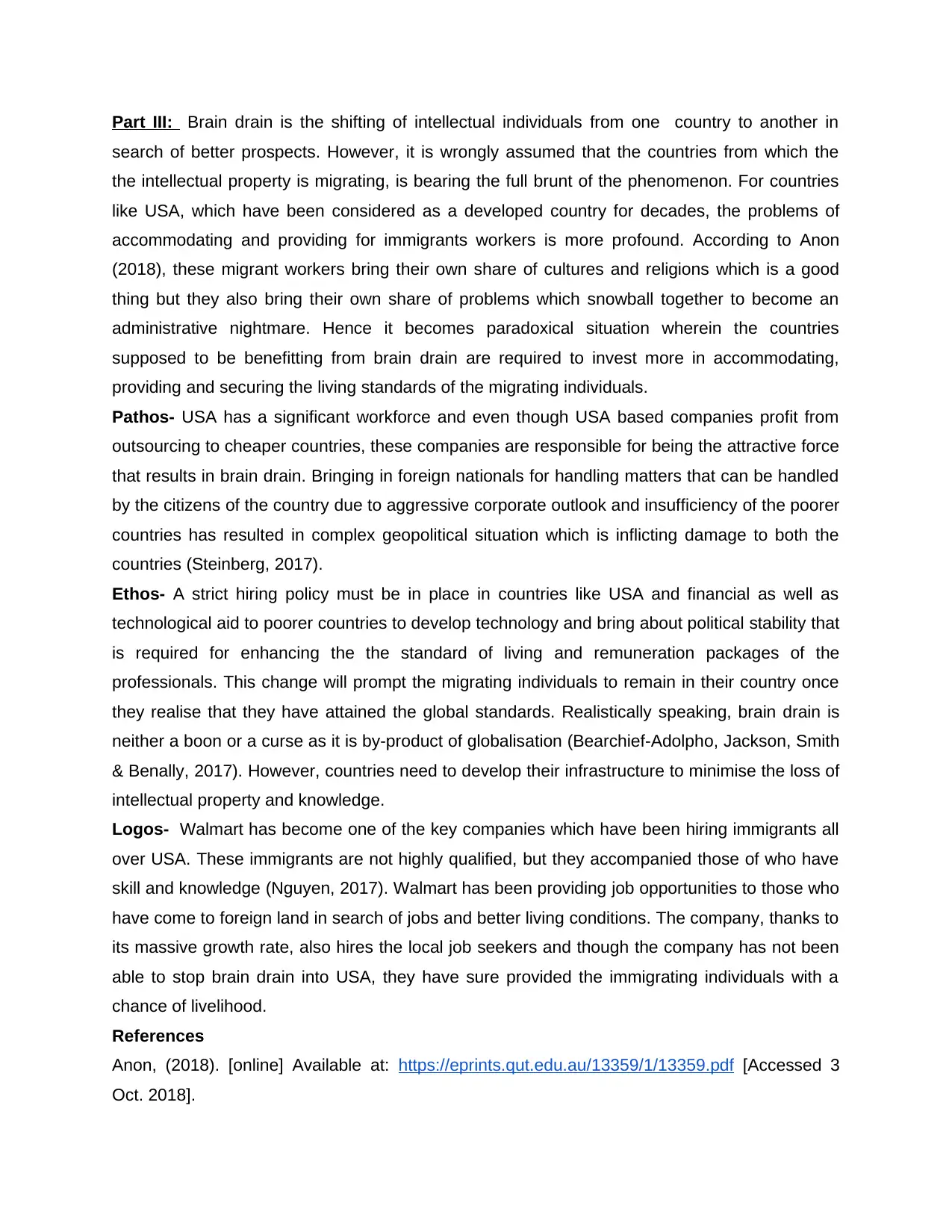
Part III: Brain drain is the shifting of intellectual individuals from one country to another in
search of better prospects. However, it is wrongly assumed that the countries from which the
the intellectual property is migrating, is bearing the full brunt of the phenomenon. For countries
like USA, which have been considered as a developed country for decades, the problems of
accommodating and providing for immigrants workers is more profound. According to Anon
(2018), these migrant workers bring their own share of cultures and religions which is a good
thing but they also bring their own share of problems which snowball together to become an
administrative nightmare. Hence it becomes paradoxical situation wherein the countries
supposed to be benefitting from brain drain are required to invest more in accommodating,
providing and securing the living standards of the migrating individuals.
Pathos- USA has a significant workforce and even though USA based companies profit from
outsourcing to cheaper countries, these companies are responsible for being the attractive force
that results in brain drain. Bringing in foreign nationals for handling matters that can be handled
by the citizens of the country due to aggressive corporate outlook and insufficiency of the poorer
countries has resulted in complex geopolitical situation which is inflicting damage to both the
countries (Steinberg, 2017).
Ethos- A strict hiring policy must be in place in countries like USA and financial as well as
technological aid to poorer countries to develop technology and bring about political stability that
is required for enhancing the the standard of living and remuneration packages of the
professionals. This change will prompt the migrating individuals to remain in their country once
they realise that they have attained the global standards. Realistically speaking, brain drain is
neither a boon or a curse as it is by-product of globalisation (Bearchief-Adolpho, Jackson, Smith
& Benally, 2017). However, countries need to develop their infrastructure to minimise the loss of
intellectual property and knowledge.
Logos- Walmart has become one of the key companies which have been hiring immigrants all
over USA. These immigrants are not highly qualified, but they accompanied those of who have
skill and knowledge (Nguyen, 2017). Walmart has been providing job opportunities to those who
have come to foreign land in search of jobs and better living conditions. The company, thanks to
its massive growth rate, also hires the local job seekers and though the company has not been
able to stop brain drain into USA, they have sure provided the immigrating individuals with a
chance of livelihood.
References
Anon, (2018). [online] Available at: https://eprints.qut.edu.au/13359/1/13359.pdf [Accessed 3
Oct. 2018].
search of better prospects. However, it is wrongly assumed that the countries from which the
the intellectual property is migrating, is bearing the full brunt of the phenomenon. For countries
like USA, which have been considered as a developed country for decades, the problems of
accommodating and providing for immigrants workers is more profound. According to Anon
(2018), these migrant workers bring their own share of cultures and religions which is a good
thing but they also bring their own share of problems which snowball together to become an
administrative nightmare. Hence it becomes paradoxical situation wherein the countries
supposed to be benefitting from brain drain are required to invest more in accommodating,
providing and securing the living standards of the migrating individuals.
Pathos- USA has a significant workforce and even though USA based companies profit from
outsourcing to cheaper countries, these companies are responsible for being the attractive force
that results in brain drain. Bringing in foreign nationals for handling matters that can be handled
by the citizens of the country due to aggressive corporate outlook and insufficiency of the poorer
countries has resulted in complex geopolitical situation which is inflicting damage to both the
countries (Steinberg, 2017).
Ethos- A strict hiring policy must be in place in countries like USA and financial as well as
technological aid to poorer countries to develop technology and bring about political stability that
is required for enhancing the the standard of living and remuneration packages of the
professionals. This change will prompt the migrating individuals to remain in their country once
they realise that they have attained the global standards. Realistically speaking, brain drain is
neither a boon or a curse as it is by-product of globalisation (Bearchief-Adolpho, Jackson, Smith
& Benally, 2017). However, countries need to develop their infrastructure to minimise the loss of
intellectual property and knowledge.
Logos- Walmart has become one of the key companies which have been hiring immigrants all
over USA. These immigrants are not highly qualified, but they accompanied those of who have
skill and knowledge (Nguyen, 2017). Walmart has been providing job opportunities to those who
have come to foreign land in search of jobs and better living conditions. The company, thanks to
its massive growth rate, also hires the local job seekers and though the company has not been
able to stop brain drain into USA, they have sure provided the immigrating individuals with a
chance of livelihood.
References
Anon, (2018). [online] Available at: https://eprints.qut.edu.au/13359/1/13359.pdf [Accessed 3
Oct. 2018].

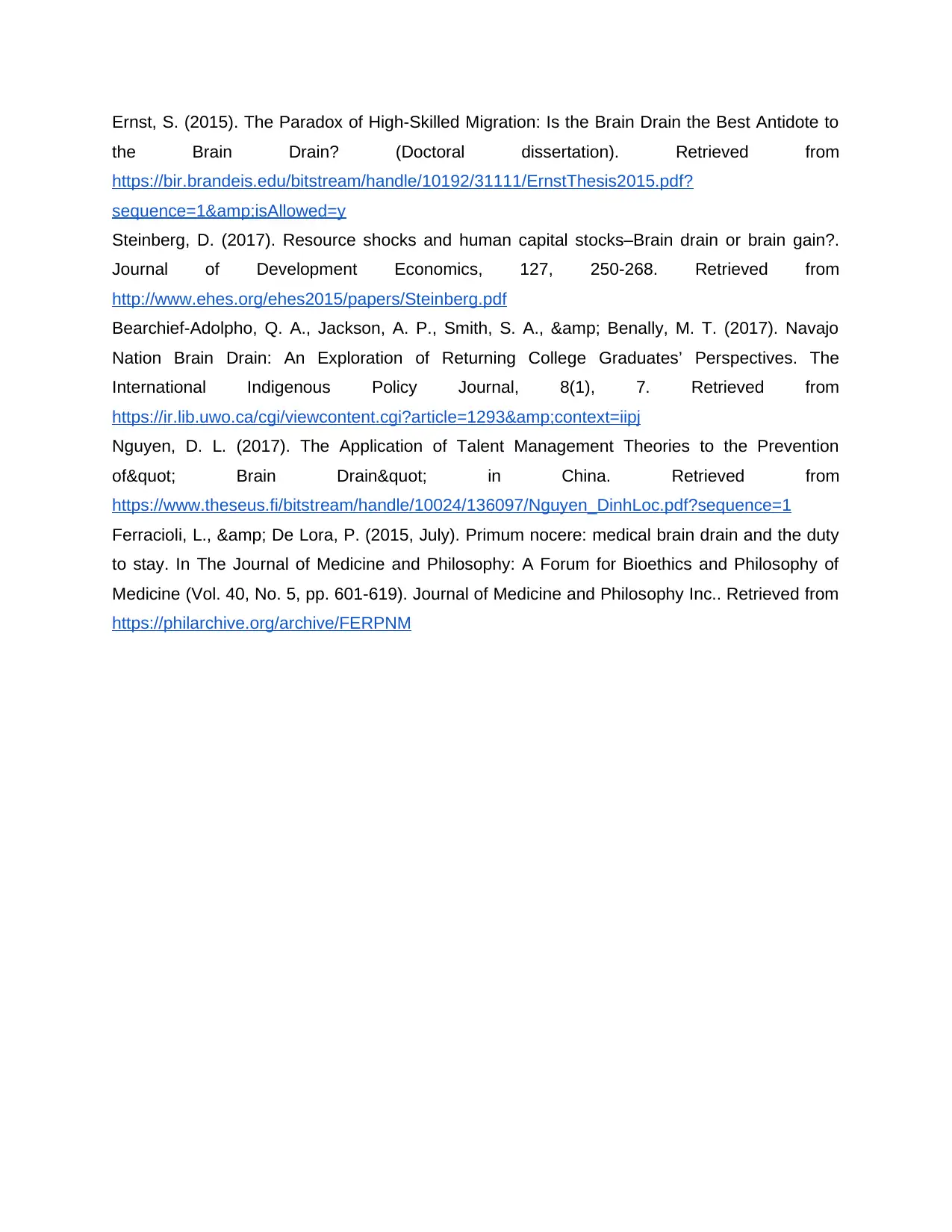
Ernst, S. (2015). The Paradox of High-Skilled Migration: Is the Brain Drain the Best Antidote to
the Brain Drain? (Doctoral dissertation). Retrieved from
https://bir.brandeis.edu/bitstream/handle/10192/31111/ErnstThesis2015.pdf?
sequence=1&isAllowed=y
Steinberg, D. (2017). Resource shocks and human capital stocks–Brain drain or brain gain?.
Journal of Development Economics, 127, 250-268. Retrieved from
http://www.ehes.org/ehes2015/papers/Steinberg.pdf
Bearchief-Adolpho, Q. A., Jackson, A. P., Smith, S. A., & Benally, M. T. (2017). Navajo
Nation Brain Drain: An Exploration of Returning College Graduates’ Perspectives. The
International Indigenous Policy Journal, 8(1), 7. Retrieved from
https://ir.lib.uwo.ca/cgi/viewcontent.cgi?article=1293&context=iipj
Nguyen, D. L. (2017). The Application of Talent Management Theories to the Prevention
of" Brain Drain" in China. Retrieved from
https://www.theseus.fi/bitstream/handle/10024/136097/Nguyen_DinhLoc.pdf?sequence=1
Ferracioli, L., & De Lora, P. (2015, July). Primum nocere: medical brain drain and the duty
to stay. In The Journal of Medicine and Philosophy: A Forum for Bioethics and Philosophy of
Medicine (Vol. 40, No. 5, pp. 601-619). Journal of Medicine and Philosophy Inc.. Retrieved from
https://philarchive.org/archive/FERPNM
the Brain Drain? (Doctoral dissertation). Retrieved from
https://bir.brandeis.edu/bitstream/handle/10192/31111/ErnstThesis2015.pdf?
sequence=1&isAllowed=y
Steinberg, D. (2017). Resource shocks and human capital stocks–Brain drain or brain gain?.
Journal of Development Economics, 127, 250-268. Retrieved from
http://www.ehes.org/ehes2015/papers/Steinberg.pdf
Bearchief-Adolpho, Q. A., Jackson, A. P., Smith, S. A., & Benally, M. T. (2017). Navajo
Nation Brain Drain: An Exploration of Returning College Graduates’ Perspectives. The
International Indigenous Policy Journal, 8(1), 7. Retrieved from
https://ir.lib.uwo.ca/cgi/viewcontent.cgi?article=1293&context=iipj
Nguyen, D. L. (2017). The Application of Talent Management Theories to the Prevention
of" Brain Drain" in China. Retrieved from
https://www.theseus.fi/bitstream/handle/10024/136097/Nguyen_DinhLoc.pdf?sequence=1
Ferracioli, L., & De Lora, P. (2015, July). Primum nocere: medical brain drain and the duty
to stay. In The Journal of Medicine and Philosophy: A Forum for Bioethics and Philosophy of
Medicine (Vol. 40, No. 5, pp. 601-619). Journal of Medicine and Philosophy Inc.. Retrieved from
https://philarchive.org/archive/FERPNM
⊘ This is a preview!⊘
Do you want full access?
Subscribe today to unlock all pages.

Trusted by 1+ million students worldwide
1 out of 3
Related Documents
Your All-in-One AI-Powered Toolkit for Academic Success.
+13062052269
info@desklib.com
Available 24*7 on WhatsApp / Email
Unlock your academic potential
Copyright © 2020–2026 A2Z Services. All Rights Reserved. Developed and managed by ZUCOL.