An Analysis of Branding and Consumer Behavior for Used Cars in the UK
VerifiedAdded on 2023/04/25
|10
|2526
|425
Project
AI Summary
This project delves into the branding strategies and consumer behavior surrounding the purchase of used cars in the UK, with a specific focus on BuyACar. The research identifies key criteria influencing consumer decisions, such as price, brand reputation, and vehicle condition. The study reviews existing literature on the used car market, including sales trends, the impact of new car sales, and the preferences of UK consumers. The methodology involves a mixed-methods approach, combining secondary data analysis from industry reports and academic journals with primary data collection through surveys and potentially interviews. The data analysis techniques include content analysis and statistical methods to interpret the collected data. The project concludes with a discussion of the findings, their implications for BuyACar and the broader used car industry, and recommendations for future research. The project follows a detailed dissertation plan, outlining the timeline for each stage of the research, from topic selection to final submission.
Branding and consumer
behavior in BuyACar of UK
Student’s Name:
Student’s ID:
behavior in BuyACar of UK
Student’s Name:
Student’s ID:

Paraphrase This Document
Need a fresh take? Get an instant paraphrase of this document with our AI Paraphraser
1
Table of Contents
Introduction...............................................................................................................................................2
Research Problem..................................................................................................................................2
Research Aims & Objectives................................................................................................................2
Background of the Study.......................................................................................................................2
Literature Review......................................................................................................................................3
Methodology..............................................................................................................................................4
Data Analysis Techniques.....................................................................................................................5
Dissertation Plan........................................................................................................................................6
Table of Contents
Introduction...............................................................................................................................................2
Research Problem..................................................................................................................................2
Research Aims & Objectives................................................................................................................2
Background of the Study.......................................................................................................................2
Literature Review......................................................................................................................................3
Methodology..............................................................................................................................................4
Data Analysis Techniques.....................................................................................................................5
Dissertation Plan........................................................................................................................................6
2
Introduction
Research Problem
The research problem statement in this research is to address the branding and consumer
behavior for buying of used cars in UK. The price was the most vital factor for purchasing the
used car, but the process seems to bit complicated as it does not depend on single criteria. The
answer to this issue might be helpful for the industry of used car in the UK.
Research Aims & Objectives
The aim of the research is to get profound knowledge about the branding and consumer behavior
for the buying of used cars in the UK.
The objectives of this research are given below:
To examine most vital criteria for buying the used cars in the UK
To evaluate the outcome of this research for branding and consumer behavior for the buying
of used cars in the UK
Research Questions
1. What are the most vital criteria for buying the used cars in the UK?
2. How can the research of these criteria helpful for the industry of used car in the UK?
Background of the Study
The industry of used car in the UK has constantly been more valuable with the sales of vast
numbers of cars, in spite of the remarkable growth of the sector of new cars in the UK. In reality,
the growth of the industry of new cars in the UK might take some years to have any impact on
the sector of the used cars. It is because most of the people in the UK are still overcoming from
the recession and less used cars are entering the market than in previous years. It has also
affected the average age of cars in the UK which has been growing over the past few years. But
from 2010, the sales of old used cars has slowly been decreased as the cars which are aged two
or less has increased while sold as second-hand by the dealers. Most of the customers are still not
able to afford to purchase a new car. Due to financial problems, they are turning to the dealers of
used cars as they think that they might get more money or a good deal. The option of doing
business with the used cars was also appealing to several people.
Introduction
Research Problem
The research problem statement in this research is to address the branding and consumer
behavior for buying of used cars in UK. The price was the most vital factor for purchasing the
used car, but the process seems to bit complicated as it does not depend on single criteria. The
answer to this issue might be helpful for the industry of used car in the UK.
Research Aims & Objectives
The aim of the research is to get profound knowledge about the branding and consumer behavior
for the buying of used cars in the UK.
The objectives of this research are given below:
To examine most vital criteria for buying the used cars in the UK
To evaluate the outcome of this research for branding and consumer behavior for the buying
of used cars in the UK
Research Questions
1. What are the most vital criteria for buying the used cars in the UK?
2. How can the research of these criteria helpful for the industry of used car in the UK?
Background of the Study
The industry of used car in the UK has constantly been more valuable with the sales of vast
numbers of cars, in spite of the remarkable growth of the sector of new cars in the UK. In reality,
the growth of the industry of new cars in the UK might take some years to have any impact on
the sector of the used cars. It is because most of the people in the UK are still overcoming from
the recession and less used cars are entering the market than in previous years. It has also
affected the average age of cars in the UK which has been growing over the past few years. But
from 2010, the sales of old used cars has slowly been decreased as the cars which are aged two
or less has increased while sold as second-hand by the dealers. Most of the customers are still not
able to afford to purchase a new car. Due to financial problems, they are turning to the dealers of
used cars as they think that they might get more money or a good deal. The option of doing
business with the used cars was also appealing to several people.
⊘ This is a preview!⊘
Do you want full access?
Subscribe today to unlock all pages.

Trusted by 1+ million students worldwide
3
BuyACar is a part of Dennis Publishing which is situated in 31-32 Alfred Place, London. It is an
organization that sells used cars, nearly new and new cars all over the world (About Us, 2019). It
was started by two brothers, Austin, and Oliver Collins in 2002 on the sofa of Austin. The
organization is controlled by the Financial Conduct Authority and supplied more than 16,000
cars which are worth £200m.
Literature Review
The market of a used car is extremely vital, so the Society of Motor Manufacturers and Traders
(SMMT) always have the latest analysis of sales. The latest figures for 2018 has released, where
the chief executive of SMMT has described that the used car industry of UK is a very high level
and it is great to see that many customers are benefiting from some of the latest models currently
available in the market. The latest figures are shocking. According to Anderson and Sallee,
(2016), the sales of new diesel cars are in doldrums, while the most recent statistics of used cars
is entirely reverse. The sales of petrol decreased by almost 10% in 2018 while the sales of used
sales cars have increased to 2%. In the words of Azadfar, Sreeram and Harries, (2015), the sales
of new diesel cars have also increased in recent years and used the hybrid, plug-in hybrid, and
electric cars raised more than 15.9% in 2018. The British purchase four times of used cars than
the new cars. The price was the most vital factor in purchasing the used car. While the buyers of
new cars are increasing as the maintenance costs of used-cars is high, but still, many buyers
prefer to buy second-hand cars to maintain their expenses low.
The sales of used cars have decreased nearly 5% in the first quarter of 2018, a decline which has
mirrored the market for new cars. It has been stressed by SMMT that these figures show the third
highest first-quarter sales records of used cars with the sales of more than 2 million sales of
second-hand cars. As mentioned by Mercure and Lam, (2015), among the used cars, the
superminis were the most popular cars as they always look like a new car. The dual-purpose cars
SUVs and Crossovers are the fastest growing types of used cars. Nearly 13% more of used cars
have been sold in early 2018 with the sales figures easily surpassing 200,000 marks. The most
sold used cars in 2018 in the UK was the Ford Fiesta. As stated by Rezvani, Jansson and Bodin,
(2015), almost 92,569 used Ford Fiesta has been sold in 2018 which is more even after
combining the Volkswagen Polo and Renault Clio. The latest Fiesta is already emerging in the
market of used cars with its costs starting from £12,000. The Other sold used cars were Ford
BuyACar is a part of Dennis Publishing which is situated in 31-32 Alfred Place, London. It is an
organization that sells used cars, nearly new and new cars all over the world (About Us, 2019). It
was started by two brothers, Austin, and Oliver Collins in 2002 on the sofa of Austin. The
organization is controlled by the Financial Conduct Authority and supplied more than 16,000
cars which are worth £200m.
Literature Review
The market of a used car is extremely vital, so the Society of Motor Manufacturers and Traders
(SMMT) always have the latest analysis of sales. The latest figures for 2018 has released, where
the chief executive of SMMT has described that the used car industry of UK is a very high level
and it is great to see that many customers are benefiting from some of the latest models currently
available in the market. The latest figures are shocking. According to Anderson and Sallee,
(2016), the sales of new diesel cars are in doldrums, while the most recent statistics of used cars
is entirely reverse. The sales of petrol decreased by almost 10% in 2018 while the sales of used
sales cars have increased to 2%. In the words of Azadfar, Sreeram and Harries, (2015), the sales
of new diesel cars have also increased in recent years and used the hybrid, plug-in hybrid, and
electric cars raised more than 15.9% in 2018. The British purchase four times of used cars than
the new cars. The price was the most vital factor in purchasing the used car. While the buyers of
new cars are increasing as the maintenance costs of used-cars is high, but still, many buyers
prefer to buy second-hand cars to maintain their expenses low.
The sales of used cars have decreased nearly 5% in the first quarter of 2018, a decline which has
mirrored the market for new cars. It has been stressed by SMMT that these figures show the third
highest first-quarter sales records of used cars with the sales of more than 2 million sales of
second-hand cars. As mentioned by Mercure and Lam, (2015), among the used cars, the
superminis were the most popular cars as they always look like a new car. The dual-purpose cars
SUVs and Crossovers are the fastest growing types of used cars. Nearly 13% more of used cars
have been sold in early 2018 with the sales figures easily surpassing 200,000 marks. The most
sold used cars in 2018 in the UK was the Ford Fiesta. As stated by Rezvani, Jansson and Bodin,
(2015), almost 92,569 used Ford Fiesta has been sold in 2018 which is more even after
combining the Volkswagen Polo and Renault Clio. The latest Fiesta is already emerging in the
market of used cars with its costs starting from £12,000. The Other sold used cars were Ford
Paraphrase This Document
Need a fresh take? Get an instant paraphrase of this document with our AI Paraphraser
4
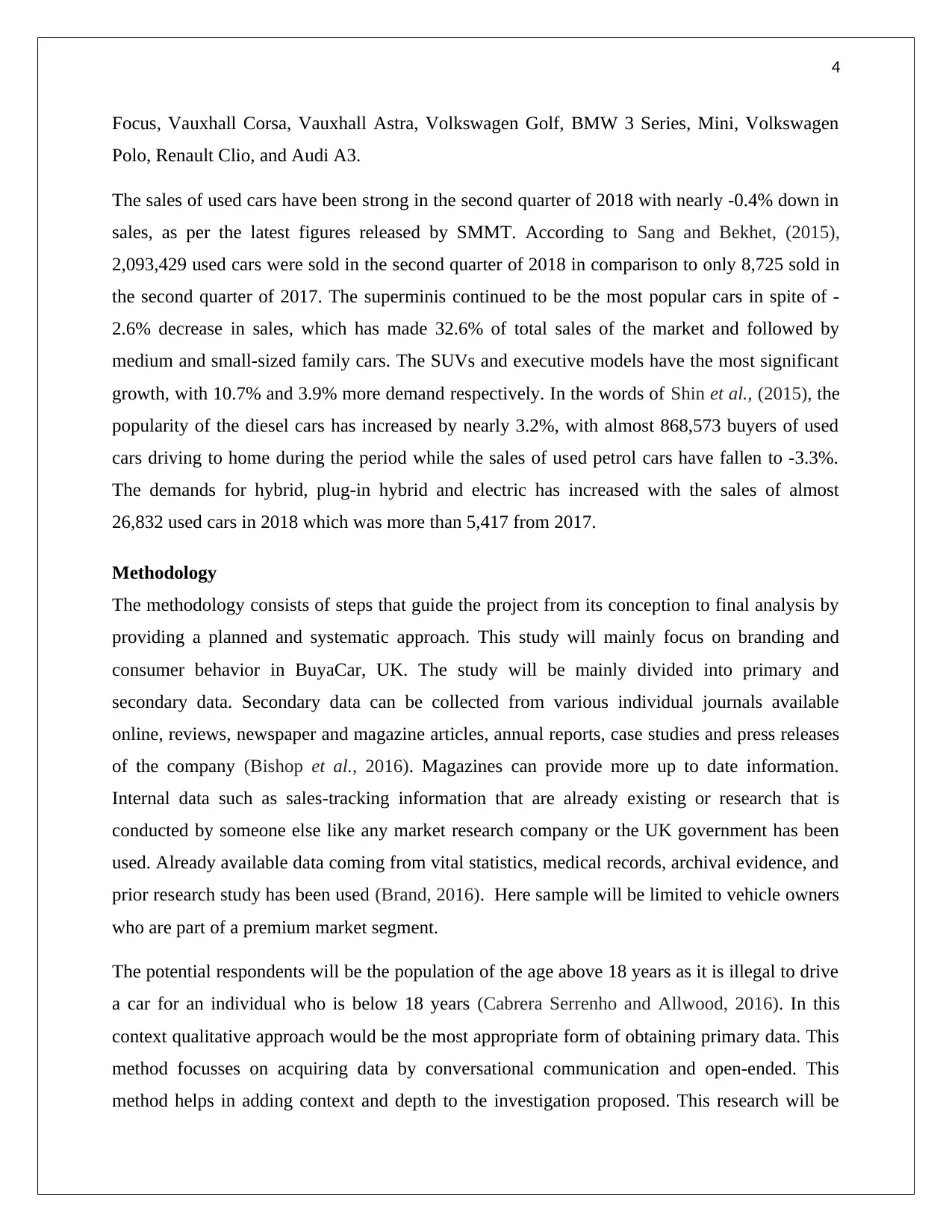
Focus, Vauxhall Corsa, Vauxhall Astra, Volkswagen Golf, BMW 3 Series, Mini, Volkswagen
Polo, Renault Clio, and Audi A3.
The sales of used cars have been strong in the second quarter of 2018 with nearly -0.4% down in
sales, as per the latest figures released by SMMT. According to Sang and Bekhet, (2015),
2,093,429 used cars were sold in the second quarter of 2018 in comparison to only 8,725 sold in
the second quarter of 2017. The superminis continued to be the most popular cars in spite of -
2.6% decrease in sales, which has made 32.6% of total sales of the market and followed by
medium and small-sized family cars. The SUVs and executive models have the most significant
growth, with 10.7% and 3.9% more demand respectively. In the words of Shin et al., (2015), the
popularity of the diesel cars has increased by nearly 3.2%, with almost 868,573 buyers of used
cars driving to home during the period while the sales of used petrol cars have fallen to -3.3%.
The demands for hybrid, plug-in hybrid and electric has increased with the sales of almost
26,832 used cars in 2018 which was more than 5,417 from 2017.
Methodology
The methodology consists of steps that guide the project from its conception to final analysis by
providing a planned and systematic approach. This study will mainly focus on branding and
consumer behavior in BuyaCar, UK. The study will be mainly divided into primary and
secondary data. Secondary data can be collected from various individual journals available
online, reviews, newspaper and magazine articles, annual reports, case studies and press releases
of the company (Bishop et al., 2016). Magazines can provide more up to date information.
Internal data such as sales-tracking information that are already existing or research that is
conducted by someone else like any market research company or the UK government has been
used. Already available data coming from vital statistics, medical records, archival evidence, and
prior research study has been used (Brand, 2016). Here sample will be limited to vehicle owners
who are part of a premium market segment.
The potential respondents will be the population of the age above 18 years as it is illegal to drive
a car for an individual who is below 18 years (Cabrera Serrenho and Allwood, 2016). In this
context qualitative approach would be the most appropriate form of obtaining primary data. This
method focusses on acquiring data by conversational communication and open-ended. This
method helps in adding context and depth to the investigation proposed. This research will be
Focus, Vauxhall Corsa, Vauxhall Astra, Volkswagen Golf, BMW 3 Series, Mini, Volkswagen
Polo, Renault Clio, and Audi A3.
The sales of used cars have been strong in the second quarter of 2018 with nearly -0.4% down in
sales, as per the latest figures released by SMMT. According to Sang and Bekhet, (2015),
2,093,429 used cars were sold in the second quarter of 2018 in comparison to only 8,725 sold in
the second quarter of 2017. The superminis continued to be the most popular cars in spite of -
2.6% decrease in sales, which has made 32.6% of total sales of the market and followed by
medium and small-sized family cars. The SUVs and executive models have the most significant
growth, with 10.7% and 3.9% more demand respectively. In the words of Shin et al., (2015), the
popularity of the diesel cars has increased by nearly 3.2%, with almost 868,573 buyers of used
cars driving to home during the period while the sales of used petrol cars have fallen to -3.3%.
The demands for hybrid, plug-in hybrid and electric has increased with the sales of almost
26,832 used cars in 2018 which was more than 5,417 from 2017.
Methodology
The methodology consists of steps that guide the project from its conception to final analysis by
providing a planned and systematic approach. This study will mainly focus on branding and
consumer behavior in BuyaCar, UK. The study will be mainly divided into primary and
secondary data. Secondary data can be collected from various individual journals available
online, reviews, newspaper and magazine articles, annual reports, case studies and press releases
of the company (Bishop et al., 2016). Magazines can provide more up to date information.
Internal data such as sales-tracking information that are already existing or research that is
conducted by someone else like any market research company or the UK government has been
used. Already available data coming from vital statistics, medical records, archival evidence, and
prior research study has been used (Brand, 2016). Here sample will be limited to vehicle owners
who are part of a premium market segment.
The potential respondents will be the population of the age above 18 years as it is illegal to drive
a car for an individual who is below 18 years (Cabrera Serrenho and Allwood, 2016). In this
context qualitative approach would be the most appropriate form of obtaining primary data. This
method focusses on acquiring data by conversational communication and open-ended. This
method helps in adding context and depth to the investigation proposed. This research will be
5
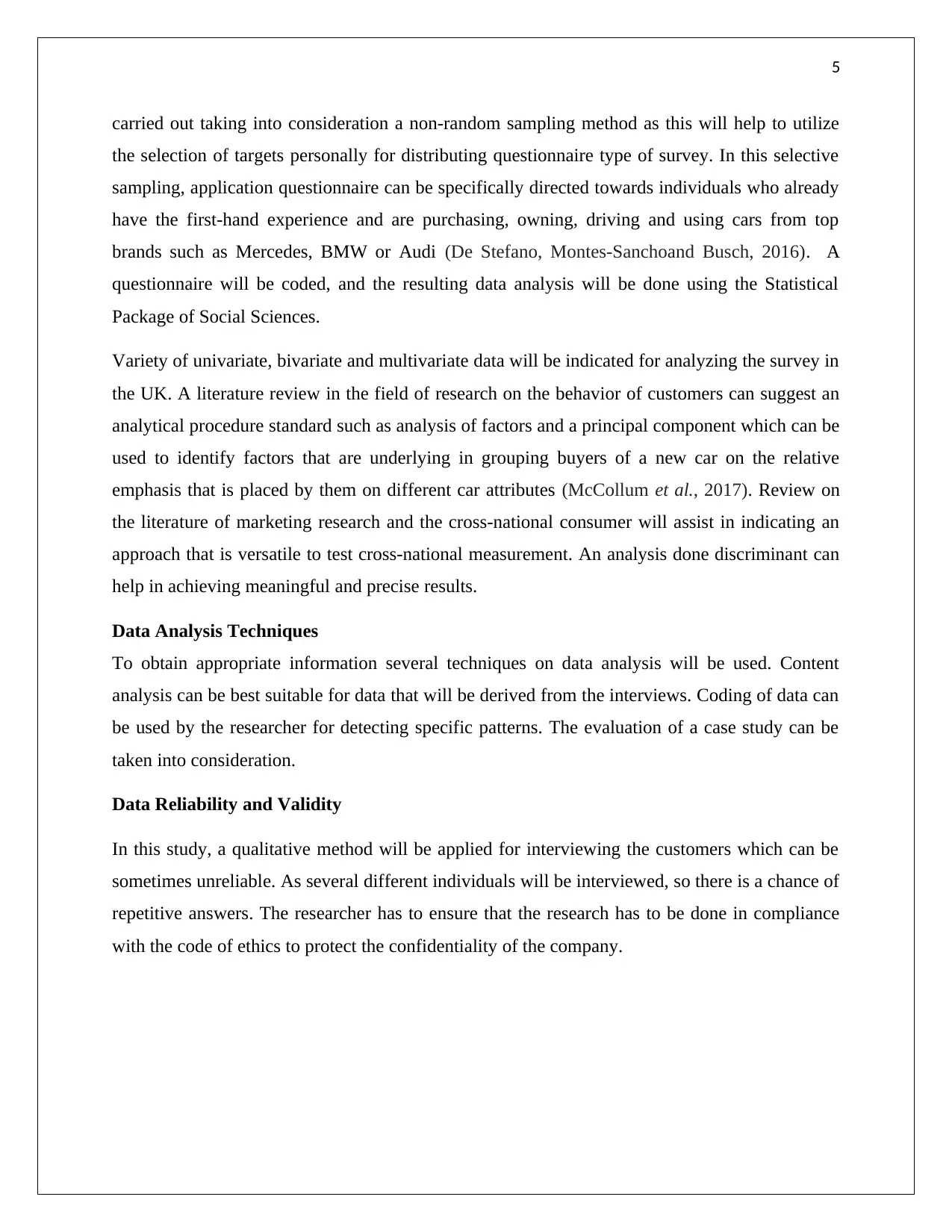
carried out taking into consideration a non-random sampling method as this will help to utilize
the selection of targets personally for distributing questionnaire type of survey. In this selective
sampling, application questionnaire can be specifically directed towards individuals who already
have the first-hand experience and are purchasing, owning, driving and using cars from top
brands such as Mercedes, BMW or Audi (De Stefano, Montes-Sanchoand Busch, 2016). A
questionnaire will be coded, and the resulting data analysis will be done using the Statistical
Package of Social Sciences.
Variety of univariate, bivariate and multivariate data will be indicated for analyzing the survey in
the UK. A literature review in the field of research on the behavior of customers can suggest an
analytical procedure standard such as analysis of factors and a principal component which can be
used to identify factors that are underlying in grouping buyers of a new car on the relative
emphasis that is placed by them on different car attributes (McCollum et al., 2017). Review on
the literature of marketing research and the cross-national consumer will assist in indicating an
approach that is versatile to test cross-national measurement. An analysis done discriminant can
help in achieving meaningful and precise results.
Data Analysis Techniques
To obtain appropriate information several techniques on data analysis will be used. Content
analysis can be best suitable for data that will be derived from the interviews. Coding of data can
be used by the researcher for detecting specific patterns. The evaluation of a case study can be
taken into consideration.
Data Reliability and Validity
In this study, a qualitative method will be applied for interviewing the customers which can be
sometimes unreliable. As several different individuals will be interviewed, so there is a chance of
repetitive answers. The researcher has to ensure that the research has to be done in compliance
with the code of ethics to protect the confidentiality of the company.
carried out taking into consideration a non-random sampling method as this will help to utilize
the selection of targets personally for distributing questionnaire type of survey. In this selective
sampling, application questionnaire can be specifically directed towards individuals who already
have the first-hand experience and are purchasing, owning, driving and using cars from top
brands such as Mercedes, BMW or Audi (De Stefano, Montes-Sanchoand Busch, 2016). A
questionnaire will be coded, and the resulting data analysis will be done using the Statistical
Package of Social Sciences.
Variety of univariate, bivariate and multivariate data will be indicated for analyzing the survey in
the UK. A literature review in the field of research on the behavior of customers can suggest an
analytical procedure standard such as analysis of factors and a principal component which can be
used to identify factors that are underlying in grouping buyers of a new car on the relative
emphasis that is placed by them on different car attributes (McCollum et al., 2017). Review on
the literature of marketing research and the cross-national consumer will assist in indicating an
approach that is versatile to test cross-national measurement. An analysis done discriminant can
help in achieving meaningful and precise results.
Data Analysis Techniques
To obtain appropriate information several techniques on data analysis will be used. Content
analysis can be best suitable for data that will be derived from the interviews. Coding of data can
be used by the researcher for detecting specific patterns. The evaluation of a case study can be
taken into consideration.
Data Reliability and Validity
In this study, a qualitative method will be applied for interviewing the customers which can be
sometimes unreliable. As several different individuals will be interviewed, so there is a chance of
repetitive answers. The researcher has to ensure that the research has to be done in compliance
with the code of ethics to protect the confidentiality of the company.
⊘ This is a preview!⊘
Do you want full access?
Subscribe today to unlock all pages.
Trusted by 1+ million students worldwide
6
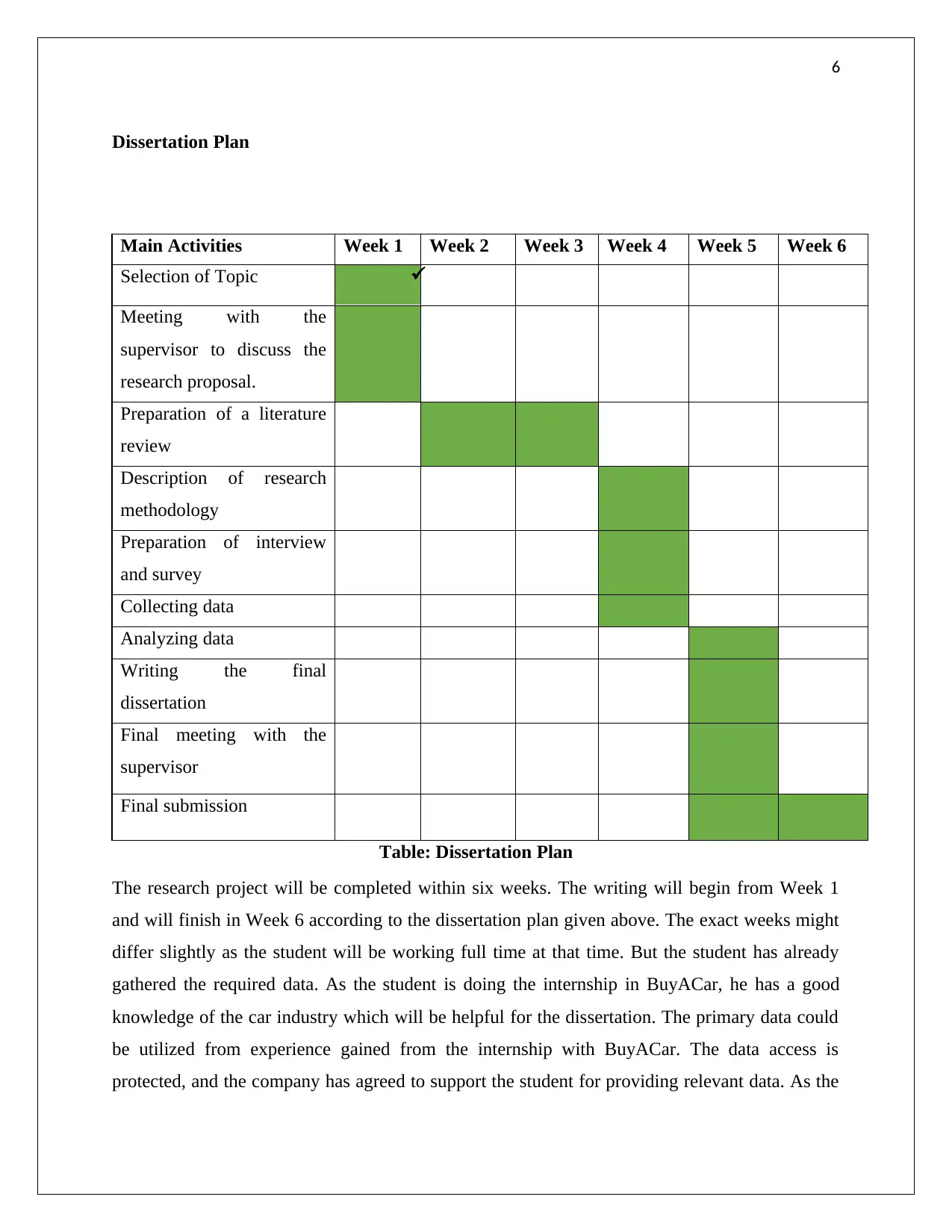
Dissertation Plan
Main Activities Week 1 Week 2 Week 3 Week 4 Week 5 Week 6
Selection of Topic
Meeting with the
supervisor to discuss the
research proposal.
Preparation of a literature
review
Description of research
methodology
Preparation of interview
and survey
Collecting data
Analyzing data
Writing the final
dissertation
Final meeting with the
supervisor
Final submission
Table: Dissertation Plan
The research project will be completed within six weeks. The writing will begin from Week 1
and will finish in Week 6 according to the dissertation plan given above. The exact weeks might
differ slightly as the student will be working full time at that time. But the student has already
gathered the required data. As the student is doing the internship in BuyACar, he has a good
knowledge of the car industry which will be helpful for the dissertation. The primary data could
be utilized from experience gained from the internship with BuyACar. The data access is
protected, and the company has agreed to support the student for providing relevant data. As the
Dissertation Plan
Main Activities Week 1 Week 2 Week 3 Week 4 Week 5 Week 6
Selection of Topic
Meeting with the
supervisor to discuss the
research proposal.
Preparation of a literature
review
Description of research
methodology
Preparation of interview
and survey
Collecting data
Analyzing data
Writing the final
dissertation
Final meeting with the
supervisor
Final submission
Table: Dissertation Plan
The research project will be completed within six weeks. The writing will begin from Week 1
and will finish in Week 6 according to the dissertation plan given above. The exact weeks might
differ slightly as the student will be working full time at that time. But the student has already
gathered the required data. As the student is doing the internship in BuyACar, he has a good
knowledge of the car industry which will be helpful for the dissertation. The primary data could
be utilized from experience gained from the internship with BuyACar. The data access is
protected, and the company has agreed to support the student for providing relevant data. As the
Paraphrase This Document
Need a fresh take? Get an instant paraphrase of this document with our AI Paraphraser

7
student is doing an internship in BuyACar, the primary data will not impose any issues due to the
broad networking.
student is doing an internship in BuyACar, the primary data will not impose any issues due to the
broad networking.
8
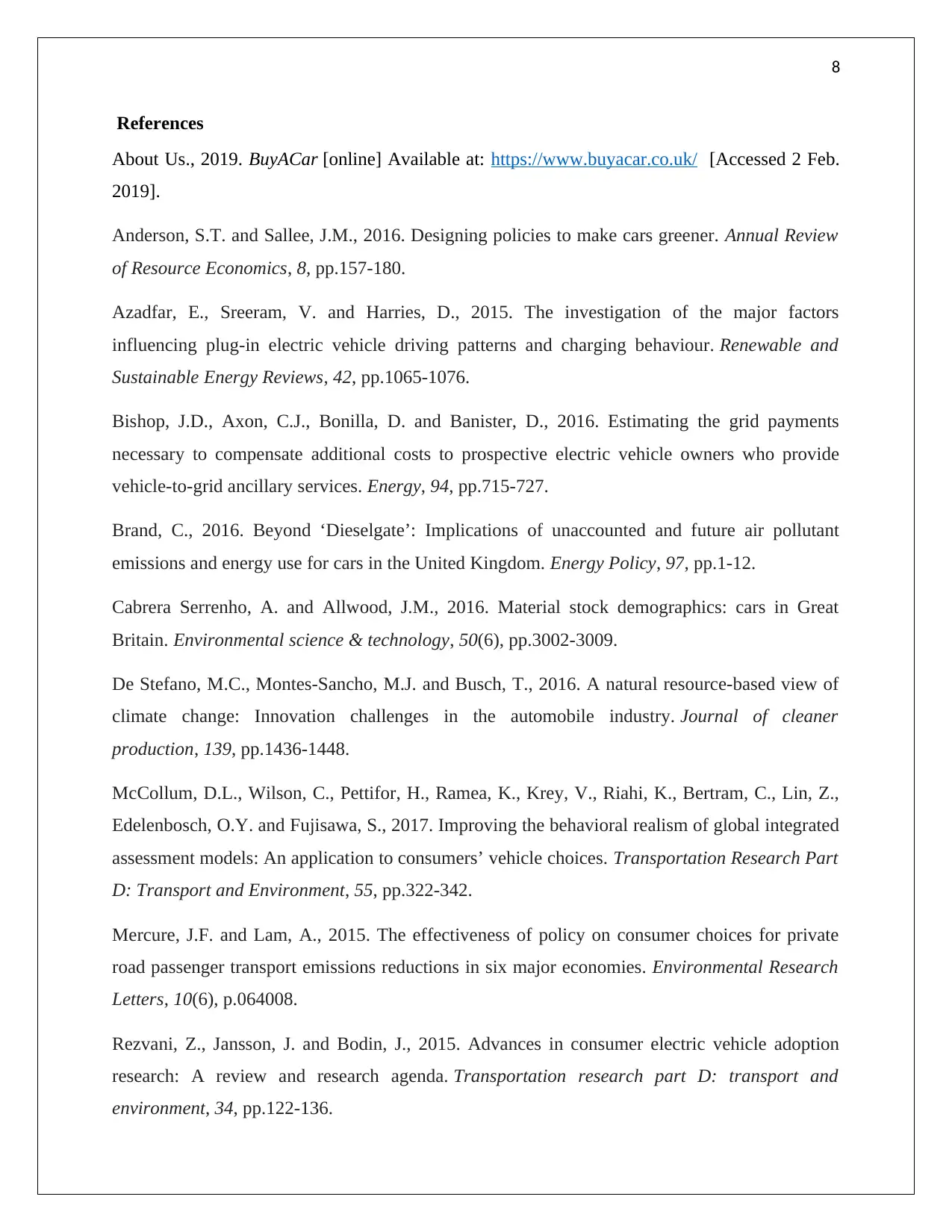
References
About Us., 2019. BuyACar [online] Available at: https://www.buyacar.co.uk/ [Accessed 2 Feb.
2019].
Anderson, S.T. and Sallee, J.M., 2016. Designing policies to make cars greener. Annual Review
of Resource Economics, 8, pp.157-180.
Azadfar, E., Sreeram, V. and Harries, D., 2015. The investigation of the major factors
influencing plug-in electric vehicle driving patterns and charging behaviour. Renewable and
Sustainable Energy Reviews, 42, pp.1065-1076.
Bishop, J.D., Axon, C.J., Bonilla, D. and Banister, D., 2016. Estimating the grid payments
necessary to compensate additional costs to prospective electric vehicle owners who provide
vehicle-to-grid ancillary services. Energy, 94, pp.715-727.
Brand, C., 2016. Beyond ‘Dieselgate’: Implications of unaccounted and future air pollutant
emissions and energy use for cars in the United Kingdom. Energy Policy, 97, pp.1-12.
Cabrera Serrenho, A. and Allwood, J.M., 2016. Material stock demographics: cars in Great
Britain. Environmental science & technology, 50(6), pp.3002-3009.
De Stefano, M.C., Montes-Sancho, M.J. and Busch, T., 2016. A natural resource-based view of
climate change: Innovation challenges in the automobile industry. Journal of cleaner
production, 139, pp.1436-1448.
McCollum, D.L., Wilson, C., Pettifor, H., Ramea, K., Krey, V., Riahi, K., Bertram, C., Lin, Z.,
Edelenbosch, O.Y. and Fujisawa, S., 2017. Improving the behavioral realism of global integrated
assessment models: An application to consumers’ vehicle choices. Transportation Research Part
D: Transport and Environment, 55, pp.322-342.
Mercure, J.F. and Lam, A., 2015. The effectiveness of policy on consumer choices for private
road passenger transport emissions reductions in six major economies. Environmental Research
Letters, 10(6), p.064008.
Rezvani, Z., Jansson, J. and Bodin, J., 2015. Advances in consumer electric vehicle adoption
research: A review and research agenda. Transportation research part D: transport and
environment, 34, pp.122-136.
References
About Us., 2019. BuyACar [online] Available at: https://www.buyacar.co.uk/ [Accessed 2 Feb.
2019].
Anderson, S.T. and Sallee, J.M., 2016. Designing policies to make cars greener. Annual Review
of Resource Economics, 8, pp.157-180.
Azadfar, E., Sreeram, V. and Harries, D., 2015. The investigation of the major factors
influencing plug-in electric vehicle driving patterns and charging behaviour. Renewable and
Sustainable Energy Reviews, 42, pp.1065-1076.
Bishop, J.D., Axon, C.J., Bonilla, D. and Banister, D., 2016. Estimating the grid payments
necessary to compensate additional costs to prospective electric vehicle owners who provide
vehicle-to-grid ancillary services. Energy, 94, pp.715-727.
Brand, C., 2016. Beyond ‘Dieselgate’: Implications of unaccounted and future air pollutant
emissions and energy use for cars in the United Kingdom. Energy Policy, 97, pp.1-12.
Cabrera Serrenho, A. and Allwood, J.M., 2016. Material stock demographics: cars in Great
Britain. Environmental science & technology, 50(6), pp.3002-3009.
De Stefano, M.C., Montes-Sancho, M.J. and Busch, T., 2016. A natural resource-based view of
climate change: Innovation challenges in the automobile industry. Journal of cleaner
production, 139, pp.1436-1448.
McCollum, D.L., Wilson, C., Pettifor, H., Ramea, K., Krey, V., Riahi, K., Bertram, C., Lin, Z.,
Edelenbosch, O.Y. and Fujisawa, S., 2017. Improving the behavioral realism of global integrated
assessment models: An application to consumers’ vehicle choices. Transportation Research Part
D: Transport and Environment, 55, pp.322-342.
Mercure, J.F. and Lam, A., 2015. The effectiveness of policy on consumer choices for private
road passenger transport emissions reductions in six major economies. Environmental Research
Letters, 10(6), p.064008.
Rezvani, Z., Jansson, J. and Bodin, J., 2015. Advances in consumer electric vehicle adoption
research: A review and research agenda. Transportation research part D: transport and
environment, 34, pp.122-136.
⊘ This is a preview!⊘
Do you want full access?
Subscribe today to unlock all pages.
Trusted by 1+ million students worldwide
9
Sang, Y.N. and Bekhet, H.A., 2015. Modelling electric vehicle usage intentions: an empirical
study in Malaysia. Journal of Cleaner Production, 92, pp.75-83.
Shin, J., Bhat, C.R., You, D., Garikapati, V.M. and Pendyala, R.M., 2015. Consumer preferences
and willingness to pay for advanced vehicle technology options and fuel types. Transportation
Research Part C: Emerging Technologies, 60, pp.511-524.
Sang, Y.N. and Bekhet, H.A., 2015. Modelling electric vehicle usage intentions: an empirical
study in Malaysia. Journal of Cleaner Production, 92, pp.75-83.
Shin, J., Bhat, C.R., You, D., Garikapati, V.M. and Pendyala, R.M., 2015. Consumer preferences
and willingness to pay for advanced vehicle technology options and fuel types. Transportation
Research Part C: Emerging Technologies, 60, pp.511-524.

1 out of 10


Related Documents


Your All-in-One AI-Powered Toolkit for Academic Success.
+13062052269
info@desklib.com
Available 24*7 on WhatsApp / Email
![[object Object]](/_next/static/media/star-bottom.7253800d.svg)
Unlock your academic potential
Copyright © 2020–2026 A2Z Services. All Rights Reserved. Developed and managed by ZUCOL.