Financial Management Practices and Budgeting Systems in Public Sector
VerifiedAdded on 2023/06/03
|9
|2103
|173
Report
AI Summary
This report provides a comprehensive analysis of budgeting systems and practices within the public sector. It begins with an introduction and literature review, establishing the context for understanding the evolution of budgeting. The report then describes the traditional budgeting system (TBS) and the Planning, Programming, Budgeting System (PPBS), highlighting their characteristics and applications. A case analysis, using Woolworths as an example, illustrates the practical implementation of these systems. The discussion section explores the historical development and significance of public budgeting, emphasizing its role in controlling expenditures and supporting socioeconomic structures. The report concludes by underscoring the vital role of budgeting in financial performance and resource allocation within the public sector. References and an appendix with interview questions are also included to support the analysis.
Budgeting Systems or Practices in Public Sector
Group No:
First Name & Surname
Group No:
First Name & Surname

Paraphrase This Document
Need a fresh take? Get an instant paraphrase of this document with our AI Paraphraser
Budgeting
Abstract
In recent observations that have been clearly stated that the need for the public budget has
changed with the passage of time. It was observed that before the 20th century the main
reason behind the adaptation of a budget was to an individual the public spending and
taxation process. In the middle of the twentieth century, a worldwide social, economic change
was observed in the task of budgeting. The thought process of Keynesian has not only helped
the economists to believe that budgeting is a legislative or government tool but also it will be
very useful when used as an instrument for taking decisions regarding economic, accounting,
executive and political terms of the general public sector. Hence, the budget is now used as a
significant document to examine the entire managerial task that is performed by an
organisation. The paper analyses the use of budgeting with solid references on TBS, PPBS
and their uses in the public sector.
2
Abstract
In recent observations that have been clearly stated that the need for the public budget has
changed with the passage of time. It was observed that before the 20th century the main
reason behind the adaptation of a budget was to an individual the public spending and
taxation process. In the middle of the twentieth century, a worldwide social, economic change
was observed in the task of budgeting. The thought process of Keynesian has not only helped
the economists to believe that budgeting is a legislative or government tool but also it will be
very useful when used as an instrument for taking decisions regarding economic, accounting,
executive and political terms of the general public sector. Hence, the budget is now used as a
significant document to examine the entire managerial task that is performed by an
organisation. The paper analyses the use of budgeting with solid references on TBS, PPBS
and their uses in the public sector.
2
Budgeting
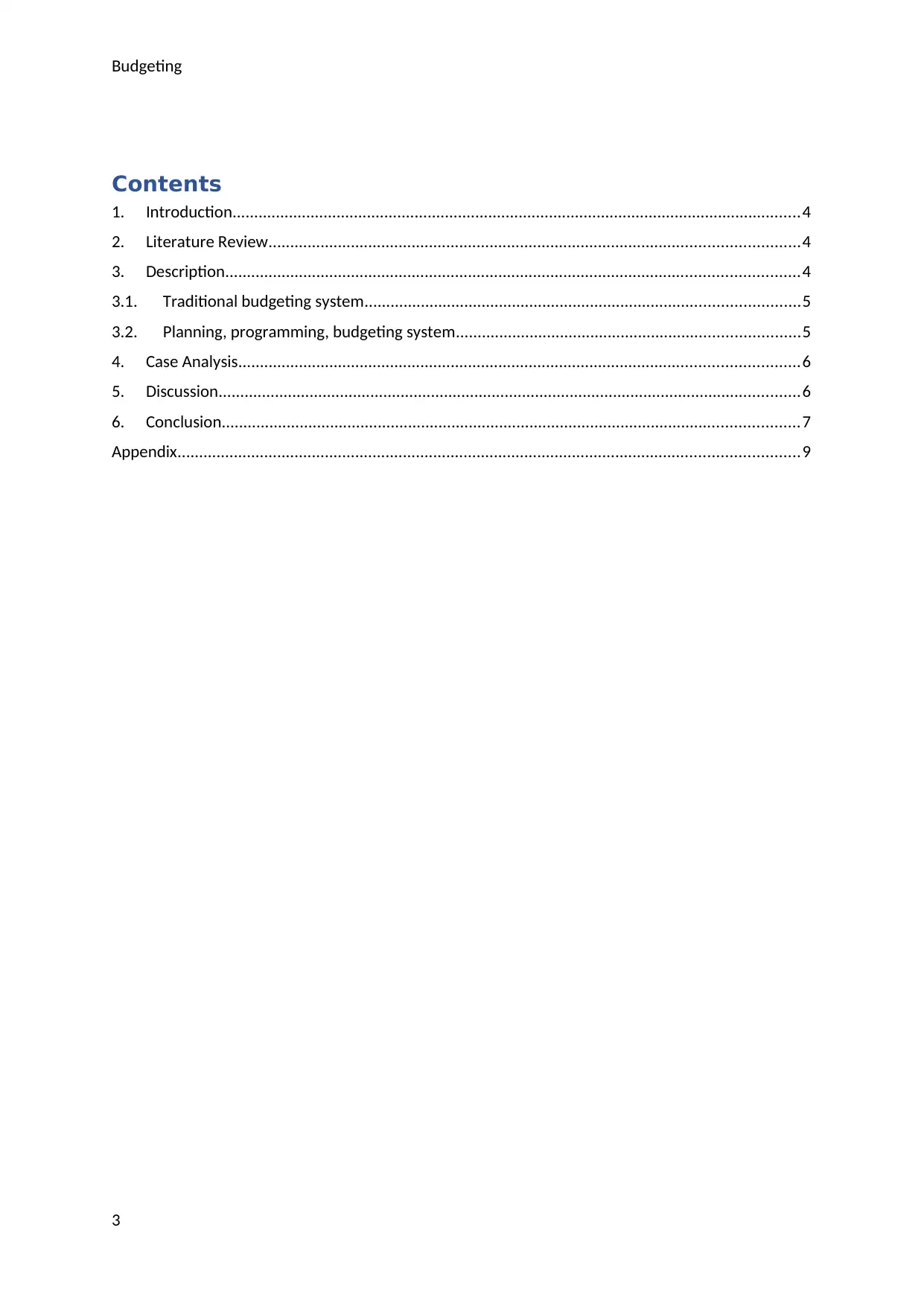
Contents
1. Introduction...................................................................................................................................4
2. Literature Review..........................................................................................................................4
3. Description....................................................................................................................................4
3.1. Traditional budgeting system....................................................................................................5
3.2. Planning, programming, budgeting system...............................................................................5
4. Case Analysis.................................................................................................................................6
5. Discussion......................................................................................................................................6
6. Conclusion.....................................................................................................................................7
Appendix...............................................................................................................................................9
3
Contents
1. Introduction...................................................................................................................................4
2. Literature Review..........................................................................................................................4
3. Description....................................................................................................................................4
3.1. Traditional budgeting system....................................................................................................5
3.2. Planning, programming, budgeting system...............................................................................5
4. Case Analysis.................................................................................................................................6
5. Discussion......................................................................................................................................6
6. Conclusion.....................................................................................................................................7
Appendix...............................................................................................................................................9
3
⊘ This is a preview!⊘
Do you want full access?
Subscribe today to unlock all pages.

Trusted by 1+ million students worldwide
Budgeting
1. Introduction
One of the primary tools that can be used for the effective performance of an organisation
nowadays is the budget. The task of budgeting helps the company to give a proper definition
to the objectives and also quantify the required data. In the study of some economic if have
been clearly stated that the need for budgeting helps the organization to fulfil specific
functions about the authoritative incomes and expenditures:
• Assistance in the task of decision making and policy making.
• Provide authority to the managers for making legal predictions for future spending.
• Providing fundamental stability to the organization for controlling income and
expenditure (Horngren, 2011).
2. Literature Review
Generally, a budget is based on short-term information collected by the organization that is
further used to take long-term financial decisions. It has been stated by an economist that to
provide flexibility to the managerial functions, an organization needs to focus on the annual
budget which can be published with the help of short-term decision making. The board of
directors can formulate the budget following the objectives of the organization.
Budgeting also depends on the ruling parties’ policies and also many other distinct systems
which can be implemented in order to fulfil the needs of the political as well as targeted
objectives. Every system in accordance to it is a systematic way of representing and relating
expenditures of the organization for the fulfilment or accomplishment of the organizational
objectives (Drury, 2011). When an organization is working according to the fiscal policy, it
will be best for it to take all the decisions about the activities carried out by it in economic
and non-economic states so that the effectiveness and efficiency of the budget can be
maintained (Merchant, 2012). Further, for successful systemization of information systems,
budgeting can be used as a fundamental process.
3. Description
After a clear analysis of the public budgeting task, this topic helps us to determine the
application of the budgeting system in the public sector organizations. Hence, it can be
4
1. Introduction
One of the primary tools that can be used for the effective performance of an organisation
nowadays is the budget. The task of budgeting helps the company to give a proper definition
to the objectives and also quantify the required data. In the study of some economic if have
been clearly stated that the need for budgeting helps the organization to fulfil specific
functions about the authoritative incomes and expenditures:
• Assistance in the task of decision making and policy making.
• Provide authority to the managers for making legal predictions for future spending.
• Providing fundamental stability to the organization for controlling income and
expenditure (Horngren, 2011).
2. Literature Review
Generally, a budget is based on short-term information collected by the organization that is
further used to take long-term financial decisions. It has been stated by an economist that to
provide flexibility to the managerial functions, an organization needs to focus on the annual
budget which can be published with the help of short-term decision making. The board of
directors can formulate the budget following the objectives of the organization.
Budgeting also depends on the ruling parties’ policies and also many other distinct systems
which can be implemented in order to fulfil the needs of the political as well as targeted
objectives. Every system in accordance to it is a systematic way of representing and relating
expenditures of the organization for the fulfilment or accomplishment of the organizational
objectives (Drury, 2011). When an organization is working according to the fiscal policy, it
will be best for it to take all the decisions about the activities carried out by it in economic
and non-economic states so that the effectiveness and efficiency of the budget can be
maintained (Merchant, 2012). Further, for successful systemization of information systems,
budgeting can be used as a fundamental process.
3. Description
After a clear analysis of the public budgeting task, this topic helps us to determine the
application of the budgeting system in the public sector organizations. Hence, it can be
4
Paraphrase This Document
Need a fresh take? Get an instant paraphrase of this document with our AI Paraphraser
Budgeting
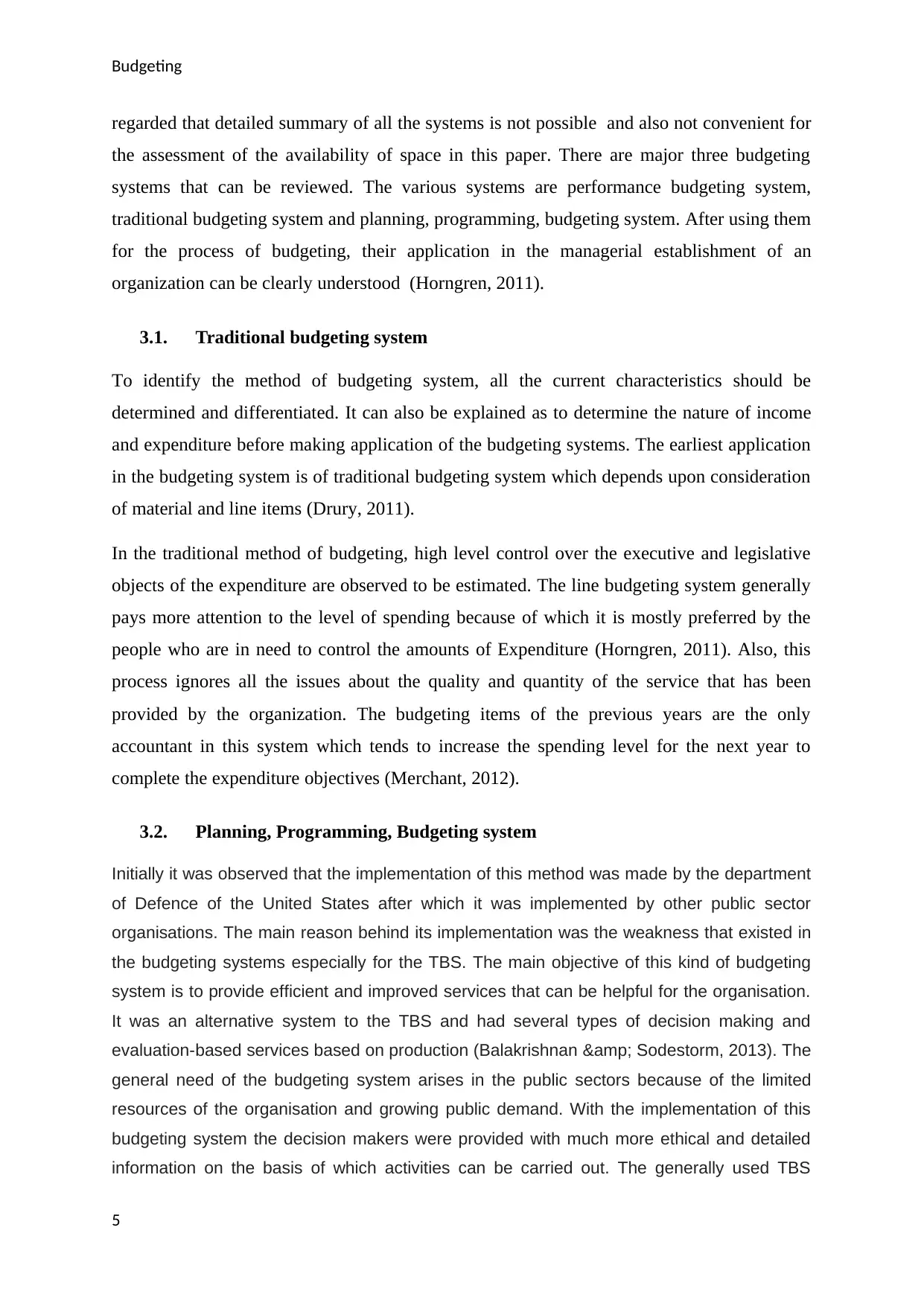
regarded that detailed summary of all the systems is not possible and also not convenient for
the assessment of the availability of space in this paper. There are major three budgeting
systems that can be reviewed. The various systems are performance budgeting system,
traditional budgeting system and planning, programming, budgeting system. After using them
for the process of budgeting, their application in the managerial establishment of an
organization can be clearly understood (Horngren, 2011).
3.1. Traditional budgeting system
To identify the method of budgeting system, all the current characteristics should be
determined and differentiated. It can also be explained as to determine the nature of income
and expenditure before making application of the budgeting systems. The earliest application
in the budgeting system is of traditional budgeting system which depends upon consideration
of material and line items (Drury, 2011).
In the traditional method of budgeting, high level control over the executive and legislative
objects of the expenditure are observed to be estimated. The line budgeting system generally
pays more attention to the level of spending because of which it is mostly preferred by the
people who are in need to control the amounts of Expenditure (Horngren, 2011). Also, this
process ignores all the issues about the quality and quantity of the service that has been
provided by the organization. The budgeting items of the previous years are the only
accountant in this system which tends to increase the spending level for the next year to
complete the expenditure objectives (Merchant, 2012).
3.2. Planning, Programming, Budgeting system
Initially it was observed that the implementation of this method was made by the department
of Defence of the United States after which it was implemented by other public sector
organisations. The main reason behind its implementation was the weakness that existed in
the budgeting systems especially for the TBS. The main objective of this kind of budgeting
system is to provide efficient and improved services that can be helpful for the organisation.
It was an alternative system to the TBS and had several types of decision making and
evaluation-based services based on production (Balakrishnan & Sodestorm, 2013). The
general need of the budgeting system arises in the public sectors because of the limited
resources of the organisation and growing public demand. With the implementation of this
budgeting system the decision makers were provided with much more ethical and detailed
information on the basis of which activities can be carried out. The generally used TBS
5
regarded that detailed summary of all the systems is not possible and also not convenient for
the assessment of the availability of space in this paper. There are major three budgeting
systems that can be reviewed. The various systems are performance budgeting system,
traditional budgeting system and planning, programming, budgeting system. After using them
for the process of budgeting, their application in the managerial establishment of an
organization can be clearly understood (Horngren, 2011).
3.1. Traditional budgeting system
To identify the method of budgeting system, all the current characteristics should be
determined and differentiated. It can also be explained as to determine the nature of income
and expenditure before making application of the budgeting systems. The earliest application
in the budgeting system is of traditional budgeting system which depends upon consideration
of material and line items (Drury, 2011).
In the traditional method of budgeting, high level control over the executive and legislative
objects of the expenditure are observed to be estimated. The line budgeting system generally
pays more attention to the level of spending because of which it is mostly preferred by the
people who are in need to control the amounts of Expenditure (Horngren, 2011). Also, this
process ignores all the issues about the quality and quantity of the service that has been
provided by the organization. The budgeting items of the previous years are the only
accountant in this system which tends to increase the spending level for the next year to
complete the expenditure objectives (Merchant, 2012).
3.2. Planning, Programming, Budgeting system
Initially it was observed that the implementation of this method was made by the department
of Defence of the United States after which it was implemented by other public sector
organisations. The main reason behind its implementation was the weakness that existed in
the budgeting systems especially for the TBS. The main objective of this kind of budgeting
system is to provide efficient and improved services that can be helpful for the organisation.
It was an alternative system to the TBS and had several types of decision making and
evaluation-based services based on production (Balakrishnan & Sodestorm, 2013). The
general need of the budgeting system arises in the public sectors because of the limited
resources of the organisation and growing public demand. With the implementation of this
budgeting system the decision makers were provided with much more ethical and detailed
information on the basis of which activities can be carried out. The generally used TBS
5
Budgeting
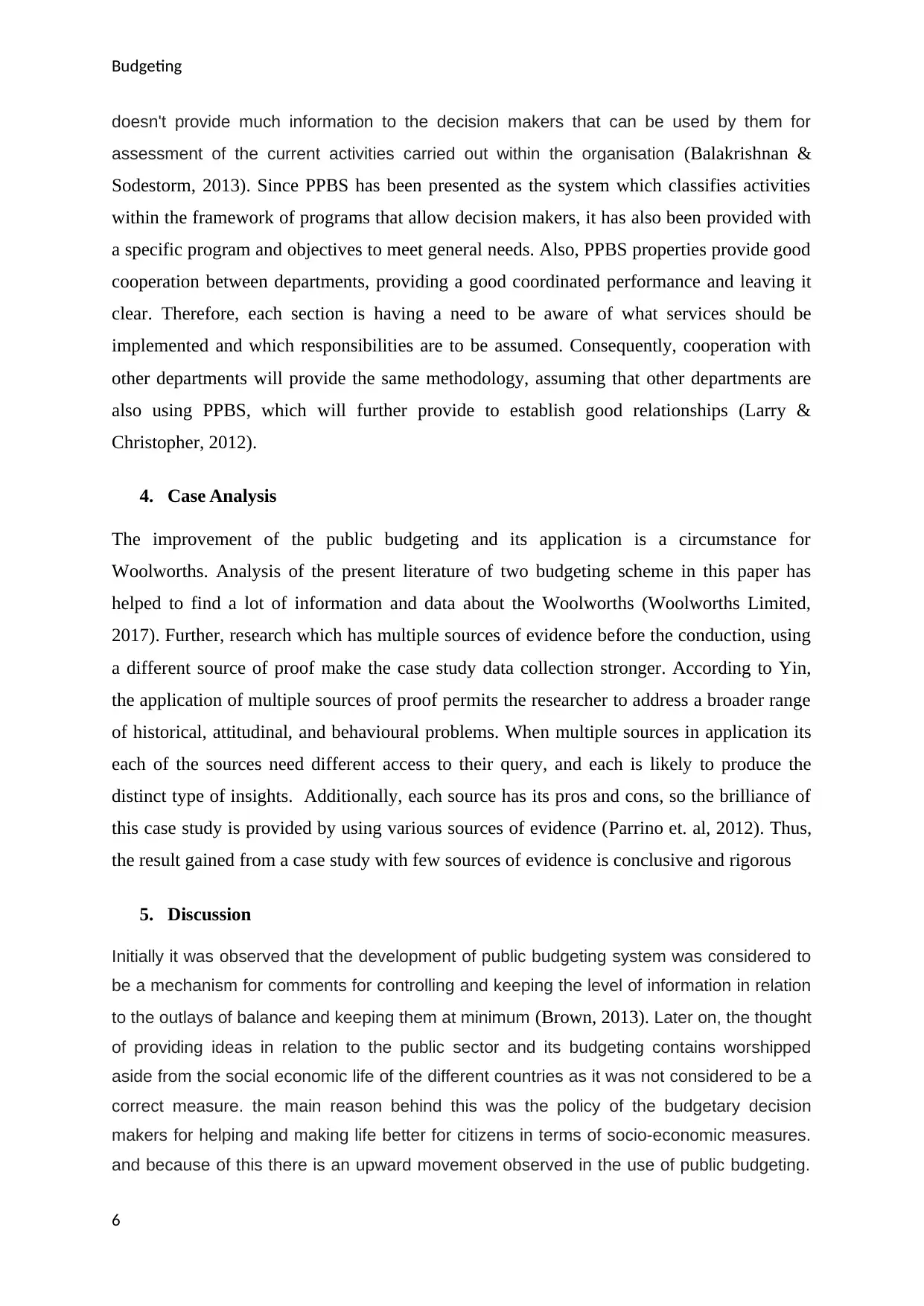
doesn't provide much information to the decision makers that can be used by them for
assessment of the current activities carried out within the organisation (Balakrishnan &
Sodestorm, 2013). Since PPBS has been presented as the system which classifies activities
within the framework of programs that allow decision makers, it has also been provided with
a specific program and objectives to meet general needs. Also, PPBS properties provide good
cooperation between departments, providing a good coordinated performance and leaving it
clear. Therefore, each section is having a need to be aware of what services should be
implemented and which responsibilities are to be assumed. Consequently, cooperation with
other departments will provide the same methodology, assuming that other departments are
also using PPBS, which will further provide to establish good relationships (Larry &
Christopher, 2012).
4. Case Analysis
The improvement of the public budgeting and its application is a circumstance for
Woolworths. Analysis of the present literature of two budgeting scheme in this paper has
helped to find a lot of information and data about the Woolworths (Woolworths Limited,
2017). Further, research which has multiple sources of evidence before the conduction, using
a different source of proof make the case study data collection stronger. According to Yin,
the application of multiple sources of proof permits the researcher to address a broader range
of historical, attitudinal, and behavioural problems. When multiple sources in application its
each of the sources need different access to their query, and each is likely to produce the
distinct type of insights. Additionally, each source has its pros and cons, so the brilliance of
this case study is provided by using various sources of evidence (Parrino et. al, 2012). Thus,
the result gained from a case study with few sources of evidence is conclusive and rigorous
5. Discussion
Initially it was observed that the development of public budgeting system was considered to
be a mechanism for comments for controlling and keeping the level of information in relation
to the outlays of balance and keeping them at minimum (Brown, 2013). Later on, the thought
of providing ideas in relation to the public sector and its budgeting contains worshipped
aside from the social economic life of the different countries as it was not considered to be a
correct measure. the main reason behind this was the policy of the budgetary decision
makers for helping and making life better for citizens in terms of socio-economic measures.
and because of this there is an upward movement observed in the use of public budgeting.
6
doesn't provide much information to the decision makers that can be used by them for
assessment of the current activities carried out within the organisation (Balakrishnan &
Sodestorm, 2013). Since PPBS has been presented as the system which classifies activities
within the framework of programs that allow decision makers, it has also been provided with
a specific program and objectives to meet general needs. Also, PPBS properties provide good
cooperation between departments, providing a good coordinated performance and leaving it
clear. Therefore, each section is having a need to be aware of what services should be
implemented and which responsibilities are to be assumed. Consequently, cooperation with
other departments will provide the same methodology, assuming that other departments are
also using PPBS, which will further provide to establish good relationships (Larry &
Christopher, 2012).
4. Case Analysis
The improvement of the public budgeting and its application is a circumstance for
Woolworths. Analysis of the present literature of two budgeting scheme in this paper has
helped to find a lot of information and data about the Woolworths (Woolworths Limited,
2017). Further, research which has multiple sources of evidence before the conduction, using
a different source of proof make the case study data collection stronger. According to Yin,
the application of multiple sources of proof permits the researcher to address a broader range
of historical, attitudinal, and behavioural problems. When multiple sources in application its
each of the sources need different access to their query, and each is likely to produce the
distinct type of insights. Additionally, each source has its pros and cons, so the brilliance of
this case study is provided by using various sources of evidence (Parrino et. al, 2012). Thus,
the result gained from a case study with few sources of evidence is conclusive and rigorous
5. Discussion
Initially it was observed that the development of public budgeting system was considered to
be a mechanism for comments for controlling and keeping the level of information in relation
to the outlays of balance and keeping them at minimum (Brown, 2013). Later on, the thought
of providing ideas in relation to the public sector and its budgeting contains worshipped
aside from the social economic life of the different countries as it was not considered to be a
correct measure. the main reason behind this was the policy of the budgetary decision
makers for helping and making life better for citizens in terms of socio-economic measures.
and because of this there is an upward movement observed in the use of public budgeting.
6
⊘ This is a preview!⊘
Do you want full access?
Subscribe today to unlock all pages.
Trusted by 1+ million students worldwide
Budgeting
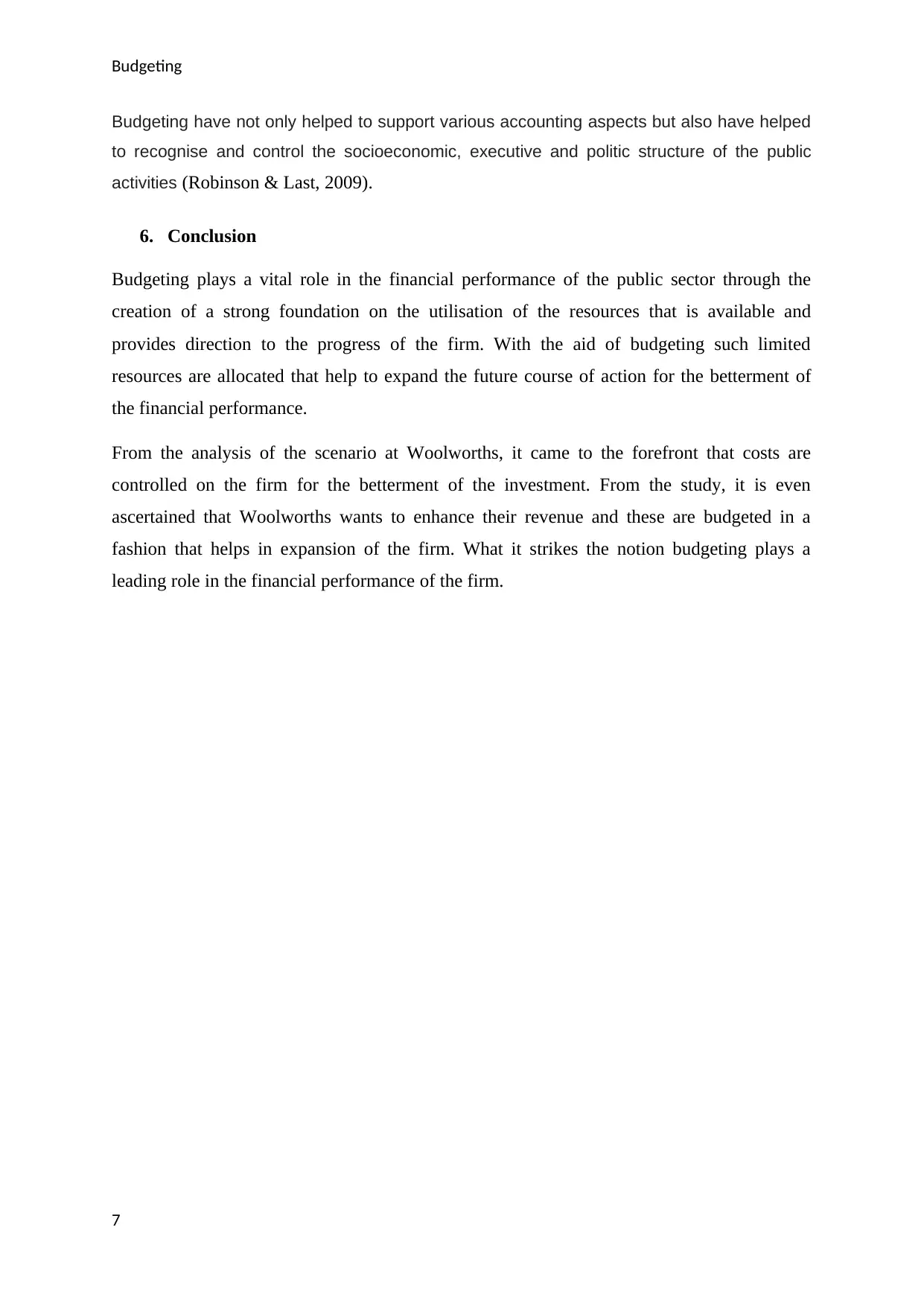
Budgeting have not only helped to support various accounting aspects but also have helped
to recognise and control the socioeconomic, executive and politic structure of the public
activities (Robinson & Last, 2009).
6. Conclusion
Budgeting plays a vital role in the financial performance of the public sector through the
creation of a strong foundation on the utilisation of the resources that is available and
provides direction to the progress of the firm. With the aid of budgeting such limited
resources are allocated that help to expand the future course of action for the betterment of
the financial performance.
From the analysis of the scenario at Woolworths, it came to the forefront that costs are
controlled on the firm for the betterment of the investment. From the study, it is even
ascertained that Woolworths wants to enhance their revenue and these are budgeted in a
fashion that helps in expansion of the firm. What it strikes the notion budgeting plays a
leading role in the financial performance of the firm.
7
Budgeting have not only helped to support various accounting aspects but also have helped
to recognise and control the socioeconomic, executive and politic structure of the public
activities (Robinson & Last, 2009).
6. Conclusion
Budgeting plays a vital role in the financial performance of the public sector through the
creation of a strong foundation on the utilisation of the resources that is available and
provides direction to the progress of the firm. With the aid of budgeting such limited
resources are allocated that help to expand the future course of action for the betterment of
the financial performance.
From the analysis of the scenario at Woolworths, it came to the forefront that costs are
controlled on the firm for the betterment of the investment. From the study, it is even
ascertained that Woolworths wants to enhance their revenue and these are budgeted in a
fashion that helps in expansion of the firm. What it strikes the notion budgeting plays a
leading role in the financial performance of the firm.
7
Paraphrase This Document
Need a fresh take? Get an instant paraphrase of this document with our AI Paraphraser
Budgeting
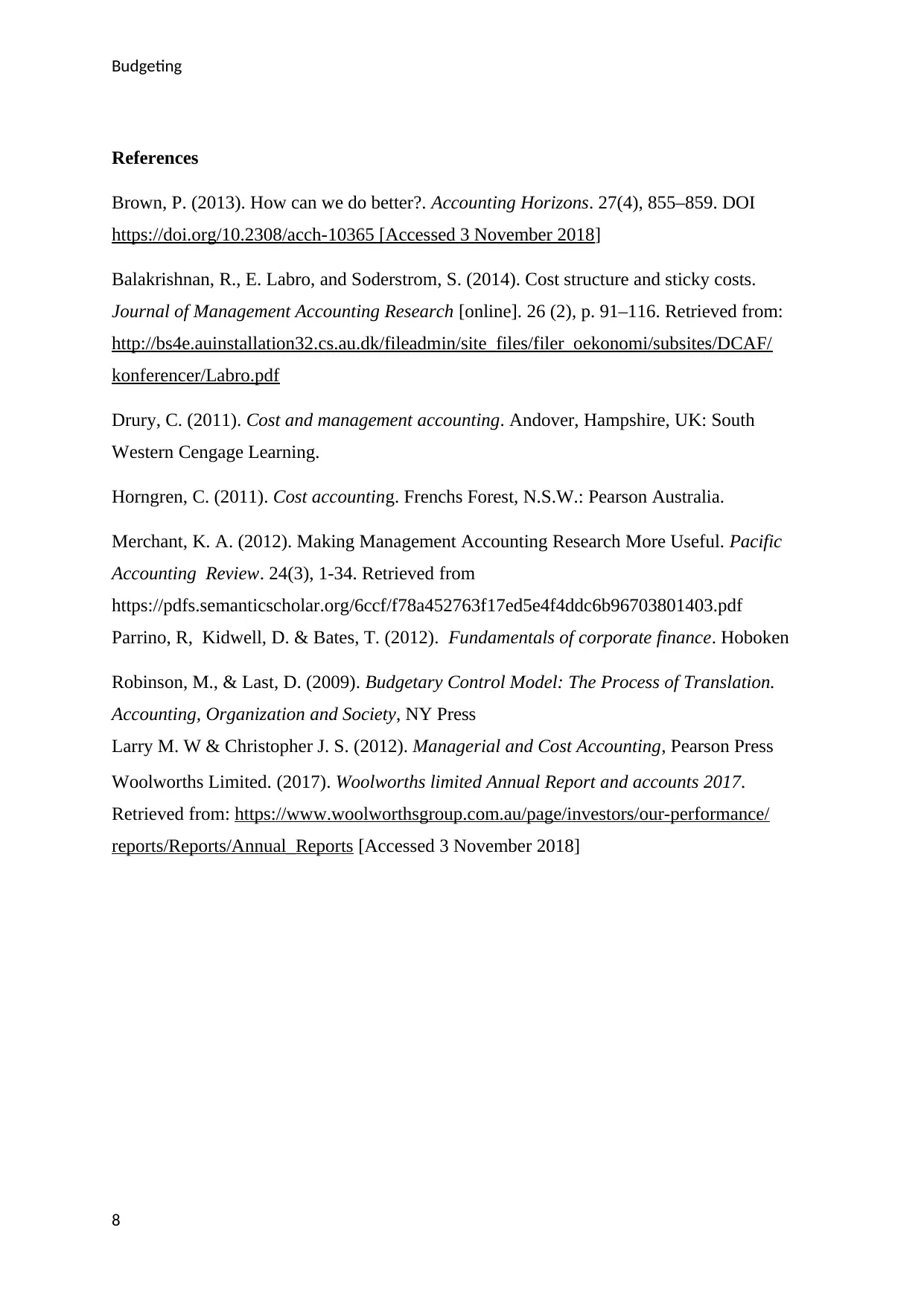
References
Brown, P. (2013). How can we do better?. Accounting Horizons. 27(4), 855–859. DOI
https://doi.org/10.2308/acch-10365 [Accessed 3 November 2018]
Balakrishnan, R., E. Labro, and Soderstrom, S. (2014). Cost structure and sticky costs.
Journal of Management Accounting Research [online]. 26 (2), p. 91–116. Retrieved from:
http://bs4e.auinstallation32.cs.au.dk/fileadmin/site_files/filer_oekonomi/subsites/DCAF/
konferencer/Labro.pdf
Drury, C. (2011). Cost and management accounting. Andover, Hampshire, UK: South
Western Cengage Learning.
Horngren, C. (2011). Cost accounting. Frenchs Forest, N.S.W.: Pearson Australia.
Merchant, K. A. (2012). Making Management Accounting Research More Useful. Pacific
Accounting Review. 24(3), 1-34. Retrieved from
https://pdfs.semanticscholar.org/6ccf/f78a452763f17ed5e4f4ddc6b96703801403.pdf
Parrino, R, Kidwell, D. & Bates, T. (2012). Fundamentals of corporate finance. Hoboken
Robinson, M., & Last, D. (2009). Budgetary Control Model: The Process of Translation.
Accounting, Organization and Society, NY Press
Larry M. W & Christopher J. S. (2012). Managerial and Cost Accounting, Pearson Press
Woolworths Limited. (2017). Woolworths limited Annual Report and accounts 2017.
Retrieved from: https://www.woolworthsgroup.com.au/page/investors/our-performance/
reports/Reports/Annual_Reports [Accessed 3 November 2018]
8
References
Brown, P. (2013). How can we do better?. Accounting Horizons. 27(4), 855–859. DOI
https://doi.org/10.2308/acch-10365 [Accessed 3 November 2018]
Balakrishnan, R., E. Labro, and Soderstrom, S. (2014). Cost structure and sticky costs.
Journal of Management Accounting Research [online]. 26 (2), p. 91–116. Retrieved from:
http://bs4e.auinstallation32.cs.au.dk/fileadmin/site_files/filer_oekonomi/subsites/DCAF/
konferencer/Labro.pdf
Drury, C. (2011). Cost and management accounting. Andover, Hampshire, UK: South
Western Cengage Learning.
Horngren, C. (2011). Cost accounting. Frenchs Forest, N.S.W.: Pearson Australia.
Merchant, K. A. (2012). Making Management Accounting Research More Useful. Pacific
Accounting Review. 24(3), 1-34. Retrieved from
https://pdfs.semanticscholar.org/6ccf/f78a452763f17ed5e4f4ddc6b96703801403.pdf
Parrino, R, Kidwell, D. & Bates, T. (2012). Fundamentals of corporate finance. Hoboken
Robinson, M., & Last, D. (2009). Budgetary Control Model: The Process of Translation.
Accounting, Organization and Society, NY Press
Larry M. W & Christopher J. S. (2012). Managerial and Cost Accounting, Pearson Press
Woolworths Limited. (2017). Woolworths limited Annual Report and accounts 2017.
Retrieved from: https://www.woolworthsgroup.com.au/page/investors/our-performance/
reports/Reports/Annual_Reports [Accessed 3 November 2018]
8
Budgeting
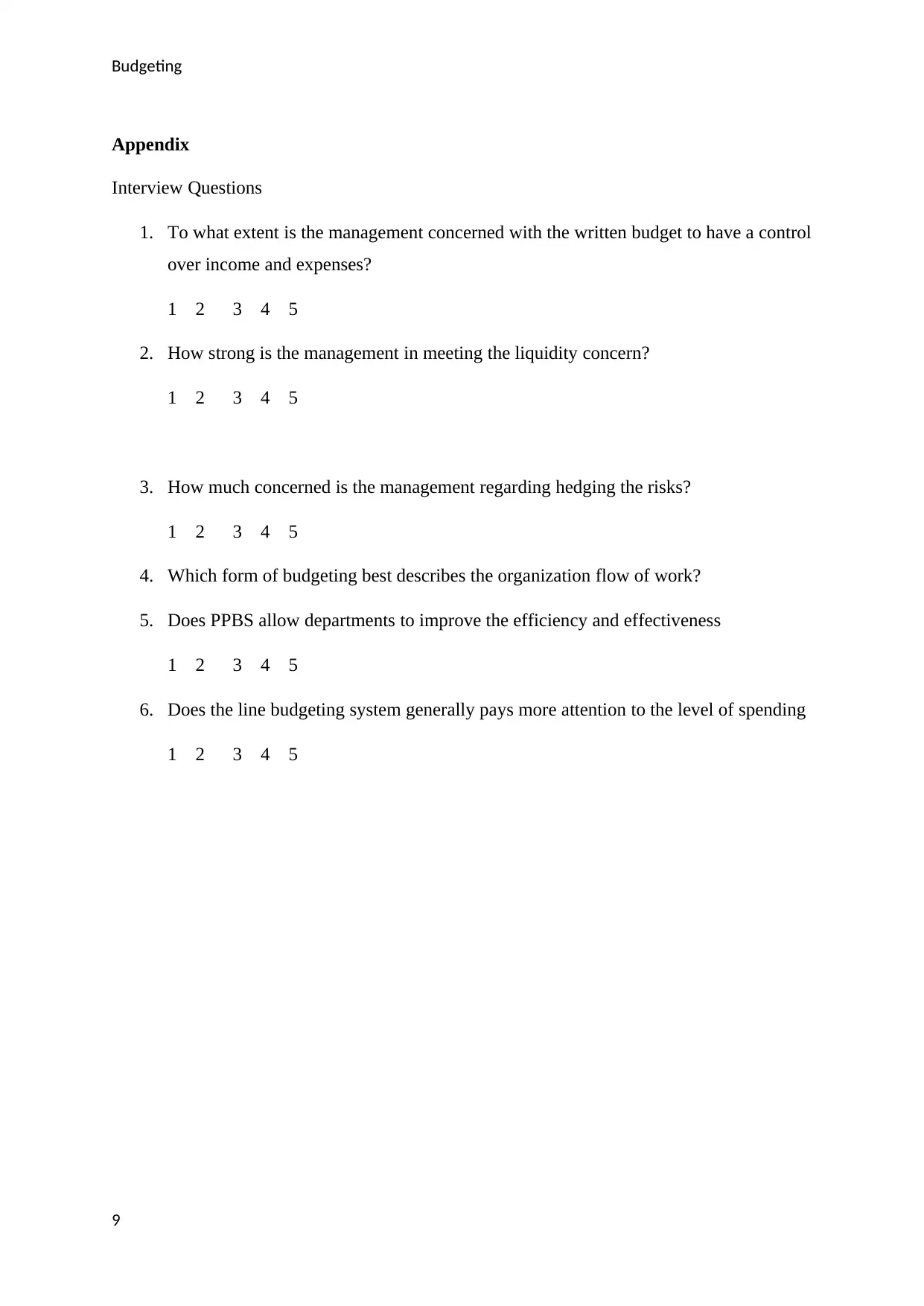
Appendix
Interview Questions
1. To what extent is the management concerned with the written budget to have a control
over income and expenses?
1 2 3 4 5
2. How strong is the management in meeting the liquidity concern?
1 2 3 4 5
3. How much concerned is the management regarding hedging the risks?
1 2 3 4 5
4. Which form of budgeting best describes the organization flow of work?
5. Does PPBS allow departments to improve the efficiency and effectiveness
1 2 3 4 5
6. Does the line budgeting system generally pays more attention to the level of spending
1 2 3 4 5
9
Appendix
Interview Questions
1. To what extent is the management concerned with the written budget to have a control
over income and expenses?
1 2 3 4 5
2. How strong is the management in meeting the liquidity concern?
1 2 3 4 5
3. How much concerned is the management regarding hedging the risks?
1 2 3 4 5
4. Which form of budgeting best describes the organization flow of work?
5. Does PPBS allow departments to improve the efficiency and effectiveness
1 2 3 4 5
6. Does the line budgeting system generally pays more attention to the level of spending
1 2 3 4 5
9
⊘ This is a preview!⊘
Do you want full access?
Subscribe today to unlock all pages.
Trusted by 1+ million students worldwide

1 out of 9


Related Documents


Your All-in-One AI-Powered Toolkit for Academic Success.
+13062052269
info@desklib.com
Available 24*7 on WhatsApp / Email
![[object Object]](/_next/static/media/star-bottom.7253800d.svg)
Unlock your academic potential
Copyright © 2020–2026 A2Z Services. All Rights Reserved. Developed and managed by ZUCOL.