Business Environment: Organisation Types, Objectives, SWOT Analysis
VerifiedAdded on 2024/05/29
|27
|5454
|253
Report
AI Summary
This report provides a comprehensive analysis of the business environment, focusing on different types of organisations (public, private, and voluntary), their purposes, size, and scope. It examines the relationship between organisational functions and their link to business objectives, along with the positive and negative impacts of the macro environment on business operations. The report includes internal and external analyses of specific organisations to identify strengths and weaknesses, and it applies SWOT/TOWS analysis to demonstrate how these factors influence decision-making. The study also explores the interrelationships between organisational functions and their impact on organisational structure, highlighting the importance of effective business strategies for maintaining healthy workplace environments and achieving business goals.

business and business environment

Paraphrase This Document
Need a fresh take? Get an instant paraphrase of this document with our AI Paraphraser
Table of Contents
INTRODUCTION...............................................................................................................................3
TASK 1..............................................................................................................................................4
P1 EXPLAIN DIFFERENT TYPES AND PURPOSES OF ORGANISATIONS; PUBLIC, PRIVATE AND
VOLUNTARY SECTORS AND LEGAL STRUCTURES.......................................................................4
P2 EXPLAIN THE SIZE AND SCOPE OF A RANGE OF DIFFERENT TYPES OF ORGANISATIONS. . .6
M1 ANALYSE HOW THE STRUCTURE, SIZE AND SCOPE OF DIFFERENT ORGANISATIONS LINK
TO THE BUSINESS OBJECTIVES AND PRODUCT AND SERVICES OFFERED BY THE
ORGANISATION...........................................................................................................................8
TASK 2..............................................................................................................................................9
P3 EXPLAIN THE RELATIONSHIP BETWEEN DIFFERENT ORGANISATIONAL FUNCTIONS AND
HOW THEY LINK TO ORGANISATIONAL OBJECTIVES AND STRUCTURE....................................9
M2 ANALYSE THE ADVANTAGES AND DISADVANTAGES OF INTERRELATIONSHIPS BETWEEN
ORGANISATIONAL FUNCTIONS AND THE IMPACT THAT CAN HAVE UPON ORGANISATIONAL
STRUCTURE................................................................................................................................11
TASK 3............................................................................................................................................13
P4 IDENTIFY THE POSITIVE AND NEGATIVE IMPACTS THE MACRO ENVIRONMENT HAS
UPON BUSINESS OPERATIONS.................................................................................................13
M3..............................................................................................................................................15
P5 CONDUCT INTERNAL AND EXTERNAL ANALYSIS OF SPECIFIC ORGANISATIONS IN ORDER
TO IDENTIFY STRENGTHS AND WEAKNESSES..........................................................................16
P6 EXPLAIN HOW STRENGTHS AND WEAKNESSES INTERRELATE WITH EXTERNAL MACRO
FACTORS....................................................................................................................................19
M4 APPLY APPROPRIATELY SWOT/TOWS ANALYSIS AND JUSTIFY HOW THEY INFLUENCE
DECISION-MAKING....................................................................................................................20
CONCLUSION.................................................................................................................................22
INTRODUCTION...............................................................................................................................3
TASK 1..............................................................................................................................................4
P1 EXPLAIN DIFFERENT TYPES AND PURPOSES OF ORGANISATIONS; PUBLIC, PRIVATE AND
VOLUNTARY SECTORS AND LEGAL STRUCTURES.......................................................................4
P2 EXPLAIN THE SIZE AND SCOPE OF A RANGE OF DIFFERENT TYPES OF ORGANISATIONS. . .6
M1 ANALYSE HOW THE STRUCTURE, SIZE AND SCOPE OF DIFFERENT ORGANISATIONS LINK
TO THE BUSINESS OBJECTIVES AND PRODUCT AND SERVICES OFFERED BY THE
ORGANISATION...........................................................................................................................8
TASK 2..............................................................................................................................................9
P3 EXPLAIN THE RELATIONSHIP BETWEEN DIFFERENT ORGANISATIONAL FUNCTIONS AND
HOW THEY LINK TO ORGANISATIONAL OBJECTIVES AND STRUCTURE....................................9
M2 ANALYSE THE ADVANTAGES AND DISADVANTAGES OF INTERRELATIONSHIPS BETWEEN
ORGANISATIONAL FUNCTIONS AND THE IMPACT THAT CAN HAVE UPON ORGANISATIONAL
STRUCTURE................................................................................................................................11
TASK 3............................................................................................................................................13
P4 IDENTIFY THE POSITIVE AND NEGATIVE IMPACTS THE MACRO ENVIRONMENT HAS
UPON BUSINESS OPERATIONS.................................................................................................13
M3..............................................................................................................................................15
P5 CONDUCT INTERNAL AND EXTERNAL ANALYSIS OF SPECIFIC ORGANISATIONS IN ORDER
TO IDENTIFY STRENGTHS AND WEAKNESSES..........................................................................16
P6 EXPLAIN HOW STRENGTHS AND WEAKNESSES INTERRELATE WITH EXTERNAL MACRO
FACTORS....................................................................................................................................19
M4 APPLY APPROPRIATELY SWOT/TOWS ANALYSIS AND JUSTIFY HOW THEY INFLUENCE
DECISION-MAKING....................................................................................................................20
CONCLUSION.................................................................................................................................22

REFERENCES...................................................................................................................................23
⊘ This is a preview!⊘
Do you want full access?
Subscribe today to unlock all pages.

Trusted by 1+ million students worldwide
INTRODUCTION
Business is an act of producing or selling goods and services to others for earning the profit and
a person who is taking a risk for earning profit from the market by providing products and
services to the customers called as the businessman. There are the different business
organization which have their different goals and objectives. All the internal and external
factors that affect the business functioning and management considered as a business
environment. The external factors affect the business growth such as political, legal,
environmental, economic, technological, and social factors. There are different strategies and
techniques applied by the different business organization in order to achieve the business goals
and objectives (Belás, et al. 2015). The business organization has to maintain a healthy
environment in the workplace so, that the employees feel motivated and encourage towards
their work. In this report, we will be discussing the different types of organizations such as
private, public and voluntary and their size and scope.
The effective business strategies are really important to maintain the effective business
functioning.
Business is an act of producing or selling goods and services to others for earning the profit and
a person who is taking a risk for earning profit from the market by providing products and
services to the customers called as the businessman. There are the different business
organization which have their different goals and objectives. All the internal and external
factors that affect the business functioning and management considered as a business
environment. The external factors affect the business growth such as political, legal,
environmental, economic, technological, and social factors. There are different strategies and
techniques applied by the different business organization in order to achieve the business goals
and objectives (Belás, et al. 2015). The business organization has to maintain a healthy
environment in the workplace so, that the employees feel motivated and encourage towards
their work. In this report, we will be discussing the different types of organizations such as
private, public and voluntary and their size and scope.
The effective business strategies are really important to maintain the effective business
functioning.
Paraphrase This Document
Need a fresh take? Get an instant paraphrase of this document with our AI Paraphraser
TASK 1
P1 EXPLAIN DIFFERENT TYPES AND PURPOSES OF
ORGANISATIONS; PUBLIC, PRIVATE AND VOLUNTARY SECTORS
AND LEGAL STRUCTURES
There are different types of organizations in the industry and they all are working for gaining
huge profit from the industry and maintain a strong brand image in the market. the different
types of business organization can be classified with the help of evaluating their size, scope, and
structure (BANICA and Hagiu, 2015). There are many factors which affect the business
functioning of the different organization. All types of business organizations contribute to the
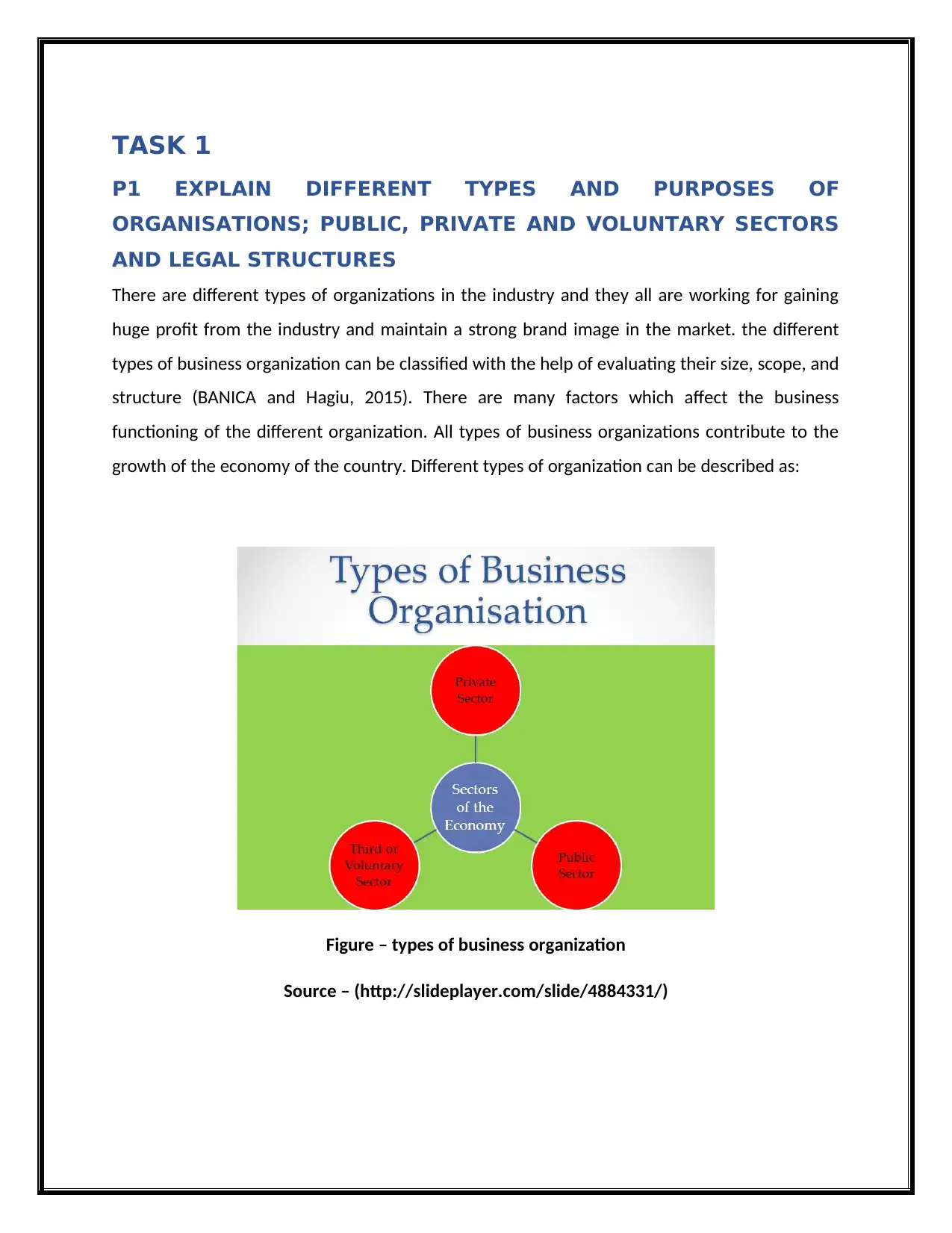
growth of the economy of the country. Different types of organization can be described as:
Figure – types of business organization
Source – (http://slideplayer.com/slide/4884331/)
P1 EXPLAIN DIFFERENT TYPES AND PURPOSES OF
ORGANISATIONS; PUBLIC, PRIVATE AND VOLUNTARY SECTORS
AND LEGAL STRUCTURES
There are different types of organizations in the industry and they all are working for gaining
huge profit from the industry and maintain a strong brand image in the market. the different
types of business organization can be classified with the help of evaluating their size, scope, and
structure (BANICA and Hagiu, 2015). There are many factors which affect the business
functioning of the different organization. All types of business organizations contribute to the
growth of the economy of the country. Different types of organization can be described as:
Figure – types of business organization
Source – (http://slideplayer.com/slide/4884331/)
PUBLIC SECTOR ORGANIZATION
These are the type of organizations that are owned by the government to provide services to
the local public (Burns, 2016). There are different types of government according to different
types of states in the country and they all have their different rules and regulations. The main
aim of public sector organization is to provide services to the citizens for an example the EE
limited (Everything everywhere) is a telecommunication mobile company of UK which comes
under the public-sector organization. The public limited organisations provide services to their
customer to gain profit from them.
PRIVATE SECTOR ORGANIZATION
The local or central government owned the private limited companies. These businesses can be
owned by an individual person or a group in order to gain profit. The main purpose of the
private limited company is to gain profit and success in the market. the British Council is one of
the private limited company of UK which work for developing relationships with other countries
for gaining profit (McAdams, et al. 2015). The company provide educational and cultural
knowledge to others and encourage them to gain opportunities for their career. There is the
organization which depends on their own belongings and create strategies to attain the desired
goals and objectives.
VOLUNTARY SECTOR ORGANIZATION
The voluntary organization does not work for gaining profit only. They want to fulfil the needs
of needy people with the help of different types of charity funds, trusts, and NGO's. These
organizations work for the betterment of society and the social welfare of the public. The Mind
is a voluntary organization of UK which works for the better mental health of peoples. The main
aim of this organization is to provide proper care and health treatment to the patients. This
organization don’t work for gaining profit. The strategy which is adopted by the Mind is called
as building on change. Moreover, these organization considered as non-profit organizations
which only wants to maintain public relations and social welfare in the country.
These are the type of organizations that are owned by the government to provide services to
the local public (Burns, 2016). There are different types of government according to different
types of states in the country and they all have their different rules and regulations. The main
aim of public sector organization is to provide services to the citizens for an example the EE
limited (Everything everywhere) is a telecommunication mobile company of UK which comes
under the public-sector organization. The public limited organisations provide services to their
customer to gain profit from them.
PRIVATE SECTOR ORGANIZATION
The local or central government owned the private limited companies. These businesses can be
owned by an individual person or a group in order to gain profit. The main purpose of the
private limited company is to gain profit and success in the market. the British Council is one of
the private limited company of UK which work for developing relationships with other countries
for gaining profit (McAdams, et al. 2015). The company provide educational and cultural
knowledge to others and encourage them to gain opportunities for their career. There is the
organization which depends on their own belongings and create strategies to attain the desired
goals and objectives.
VOLUNTARY SECTOR ORGANIZATION
The voluntary organization does not work for gaining profit only. They want to fulfil the needs
of needy people with the help of different types of charity funds, trusts, and NGO's. These
organizations work for the betterment of society and the social welfare of the public. The Mind
is a voluntary organization of UK which works for the better mental health of peoples. The main
aim of this organization is to provide proper care and health treatment to the patients. This
organization don’t work for gaining profit. The strategy which is adopted by the Mind is called
as building on change. Moreover, these organization considered as non-profit organizations
which only wants to maintain public relations and social welfare in the country.
⊘ This is a preview!⊘
Do you want full access?
Subscribe today to unlock all pages.
Trusted by 1+ million students worldwide
P2 EXPLAIN THE SIZE AND SCOPE OF A RANGE OF DIFFERENT
TYPES OF ORGANISATIONS
The size of an organization means the number of employees working in the organization and
the area of the company where they are serving their products and service to the customers.
the scope of the organization refers to the elements which needed for the expansion and
growth of the organization to gain more profit (Galaskiewicz, 2016). The products and services
can be described as the elements which provided the organization to fulfil the requirements
and needs of their customers.
To analyse any kind of organization it is really important to know about the size, scope and area
of the organization. There are some aspects which can be helpful in evaluating the different
types of organization. The shares in the market, employees working in the company, brand
awareness in public, profit ration and the name and fame of the business can be helpful in
calculating the private sector organization. the size and scope of public sector organizations can
be measured through their working area, rules and regulations, policies, and services area for
providing the best product to the customers. further, the voluntary organization's scope and
size can be evaluated with the help campaign they organize for the needy people or their
relationship with the people and trustful associations which is operated by them to fulfil the
needs of needy people. The British Council is a private sector organization which provide
educational and cultural knowledge and opportunities nationally and internationally among
1000 countries to the people. The voluntary organization named as Mind provide mental health
care and facilities to the needy people in the county for social welfare and social awareness.
There are different business organization according to size and scope and they can be classified
as:
SMALL BUSINESS
The small businesses are generally owned by a person or can be defined as a sole
proprietorship which has some employees and a less annual revenue and profit. Small business
can apply for support of government depends on the industry and the policies of the country.
The main focus of the small business organization is on the strong and effective business
TYPES OF ORGANISATIONS
The size of an organization means the number of employees working in the organization and
the area of the company where they are serving their products and service to the customers.
the scope of the organization refers to the elements which needed for the expansion and
growth of the organization to gain more profit (Galaskiewicz, 2016). The products and services
can be described as the elements which provided the organization to fulfil the requirements
and needs of their customers.
To analyse any kind of organization it is really important to know about the size, scope and area
of the organization. There are some aspects which can be helpful in evaluating the different
types of organization. The shares in the market, employees working in the company, brand
awareness in public, profit ration and the name and fame of the business can be helpful in
calculating the private sector organization. the size and scope of public sector organizations can
be measured through their working area, rules and regulations, policies, and services area for
providing the best product to the customers. further, the voluntary organization's scope and
size can be evaluated with the help campaign they organize for the needy people or their
relationship with the people and trustful associations which is operated by them to fulfil the
needs of needy people. The British Council is a private sector organization which provide
educational and cultural knowledge and opportunities nationally and internationally among
1000 countries to the people. The voluntary organization named as Mind provide mental health
care and facilities to the needy people in the county for social welfare and social awareness.
There are different business organization according to size and scope and they can be classified
as:
SMALL BUSINESS
The small businesses are generally owned by a person or can be defined as a sole
proprietorship which has some employees and a less annual revenue and profit. Small business
can apply for support of government depends on the industry and the policies of the country.
The main focus of the small business organization is on the strong and effective business
Paraphrase This Document
Need a fresh take? Get an instant paraphrase of this document with our AI Paraphraser

functioning for the development of the business. the financial capital of a small size business
organization cannot more than $50,000.
organization cannot more than $50,000.
MEDIUM BUSINESS
The private organizations generally come under the medium business organization. the main
aim of this kind of business is to produce more revenue and gaining huge profit from the
market. These kinds of business having the aim of development of the business and maintain an
effective business position in the market (Harmon, 2014). They generate a different type of
strategies and innovative ideas for maintaining the good relations whit their customers. The
size and scope of medium business are large than the small business organizations.
LARGE BUSINESS
The large business organizations have the legal and government support for managing and
maintain their business effectiveness. These types of business produce the huge amount of
profit and revenue by providing a different kind of services and product to the customers. The
large business organizations based on long-term planning for achieving the goals and objectives
of the business organization. The large business organizations cover a huge area and more
scope than the small and medium business organizations.
The private organizations generally come under the medium business organization. the main
aim of this kind of business is to produce more revenue and gaining huge profit from the
market. These kinds of business having the aim of development of the business and maintain an
effective business position in the market (Harmon, 2014). They generate a different type of
strategies and innovative ideas for maintaining the good relations whit their customers. The
size and scope of medium business are large than the small business organizations.
LARGE BUSINESS
The large business organizations have the legal and government support for managing and
maintain their business effectiveness. These types of business produce the huge amount of
profit and revenue by providing a different kind of services and product to the customers. The
large business organizations based on long-term planning for achieving the goals and objectives
of the business organization. The large business organizations cover a huge area and more
scope than the small and medium business organizations.
⊘ This is a preview!⊘
Do you want full access?
Subscribe today to unlock all pages.
Trusted by 1+ million students worldwide
M1 ANALYSE HOW THE STRUCTURE, SIZE AND SCOPE OF
DIFFERENT ORGANISATIONS LINK TO THE BUSINESS
OBJECTIVES AND PRODUCT AND SERVICES OFFERED BY THE
ORGANISATION
The size and scope of the organization can be measured by the employees and the profit ratio
of the company. Different types of organizational functions such as marketing, finance,
operations and HR department of the company help the company to maintain a brand
awareness of their products and services among the customers (Wong, et al. 2014). All the
department should maintain the interrelation between them to attain the overall business
objective and goal. The marketing department is completely linked to the finance department
of the company because finance department creates the budget plan for the advertisement and
promotions as per the financial condition of the organization. The HR department recruits the
potential and skilled employees for the growth and development of the organization this will be
good for operations department of the company for effective and fast production. All the
departments of the company work for attaining success for the business. The main aim of all
the departments is development and growth of the company and that is possible when all the
departments work together to achieve that. The collaboration of all the department affects the
sales and revenue of the company as the customers got attracted towards the effective
functioning and innovative production of the company. Maintaining healthy relationship
between all the functional department is really important to attain the desired goal of the
company.
DIFFERENT ORGANISATIONS LINK TO THE BUSINESS
OBJECTIVES AND PRODUCT AND SERVICES OFFERED BY THE
ORGANISATION
The size and scope of the organization can be measured by the employees and the profit ratio
of the company. Different types of organizational functions such as marketing, finance,
operations and HR department of the company help the company to maintain a brand
awareness of their products and services among the customers (Wong, et al. 2014). All the
department should maintain the interrelation between them to attain the overall business
objective and goal. The marketing department is completely linked to the finance department
of the company because finance department creates the budget plan for the advertisement and
promotions as per the financial condition of the organization. The HR department recruits the
potential and skilled employees for the growth and development of the organization this will be
good for operations department of the company for effective and fast production. All the
departments of the company work for attaining success for the business. The main aim of all
the departments is development and growth of the company and that is possible when all the
departments work together to achieve that. The collaboration of all the department affects the
sales and revenue of the company as the customers got attracted towards the effective
functioning and innovative production of the company. Maintaining healthy relationship
between all the functional department is really important to attain the desired goal of the
company.
Paraphrase This Document
Need a fresh take? Get an instant paraphrase of this document with our AI Paraphraser
TASK 2
P3 EXPLAIN THE RELATIONSHIP BETWEEN DIFFERENT
ORGANISATIONAL FUNCTIONS AND HOW THEY LINK TO
ORGANISATIONAL OBJECTIVES AND STRUCTURE
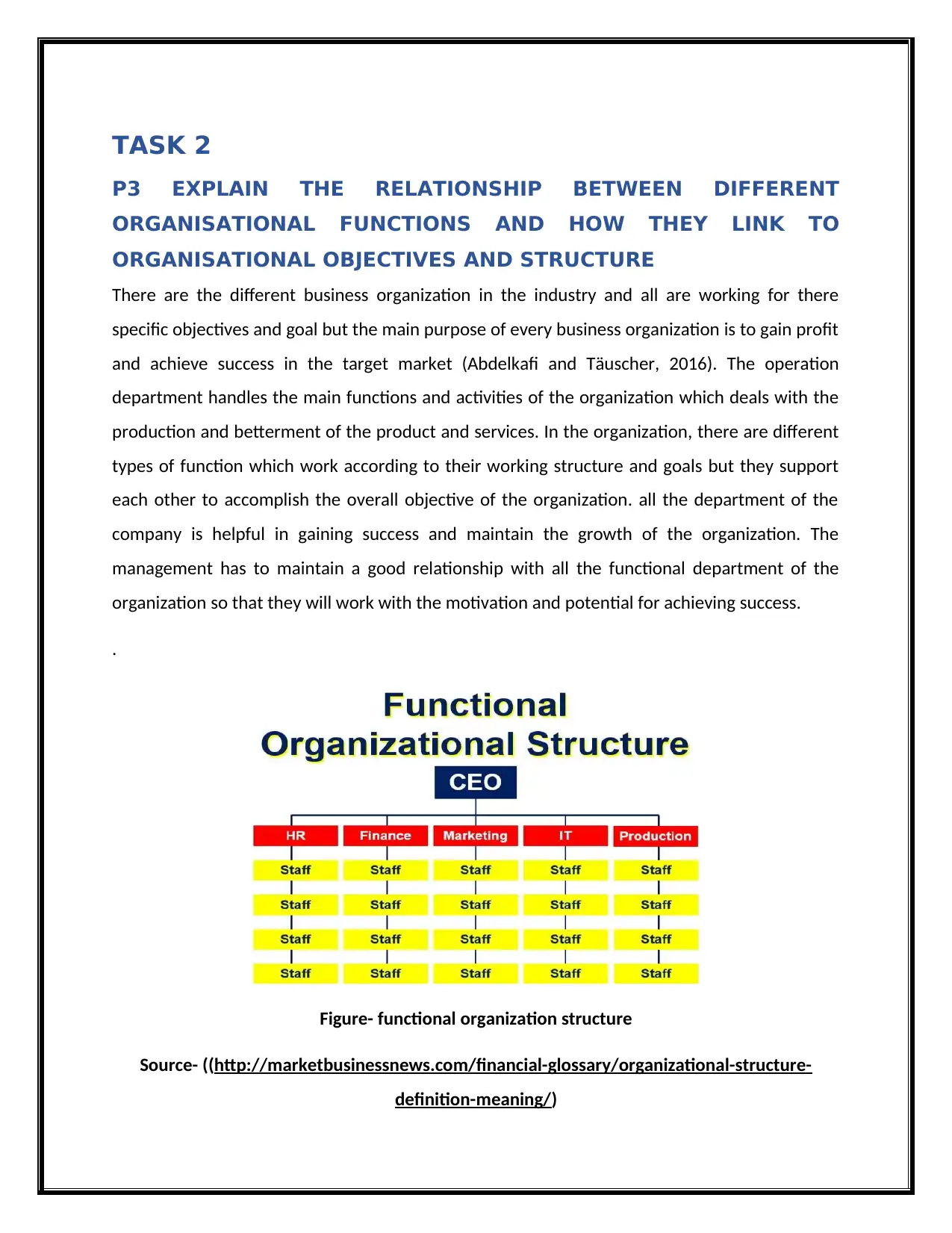
There are the different business organization in the industry and all are working for there
specific objectives and goal but the main purpose of every business organization is to gain profit
and achieve success in the target market (Abdelkafi and Täuscher, 2016). The operation
department handles the main functions and activities of the organization which deals with the
production and betterment of the product and services. In the organization, there are different
types of function which work according to their working structure and goals but they support
each other to accomplish the overall objective of the organization. all the department of the
company is helpful in gaining success and maintain the growth of the organization. The
management has to maintain a good relationship with all the functional department of the
organization so that they will work with the motivation and potential for achieving success.
.
Figure- functional organization structure
Source- ((http://marketbusinessnews.com/financial-glossary/organizational-structure-
definition-meaning/)
P3 EXPLAIN THE RELATIONSHIP BETWEEN DIFFERENT
ORGANISATIONAL FUNCTIONS AND HOW THEY LINK TO
ORGANISATIONAL OBJECTIVES AND STRUCTURE
There are the different business organization in the industry and all are working for there
specific objectives and goal but the main purpose of every business organization is to gain profit
and achieve success in the target market (Abdelkafi and Täuscher, 2016). The operation
department handles the main functions and activities of the organization which deals with the
production and betterment of the product and services. In the organization, there are different
types of function which work according to their working structure and goals but they support
each other to accomplish the overall objective of the organization. all the department of the
company is helpful in gaining success and maintain the growth of the organization. The
management has to maintain a good relationship with all the functional department of the
organization so that they will work with the motivation and potential for achieving success.
.
Figure- functional organization structure
Source- ((http://marketbusinessnews.com/financial-glossary/organizational-structure-
definition-meaning/)

⊘ This is a preview!⊘
Do you want full access?
Subscribe today to unlock all pages.
Trusted by 1+ million students worldwide

1 out of 27


Related Documents


Your All-in-One AI-Powered Toolkit for Academic Success.
+13062052269
info@desklib.com
Available 24*7 on WhatsApp / Email
![[object Object]](/_next/static/media/star-bottom.7253800d.svg)
Unlock your academic potential
Copyright © 2020–2026 A2Z Services. All Rights Reserved. Developed and managed by ZUCOL.