Business Entrepreneurship and Small Business Management Analysis
VerifiedAdded on 2024/05/30
|17
|5152
|224
Report
AI Summary
This report delves into the realm of business entrepreneurship and small business management, examining its origins, various types, and related concepts. It explores different kinds of business ventures, highlighting the traits necessary for successful business individuals and addressing challenges that can hinder business growth. The report distinguishes between different entrepreneurial ventures based on size, structure, and funding, categorizing them as lifestyle ventures, small profit ventures, and high-growth ventures. It also contrasts corporate and social entrepreneurial ventures, emphasizing their similarities and differences. Furthermore, the report assesses the impact of micro and small businesses (SMEs) on the economy, particularly in the context of the European Union and the UK, illustrating their role in driving growth, creating jobs, and fostering innovation. Finally, it underscores the importance of small businesses and start-ups in contributing to the growth of the social economy.
BUSINESS ENTREPRENEURSHIP AND
SMALL BUSINESS MANAGEMENT
1
SMALL BUSINESS MANAGEMENT
1

Paraphrase This Document
Need a fresh take? Get an instant paraphrase of this document with our AI Paraphraser
Contents
Introduction.................................................................................................................................................3
Task 1..........................................................................................................................................................4
Task 2..........................................................................................................................................................7
Task 3........................................................................................................................................................11
Task 4........................................................................................................................................................14
Conclusion.................................................................................................................................................15
Reference List............................................................................................................................................16
2
Introduction.................................................................................................................................................3
Task 1..........................................................................................................................................................4
Task 2..........................................................................................................................................................7
Task 3........................................................................................................................................................11
Task 4........................................................................................................................................................14
Conclusion.................................................................................................................................................15
Reference List............................................................................................................................................16
2
Introduction
The project aims to study Business entrepreneurship and small business management
in the present day scenario, by closely studying its origin, types, related concepts, and
more. The project discusses various concepts of business entrepreneurship and links
them to each other, as well as distinguishing between them in terms of similarities and
differences of operational methods. The project inspects kinds of business ventures
citing examples wherever necessary, and simultaneously examining the traits and
characteristics that are required for efficient business individuals. The assignment
explores varieties of situations that can hinder business growth and reflects on ways to
resolve issues that affect business entrepreneurship negatively. All this is explained,
discussed and highlighted in the context of only small business management structures.
3
The project aims to study Business entrepreneurship and small business management
in the present day scenario, by closely studying its origin, types, related concepts, and
more. The project discusses various concepts of business entrepreneurship and links
them to each other, as well as distinguishing between them in terms of similarities and
differences of operational methods. The project inspects kinds of business ventures
citing examples wherever necessary, and simultaneously examining the traits and
characteristics that are required for efficient business individuals. The assignment
explores varieties of situations that can hinder business growth and reflects on ways to
resolve issues that affect business entrepreneurship negatively. All this is explained,
discussed and highlighted in the context of only small business management structures.
3
⊘ This is a preview!⊘
Do you want full access?
Subscribe today to unlock all pages.

Trusted by 1+ million students worldwide
Task 1
Examine different types of entrepreneurial ventures and explain how they relate
to the typology of entrepreneurship. [P1]
In the present day business scenario, the current global trend is of entrepreneurial
ventures. These entrepreneurial ventures are based on two root concepts namely
entrepreneurship and venture. Entrepreneurship is the current buzz word in business
terminology. It entails all responsibilities from ideating, to recruiting employees; to
strategic management risk-taking for a business organization that aims at creating new
opportunities for more individuals (Schaper, 2014).Ventures are nothing but goal-
oriented endeavours or undertakings that can be small, medium-sized or large.
An entrepreneur, or owner of a venture, hence, can be defined as one who pioneers the
business organization, bearing all risks and responsibilities of operation of the business.
Entrepreneurial ventures or business organizations are classified into three broad
divisions based on their size and functionality:
Lifestyle Ventures– According to Goffee and Scase, (2015), these are usually
companies small in size of its number of employees. These ventures are generally
autonomous and independent of any union or bigger corporation. Lifestyle firms, as the
name suggests, are focused on a particular product or service, for example, UK-based
Ekea that produces organic skincare for women. Other features of Lifestyle ventures are
:
They serve a personal interest or goal of the owner or entrepreneur
They align personal interest with creating profit through the lifestyle venture
They have limited opportunities of growth since attracting a significant customer
base based on a specific choice is tough.
Small Profit Venture– Small profit ventures are business organizations where the
number of employees are very few, 10 or maximum 20 in number. These small profit
ventures are generally one stop shop for a unique product that isn’t available in other
branches or stores across the location it is based in. The London-based Archipelago is
an exotic meat food stop that featured in Business Insider among the 22 coolest small
profit business ventures. Other features of Small profit ventures are:
They are more focused in their business delivery than any other business
structure
It is easier to achieve visions and short term goals due to the concentrated
number of workers
They are more concerned about a solid fan base rather generating million dollar
profits in initial years.
High Growth Venture– High Growth Ventures are built upon multiple levels of business
hierarchy where the one at the apex has either less or nil communication with the ones
4
Examine different types of entrepreneurial ventures and explain how they relate
to the typology of entrepreneurship. [P1]
In the present day business scenario, the current global trend is of entrepreneurial
ventures. These entrepreneurial ventures are based on two root concepts namely
entrepreneurship and venture. Entrepreneurship is the current buzz word in business
terminology. It entails all responsibilities from ideating, to recruiting employees; to
strategic management risk-taking for a business organization that aims at creating new
opportunities for more individuals (Schaper, 2014).Ventures are nothing but goal-
oriented endeavours or undertakings that can be small, medium-sized or large.
An entrepreneur, or owner of a venture, hence, can be defined as one who pioneers the
business organization, bearing all risks and responsibilities of operation of the business.
Entrepreneurial ventures or business organizations are classified into three broad
divisions based on their size and functionality:
Lifestyle Ventures– According to Goffee and Scase, (2015), these are usually
companies small in size of its number of employees. These ventures are generally
autonomous and independent of any union or bigger corporation. Lifestyle firms, as the
name suggests, are focused on a particular product or service, for example, UK-based
Ekea that produces organic skincare for women. Other features of Lifestyle ventures are
:
They serve a personal interest or goal of the owner or entrepreneur
They align personal interest with creating profit through the lifestyle venture
They have limited opportunities of growth since attracting a significant customer
base based on a specific choice is tough.
Small Profit Venture– Small profit ventures are business organizations where the
number of employees are very few, 10 or maximum 20 in number. These small profit
ventures are generally one stop shop for a unique product that isn’t available in other
branches or stores across the location it is based in. The London-based Archipelago is
an exotic meat food stop that featured in Business Insider among the 22 coolest small
profit business ventures. Other features of Small profit ventures are:
They are more focused in their business delivery than any other business
structure
It is easier to achieve visions and short term goals due to the concentrated
number of workers
They are more concerned about a solid fan base rather generating million dollar
profits in initial years.
High Growth Venture– High Growth Ventures are built upon multiple levels of business
hierarchy where the one at the apex has either less or nil communication with the ones
4
Paraphrase This Document
Need a fresh take? Get an instant paraphrase of this document with our AI Paraphraser
at the bottom of the structure. High growth ventures are built upon huge financing and
require continuous situational challenges and risks to ensure high profitability (Parker,
2018). An example of high profit venture based in the UK is retail clothing chain Marks &
Spencer.
Other features of high growth ventures are:
They are built on huge funding so their goal is consistent innovation, failing which
the business might run into heavy risks or losses.
They are usually more attractive to business funding organizations and individual
business funders.
They are spread across locations, often transnational.
Despite the dissimilarity in their business goals and functional models, all the three
ventures have one thing in common– entrepreneurship. They are based on
entrepreneurial ideation, innovation of products and services for profits, and so on. It is
however, important to distinguish between a small business and an entrepreneurial
small organization. However similar they seem, they are both very different and only
one of the two is related to the typology of entrepreneurship.
Trading products like buying bulk of branded shampoo at wholesale rates from a retailer
and then selling them at retail rates through online or physical shop or home-delivery is
a small business in itself. But it is not an entrepreneurial venture because there is no
creative innovation or idea at the base level of the business. However, starting from
ideation, branding and selling an organic shampoo through either a physical store or
online retailing is a small entrepreneurial venture.
Explore the similarities and differences between entrepreneurial ventures. [P2]
Entrepreneurial ventures vary in types not only in terms of their sizes or structure, but
also in the kinds of funding obtained for their smooth functioning (Burns, 2016). The
distinction between entrepreneurial ventures help understand more about how they
originate, run and sustain to fulfil their long term as well short term business goals and
vision.
Broadly speaking, there are two categories of entrepreneurial ventures based on the
sort of funding and efforts employed to build them. These two types are: Corporate or Business Entrepreneurial Venture
Corporate entrepreneurial ventures are one of the most common among all kinds
of business ventures. They are often called ‘corporate’ because in its strictest
sense, they are all about focusing on investment, profit and money-making.
According to Abrams, (2017), the main business goal of a corporate venture is to
create huge profits from the investment. Other areas it stands to serve are to
gain customer satisfaction, innovation and growth of its services and products,
etc. Also, providing a level of professional contentment of its employees through
appraisals, meritorious mentions, etc. are essential goals of a corporate business
entrepreneurial venture (Drucker, 2014). Deloitte Touche Tohmatsu Limited,
headquartered at the New York City, is a UK-based multinational professional
consultancy company that is one of the fastest growing and leading information
5
require continuous situational challenges and risks to ensure high profitability (Parker,
2018). An example of high profit venture based in the UK is retail clothing chain Marks &
Spencer.
Other features of high growth ventures are:
They are built on huge funding so their goal is consistent innovation, failing which
the business might run into heavy risks or losses.
They are usually more attractive to business funding organizations and individual
business funders.
They are spread across locations, often transnational.
Despite the dissimilarity in their business goals and functional models, all the three
ventures have one thing in common– entrepreneurship. They are based on
entrepreneurial ideation, innovation of products and services for profits, and so on. It is
however, important to distinguish between a small business and an entrepreneurial
small organization. However similar they seem, they are both very different and only
one of the two is related to the typology of entrepreneurship.
Trading products like buying bulk of branded shampoo at wholesale rates from a retailer
and then selling them at retail rates through online or physical shop or home-delivery is
a small business in itself. But it is not an entrepreneurial venture because there is no
creative innovation or idea at the base level of the business. However, starting from
ideation, branding and selling an organic shampoo through either a physical store or
online retailing is a small entrepreneurial venture.
Explore the similarities and differences between entrepreneurial ventures. [P2]
Entrepreneurial ventures vary in types not only in terms of their sizes or structure, but
also in the kinds of funding obtained for their smooth functioning (Burns, 2016). The
distinction between entrepreneurial ventures help understand more about how they
originate, run and sustain to fulfil their long term as well short term business goals and
vision.
Broadly speaking, there are two categories of entrepreneurial ventures based on the
sort of funding and efforts employed to build them. These two types are: Corporate or Business Entrepreneurial Venture
Corporate entrepreneurial ventures are one of the most common among all kinds
of business ventures. They are often called ‘corporate’ because in its strictest
sense, they are all about focusing on investment, profit and money-making.
According to Abrams, (2017), the main business goal of a corporate venture is to
create huge profits from the investment. Other areas it stands to serve are to
gain customer satisfaction, innovation and growth of its services and products,
etc. Also, providing a level of professional contentment of its employees through
appraisals, meritorious mentions, etc. are essential goals of a corporate business
entrepreneurial venture (Drucker, 2014). Deloitte Touche Tohmatsu Limited,
headquartered at the New York City, is a UK-based multinational professional
consultancy company that is one of the fastest growing and leading information
5
technology solutions business organizations falling under the category of
corporate entrepreneurial business venture.
One of the top priorities of corporate entrepreneurial business venture is to
maximize on their revenue, in such a graph that each year records an increase in
comparison to the previous trends. It is this capital that enhances their innovation
and delivering assistance to their huge clientele. They conduct regular research
to study market needs and assess how they can better serve their customers
through making a sound technological system that fulfils their desires in the form
of material or software items.
Social Entrepreneurial Venture
The primary emphasis of social entrepreneurial ventures is to build a certain
social order through their products or brands. Social entrepreneurial ventures
collaborate with investors to mainly create services and products that contribute
to the overall standard of living. Their initial concern is to conduct studies and
realize if there is a gap within their local community and once they discover the
gap, they intend to fill it through manufacturing products that cater direct to target
audience needs. The centre of focus of a social entrepreneurial venture is not
profit, but serving the needs of their surrounding community (Dees, 2017).
Social entrepreneurial ventures often find themselves in situations with very less
financial support, but are constantly motivated by their will to help in the well
being of their societal counterparts. They are involved in making a significant
progress in society, through the way they market, advertise and brand their
products. According to McDermott et al., (2018), Social entrepreneurs would
most of the times be seen investing amounts of money in a particular
professional goal that wouldn’t even earn them a considerable gain.
One of the most fabulous examples of a social entrepreneurial venture is the
California-based Khan Academy. It is a non-profit organization that produces
online study material, videos, projects and studies to help students across the
world academically. To fulfil the ambition of universal education, Khan Academy
as a successful social entrepreneurial venture delivers materials in multiple
languages to assist students from different social and linguistic backgrounds.
Both of the above, despite their difference share similarities like:
Generation of employment
Serving a definite professional goal
Banking on investment to gain a considerable future profit.
6
corporate entrepreneurial business venture.
One of the top priorities of corporate entrepreneurial business venture is to
maximize on their revenue, in such a graph that each year records an increase in
comparison to the previous trends. It is this capital that enhances their innovation
and delivering assistance to their huge clientele. They conduct regular research
to study market needs and assess how they can better serve their customers
through making a sound technological system that fulfils their desires in the form
of material or software items.
Social Entrepreneurial Venture
The primary emphasis of social entrepreneurial ventures is to build a certain
social order through their products or brands. Social entrepreneurial ventures
collaborate with investors to mainly create services and products that contribute
to the overall standard of living. Their initial concern is to conduct studies and
realize if there is a gap within their local community and once they discover the
gap, they intend to fill it through manufacturing products that cater direct to target
audience needs. The centre of focus of a social entrepreneurial venture is not
profit, but serving the needs of their surrounding community (Dees, 2017).
Social entrepreneurial ventures often find themselves in situations with very less
financial support, but are constantly motivated by their will to help in the well
being of their societal counterparts. They are involved in making a significant
progress in society, through the way they market, advertise and brand their
products. According to McDermott et al., (2018), Social entrepreneurs would
most of the times be seen investing amounts of money in a particular
professional goal that wouldn’t even earn them a considerable gain.
One of the most fabulous examples of a social entrepreneurial venture is the
California-based Khan Academy. It is a non-profit organization that produces
online study material, videos, projects and studies to help students across the
world academically. To fulfil the ambition of universal education, Khan Academy
as a successful social entrepreneurial venture delivers materials in multiple
languages to assist students from different social and linguistic backgrounds.
Both of the above, despite their difference share similarities like:
Generation of employment
Serving a definite professional goal
Banking on investment to gain a considerable future profit.
6
⊘ This is a preview!⊘
Do you want full access?
Subscribe today to unlock all pages.
Trusted by 1+ million students worldwide
Task 2
Interpret and assess relevant data and statistics to illustrate how micro and small
business impact on the economy [P3].
In economic terms, small business organizations and medium-sized business
organizations are together referred by SMEs or small and medium-sized enterprises. In
order to understand what constitutes these as small micro business organizations, it is
vital to know its features. Below are the salient features of SMEs:
They consists of employees 20 to 50 in number
They are autonomous, or owned independently by individual investor or business
entrepreneur
They are based on individual creativity and professional goal
Their chances of partnering with e-commerce giants are higher
Their chances of creating huge export and import business on a global scare is
more than large organizations
The make up the largest number of business organizations in the world
Micro and small business structures have a greater role to play in the economy of a
country because its number is relatively higher than any other business type.
Additionally, it is easier to implement work ethic and professional competence in micro
organizations due to their controlled hierarchy and efficient distribution of work.
In order to illustrate how SMEs are currently impacting the economy, we have taken the
case of the European Union (EU). SMEs are considered as the backbone of UK
economy because it able to drive growth, create more jobs and open an entire avenue
of new market models (Ghaffarianhoseini, Doan, et al., 2016).They even encourage
competitiveness and innovative technology, furthering progress in the nation’s overall
status. Presently, 99.3 per cent of business in the UK is comprised of SMEs.
The graph below represents the predominance of SMEs in UK:
7
Interpret and assess relevant data and statistics to illustrate how micro and small
business impact on the economy [P3].
In economic terms, small business organizations and medium-sized business
organizations are together referred by SMEs or small and medium-sized enterprises. In
order to understand what constitutes these as small micro business organizations, it is
vital to know its features. Below are the salient features of SMEs:
They consists of employees 20 to 50 in number
They are autonomous, or owned independently by individual investor or business
entrepreneur
They are based on individual creativity and professional goal
Their chances of partnering with e-commerce giants are higher
Their chances of creating huge export and import business on a global scare is
more than large organizations
The make up the largest number of business organizations in the world
Micro and small business structures have a greater role to play in the economy of a
country because its number is relatively higher than any other business type.
Additionally, it is easier to implement work ethic and professional competence in micro
organizations due to their controlled hierarchy and efficient distribution of work.
In order to illustrate how SMEs are currently impacting the economy, we have taken the
case of the European Union (EU). SMEs are considered as the backbone of UK
economy because it able to drive growth, create more jobs and open an entire avenue
of new market models (Ghaffarianhoseini, Doan, et al., 2016).They even encourage
competitiveness and innovative technology, furthering progress in the nation’s overall
status. Presently, 99.3 per cent of business in the UK is comprised of SMEs.
The graph below represents the predominance of SMEs in UK:
7
Paraphrase This Document
Need a fresh take? Get an instant paraphrase of this document with our AI Paraphraser
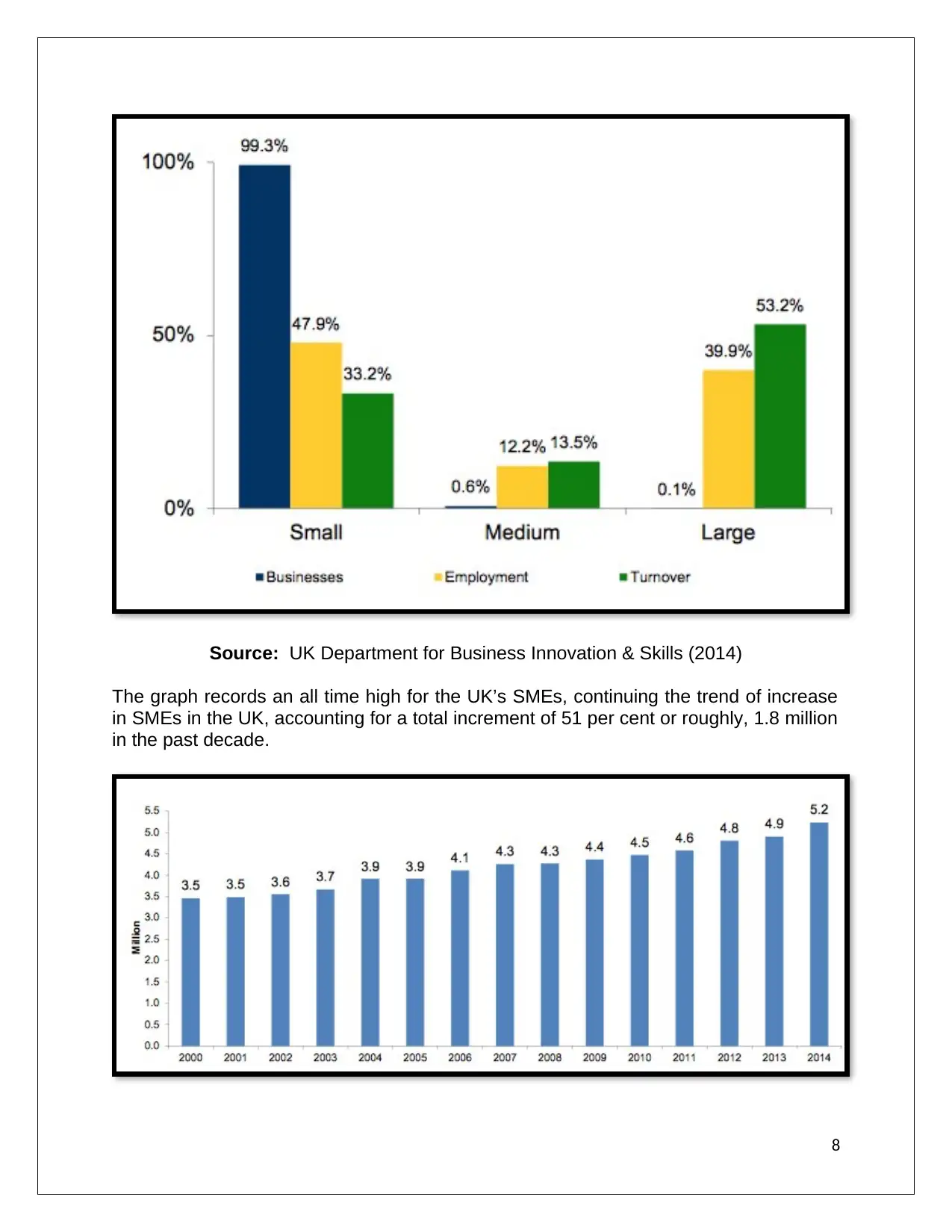
Source: UK Department for Business Innovation & Skills (2014)
The graph records an all time high for the UK’s SMEs, continuing the trend of increase
in SMEs in the UK, accounting for a total increment of 51 per cent or roughly, 1.8 million
in the past decade.
8
The graph records an all time high for the UK’s SMEs, continuing the trend of increase
in SMEs in the UK, accounting for a total increment of 51 per cent or roughly, 1.8 million
in the past decade.
8
Source: UK Department for Business Innovation & Skills (2014)
The above graph illustrates that despite the record-breaking impact of SMEs in the UK
economy, there exists a funding crisis, which can be understood after the EU Crisis as
bank financing process have become more intrusive and lengthy.
Other than the above, major findings from the UK Department for Business Innovation
& Skills state the following:
A total rate of employment in small and micro business organizations in the UK
is presently 16.1 million, which is about 60 per cent of the employment in the
UK.
At the start of 2017, it was suggested by trends that about 99.3 per cent of all
private sector businesses were mostly small or medium sized corporations
(99.9 per cent).
The combined annual turnover of small and micro sized business organizations
in the UK was £1.9 trillion by 2017.
Explain the importance of small businesses and business starts-ups to the
growth of social economy. [P4].
According to research data from global business experts and political analysts, small
businesses, micro business organizations in the private sector, and start-ups more
recently have been significantly changing the scene of economic growth worldwide. The
trend had started in the 1980s when small business organizations, driven by business
entrepreneurs began receiving greater attention due to their simple hierarchy and
focused vision (Cowling, 2016). It became easier and more reliable to invest in short
term goals rather than financing huge business organizations involving a higher risk of
running into a loss in case of a mishap.
In the past two decades due to the global paradigm shift in business models, often
leading to economic crisis, it has become a priority for business authorities to invest
smaller amount of capital focused on gaining considerable profit within a short period of
time. To face such economic instability, not just developing economies, but also
developed economies started financing newer business organizations with a different
style of functioning. These came to be known as start-ups. Relying on the financial
figures over the previous two decades, it can be observed that extensive literature has
been written on the growing significance of small business in the overall economy of a
nation. As well as playing a vital role in creating more employment nationally and
globally, driving business exchange has made small business organizations massively
successfully.
According to Storey, (2016), small business organizations often have promising
innovative technology to encourage future growth because, considering their role
distribution and time management, it is easier for them allocate resources and funding
to consistently promote their financial prospects. Hence, they have become extremely
important for economic growth.
9
The above graph illustrates that despite the record-breaking impact of SMEs in the UK
economy, there exists a funding crisis, which can be understood after the EU Crisis as
bank financing process have become more intrusive and lengthy.
Other than the above, major findings from the UK Department for Business Innovation
& Skills state the following:
A total rate of employment in small and micro business organizations in the UK
is presently 16.1 million, which is about 60 per cent of the employment in the
UK.
At the start of 2017, it was suggested by trends that about 99.3 per cent of all
private sector businesses were mostly small or medium sized corporations
(99.9 per cent).
The combined annual turnover of small and micro sized business organizations
in the UK was £1.9 trillion by 2017.
Explain the importance of small businesses and business starts-ups to the
growth of social economy. [P4].
According to research data from global business experts and political analysts, small
businesses, micro business organizations in the private sector, and start-ups more
recently have been significantly changing the scene of economic growth worldwide. The
trend had started in the 1980s when small business organizations, driven by business
entrepreneurs began receiving greater attention due to their simple hierarchy and
focused vision (Cowling, 2016). It became easier and more reliable to invest in short
term goals rather than financing huge business organizations involving a higher risk of
running into a loss in case of a mishap.
In the past two decades due to the global paradigm shift in business models, often
leading to economic crisis, it has become a priority for business authorities to invest
smaller amount of capital focused on gaining considerable profit within a short period of
time. To face such economic instability, not just developing economies, but also
developed economies started financing newer business organizations with a different
style of functioning. These came to be known as start-ups. Relying on the financial
figures over the previous two decades, it can be observed that extensive literature has
been written on the growing significance of small business in the overall economy of a
nation. As well as playing a vital role in creating more employment nationally and
globally, driving business exchange has made small business organizations massively
successfully.
According to Storey, (2016), small business organizations often have promising
innovative technology to encourage future growth because, considering their role
distribution and time management, it is easier for them allocate resources and funding
to consistently promote their financial prospects. Hence, they have become extremely
important for economic growth.
9
⊘ This is a preview!⊘
Do you want full access?
Subscribe today to unlock all pages.
Trusted by 1+ million students worldwide
Combined with the business ideal of ‘business entrepreneurship’, these organizations
are being lead by motivated individuals who are driven by passion and personal interest
besides zeal to professionally perform among competition. Small business
organizations and start-ups, above all, allow for a huge amount of sustainability which
wasn’t previously guaranteed by business organizations. According to Sahut and Peris-
Ortiz, (2014), the structure and operational understanding of SMEs and start-ups follow
the multidimensional model of sustainability by practicing these processes, in general:
Economic management
Technological innovation
Social inclusion
Value learning
Eco-friendly solutions
The above features of SMEs and start-ups accelerate the journey to professional
success, and the above practices effectively allow for SMEs to operate without
compromising with their future resources. The above features make SMEs and start-ups
a high ranking category in improving the economic stability or a nation.
Separate studies in global finance disclose that SMEs currently hire14, 424,000 in total
in the United Kingdom. It is estimated that the gross value of these businesses is €473
billion (£375.73 billion) that represent 49.8 per cent of the total UK economy.
Further, examining the recent research by the Confederation of British Industry (CBI) in
global finance indicate that by allowing SMEs to increase their operations, an amount of
£20 billion can be injected into the UK economy by 2020. Hence, SMEs and start-ups
play a very crucial role in contributing to the economic growth of a nation.
10
are being lead by motivated individuals who are driven by passion and personal interest
besides zeal to professionally perform among competition. Small business
organizations and start-ups, above all, allow for a huge amount of sustainability which
wasn’t previously guaranteed by business organizations. According to Sahut and Peris-
Ortiz, (2014), the structure and operational understanding of SMEs and start-ups follow
the multidimensional model of sustainability by practicing these processes, in general:
Economic management
Technological innovation
Social inclusion
Value learning
Eco-friendly solutions
The above features of SMEs and start-ups accelerate the journey to professional
success, and the above practices effectively allow for SMEs to operate without
compromising with their future resources. The above features make SMEs and start-ups
a high ranking category in improving the economic stability or a nation.
Separate studies in global finance disclose that SMEs currently hire14, 424,000 in total
in the United Kingdom. It is estimated that the gross value of these businesses is €473
billion (£375.73 billion) that represent 49.8 per cent of the total UK economy.
Further, examining the recent research by the Confederation of British Industry (CBI) in
global finance indicate that by allowing SMEs to increase their operations, an amount of
£20 billion can be injected into the UK economy by 2020. Hence, SMEs and start-ups
play a very crucial role in contributing to the economic growth of a nation.
10
Paraphrase This Document
Need a fresh take? Get an instant paraphrase of this document with our AI Paraphraser
Task 3
Determine the characteristic traits and skills of successful entrepreneurs that
differentiate them from other business managers. [P5]
An entrepreneur is one who ideates initiates, establishes, organizes and actively
participates in business decision-making of an organizational structure (Yunus, 2017). It
is the responsibility of the entrepreneur to constantly strive to achieve the organization’s
short and long term goals, without compromising on its ideals, and simultaneously
bearing the challenges, risks and losses other than the gains earned through his
business transactions.
There are different elements of personality that researchers would point out at, for
making a successful entrepreneur. Deriving from the basics and essential components
from global organizational structures, the following qualities have been listed to be
found in a successful entrepreneur:
Goal-orientedness: A successful entrepreneur must be passionate about his
vision and fulfil business objectives through consistency in his organizational
role. He or she must set short term and long term goals after making a situational
analysis of the company within regular intervals of time, and aim to work towards
them to ensure success.
Flexibility: An entrepreneur must be able to handle pressure and manage his
time effectively. He or she must adjust and adapt to evolving work environments
and encourage an inclusive, pluralistic culture within his organization. All of this
makes him or her flexible entrepreneur.
Interdependence: A successful entrepreneur is not one who teaches his team the
quality of independence but one who makes his team understand the value of
interdependence such that each worker in his organization is equally reliable,
responsible and efficient in his or her professional undertakings.
Tolerance: A successful entrepreneur has to often juggle between his personal
and professional life, deal with people in exact contradiction to his ideals or
values. In such a scenario he or she may lose calm and bring an unpleasant
situation into play. All of this can be avoided if the entrepreneur has a very
degree of tolerance that enables him to make a calm approach to his work and
team and maintain his own composure at work and outside.
Other than the above, a successful entrepreneur must have a perpetual outlook for
creativity and innovation. In addition to the above traits and characteristics, a successful
entrepreneur must have a comprehensive understanding of the 5 Cs of
entrepreneurship ecosystem and work towards achieving it at all costs (Borissenko and
Boschma, 2016).
The 5 Cs of entrepreneurship ecosystem is:
Capital – The entrepreneur must ensure a smooth capital flow, or financial
investments are in action to achieve organizational goals.
Capability – The entrepreneur must be capable enough to distribute roles
according to his as well as his team’s skill set.
11
Determine the characteristic traits and skills of successful entrepreneurs that
differentiate them from other business managers. [P5]
An entrepreneur is one who ideates initiates, establishes, organizes and actively
participates in business decision-making of an organizational structure (Yunus, 2017). It
is the responsibility of the entrepreneur to constantly strive to achieve the organization’s
short and long term goals, without compromising on its ideals, and simultaneously
bearing the challenges, risks and losses other than the gains earned through his
business transactions.
There are different elements of personality that researchers would point out at, for
making a successful entrepreneur. Deriving from the basics and essential components
from global organizational structures, the following qualities have been listed to be
found in a successful entrepreneur:
Goal-orientedness: A successful entrepreneur must be passionate about his
vision and fulfil business objectives through consistency in his organizational
role. He or she must set short term and long term goals after making a situational
analysis of the company within regular intervals of time, and aim to work towards
them to ensure success.
Flexibility: An entrepreneur must be able to handle pressure and manage his
time effectively. He or she must adjust and adapt to evolving work environments
and encourage an inclusive, pluralistic culture within his organization. All of this
makes him or her flexible entrepreneur.
Interdependence: A successful entrepreneur is not one who teaches his team the
quality of independence but one who makes his team understand the value of
interdependence such that each worker in his organization is equally reliable,
responsible and efficient in his or her professional undertakings.
Tolerance: A successful entrepreneur has to often juggle between his personal
and professional life, deal with people in exact contradiction to his ideals or
values. In such a scenario he or she may lose calm and bring an unpleasant
situation into play. All of this can be avoided if the entrepreneur has a very
degree of tolerance that enables him to make a calm approach to his work and
team and maintain his own composure at work and outside.
Other than the above, a successful entrepreneur must have a perpetual outlook for
creativity and innovation. In addition to the above traits and characteristics, a successful
entrepreneur must have a comprehensive understanding of the 5 Cs of
entrepreneurship ecosystem and work towards achieving it at all costs (Borissenko and
Boschma, 2016).
The 5 Cs of entrepreneurship ecosystem is:
Capital – The entrepreneur must ensure a smooth capital flow, or financial
investments are in action to achieve organizational goals.
Capability – The entrepreneur must be capable enough to distribute roles
according to his as well as his team’s skill set.
11
Connection – The entrepreneur must indulge in networking and creating
resources and contacts for meeting the professional demands of his organization
time to time.
Culture – The entrepreneur must be able to integrate his own culture with that of
his local community to develop a better work relationship.
Climate – The entrepreneur must at all times check the political, economic,
environmental and social climate he or she is working in, and adapt to their
respective regulations accordingly.
If an entrepreneur makes effective use of the above traits, characteristics and guidelines
within his organization, he or she is sure to become a successful one.
Assess how aspects of the entrepreneurial aspects personality reflect
entrepreneurial motivation and mindset. [P6]
An entrepreneur is an individual who is known to be skilled in his field of innovation for
the betterment of the respective company (Drucker, 2014). The business unit or
organization is prone to procure lucrative gains due to the rational and original
strategies set by them. Entrepreneurs possess a magnetic personality and are the main
motivators behind the success of a company (York et al., 2016). The entrepreneurs are
expected to ingrain their employees with motivation for the sustainability of the
company. The personality of an entrepreneur depends on his sense of judgment and
creativity. Their rational strategies are instrumental for the company or the business
organization to gain profit margins and increase market targets. The personality of an
entrepreneur is often crisp in the terms of judgment as they are accountable for the
growth of the company and for motivating their employees to attain better market
targets. According to the opinions opined by various scholars it is believed that the
frame of mind for an entrepreneur is also based on the childhood experiences and the
hardships that were faced during his lifetime. An entrepreneur is expected to be a risk
taker and an efficient manager (Faccio et al., 2016). Their managerial skills are
expected to boost the organization to procure better success. Their personality is based
on their childhood experiences and struggles incurred during the course of their lifetime.
An entrepreneur is expected to be an innovator and a unique managerial actor. An
entrepreneur is also expected to have enough collaborators to implement the solutions
garnered by him.
The Entrepreneurs of a business firm or company do not motivate their employees to
only work for the attainment of lucrative gains; they also work in accordance with the
attainment of goals and objectives and goals that are beneficial for the growth of the
company (Grant, 2016) The mindset of an entrepreneur can be critically assessed
through the glance at the lives of Bill Gates or Steve Jobs who were subjected to their
trials and tribulations during the course of their lifetime. According to learned scholars
the entrepreneurial mindset is the integration of creativity and rationality to attain better
business prospects. The personality of a strong entrepreneur is composed of the
readiness to face challenges and obstacles during the implementation of their
strategies. This helps them to adopt better ways to attain a drive for improvement within
their sphere of activity. The creation of the well reputed company Apple was due to the
12
resources and contacts for meeting the professional demands of his organization
time to time.
Culture – The entrepreneur must be able to integrate his own culture with that of
his local community to develop a better work relationship.
Climate – The entrepreneur must at all times check the political, economic,
environmental and social climate he or she is working in, and adapt to their
respective regulations accordingly.
If an entrepreneur makes effective use of the above traits, characteristics and guidelines
within his organization, he or she is sure to become a successful one.
Assess how aspects of the entrepreneurial aspects personality reflect
entrepreneurial motivation and mindset. [P6]
An entrepreneur is an individual who is known to be skilled in his field of innovation for
the betterment of the respective company (Drucker, 2014). The business unit or
organization is prone to procure lucrative gains due to the rational and original
strategies set by them. Entrepreneurs possess a magnetic personality and are the main
motivators behind the success of a company (York et al., 2016). The entrepreneurs are
expected to ingrain their employees with motivation for the sustainability of the
company. The personality of an entrepreneur depends on his sense of judgment and
creativity. Their rational strategies are instrumental for the company or the business
organization to gain profit margins and increase market targets. The personality of an
entrepreneur is often crisp in the terms of judgment as they are accountable for the
growth of the company and for motivating their employees to attain better market
targets. According to the opinions opined by various scholars it is believed that the
frame of mind for an entrepreneur is also based on the childhood experiences and the
hardships that were faced during his lifetime. An entrepreneur is expected to be a risk
taker and an efficient manager (Faccio et al., 2016). Their managerial skills are
expected to boost the organization to procure better success. Their personality is based
on their childhood experiences and struggles incurred during the course of their lifetime.
An entrepreneur is expected to be an innovator and a unique managerial actor. An
entrepreneur is also expected to have enough collaborators to implement the solutions
garnered by him.
The Entrepreneurs of a business firm or company do not motivate their employees to
only work for the attainment of lucrative gains; they also work in accordance with the
attainment of goals and objectives and goals that are beneficial for the growth of the
company (Grant, 2016) The mindset of an entrepreneur can be critically assessed
through the glance at the lives of Bill Gates or Steve Jobs who were subjected to their
trials and tribulations during the course of their lifetime. According to learned scholars
the entrepreneurial mindset is the integration of creativity and rationality to attain better
business prospects. The personality of a strong entrepreneur is composed of the
readiness to face challenges and obstacles during the implementation of their
strategies. This helps them to adopt better ways to attain a drive for improvement within
their sphere of activity. The creation of the well reputed company Apple was due to the
12
⊘ This is a preview!⊘
Do you want full access?
Subscribe today to unlock all pages.
Trusted by 1+ million students worldwide

1 out of 17


Related Documents


Your All-in-One AI-Powered Toolkit for Academic Success.
+13062052269
info@desklib.com
Available 24*7 on WhatsApp / Email
![[object Object]](/_next/static/media/star-bottom.7253800d.svg)
Unlock your academic potential
Copyright © 2020–2026 A2Z Services. All Rights Reserved. Developed and managed by ZUCOL.