Analysis of Business Structures and Organizational Functions at ASDA
VerifiedAdded on 2020/06/06
|9
|2794
|46
Report
AI Summary
This report analyzes the business environment and organizational structures, using ASDA as a case study. It begins by defining and differentiating between public, private, and voluntary sector organizations, outlining their purposes and legal structures. The report then explores the size and scope of these organizations, specifically examining ASDA and Pizza Hut. Furthermore, it analyzes the interrelationship between organizational size and objectives, highlighting how larger organizations like ASDA, Pizza Hut, and NAVCA align their objectives with their size and market reach. The report also delves into the interrelationship between organizational functions and structure, describing the key departments within ASDA, such as finance, human resources, and marketing, and how they contribute to the company's overall goals. Finally, it discusses the advantages and disadvantages of these interrelationships, providing a balanced perspective on the complexities of business structures. The report concludes by summarizing the key findings and their implications for business management and development.
Business and business
environment
environment

Paraphrase This Document
Need a fresh take? Get an instant paraphrase of this document with our AI Paraphraser
Table of Contents
INTRODUCTION...........................................................................................................................1
TASK 1............................................................................................................................................1
P1 Different types and purpose of business organisations.....................................................1
1.2 Size and scope of different types of organisations...........................................................3
1.3 (M1) Inter-linked organisational size with its objectives.................................................4
TASK 2............................................................................................................................................5
2.1 Interrelationship between organisational functions and its structure...............................5
2.2 (M2) Advantages and disadvantages of interrelationships between organisational functions
................................................................................................................................................6
2.3 (D1) Complexities of business structure..........................................................................6
CONCLUSION................................................................................................................................6
REFERENCES................................................................................................................................7
INTRODUCTION...........................................................................................................................1
TASK 1............................................................................................................................................1
P1 Different types and purpose of business organisations.....................................................1
1.2 Size and scope of different types of organisations...........................................................3
1.3 (M1) Inter-linked organisational size with its objectives.................................................4
TASK 2............................................................................................................................................5
2.1 Interrelationship between organisational functions and its structure...............................5
2.2 (M2) Advantages and disadvantages of interrelationships between organisational functions
................................................................................................................................................6
2.3 (D1) Complexities of business structure..........................................................................6
CONCLUSION................................................................................................................................6
REFERENCES................................................................................................................................7
INTRODUCTION
Business environment plays an eminent role in growth and vitality of a commercial
entity. There are certain internal and external factors which influence decision making process of
the company. Business environment also put a huge impact on working activities and operations
in positive as well as negative manner. The present report is based upon ASDA; it is one of the
largest British supermarket chain. The firm was founded in 1965 and its operating income is £1
billion. Apart from this, the assignment will be described various types and purpose of public,
private and voluntary sectors. There will be a discussion upon the impact of organisational
structure on business goals and objectives.
TASK 1
P1 Different types and purpose of business organisations
In this global environment, there is operating several business entities by having different
aims and objectives. But it is essential for all of them to manage their work in an effective
manner so as to get high competitive advantage. Business organisations are classified into three
categories on the basis of their activities, such as- public, private and voluntary sector. Below
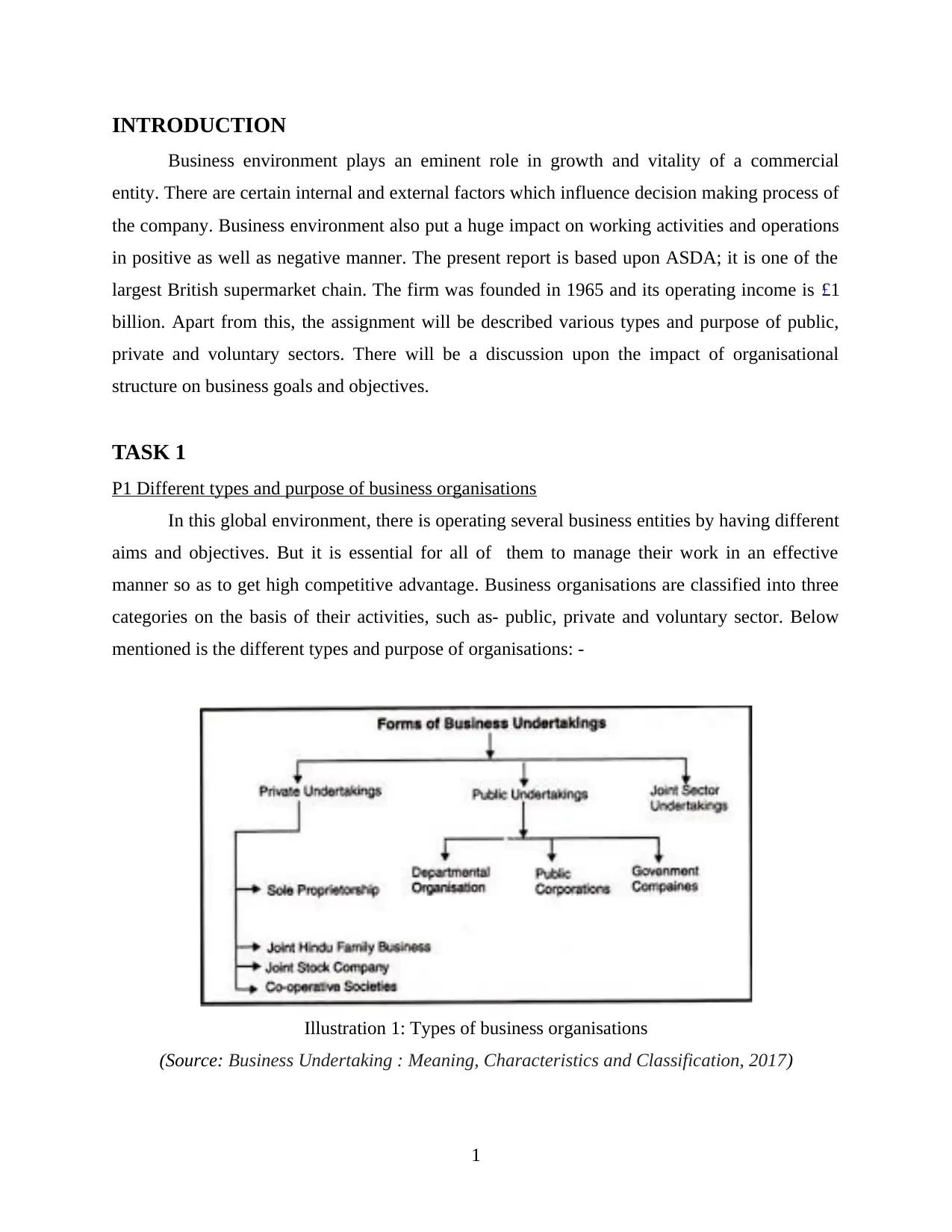
mentioned is the different types and purpose of organisations: -
(Source: Business Undertaking : Meaning, Characteristics and Classification, 2017)
1
Illustration 1: Types of business organisations
Business environment plays an eminent role in growth and vitality of a commercial
entity. There are certain internal and external factors which influence decision making process of
the company. Business environment also put a huge impact on working activities and operations
in positive as well as negative manner. The present report is based upon ASDA; it is one of the
largest British supermarket chain. The firm was founded in 1965 and its operating income is £1
billion. Apart from this, the assignment will be described various types and purpose of public,
private and voluntary sectors. There will be a discussion upon the impact of organisational
structure on business goals and objectives.
TASK 1
P1 Different types and purpose of business organisations
In this global environment, there is operating several business entities by having different
aims and objectives. But it is essential for all of them to manage their work in an effective
manner so as to get high competitive advantage. Business organisations are classified into three
categories on the basis of their activities, such as- public, private and voluntary sector. Below
mentioned is the different types and purpose of organisations: -
(Source: Business Undertaking : Meaning, Characteristics and Classification, 2017)
1
Illustration 1: Types of business organisations
⊘ This is a preview!⊘
Do you want full access?
Subscribe today to unlock all pages.

Trusted by 1+ million students worldwide
Public sector – Public sector organisations are vital and crucial as they gives strengthen
to any country's economy. Its main purpose is to establish strong infrastructure for economic
growth and success. Due to increasing fiscal deficit forces a government to adopt certain new
approaches for working in PSU. Apart from this, public sector involves those companies which
are implemented and controlled by the central government by having 100% stake in it. At the
economic recessions, when UK was facing various financial or economical issues then public
sector organisation gives strength to the economy condition of the country. Hence, the main
objective of public sectors is to rapidly promote economic growth and provide job opportunities
to people in order to improve their living standard. In other words, public sector entities are
executed for public welfare and evolvement as people can live better life. For example- ASDA is
subsidiary company of WALMART which is one of the largest public organisation. It was the
greatest super market chain since 2003 to 2014 by having a market share of 135. ASDA has
located in 650 locations in different countries across the world. Its main products are – grocery,
financial services and general merchandise. Purpose – The main purpose of the company to produce effective and qualitative
products on an average rate, therefore people of all backgrounds can easily afford them.
Public sector organisations also liable to fulfil its social responsibilities in order to build
up its goodwill in target market.
Legal structure – Public sectors are directly funded by taxes and duties and it is not
essential for delivering organisations to achieve specific criteria of success. The level of
PSU's are federal, national and local communities. Basically public organisations are
followed vertical structure in which only a few people are responsible for decision
making process of the company.
Private sector – These companies are executed in order to gain maximum profit and
market share. Such organisations are not controlled and directed by government. In recent years,
there are several private business organisations are developed in UIK; which plays an important
role in economic development. Such firms also provides job opportunities to people in order to
improve their income level. Private sector organisations are employed by individuals.
Corporations and non government agencies. Working in competitive environment, means the
products and services of these organisations are more demanding among customers. For
example- Pizza hut is the private sector organisation; it is an American restaurant chain. The firm
2
to any country's economy. Its main purpose is to establish strong infrastructure for economic
growth and success. Due to increasing fiscal deficit forces a government to adopt certain new
approaches for working in PSU. Apart from this, public sector involves those companies which
are implemented and controlled by the central government by having 100% stake in it. At the
economic recessions, when UK was facing various financial or economical issues then public
sector organisation gives strength to the economy condition of the country. Hence, the main
objective of public sectors is to rapidly promote economic growth and provide job opportunities
to people in order to improve their living standard. In other words, public sector entities are
executed for public welfare and evolvement as people can live better life. For example- ASDA is
subsidiary company of WALMART which is one of the largest public organisation. It was the
greatest super market chain since 2003 to 2014 by having a market share of 135. ASDA has
located in 650 locations in different countries across the world. Its main products are – grocery,
financial services and general merchandise. Purpose – The main purpose of the company to produce effective and qualitative
products on an average rate, therefore people of all backgrounds can easily afford them.
Public sector organisations also liable to fulfil its social responsibilities in order to build
up its goodwill in target market.
Legal structure – Public sectors are directly funded by taxes and duties and it is not
essential for delivering organisations to achieve specific criteria of success. The level of
PSU's are federal, national and local communities. Basically public organisations are
followed vertical structure in which only a few people are responsible for decision
making process of the company.
Private sector – These companies are executed in order to gain maximum profit and
market share. Such organisations are not controlled and directed by government. In recent years,
there are several private business organisations are developed in UIK; which plays an important
role in economic development. Such firms also provides job opportunities to people in order to
improve their income level. Private sector organisations are employed by individuals.
Corporations and non government agencies. Working in competitive environment, means the
products and services of these organisations are more demanding among customers. For
example- Pizza hut is the private sector organisation; it is an American restaurant chain. The firm
2
Paraphrase This Document
Need a fresh take? Get an instant paraphrase of this document with our AI Paraphraser
was founded 1958 and it is famous for its american-italian cuisine, i.e. pizza and pasta. Pizza hut
is served at 16000 locations over the globe and its headquarter is in Plano, UK. Purpose – The main motive of private business organisations is to provide effective and
value added products and services which are liable to attain and retain customers for long
term period. In addition, these companies are able to reduce political interference in the
management of enterprise which leads to boost up productivity and efficiency.
Legal structure – The legal structure of private business is classified into five categories,
such as- sole traders, private companies, partnership, franchising etc. Shareholders and
boards of directors of the firm are liable to take certain important decision whereas CEO
of the company is managed all working activities at workplace.
Voluntary sector – It refers all those business entities which are implemented for social
welfare and development. NAVCA is one of the voluntary sector; it is a national membership
body for local support and development organisation in England. Purpose – It promotes local voluntary and community sector nationally. The main
objective of the firm is to render growth and development opportunities for the lower
sector of the society.
Legal structure – Trustees, funders, volunteers etc. are involved in business activities and
operations of voluntary sector.
1.2 Size and scope of different types of organisations
In the competitive era, there are different private, public and voluntary sectors are
implemented day day. Adaptive and flexible nature of corporate it is very easy for these firms to
perform in market. Business managers are used different tools and techniques in order to
evaluate their profitability and sales so as to serve something better to society. On the basis of
size and scope, business organisations are divided into different parts which are stated as under: -
Public sector – PSUs are responsible for economic growth and development. ASDA is
one of the largest public sector organisation in UK which deals in retail services at global
level. The firm also offers other services in financial and telecom sector. It is parent
company of WALMART which promotes itself through this slogan – Save money and
Live better. The was founded in 1949 and now it has almost 200000 employees over the
world. As the subsidiary company, ASDA is not required to represent its quarterly or half
yearly income statement but it submits annual earnings to US securities and exchange
3
is served at 16000 locations over the globe and its headquarter is in Plano, UK. Purpose – The main motive of private business organisations is to provide effective and
value added products and services which are liable to attain and retain customers for long
term period. In addition, these companies are able to reduce political interference in the
management of enterprise which leads to boost up productivity and efficiency.
Legal structure – The legal structure of private business is classified into five categories,
such as- sole traders, private companies, partnership, franchising etc. Shareholders and
boards of directors of the firm are liable to take certain important decision whereas CEO
of the company is managed all working activities at workplace.
Voluntary sector – It refers all those business entities which are implemented for social
welfare and development. NAVCA is one of the voluntary sector; it is a national membership
body for local support and development organisation in England. Purpose – It promotes local voluntary and community sector nationally. The main
objective of the firm is to render growth and development opportunities for the lower
sector of the society.
Legal structure – Trustees, funders, volunteers etc. are involved in business activities and
operations of voluntary sector.
1.2 Size and scope of different types of organisations
In the competitive era, there are different private, public and voluntary sectors are
implemented day day. Adaptive and flexible nature of corporate it is very easy for these firms to
perform in market. Business managers are used different tools and techniques in order to
evaluate their profitability and sales so as to serve something better to society. On the basis of
size and scope, business organisations are divided into different parts which are stated as under: -
Public sector – PSUs are responsible for economic growth and development. ASDA is
one of the largest public sector organisation in UK which deals in retail services at global
level. The firm also offers other services in financial and telecom sector. It is parent
company of WALMART which promotes itself through this slogan – Save money and
Live better. The was founded in 1949 and now it has almost 200000 employees over the
world. As the subsidiary company, ASDA is not required to represent its quarterly or half
yearly income statement but it submits annual earnings to US securities and exchange
3
commission. The firm is having 11695 stores in the world and it has 13% market share of
whole retailing market. The operating income of the company is US$22.764 billion.
Goals and objectives – ASDA has series of values, therefore the main objective of the
company is to set long term directions for the organisation. The mission statement of the firm is
to be UK's best retailer company by providing qualitative products which can meet their needs
and wants.
Private sector – Pizza Hut is the selected private organisation that deals in food products.
It is also a subsidiary company of Yum! Brands Inc. Along with this, the company is
located in around 14000 locations across the world, i.e. china, India, UK, Malaysia,
America etc. The firm was executed in 15th June 1958; there are over 40000 employees
are presently worked with Pizza hut. The firm also emphasis on providing healthy and
safe working environment to employees as they can attain and retain for long term
period. The sales revenue of Pizza hut is increased by 20% every year.
Goals and objectives – The firm believes to provide great quality of pizza and excellent
customer services. In addition, the mission statement of the firm is to become faster as well as
best pizza provider by achieving values, customer satisfaction level etc.
Voluntary sector - NAVCA is the voluntary sector organisation which services its
services in England. It is strategic partner of department of health as well as cabinet
offices of civil society. Its main aim is to contribute in government policies. NAVCA a
coalition of 17 charities so as to prevent grants of community groups.
Goal and objective – The prime objective of the firm is to improve social activities and
provide a healthy environment to public.
1.3 (M1) Inter-linked organisational size with its objectives
The growth and development of every business organisation is depend upon its size and
number of employees as well. Small business enterprises have limited objects because they serve
to local areas whereas objectives of multinational organisations are linked with international
market. For example- ASDA, Pizza Hut and NAVCA are large companies and provides their
services at global level. Therefore, size and scope of a business organisations helps it to achieve
goals and objectives in a certain time period. In this perspective, if a commercial entity has
variety of products and services then it can easily accomplish high competitive advantage in a
pervasive manner. Beside this, number of customers will be also helpful for these companies, i.e.
4
whole retailing market. The operating income of the company is US$22.764 billion.
Goals and objectives – ASDA has series of values, therefore the main objective of the
company is to set long term directions for the organisation. The mission statement of the firm is
to be UK's best retailer company by providing qualitative products which can meet their needs
and wants.
Private sector – Pizza Hut is the selected private organisation that deals in food products.
It is also a subsidiary company of Yum! Brands Inc. Along with this, the company is
located in around 14000 locations across the world, i.e. china, India, UK, Malaysia,
America etc. The firm was executed in 15th June 1958; there are over 40000 employees
are presently worked with Pizza hut. The firm also emphasis on providing healthy and
safe working environment to employees as they can attain and retain for long term
period. The sales revenue of Pizza hut is increased by 20% every year.
Goals and objectives – The firm believes to provide great quality of pizza and excellent
customer services. In addition, the mission statement of the firm is to become faster as well as
best pizza provider by achieving values, customer satisfaction level etc.
Voluntary sector - NAVCA is the voluntary sector organisation which services its
services in England. It is strategic partner of department of health as well as cabinet
offices of civil society. Its main aim is to contribute in government policies. NAVCA a
coalition of 17 charities so as to prevent grants of community groups.
Goal and objective – The prime objective of the firm is to improve social activities and
provide a healthy environment to public.
1.3 (M1) Inter-linked organisational size with its objectives
The growth and development of every business organisation is depend upon its size and
number of employees as well. Small business enterprises have limited objects because they serve
to local areas whereas objectives of multinational organisations are linked with international
market. For example- ASDA, Pizza Hut and NAVCA are large companies and provides their
services at global level. Therefore, size and scope of a business organisations helps it to achieve
goals and objectives in a certain time period. In this perspective, if a commercial entity has
variety of products and services then it can easily accomplish high competitive advantage in a
pervasive manner. Beside this, number of customers will be also helpful for these companies, i.e.
4
⊘ This is a preview!⊘
Do you want full access?
Subscribe today to unlock all pages.
Trusted by 1+ million students worldwide
ASDA, Pizza Hut and NAVCA to deal effectively in global environment. Target audiences are
also helpful in increasing annual turnover and sales revenue of the firm in a certain time period.
As ASDA is operating in different countries in which it has covered 13% market share; in order
to enhance market area the firm has to provide well qualitative and branded products to its
customers.
TASK 2
2.1 Interrelationship between organisational functions and its structure
In order to perform effectively in target market, it is essential for every firm to prepare an
adequate organisational structure. It also helps managers in delegation of authorities among staff
members as per their capabilities. ASDA is following a proper and systematically preparative
organisational structures in which working activities are divided into different departments. All
managers and their operations are also inter linked with each other. It aids to accomplish its
vision and mission in an effective manner (Bovee, Thill and Raina, 2016). Organisational
structure involved different units, such as- finance, operations, research, marketing and human
resources etc. Apart from this, it is necessary for decision makers of these departments to
develop business plan and monitor them, then give appropriate recommendations in order to get
better outcomes. All these departments have a crucial role in growth and vitality of the firm. Finance department – This department of ASDA is liable for preparing different
financial statements for external uses. Finance department also provides information
regarding management as well as accounts and give advice to board departments. It also
helps in providing financial forecasts so that managers can manage their working
activities in an effective manner. Human resource department – The HR department of the company is liable to manage
overall workforce of the company. Human resource professionals provides training and
development assistance to employees in order to improve their efficiency and
productivity (Belás and et. al., 2015).
Marketing department – The main objective of marketing department is to boost up sales
of the company. In this perspective, managers make several strategies and policies in
order to attain and retain customers for long term period.
5
also helpful in increasing annual turnover and sales revenue of the firm in a certain time period.
As ASDA is operating in different countries in which it has covered 13% market share; in order
to enhance market area the firm has to provide well qualitative and branded products to its
customers.
TASK 2
2.1 Interrelationship between organisational functions and its structure
In order to perform effectively in target market, it is essential for every firm to prepare an
adequate organisational structure. It also helps managers in delegation of authorities among staff
members as per their capabilities. ASDA is following a proper and systematically preparative
organisational structures in which working activities are divided into different departments. All
managers and their operations are also inter linked with each other. It aids to accomplish its
vision and mission in an effective manner (Bovee, Thill and Raina, 2016). Organisational
structure involved different units, such as- finance, operations, research, marketing and human
resources etc. Apart from this, it is necessary for decision makers of these departments to
develop business plan and monitor them, then give appropriate recommendations in order to get
better outcomes. All these departments have a crucial role in growth and vitality of the firm. Finance department – This department of ASDA is liable for preparing different
financial statements for external uses. Finance department also provides information
regarding management as well as accounts and give advice to board departments. It also
helps in providing financial forecasts so that managers can manage their working
activities in an effective manner. Human resource department – The HR department of the company is liable to manage
overall workforce of the company. Human resource professionals provides training and
development assistance to employees in order to improve their efficiency and
productivity (Belás and et. al., 2015).
Marketing department – The main objective of marketing department is to boost up sales
of the company. In this perspective, managers make several strategies and policies in
order to attain and retain customers for long term period.
5
Paraphrase This Document
Need a fresh take? Get an instant paraphrase of this document with our AI Paraphraser
Apart from this, ASDA is following matrix organisational structure in which only higehr
authorities are liable to final decisions within the company. But it allows employees as they can
easily interact with their managers and share their ideas or view points towarsd any particular
topic.
2.2 (M2) Advantages and disadvantages of interrelationships between organisational functions
There is a strong inter relation within all departments of the firms as its is essential to
perform any working activity. But it has certain merit and demerits for a company; which are
described as under: -
Advantages Disadvantages
Access to expertise. Confusion of demand
Adequate and proper supervision. Power struggle and conflicts
Mass production and flexibility Lack of responsibilities
2.3 (D1) Complexities of business structure
There are various kinds of organisational structures, but ASDA is following matrix
organisational structure. In that, workers have to report two managers which generates more
confusions and conflicts. Along with this, staff members also confused regrading their roles and
responsibilities which can hamper working processes and activities (Commander and Svejnar,
2011).
CONCLUSION
From the above mentioned report, it has been concluded that corporate world in an
intermixture of three types of organisations, i.e. public, private and voluntary. All these entities
are equally responsible for economic growth and development. In order to perform effectively in
target market, ASDA is following matrix organisational structure. Through which employees can
easily interact with each other.
6
authorities are liable to final decisions within the company. But it allows employees as they can
easily interact with their managers and share their ideas or view points towarsd any particular
topic.
2.2 (M2) Advantages and disadvantages of interrelationships between organisational functions
There is a strong inter relation within all departments of the firms as its is essential to
perform any working activity. But it has certain merit and demerits for a company; which are
described as under: -
Advantages Disadvantages
Access to expertise. Confusion of demand
Adequate and proper supervision. Power struggle and conflicts
Mass production and flexibility Lack of responsibilities
2.3 (D1) Complexities of business structure
There are various kinds of organisational structures, but ASDA is following matrix
organisational structure. In that, workers have to report two managers which generates more
confusions and conflicts. Along with this, staff members also confused regrading their roles and
responsibilities which can hamper working processes and activities (Commander and Svejnar,
2011).
CONCLUSION
From the above mentioned report, it has been concluded that corporate world in an
intermixture of three types of organisations, i.e. public, private and voluntary. All these entities
are equally responsible for economic growth and development. In order to perform effectively in
target market, ASDA is following matrix organisational structure. Through which employees can
easily interact with each other.
6
REFERENCES
Books and Journal
Bovee, C. L., Thill, J. V. and Raina, R. L., 2016. Business communication today. Pearson
Education India.
Belás, J. and et. al., 2015. The business environment of small and medium-sized enterprises in
selected regions of the Czech Republic and Slovakia. E+ M Ekonomie a Management.
(1). p.95.
Commander, S. and Svejnar, J., 2011. Business environment, exports, ownership, and firm
performance. The Review of Economics and Statistics. 93(1). pp.309-337.
Cronan, T. P. and et. al., 2011. Decision making in an integrated business process context:
Learning using an ERP simulation game. Decision Sciences Journal of Innovative
Education. 9(2). pp.227-234.
Cuervo‐Cazurra, A., 2011. Global strategy and global business environment: the direct and
indirect influences of the home country on a firm's global strategy. Global Strategy
Journal. 1(3‐4). pp.382-386.
Elliot, S., 2011. Transdisciplinary perspectives on environmental sustainability: a resource base
and framework for IT-enabled business transformation. Mis quarterly. 35(1). pp.197-
236.
Guglielmetti, C., 2011. Measuring the business environment for entrepreneurship in fragile
states. In Entrepreneurship and Economic Development. (pp. 124-143). Palgrave
Macmillan UK.Boons, F. and Lüdeke-Freund, F., 2013. Business models for sustainable
innovation: state-of-the-art and steps towards a research agenda. Journal of Cleaner
Production. 45. pp.9-19.
Online
Business Undertaking : Meaning, Characteristics and Classification, 2017. [Online] Available
through: <http://www.yourarticlelibrary.com/business/business-undertaking-meaning-
characteristics-and-classification/42034>.
7
Books and Journal
Bovee, C. L., Thill, J. V. and Raina, R. L., 2016. Business communication today. Pearson
Education India.
Belás, J. and et. al., 2015. The business environment of small and medium-sized enterprises in
selected regions of the Czech Republic and Slovakia. E+ M Ekonomie a Management.
(1). p.95.
Commander, S. and Svejnar, J., 2011. Business environment, exports, ownership, and firm
performance. The Review of Economics and Statistics. 93(1). pp.309-337.
Cronan, T. P. and et. al., 2011. Decision making in an integrated business process context:
Learning using an ERP simulation game. Decision Sciences Journal of Innovative
Education. 9(2). pp.227-234.
Cuervo‐Cazurra, A., 2011. Global strategy and global business environment: the direct and
indirect influences of the home country on a firm's global strategy. Global Strategy
Journal. 1(3‐4). pp.382-386.
Elliot, S., 2011. Transdisciplinary perspectives on environmental sustainability: a resource base
and framework for IT-enabled business transformation. Mis quarterly. 35(1). pp.197-
236.
Guglielmetti, C., 2011. Measuring the business environment for entrepreneurship in fragile
states. In Entrepreneurship and Economic Development. (pp. 124-143). Palgrave
Macmillan UK.Boons, F. and Lüdeke-Freund, F., 2013. Business models for sustainable
innovation: state-of-the-art and steps towards a research agenda. Journal of Cleaner
Production. 45. pp.9-19.
Online
Business Undertaking : Meaning, Characteristics and Classification, 2017. [Online] Available
through: <http://www.yourarticlelibrary.com/business/business-undertaking-meaning-
characteristics-and-classification/42034>.
7
⊘ This is a preview!⊘
Do you want full access?
Subscribe today to unlock all pages.
Trusted by 1+ million students worldwide

1 out of 9


Related Documents


Your All-in-One AI-Powered Toolkit for Academic Success.
+13062052269
info@desklib.com
Available 24*7 on WhatsApp / Email
![[object Object]](/_next/static/media/star-bottom.7253800d.svg)
Unlock your academic potential
Copyright © 2020–2025 A2Z Services. All Rights Reserved. Developed and managed by ZUCOL.