Business Environment: Analysis of Two Contrasting Businesses Report
VerifiedAdded on 2020/11/12
|11
|3590
|224
Report
AI Summary
This report provides a comprehensive analysis of the business environment, focusing on two contrasting businesses: Transdev and Transport for London (TFL). The report begins by describing the type of business, purpose, and ownership of each company, highlighting their contrasting structures as a private and public entity, respectively. It then identifies and analyzes the influence of various stakeholders, including customers, employees, and government, on each business's objectives. The organizational structures of both businesses are examined, with a focus on how they are organized to fulfill their purposes. Furthermore, the report explores the impact of different economic environments, such as those in the UK and Australia, on the business activities of Transdev. Finally, the report delves into the political, legal, and social factors that affect the operations of both companies, providing a detailed overview of the challenges and opportunities they face within their respective business environments. The analysis includes how these factors impact the company's operations and strategies.
BUSINESS
ENVIRONMENT
ENVIRONMENT

Paraphrase This Document
Need a fresh take? Get an instant paraphrase of this document with our AI Paraphraser
Table of Contents
INTRODUCTION...........................................................................................................................3
TASK 1............................................................................................................................................3
P1- Describe the type of business, purpose and ownership of two contrasting businesses........3
P2- Describe the different stakeholders who influence the purpose of two contrasting
businesses....................................................................................................................................4
TASK 2............................................................................................................................................6
P3 How businesses are organised...............................................................................................6
P4 Style of organisation in order to fulfil the purpose of organisations....................................7
TASK 3............................................................................................................................................7
P5- Influence of two contrasting economic environments on business activities.......................7
TASK 4............................................................................................................................................8
P6- How political, legal and social factors are impacting the business activities.......................8
CONCLUSION..............................................................................................................................10
REFERENCES..............................................................................................................................11
INTRODUCTION...........................................................................................................................3
TASK 1............................................................................................................................................3
P1- Describe the type of business, purpose and ownership of two contrasting businesses........3
P2- Describe the different stakeholders who influence the purpose of two contrasting
businesses....................................................................................................................................4
TASK 2............................................................................................................................................6
P3 How businesses are organised...............................................................................................6
P4 Style of organisation in order to fulfil the purpose of organisations....................................7
TASK 3............................................................................................................................................7
P5- Influence of two contrasting economic environments on business activities.......................7
TASK 4............................................................................................................................................8
P6- How political, legal and social factors are impacting the business activities.......................8
CONCLUSION..............................................................................................................................10
REFERENCES..............................................................................................................................11
INTRODUCTION
Business refers to the system which is formed for satisfying the needs and demands of the
people. These businesses varies in different aspects such as products and services, size of
organisation, purpose of establishing, etc. These firms operates in a business environment having
a large number of firms which creates competition. The management of the companies needs to
determine the factors of business environment in order to reduce their impact. The taken firm is
the Transdev which is providing different types of transportation services to the customers. This
report will cover the type of business, purpose and ownership along with the different
stakeholders of the firms. Further this report will also cover how the different businesses are
organised along with the type of styles for fulfilling their purposes. This report will also cover
the political, legal and social factors which are impacting the business activities.
TASK 1
P1- Describe the type of business, purpose and ownership of two contrasting businesses
Businesses are formed for providing their products and services to the customers for
fulfilling their demands and requirements. The products and services provided by the businesses
varies with their purpose and objectives. There are several types of business whose purpose and
size varies with each other.
First type of organisation is the Profit organisation. These firms are formed for the purpose
of earning money by supplying their products and services to the customers. Such firms are
focused on enhancing their profit rather than improving the life style of the society. These
organisations desires to accomplish high market share and sustainability at the market place. The
owners of these firms are single individuals or board of directors who are liable for the company
loss and profit (Garrido-Moreno and Padilla-Meléndez, 2011). Example of such firm is Transdev
which is private or profit organisation providing different types of transportation services to the
customers which includes include bus, coach and private hire services. The ownership of the
company lies in the hand of Board of Directors, jointly owned by Caisse des Dépôts and the
RETHMANN Group. The two groups are in partnership agreement for achieving their shared
strategic vision for the development of Transdev (Who leads the group, 2018). Purpose of the
company is to satisfy the transportation or travelling needs of individuals in order to achieve high
profitability and revenue by providing them safe and secure transportation facilities. Due to the
Business refers to the system which is formed for satisfying the needs and demands of the
people. These businesses varies in different aspects such as products and services, size of
organisation, purpose of establishing, etc. These firms operates in a business environment having
a large number of firms which creates competition. The management of the companies needs to
determine the factors of business environment in order to reduce their impact. The taken firm is
the Transdev which is providing different types of transportation services to the customers. This
report will cover the type of business, purpose and ownership along with the different
stakeholders of the firms. Further this report will also cover how the different businesses are
organised along with the type of styles for fulfilling their purposes. This report will also cover
the political, legal and social factors which are impacting the business activities.
TASK 1
P1- Describe the type of business, purpose and ownership of two contrasting businesses
Businesses are formed for providing their products and services to the customers for
fulfilling their demands and requirements. The products and services provided by the businesses
varies with their purpose and objectives. There are several types of business whose purpose and
size varies with each other.
First type of organisation is the Profit organisation. These firms are formed for the purpose
of earning money by supplying their products and services to the customers. Such firms are
focused on enhancing their profit rather than improving the life style of the society. These
organisations desires to accomplish high market share and sustainability at the market place. The
owners of these firms are single individuals or board of directors who are liable for the company
loss and profit (Garrido-Moreno and Padilla-Meléndez, 2011). Example of such firm is Transdev
which is private or profit organisation providing different types of transportation services to the
customers which includes include bus, coach and private hire services. The ownership of the
company lies in the hand of Board of Directors, jointly owned by Caisse des Dépôts and the
RETHMANN Group. The two groups are in partnership agreement for achieving their shared
strategic vision for the development of Transdev (Who leads the group, 2018). Purpose of the
company is to satisfy the transportation or travelling needs of individuals in order to achieve high
profitability and revenue by providing them safe and secure transportation facilities. Due to the
⊘ This is a preview!⊘
Do you want full access?
Subscribe today to unlock all pages.

Trusted by 1+ million students worldwide
partnership agreement, liability and debt for the owners are limited in case of company
insolvency, company liquidation or company rescue procedure. The partners are liable for the
loss and profit based on their percent of share invested in the company.
Public or Not for profit organisations are formed for satisfying the needs and
requirements of the society and are operated by the government of that particular place. The
government is liable for the loss and profit in these organisations. The purpose of these
organisation is to offer products and services to the consumers at low and affordable rates in
order to provide the services to a large number of people (Wales, Monsen, and McKelvie, 2011).
The example of such businesses includes Transport for London (TFL) which is a public limited
organisation having headquarter in London. The company is providing transportation services to
the citizen of London. The share of the firm is traded and available for public. Purpose of this
firm is to provide the transportation services to the customers at affordable rates so as to enhance
their travelling experience and ease in travelling around the London. The ownership of the
company lies in hand of Mayor of London who is Sadiq Khan (How we are governed, 2019). For
the liability and debts of the company, Mayor or owner is not liable as these are operated by the
government and government pay the loss occurred.
P2- Describe the different stakeholders who influence the purpose of two contrasting businesses
Stakeholders are the people who provides their contribution and efforts to the
organisation in achieving the organisational objectives and purpose. These stakeholders are
either directly or indirectly influenced by the decision or strategies of the company. The
stakeholders of the organisations includes such as customers, employees, owners, suppliers, trade
unions, employer associations etc. The stakeholders of taken organisations and their influence on
purpose of organisations are as follows:
Customers purchases the products and services provided by the firms and get direct
impacted by the business operations. The customers of TFL can influence the company in
achieving their aim and purpose as without their interest in services of company, they would not
travel from the buses and instead take their own transportation medium which will impact the
sales and profit of the company (Craig and Campbell, 2012). These customers also impacts the
Transdev in achieving their aims and purpose as if they feel dissatisfied with services of the
company then the brand image of company will reduce and the company can face issues in
handling their operations at global level.
insolvency, company liquidation or company rescue procedure. The partners are liable for the
loss and profit based on their percent of share invested in the company.
Public or Not for profit organisations are formed for satisfying the needs and
requirements of the society and are operated by the government of that particular place. The
government is liable for the loss and profit in these organisations. The purpose of these
organisation is to offer products and services to the consumers at low and affordable rates in
order to provide the services to a large number of people (Wales, Monsen, and McKelvie, 2011).
The example of such businesses includes Transport for London (TFL) which is a public limited
organisation having headquarter in London. The company is providing transportation services to
the citizen of London. The share of the firm is traded and available for public. Purpose of this
firm is to provide the transportation services to the customers at affordable rates so as to enhance
their travelling experience and ease in travelling around the London. The ownership of the
company lies in hand of Mayor of London who is Sadiq Khan (How we are governed, 2019). For
the liability and debts of the company, Mayor or owner is not liable as these are operated by the
government and government pay the loss occurred.
P2- Describe the different stakeholders who influence the purpose of two contrasting businesses
Stakeholders are the people who provides their contribution and efforts to the
organisation in achieving the organisational objectives and purpose. These stakeholders are
either directly or indirectly influenced by the decision or strategies of the company. The
stakeholders of the organisations includes such as customers, employees, owners, suppliers, trade
unions, employer associations etc. The stakeholders of taken organisations and their influence on
purpose of organisations are as follows:
Customers purchases the products and services provided by the firms and get direct
impacted by the business operations. The customers of TFL can influence the company in
achieving their aim and purpose as without their interest in services of company, they would not
travel from the buses and instead take their own transportation medium which will impact the
sales and profit of the company (Craig and Campbell, 2012). These customers also impacts the
Transdev in achieving their aims and purpose as if they feel dissatisfied with services of the
company then the brand image of company will reduce and the company can face issues in
handling their operations at global level.
Paraphrase This Document
Need a fresh take? Get an instant paraphrase of this document with our AI Paraphraser
Employees provides their efforts and output to the organisation so that the business
operations can be performed effectively. Transdev is a global company employing a large
number of employees. These employees should perform their work properly for executing their
work in an effective manner. If they lack their interest in their working then it will leads to
reduced profitability and productivity of the company which will also impact the sustainability
(Adeoye and Elegunde, 2012). The employees of TFL can also influence the company in
attaining their purpose and aims as the company is providing the services to public and slightest
mistake from employees can result into reduced brand image and loss of the company. These
employees should needs to perform their work with accuracy in order to achieve the
organisational purpose of serving the customers with utmost care and safety.
Government also influences the companies in attaining their aims and objectives due to
the developed laws and standards which should be followed by the organisations. TFL is a public
organisation so the government can influence it directly in achieving their purpose. This is
because, the company is operated by the government and work according to strategies and
policies of government (Hickman and Silva, 2018). Change in policies and strategies can effect
the functioning of company due to which the purpose may not be achieved. Transdev is a private
firm which can also be influenced by the government as changes in laws and regulations can
impact the operations and services of the company. Also the factors and laws associated with
pollution, passengers capacity etc. can influence the company in operating the business
effectively.
These above discussed stakeholders can impact the Transdev company directly or
indirectly in both positive and negative manner. The positive impact is of effective functioning if
the legal laws are followed by the firm which will also positively impact the brand image and
reputation of the company. This will bring more customers towards the services of the company.
However, negative impact exists if the laws are not followed which will impact the mindset of
customers and employees which will result in dissatisfaction among them. This will negatively
impact the reputation of firm and firm may not perform the operations in an effective manner.
operations can be performed effectively. Transdev is a global company employing a large
number of employees. These employees should perform their work properly for executing their
work in an effective manner. If they lack their interest in their working then it will leads to
reduced profitability and productivity of the company which will also impact the sustainability
(Adeoye and Elegunde, 2012). The employees of TFL can also influence the company in
attaining their purpose and aims as the company is providing the services to public and slightest
mistake from employees can result into reduced brand image and loss of the company. These
employees should needs to perform their work with accuracy in order to achieve the
organisational purpose of serving the customers with utmost care and safety.
Government also influences the companies in attaining their aims and objectives due to
the developed laws and standards which should be followed by the organisations. TFL is a public
organisation so the government can influence it directly in achieving their purpose. This is
because, the company is operated by the government and work according to strategies and
policies of government (Hickman and Silva, 2018). Change in policies and strategies can effect
the functioning of company due to which the purpose may not be achieved. Transdev is a private
firm which can also be influenced by the government as changes in laws and regulations can
impact the operations and services of the company. Also the factors and laws associated with
pollution, passengers capacity etc. can influence the company in operating the business
effectively.
These above discussed stakeholders can impact the Transdev company directly or
indirectly in both positive and negative manner. The positive impact is of effective functioning if
the legal laws are followed by the firm which will also positively impact the brand image and
reputation of the company. This will bring more customers towards the services of the company.
However, negative impact exists if the laws are not followed which will impact the mindset of
customers and employees which will result in dissatisfaction among them. This will negatively
impact the reputation of firm and firm may not perform the operations in an effective manner.
TASK 2
P3 How businesses are organised
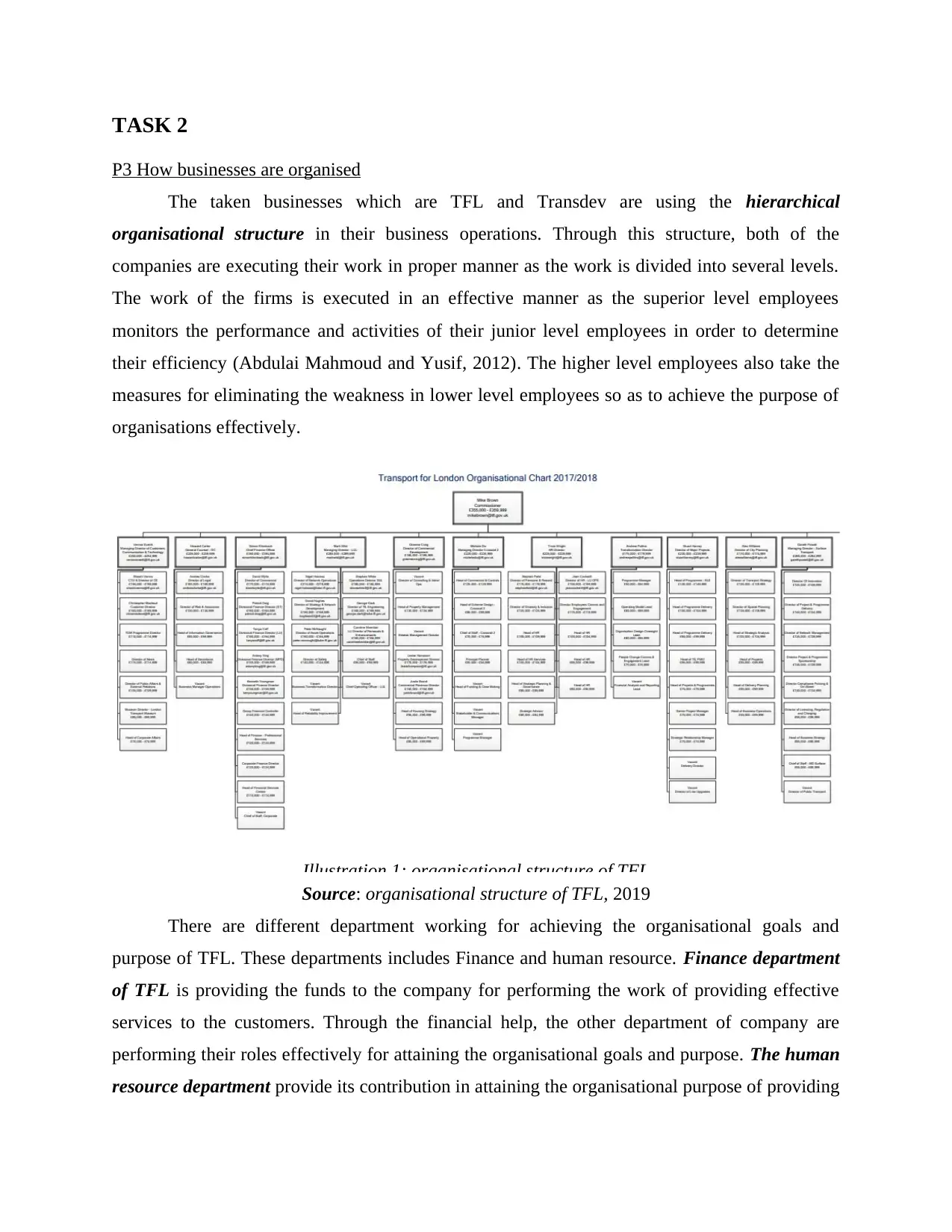
The taken businesses which are TFL and Transdev are using the hierarchical
organisational structure in their business operations. Through this structure, both of the
companies are executing their work in proper manner as the work is divided into several levels.
The work of the firms is executed in an effective manner as the superior level employees
monitors the performance and activities of their junior level employees in order to determine
their efficiency (Abdulai Mahmoud and Yusif, 2012). The higher level employees also take the
measures for eliminating the weakness in lower level employees so as to achieve the purpose of
organisations effectively.
Source: organisational structure of TFL, 2019
There are different department working for achieving the organisational goals and
purpose of TFL. These departments includes Finance and human resource. Finance department
of TFL is providing the funds to the company for performing the work of providing effective
services to the customers. Through the financial help, the other department of company are
performing their roles effectively for attaining the organisational goals and purpose. The human
resource department provide its contribution in attaining the organisational purpose of providing
Illustration 1: organisational structure of TFL
P3 How businesses are organised
The taken businesses which are TFL and Transdev are using the hierarchical
organisational structure in their business operations. Through this structure, both of the
companies are executing their work in proper manner as the work is divided into several levels.
The work of the firms is executed in an effective manner as the superior level employees
monitors the performance and activities of their junior level employees in order to determine
their efficiency (Abdulai Mahmoud and Yusif, 2012). The higher level employees also take the
measures for eliminating the weakness in lower level employees so as to achieve the purpose of
organisations effectively.
Source: organisational structure of TFL, 2019
There are different department working for achieving the organisational goals and
purpose of TFL. These departments includes Finance and human resource. Finance department
of TFL is providing the funds to the company for performing the work of providing effective
services to the customers. Through the financial help, the other department of company are
performing their roles effectively for attaining the organisational goals and purpose. The human
resource department provide its contribution in attaining the organisational purpose of providing
Illustration 1: organisational structure of TFL
⊘ This is a preview!⊘
Do you want full access?
Subscribe today to unlock all pages.
Trusted by 1+ million students worldwide
effective services to the customers by hiring suitable candidates who can perform the work in
required manner with required efficiency (Miles, 2012). Transdev is also having several
departments such as finance and marketing which provides their contribution for achieving the
organisational goals and purpose. The finance department of Transdev is providing funds
assistance to the company and its different departments so that they can perform their function
for providing the services to customers in an effective manner. The human resource department
of Transdev is hiring the candidates having suitable skills and knowledge for performing the
business operations. The human resource department is using the interview for selecting the
potential candidates.
P4 Style of organisation in order to fulfil the purpose of organisations
There are various types of styles which are used by the organisations for fulfilling their
purpose for which the firms are developed. These styles are discussed below:
Organisational structure: This is an essential aspect for the firms which is beneficial for
accomplishing the desired organisational goals. Both of the firms are following the hierarchical
organisational structure due to which the work of the company is being executed in an effective
manner (Stare, 2011). Through this structure, both firms are attaining their goals of providing
good quality based transportation services to the customers.
Strategic planning: This is also an essential component for the fulfilment of purposes of
both organisations. TFL is following the participative leadership and management style for
developing the future strategies by considering the views and opinions of their employees so that
the strategies can assist them in achieving their organisational goals (Bryson, 2018). The
Transdev is following the autocratic leadership and management style for developing their future
strategies so as to provide the direction to employees in which the employees has to work for
achieving the organisational goals and purposes.
TASK 3
P5- Influence of two contrasting economic environments on business activities
Transdev is a global firm providing services to the customers in several countries. The
company is operating the business in different economic environments due to which these can
impact the business activities of company. The first is the economic environment of UK and
second is of Australia in which the company is performing their operations. The economic
required manner with required efficiency (Miles, 2012). Transdev is also having several
departments such as finance and marketing which provides their contribution for achieving the
organisational goals and purpose. The finance department of Transdev is providing funds
assistance to the company and its different departments so that they can perform their function
for providing the services to customers in an effective manner. The human resource department
of Transdev is hiring the candidates having suitable skills and knowledge for performing the
business operations. The human resource department is using the interview for selecting the
potential candidates.
P4 Style of organisation in order to fulfil the purpose of organisations
There are various types of styles which are used by the organisations for fulfilling their
purpose for which the firms are developed. These styles are discussed below:
Organisational structure: This is an essential aspect for the firms which is beneficial for
accomplishing the desired organisational goals. Both of the firms are following the hierarchical
organisational structure due to which the work of the company is being executed in an effective
manner (Stare, 2011). Through this structure, both firms are attaining their goals of providing
good quality based transportation services to the customers.
Strategic planning: This is also an essential component for the fulfilment of purposes of
both organisations. TFL is following the participative leadership and management style for
developing the future strategies by considering the views and opinions of their employees so that
the strategies can assist them in achieving their organisational goals (Bryson, 2018). The
Transdev is following the autocratic leadership and management style for developing their future
strategies so as to provide the direction to employees in which the employees has to work for
achieving the organisational goals and purposes.
TASK 3
P5- Influence of two contrasting economic environments on business activities
Transdev is a global firm providing services to the customers in several countries. The
company is operating the business in different economic environments due to which these can
impact the business activities of company. The first is the economic environment of UK and
second is of Australia in which the company is performing their operations. The economic
Paraphrase This Document
Need a fresh take? Get an instant paraphrase of this document with our AI Paraphraser
environment of UK includes growth rate, inflation & industry’s economic indicators such as
consumer spending etc. which can be used by the Transdev for forecasting the growth of the
company (O'Neill, 2013). The government of UK is stable now after the Brexit which is
positively impacting the firm. The inflation in UK also decreased due to which customers of UK
are spending their money again in proper manner. The policies of UK government are also stable
and monitored by the organisation in order to reduce the impact if occurs which is positively
impacting the firm.
The economic environment of Australia includes growth rate, inflation, tax rate etc.
which are impacting the Transdev. The recession is high in Australia along with the 10% Sales
tax and 30% of corporate tax which is comparatively higher than UK (Pecotich, and Shultz,
2016). This is impacting the sales of the firm as the customers are facing economic crises due to
which they are not capable of spending much. However, company has strong financial position
due to which the loss of the company is less due to the recession and high tax and corporate tax.
TASK 4
P6- How political, legal and social factors are impacting the business activities
There are various factors which can impacts the business activities of firms i.e.
TFL and Transdev which are operating in different economic environment. These factors
includes social, legal and political which should be considered by both firms for effectively
achieving the desired organisational purposes. Political factors includes political stability,
government support, government policies etc. Political condition of Australia is stable due to
which the business firms such as Transdev is getting the support from government as they are
providing services to the general public (Zheng, 2014). The customers and employees are also
getting positive impact as the company is providing effective services and facilities to customers
and employees. Whereas political environment of UK is not stable due to the Brexit which is
negatively impacting the TFL as the firm is public. The government is changing the policies and
strategies at certain interval of time due to which company is failing in providing effective
services to customers and this is negatively impacting the brand image of firm too in front of
customers, employees and government.
Legal factors includes the laws and regulations formed by the government. Australia has
a strong and transparent legal framework due to which it is essential for Transdev to follow the
consumer spending etc. which can be used by the Transdev for forecasting the growth of the
company (O'Neill, 2013). The government of UK is stable now after the Brexit which is
positively impacting the firm. The inflation in UK also decreased due to which customers of UK
are spending their money again in proper manner. The policies of UK government are also stable
and monitored by the organisation in order to reduce the impact if occurs which is positively
impacting the firm.
The economic environment of Australia includes growth rate, inflation, tax rate etc.
which are impacting the Transdev. The recession is high in Australia along with the 10% Sales
tax and 30% of corporate tax which is comparatively higher than UK (Pecotich, and Shultz,
2016). This is impacting the sales of the firm as the customers are facing economic crises due to
which they are not capable of spending much. However, company has strong financial position
due to which the loss of the company is less due to the recession and high tax and corporate tax.
TASK 4
P6- How political, legal and social factors are impacting the business activities
There are various factors which can impacts the business activities of firms i.e.
TFL and Transdev which are operating in different economic environment. These factors
includes social, legal and political which should be considered by both firms for effectively
achieving the desired organisational purposes. Political factors includes political stability,
government support, government policies etc. Political condition of Australia is stable due to
which the business firms such as Transdev is getting the support from government as they are
providing services to the general public (Zheng, 2014). The customers and employees are also
getting positive impact as the company is providing effective services and facilities to customers
and employees. Whereas political environment of UK is not stable due to the Brexit which is
negatively impacting the TFL as the firm is public. The government is changing the policies and
strategies at certain interval of time due to which company is failing in providing effective
services to customers and this is negatively impacting the brand image of firm too in front of
customers, employees and government.
Legal factors includes the laws and regulations formed by the government. Australia has
a strong and transparent legal framework due to which it is essential for Transdev to follow the
acts and laws developed by the government. However the company is following the laws of
Australian government which is positively impacting the firm. The company needs to determine
the changes in such laws so that the impact can be reduced. Whereas TFL is a UK based public
firm, due to which the company is following the laws and regulations specified by the
government (Australia. Productivity Commission, 2013). Both of the firms are following the
laws of government due to which the stakeholders of the firms such as employees, customers,
government are also providing their support and contribution for accomplishing the goals.
Social factors involves the Population growth or decline, taste and preferences of
customers. Population in Australia is increasing and the people are also educated due to which a
large number of customers prefer the public vehicles in order to reduce the pollution which is
positive impact for the Transdev. Also the country more than 68% population of between the age
of 15-64 which also positively impacting the firm as such people prefer public vehicles too.
Whereas in UK, most people are old due to which they prefer to travel through public transport
which is improving the sales of the company (Davies and James, 2016). The population of the
country is increasing gradually and the people of UK are educated too due to which they
understand the importance of preserving the environment. The TFL is providing public
transportation services due to which company is enjoying the support from the government as
well as customers which is also positively impacting the employees in working properly so as to
enhance the support from other stakeholders (Brown and Green, 2012). Also the attitude of
people towards the work is positive due to which they are working hard for attaining the
organisational goals.
Impact of business activities in achieving the organisational purpose
Recruitment of right mix of skilled staff is essential requirement for both organisation
which can perform the business operations in effective manner for accomplishing the
organisational goals. Through such workers, these both firms can provide their services to
customers in an effective manner so as to achieve their goals and purposes. Also the product or
service design is an essential requirement for both firms in attracting the customers (Berkman,
Kawachi and Glymour, 2014). This design can be in terms of features, accessibility, travel routes
etc. which should be considered by management of firms for attracting the customers so that the
goals and purposes can be fulfilled. Through good services design, both companies can attract
the customers towards their services in order to ensure the customer satisfaction.
Australian government which is positively impacting the firm. The company needs to determine
the changes in such laws so that the impact can be reduced. Whereas TFL is a UK based public
firm, due to which the company is following the laws and regulations specified by the
government (Australia. Productivity Commission, 2013). Both of the firms are following the
laws of government due to which the stakeholders of the firms such as employees, customers,
government are also providing their support and contribution for accomplishing the goals.
Social factors involves the Population growth or decline, taste and preferences of
customers. Population in Australia is increasing and the people are also educated due to which a
large number of customers prefer the public vehicles in order to reduce the pollution which is
positive impact for the Transdev. Also the country more than 68% population of between the age
of 15-64 which also positively impacting the firm as such people prefer public vehicles too.
Whereas in UK, most people are old due to which they prefer to travel through public transport
which is improving the sales of the company (Davies and James, 2016). The population of the
country is increasing gradually and the people of UK are educated too due to which they
understand the importance of preserving the environment. The TFL is providing public
transportation services due to which company is enjoying the support from the government as
well as customers which is also positively impacting the employees in working properly so as to
enhance the support from other stakeholders (Brown and Green, 2012). Also the attitude of
people towards the work is positive due to which they are working hard for attaining the
organisational goals.
Impact of business activities in achieving the organisational purpose
Recruitment of right mix of skilled staff is essential requirement for both organisation
which can perform the business operations in effective manner for accomplishing the
organisational goals. Through such workers, these both firms can provide their services to
customers in an effective manner so as to achieve their goals and purposes. Also the product or
service design is an essential requirement for both firms in attracting the customers (Berkman,
Kawachi and Glymour, 2014). This design can be in terms of features, accessibility, travel routes
etc. which should be considered by management of firms for attracting the customers so that the
goals and purposes can be fulfilled. Through good services design, both companies can attract
the customers towards their services in order to ensure the customer satisfaction.
⊘ This is a preview!⊘
Do you want full access?
Subscribe today to unlock all pages.
Trusted by 1+ million students worldwide
CONCLUSION
It has been concluded from the above essay that the organisations has different purposes
for which they are formed. The stakeholders influences the businesses due to which management
needs to consider their interest in decision making. The companies should also needs to consider
the different styles which can be used for achieving the goals and purpose. The organisations
also needs to consider the factors which can impact the performance of company and its business
operations in strategy development so as to minimise their impact.
It has been concluded from the above essay that the organisations has different purposes
for which they are formed. The stakeholders influences the businesses due to which management
needs to consider their interest in decision making. The companies should also needs to consider
the different styles which can be used for achieving the goals and purpose. The organisations
also needs to consider the factors which can impact the performance of company and its business
operations in strategy development so as to minimise their impact.
Paraphrase This Document
Need a fresh take? Get an instant paraphrase of this document with our AI Paraphraser
REFERENCES
Books and journals
Abdulai Mahmoud, M. and Yusif, B., 2012. Market orientation, learning orientation, and the
performance of nonprofit organisations (NPOs). International Journal of Productivity
and Performance Management. 61(6). pp.624-652.
Adeoye, A.O. and Elegunde, A.F., 2012. Impacts of external business environment on
organisational performance in the food and beverage industry in Nigeria. British
Journal of Arts and Social Sciences. 6(2). pp.194-201.
Australia. Productivity Commission, 2013. An ageing Australia: Preparing for the future.
Productivity Commission.
Berkman, L.F., Kawachi, I. and Glymour, M.M. eds., 2014. Social epidemiology. Oxford
University Press.
Brown, B. and Green, N. eds., 2012. Wireless world: Social and interactional aspects of the
mobile age. Springer Science & Business Media.
Bryson, J.M., 2018. Strategic planning for public and nonprofit organizations: A guide to
strengthening and sustaining organizational achievement. John Wiley & Sons.
Craig, T. and Campbell, D., 2012. Organisations and the business environment. Routledge.
Davies, A. and James, A., 2016. Geographies of ageing: Social processes and the spatial
unevenness of population ageing. Routledge.
Garrido-Moreno, A. and Padilla-Meléndez, A., 2011. Analyzing the impact of knowledge
management on CRM success: The mediating effects of organizational
factors. International Journal of Information Management. 31(5). pp.437-444.
Hickman, C.R. and Silva, M.A., 2018. The Future 500: Creating Tomorrow's Organisations
Today. Routledge.
Miles, S., 2012. Stakeholder: essentially contested or just confused?. Journal of Business Ethics.
108(3). pp.285-298.
O'Neill, J., 2013. Markets, deliberation and environment. Routledge.
Pecotich, A. and Shultz, C.J., 2016. Handbook of Markets and Economies: East Asia, Southeast
Asia, Australia, New Zealand: East Asia, Southeast Asia, Australia, New Zealand.
Routledge.
Stare, A., 2011. The impact of the organisational structure and project organisational culture on
project performance in Slovenian enterprises. Management: journal of contemporary
management issues. 16(2). pp.1-22.
Wales, W., Monsen, E. and McKelvie, A., 2011. The organizational pervasiveness of
entrepreneurial orientation. Entrepreneurship Theory and Practice. 35(5). pp.895-923.
Zheng, P., 2014. Antecedents to international student inflows to UK higher education: A
comparative analysis. Journal of Business Research. 67(2). pp.136-143.
Online
Organisational chart of TFL. 2018. [Online]. Available through: <http://content.tfl.gov.uk/tfl-
organisational-chart-2017-2018.pdf>.
Who leads the group. 2018. [Online]. Available through: <https://www.transdev.com/en/about-
us/who-leads-the-group/>.
How we are governed. 2019. [Online]. Available through: <https://tfl.gov.uk/corporate/about-
tfl/how-we-work/how-we-are-governed>.
Books and journals
Abdulai Mahmoud, M. and Yusif, B., 2012. Market orientation, learning orientation, and the
performance of nonprofit organisations (NPOs). International Journal of Productivity
and Performance Management. 61(6). pp.624-652.
Adeoye, A.O. and Elegunde, A.F., 2012. Impacts of external business environment on
organisational performance in the food and beverage industry in Nigeria. British
Journal of Arts and Social Sciences. 6(2). pp.194-201.
Australia. Productivity Commission, 2013. An ageing Australia: Preparing for the future.
Productivity Commission.
Berkman, L.F., Kawachi, I. and Glymour, M.M. eds., 2014. Social epidemiology. Oxford
University Press.
Brown, B. and Green, N. eds., 2012. Wireless world: Social and interactional aspects of the
mobile age. Springer Science & Business Media.
Bryson, J.M., 2018. Strategic planning for public and nonprofit organizations: A guide to
strengthening and sustaining organizational achievement. John Wiley & Sons.
Craig, T. and Campbell, D., 2012. Organisations and the business environment. Routledge.
Davies, A. and James, A., 2016. Geographies of ageing: Social processes and the spatial
unevenness of population ageing. Routledge.
Garrido-Moreno, A. and Padilla-Meléndez, A., 2011. Analyzing the impact of knowledge
management on CRM success: The mediating effects of organizational
factors. International Journal of Information Management. 31(5). pp.437-444.
Hickman, C.R. and Silva, M.A., 2018. The Future 500: Creating Tomorrow's Organisations
Today. Routledge.
Miles, S., 2012. Stakeholder: essentially contested or just confused?. Journal of Business Ethics.
108(3). pp.285-298.
O'Neill, J., 2013. Markets, deliberation and environment. Routledge.
Pecotich, A. and Shultz, C.J., 2016. Handbook of Markets and Economies: East Asia, Southeast
Asia, Australia, New Zealand: East Asia, Southeast Asia, Australia, New Zealand.
Routledge.
Stare, A., 2011. The impact of the organisational structure and project organisational culture on
project performance in Slovenian enterprises. Management: journal of contemporary
management issues. 16(2). pp.1-22.
Wales, W., Monsen, E. and McKelvie, A., 2011. The organizational pervasiveness of
entrepreneurial orientation. Entrepreneurship Theory and Practice. 35(5). pp.895-923.
Zheng, P., 2014. Antecedents to international student inflows to UK higher education: A
comparative analysis. Journal of Business Research. 67(2). pp.136-143.
Online
Organisational chart of TFL. 2018. [Online]. Available through: <http://content.tfl.gov.uk/tfl-
organisational-chart-2017-2018.pdf>.
Who leads the group. 2018. [Online]. Available through: <https://www.transdev.com/en/about-
us/who-leads-the-group/>.
How we are governed. 2019. [Online]. Available through: <https://tfl.gov.uk/corporate/about-
tfl/how-we-work/how-we-are-governed>.

1 out of 11


Related Documents


Your All-in-One AI-Powered Toolkit for Academic Success.
+13062052269
info@desklib.com
Available 24*7 on WhatsApp / Email
![[object Object]](/_next/static/media/star-bottom.7253800d.svg)
Unlock your academic potential
Copyright © 2020–2026 A2Z Services. All Rights Reserved. Developed and managed by ZUCOL.