Online Discussion: Management, Business Environment, and Strategy
VerifiedAdded on 2023/06/11
|10
|2488
|402
Discussion Board Post
AI Summary
This document comprises a student's responses to ten discussion topics related to the business environment, as part of an online participation activity for a MySCU course. The topics cover a wide range of management concepts, including the evolution of management thinking, environmental considerations, change management, human resource management, individual and organizational behavior, leadership, employee motivation, communication, teamwork, and sustainable operations. Each response provides insights and analysis on the given topic, demonstrating engagement with the course materials and critical thinking skills. The document also includes a reference list.

Running head: UNDERSTANDING THE BUSINESS ENVIRONMENT
Understanding the Business Environment
Name of the student:
Name of the university:
Author note:
Understanding the Business Environment
Name of the student:
Name of the university:
Author note:

Paraphrase This Document
Need a fresh take? Get an instant paraphrase of this document with our AI Paraphraser
1UNDERSTANDING THE BUSINESS ENVIRONMENT
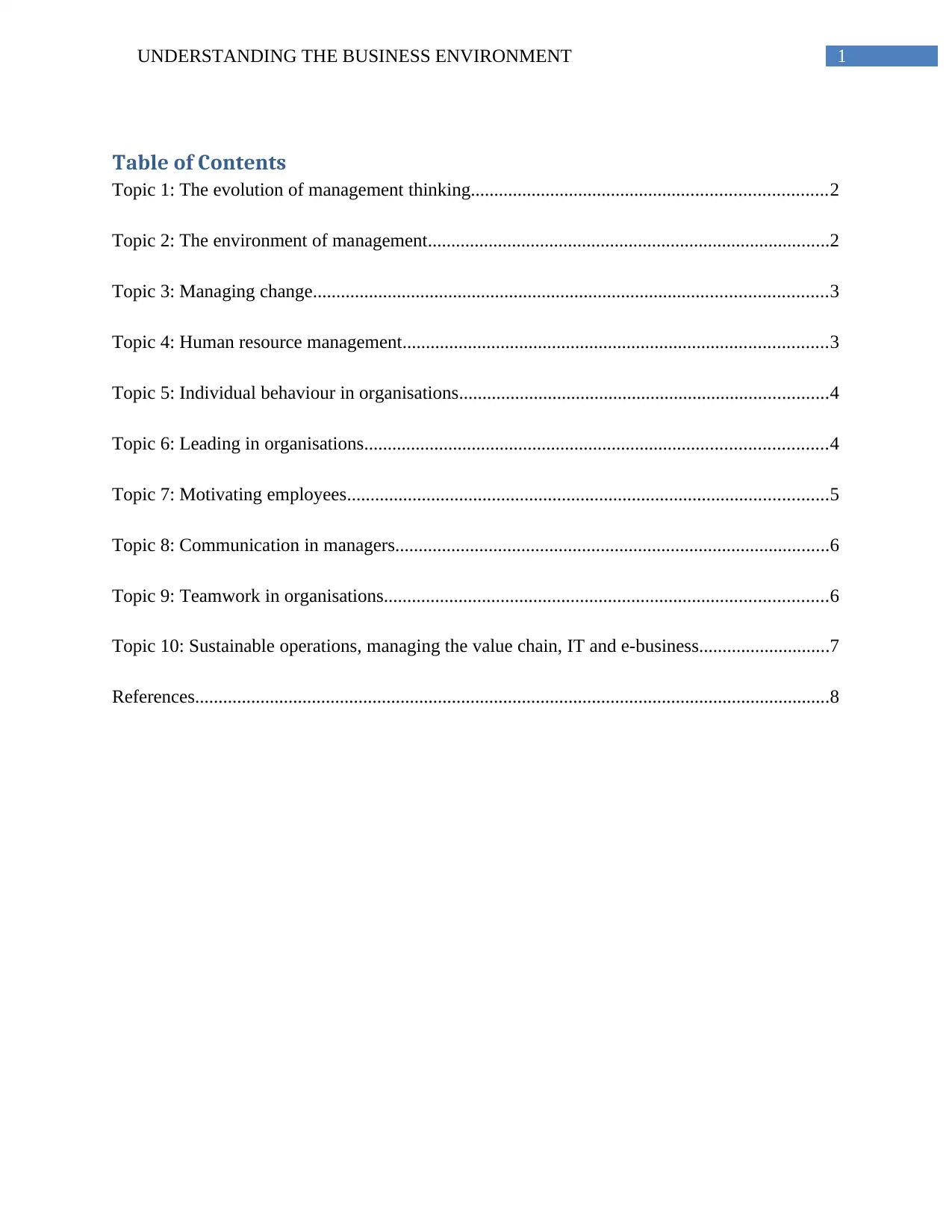
Table of Contents
Topic 1: The evolution of management thinking............................................................................2
Topic 2: The environment of management......................................................................................2
Topic 3: Managing change..............................................................................................................3
Topic 4: Human resource management...........................................................................................3
Topic 5: Individual behaviour in organisations...............................................................................4
Topic 6: Leading in organisations...................................................................................................4
Topic 7: Motivating employees.......................................................................................................5
Topic 8: Communication in managers.............................................................................................6
Topic 9: Teamwork in organisations...............................................................................................6
Topic 10: Sustainable operations, managing the value chain, IT and e-business............................7
References........................................................................................................................................8
Table of Contents
Topic 1: The evolution of management thinking............................................................................2
Topic 2: The environment of management......................................................................................2
Topic 3: Managing change..............................................................................................................3
Topic 4: Human resource management...........................................................................................3
Topic 5: Individual behaviour in organisations...............................................................................4
Topic 6: Leading in organisations...................................................................................................4
Topic 7: Motivating employees.......................................................................................................5
Topic 8: Communication in managers.............................................................................................6
Topic 9: Teamwork in organisations...............................................................................................6
Topic 10: Sustainable operations, managing the value chain, IT and e-business............................7
References........................................................................................................................................8
2UNDERSTANDING THE BUSINESS ENVIRONMENT
Topic 1: The evolution of management thinking
The question is a bit confusing for a fact that both technologies and people are important
for an organisation. Technological innovations have encouraged organisations to use the variety f
technologies to attain the competency. However, this is also undeniable that employees are the
asset for an organisation. Additionally, the fact that employee turnover is a global issue; it
becomes important to have an effective employee engagement program (Ahmed et al. 2018).
According to the leaner, the management of people is more important than technology. This is
due to a fact that people are the ones who are deployed to manage the technologies. Few
technologies may not have a direct intervention of the organisational resources; however, such
points are very rare. The list of such technologies includes customer relationship management
(CRM) and others. However, there are many aspects also where continuous exposure to
technologies is required which is never possible without the deployment of relevantly skilled
people (Browning 2014).
Topic 2: The environment of management
Part B
“Carbon emissions” is one of the environmental issues which are impacting the
environment. Global industries and companies are now required to take care of the three
elements of the triple bottom line approach which is people, planet and profit (Ozanne et al.
2016). Doing some works for the planet is the necessity now for modern day businesses.
Woolworths is very concerned with reducing the carbon footprint from stores, distribution
centres and offices. It has taken a few innovative strategies like using the energy efficiency
devices in stores particularly in newly furbished stores. The key area to focus is the refrigeration.
Topic 1: The evolution of management thinking
The question is a bit confusing for a fact that both technologies and people are important
for an organisation. Technological innovations have encouraged organisations to use the variety f
technologies to attain the competency. However, this is also undeniable that employees are the
asset for an organisation. Additionally, the fact that employee turnover is a global issue; it
becomes important to have an effective employee engagement program (Ahmed et al. 2018).
According to the leaner, the management of people is more important than technology. This is
due to a fact that people are the ones who are deployed to manage the technologies. Few
technologies may not have a direct intervention of the organisational resources; however, such
points are very rare. The list of such technologies includes customer relationship management
(CRM) and others. However, there are many aspects also where continuous exposure to
technologies is required which is never possible without the deployment of relevantly skilled
people (Browning 2014).
Topic 2: The environment of management
Part B
“Carbon emissions” is one of the environmental issues which are impacting the
environment. Global industries and companies are now required to take care of the three
elements of the triple bottom line approach which is people, planet and profit (Ozanne et al.
2016). Doing some works for the planet is the necessity now for modern day businesses.
Woolworths is very concerned with reducing the carbon footprint from stores, distribution
centres and offices. It has taken a few innovative strategies like using the energy efficiency
devices in stores particularly in newly furbished stores. The key area to focus is the refrigeration.
⊘ This is a preview!⊘
Do you want full access?
Subscribe today to unlock all pages.

Trusted by 1+ million students worldwide
3UNDERSTANDING THE BUSINESS ENVIRONMENT
The plan is there to replace the existing HFC refrigerants from a hybrid system, so that, the CO2
emission is reduced (Akbar and Ahsan 2014). The move may expectedly reduce the greenhouse
gas emission and hence, the brand image will remain secured. The educated modern day
customers give high regards to the employer with good CSR scoring.
Topic 3: Managing change
It is very difficult to manage a change process, especially in circumstances when there is
resistance from few of employees. They may have fears of job loss. In course to keep them safe
such employees become resistant to change management. Change may not necessarily be
feasible or appropriate at all the times; however, at times when it is feasible, it must be
implemented strategically. Following ways can be used to manage the change (Hornstein 2015):
Keeping an expectation of resistance to change
Use of formal ways in addressing to resistance
Identification of root causes which have triggered the resistance
Allocation of resistant managing tasks to the appropriate managers such as senior leaders,
supervisors and managers
Respective managers or the supervisors generally have the adequate understanding of employees.
Hence, they will find ways to deal with employees who are resistant to change process.
Topic 4: Human resource management
No, it is not wise although it may provide some useful information regarding the
participating applicants. Accessing to someone’s data without any prior consent for the same is
prohibited from The Privacy Act 1988 (Australia) (Oaic.gov.au 2018). As per the act, it is not
The plan is there to replace the existing HFC refrigerants from a hybrid system, so that, the CO2
emission is reduced (Akbar and Ahsan 2014). The move may expectedly reduce the greenhouse
gas emission and hence, the brand image will remain secured. The educated modern day
customers give high regards to the employer with good CSR scoring.
Topic 3: Managing change
It is very difficult to manage a change process, especially in circumstances when there is
resistance from few of employees. They may have fears of job loss. In course to keep them safe
such employees become resistant to change management. Change may not necessarily be
feasible or appropriate at all the times; however, at times when it is feasible, it must be
implemented strategically. Following ways can be used to manage the change (Hornstein 2015):
Keeping an expectation of resistance to change
Use of formal ways in addressing to resistance
Identification of root causes which have triggered the resistance
Allocation of resistant managing tasks to the appropriate managers such as senior leaders,
supervisors and managers
Respective managers or the supervisors generally have the adequate understanding of employees.
Hence, they will find ways to deal with employees who are resistant to change process.
Topic 4: Human resource management
No, it is not wise although it may provide some useful information regarding the
participating applicants. Accessing to someone’s data without any prior consent for the same is
prohibited from The Privacy Act 1988 (Australia) (Oaic.gov.au 2018). As per the act, it is not
Paraphrase This Document
Need a fresh take? Get an instant paraphrase of this document with our AI Paraphraser
4UNDERSTANDING THE BUSINESS ENVIRONMENT
allowed to access or unethically use the other’s data for the wrong purpose. Apart from this, such
things should not happen because postings on social media sites like Facebook may not
necessarily reveal the actual image of the person. On top of all, such postings do not speak of the
talents, skills and qualifications of the concerned applicants. The best way to know the talent is
to test the applicants either verbally or else to check for the skills.
It is unethical to access the other’s data without a prior concern for the same from the
person. This is understandable as well from The Privacy Act 1988 (Australia). The act does not
allow a misuse of and an unauthorised access to someone’s data.
Topic 5: Individual behaviour in organisations
Work pressure, incompetent salary, unfriendly work environment and others can be the
reasons for stress (Jacobs et al. 2014). Irrespective of the reasons for stress, there must be a
system to motivate employees and give an effort to reduce the employee turnover. The most
effective way to help employees get rid of stress is listening to them. A system advocating the
comments posting activity from employees can be a good strategy for managers. Managers must
provide a system to employees where they can feel free to share comments on a daily or weekly
basis. Assigning coach to such employees can also be helpful. The coach will take one-to-one
session separately with employees who are distressed. Such discussions will produce ample of
findings such as the reasons for stress. Managers can then collect the data to identify the best
possible way to mitigate the issue. Notably, the one-to-one session is not just to find the reasons
but also for sorting those out (Rajalakshmi and Gomathi, 2015).
Topic 6: Leading in organisations
allowed to access or unethically use the other’s data for the wrong purpose. Apart from this, such
things should not happen because postings on social media sites like Facebook may not
necessarily reveal the actual image of the person. On top of all, such postings do not speak of the
talents, skills and qualifications of the concerned applicants. The best way to know the talent is
to test the applicants either verbally or else to check for the skills.
It is unethical to access the other’s data without a prior concern for the same from the
person. This is understandable as well from The Privacy Act 1988 (Australia). The act does not
allow a misuse of and an unauthorised access to someone’s data.
Topic 5: Individual behaviour in organisations
Work pressure, incompetent salary, unfriendly work environment and others can be the
reasons for stress (Jacobs et al. 2014). Irrespective of the reasons for stress, there must be a
system to motivate employees and give an effort to reduce the employee turnover. The most
effective way to help employees get rid of stress is listening to them. A system advocating the
comments posting activity from employees can be a good strategy for managers. Managers must
provide a system to employees where they can feel free to share comments on a daily or weekly
basis. Assigning coach to such employees can also be helpful. The coach will take one-to-one
session separately with employees who are distressed. Such discussions will produce ample of
findings such as the reasons for stress. Managers can then collect the data to identify the best
possible way to mitigate the issue. Notably, the one-to-one session is not just to find the reasons
but also for sorting those out (Rajalakshmi and Gomathi, 2015).
Topic 6: Leading in organisations
5UNDERSTANDING THE BUSINESS ENVIRONMENT
There is a list of traits which modern day leaders possess. The traits include emotional
stability, enthusiasm, dominance, Conscientiousness, tough-mindedness, social boldness,
compulsiveness and self-assurance. Out of the mentioned traits tough-mindedness, social
boldness, emotional stability and self-assurance are the most effective traits. Leaders must be
practical, so that, professionalism is displayed rather than biases. Emotional stability is important
as it helps to remain strong in tough times which are important to make decisions. Social
boldness is necessary to get attached to the organisational members. Self-assurance helps leaders
to portray their image as a resilient person (DuBois et al. 2015).
Strengths are different to leadership traits because traits can be both positive and negative
as well. However, strengths are always the elements which inspire the followers or others. For
example, compulsiveness is one of the leadership traits which indicate a low socialism in leaders.
Leaders are generally limited in social interactions. Entrepreneurship is one of the strengths
which few of the leaders have like Mark Zuckerberg, Bill Gates and Steve Jobs (Davidsson
2015).
Topic 7: Motivating employees
The contemporary workforce is comprised of Millennials, Boomers and baby Boomers.
The three generations differ to each other in workplace behaviour due to their family status, the
social wellbeing and the life responsibilities. Millennials generally carry little or no
responsibilities at their homes while Baby Boomers are the most active part of it. Boomers due to
their age are just a part of it and rarely take the ownership in decision making. The list is endless
and very difficult to cover as well. However, it is evident that motivating factors will be more or
less different for different generations. Millennials keep shuffling with jobs unless they get their
There is a list of traits which modern day leaders possess. The traits include emotional
stability, enthusiasm, dominance, Conscientiousness, tough-mindedness, social boldness,
compulsiveness and self-assurance. Out of the mentioned traits tough-mindedness, social
boldness, emotional stability and self-assurance are the most effective traits. Leaders must be
practical, so that, professionalism is displayed rather than biases. Emotional stability is important
as it helps to remain strong in tough times which are important to make decisions. Social
boldness is necessary to get attached to the organisational members. Self-assurance helps leaders
to portray their image as a resilient person (DuBois et al. 2015).
Strengths are different to leadership traits because traits can be both positive and negative
as well. However, strengths are always the elements which inspire the followers or others. For
example, compulsiveness is one of the leadership traits which indicate a low socialism in leaders.
Leaders are generally limited in social interactions. Entrepreneurship is one of the strengths
which few of the leaders have like Mark Zuckerberg, Bill Gates and Steve Jobs (Davidsson
2015).
Topic 7: Motivating employees
The contemporary workforce is comprised of Millennials, Boomers and baby Boomers.
The three generations differ to each other in workplace behaviour due to their family status, the
social wellbeing and the life responsibilities. Millennials generally carry little or no
responsibilities at their homes while Baby Boomers are the most active part of it. Boomers due to
their age are just a part of it and rarely take the ownership in decision making. The list is endless
and very difficult to cover as well. However, it is evident that motivating factors will be more or
less different for different generations. Millennials keep shuffling with jobs unless they get their
⊘ This is a preview!⊘
Do you want full access?
Subscribe today to unlock all pages.
Trusted by 1+ million students worldwide
6UNDERSTANDING THE BUSINESS ENVIRONMENT
dream job. Boomers want to settle with the job they have. Baby Boomers are mostly near to their
retirement. Millennials are very keen for workplace environment apart from their salary. Baby
Boomers look for better work policies, so that, job stability is attained. Boomers need easier
work, so that, they are also valued (Becton, Walker and Jones‐Farmer 2014).
Topic 8: Communication in managers
Managers with effective communication skills will have better ability to tackle the
challenging situation and will also be able to effectively collaborate with the organisational
members. However, managers must have some skills which are essential to effective
communication. Such skills can be explored by managers through training which will comprise a
specifically designed training module. The module will have self-assessment stage where
managers will get a chance to test their capability in communication. Effective communication
skills development will be the next stage of training. There will be modules focussing on the
barriers to communication. In the training, managers will also learn the obstacles to learning.
Managers will also need to learn the effective way of questioning. Training will be given to
improving the question posing skills. Training must also have an element of educating on how to
give effective feedback. Moreover, managers will be trained on the Situation-Behaviour-Impact
model to help them become an effective feedback giver (DuBois et al. 2015).
Topic 9: Teamwork in organisations
Rewarding the entire team for quality performance will provide an opportunity to every
member of the team to work as a collective group which is very good to lift the team spirit.
Managers must understand the importance of a socially infused workplace environment. Teams
must get an encouragement from their leaders for being social. Outlining the clear and feasible
dream job. Boomers want to settle with the job they have. Baby Boomers are mostly near to their
retirement. Millennials are very keen for workplace environment apart from their salary. Baby
Boomers look for better work policies, so that, job stability is attained. Boomers need easier
work, so that, they are also valued (Becton, Walker and Jones‐Farmer 2014).
Topic 8: Communication in managers
Managers with effective communication skills will have better ability to tackle the
challenging situation and will also be able to effectively collaborate with the organisational
members. However, managers must have some skills which are essential to effective
communication. Such skills can be explored by managers through training which will comprise a
specifically designed training module. The module will have self-assessment stage where
managers will get a chance to test their capability in communication. Effective communication
skills development will be the next stage of training. There will be modules focussing on the
barriers to communication. In the training, managers will also learn the obstacles to learning.
Managers will also need to learn the effective way of questioning. Training will be given to
improving the question posing skills. Training must also have an element of educating on how to
give effective feedback. Moreover, managers will be trained on the Situation-Behaviour-Impact
model to help them become an effective feedback giver (DuBois et al. 2015).
Topic 9: Teamwork in organisations
Rewarding the entire team for quality performance will provide an opportunity to every
member of the team to work as a collective group which is very good to lift the team spirit.
Managers must understand the importance of a socially infused workplace environment. Teams
must get an encouragement from their leaders for being social. Outlining the clear and feasible
Paraphrase This Document
Need a fresh take? Get an instant paraphrase of this document with our AI Paraphraser
7UNDERSTANDING THE BUSINESS ENVIRONMENT
roles to every team member is also essential. This will help to avoid any conflict regarding the
job responsibilities. It must also be communicated effectively to make it understandable to all.
Identifying the issues is another managerial quality which helps to reach to the root cause of the
issue. Such strategy will open up opportunities for the solution. Managers must also be able to
dislodge the media disputes. It is very important that managers are able to face media in tough
times and are able to save the company’s brand image by effectively justifying the truth.
Topic 10: Sustainable operations, managing the value chain, IT and e-business
Technological innovation is one of the most talked about topic in business today. This is
viewed as a mean to competency. For example, the use of CRM (customer relationship
management) and Big Data analytics are the few examples of technological innovation.
However, it is not necessary that same technology is equally useful or feasible to every industry.
Some of the technologies as mentioned above are highly used in firms where data management is
a key operation. Data management in this way may not be a feasible concern to SMEs. To such
firms, there are other technologies like the automated telephone enquiry system which can be
both useful and feasible to SMEs. Technological advancement is a growing concern without any
doubt; however, feasibility with the concerned industry is also an important task to check.
roles to every team member is also essential. This will help to avoid any conflict regarding the
job responsibilities. It must also be communicated effectively to make it understandable to all.
Identifying the issues is another managerial quality which helps to reach to the root cause of the
issue. Such strategy will open up opportunities for the solution. Managers must also be able to
dislodge the media disputes. It is very important that managers are able to face media in tough
times and are able to save the company’s brand image by effectively justifying the truth.
Topic 10: Sustainable operations, managing the value chain, IT and e-business
Technological innovation is one of the most talked about topic in business today. This is
viewed as a mean to competency. For example, the use of CRM (customer relationship
management) and Big Data analytics are the few examples of technological innovation.
However, it is not necessary that same technology is equally useful or feasible to every industry.
Some of the technologies as mentioned above are highly used in firms where data management is
a key operation. Data management in this way may not be a feasible concern to SMEs. To such
firms, there are other technologies like the automated telephone enquiry system which can be
both useful and feasible to SMEs. Technological advancement is a growing concern without any
doubt; however, feasibility with the concerned industry is also an important task to check.
8UNDERSTANDING THE BUSINESS ENVIRONMENT
References
Ahmed, S., Hasanuzzaman, M., Chowdhury, M.S.I., Shaikh, M.E. and Munir, M.S., 2018. A
Survey on the Factors Affecting Employee Turnover in the Readymade Garments of
Bangladesh. Global Journal of Research In Engineering.
Akbar, S. and Ahsan, K., 2014. Analysis of corporate social disclosure practices of Australian
retail firms. International Journal of Managerial and Financial Accounting, 6(4), pp.375-396.
Becton, J.B., Walker, H.J. and Jones‐Farmer, A., 2014. Generational differences in workplace
behavior. Journal of Applied Social Psychology, 44(3), pp.175-189.
Browning, T.R., 2014. Managing complex project process models with a process architecture
framework. International Journal of Project Management, 32(2), pp.229-241.
Davidsson, P., 2015. Entrepreneurial opportunities and the entrepreneurship nexus: A re-
conceptualization. Journal of Business Venturing, 30(5), pp.674-695.
DuBois, M., Hanlon, J., Koch, J., Nyatuga, B. and Kerr, N., 2015. Leadership styles of effective
project managers: Techniques and traits to lead high performance teams. Journal of Economic
Development, Management, IT, Finance, and Marketing, 7(1), p.30.
Hornstein, H.A., 2015. The integration of project management and organizational change
management is now a necessity. International Journal of Project Management, 33(2), pp.291-
298.
Jacobs, S., Hassell, K., Ashcroft, D., Johnson, S. and O’Connor, E., 2014. Workplace stress in
community pharmacies in England: associations with individual, organizational and job
characteristics. Journal of health services research & policy, 19(1), pp.27-33.
References
Ahmed, S., Hasanuzzaman, M., Chowdhury, M.S.I., Shaikh, M.E. and Munir, M.S., 2018. A
Survey on the Factors Affecting Employee Turnover in the Readymade Garments of
Bangladesh. Global Journal of Research In Engineering.
Akbar, S. and Ahsan, K., 2014. Analysis of corporate social disclosure practices of Australian
retail firms. International Journal of Managerial and Financial Accounting, 6(4), pp.375-396.
Becton, J.B., Walker, H.J. and Jones‐Farmer, A., 2014. Generational differences in workplace
behavior. Journal of Applied Social Psychology, 44(3), pp.175-189.
Browning, T.R., 2014. Managing complex project process models with a process architecture
framework. International Journal of Project Management, 32(2), pp.229-241.
Davidsson, P., 2015. Entrepreneurial opportunities and the entrepreneurship nexus: A re-
conceptualization. Journal of Business Venturing, 30(5), pp.674-695.
DuBois, M., Hanlon, J., Koch, J., Nyatuga, B. and Kerr, N., 2015. Leadership styles of effective
project managers: Techniques and traits to lead high performance teams. Journal of Economic
Development, Management, IT, Finance, and Marketing, 7(1), p.30.
Hornstein, H.A., 2015. The integration of project management and organizational change
management is now a necessity. International Journal of Project Management, 33(2), pp.291-
298.
Jacobs, S., Hassell, K., Ashcroft, D., Johnson, S. and O’Connor, E., 2014. Workplace stress in
community pharmacies in England: associations with individual, organizational and job
characteristics. Journal of health services research & policy, 19(1), pp.27-33.
⊘ This is a preview!⊘
Do you want full access?
Subscribe today to unlock all pages.
Trusted by 1+ million students worldwide
9UNDERSTANDING THE BUSINESS ENVIRONMENT
Oaic.gov.au 2018. Privacy law| Office of the Australian Information Commissioner - OAIC.
[online] Oaic.gov.au. Available at: https://oaic.gov.au/privacy-law/ [Accessed 27 May 2018].
Ozanne, L.K., Phipps, M., Weaver, T., Carrington, M., Luchs, M., Catlin, J., Gupta, S., Santos,
N., Scott, K. and Williams, J., 2016. Managing the tensions at the intersection of the triple
bottom line: A paradox theory approach to sustainability management. Journal of Public Policy
& Marketing, 35(2), pp.249-261.
Rajalakshmi, M. and Gomathi, S., 2015. A study on the factors influencing workplace bullying
and its impact on employee stress. Mediterranean Journal of Social Sciences, 6(1), p.292.
Oaic.gov.au 2018. Privacy law| Office of the Australian Information Commissioner - OAIC.
[online] Oaic.gov.au. Available at: https://oaic.gov.au/privacy-law/ [Accessed 27 May 2018].
Ozanne, L.K., Phipps, M., Weaver, T., Carrington, M., Luchs, M., Catlin, J., Gupta, S., Santos,
N., Scott, K. and Williams, J., 2016. Managing the tensions at the intersection of the triple
bottom line: A paradox theory approach to sustainability management. Journal of Public Policy
& Marketing, 35(2), pp.249-261.
Rajalakshmi, M. and Gomathi, S., 2015. A study on the factors influencing workplace bullying
and its impact on employee stress. Mediterranean Journal of Social Sciences, 6(1), p.292.

1 out of 10


Related Documents


Your All-in-One AI-Powered Toolkit for Academic Success.
+13062052269
info@desklib.com
Available 24*7 on WhatsApp / Email
![[object Object]](/_next/static/media/star-bottom.7253800d.svg)
Unlock your academic potential
Copyright © 2020–2026 A2Z Services. All Rights Reserved. Developed and managed by ZUCOL.