Business Ethics Case Study: Analyzing Abbot's Theft and Justification

Verified

Added on  2021/04/16

|4
|724
|35
Case Study
AI Summary
This case study examines the ethical dilemma faced by Abbot, a philosophy student suffering from poverty and vitamin deficiency, who steals meat from a grocery store. The assignment analyzes whether Abbot's actions are justified, considering the principles of virtue ethics and the legal implications under the Canadian Criminal Code. It explores the conflict between individual needs and societal obligations, including the justification of theft based on social responsibility. The analysis highlights the inherent unethical and illegal nature of stealing, emphasizing that such actions do not reflect good virtues or moral character. The study references relevant academic sources to support its arguments, ultimately concluding that Abbot's act of stealing was both unethical and illegal, regardless of his circumstances.
Document Page
Running Head: BUSINESS ETHICS
Business Ethics
Name of the Student:
Name of the University:
Author Note
tabler-icon-diamond-filled.svg

Paraphrase This Document

Need a fresh take? Get an instant paraphrase of this document with our AI Paraphraser
Document Page
1BUSINESS ETHICS
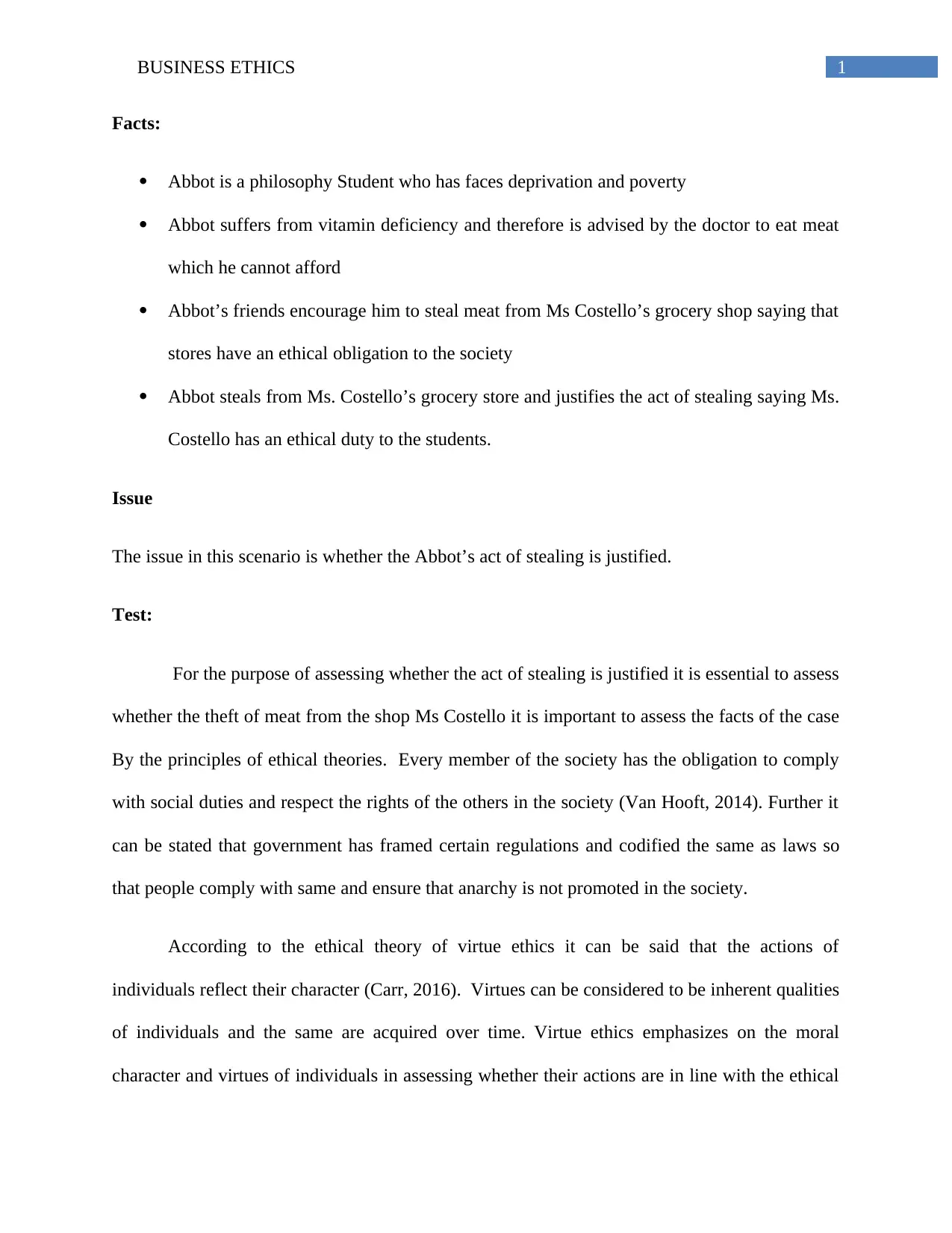
Facts:
Abbot is a philosophy Student who has faces deprivation and poverty
Abbot suffers from vitamin deficiency and therefore is advised by the doctor to eat meat
which he cannot afford
Abbot’s friends encourage him to steal meat from Ms Costello’s grocery shop saying that
stores have an ethical obligation to the society
Abbot steals from Ms. Costello’s grocery store and justifies the act of stealing saying Ms.
Costello has an ethical duty to the students.
Issue
The issue in this scenario is whether the Abbot’s act of stealing is justified.
Test:
For the purpose of assessing whether the act of stealing is justified it is essential to assess
whether the theft of meat from the shop Ms Costello it is important to assess the facts of the case
By the principles of ethical theories. Every member of the society has the obligation to comply
with social duties and respect the rights of the others in the society (Van Hooft, 2014). Further it
can be stated that government has framed certain regulations and codified the same as laws so
that people comply with same and ensure that anarchy is not promoted in the society.
According to the ethical theory of virtue ethics it can be said that the actions of
individuals reflect their character (Carr, 2016). Virtues can be considered to be inherent qualities
of individuals and the same are acquired over time. Virtue ethics emphasizes on the moral
character and virtues of individuals in assessing whether their actions are in line with the ethical
Document Page
2BUSINESS ETHICS
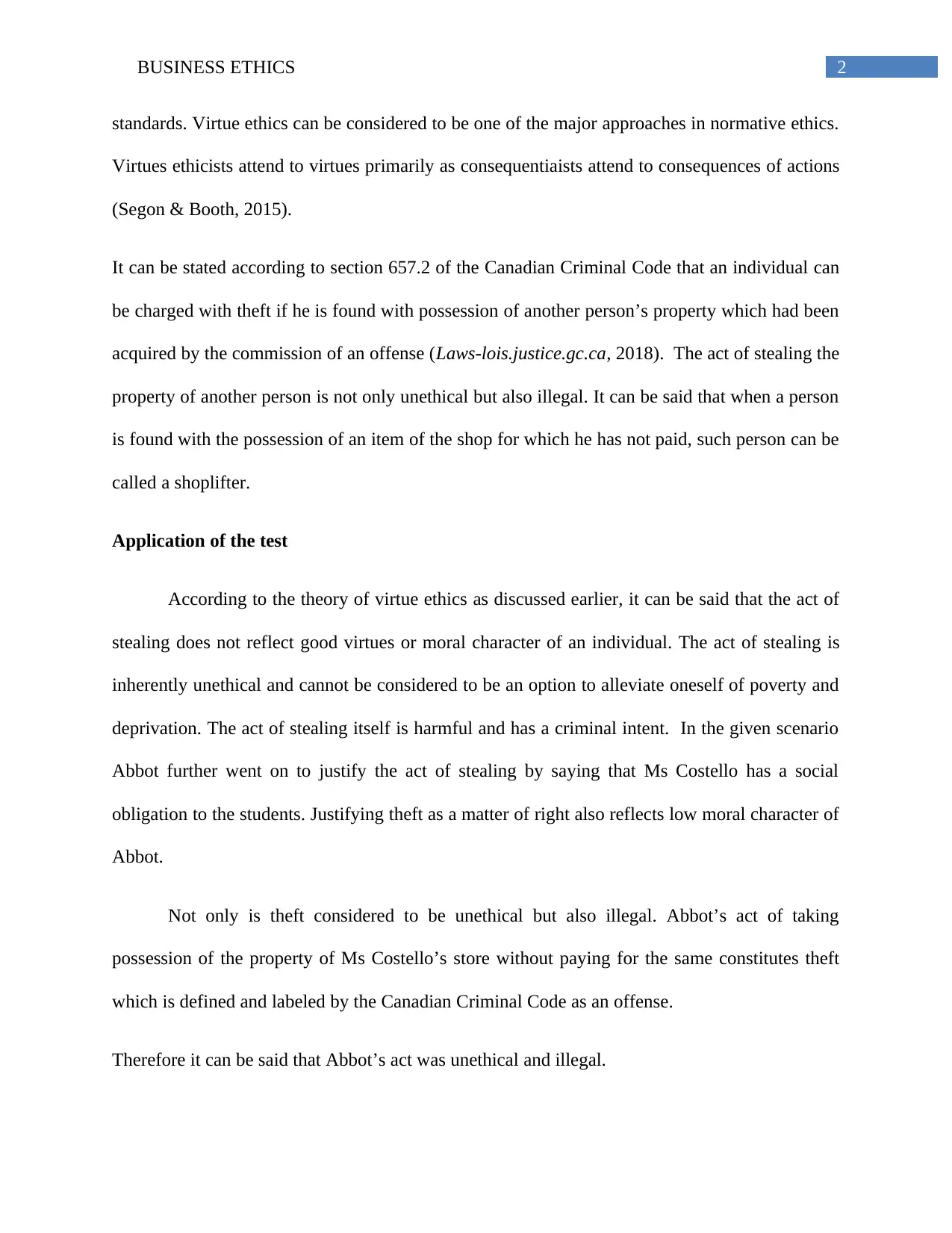
standards. Virtue ethics can be considered to be one of the major approaches in normative ethics.
Virtues ethicists attend to virtues primarily as consequentiaists attend to consequences of actions
(Segon & Booth, 2015).
It can be stated according to section 657.2 of the Canadian Criminal Code that an individual can
be charged with theft if he is found with possession of another person’s property which had been
acquired by the commission of an offense (Laws-lois.justice.gc.ca, 2018). The act of stealing the
property of another person is not only unethical but also illegal. It can be said that when a person
is found with the possession of an item of the shop for which he has not paid, such person can be
called a shoplifter.
Application of the test
According to the theory of virtue ethics as discussed earlier, it can be said that the act of
stealing does not reflect good virtues or moral character of an individual. The act of stealing is
inherently unethical and cannot be considered to be an option to alleviate oneself of poverty and
deprivation. The act of stealing itself is harmful and has a criminal intent. In the given scenario
Abbot further went on to justify the act of stealing by saying that Ms Costello has a social
obligation to the students. Justifying theft as a matter of right also reflects low moral character of
Abbot.
Not only is theft considered to be unethical but also illegal. Abbot’s act of taking
possession of the property of Ms Costello’s store without paying for the same constitutes theft
which is defined and labeled by the Canadian Criminal Code as an offense.
Therefore it can be said that Abbot’s act was unethical and illegal.
Document Page
3BUSINESS ETHICS
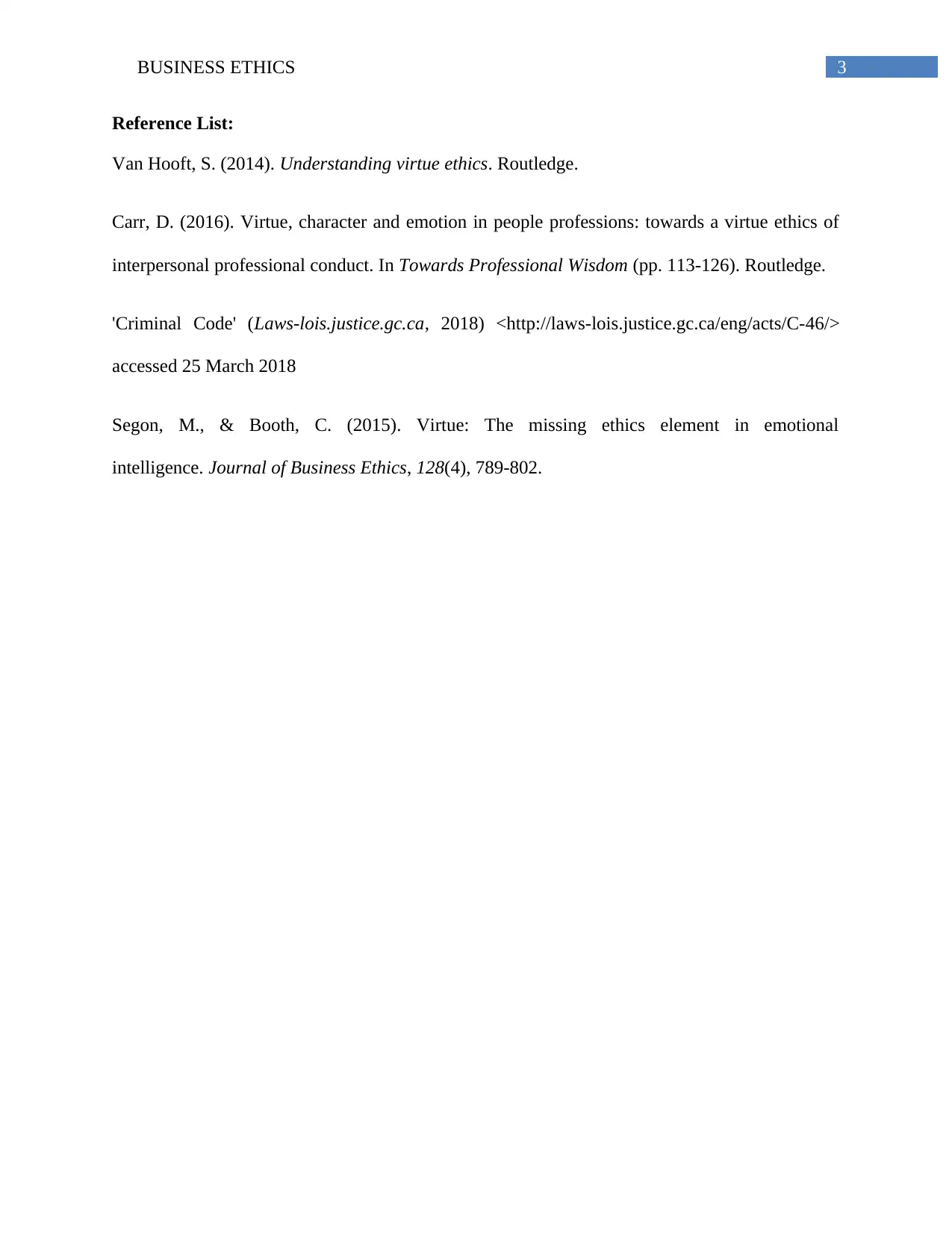
Reference List:
Van Hooft, S. (2014). Understanding virtue ethics. Routledge.
Carr, D. (2016). Virtue, character and emotion in people professions: towards a virtue ethics of
interpersonal professional conduct. In Towards Professional Wisdom (pp. 113-126). Routledge.
'Criminal Code' (Laws-lois.justice.gc.ca, 2018) <http://laws-lois.justice.gc.ca/eng/acts/C-46/>
accessed 25 March 2018
Segon, M., & Booth, C. (2015). Virtue: The missing ethics element in emotional
intelligence. Journal of Business Ethics, 128(4), 789-802.
chevron_up_icon
1 out of 4
circle_padding
hide_on_mobile
zoom_out_icon
[object Object]