BMP3005 Applied Business Finance: Financial Analysis and Improvement
VerifiedAdded on 2023/06/18
|13
|2614
|154
Report
AI Summary
This report provides a detailed analysis of applied business finance, focusing on the concept and importance of financial management within an organization. It explores key aspects such as financial planning, resource allocation, and the significance of maintaining adequate funds for operational efficiency and shareholder returns. The report also delves into the main financial statements, including the balance sheet, income statement, and cash flow statement, explaining their composition and utility in assessing a company's financial health. Furthermore, it discusses the application of financial ratios for evaluating profitability, liquidity, and overall performance, using a provided case study for practical illustration. The report concludes by examining strategies businesses can implement to enhance their financial performance, emphasizing the importance of tax planning, capital reserve management, and strategic investment opportunities. This comprehensive overview aims to provide a clear understanding of the principles and practices of effective financial management.

BMP3005 Applied Business
Finance
Finance

Paraphrase This Document
Need a fresh take? Get an instant paraphrase of this document with our AI Paraphraser
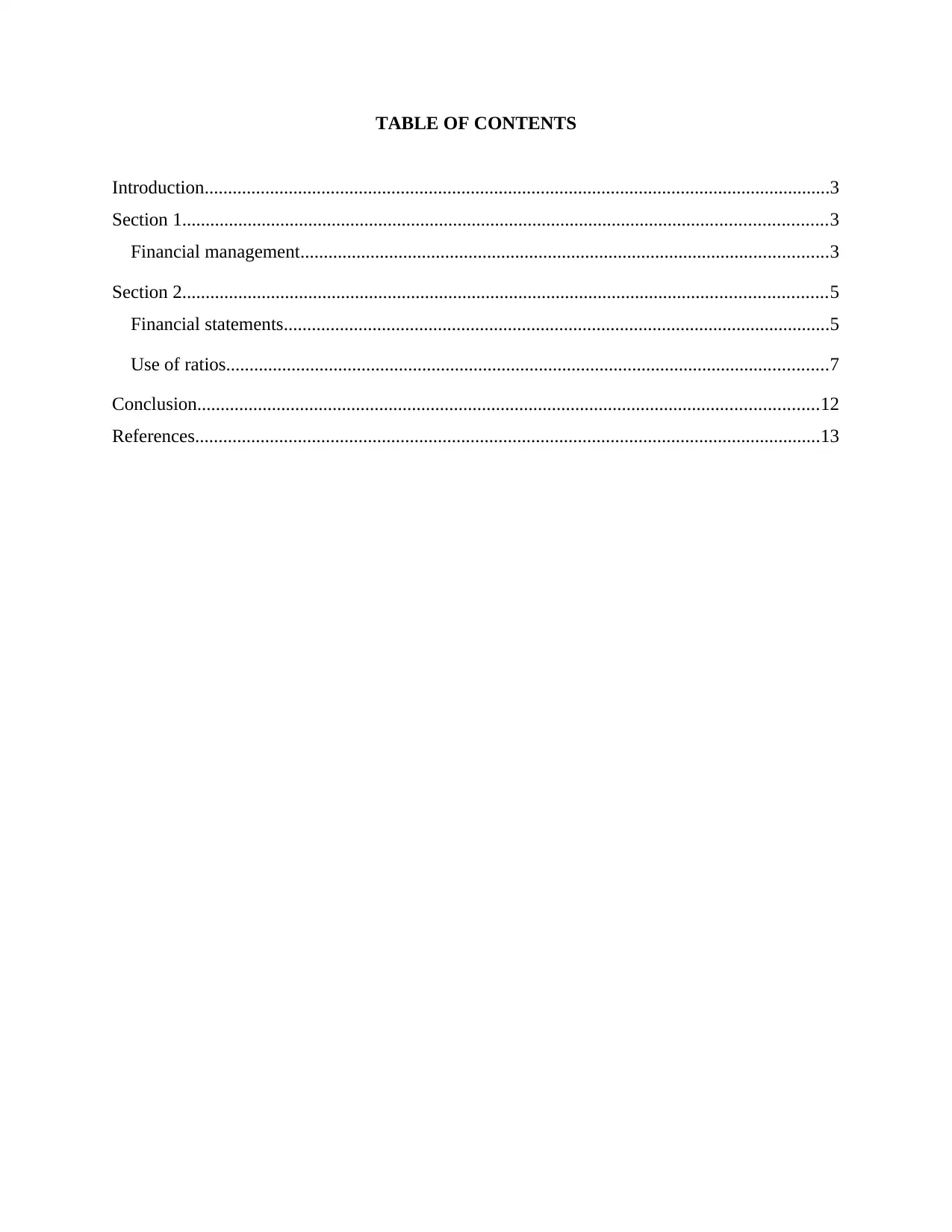
TABLE OF CONTENTS
Introduction......................................................................................................................................3
Section 1..........................................................................................................................................3
Financial management.................................................................................................................3
Section 2..........................................................................................................................................5
Financial statements.....................................................................................................................5
Use of ratios.................................................................................................................................7
Conclusion.....................................................................................................................................12
References......................................................................................................................................13
Introduction......................................................................................................................................3
Section 1..........................................................................................................................................3
Financial management.................................................................................................................3
Section 2..........................................................................................................................................5
Financial statements.....................................................................................................................5
Use of ratios.................................................................................................................................7
Conclusion.....................................................................................................................................12
References......................................................................................................................................13
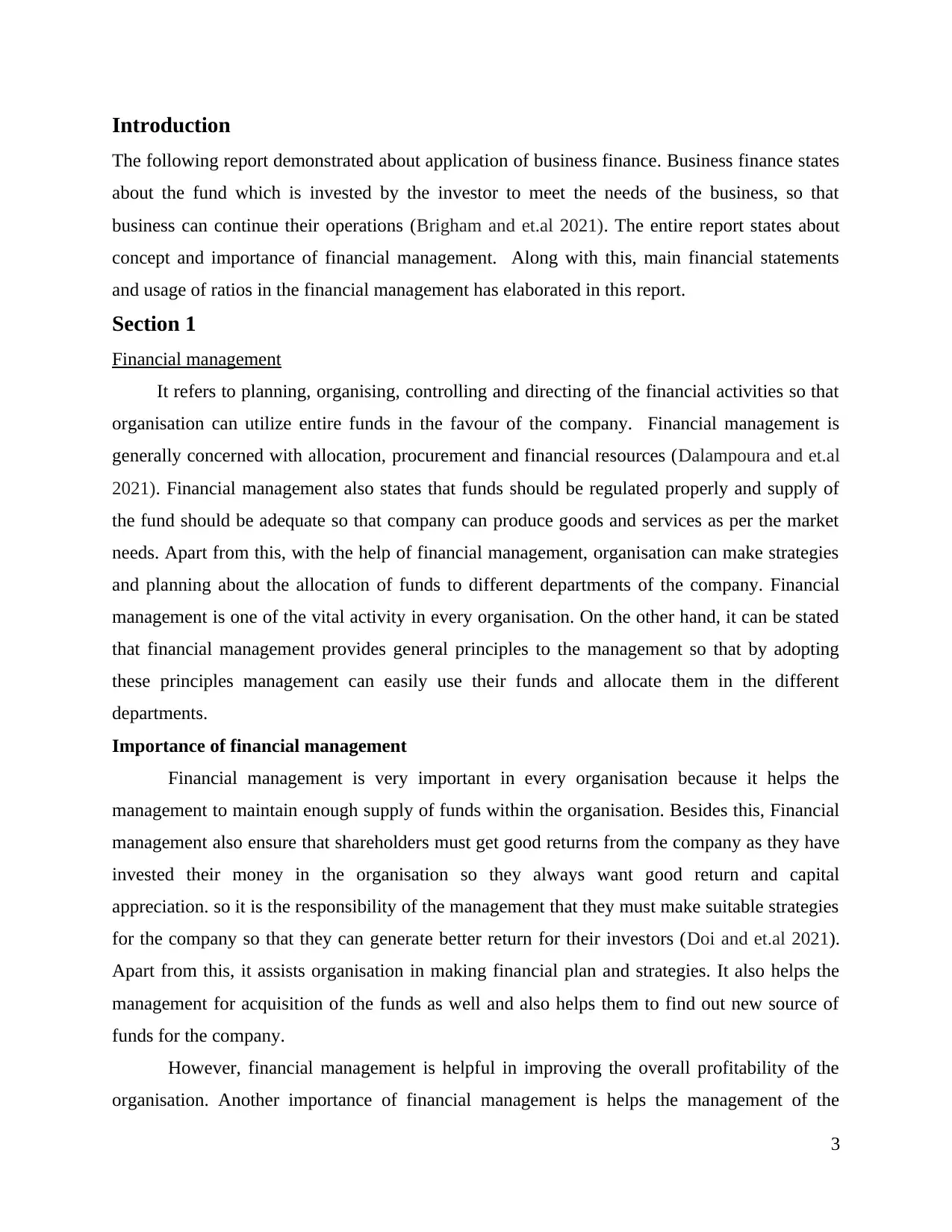
Introduction
The following report demonstrated about application of business finance. Business finance states
about the fund which is invested by the investor to meet the needs of the business, so that
business can continue their operations (Brigham and et.al 2021). The entire report states about
concept and importance of financial management. Along with this, main financial statements
and usage of ratios in the financial management has elaborated in this report.
Section 1
Financial management
It refers to planning, organising, controlling and directing of the financial activities so that
organisation can utilize entire funds in the favour of the company. Financial management is
generally concerned with allocation, procurement and financial resources (Dalampoura and et.al
2021). Financial management also states that funds should be regulated properly and supply of
the fund should be adequate so that company can produce goods and services as per the market
needs. Apart from this, with the help of financial management, organisation can make strategies
and planning about the allocation of funds to different departments of the company. Financial
management is one of the vital activity in every organisation. On the other hand, it can be stated
that financial management provides general principles to the management so that by adopting
these principles management can easily use their funds and allocate them in the different
departments.
Importance of financial management
Financial management is very important in every organisation because it helps the
management to maintain enough supply of funds within the organisation. Besides this, Financial
management also ensure that shareholders must get good returns from the company as they have
invested their money in the organisation so they always want good return and capital
appreciation. so it is the responsibility of the management that they must make suitable strategies
for the company so that they can generate better return for their investors (Doi and et.al 2021).
Apart from this, it assists organisation in making financial plan and strategies. It also helps the
management for acquisition of the funds as well and also helps them to find out new source of
funds for the company.
However, financial management is helpful in improving the overall profitability of the
organisation. Another importance of financial management is helps the management of the
3
The following report demonstrated about application of business finance. Business finance states
about the fund which is invested by the investor to meet the needs of the business, so that
business can continue their operations (Brigham and et.al 2021). The entire report states about
concept and importance of financial management. Along with this, main financial statements
and usage of ratios in the financial management has elaborated in this report.
Section 1
Financial management
It refers to planning, organising, controlling and directing of the financial activities so that
organisation can utilize entire funds in the favour of the company. Financial management is
generally concerned with allocation, procurement and financial resources (Dalampoura and et.al
2021). Financial management also states that funds should be regulated properly and supply of
the fund should be adequate so that company can produce goods and services as per the market
needs. Apart from this, with the help of financial management, organisation can make strategies
and planning about the allocation of funds to different departments of the company. Financial
management is one of the vital activity in every organisation. On the other hand, it can be stated
that financial management provides general principles to the management so that by adopting
these principles management can easily use their funds and allocate them in the different
departments.
Importance of financial management
Financial management is very important in every organisation because it helps the
management to maintain enough supply of funds within the organisation. Besides this, Financial
management also ensure that shareholders must get good returns from the company as they have
invested their money in the organisation so they always want good return and capital
appreciation. so it is the responsibility of the management that they must make suitable strategies
for the company so that they can generate better return for their investors (Doi and et.al 2021).
Apart from this, it assists organisation in making financial plan and strategies. It also helps the
management for acquisition of the funds as well and also helps them to find out new source of
funds for the company.
However, financial management is helpful in improving the overall profitability of the
organisation. Another importance of financial management is helps the management of the
3
⊘ This is a preview!⊘
Do you want full access?
Subscribe today to unlock all pages.

Trusted by 1+ million students worldwide
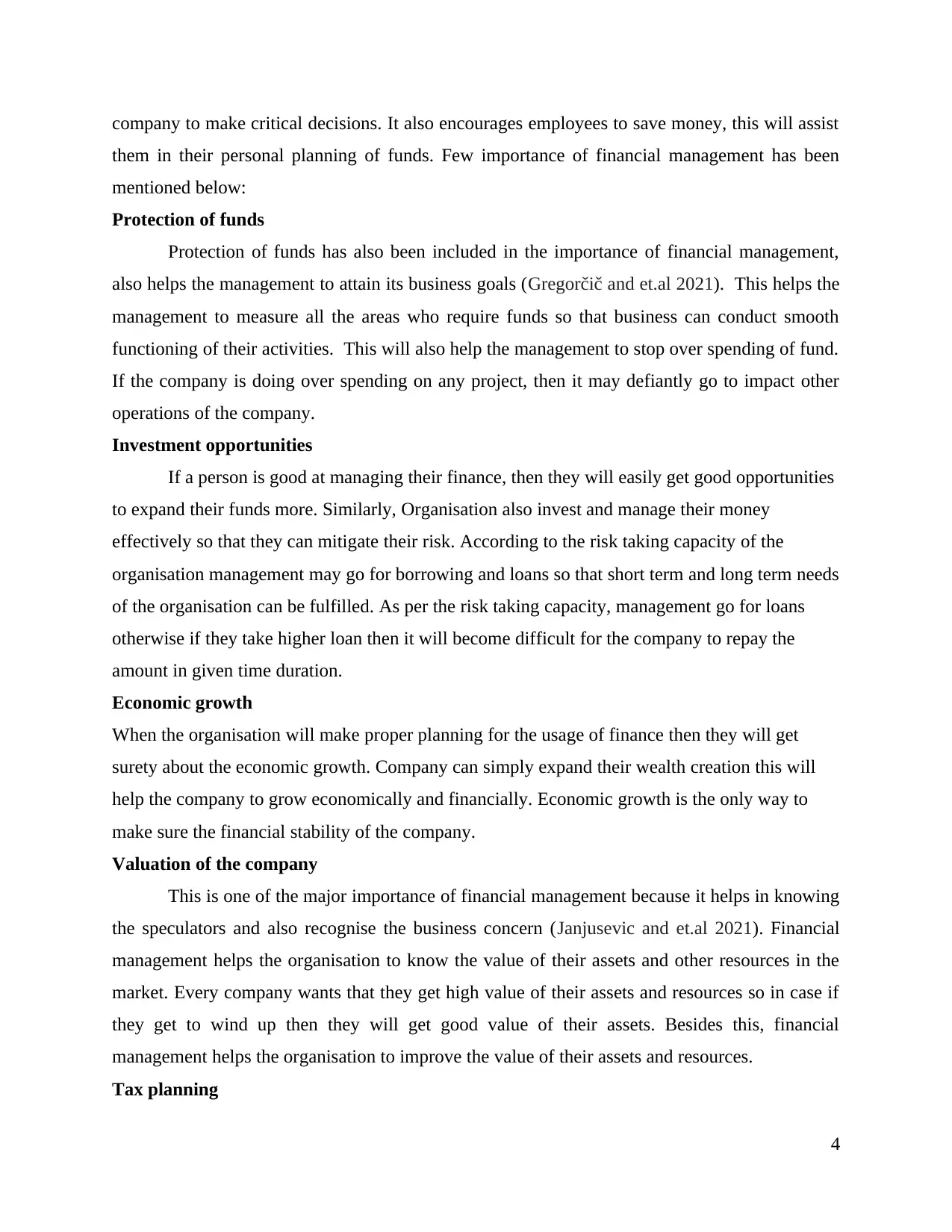
company to make critical decisions. It also encourages employees to save money, this will assist
them in their personal planning of funds. Few importance of financial management has been
mentioned below:
Protection of funds
Protection of funds has also been included in the importance of financial management,
also helps the management to attain its business goals (Gregorčič and et.al 2021). This helps the
management to measure all the areas who require funds so that business can conduct smooth
functioning of their activities. This will also help the management to stop over spending of fund.
If the company is doing over spending on any project, then it may defiantly go to impact other
operations of the company.
Investment opportunities
If a person is good at managing their finance, then they will easily get good opportunities
to expand their funds more. Similarly, Organisation also invest and manage their money
effectively so that they can mitigate their risk. According to the risk taking capacity of the
organisation management may go for borrowing and loans so that short term and long term needs
of the organisation can be fulfilled. As per the risk taking capacity, management go for loans
otherwise if they take higher loan then it will become difficult for the company to repay the
amount in given time duration.
Economic growth
When the organisation will make proper planning for the usage of finance then they will get
surety about the economic growth. Company can simply expand their wealth creation this will
help the company to grow economically and financially. Economic growth is the only way to
make sure the financial stability of the company.
Valuation of the company
This is one of the major importance of financial management because it helps in knowing
the speculators and also recognise the business concern (Janjusevic and et.al 2021). Financial
management helps the organisation to know the value of their assets and other resources in the
market. Every company wants that they get high value of their assets and resources so in case if
they get to wind up then they will get good value of their assets. Besides this, financial
management helps the organisation to improve the value of their assets and resources.
Tax planning
4
them in their personal planning of funds. Few importance of financial management has been
mentioned below:
Protection of funds
Protection of funds has also been included in the importance of financial management,
also helps the management to attain its business goals (Gregorčič and et.al 2021). This helps the
management to measure all the areas who require funds so that business can conduct smooth
functioning of their activities. This will also help the management to stop over spending of fund.
If the company is doing over spending on any project, then it may defiantly go to impact other
operations of the company.
Investment opportunities
If a person is good at managing their finance, then they will easily get good opportunities
to expand their funds more. Similarly, Organisation also invest and manage their money
effectively so that they can mitigate their risk. According to the risk taking capacity of the
organisation management may go for borrowing and loans so that short term and long term needs
of the organisation can be fulfilled. As per the risk taking capacity, management go for loans
otherwise if they take higher loan then it will become difficult for the company to repay the
amount in given time duration.
Economic growth
When the organisation will make proper planning for the usage of finance then they will get
surety about the economic growth. Company can simply expand their wealth creation this will
help the company to grow economically and financially. Economic growth is the only way to
make sure the financial stability of the company.
Valuation of the company
This is one of the major importance of financial management because it helps in knowing
the speculators and also recognise the business concern (Janjusevic and et.al 2021). Financial
management helps the organisation to know the value of their assets and other resources in the
market. Every company wants that they get high value of their assets and resources so in case if
they get to wind up then they will get good value of their assets. Besides this, financial
management helps the organisation to improve the value of their assets and resources.
Tax planning
4
Paraphrase This Document
Need a fresh take? Get an instant paraphrase of this document with our AI Paraphraser
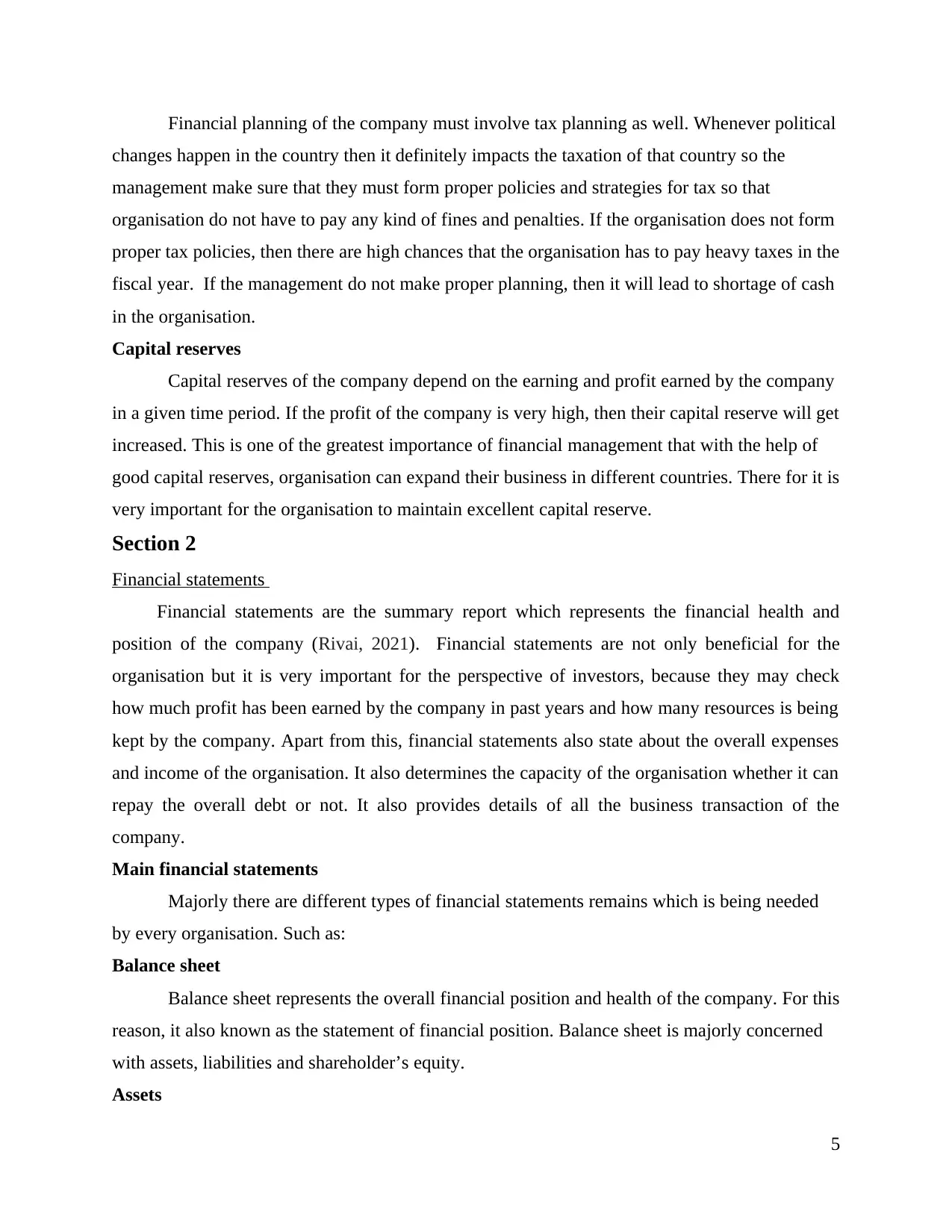
Financial planning of the company must involve tax planning as well. Whenever political
changes happen in the country then it definitely impacts the taxation of that country so the
management make sure that they must form proper policies and strategies for tax so that
organisation do not have to pay any kind of fines and penalties. If the organisation does not form
proper tax policies, then there are high chances that the organisation has to pay heavy taxes in the
fiscal year. If the management do not make proper planning, then it will lead to shortage of cash
in the organisation.
Capital reserves
Capital reserves of the company depend on the earning and profit earned by the company
in a given time period. If the profit of the company is very high, then their capital reserve will get
increased. This is one of the greatest importance of financial management that with the help of
good capital reserves, organisation can expand their business in different countries. There for it is
very important for the organisation to maintain excellent capital reserve.
Section 2
Financial statements
Financial statements are the summary report which represents the financial health and
position of the company (Rivai, 2021). Financial statements are not only beneficial for the
organisation but it is very important for the perspective of investors, because they may check
how much profit has been earned by the company in past years and how many resources is being
kept by the company. Apart from this, financial statements also state about the overall expenses
and income of the organisation. It also determines the capacity of the organisation whether it can
repay the overall debt or not. It also provides details of all the business transaction of the
company.
Main financial statements
Majorly there are different types of financial statements remains which is being needed
by every organisation. Such as:
Balance sheet
Balance sheet represents the overall financial position and health of the company. For this
reason, it also known as the statement of financial position. Balance sheet is majorly concerned
with assets, liabilities and shareholder’s equity.
Assets
5
changes happen in the country then it definitely impacts the taxation of that country so the
management make sure that they must form proper policies and strategies for tax so that
organisation do not have to pay any kind of fines and penalties. If the organisation does not form
proper tax policies, then there are high chances that the organisation has to pay heavy taxes in the
fiscal year. If the management do not make proper planning, then it will lead to shortage of cash
in the organisation.
Capital reserves
Capital reserves of the company depend on the earning and profit earned by the company
in a given time period. If the profit of the company is very high, then their capital reserve will get
increased. This is one of the greatest importance of financial management that with the help of
good capital reserves, organisation can expand their business in different countries. There for it is
very important for the organisation to maintain excellent capital reserve.
Section 2
Financial statements
Financial statements are the summary report which represents the financial health and
position of the company (Rivai, 2021). Financial statements are not only beneficial for the
organisation but it is very important for the perspective of investors, because they may check
how much profit has been earned by the company in past years and how many resources is being
kept by the company. Apart from this, financial statements also state about the overall expenses
and income of the organisation. It also determines the capacity of the organisation whether it can
repay the overall debt or not. It also provides details of all the business transaction of the
company.
Main financial statements
Majorly there are different types of financial statements remains which is being needed
by every organisation. Such as:
Balance sheet
Balance sheet represents the overall financial position and health of the company. For this
reason, it also known as the statement of financial position. Balance sheet is majorly concerned
with assets, liabilities and shareholder’s equity.
Assets
5
Assets represents all the resources which is being earned by the company. In other words,
all those resources which is being owned by the company whether they are fixed and current.
Typically, it can be sold and used by the company for further development. Assets may include
physical property of the company such as machinery, plants, land and other equipment. Assets
also represent trademark and patents.
liabilities
Liability refers borrowings and loans of the company. This can include all the sources
through which money is being earned by the company (Shkurti and et.al 2021). Borrowings can
be short term and long term in nature. All company want that their liability remains low as
compared to their assets so that company do not have to spend their reserves and profit to repay
the loan amount and also the interest payment.
Shareholder’s equity
Equity of shareholder is also known as capital and it also remain present in the liability
side of the balance sheet. It is also known as the difference between assets and liabilities.
Shareholder’s equity also states about the amount invested by the owner in the company.
Income statement
It is another important financial statement of the company. Income statement refers to a
report which shows that how much earnings and revenue generated by the company. Income
statement describes all the cost and expenses which are associated with the earnings of the
company. This statement is useful to know that whether the company is in profit or loss. Profit
and loss of the company can be recognised by subtracting all the expenses form revenues. All the
operating and non – operating expenses have to get deducted from income. It also helps the
management to make suitable policies and strategies for the company so that they may increase
the profit and revenues for the specific time duration. It is also useful in knowing the overall
effectiveness of the strategies whether the strategies are working as per the expectations or not.
Cash flow statement
This statement represents the cash inflow and outflow of the company. The main motive of
preparing cash flow is to know the reason behind the flow of cash. This statement also shows the
changes when the time passes. cash flow statement also classified in three categories such as:
Operating activities
6
all those resources which is being owned by the company whether they are fixed and current.
Typically, it can be sold and used by the company for further development. Assets may include
physical property of the company such as machinery, plants, land and other equipment. Assets
also represent trademark and patents.
liabilities
Liability refers borrowings and loans of the company. This can include all the sources
through which money is being earned by the company (Shkurti and et.al 2021). Borrowings can
be short term and long term in nature. All company want that their liability remains low as
compared to their assets so that company do not have to spend their reserves and profit to repay
the loan amount and also the interest payment.
Shareholder’s equity
Equity of shareholder is also known as capital and it also remain present in the liability
side of the balance sheet. It is also known as the difference between assets and liabilities.
Shareholder’s equity also states about the amount invested by the owner in the company.
Income statement
It is another important financial statement of the company. Income statement refers to a
report which shows that how much earnings and revenue generated by the company. Income
statement describes all the cost and expenses which are associated with the earnings of the
company. This statement is useful to know that whether the company is in profit or loss. Profit
and loss of the company can be recognised by subtracting all the expenses form revenues. All the
operating and non – operating expenses have to get deducted from income. It also helps the
management to make suitable policies and strategies for the company so that they may increase
the profit and revenues for the specific time duration. It is also useful in knowing the overall
effectiveness of the strategies whether the strategies are working as per the expectations or not.
Cash flow statement
This statement represents the cash inflow and outflow of the company. The main motive of
preparing cash flow is to know the reason behind the flow of cash. This statement also shows the
changes when the time passes. cash flow statement also classified in three categories such as:
Operating activities
6
⊘ This is a preview!⊘
Do you want full access?
Subscribe today to unlock all pages.
Trusted by 1+ million students worldwide
This is the first part of cash flow which analyses the cash flow from net income. This activity
states that how much cash being received by the company through operating activity.
Investing activity
It is the second part of cash flow statement which represents the generation of cash by investing
activity. This activity states about purchase of property, plants, equipment and other investments
of the company.
Financing activity
This activity include all the cash raised by selling of stocks and bonds so that company do not
have to run short of money.
Use of ratios
Gross profit
This ratio measures the performance and efficiency of the company (Wang, 2021). Gross profit
ratio of this company is good and it is showing that company is efficient.
Net profit
It states all the income generated by the company in a specific accounting year.
Current ratio
This ratios states that how company is using their current assets to repay current
liabilities. This company has sufficient current assets to repay the obligation.
Quick ratio
This ratio states about those assets which can get converted into cash immediately and
therefor it does not include stock.
Balance sheet as at 31 December 2016
2016
Total
£0
Non-Current
assets / fixed assets
Intangible assets 22,000
Tangible assets 154,400
Investments 15,000
191,400
Current assets/ short
7
states that how much cash being received by the company through operating activity.
Investing activity
It is the second part of cash flow statement which represents the generation of cash by investing
activity. This activity states about purchase of property, plants, equipment and other investments
of the company.
Financing activity
This activity include all the cash raised by selling of stocks and bonds so that company do not
have to run short of money.
Use of ratios
Gross profit
This ratio measures the performance and efficiency of the company (Wang, 2021). Gross profit
ratio of this company is good and it is showing that company is efficient.
Net profit
It states all the income generated by the company in a specific accounting year.
Current ratio
This ratios states that how company is using their current assets to repay current
liabilities. This company has sufficient current assets to repay the obligation.
Quick ratio
This ratio states about those assets which can get converted into cash immediately and
therefor it does not include stock.
Balance sheet as at 31 December 2016
2016
Total
£0
Non-Current
assets / fixed assets
Intangible assets 22,000
Tangible assets 154,400
Investments 15,000
191,400
Current assets/ short
7
Paraphrase This Document
Need a fresh take? Get an instant paraphrase of this document with our AI Paraphraser
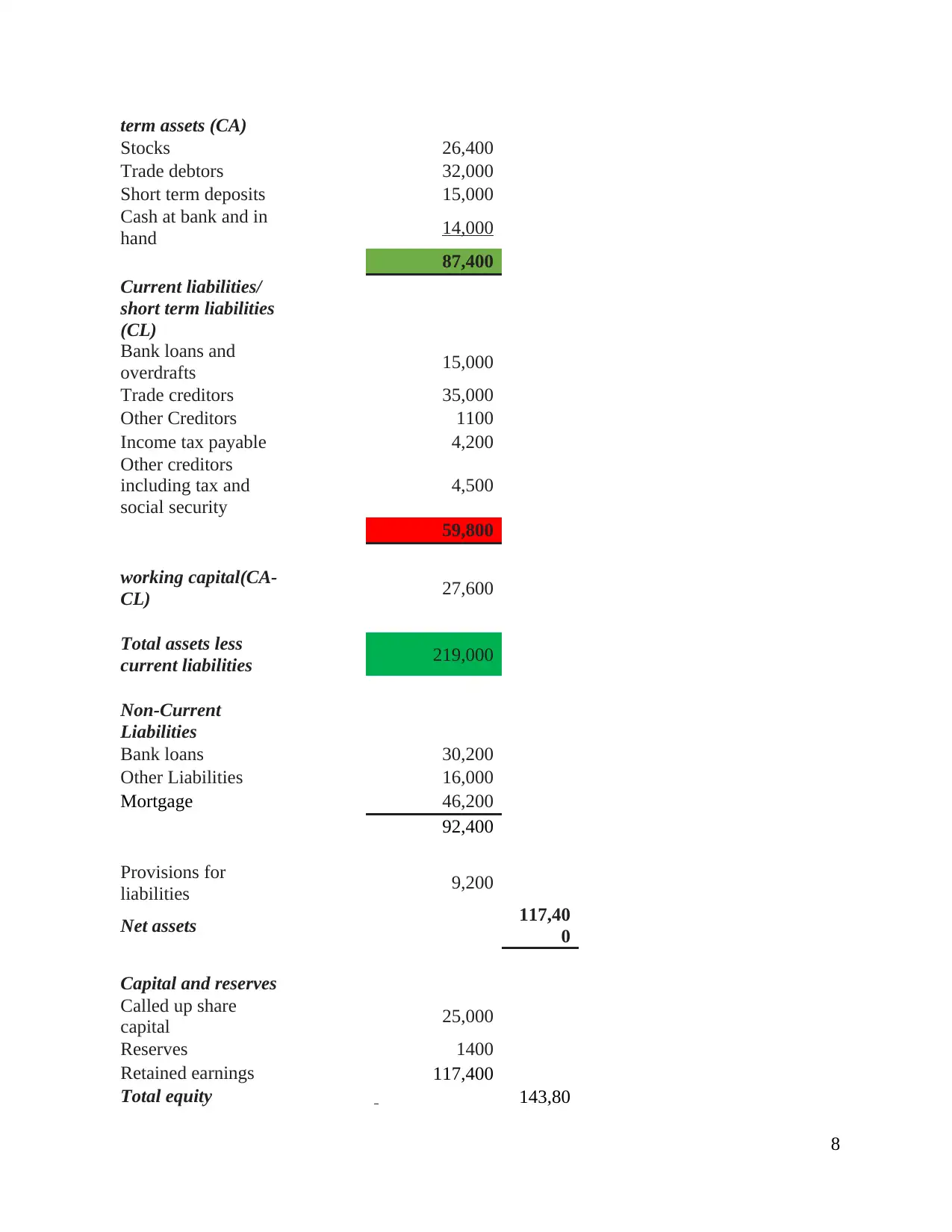
term assets (CA)
Stocks 26,400
Trade debtors 32,000
Short term deposits 15,000
Cash at bank and in
hand 14,000
87,400
Current liabilities/
short term liabilities
(CL)
Bank loans and
overdrafts 15,000
Trade creditors 35,000
Other Creditors 1100
Income tax payable 4,200
Other creditors
including tax and
social security
4,500
59,800
working capital(CA-
CL) 27,600
Total assets less
current liabilities 219,000
Non-Current
Liabilities
Bank loans 30,200
Other Liabilities 16,000
Mortgage 46,200
92,400
Provisions for
liabilities 9,200
Net assets 117,40
0
Capital and reserves
Called up share
capital 25,000
Reserves 1400
Retained earnings 117,400
Total equity 143,80
8
Stocks 26,400
Trade debtors 32,000
Short term deposits 15,000
Cash at bank and in
hand 14,000
87,400
Current liabilities/
short term liabilities
(CL)
Bank loans and
overdrafts 15,000
Trade creditors 35,000
Other Creditors 1100
Income tax payable 4,200
Other creditors
including tax and
social security
4,500
59,800
working capital(CA-
CL) 27,600
Total assets less
current liabilities 219,000
Non-Current
Liabilities
Bank loans 30,200
Other Liabilities 16,000
Mortgage 46,200
92,400
Provisions for
liabilities 9,200
Net assets 117,40
0
Capital and reserves
Called up share
capital 25,000
Reserves 1400
Retained earnings 117,400
Total equity 143,80
8
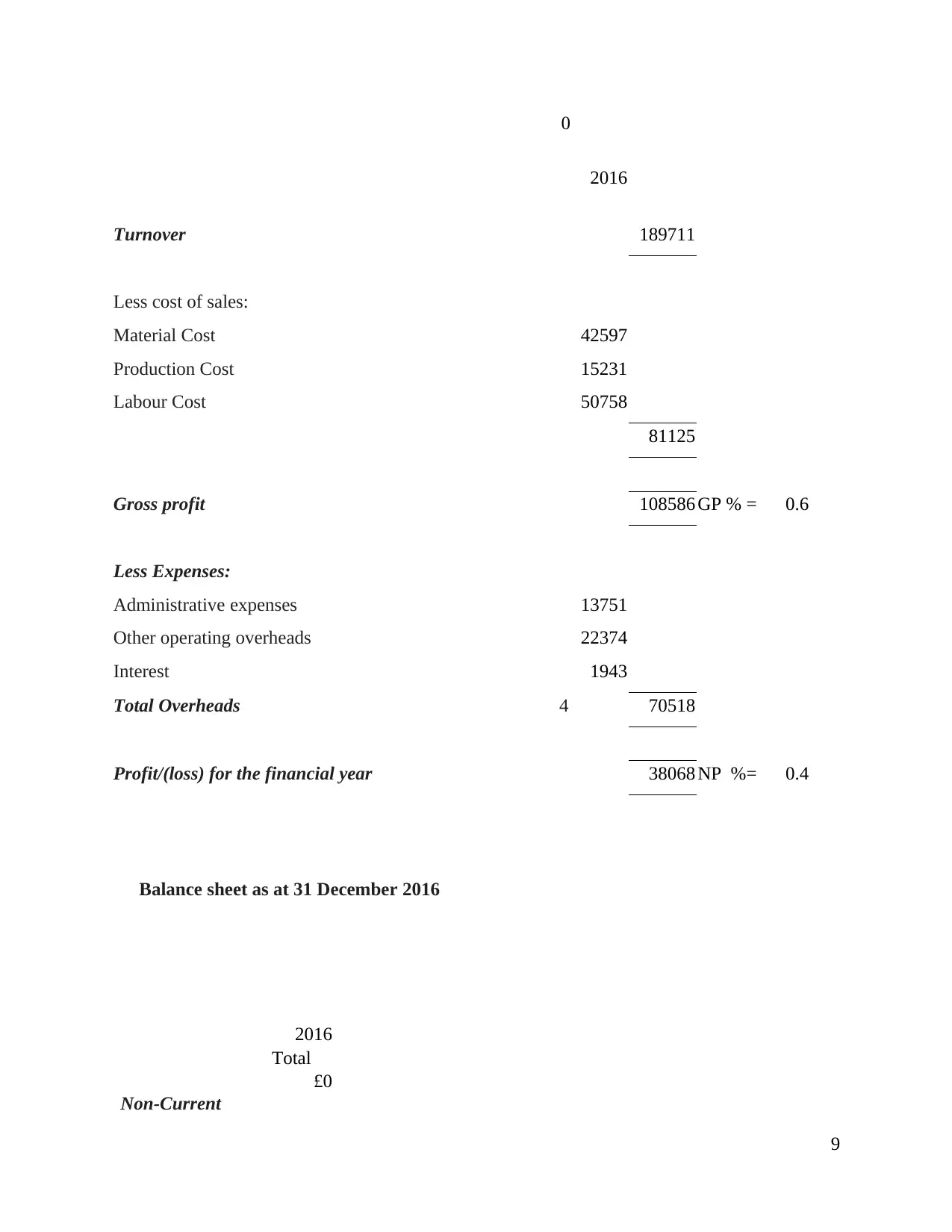
0
2016
Turnover 189711
Less cost of sales:
Material Cost 42597
Production Cost 15231
Labour Cost 50758
81125
Gross profit 108586 GP % = 0.6
Less Expenses:
Administrative expenses 13751
Other operating overheads 22374
Interest 1943
Total Overheads 4 70518
Profit/(loss) for the financial year 38068 NP %= 0.4
Balance sheet as at 31 December 2016
2016
Total
£0
Non-Current
9
2016
Turnover 189711
Less cost of sales:
Material Cost 42597
Production Cost 15231
Labour Cost 50758
81125
Gross profit 108586 GP % = 0.6
Less Expenses:
Administrative expenses 13751
Other operating overheads 22374
Interest 1943
Total Overheads 4 70518
Profit/(loss) for the financial year 38068 NP %= 0.4
Balance sheet as at 31 December 2016
2016
Total
£0
Non-Current
9
⊘ This is a preview!⊘
Do you want full access?
Subscribe today to unlock all pages.
Trusted by 1+ million students worldwide
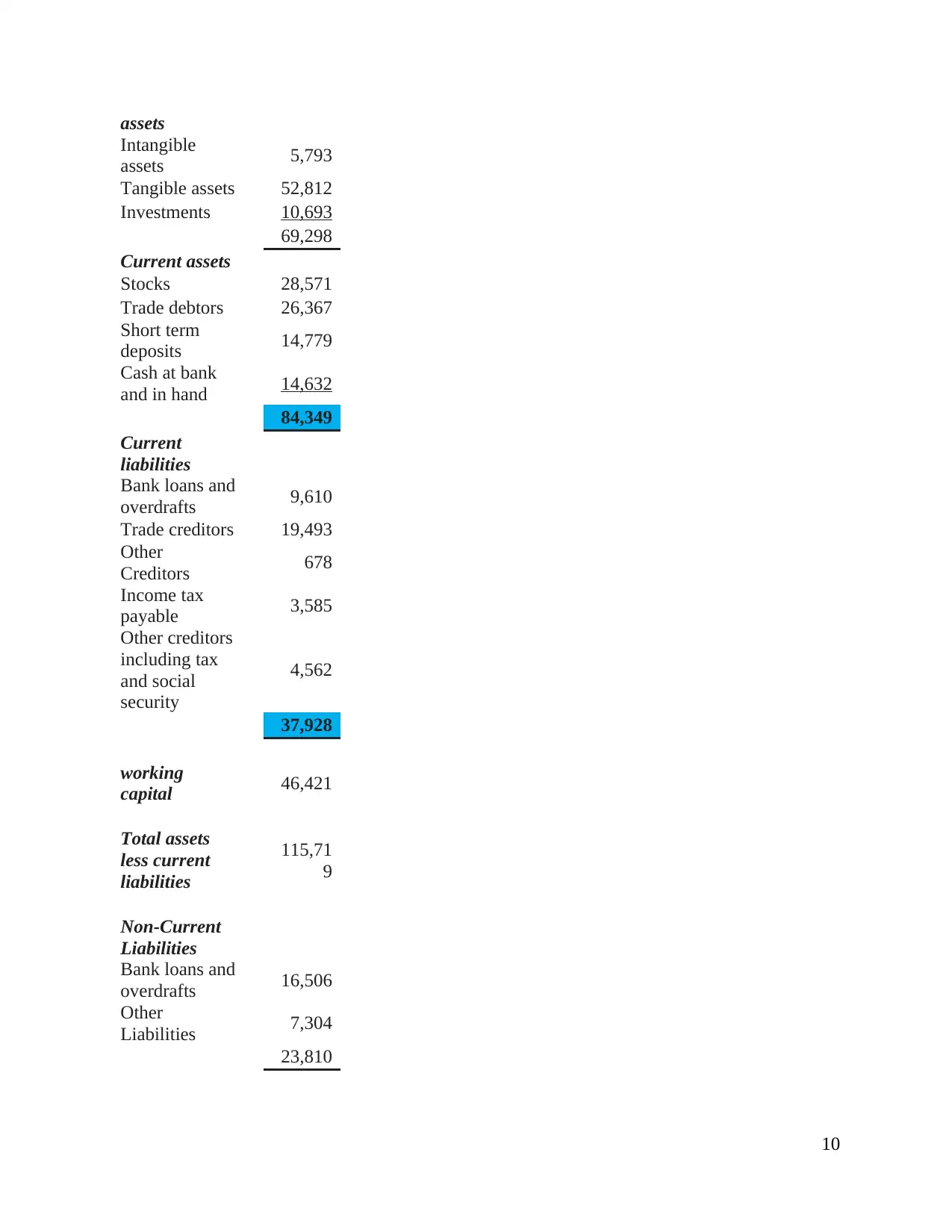
assets
Intangible
assets 5,793
Tangible assets 52,812
Investments 10,693
69,298
Current assets
Stocks 28,571
Trade debtors 26,367
Short term
deposits 14,779
Cash at bank
and in hand 14,632
84,349
Current
liabilities
Bank loans and
overdrafts 9,610
Trade creditors 19,493
Other
Creditors 678
Income tax
payable 3,585
Other creditors
including tax
and social
security
4,562
37,928
working
capital 46,421
Total assets
less current
liabilities
115,71
9
Non-Current
Liabilities
Bank loans and
overdrafts 16,506
Other
Liabilities 7,304
23,810
10
Intangible
assets 5,793
Tangible assets 52,812
Investments 10,693
69,298
Current assets
Stocks 28,571
Trade debtors 26,367
Short term
deposits 14,779
Cash at bank
and in hand 14,632
84,349
Current
liabilities
Bank loans and
overdrafts 9,610
Trade creditors 19,493
Other
Creditors 678
Income tax
payable 3,585
Other creditors
including tax
and social
security
4,562
37,928
working
capital 46,421
Total assets
less current
liabilities
115,71
9
Non-Current
Liabilities
Bank loans and
overdrafts 16,506
Other
Liabilities 7,304
23,810
10
Paraphrase This Document
Need a fresh take? Get an instant paraphrase of this document with our AI Paraphraser
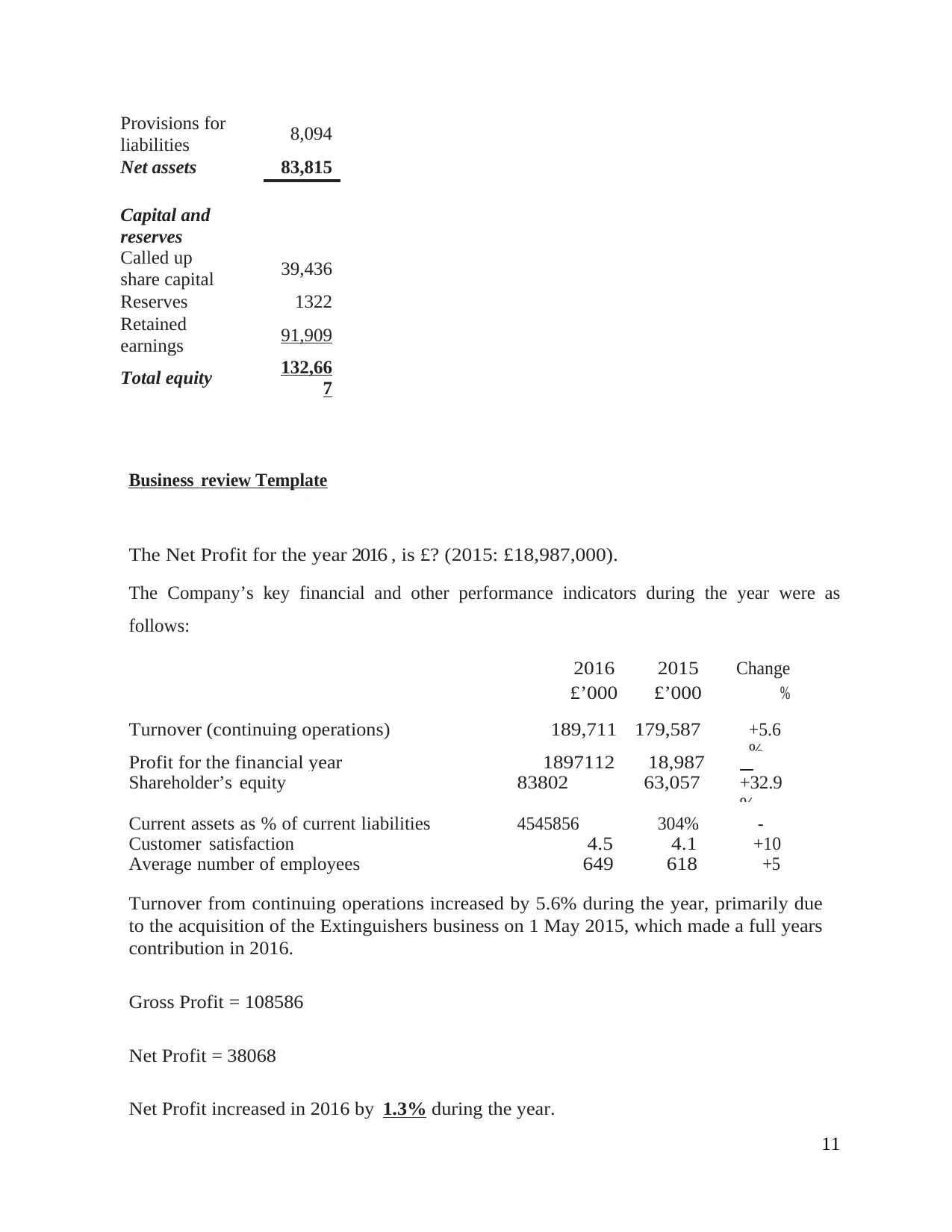
Provisions for
liabilities 8,094
Net assets 83,815
Capital and
reserves
Called up
share capital 39,436
Reserves 1322
Retained
earnings 91,909
Total equity 132,66
7
Business review Template
The Net Profit for the year 2016 , is £? (2015: £18,987,000).
The Company’s key financial and other performance indicators during the year were as
follows:
2016
£’000
2015
£’000
Change
%
Turnover (continuing operations) 189,711 179,587 +5.6
%
Profit for the financial year 1897112 18,987
Shareholder’s equity 83802 63,057 +32.9
%
Current assets as % of current liabilities 4545856 304% -
Customer satisfaction 4.5 4.1 +10
Average number of employees 649 618 +5
%
Turnover from continuing operations increased by 5.6% during the year, primarily due
to the acquisition of the Extinguishers business on 1 May 2015, which made a full years
contribution in 2016.
Gross Profit = 108586
Net Profit = 38068
Net Profit increased in 2016 by 1.3% during the year.
11
liabilities 8,094
Net assets 83,815
Capital and
reserves
Called up
share capital 39,436
Reserves 1322
Retained
earnings 91,909
Total equity 132,66
7
Business review Template
The Net Profit for the year 2016 , is £? (2015: £18,987,000).
The Company’s key financial and other performance indicators during the year were as
follows:
2016
£’000
2015
£’000
Change
%
Turnover (continuing operations) 189,711 179,587 +5.6
%
Profit for the financial year 1897112 18,987
Shareholder’s equity 83802 63,057 +32.9
%
Current assets as % of current liabilities 4545856 304% -
Customer satisfaction 4.5 4.1 +10
Average number of employees 649 618 +5
%
Turnover from continuing operations increased by 5.6% during the year, primarily due
to the acquisition of the Extinguishers business on 1 May 2015, which made a full years
contribution in 2016.
Gross Profit = 108586
Net Profit = 38068
Net Profit increased in 2016 by 1.3% during the year.
11
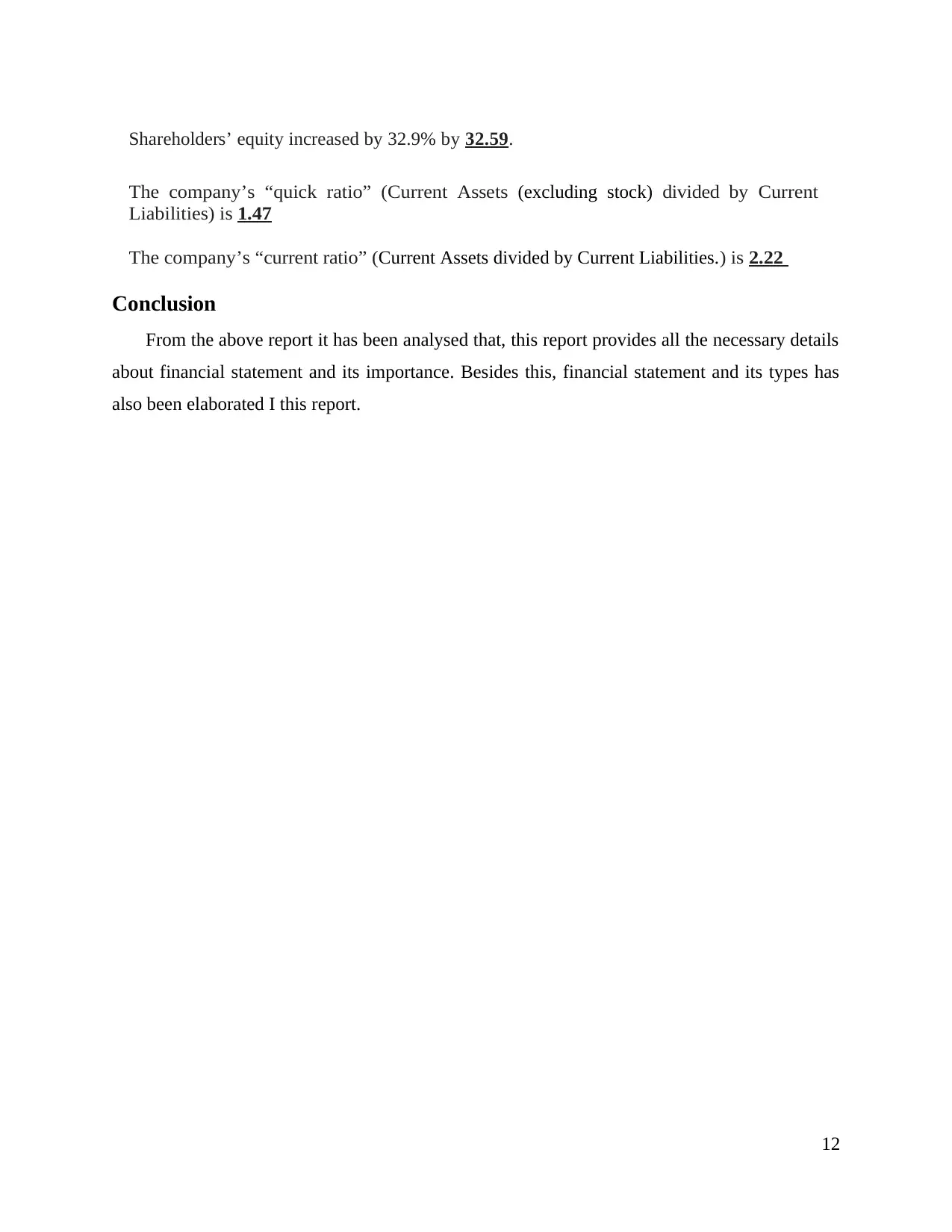
Shareholders’ equity increased by 32.9% by 32.59.
The company’s “quick ratio” (Current Assets (excluding stock) divided by Current
Liabilities) is 1.47
The company’s “current ratio” (Current Assets divided by Current Liabilities. ) is 2.22
Conclusion
From the above report it has been analysed that, this report provides all the necessary details
about financial statement and its importance. Besides this, financial statement and its types has
also been elaborated I this report.
12
The company’s “quick ratio” (Current Assets (excluding stock) divided by Current
Liabilities) is 1.47
The company’s “current ratio” (Current Assets divided by Current Liabilities. ) is 2.22
Conclusion
From the above report it has been analysed that, this report provides all the necessary details
about financial statement and its importance. Besides this, financial statement and its types has
also been elaborated I this report.
12
⊘ This is a preview!⊘
Do you want full access?
Subscribe today to unlock all pages.
Trusted by 1+ million students worldwide

1 out of 13


Related Documents


Your All-in-One AI-Powered Toolkit for Academic Success.
+13062052269
info@desklib.com
Available 24*7 on WhatsApp / Email
![[object Object]](/_next/static/media/star-bottom.7253800d.svg)
Unlock your academic potential
Copyright © 2020–2026 A2Z Services. All Rights Reserved. Developed and managed by ZUCOL.