Business Finance: Working Capital, Sources of Finance & Appraisal
VerifiedAdded on 2024/05/17
|12
|3078
|407
Report
AI Summary
This report provides an in-depth analysis of working capital management and investment appraisal techniques within the context of business finance. It examines the constituent parts of working capital, justifying its importance for a company's long-term survival, and assesses the suitability of different internal and external sources of finance for specific business needs. The report applies capital investment appraisal techniques, including payback period, accounting rate of return, and net present value methods, to making informed investment decisions. Additionally, it explores the application of cost-benefit analysis in evaluating investment opportunities, providing a comprehensive overview of financial decision-making processes crucial for organizational success. Desklib offers a wide array of study resources, including solved assignments and past papers, to support students in mastering complex topics like business finance.

BUSINESS FINANCE
1
1

Paraphrase This Document
Need a fresh take? Get an instant paraphrase of this document with our AI Paraphraser
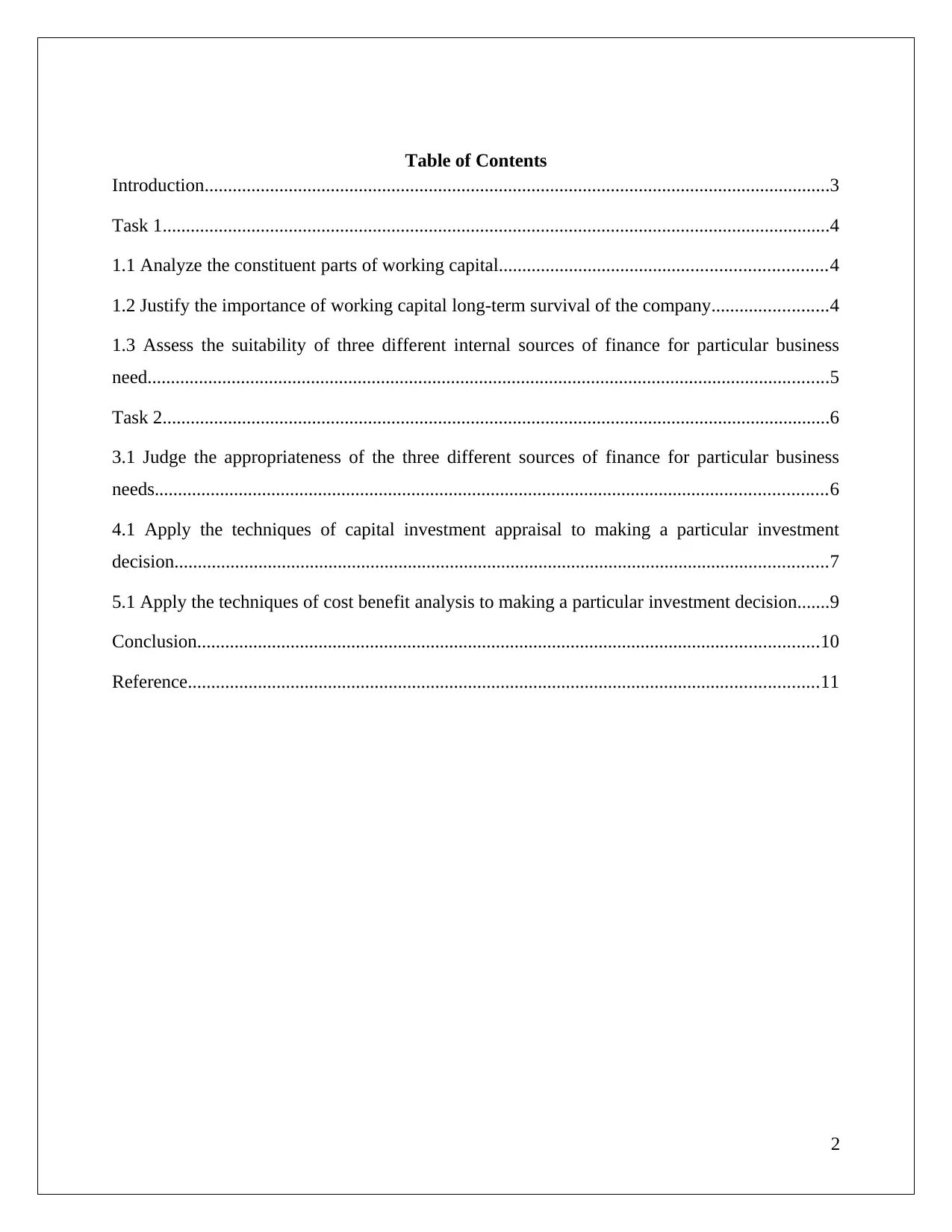
Table of Contents
Introduction......................................................................................................................................3
Task 1...............................................................................................................................................4
1.1 Analyze the constituent parts of working capital......................................................................4
1.2 Justify the importance of working capital long-term survival of the company.........................4
1.3 Assess the suitability of three different internal sources of finance for particular business
need..................................................................................................................................................5
Task 2...............................................................................................................................................6
3.1 Judge the appropriateness of the three different sources of finance for particular business
needs................................................................................................................................................6
4.1 Apply the techniques of capital investment appraisal to making a particular investment
decision............................................................................................................................................7
5.1 Apply the techniques of cost benefit analysis to making a particular investment decision.......9
Conclusion.....................................................................................................................................10
Reference.......................................................................................................................................11
2
Introduction......................................................................................................................................3
Task 1...............................................................................................................................................4
1.1 Analyze the constituent parts of working capital......................................................................4
1.2 Justify the importance of working capital long-term survival of the company.........................4
1.3 Assess the suitability of three different internal sources of finance for particular business
need..................................................................................................................................................5
Task 2...............................................................................................................................................6
3.1 Judge the appropriateness of the three different sources of finance for particular business
needs................................................................................................................................................6
4.1 Apply the techniques of capital investment appraisal to making a particular investment
decision............................................................................................................................................7
5.1 Apply the techniques of cost benefit analysis to making a particular investment decision.......9
Conclusion.....................................................................................................................................10
Reference.......................................................................................................................................11
2
Introduction
The assignment provides the details regarding the working capital of the organization. It provides
the details regarding the sources of capital in the organization. The capital adequacy techniques
are to be ascertained during the course of the proceedings. It is the approach towards the
effective measures in the field of generating of finance in the assignment. The capital adequacy
techniques are directed towards the procurement of the capital in the due course. Here working
capital plays a pivotal role in the implementation of the cash inflow and the cash outflow during
the initiation of the capital adequacy.
3
The assignment provides the details regarding the working capital of the organization. It provides
the details regarding the sources of capital in the organization. The capital adequacy techniques
are to be ascertained during the course of the proceedings. It is the approach towards the
effective measures in the field of generating of finance in the assignment. The capital adequacy
techniques are directed towards the procurement of the capital in the due course. Here working
capital plays a pivotal role in the implementation of the cash inflow and the cash outflow during
the initiation of the capital adequacy.
3
⊘ This is a preview!⊘
Do you want full access?
Subscribe today to unlock all pages.

Trusted by 1+ million students worldwide
Task 1
1.1 Analyze the constituent parts of working capital
Working capital can be considered as the financial resource that is required by the organizations
for operating the daily business activities. It is the blood of any business. Without working
capital the survival of the business is not possible. Panigrahi (2017) has defined working capital
as the difference between the current assets and current liabilities of a company. on the other
hand, Tran et al. (2017) mentioned that working capital is the amount or fund that remains in the
hands of the company after meeting its current liabilities. Zariyawati et al. (2017) stated that
maintaining a standard amount of working capital is essential for every business because it helps
in maintaining smooth flow of business operations. The working capital of a company indicates
the liquidity of the business. The formula for calculating working capital of a business is as
follows:
Working capital = Current Assets – Current liabilities
The above formula is indicating or showing the constituent parts of working capital and these
parts are the current assets and current liabilities of the business. Current assets are the short-term
assets of the business; whereas, current liabilities are the short-term liabilities of the firm. The
current assets of the company include the inventory, debtor or accounts receivables, and cash in
hand and cash at bank. On the other hand, the current liabilities of the business includes the
creditors or accounts payables, bank over draft and short-term bank loan and many others short-
term loans. According to Sharif et al. (2018), in order to maintain higher or standard amount of
working capital, a company must maintain higher amount of current assets like, inventories or
cash in hand than the current liabilities like, creditors or bill payables.
1.2 Justify the importance of working capital long-term survival of the company
In the above discussion, it has been understood that working capital is an essential part of every
business. If the importance of the working capital is critically analyzed, it can be identified that
the working capital is essential for the long-term survival of the company. Working capital is
required by the business organizations to operate daily activities of the business (Tran et al.
4
1.1 Analyze the constituent parts of working capital
Working capital can be considered as the financial resource that is required by the organizations
for operating the daily business activities. It is the blood of any business. Without working
capital the survival of the business is not possible. Panigrahi (2017) has defined working capital
as the difference between the current assets and current liabilities of a company. on the other
hand, Tran et al. (2017) mentioned that working capital is the amount or fund that remains in the
hands of the company after meeting its current liabilities. Zariyawati et al. (2017) stated that
maintaining a standard amount of working capital is essential for every business because it helps
in maintaining smooth flow of business operations. The working capital of a company indicates
the liquidity of the business. The formula for calculating working capital of a business is as
follows:
Working capital = Current Assets – Current liabilities
The above formula is indicating or showing the constituent parts of working capital and these
parts are the current assets and current liabilities of the business. Current assets are the short-term
assets of the business; whereas, current liabilities are the short-term liabilities of the firm. The
current assets of the company include the inventory, debtor or accounts receivables, and cash in
hand and cash at bank. On the other hand, the current liabilities of the business includes the
creditors or accounts payables, bank over draft and short-term bank loan and many others short-
term loans. According to Sharif et al. (2018), in order to maintain higher or standard amount of
working capital, a company must maintain higher amount of current assets like, inventories or
cash in hand than the current liabilities like, creditors or bill payables.
1.2 Justify the importance of working capital long-term survival of the company
In the above discussion, it has been understood that working capital is an essential part of every
business. If the importance of the working capital is critically analyzed, it can be identified that
the working capital is essential for the long-term survival of the company. Working capital is
required by the business organizations to operate daily activities of the business (Tran et al.
4
Paraphrase This Document
Need a fresh take? Get an instant paraphrase of this document with our AI Paraphraser
2017). Therefore, in the other words, it can be stated that without working capital, a company
cannot operate its regular activities that are very important to the business. It means, without
working capital the regular activities of the business is hampered and if the business cannot
perform the regular activities, it cannot survive in the market (Sharif et al. 2018).
For example, due to the unavailability of the working capital, Company Agros cannot purchase
some raw materials that are urgent for the production. Therefore, the production of the company
is hampered because of the crisis of working capital. As the company is not able to produce the
products, it cannot sell the same and cannot satisfy the customers. Therefore, the customers will
never trust Company Agros and in the near future, the sales level of the business will go down.
At last, the company will be shut down. This example is clearly stating that a company is
dependent on the availability of working capital for long-term survival.
This discussion can be made from a different perspective also. Working capital indicates the
liquidity position of the business. Therefore, if there is lack of working capital, the liquidity of
the company is a question to the stakeholders. In this situation, no bank or creditor wants to
provide financial support to the company (Panigrahi 2017). Therefore, if the company needs
money or funds on urgent basis, it cannot arrange that. Hence, the performance of the company
will be hampered, which will make the future of the business insecure.
Therefore, from the above discussion, it is very clear that for long-term survival of the business,
the management must take care of the level of working capital.
1.3 Assess the suitability of three different internal sources of finance for particular
business need
In order to operate a business, a company needs sufficient amount of funds. However, arranging
the required amount of funds is not that easy. The company needs to access several sources for
arranging the funds or financial support. These sources can be divided in to two parts – internal
sources and external sources. Here, the discussion has been made on the internal sources of funds
and their suitable to a particular business.
There are several internal sources of finance that the company may use to meet the financial
needs of the business. The three main internal sources of finance are stated below:
5
cannot operate its regular activities that are very important to the business. It means, without
working capital the regular activities of the business is hampered and if the business cannot
perform the regular activities, it cannot survive in the market (Sharif et al. 2018).
For example, due to the unavailability of the working capital, Company Agros cannot purchase
some raw materials that are urgent for the production. Therefore, the production of the company
is hampered because of the crisis of working capital. As the company is not able to produce the
products, it cannot sell the same and cannot satisfy the customers. Therefore, the customers will
never trust Company Agros and in the near future, the sales level of the business will go down.
At last, the company will be shut down. This example is clearly stating that a company is
dependent on the availability of working capital for long-term survival.
This discussion can be made from a different perspective also. Working capital indicates the
liquidity position of the business. Therefore, if there is lack of working capital, the liquidity of
the company is a question to the stakeholders. In this situation, no bank or creditor wants to
provide financial support to the company (Panigrahi 2017). Therefore, if the company needs
money or funds on urgent basis, it cannot arrange that. Hence, the performance of the company
will be hampered, which will make the future of the business insecure.
Therefore, from the above discussion, it is very clear that for long-term survival of the business,
the management must take care of the level of working capital.
1.3 Assess the suitability of three different internal sources of finance for particular
business need
In order to operate a business, a company needs sufficient amount of funds. However, arranging
the required amount of funds is not that easy. The company needs to access several sources for
arranging the funds or financial support. These sources can be divided in to two parts – internal
sources and external sources. Here, the discussion has been made on the internal sources of funds
and their suitable to a particular business.
There are several internal sources of finance that the company may use to meet the financial
needs of the business. The three main internal sources of finance are stated below:
5
Retained profit – It is one of the major internal sources of finance that the company can utilize
during the requirements. This particular internal source is created by the company by saving a
certain portion of profit in each financial year. The main advantage of this particular internal
source is that the company can arrange the funds at any time from this source (Amornkitvikai
and Harvie 2018). It means for arranging the required funds, the company will not require to wait
for long or any critical procedure. This is easily available to the company. However, it is also
true that in order to create this source of fund, the company needs to compromise a certain
portion of profit in every financial year.
Sale of old assets – This is another most important internal source of fund. In most of the
companies, which are operating business for long time, there are some old assets that are not
usable to the company (Ferrando and Lekpek 2018). During the requirements of the funds, the
company can arrange money by selling these unused or spare assets. This is also an easy source
of fund and no extra change is required to pay to avail this source. However, it takes some times
to sell the assets.
Sale of inventory – The Company can also use the internal source of fund that is sale of
inventory. The company can use the inventory and can arrange money within short-period.
However, if the market value of the inventory decreases, it may generate loss to the company
(Amornkitvikai and Harvie 2018).
Task 2
3.1 Judge the appropriateness of the three different sources of finance for particular
business needs.
Finance is one of the vital parts in the starting of business (Storey, 2016). It is the backbone for
any business organization. It acts as the growth escalator in the business organization. It
enhances the infrastructure of the organization. It helps in the generation of goodwill in the
organization. Some of the most vital sources of finance are provided hereunder:
Equity Share – Equity share is the prime source of finance in the organization (Asante et al.,
2016). It procures voting rights for the investors and they have the right to the claim on the
6
during the requirements. This particular internal source is created by the company by saving a
certain portion of profit in each financial year. The main advantage of this particular internal
source is that the company can arrange the funds at any time from this source (Amornkitvikai
and Harvie 2018). It means for arranging the required funds, the company will not require to wait
for long or any critical procedure. This is easily available to the company. However, it is also
true that in order to create this source of fund, the company needs to compromise a certain
portion of profit in every financial year.
Sale of old assets – This is another most important internal source of fund. In most of the
companies, which are operating business for long time, there are some old assets that are not
usable to the company (Ferrando and Lekpek 2018). During the requirements of the funds, the
company can arrange money by selling these unused or spare assets. This is also an easy source
of fund and no extra change is required to pay to avail this source. However, it takes some times
to sell the assets.
Sale of inventory – The Company can also use the internal source of fund that is sale of
inventory. The company can use the inventory and can arrange money within short-period.
However, if the market value of the inventory decreases, it may generate loss to the company
(Amornkitvikai and Harvie 2018).
Task 2
3.1 Judge the appropriateness of the three different sources of finance for particular
business needs.
Finance is one of the vital parts in the starting of business (Storey, 2016). It is the backbone for
any business organization. It acts as the growth escalator in the business organization. It
enhances the infrastructure of the organization. It helps in the generation of goodwill in the
organization. Some of the most vital sources of finance are provided hereunder:
Equity Share – Equity share is the prime source of finance in the organization (Asante et al.,
2016). It procures voting rights for the investors and they have the right to the claim on the
6
⊘ This is a preview!⊘
Do you want full access?
Subscribe today to unlock all pages.
Trusted by 1+ million students worldwide
assets. Various types of equity capital are subscribed, authorized, issue, paid up, sweat equity,
rights, bonus (Shah et al., 2016). The value of the shares is expressed in terms of face value or
par value, book value, market value or the issue price. They are called the long term finance as
they are incorrigible in nature. Their liability in the company is limited to the amount of
investment in the company. Claiming the assets of the company is one of the rights of the equity
shareholders. They procure the rights and have the definitive right in the organization. Rights to
the credit of the organization can be acquired at the time of liquidation of the organization which
can be acquired by the equity share holders in a significant manner.
Angels – They are the next source of finance. They normally invest in the originations where the
financial aspect is at the larger scale along with the long term planning and the collaboration of
effective measures in the enhancement of the organizations. They are normally inclined towards
the industrialist bench. They act as the investor in a multifaceted manner.
Venture Capital- This is one of the prime investor in the field of financing. They are the prime
source of investor after the equity shareholders. They normally invest in the organizations where
the working capital along with the prospects of the organizations is towards progressive growth
and development. It is one of the prime medium in the respective field of investment.
The financers as mentioned in the above analyses are the prime movers in the organization. They
act as the formulative machine in the organization in a larger dimension. They set the podium in
the fields of the global market.
4.1 Apply the techniques of capital investment appraisal to making a particular investment
decision
The capital investment techniques help to ascertain the investment measures in the future. The
measures act as the forum for the application of investment. The methods are ascertained
hereunder:
Payback period method- The payback period method is usually expressed in years and takes
the cash flows to determine the cash outflows for a certain period of time (Gotze et al., 2016).
This method helps in the recognizing the original capital invested in the project. At this method
the cash inflow will be equal to the cash outflow. This method specifies the recovery time by the
7
rights, bonus (Shah et al., 2016). The value of the shares is expressed in terms of face value or
par value, book value, market value or the issue price. They are called the long term finance as
they are incorrigible in nature. Their liability in the company is limited to the amount of
investment in the company. Claiming the assets of the company is one of the rights of the equity
shareholders. They procure the rights and have the definitive right in the organization. Rights to
the credit of the organization can be acquired at the time of liquidation of the organization which
can be acquired by the equity share holders in a significant manner.
Angels – They are the next source of finance. They normally invest in the originations where the
financial aspect is at the larger scale along with the long term planning and the collaboration of
effective measures in the enhancement of the organizations. They are normally inclined towards
the industrialist bench. They act as the investor in a multifaceted manner.
Venture Capital- This is one of the prime investor in the field of financing. They are the prime
source of investor after the equity shareholders. They normally invest in the organizations where
the working capital along with the prospects of the organizations is towards progressive growth
and development. It is one of the prime medium in the respective field of investment.
The financers as mentioned in the above analyses are the prime movers in the organization. They
act as the formulative machine in the organization in a larger dimension. They set the podium in
the fields of the global market.
4.1 Apply the techniques of capital investment appraisal to making a particular investment
decision
The capital investment techniques help to ascertain the investment measures in the future. The
measures act as the forum for the application of investment. The methods are ascertained
hereunder:
Payback period method- The payback period method is usually expressed in years and takes
the cash flows to determine the cash outflows for a certain period of time (Gotze et al., 2016).
This method helps in the recognizing the original capital invested in the project. At this method
the cash inflow will be equal to the cash outflow. This method specifies the recovery time by the
7
Paraphrase This Document
Need a fresh take? Get an instant paraphrase of this document with our AI Paraphraser
accumulation of the cash inflow year by year until the cash inflow will be equal to the invested
capital. It ascertains the number of taken to ascertain the capital invested in the project.
Accounting Rate of Return Method- This is also known as the return on investment method. It
is provided to ensure the margin of profit during a particular point of time (Magni, 2016). Net
accounting profit is to be ascertained to derive the percentage of capital invested during a
particular point of time. It does not take into account all the years required in the ascertainment
of profit but takes into account only a certain period of time.
Net present value method- This is another cardinal method in the respective field. The
objective of the firm is to create the wealth by using present and the future resources to produce
goods and services. To create wealth the inflows must exceed the present value of all the
anticipated cash outflows. Net present value is ascertained by the discounting all the cash
outflows and inflows attributable to a capital outlay project by the selected percentage.
These are the cardinal methods in the ascertainment of the capital investment for a particular
point of time although some are oriented towards the long term investment.
8
capital. It ascertains the number of taken to ascertain the capital invested in the project.
Accounting Rate of Return Method- This is also known as the return on investment method. It
is provided to ensure the margin of profit during a particular point of time (Magni, 2016). Net
accounting profit is to be ascertained to derive the percentage of capital invested during a
particular point of time. It does not take into account all the years required in the ascertainment
of profit but takes into account only a certain period of time.
Net present value method- This is another cardinal method in the respective field. The
objective of the firm is to create the wealth by using present and the future resources to produce
goods and services. To create wealth the inflows must exceed the present value of all the
anticipated cash outflows. Net present value is ascertained by the discounting all the cash
outflows and inflows attributable to a capital outlay project by the selected percentage.
These are the cardinal methods in the ascertainment of the capital investment for a particular
point of time although some are oriented towards the long term investment.
8
5.1 Apply the techniques of cost benefit analysis to making a particular investment decision
Cost benefit analyses is the method to ascertain the investment incurred during a particular point
of time.
The methods are similar to the one discussed in the capital investment appraisal method. The
scenario is directed towards the ascertainment of the capital invested in the project and the
allocation in the respective field. The methods help in the ascertainment of the Accounting Rate
of Return Method, Net Present Value method and the Payback period method.
The payback method helps in the ascertainment of the total cash invested in the project. It helps
in the ascertainment of the amount of capital invested in the company. It is the projection of the
future analyses of the organization for a certain point of time and helps in the ascertainment of
the amount invested in the respected field for a certain point of time. This help in the
ascertainment of the budget for the particular point of time.
Accounting Rate of return method is the ascertainment of the amount of the capital invested in
the company (Korteweg and Nagel, 2016). It is the projection of the annual amount invested
during a particular point of time. It is the effective tool in the enhancement of the organizational
in a systematic manner. The rate of return method helps in the ascertainment of capital which is
for a certain period of time. The method helps in the analyzing of the budget that has been
enshrined in the respective scenario.
Net present value helps in the ascertainment of the net inflow along with the cash outflow for a
certain period of time. It is the cardinal measure in the ascertainment of the policies regarding the
accounting for a certain point of time and in the calculation of the net inflow of the cash in the
respective field along with the outflow that would help in the allocation of the effective measures
in the inflow of the cash rather than cash outflow. This is the method which helps in the proper
and effective allocation of the funds for the organization.
9
Cost benefit analyses is the method to ascertain the investment incurred during a particular point
of time.
The methods are similar to the one discussed in the capital investment appraisal method. The
scenario is directed towards the ascertainment of the capital invested in the project and the
allocation in the respective field. The methods help in the ascertainment of the Accounting Rate
of Return Method, Net Present Value method and the Payback period method.
The payback method helps in the ascertainment of the total cash invested in the project. It helps
in the ascertainment of the amount of capital invested in the company. It is the projection of the
future analyses of the organization for a certain point of time and helps in the ascertainment of
the amount invested in the respected field for a certain point of time. This help in the
ascertainment of the budget for the particular point of time.
Accounting Rate of return method is the ascertainment of the amount of the capital invested in
the company (Korteweg and Nagel, 2016). It is the projection of the annual amount invested
during a particular point of time. It is the effective tool in the enhancement of the organizational
in a systematic manner. The rate of return method helps in the ascertainment of capital which is
for a certain period of time. The method helps in the analyzing of the budget that has been
enshrined in the respective scenario.
Net present value helps in the ascertainment of the net inflow along with the cash outflow for a
certain period of time. It is the cardinal measure in the ascertainment of the policies regarding the
accounting for a certain point of time and in the calculation of the net inflow of the cash in the
respective field along with the outflow that would help in the allocation of the effective measures
in the inflow of the cash rather than cash outflow. This is the method which helps in the proper
and effective allocation of the funds for the organization.
9
⊘ This is a preview!⊘
Do you want full access?
Subscribe today to unlock all pages.
Trusted by 1+ million students worldwide
Conclusion
The financial analyses help in the cash inflow and the cash outflow in a systematic manner. The
initiation of the project is directed towards the capital investment measures which are to be
initiated to bring out the prospects of the future in a systematic manner. It helps in the checking
of the policies that are to be ascertaining the cash inflow and the cash outflow from time to time.
It is the progressive approach in the ascertainment of the policies by the investment measures in
the long run. The capital investment measures would help in the ascertainment of the policies
regarding the future projects that are to be ascertained for the growth and development.
10
The financial analyses help in the cash inflow and the cash outflow in a systematic manner. The
initiation of the project is directed towards the capital investment measures which are to be
initiated to bring out the prospects of the future in a systematic manner. It helps in the checking
of the policies that are to be ascertaining the cash inflow and the cash outflow from time to time.
It is the progressive approach in the ascertainment of the policies by the investment measures in
the long run. The capital investment measures would help in the ascertainment of the policies
regarding the future projects that are to be ascertained for the growth and development.
10
Paraphrase This Document
Need a fresh take? Get an instant paraphrase of this document with our AI Paraphraser
Reference
Amornkitvikai, Y. and Harvie, C., 2018. Sources of finance and export performance: evidence
from Thai manufacturing SMEs. The Singapore Economic Review, 63(01), pp.83-109.
Asante, A., Price, J., Hayen, A., Jan, S. and Wiseman, V., 2016. Equity in health care financing
in low-and middle-income countries: a systematic review of evidence from studies using benefit
and financing incidence analyses. PloS one, 11(4), p.e0152866.
Ferrando, A. and Lekpek, S., 2018. Access to finance and innovative activity of EU firms: A
cluster analysis (No. 2018/02). EIB Working Papers.
Gotze, U., Northcott, D. and Schuster, P., 2016. INVESTMENT APPRAISAL. SPRINGER-
VERLAG BERLIN AN.
Korteweg, A. and Nagel, S., 2016. Risk‐Adjusting the Returns to Venture Capital. The Journal
of Finance, 71(3), pp.1437-1470.
Magni, C.A., 2016. An average-based accounting approach to capital asset investments: The case
of project finance. European Accounting Review, 25(2), pp.275-286.
Panigrahi, A.K., 2017. Working Capital Management Efficiency of Indian Cement Industry.
Shah, M.R.N., Village, M., Roads, S.C., Patel, M.A.C., Goyal, M.M.R., Chiripal, M.J.D. and
Roads, N.M.C., 2016. Company information. Corporate Governance, 9, p.14.
Sharif, M.A. and Islam, M.R., 2018. Working Capital Management a Measurement Tool for
Profitability: A Study on Pharmaceutical Industry in Bangladesh. Journal of Finance and
Accounting, 6(1), p.1.
Storey, D.J., 2016. Understanding the small business sector. Routledge.
Tran, H., Abbott, M. and Jin Yap, C., 2017. How does working capital management affect the
profitability of Vietnamese small-and medium-sized enterprises?. Journal of Small Business and
Enterprise Development, 24(1), pp.2-11.
11
Amornkitvikai, Y. and Harvie, C., 2018. Sources of finance and export performance: evidence
from Thai manufacturing SMEs. The Singapore Economic Review, 63(01), pp.83-109.
Asante, A., Price, J., Hayen, A., Jan, S. and Wiseman, V., 2016. Equity in health care financing
in low-and middle-income countries: a systematic review of evidence from studies using benefit
and financing incidence analyses. PloS one, 11(4), p.e0152866.
Ferrando, A. and Lekpek, S., 2018. Access to finance and innovative activity of EU firms: A
cluster analysis (No. 2018/02). EIB Working Papers.
Gotze, U., Northcott, D. and Schuster, P., 2016. INVESTMENT APPRAISAL. SPRINGER-
VERLAG BERLIN AN.
Korteweg, A. and Nagel, S., 2016. Risk‐Adjusting the Returns to Venture Capital. The Journal
of Finance, 71(3), pp.1437-1470.
Magni, C.A., 2016. An average-based accounting approach to capital asset investments: The case
of project finance. European Accounting Review, 25(2), pp.275-286.
Panigrahi, A.K., 2017. Working Capital Management Efficiency of Indian Cement Industry.
Shah, M.R.N., Village, M., Roads, S.C., Patel, M.A.C., Goyal, M.M.R., Chiripal, M.J.D. and
Roads, N.M.C., 2016. Company information. Corporate Governance, 9, p.14.
Sharif, M.A. and Islam, M.R., 2018. Working Capital Management a Measurement Tool for
Profitability: A Study on Pharmaceutical Industry in Bangladesh. Journal of Finance and
Accounting, 6(1), p.1.
Storey, D.J., 2016. Understanding the small business sector. Routledge.
Tran, H., Abbott, M. and Jin Yap, C., 2017. How does working capital management affect the
profitability of Vietnamese small-and medium-sized enterprises?. Journal of Small Business and
Enterprise Development, 24(1), pp.2-11.
11
Zariyawati, M.A., Hirnissa, M.T. and Diana-Rose, F., 2017. WORKING CAPITAL
MANAGEMENT AND FIRM PERFORMANCE OF SMALL AND LARGE FIRMS IN
MALAYSIA. Journal of Global Business and Social Entrepreneurship (GBSE), 3(7).
12
MANAGEMENT AND FIRM PERFORMANCE OF SMALL AND LARGE FIRMS IN
MALAYSIA. Journal of Global Business and Social Entrepreneurship (GBSE), 3(7).
12
⊘ This is a preview!⊘
Do you want full access?
Subscribe today to unlock all pages.
Trusted by 1+ million students worldwide

1 out of 12


Related Documents


Your All-in-One AI-Powered Toolkit for Academic Success.
+13062052269
info@desklib.com
Available 24*7 on WhatsApp / Email
![[object Object]](/_next/static/media/star-bottom.7253800d.svg)
Unlock your academic potential
Copyright © 2020–2026 A2Z Services. All Rights Reserved. Developed and managed by ZUCOL.