Business in Practice: An Analysis of Business Types and Practices
VerifiedAdded on 2022/11/29
|10
|2925
|318
Report
AI Summary
This report provides a comprehensive overview of business practices, organizational structures, and influential factors. It begins with an introduction defining an organization and its significance. The main body covers various aspects, starting with an analysis of different business sizes and their characteristics, including micro, small, medium, and large enterprises. It then delves into different business types, such as sole proprietorships, partnerships, LLCs, co-operatives, and PLCs, outlining their features and suitability. The report further examines organizational structures, including functional, hierarchical, flat, divisional, and matrix structures, and their impact on productivity. It also discusses the PESTLE analysis, explaining the influence of political, economic, social, technological, legal, and environmental factors on business operations. The report concludes by summarizing the key findings and the importance of understanding these elements for business success.
Business in practice

Paraphrase This Document
Need a fresh take? Get an instant paraphrase of this document with our AI Paraphraser
Contents
Contents...........................................................................................................................................2
INTRODUCTION...........................................................................................................................3
MAIN BODY..................................................................................................................................3
Section1.......................................................................................................................................3
Section2.......................................................................................................................................4
Section3.......................................................................................................................................5
CONCLUSION................................................................................................................................3
REFERENCES................................................................................................................................4
Contents...........................................................................................................................................2
INTRODUCTION...........................................................................................................................3
MAIN BODY..................................................................................................................................3
Section1.......................................................................................................................................3
Section2.......................................................................................................................................4
Section3.......................................................................................................................................5
CONCLUSION................................................................................................................................3
REFERENCES................................................................................................................................4
INTRODUCTION
An organization is indeed the sort of business which the legislation establishes. It corresponds
to the quantity of persons who have a distinct legal status, an irrevocable lineage, and a judicial
body that's been formed to help a company grow (Andreini and Bettinelli, 2017). The goal of this
research is to examine all of the primary sorts of businesses that exist today, as well as their
practises and the most critical determinant influences that affect them. There seem to be numerous
types of businesses, each with its own system of regulations and workplace safety. This report
examines the various sorts of businesses and its features in this study. It also comprises internally
and outside impacted company tasks and processes. The purpose of this project is to provide a
realistic assessment of numerous sectors as well as the work environment. An organization is a
type of business strategy that is governed by law. It refers to a group of people who are planning to
start a new business, and it includes an autonomous corporate structure, ongoing development, and
a common emblem.
MAIN BODY
Section1.
Among the most obvious causes for this is the magnitude of businesses. Many of us are
familiar with a few extremely small businesses — one-person businesses or micro-businesses with
fewer than 50 employees. For example, a website designing firm, a barber shop, a modest cupcake
bakery, or a local business like an apothecary or a floral run by one or two persons. Throughout
most nations, small businesses make for even more than 90percentage points of all companies (but
still they does not hire 90 percent workers neither it accompanies 90 percent dealings of the firm).
Extremely large corporations—multinationals with thousands of people working in multiple
countries—are on either end of the range. Google, Apple, Volkswagen, Peugeot, and a number of
some well and lesser-known key figures are among our premium companies. There are also the
many organizations of multiple kinds.
Businesses with a number of 250 workers or more and operating income of far more than
€50 million are considered large.
Medium-sized firms employ fewer than 250 people and generate less than €50 million in
annual revenue.
Small firms have a turnover of only about € 10 million and engage fewer than 50 people.
Micro-enterprises with total sales of up to 2 million Euros and fewer than 10 employees.
Small businesses (SMEs) are defined as companies with fewer than 250 employees.
An organization is indeed the sort of business which the legislation establishes. It corresponds
to the quantity of persons who have a distinct legal status, an irrevocable lineage, and a judicial
body that's been formed to help a company grow (Andreini and Bettinelli, 2017). The goal of this
research is to examine all of the primary sorts of businesses that exist today, as well as their
practises and the most critical determinant influences that affect them. There seem to be numerous
types of businesses, each with its own system of regulations and workplace safety. This report
examines the various sorts of businesses and its features in this study. It also comprises internally
and outside impacted company tasks and processes. The purpose of this project is to provide a
realistic assessment of numerous sectors as well as the work environment. An organization is a
type of business strategy that is governed by law. It refers to a group of people who are planning to
start a new business, and it includes an autonomous corporate structure, ongoing development, and
a common emblem.
MAIN BODY
Section1.
Among the most obvious causes for this is the magnitude of businesses. Many of us are
familiar with a few extremely small businesses — one-person businesses or micro-businesses with
fewer than 50 employees. For example, a website designing firm, a barber shop, a modest cupcake
bakery, or a local business like an apothecary or a floral run by one or two persons. Throughout
most nations, small businesses make for even more than 90percentage points of all companies (but
still they does not hire 90 percent workers neither it accompanies 90 percent dealings of the firm).
Extremely large corporations—multinationals with thousands of people working in multiple
countries—are on either end of the range. Google, Apple, Volkswagen, Peugeot, and a number of
some well and lesser-known key figures are among our premium companies. There are also the
many organizations of multiple kinds.
Businesses with a number of 250 workers or more and operating income of far more than
€50 million are considered large.
Medium-sized firms employ fewer than 250 people and generate less than €50 million in
annual revenue.
Small firms have a turnover of only about € 10 million and engage fewer than 50 people.
Micro-enterprises with total sales of up to 2 million Euros and fewer than 10 employees.
Small businesses (SMEs) are defined as companies with fewer than 250 employees.
⊘ This is a preview!⊘
Do you want full access?
Subscribe today to unlock all pages.

Trusted by 1+ million students worldwide
In some ways, the issues faced by residential and commercial customers are similar (Castillo-
Vergara, Alvarez-Marin and Placencio-Hidalgo, 2018). All enterprises need guarantee because
businesses produce goods or services which clients want, that they will have enough revenues to
cover respective cost and whatever is left over, and also that its employees are motivated, well-
trained, and operate well with each other. Small businesses, on the other hand, vary unlike large
organisations across several ways. Local firms are frequently handled by the very same person.
This 'proprietor' could be the corporation's originator or a parent. Directors of small businesses
engage significantly personally in the businesses as executives of large organisations with
unidentified shareholders. Due to the small size of the company, managers are usually involved in
the day-to-day operations. Many – if not all – employees are also publicly identified. In a large
organisation, where upper executives cannot feel close all of its employees, this is not the case. It
frequently results in an unique, highly personal managerial style. Smaller businesses often have
lower administrative expenditures. To respond to anyone at the identical moment with a single
supervisor or a lowest administrative staff, it takes far too much effort. It may be a reason to be
concerned although it can limit a corporation's readiness to explore new marketplaces – for
instance, by producing emerging innovations – or to deal with new requirements – like new
competitors or emerging business laws – simply when no one has opportunity.
Section2.
Sole possession- Single ownership is straightforward to establish and gives you complete
control over your business. When someone market expansion but just don't register as another type
of company, they were normally treated as a sole trader. A distinct organization also isn't formed
solely on the basis of possession. As a result, the business assets and obligations should be
consistent with their private assets and debts. Anyone would be held personally liable for the
corporation's jointly and severally liable. A trade trademark will henceforth be available only to
proprietors. It would be difficult to raise funds if company couldn't take profits and lenders
wouldn't loan to your own company. Solo enterprises could be an excellent solution for smaller
organisations and entrepreneurs that wish to test a business idea while establishing a much more
structured corporation (Choi, Chan and Yue, 2016).
Partnership- Associations are the simplest option for 2 or more persons to jointly have a
business. Joint Ventures (JV) and Limited Liability Partnerships (LLPs) are the two types of
partnerships. Limited liability partnerships are similar to limited liability corporations, but they
only protect the owners. An LLP protects any member from the current relationship liabilities, and
it is not accountable for the negligence of many other members. Partnerships are an excellent
Vergara, Alvarez-Marin and Placencio-Hidalgo, 2018). All enterprises need guarantee because
businesses produce goods or services which clients want, that they will have enough revenues to
cover respective cost and whatever is left over, and also that its employees are motivated, well-
trained, and operate well with each other. Small businesses, on the other hand, vary unlike large
organisations across several ways. Local firms are frequently handled by the very same person.
This 'proprietor' could be the corporation's originator or a parent. Directors of small businesses
engage significantly personally in the businesses as executives of large organisations with
unidentified shareholders. Due to the small size of the company, managers are usually involved in
the day-to-day operations. Many – if not all – employees are also publicly identified. In a large
organisation, where upper executives cannot feel close all of its employees, this is not the case. It
frequently results in an unique, highly personal managerial style. Smaller businesses often have
lower administrative expenditures. To respond to anyone at the identical moment with a single
supervisor or a lowest administrative staff, it takes far too much effort. It may be a reason to be
concerned although it can limit a corporation's readiness to explore new marketplaces – for
instance, by producing emerging innovations – or to deal with new requirements – like new
competitors or emerging business laws – simply when no one has opportunity.
Section2.
Sole possession- Single ownership is straightforward to establish and gives you complete
control over your business. When someone market expansion but just don't register as another type
of company, they were normally treated as a sole trader. A distinct organization also isn't formed
solely on the basis of possession. As a result, the business assets and obligations should be
consistent with their private assets and debts. Anyone would be held personally liable for the
corporation's jointly and severally liable. A trade trademark will henceforth be available only to
proprietors. It would be difficult to raise funds if company couldn't take profits and lenders
wouldn't loan to your own company. Solo enterprises could be an excellent solution for smaller
organisations and entrepreneurs that wish to test a business idea while establishing a much more
structured corporation (Choi, Chan and Yue, 2016).
Partnership- Associations are the simplest option for 2 or more persons to jointly have a
business. Joint Ventures (JV) and Limited Liability Partnerships (LLPs) are the two types of
partnerships. Limited liability partnerships are similar to limited liability corporations, but they
only protect the owners. An LLP protects any member from the current relationship liabilities, and
it is not accountable for the negligence of many other members. Partnerships are an excellent
Paraphrase This Document
Need a fresh take? Get an instant paraphrase of this document with our AI Paraphraser
choice for multi-owner companies, specialised organisations (like attorneys), and teams who want
to test their proposal while establishing a more organised enterprise.
Limited liability Company (LLC)- A limited liability company (LLC) allows you to benefit
from both the administrative and partnership structures. In most situations, LLCs protect you from
collateral liability; your private possessions, such as your car, property, and health accounts, would
not be at risk if the LLC goes through legal or insolvency processes.
Co-operative- A co-operative is an organization or business that is owned and monitored
through the use of resources. The co-advantage operative's and revenue are distributed amongst
these members, who are called as user owners. The founder is normally administered by an
effective board, while current attendees retain right to vote to affect the co-path. operative's
Membership can join the co-op simply purchasing shares, however the amount of shares they own
has no bearing on the strength of their voting.
Public Limited Company (PLC)- The abbreviation PLC, which appears at the end of the
business's name, denotes that business sells shares to the general public. It is the opposite of “Inc.”
and is prevalent in the United Kingdom and several European nations. It has issued equities to the
public at large. The buyers of these assets are only liable to a certain extent. Investors really aren't
liable for any losses to the business that surpasses the price they paid for the stock. A PLC in the
United Kingdom functions similarly to a government corporation in the United States. Their
business dealings are strictly monitored (Corallo, Lazoi and Lezzi, 2020).
Section3.
An operative model is a system which outlines whether these duties are aimed at attaining the
goals of an organisation. It explains the workers and employers hierarchies, as well as each
position, its function, and its relationship to the firm.
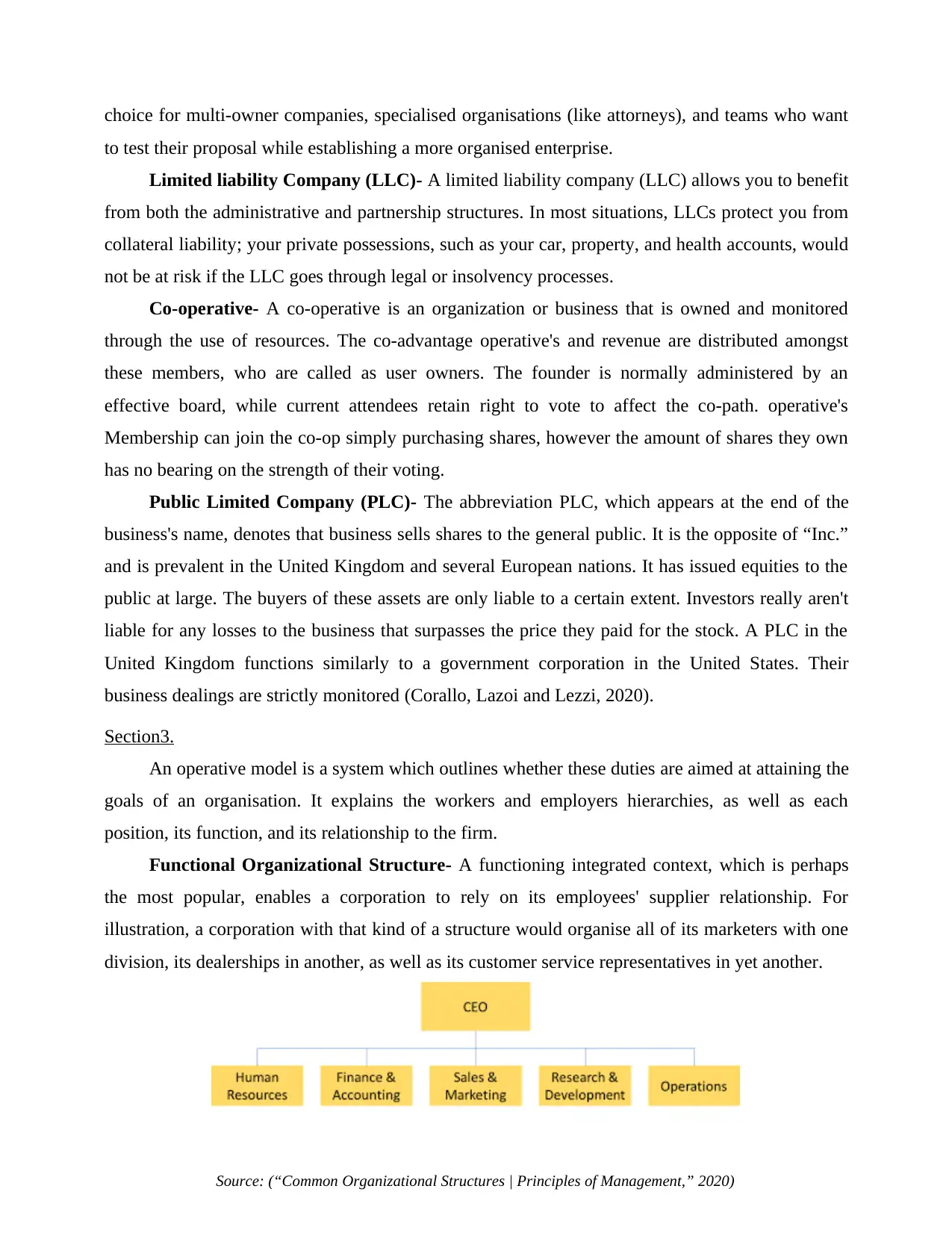
Functional Organizational Structure- A functioning integrated context, which is perhaps
the most popular, enables a corporation to rely on its employees' supplier relationship. For
illustration, a corporation with that kind of a structure would organise all of its marketers with one
division, its dealerships in another, as well as its customer service representatives in yet another.
Source: (“Common Organizational Structures | Principles of Management,” 2020)
to test their proposal while establishing a more organised enterprise.
Limited liability Company (LLC)- A limited liability company (LLC) allows you to benefit
from both the administrative and partnership structures. In most situations, LLCs protect you from
collateral liability; your private possessions, such as your car, property, and health accounts, would
not be at risk if the LLC goes through legal or insolvency processes.
Co-operative- A co-operative is an organization or business that is owned and monitored
through the use of resources. The co-advantage operative's and revenue are distributed amongst
these members, who are called as user owners. The founder is normally administered by an
effective board, while current attendees retain right to vote to affect the co-path. operative's
Membership can join the co-op simply purchasing shares, however the amount of shares they own
has no bearing on the strength of their voting.
Public Limited Company (PLC)- The abbreviation PLC, which appears at the end of the
business's name, denotes that business sells shares to the general public. It is the opposite of “Inc.”
and is prevalent in the United Kingdom and several European nations. It has issued equities to the
public at large. The buyers of these assets are only liable to a certain extent. Investors really aren't
liable for any losses to the business that surpasses the price they paid for the stock. A PLC in the
United Kingdom functions similarly to a government corporation in the United States. Their
business dealings are strictly monitored (Corallo, Lazoi and Lezzi, 2020).
Section3.
An operative model is a system which outlines whether these duties are aimed at attaining the
goals of an organisation. It explains the workers and employers hierarchies, as well as each
position, its function, and its relationship to the firm.
Functional Organizational Structure- A functioning integrated context, which is perhaps
the most popular, enables a corporation to rely on its employees' supplier relationship. For
illustration, a corporation with that kind of a structure would organise all of its marketers with one
division, its dealerships in another, as well as its customer service representatives in yet another.
Source: (“Common Organizational Structures | Principles of Management,” 2020)
Structure of Hierarchy- Employees at multiple levels are rated higher than one another in
this method. Professionals, with the exception of those in extremely high-ranking positions like
owners or employers, and those in entry-level positions, can have supervisors and followers.
Flat Structure- A flattened organization limits organizational changes in just such a
manner that almost all employees get a measure of authority around, while the two previous
designs are somewhat pyramidal owing to the layers of mangers. There really are limited
tenure norms in this structure, as well as some positions have no specified tiers. Staffs are
offered main roles and provide in-line duties based on the experiences, allowing them to
become more involved in all activities and thus influence judgement procedures (Cosenz,
Rodrigues and Rosati, 2020).
Divisional Structure- They're used among bigger companies in a major metro area, as well
as smaller firms which are members of an overarching group that represents a variety of
items or sectors. Each divisions functions successfully as a corporation underneath this
system, controlling investment and spending on projects and elements in specific divisions.
Matrix Structure- Under that same structure, most employees have double connections
and report to two (or even more) managers, based mostly on situation or purpose.
Throughout the realm of pragmatic accounting and brand accounting, this is usually the
case.
Impact of organizational structure on productivity- The policy chart establishes a structure
of responsibilities inside an institution, resulting in various degrees of cooperation. The manner a
structure of the organization was created and managed has a significant influence on corporate
performance. In tracking work engagement, keep in mind that a variety of issues with information
systems might affect productivity.
Influence in administration- Because of the structure of the structure, the efficiency of the
leadership has a huge effect on your firm. Terrible or incompetent leadership at any level of
an organisation can spread throughout the entire company, so improper managerial
decisions in such sectors all have an effect on units that interact with others, system
involved. Efficient leadership may have had the inverse result, as efficient and sensible
actions can help improve speed and effectiveness (Denisoff and Romanowski, 2017).
Structural faults- Information may flow as it should if indeed the hierarchy equipment is
not fully established. This can take several months for commercial enterprise information to
reach the entire squad if the intermediate leadership team does not have provides clear
channels with executive team. To increase production easier, flaws in the government
machine that cause coordinating faults or limitations should be addressed.
this method. Professionals, with the exception of those in extremely high-ranking positions like
owners or employers, and those in entry-level positions, can have supervisors and followers.
Flat Structure- A flattened organization limits organizational changes in just such a
manner that almost all employees get a measure of authority around, while the two previous
designs are somewhat pyramidal owing to the layers of mangers. There really are limited
tenure norms in this structure, as well as some positions have no specified tiers. Staffs are
offered main roles and provide in-line duties based on the experiences, allowing them to
become more involved in all activities and thus influence judgement procedures (Cosenz,
Rodrigues and Rosati, 2020).
Divisional Structure- They're used among bigger companies in a major metro area, as well
as smaller firms which are members of an overarching group that represents a variety of
items or sectors. Each divisions functions successfully as a corporation underneath this
system, controlling investment and spending on projects and elements in specific divisions.
Matrix Structure- Under that same structure, most employees have double connections
and report to two (or even more) managers, based mostly on situation or purpose.
Throughout the realm of pragmatic accounting and brand accounting, this is usually the
case.
Impact of organizational structure on productivity- The policy chart establishes a structure
of responsibilities inside an institution, resulting in various degrees of cooperation. The manner a
structure of the organization was created and managed has a significant influence on corporate
performance. In tracking work engagement, keep in mind that a variety of issues with information
systems might affect productivity.
Influence in administration- Because of the structure of the structure, the efficiency of the
leadership has a huge effect on your firm. Terrible or incompetent leadership at any level of
an organisation can spread throughout the entire company, so improper managerial
decisions in such sectors all have an effect on units that interact with others, system
involved. Efficient leadership may have had the inverse result, as efficient and sensible
actions can help improve speed and effectiveness (Denisoff and Romanowski, 2017).
Structural faults- Information may flow as it should if indeed the hierarchy equipment is
not fully established. This can take several months for commercial enterprise information to
reach the entire squad if the intermediate leadership team does not have provides clear
channels with executive team. To increase production easier, flaws in the government
machine that cause coordinating faults or limitations should be addressed.
⊘ This is a preview!⊘
Do you want full access?
Subscribe today to unlock all pages.
Trusted by 1+ million students worldwide
Creativeness- Bureaucratic system, which would be common in complex strategy, will
stifle growth and reduce the efficiency. For instance, if a factory worker advises the
technical cooperation should be used more effectively, however the suggestion is buried
in the churn of government structure, the corporation may lose a lot of money while
efficiency might be improved.
Development- Communication and operational connections become strained to a brink
of inefficiencies whenever a company growth with an inadequate internal architecture. A
robust management chart that's also designed to expand with the industry can keep
productivity levels high throughout times of expansion while also allowing for policy
plans that'll be needed as the firm expands (Geissdoerfer, Bocken and Hultink, 2016).
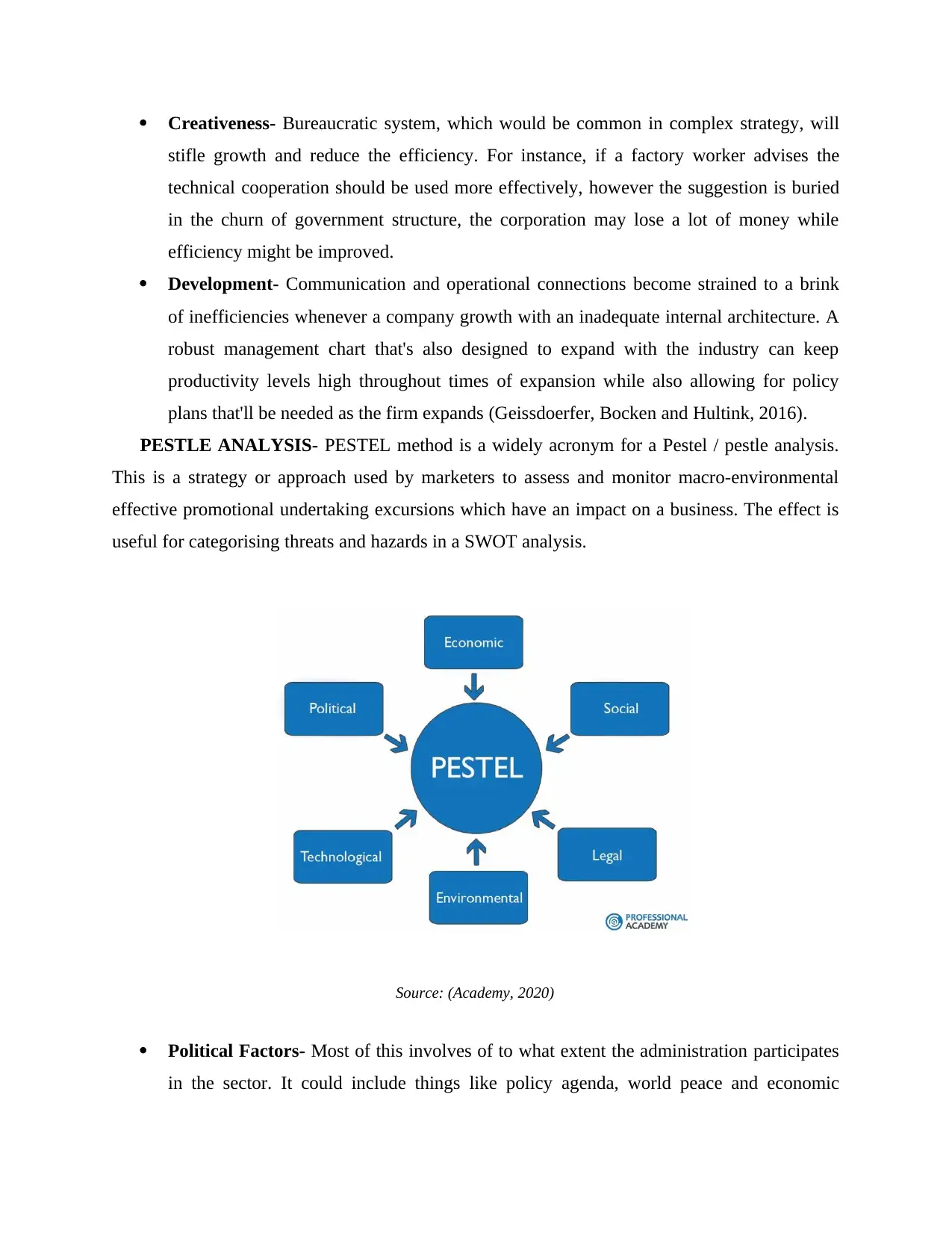
PESTLE ANALYSIS- PESTEL method is a widely acronym for a Pestel / pestle analysis.
This is a strategy or approach used by marketers to assess and monitor macro-environmental
effective promotional undertaking excursions which have an impact on a business. The effect is
useful for categorising threats and hazards in a SWOT analysis.
Source: (Academy, 2020)
Political Factors- Most of this involves of to what extent the administration participates
in the sector. It could include things like policy agenda, world peace and economic
stifle growth and reduce the efficiency. For instance, if a factory worker advises the
technical cooperation should be used more effectively, however the suggestion is buried
in the churn of government structure, the corporation may lose a lot of money while
efficiency might be improved.
Development- Communication and operational connections become strained to a brink
of inefficiencies whenever a company growth with an inadequate internal architecture. A
robust management chart that's also designed to expand with the industry can keep
productivity levels high throughout times of expansion while also allowing for policy
plans that'll be needed as the firm expands (Geissdoerfer, Bocken and Hultink, 2016).
PESTLE ANALYSIS- PESTEL method is a widely acronym for a Pestel / pestle analysis.
This is a strategy or approach used by marketers to assess and monitor macro-environmental
effective promotional undertaking excursions which have an impact on a business. The effect is
useful for categorising threats and hazards in a SWOT analysis.
Source: (Academy, 2020)
Political Factors- Most of this involves of to what extent the administration participates
in the sector. It could include things like policy agenda, world peace and economic
Paraphrase This Document
Need a fresh take? Get an instant paraphrase of this document with our AI Paraphraser
upheaval, foreign exchange policies, fiscal policy, labour law, and immigration laws,
among other things (Kowalkowski and Ulaga, 2017).
Economic Factors- Financial fundamentals get a significant impact on how an
organisation works, including aspects such as international trade, inflation rates, currency
exchange rates, family and business revenue, and so forth.
Social Factors- Professional views, population increase, age structure, health education,
and other cultural or sociological aspects are examples. Those elements are also of
special importance since they actually impact how marketing perceive and draw traffic.
Technological Factors- The changing technical environment has an effect on product
advertising inside the following ways: Administration and advertising are influenced by
technology elements in the following ways:
o New distribution channels for products and service
o New types of products and services
o The most up-to-date methods for engaging target populations
Environmental Factors- Businesses might well have morally acceptable corporate
practices, while countries may have carbon emissions targets (a clear example of a
concern that may be classified as both ecological and social). Advertisers are frequently
confronted with such challenges. Ever more healthy and responsible market demands that
perhaps the things that purchase originate from healthy and responsible sources, if at all
possible (Philipson, 2016).
Legal Factors- Rights and wellbeing, equitable access, advertising requirements, security
mechanisms and laws, product labelling, and democratic ownership are all legal
concerns. To conduct business successfully, organisations must understand fully whether
or not it is legal. Whenever a company operates internationally, it's a very difficult sector
to navigate because each culture has its own set of rules and laws.
Ethical Factors- PESTEL is given an extra E, as is the case with PESTELE. It refers for
moral principles, and it refers to any morality difficulties that may arise in a company. It
takes into account concerns such as corporate social responsibility (CSR), in which a
company commits to societal or local goals.
among other things (Kowalkowski and Ulaga, 2017).
Economic Factors- Financial fundamentals get a significant impact on how an
organisation works, including aspects such as international trade, inflation rates, currency
exchange rates, family and business revenue, and so forth.
Social Factors- Professional views, population increase, age structure, health education,
and other cultural or sociological aspects are examples. Those elements are also of
special importance since they actually impact how marketing perceive and draw traffic.
Technological Factors- The changing technical environment has an effect on product
advertising inside the following ways: Administration and advertising are influenced by
technology elements in the following ways:
o New distribution channels for products and service
o New types of products and services
o The most up-to-date methods for engaging target populations
Environmental Factors- Businesses might well have morally acceptable corporate
practices, while countries may have carbon emissions targets (a clear example of a
concern that may be classified as both ecological and social). Advertisers are frequently
confronted with such challenges. Ever more healthy and responsible market demands that
perhaps the things that purchase originate from healthy and responsible sources, if at all
possible (Philipson, 2016).
Legal Factors- Rights and wellbeing, equitable access, advertising requirements, security
mechanisms and laws, product labelling, and democratic ownership are all legal
concerns. To conduct business successfully, organisations must understand fully whether
or not it is legal. Whenever a company operates internationally, it's a very difficult sector
to navigate because each culture has its own set of rules and laws.
Ethical Factors- PESTEL is given an extra E, as is the case with PESTELE. It refers for
moral principles, and it refers to any morality difficulties that may arise in a company. It
takes into account concerns such as corporate social responsibility (CSR), in which a
company commits to societal or local goals.
o Innocent persons ‘big knit' push to raise funds charity her drinks in the UK is an instance
of corporate social responsibility.
o McDonald's community effort for job readiness and advancement (Staniewski, Szopiński
and Awruk, 2016).
CONCLUSION
It can concluded that there are a number of types of business that are very important and
thus has to be analysed and evaluated so that it can add value in the long run.
of corporate social responsibility.
o McDonald's community effort for job readiness and advancement (Staniewski, Szopiński
and Awruk, 2016).
CONCLUSION
It can concluded that there are a number of types of business that are very important and
thus has to be analysed and evaluated so that it can add value in the long run.
⊘ This is a preview!⊘
Do you want full access?
Subscribe today to unlock all pages.
Trusted by 1+ million students worldwide
REFERENCES
Books and journals
Andreini, D. and Bettinelli, C., 2017. Business model innovation. Springer International
Publishing AG.
Castillo-Vergara, M., Alvarez-Marin, A. and Placencio-Hidalgo, D., 2018. A bibliometric
analysis of creativity in the field of business economics. Journal of Business Research,
85, pp.1-9.
Choi, T.M., Chan, H.K. and Yue, X., 2016. Recent development in big data analytics for
business operations and risk management. IEEE transactions on cybernetics, 47(1),
pp.81-92.
Corallo, A., Lazoi, M. and Lezzi, M., 2020. Cybersecurity in the context of industry 4.0: A
structured classification of critical assets and business impacts. Computers in industry,
114, p.103165.
Cosenz, F., Rodrigues, V.P. and Rosati, F., 2020. Dynamic business modeling for sustainability:
Exploring a system dynamics perspective to develop sustainable business models.
Business Strategy and the Environment, 29(2), pp.651-664.
Denisoff, R.S. and Romanowski, W.D., 2017. Risky business: Rock in film. Routledge.
Geissdoerfer, M., Bocken, N.M. and Hultink, E.J., 2016. Design thinking to enhance the
sustainable business modelling process–A workshop based on a value mapping process.
Journal of Cleaner Production, 135, pp.1218-1232.
Kowalkowski, C. and Ulaga, W., 2017. Service strategy in action: A practical guide for growing
your B2B service and solution business. Service Strategy Press.
Philipson, S., 2016. Radical innovation of a business model: is business modelling a key to
understand the essence of doing business?. Competitiveness Review.
Staniewski, M.W., Szopiński, T. and Awruk, K., 2016. Setting up a business and funding
sources. Journal of Business Research, 69(6), pp.2108-2112.
Books and journals
Andreini, D. and Bettinelli, C., 2017. Business model innovation. Springer International
Publishing AG.
Castillo-Vergara, M., Alvarez-Marin, A. and Placencio-Hidalgo, D., 2018. A bibliometric
analysis of creativity in the field of business economics. Journal of Business Research,
85, pp.1-9.
Choi, T.M., Chan, H.K. and Yue, X., 2016. Recent development in big data analytics for
business operations and risk management. IEEE transactions on cybernetics, 47(1),
pp.81-92.
Corallo, A., Lazoi, M. and Lezzi, M., 2020. Cybersecurity in the context of industry 4.0: A
structured classification of critical assets and business impacts. Computers in industry,
114, p.103165.
Cosenz, F., Rodrigues, V.P. and Rosati, F., 2020. Dynamic business modeling for sustainability:
Exploring a system dynamics perspective to develop sustainable business models.
Business Strategy and the Environment, 29(2), pp.651-664.
Denisoff, R.S. and Romanowski, W.D., 2017. Risky business: Rock in film. Routledge.
Geissdoerfer, M., Bocken, N.M. and Hultink, E.J., 2016. Design thinking to enhance the
sustainable business modelling process–A workshop based on a value mapping process.
Journal of Cleaner Production, 135, pp.1218-1232.
Kowalkowski, C. and Ulaga, W., 2017. Service strategy in action: A practical guide for growing
your B2B service and solution business. Service Strategy Press.
Philipson, S., 2016. Radical innovation of a business model: is business modelling a key to
understand the essence of doing business?. Competitiveness Review.
Staniewski, M.W., Szopiński, T. and Awruk, K., 2016. Setting up a business and funding
sources. Journal of Business Research, 69(6), pp.2108-2112.

1 out of 10


Related Documents


Your All-in-One AI-Powered Toolkit for Academic Success.
+13062052269
info@desklib.com
Available 24*7 on WhatsApp / Email
![[object Object]](/_next/static/media/star-bottom.7253800d.svg)
Unlock your academic potential
Copyright © 2020–2026 A2Z Services. All Rights Reserved. Developed and managed by ZUCOL.