Analyzing Company Types, Structures, and PESTLE in Business Practice
VerifiedAdded on 2023/06/07
|9
|2584
|190
Report
AI Summary
This report provides a comprehensive overview of business practices, focusing on different types of companies, ranging from micro businesses to large corporations, and their operational characteristics. It delves into various business structures such as sole proprietorships, partnerships, limited liability companies, public limited liability businesses, and cooperatives, highlighting their unique features. Furthermore, the report examines the impact of different organizational structures on business productivity, including functional, divisional, and matrix structures. It also includes a PESTLE analysis, evaluating the political, economic, social, technological, legal, and environmental factors that influence business performance. The report concludes by emphasizing the importance of selecting the most suitable organizational structure and understanding external factors for achieving business success. Desklib offers a range of solved assignments and past papers to aid students in their studies.
Business In Practice

Paraphrase This Document
Need a fresh take? Get an instant paraphrase of this document with our AI Paraphraser
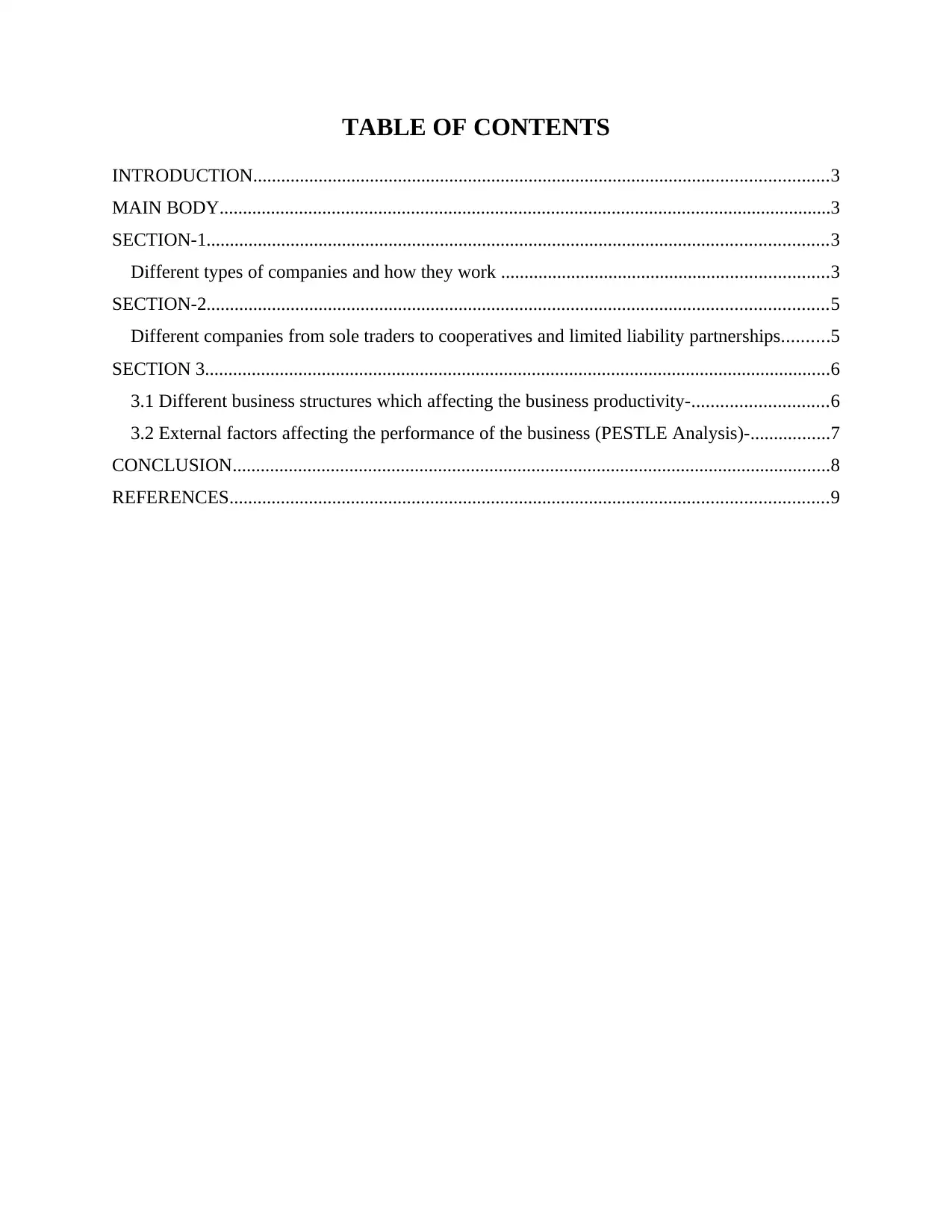
TABLE OF CONTENTS
INTRODUCTION...........................................................................................................................3
MAIN BODY...................................................................................................................................3
SECTION-1.....................................................................................................................................3
Different types of companies and how they work ......................................................................3
SECTION-2.....................................................................................................................................5
Different companies from sole traders to cooperatives and limited liability partnerships..........5
SECTION 3......................................................................................................................................6
3.1 Different business structures which affecting the business productivity-.............................6
3.2 External factors affecting the performance of the business (PESTLE Analysis)-.................7
CONCLUSION................................................................................................................................8
REFERENCES................................................................................................................................9
INTRODUCTION...........................................................................................................................3
MAIN BODY...................................................................................................................................3
SECTION-1.....................................................................................................................................3
Different types of companies and how they work ......................................................................3
SECTION-2.....................................................................................................................................5
Different companies from sole traders to cooperatives and limited liability partnerships..........5
SECTION 3......................................................................................................................................6
3.1 Different business structures which affecting the business productivity-.............................6
3.2 External factors affecting the performance of the business (PESTLE Analysis)-.................7
CONCLUSION................................................................................................................................8
REFERENCES................................................................................................................................9
INTRODUCTION
Business practices can be defined as the information which is related to the intellectual
property, business plans, financial information, products and services, manufacturing processes
and methods, customer lists, sales, profits and losses, pricing methods and many more. This
report is consisted of 3 sections that is first section will cover the different types of the
companies as well as in section two, the sole traders, limited liability companies will be
discussed. Along with this, the third section will discuss the various types of business structures
as well as the PESTLE analysis affecting business performance will be illustrated within this
report.
MAIN BODY
SECTION-1
Different types of companies and how they work
A company can be defined as an artificial person which has been developed by a group of
individuals that is regulated by a separate law in different countries all over the work (Mittal,
2020). When a company is created, it is assumed that it will be running for a long period of time
and does have any time boundation attached to it. There are different types of companies, some
of which are explained below:
Micro business
A micro business can be identified as an organization that carries out their business by
hiring a very few number i.e., nine or fewer employees within their business. The micro business
organizations do have a balance sheet, however their turnover is below a certain amount i.e.,
Euro 2 million p.a. the examples of a micro business include Etsy business owners, Amazon
suppliers, home based business, etc. The major characteristics of a micro business are as follows:
A micro business has a very small team of employees in order to carry out their business
operations. There is small business that are even run by a single individual.
These businesses are available at very few or maybe only a single location.
Since, they are mostly run from a single location and do not have much scope of hiring
new employees, these businesses only cover a small market size or the local area.
Small business
Business practices can be defined as the information which is related to the intellectual
property, business plans, financial information, products and services, manufacturing processes
and methods, customer lists, sales, profits and losses, pricing methods and many more. This
report is consisted of 3 sections that is first section will cover the different types of the
companies as well as in section two, the sole traders, limited liability companies will be
discussed. Along with this, the third section will discuss the various types of business structures
as well as the PESTLE analysis affecting business performance will be illustrated within this
report.
MAIN BODY
SECTION-1
Different types of companies and how they work
A company can be defined as an artificial person which has been developed by a group of
individuals that is regulated by a separate law in different countries all over the work (Mittal,
2020). When a company is created, it is assumed that it will be running for a long period of time
and does have any time boundation attached to it. There are different types of companies, some
of which are explained below:
Micro business
A micro business can be identified as an organization that carries out their business by
hiring a very few number i.e., nine or fewer employees within their business. The micro business
organizations do have a balance sheet, however their turnover is below a certain amount i.e.,
Euro 2 million p.a. the examples of a micro business include Etsy business owners, Amazon
suppliers, home based business, etc. The major characteristics of a micro business are as follows:
A micro business has a very small team of employees in order to carry out their business
operations. There is small business that are even run by a single individual.
These businesses are available at very few or maybe only a single location.
Since, they are mostly run from a single location and do not have much scope of hiring
new employees, these businesses only cover a small market size or the local area.
Small business
⊘ This is a preview!⊘
Do you want full access?
Subscribe today to unlock all pages.

Trusted by 1+ million students worldwide
A little different from micro business, a small business can be defined as an organization
that privately owned corporation, sole proprietorship, or partnership that has comparatively
higher number of employees and turnover from the micro business but lesser than the medium
sized business enterprise can be referred to as a small business (Iovino, and Migliaccio, 2019).
Some of the examples of a small business include health care and virtual medicine, consultancy
services and many more. The features of a small business are as follows:
A small scale company can have up to 100 employees.
However, the profitability of small business is comparatively lesser than the medium and
large scale companies.
Medium size business
A medium sized business is available in certain markets and is considered as a legally
independent company (Daas, and de Wolf, 2021). In order to fall within the category a medium
size business, it is essential for a company to have an annual revenue of $10 million to $1 billion.
The examples of the medium size business are Giacom, Pharmacy2U, Smith brothers and many
more. The characteristics of a medium size business are explained below:
A medium sized business includes a variety of department within their organization.
They have a small group of IT staff, some employees with general skills and some with
specialization in different field related to the business.
These business are likely to present at more locations as compared to small businesses.
Large size business
It has been identified that a large business refers to a company that has above average
business size, who has large team for carrying out the routine business processes and include
huge economies of scale. The examples of Large business size are Unilever, GlaxoSmithKline,
HSBC Holdings, etc. The characteristics of the large business are:
Has more than 1000 employees.
The annual revenue of the company is over $1 billion.
Has a wide range of departments within their company.
Serves both nationally and internationally.
that privately owned corporation, sole proprietorship, or partnership that has comparatively
higher number of employees and turnover from the micro business but lesser than the medium
sized business enterprise can be referred to as a small business (Iovino, and Migliaccio, 2019).
Some of the examples of a small business include health care and virtual medicine, consultancy
services and many more. The features of a small business are as follows:
A small scale company can have up to 100 employees.
However, the profitability of small business is comparatively lesser than the medium and
large scale companies.
Medium size business
A medium sized business is available in certain markets and is considered as a legally
independent company (Daas, and de Wolf, 2021). In order to fall within the category a medium
size business, it is essential for a company to have an annual revenue of $10 million to $1 billion.
The examples of the medium size business are Giacom, Pharmacy2U, Smith brothers and many
more. The characteristics of a medium size business are explained below:
A medium sized business includes a variety of department within their organization.
They have a small group of IT staff, some employees with general skills and some with
specialization in different field related to the business.
These business are likely to present at more locations as compared to small businesses.
Large size business
It has been identified that a large business refers to a company that has above average
business size, who has large team for carrying out the routine business processes and include
huge economies of scale. The examples of Large business size are Unilever, GlaxoSmithKline,
HSBC Holdings, etc. The characteristics of the large business are:
Has more than 1000 employees.
The annual revenue of the company is over $1 billion.
Has a wide range of departments within their company.
Serves both nationally and internationally.
Paraphrase This Document
Need a fresh take? Get an instant paraphrase of this document with our AI Paraphraser
SECTION-2
Different companies from sole traders to cooperatives and limited liability partnerships
The different types of companies are explained below:
Sole trader business
A business that is specifically run by an individual is known as a sole trader business or
proprietorship (Huang, 2020). Since, there is only one person involved in the business, all the
profits are enjoyed by the owner. Similarly, in case of losses they are bared by the owner itself.
For instance, a hairdresser that provides the customers with salon services and is self-employed
is a kind of sole trader business. The features of a sole trader include minimal filing and
administrative requirements, unlimited liability, and full control over the business.
Partnerships
An arrangement between two or more individuals for the purpose of carrying out the
business activities and share the profits and liability of the enterprise is known as a partnership.
The example of a partnership business is social chain. The features of a partnership are as
follows:
An agreement between the parties to decide their ratios in which the profits and losses
can be shared among them.
In a partnership, there is a principle agency relationship between the partners. This means
that business activities can be carried out either by all partners or maybe a single partner
acting on the behalf of others.
Limited Liability business
A legal entity in which the management of the company decides a limit after which the
economic loss will not be bared by the company. The limit is set in relation with the value of the
assets of the company (Legendre, and Bowen, 2020). The personal assets of the investors and
owners are not used for the purpose of repaying the debt. Virgin Atlantic and John Lewis
partnership are examples of a limited liability business. The main characteristics of this business
separate legal entity as it is considered different from its owners and limited liability as the
owner is not liable to pay the liability to the extent of the value of the assets of the company.
Public limited liability business
A public limited liability can be defined as a company that offers shares in the form of
the stocks to the public. The public who purchases these shares have limited liability which
Different companies from sole traders to cooperatives and limited liability partnerships
The different types of companies are explained below:
Sole trader business
A business that is specifically run by an individual is known as a sole trader business or
proprietorship (Huang, 2020). Since, there is only one person involved in the business, all the
profits are enjoyed by the owner. Similarly, in case of losses they are bared by the owner itself.
For instance, a hairdresser that provides the customers with salon services and is self-employed
is a kind of sole trader business. The features of a sole trader include minimal filing and
administrative requirements, unlimited liability, and full control over the business.
Partnerships
An arrangement between two or more individuals for the purpose of carrying out the
business activities and share the profits and liability of the enterprise is known as a partnership.
The example of a partnership business is social chain. The features of a partnership are as
follows:
An agreement between the parties to decide their ratios in which the profits and losses
can be shared among them.
In a partnership, there is a principle agency relationship between the partners. This means
that business activities can be carried out either by all partners or maybe a single partner
acting on the behalf of others.
Limited Liability business
A legal entity in which the management of the company decides a limit after which the
economic loss will not be bared by the company. The limit is set in relation with the value of the
assets of the company (Legendre, and Bowen, 2020). The personal assets of the investors and
owners are not used for the purpose of repaying the debt. Virgin Atlantic and John Lewis
partnership are examples of a limited liability business. The main characteristics of this business
separate legal entity as it is considered different from its owners and limited liability as the
owner is not liable to pay the liability to the extent of the value of the assets of the company.
Public limited liability business
A public limited liability can be defined as a company that offers shares in the form of
the stocks to the public. The public who purchases these shares have limited liability which
means that they are not responsible for any business loss except their shares in the company.
British petroleum is a Public Limited Liability business. Certain features of a limited liability
business includes limited liability of shareholders, and paid up capital.
Cooperative
An association of persons that is specifically owned and controlled the people in order to
fulfil their economic, cultural and social needs. The major characteristic of a cooperative is that it
is jointly owned a number of individuals. ARLA foods is an example of a cooperative store that
is becoming quiet popular in the market, lately.
SECTION 3
3.1 Different business structures which affecting the business productivity-
Organisational structure can be defined as the system which shows how some activities
of the businesses are directed for achieving the goals of the organisation. These activities are
such as rules, roles as well as the responsibilities.
There are various types of the organisational structures are such as-
Functional structure: This is one of the most common organisational structure which is used in
the present era. This organisational structure is also known as the bureaucratic organisational
structure. It has been found that maximum number of the small and medium sized companies are
implementing this type if the organisational structure (RECTOR, 2021). This basically divides
the companies into the various departments which involves marketing, sales as well as the
operations. These departments of the companies swerves as the overall functional units as these
are seen by the functional managers or maybe by the head of department. This helps the
companies to run their businesses and enables them to earn huge profits by grouping the
employees according to their skills.
Divisional Structure: This type of the organisational structure is most common type among the
large corporations. This is also called as the multi divisional (M- Form) structure as the
companies which are using this type of the structure, then the leadership team is highly based on
the products and the projects in which they operates. This is basically the system in which the
organisations separates and divides the employees according to the products or markets which is
opposed to their respective job profile. The divisional organisation structure is having the teams
which are dedicated to the particular region and the product.
British petroleum is a Public Limited Liability business. Certain features of a limited liability
business includes limited liability of shareholders, and paid up capital.
Cooperative
An association of persons that is specifically owned and controlled the people in order to
fulfil their economic, cultural and social needs. The major characteristic of a cooperative is that it
is jointly owned a number of individuals. ARLA foods is an example of a cooperative store that
is becoming quiet popular in the market, lately.
SECTION 3
3.1 Different business structures which affecting the business productivity-
Organisational structure can be defined as the system which shows how some activities
of the businesses are directed for achieving the goals of the organisation. These activities are
such as rules, roles as well as the responsibilities.
There are various types of the organisational structures are such as-
Functional structure: This is one of the most common organisational structure which is used in
the present era. This organisational structure is also known as the bureaucratic organisational
structure. It has been found that maximum number of the small and medium sized companies are
implementing this type if the organisational structure (RECTOR, 2021). This basically divides
the companies into the various departments which involves marketing, sales as well as the
operations. These departments of the companies swerves as the overall functional units as these
are seen by the functional managers or maybe by the head of department. This helps the
companies to run their businesses and enables them to earn huge profits by grouping the
employees according to their skills.
Divisional Structure: This type of the organisational structure is most common type among the
large corporations. This is also called as the multi divisional (M- Form) structure as the
companies which are using this type of the structure, then the leadership team is highly based on
the products and the projects in which they operates. This is basically the system in which the
organisations separates and divides the employees according to the products or markets which is
opposed to their respective job profile. The divisional organisation structure is having the teams
which are dedicated to the particular region and the product.
⊘ This is a preview!⊘
Do you want full access?
Subscribe today to unlock all pages.
Trusted by 1+ million students worldwide
Matrix Structure: This type of the organisational structure is least used by the companies as this
is most confusing organisational structure. The matrix structure is the combination of the two or
the more types of organisational structure (Gillam and Cosford, 2021). This is basically the way
of making the arrangements which helps in setting up the reporting relationships as the grid and
the matrix instead of the traditional hierarchy. In this matrix organisational structure, the
employees are usually accountable to more number of the bosses that is more than one boss.
There are many of the successful companies who are using this type of the organisational
structure such as Phillips.
3.2 External factors affecting the performance of the business (PESTLE Analysis)-
Pestle analysis can be defined as the tool or the framework which is used by the
companies to analyse and evaluate the external business environment which can affect the
performance of the businesses (Buye, 2021). This is basically the concept of the marketing
principles which helps the companies to determine the external factors which is highly
influencing the overall performance of the organisation such as-
Political factors: These factors helps the companies in analysing the extent to which the
government is influencing the economy or the industry. These factors are such as new tax or the
duty, tax policies. Fiscal policies, trade tariffs and many more.
Economic Factors: These factors are basically the determinants of the performance of economy
which highly impacts the overall company's performance. These factors includes interest rates,
inflation rates, foreign exchange rates, economic growth patterns and many more.
Social factors: These factors are those which enables the company to analyse the social
environment of the business market. These are such as cultural trends, demographics, population
analytics and many more.
Technological factors: These factors are associated with the innovations in the technology
which will highly influence the overall operations of the industry or the organisations. This also
affects the market favourably as well as unfavourably. This basically known as the automation,
research and the development as well as the amount of the technological awareness which the
market is possessing (Shtal, and et.al., 2018).
Legal Factors: These are the factors which affects both that is external as well as the internal
environment of business. There are some of the laws which highly affects the business
environment within the country as well as the policies are also affecting the certain of the
is most confusing organisational structure. The matrix structure is the combination of the two or
the more types of organisational structure (Gillam and Cosford, 2021). This is basically the way
of making the arrangements which helps in setting up the reporting relationships as the grid and
the matrix instead of the traditional hierarchy. In this matrix organisational structure, the
employees are usually accountable to more number of the bosses that is more than one boss.
There are many of the successful companies who are using this type of the organisational
structure such as Phillips.
3.2 External factors affecting the performance of the business (PESTLE Analysis)-
Pestle analysis can be defined as the tool or the framework which is used by the
companies to analyse and evaluate the external business environment which can affect the
performance of the businesses (Buye, 2021). This is basically the concept of the marketing
principles which helps the companies to determine the external factors which is highly
influencing the overall performance of the organisation such as-
Political factors: These factors helps the companies in analysing the extent to which the
government is influencing the economy or the industry. These factors are such as new tax or the
duty, tax policies. Fiscal policies, trade tariffs and many more.
Economic Factors: These factors are basically the determinants of the performance of economy
which highly impacts the overall company's performance. These factors includes interest rates,
inflation rates, foreign exchange rates, economic growth patterns and many more.
Social factors: These factors are those which enables the company to analyse the social
environment of the business market. These are such as cultural trends, demographics, population
analytics and many more.
Technological factors: These factors are associated with the innovations in the technology
which will highly influence the overall operations of the industry or the organisations. This also
affects the market favourably as well as unfavourably. This basically known as the automation,
research and the development as well as the amount of the technological awareness which the
market is possessing (Shtal, and et.al., 2018).
Legal Factors: These are the factors which affects both that is external as well as the internal
environment of business. There are some of the laws which highly affects the business
environment within the country as well as the policies are also affecting the certain of the
Paraphrase This Document
Need a fresh take? Get an instant paraphrase of this document with our AI Paraphraser
policies which is maintaining the companies for better and smooth running. Examples are such
as the consumer laws safety standards, labour laws and many other legal factors has the effect on
the performance of the organisation.
Environmental factors: These are the factors which basically associated with the surrounding
environment. These also have very high level of influence on the overall performance of the
organisation. These factors includes such as climate, weather, geographical location, global
changes within the climate and many more such factors are affecting the performance of the
businesses.
CONCLUSION
From the above report it can be concluded that it is very important for the companies to select the
most suitable organisational structure, business size, type of the company and many more. This
is essential for the businesses to select these before the company is registered. The report has
discussed the various types of the companies as well as their working. Along with this, the
different companies from the sole traders to the limited liability partnerships are illustrated.
Further, the different types of the organisational structure has been discussed and how the
external factors of the business environment is affecting the overall business performance by
discussing through the Pestle analysis framework.
as the consumer laws safety standards, labour laws and many other legal factors has the effect on
the performance of the organisation.
Environmental factors: These are the factors which basically associated with the surrounding
environment. These also have very high level of influence on the overall performance of the
organisation. These factors includes such as climate, weather, geographical location, global
changes within the climate and many more such factors are affecting the performance of the
businesses.
CONCLUSION
From the above report it can be concluded that it is very important for the companies to select the
most suitable organisational structure, business size, type of the company and many more. This
is essential for the businesses to select these before the company is registered. The report has
discussed the various types of the companies as well as their working. Along with this, the
different companies from the sole traders to the limited liability partnerships are illustrated.
Further, the different types of the organisational structure has been discussed and how the
external factors of the business environment is affecting the overall business performance by
discussing through the Pestle analysis framework.
REFERENCES
Books and journals
Buye, R., 2021. Critical examination of the PESTLE analysis model. Action Research for
Development: Research Gate.
Daas, P. and de Wolf, N., 2021, June. Identifying different types of companies via their website
text. In Symposium on Data Science & Statistics: Beyond Big Data-Shaping the Future.
Gillam, S. and Cosford, P., 2021. Organisational structure. In Leadership and Management for
Doctors in Training (pp. 26-31). CRC Press.
Huang, Y., 2020. The Relationship between the Impact that Customer Satisfaction has on
Service Companies' and Product Companies' Revenue. Frontiers in Economics and
Management. 1(12). pp.20-22.
Iovino, F. and Migliaccio, G., 2019. Energy companies and sizes: An opportunity? Some
empirical evidences. Energy Policy. 128. pp.431-439.
Legendre, T.S. and Bowen, J.T., 2020. Customer perspectives on the acquisition of local
artisanal companies. International Journal of Contemporary Hospitality Management.
Mittal, H., 2020. HOW DOES THE INSTITUTIONAL CONTEXT OF AN EMERGING
ECONOMY SHAPE THE INNOVATION TRAJECTORY OF DIFFERENT TYPES
OF COMPANIES? A CASE STUDY OF INDIA. Ekonomicko-manazerske spektrum.
14(2). pp.36-51.
RECTOR, D., 2021. Organisational Structure.
Shtal, T.V., and et.al., 2018. Methods of analysis of the external environment of business
activities. Revista espacios, 39(12).
1
Books and journals
Buye, R., 2021. Critical examination of the PESTLE analysis model. Action Research for
Development: Research Gate.
Daas, P. and de Wolf, N., 2021, June. Identifying different types of companies via their website
text. In Symposium on Data Science & Statistics: Beyond Big Data-Shaping the Future.
Gillam, S. and Cosford, P., 2021. Organisational structure. In Leadership and Management for
Doctors in Training (pp. 26-31). CRC Press.
Huang, Y., 2020. The Relationship between the Impact that Customer Satisfaction has on
Service Companies' and Product Companies' Revenue. Frontiers in Economics and
Management. 1(12). pp.20-22.
Iovino, F. and Migliaccio, G., 2019. Energy companies and sizes: An opportunity? Some
empirical evidences. Energy Policy. 128. pp.431-439.
Legendre, T.S. and Bowen, J.T., 2020. Customer perspectives on the acquisition of local
artisanal companies. International Journal of Contemporary Hospitality Management.
Mittal, H., 2020. HOW DOES THE INSTITUTIONAL CONTEXT OF AN EMERGING
ECONOMY SHAPE THE INNOVATION TRAJECTORY OF DIFFERENT TYPES
OF COMPANIES? A CASE STUDY OF INDIA. Ekonomicko-manazerske spektrum.
14(2). pp.36-51.
RECTOR, D., 2021. Organisational Structure.
Shtal, T.V., and et.al., 2018. Methods of analysis of the external environment of business
activities. Revista espacios, 39(12).
1
⊘ This is a preview!⊘
Do you want full access?
Subscribe today to unlock all pages.
Trusted by 1+ million students worldwide

1 out of 9


Related Documents


Your All-in-One AI-Powered Toolkit for Academic Success.
+13062052269
info@desklib.com
Available 24*7 on WhatsApp / Email
![[object Object]](/_next/static/media/star-bottom.7253800d.svg)
Unlock your academic potential
Copyright © 2020–2026 A2Z Services. All Rights Reserved. Developed and managed by ZUCOL.