Business Law Assignment One: Sources of Irish Law, Courts, Civil Law
VerifiedAdded on 2023/06/03
|12
|2721
|112
Homework Assignment
AI Summary
This business law assignment delves into the Irish legal system, examining its primary sources, including common law, equity, the constitution, and European Union law. It further discusses the jurisdiction of the High Court and Circuit Courts of Ireland, outlining their powers in civil and criminal matters. The assignment also provides a detailed comparison between civil and criminal law, focusing on the scope of each, standards of proof, burden of proof, and the procedures involved in each system, highlighting the distinct roles of the courts and tribunals in handling different types of cases. Desklib provides students access to a wealth of resources, including past papers and solved assignments, to aid in their studies.
Running Head: BUSINESS LAW 0
Business Law Assignment
Assignment Number :One
Take Home Assignment
Student’s Name
10/17/2018
Business Law Assignment
Assignment Number :One
Take Home Assignment
Student’s Name
10/17/2018

Paraphrase This Document
Need a fresh take? Get an instant paraphrase of this document with our AI Paraphraser
BUSINESS LAW ASSIGNMNET 1
Contents
Question 1 Four sources of Irish law...............................................................................................2
Question 2: Jurisdiction of the High Court of Ireland.....................................................................4
Question 3 Jurisdiction of the Circuit Court of Ireland...................................................................5
Question 4 Differences between civil law and criminal law on various basis................................6
References......................................................................................................................................10
Contents
Question 1 Four sources of Irish law...............................................................................................2
Question 2: Jurisdiction of the High Court of Ireland.....................................................................4
Question 3 Jurisdiction of the Circuit Court of Ireland...................................................................5
Question 4 Differences between civil law and criminal law on various basis................................6
References......................................................................................................................................10
BUSINESS LAW ASSIGNMNET 2
Question 1 Four sources of Irish law
Irish Law refers to the law of Ireland and the prison system and courts of the country support the
same. Similar to any other law, Irish law is also been developed with the help of one or more
sources. Some of the lead sources of Irish law are mentioned below.
1. Common Law: - Common law has been developed in England originally. It is based on
the practices and legal precedents. A legal precedent is a decision of a past case, which
works as a reference in present cases. The idea behind the common law is to ensure that
in similar kind of cases, the similar law must be applied. At present, the presence of
common law can be seen in Irish law. Judges are used to look after the decisions of
previous cases and make them reference too (Holland Condon, 2014). In addition to
precedent, the other factor of common law i.e. tradition and customs can also be seen in
Irish law as the rules have been developed according to the custom of the nation.
2. Equity: - Equity is a most common source of any law. The law of every nation provides
the principles of equity. Similarly, it becomes a most important source of Irish Law too.
The basis of equity has been developed when people started finding its unfair to provide
decisions based on legal precedents every time (scsi.ie, 2018). The basis of using equity
principle was to get justice in those cases where the application of legal precedent did not
seem to be justified. The circumstance of every case does not remain the same and hence
it was found unfair and unjustified to give a similar decision in similar kind of cases
regardless of the facts and circumstances of individual cases. People started being
disagreed with the decisions of common law judges and in this manner, the principle of
Question 1 Four sources of Irish law
Irish Law refers to the law of Ireland and the prison system and courts of the country support the
same. Similar to any other law, Irish law is also been developed with the help of one or more
sources. Some of the lead sources of Irish law are mentioned below.
1. Common Law: - Common law has been developed in England originally. It is based on
the practices and legal precedents. A legal precedent is a decision of a past case, which
works as a reference in present cases. The idea behind the common law is to ensure that
in similar kind of cases, the similar law must be applied. At present, the presence of
common law can be seen in Irish law. Judges are used to look after the decisions of
previous cases and make them reference too (Holland Condon, 2014). In addition to
precedent, the other factor of common law i.e. tradition and customs can also be seen in
Irish law as the rules have been developed according to the custom of the nation.
2. Equity: - Equity is a most common source of any law. The law of every nation provides
the principles of equity. Similarly, it becomes a most important source of Irish Law too.
The basis of equity has been developed when people started finding its unfair to provide
decisions based on legal precedents every time (scsi.ie, 2018). The basis of using equity
principle was to get justice in those cases where the application of legal precedent did not
seem to be justified. The circumstance of every case does not remain the same and hence
it was found unfair and unjustified to give a similar decision in similar kind of cases
regardless of the facts and circumstances of individual cases. People started being
disagreed with the decisions of common law judges and in this manner, the principle of
⊘ This is a preview!⊘
Do you want full access?
Subscribe today to unlock all pages.

Trusted by 1+ million students worldwide
BUSINESS LAW ASSIGNMNET 3
equity has developed and introduced to Irish law. This is to understand that this source of
law acted as an addition to the existed source i.e. common law and did not replace the
same.
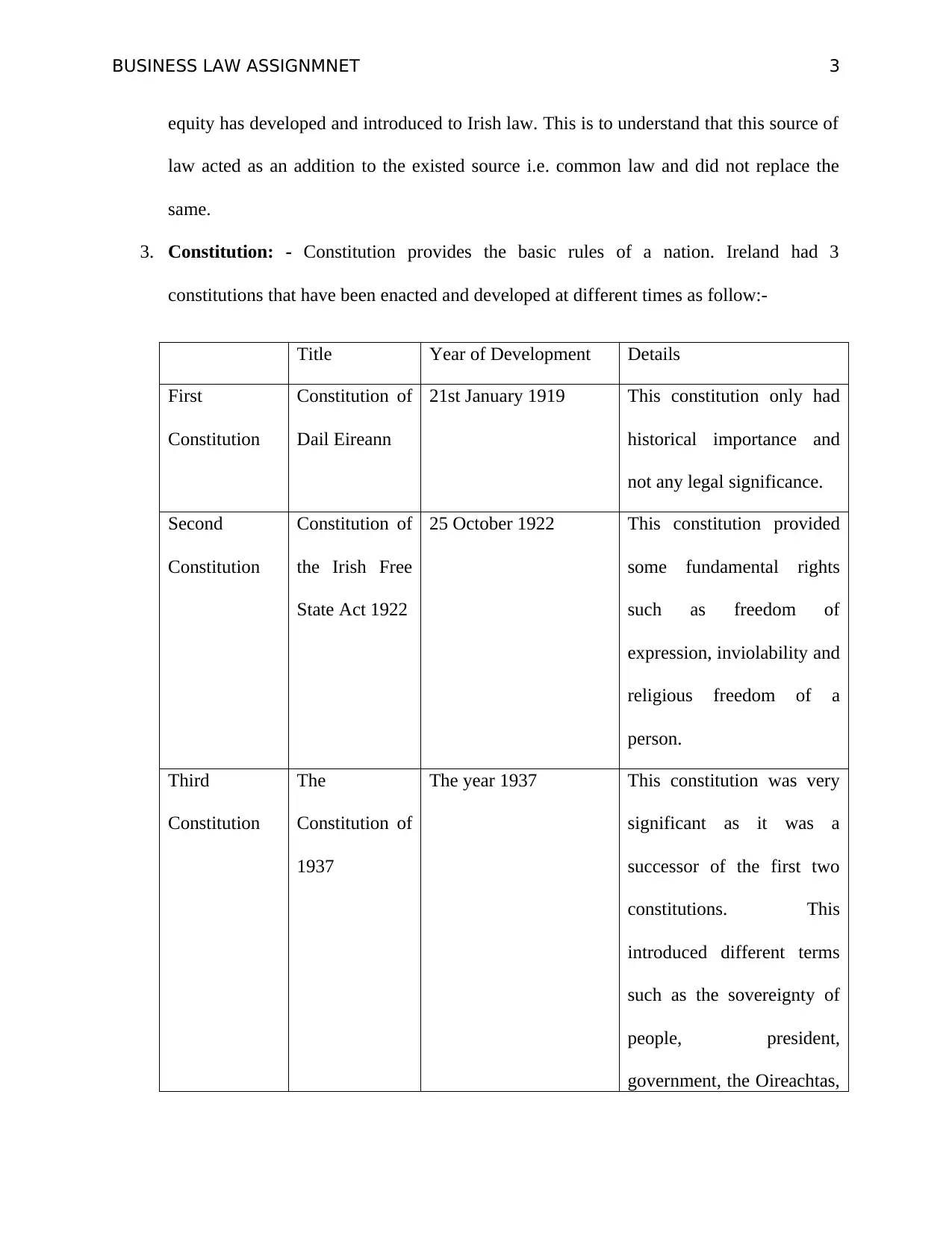
3. Constitution: - Constitution provides the basic rules of a nation. Ireland had 3
constitutions that have been enacted and developed at different times as follow:-
Title Year of Development Details
First
Constitution
Constitution of
Dail Eireann
21st January 1919 This constitution only had
historical importance and
not any legal significance.
Second
Constitution
Constitution of
the Irish Free
State Act 1922
25 October 1922 This constitution provided
some fundamental rights
such as freedom of
expression, inviolability and
religious freedom of a
person.
Third
Constitution
The
Constitution of
1937
The year 1937 This constitution was very
significant as it was a
successor of the first two
constitutions. This
introduced different terms
such as the sovereignty of
people, president,
government, the Oireachtas,
equity has developed and introduced to Irish law. This is to understand that this source of
law acted as an addition to the existed source i.e. common law and did not replace the
same.
3. Constitution: - Constitution provides the basic rules of a nation. Ireland had 3
constitutions that have been enacted and developed at different times as follow:-
Title Year of Development Details
First
Constitution
Constitution of
Dail Eireann
21st January 1919 This constitution only had
historical importance and
not any legal significance.
Second
Constitution
Constitution of
the Irish Free
State Act 1922
25 October 1922 This constitution provided
some fundamental rights
such as freedom of
expression, inviolability and
religious freedom of a
person.
Third
Constitution
The
Constitution of
1937
The year 1937 This constitution was very
significant as it was a
successor of the first two
constitutions. This
introduced different terms
such as the sovereignty of
people, president,
government, the Oireachtas,
Paraphrase This Document
Need a fresh take? Get an instant paraphrase of this document with our AI Paraphraser
BUSINESS LAW ASSIGNMNET 4
courts and so on.
Irish law got many of the provisions from all three constitutions. As these were the
provisions and rules that already were there and hence in the development of Irish law,
the same acted as a source.
4. European Union Law: - In the development of Irish law, there is a significant influence
of European Union law. The reason behind is that Ireland becomes a member of the
European Economic Community. European Union possesses a complete legal system and
a body of law that is applicable to every member of the union. Being a member of a
subjective union, Ireland was also required to comply with the laws of EU and in this
manner, nation’s own law been included the EU laws (e-justice.europa.eu, 2018).
In addition to aforesaid primary sources, Irish law also has some more sources such as
customs, international laws, and legislation of the country.
Question 2: Jurisdiction of the High Court of Ireland.
The high court of the country consists of 1 president and 36 ordinary judges. The high court of
Ireland has full powers and jurisdiction to determine the laws and facts of the cases related to
criminal as well as civil law. The jurisdiction of the courts is extended up to the question of the
legality of any law with respect to the constitution of the country. The high court has the power
to hear the appeal in against of the decision of circuit courts (in civil matters). In conjunction
with this, this court also has the power to make a review of the decisions of some tribunals
(courts.ie (a), 2018).
courts and so on.
Irish law got many of the provisions from all three constitutions. As these were the
provisions and rules that already were there and hence in the development of Irish law,
the same acted as a source.
4. European Union Law: - In the development of Irish law, there is a significant influence
of European Union law. The reason behind is that Ireland becomes a member of the
European Economic Community. European Union possesses a complete legal system and
a body of law that is applicable to every member of the union. Being a member of a
subjective union, Ireland was also required to comply with the laws of EU and in this
manner, nation’s own law been included the EU laws (e-justice.europa.eu, 2018).
In addition to aforesaid primary sources, Irish law also has some more sources such as
customs, international laws, and legislation of the country.
Question 2: Jurisdiction of the High Court of Ireland.
The high court of the country consists of 1 president and 36 ordinary judges. The high court of
Ireland has full powers and jurisdiction to determine the laws and facts of the cases related to
criminal as well as civil law. The jurisdiction of the courts is extended up to the question of the
legality of any law with respect to the constitution of the country. The high court has the power
to hear the appeal in against of the decision of circuit courts (in civil matters). In conjunction
with this, this court also has the power to make a review of the decisions of some tribunals
(courts.ie (a), 2018).
BUSINESS LAW ASSIGNMNET 5
Whenever district court submits a question of law, the high court has the power to grant ruling on
the same. The high court also has it is criminal jurisdiction, and this court exercises such
jurisdiction via central criminal courts (Lexadin.nl, 2018). The only high court can provide the
bail in the cases of murder. The high court of the country also has jurisdiction to vary the
conditions of bail provided by the district court and this court also can provide bail to a person
even if the district court has rejected the same. By looking after the aforementioned discussion,
this is far much clear that High court of the country has huge powers over the decisions of the
district courts as the same can cancel and revise the decisions of these lower courts.
Question 3 Jurisdiction of the Circuit Court of Ireland.
There are total eight circuit courts in the country. The powers and jurisdiction of these courts are
divided into a local and limited jurisdiction (Ward, 2010) A circuit court of the county has
limited power to listen to those civil cases where the value of the claim does not exceed €75,000
and further market value is or less than €3,000,000 (Whitney Moore, 2014)
Moving towards the family law cases, a circuit court has wider power to hear the cases related to
divorce, judicial separation, and nullity. Such courts can also entertain the appeals made in
against of the decisions of the district court. In the matter of criminal cases, a circuit court has
equivalent powers to central criminal courts in relation to all indictable offense. However, these
powers are not available in the matters of rape, murder, treason, aggravated sexual assault,
piracy, and other related offenses courts.ie (b), 2018. Circuit Courts can use this jurisdiction in
those cases where a guilty person (criminal) has committed an offense or the accused person has
been resides or arrested (Citizens Information, 2018). IN addition to civil and criminal
Whenever district court submits a question of law, the high court has the power to grant ruling on
the same. The high court also has it is criminal jurisdiction, and this court exercises such
jurisdiction via central criminal courts (Lexadin.nl, 2018). The only high court can provide the
bail in the cases of murder. The high court of the country also has jurisdiction to vary the
conditions of bail provided by the district court and this court also can provide bail to a person
even if the district court has rejected the same. By looking after the aforementioned discussion,
this is far much clear that High court of the country has huge powers over the decisions of the
district courts as the same can cancel and revise the decisions of these lower courts.
Question 3 Jurisdiction of the Circuit Court of Ireland.
There are total eight circuit courts in the country. The powers and jurisdiction of these courts are
divided into a local and limited jurisdiction (Ward, 2010) A circuit court of the county has
limited power to listen to those civil cases where the value of the claim does not exceed €75,000
and further market value is or less than €3,000,000 (Whitney Moore, 2014)
Moving towards the family law cases, a circuit court has wider power to hear the cases related to
divorce, judicial separation, and nullity. Such courts can also entertain the appeals made in
against of the decisions of the district court. In the matter of criminal cases, a circuit court has
equivalent powers to central criminal courts in relation to all indictable offense. However, these
powers are not available in the matters of rape, murder, treason, aggravated sexual assault,
piracy, and other related offenses courts.ie (b), 2018. Circuit Courts can use this jurisdiction in
those cases where a guilty person (criminal) has committed an offense or the accused person has
been resides or arrested (Citizens Information, 2018). IN addition to civil and criminal
⊘ This is a preview!⊘
Do you want full access?
Subscribe today to unlock all pages.
Trusted by 1+ million students worldwide
BUSINESS LAW ASSIGNMNET 6
jurisdiction, a circuit court also has appellate jurisdiction as the same can hear an appeal against
the decision of district courts except in some of the cases. Circuit courts also have jurisdiction to
work as an appellate court in the decision granted by the Employment Appeals Tribunal, labor
courts, and the Employment Appeals Tribunal.
Question 4 Differences between civil law and criminal law on various
basis
The legal system of Ireland is divided into two lead branches namely Civil Law and Criminal
Law. Before discussing the difference between civil and criminal law based on other factors, one
needs to know about the scope of these laws. Many differences are there between civil and
criminal law. Criminal law deals with those matters in which one party states. It means a
commitment of those acts, which are specifically mentioned as an offense by states, comes under
the purview of criminal law for further consideration. On the other, in civil law, those cases
come in which both of the parties to a case are private persons. Such private persons can be
private statutory undertaker individual, company and private individual. In the cases of civil law,
a plaintiff initiates an action against the defendant to get compensation for the wrong act of
defendant (The Bar of Ireland, 2018)
There are other differences between these two laws based on the standard of proof. In cases of
civil law, the claimant must provide proof/evidence outside the limit of probabilities, whereas in
the cases of criminal law, the applicant needs to produce the evidence beyond a reasonable
doubt. Further, in cases of civil law, the burden of proof lies with the plaintiff (Diffen.com,
2018). However, in those circumstances where the defendant says something to defend, then this
jurisdiction, a circuit court also has appellate jurisdiction as the same can hear an appeal against
the decision of district courts except in some of the cases. Circuit courts also have jurisdiction to
work as an appellate court in the decision granted by the Employment Appeals Tribunal, labor
courts, and the Employment Appeals Tribunal.
Question 4 Differences between civil law and criminal law on various
basis
The legal system of Ireland is divided into two lead branches namely Civil Law and Criminal
Law. Before discussing the difference between civil and criminal law based on other factors, one
needs to know about the scope of these laws. Many differences are there between civil and
criminal law. Criminal law deals with those matters in which one party states. It means a
commitment of those acts, which are specifically mentioned as an offense by states, comes under
the purview of criminal law for further consideration. On the other, in civil law, those cases
come in which both of the parties to a case are private persons. Such private persons can be
private statutory undertaker individual, company and private individual. In the cases of civil law,
a plaintiff initiates an action against the defendant to get compensation for the wrong act of
defendant (The Bar of Ireland, 2018)
There are other differences between these two laws based on the standard of proof. In cases of
civil law, the claimant must provide proof/evidence outside the limit of probabilities, whereas in
the cases of criminal law, the applicant needs to produce the evidence beyond a reasonable
doubt. Further, in cases of civil law, the burden of proof lies with the plaintiff (Diffen.com,
2018). However, in those circumstances where the defendant says something to defend, then this
Paraphrase This Document
Need a fresh take? Get an instant paraphrase of this document with our AI Paraphraser
BUSINESS LAW ASSIGNMNET 7
Burdon of proof shifts towards him/her. In the matter of criminal law, a person remains innocent
until unless the prosecution proves such person guilty. Therefore, this can be stated that in the
cases of criminal law, the prosecution must produce the supporting proof in order to held a
person guilty or liable.
Under the Irish legal system, the manner of proceeding in criminal and Civil law is different.
Under Civil law cases, the proceedings of a case start with the filing of a petition by the
aggrieved party. Such petition needs to be a file with respective court or tribunal. Whereas, the
proceedings under criminal law starts with the reporting of an issue by the police who investigate
a matter.
Mainly four courts are there in the country to entertain a case related to civil law. These courts
are as follow:-
1. District Court
2. Circuit Court
3. High Court
4. Supreme Court
(Adshead and Tonge, 2009)
All the aforesaid courts have their different jurisdiction in relation to civil matters. For instance,
the circuit courts mainly consider and hear the cases of disputes arises out of a contract
(lawyersireland.eu, 2018). For the matters related to civil law, Civil Liability and Courts Act has
been signed in the year 2004. The working and operation of civil law cases are very easy to
understand. Each court and tribunal has it is distinctive roles and area of working. A person who
wants to initiate an action against other, first need to identify the nature of his/her application.
Burdon of proof shifts towards him/her. In the matter of criminal law, a person remains innocent
until unless the prosecution proves such person guilty. Therefore, this can be stated that in the
cases of criminal law, the prosecution must produce the supporting proof in order to held a
person guilty or liable.
Under the Irish legal system, the manner of proceeding in criminal and Civil law is different.
Under Civil law cases, the proceedings of a case start with the filing of a petition by the
aggrieved party. Such petition needs to be a file with respective court or tribunal. Whereas, the
proceedings under criminal law starts with the reporting of an issue by the police who investigate
a matter.
Mainly four courts are there in the country to entertain a case related to civil law. These courts
are as follow:-
1. District Court
2. Circuit Court
3. High Court
4. Supreme Court
(Adshead and Tonge, 2009)
All the aforesaid courts have their different jurisdiction in relation to civil matters. For instance,
the circuit courts mainly consider and hear the cases of disputes arises out of a contract
(lawyersireland.eu, 2018). For the matters related to civil law, Civil Liability and Courts Act has
been signed in the year 2004. The working and operation of civil law cases are very easy to
understand. Each court and tribunal has it is distinctive roles and area of working. A person who
wants to initiate an action against other, first need to identify the nature of his/her application.
BUSINESS LAW ASSIGNMNET 8
Secondly, the jurisdiction of the court needs to be checked. After that, proceedings can be
initiated in the cases of civil law.
Moving forward to Criminal Law, as earlier stated that it is a matter of a private party and states,
this is to state that a person need not make any application in such cases. In fact, many of the
offenses are stipulated in the Criminal law of the country and is detailed further according to the
nature of the crime. For every kind of offense, the way of reporting is mentioned and the
authorities are required to follow that particular mode while addressing a case under Criminal
Law. Further, similar to civil law matters, some courts are also there for criminal cases such as
Central Criminal Courts and circuit criminal courts. According to the nature of the case and the
scope of these courts, a matter related to criminal law refers to the respective courts. Further,
many of the legislation is there in the country that deals with various kinds of crime. For an
example, Misuse of Drugs Act 1977 is there to deal with the issues related to drug offenses.
Further, Criminal Justice (Public Order) Act, 1994 deals with the issues related to public order
offense. Many other criminal legislations are also there to handle criminal cases.
As the scope of the criminal and civil law is very much different, the manner in which these laws
act also differs. Further, some more differences are also there in these laws. Plaintiff reports a
matter under civil law, whereas in criminal law, the government reports a matter. Hearings are
common under both laws. It means the respective court can call the required parties for the
hearings however the remedies are different in both these laws. Under civil law, one or more
parties are granted remedies, whereas punishment or relief is granted under criminal law.
Secondly, the jurisdiction of the court needs to be checked. After that, proceedings can be
initiated in the cases of civil law.
Moving forward to Criminal Law, as earlier stated that it is a matter of a private party and states,
this is to state that a person need not make any application in such cases. In fact, many of the
offenses are stipulated in the Criminal law of the country and is detailed further according to the
nature of the crime. For every kind of offense, the way of reporting is mentioned and the
authorities are required to follow that particular mode while addressing a case under Criminal
Law. Further, similar to civil law matters, some courts are also there for criminal cases such as
Central Criminal Courts and circuit criminal courts. According to the nature of the case and the
scope of these courts, a matter related to criminal law refers to the respective courts. Further,
many of the legislation is there in the country that deals with various kinds of crime. For an
example, Misuse of Drugs Act 1977 is there to deal with the issues related to drug offenses.
Further, Criminal Justice (Public Order) Act, 1994 deals with the issues related to public order
offense. Many other criminal legislations are also there to handle criminal cases.
As the scope of the criminal and civil law is very much different, the manner in which these laws
act also differs. Further, some more differences are also there in these laws. Plaintiff reports a
matter under civil law, whereas in criminal law, the government reports a matter. Hearings are
common under both laws. It means the respective court can call the required parties for the
hearings however the remedies are different in both these laws. Under civil law, one or more
parties are granted remedies, whereas punishment or relief is granted under criminal law.
⊘ This is a preview!⊘
Do you want full access?
Subscribe today to unlock all pages.
Trusted by 1+ million students worldwide
BUSINESS LAW ASSIGNMNET 9
Courts also have different powers under two of these laws. In civil cases, courts can grant an
injunction, or award for damages in favor of victim party, whereas in criminal law cases, courts
can levy fines and punishment to the guilty party.
To conclude the topic, this can be stated that in Ireland, courts are developed under the Civil law
as well as under the criminal law, however, the cause of nature and scope of these laws, the
difference is there in many of the terms related thereto.
Courts also have different powers under two of these laws. In civil cases, courts can grant an
injunction, or award for damages in favor of victim party, whereas in criminal law cases, courts
can levy fines and punishment to the guilty party.
To conclude the topic, this can be stated that in Ireland, courts are developed under the Civil law
as well as under the criminal law, however, the cause of nature and scope of these laws, the
difference is there in many of the terms related thereto.
Paraphrase This Document
Need a fresh take? Get an instant paraphrase of this document with our AI Paraphraser
BUSINESS LAW ASSIGNMNET 10
References
Adshead, M. and Tonge, J. (2009) Politics in Ireland: Convergence and Divergence in a Two-
Polity Island. New York : Palgrave Macmillan.
Citizens Information. (2018) Circuit Court. [online] Available from:
Courts.ie (a). (2018) Circuit Court. [online] Available from:
http://www.courts.ie/Courts.ie/Library3.nsf/PageCurrent/57C2CD637FD15CC980257FBC004C
3D82?opendocument&l=en [Accessed on 13/10/2018]
Courts.ie (a). (2018) High Court. [online] Available from:
http://www.courts.ie/Courts.ie/Library3.nsf/PageCurrent/E89AE66194C92EF880257FBC004D8
67C?opendocument&l=en [Accessed on 13/10/2018]
Diffen.com. (2018) Civil Law vs. Criminal Law. [online] Available from:
https://www.diffen.com/difference/Civil_Law_vs_Criminal_Law
e-justice.europa.eu. (2018) Legal Order. [online] Available from:
https://e-justice.europa.eu/content_member_state_law-6-ie-en.do?member=1 [Accessed on
13/10/2018]
Holland Condon. (2014) The Irish Legal System – law notes for legal and accounting students
from Holland Condon solicitors. [online] Available from: http://www.hollandcondon.ie/the-irish-
legal-system/ [Accessed on 13/10/2018]
http://www.citizensinformation.ie/en/justice/courts_system/circuit_court.html [Accessed on
13/10/2018]
References
Adshead, M. and Tonge, J. (2009) Politics in Ireland: Convergence and Divergence in a Two-
Polity Island. New York : Palgrave Macmillan.
Citizens Information. (2018) Circuit Court. [online] Available from:
Courts.ie (a). (2018) Circuit Court. [online] Available from:
http://www.courts.ie/Courts.ie/Library3.nsf/PageCurrent/57C2CD637FD15CC980257FBC004C
3D82?opendocument&l=en [Accessed on 13/10/2018]
Courts.ie (a). (2018) High Court. [online] Available from:
http://www.courts.ie/Courts.ie/Library3.nsf/PageCurrent/E89AE66194C92EF880257FBC004D8
67C?opendocument&l=en [Accessed on 13/10/2018]
Diffen.com. (2018) Civil Law vs. Criminal Law. [online] Available from:
https://www.diffen.com/difference/Civil_Law_vs_Criminal_Law
e-justice.europa.eu. (2018) Legal Order. [online] Available from:
https://e-justice.europa.eu/content_member_state_law-6-ie-en.do?member=1 [Accessed on
13/10/2018]
Holland Condon. (2014) The Irish Legal System – law notes for legal and accounting students
from Holland Condon solicitors. [online] Available from: http://www.hollandcondon.ie/the-irish-
legal-system/ [Accessed on 13/10/2018]
http://www.citizensinformation.ie/en/justice/courts_system/circuit_court.html [Accessed on
13/10/2018]
BUSINESS LAW ASSIGNMNET 11
lawyersireland.eu. (2018) Civil Law in Ireland. [online] Available from:
https://www.lawyersireland.eu/civil-law-in-ireland [Accessed on 13/10/2018]
Lexadin.nl. (2018) Courts and Cases Ireland. [online] Available from:
https://www.lexadin.nl/wlg/courts/nofr/eur/lxctier.htm
scsi.ie. (2018) An Introduction into the Irish Legal System. [online] Available from:
https://www.scsi.ie/resources/migrated/pdf/lawintroduction.pdf [Accessed on 13/10/2018]
The Bar of Ireland. (2018) The court system. [online] Available from:
https://www.lawlibrary.ie/Legal-Services/The-Courts-System.aspx [Accessed on 13/10/2018]
Ward, P. (2010) Family Law in Ireland. The Netherlands : :Kluwer Law International.
Whitney Moore. (2018) Jurisdiction limits of District and circuit civil courts to increase on 3
February 2014. [online] Available from: https://whitneymoore.ie/2014/01/16/jurisdiction-limits-
of-district-and-circuit-civil-courts-to-increase-on-3-february-2014/ [Accessed on 13/10/2018]
lawyersireland.eu. (2018) Civil Law in Ireland. [online] Available from:
https://www.lawyersireland.eu/civil-law-in-ireland [Accessed on 13/10/2018]
Lexadin.nl. (2018) Courts and Cases Ireland. [online] Available from:
https://www.lexadin.nl/wlg/courts/nofr/eur/lxctier.htm
scsi.ie. (2018) An Introduction into the Irish Legal System. [online] Available from:
https://www.scsi.ie/resources/migrated/pdf/lawintroduction.pdf [Accessed on 13/10/2018]
The Bar of Ireland. (2018) The court system. [online] Available from:
https://www.lawlibrary.ie/Legal-Services/The-Courts-System.aspx [Accessed on 13/10/2018]
Ward, P. (2010) Family Law in Ireland. The Netherlands : :Kluwer Law International.
Whitney Moore. (2018) Jurisdiction limits of District and circuit civil courts to increase on 3
February 2014. [online] Available from: https://whitneymoore.ie/2014/01/16/jurisdiction-limits-
of-district-and-circuit-civil-courts-to-increase-on-3-february-2014/ [Accessed on 13/10/2018]
⊘ This is a preview!⊘
Do you want full access?
Subscribe today to unlock all pages.
Trusted by 1+ million students worldwide

1 out of 12


Related Documents


Your All-in-One AI-Powered Toolkit for Academic Success.
+13062052269
info@desklib.com
Available 24*7 on WhatsApp / Email
![[object Object]](/_next/static/media/star-bottom.7253800d.svg)
Unlock your academic potential
Copyright © 2020–2026 A2Z Services. All Rights Reserved. Developed and managed by ZUCOL.