Business Law Report: UK Legal System, Organizations, and Conflicts
VerifiedAdded on 2021/01/02
|11
|3869
|165
Report
AI Summary
This report provides a comprehensive overview of the UK legal system and its impact on businesses. It begins by describing the different sources of law in the UK, including legislation, common law, and EU law, and elaborates on the government's role in law-making. The report then evaluates the effectiveness of the legal system, considering recent reforms and developments. It provides specific examples to demonstrate the potential impact of company, employment, and contract law on businesses, differentiating between legislation, regulations, and standards. The report further discusses different types of business organizations, including companies, partnership firms, sole proprietorships, and LLPs, along with their management and funding. It analyzes the advantages and disadvantages of forming different types of business organizations and reviews various legal solutions for resolving conflicts, offering a recommendation. Finally, it compares and contrasts different sources of legal advice, providing a complete analysis of the UK business law.

BUSINESS LAW

Paraphrase This Document
Need a fresh take? Get an instant paraphrase of this document with our AI Paraphraser

Table of Contents
INTRODUCTION...........................................................................................................................1
MAIN BODY...................................................................................................................................1
P1. Description of the different sources of law in the UK..........................................................1
P2. Elaboration on the role of government in law-making, and how statutory and common law
is applied in the justice courts.....................................................................................................2
M1. Evaluation of effectiveness of legal system by considering recent reforms and
developments...............................................................................................................................3
TASK 2............................................................................................................................................3
P3. Specific examples to show the potential impact of company, employment and contract law
upon business..............................................................................................................................3
M2. Differentiation between legislation, regulations and standards to analyse potential
impacts upon business.................................................................................................................4
D1. Coherent and critical evaluation of legal system and law ...................................................4
TASK 3............................................................................................................................................4
P4. Different types of business organizations.............................................................................4
P5. Management and funding of above-mentioned business types............................................5
M3. Advantages and disadvantages of formation of different types of business organizations. 6
D2. Critical review and evaluation of types of business.............................................................7
TASK 4............................................................................................................................................7
P6. Various legal solution for resolving conflicts along a recommendation..............................7
M4. Compare and contrast different sources of legal advice......................................................8
CONCLUSION................................................................................................................................8
REFERENCES..............................................................................................................................10
.......................................................................................................................................................10
INTRODUCTION...........................................................................................................................1
MAIN BODY...................................................................................................................................1
P1. Description of the different sources of law in the UK..........................................................1
P2. Elaboration on the role of government in law-making, and how statutory and common law
is applied in the justice courts.....................................................................................................2
M1. Evaluation of effectiveness of legal system by considering recent reforms and
developments...............................................................................................................................3
TASK 2............................................................................................................................................3
P3. Specific examples to show the potential impact of company, employment and contract law
upon business..............................................................................................................................3
M2. Differentiation between legislation, regulations and standards to analyse potential
impacts upon business.................................................................................................................4
D1. Coherent and critical evaluation of legal system and law ...................................................4
TASK 3............................................................................................................................................4
P4. Different types of business organizations.............................................................................4
P5. Management and funding of above-mentioned business types............................................5
M3. Advantages and disadvantages of formation of different types of business organizations. 6
D2. Critical review and evaluation of types of business.............................................................7
TASK 4............................................................................................................................................7
P6. Various legal solution for resolving conflicts along a recommendation..............................7
M4. Compare and contrast different sources of legal advice......................................................8
CONCLUSION................................................................................................................................8
REFERENCES..............................................................................................................................10
.......................................................................................................................................................10

INTRODUCTION
In general words, law can be defined as the system which is beneficial for maintain
peacefulness with in the boundary of a country. Business law is known as sub branch of Law
which focuses on all those activities which are helpful in conducting successful businesses. It is
one of those law which can be very crucial in taking decisions on regular basis. It is said that
every individual must have some sort of knowledge regarding commercial law because it is
being used on daily basis. In this file, the major discussion will be on the topic which will be
related with sovereignty of parliament (Baden-Fuller and Mangematin, 2013). There will be
detail information about how company can be formed and what is the legal process of its
incorporation. Also, framed case study will help to know how disputes can be solved.
MAIN BODY
P1. Description of the different sources of law in the UK
The boundary of UK covers four nations and they are Wales, England, Northern Ireland
and Scotland. While making any kind of laws they need to focus on all those activities which can
be helpful to maintain rules and regulations within its territory. The different sources of UK law
are explained below in detail:
Legislation: It is the major sources of UK law where role of Parliament increases. The
decisions of parliament is taken by the top House of Lords. The laws which are enforced by the
legislation must be followed by everyone else various penalties can be imposed. The laws which
are composed by legislation cannot be challenged by court also.
Common law: This is those form of constituting law where role of high court and
supreme court increases. Common laws are of temporary bases which can be changed at any
period of time as per the requirement of general public. It is obligation that every people must
follow all those laws which are imposed by common law (Besley, 2015).
European Union Law (EU): This is one of those law in UK which overwrites the rules
and regulations of House of Parliament. Most of the laws which are passed in United Kingdom
have been made by EU law. It have been playing crucial role for UK just for the purpose of
maintaining peace and silence.
European Convention Of Human Rights (ECHR): The laws which are proposed by
ECHR are mainly connected with rights of common people. Even ECHR overrules the policies
In general words, law can be defined as the system which is beneficial for maintain
peacefulness with in the boundary of a country. Business law is known as sub branch of Law
which focuses on all those activities which are helpful in conducting successful businesses. It is
one of those law which can be very crucial in taking decisions on regular basis. It is said that
every individual must have some sort of knowledge regarding commercial law because it is
being used on daily basis. In this file, the major discussion will be on the topic which will be
related with sovereignty of parliament (Baden-Fuller and Mangematin, 2013). There will be
detail information about how company can be formed and what is the legal process of its
incorporation. Also, framed case study will help to know how disputes can be solved.
MAIN BODY
P1. Description of the different sources of law in the UK
The boundary of UK covers four nations and they are Wales, England, Northern Ireland
and Scotland. While making any kind of laws they need to focus on all those activities which can
be helpful to maintain rules and regulations within its territory. The different sources of UK law
are explained below in detail:
Legislation: It is the major sources of UK law where role of Parliament increases. The
decisions of parliament is taken by the top House of Lords. The laws which are enforced by the
legislation must be followed by everyone else various penalties can be imposed. The laws which
are composed by legislation cannot be challenged by court also.
Common law: This is those form of constituting law where role of high court and
supreme court increases. Common laws are of temporary bases which can be changed at any
period of time as per the requirement of general public. It is obligation that every people must
follow all those laws which are imposed by common law (Besley, 2015).
European Union Law (EU): This is one of those law in UK which overwrites the rules
and regulations of House of Parliament. Most of the laws which are passed in United Kingdom
have been made by EU law. It have been playing crucial role for UK just for the purpose of
maintaining peace and silence.
European Convention Of Human Rights (ECHR): The laws which are proposed by
ECHR are mainly connected with rights of common people. Even ECHR overrules the policies
⊘ This is a preview!⊘
Do you want full access?
Subscribe today to unlock all pages.

Trusted by 1+ million students worldwide

of House of Parliament but they have the power to do amendments if it is necessary. If rights of
any people are violated then they can take the help from Human Rights Act which is working for
protecting the rights of every individuals.
P2. Elaboration on the role of government in law-making, and how statutory and common law is
applied in the justice courts.
The role of government increases in at the time of law-making process just of
sovereignty of Parliament. They are the one who have been given roles and responsibilities to
form any law in the boundary of UK (Chen-Wishart, 2012). The House of Parliament have been
divided to two parts and they are House of Commons and House of Lords. The final approval
must be obtained by the House of Lords under Royal Ascent Act, 1961. The various stages that
are being followed by government at the time making any new law are:
drafting a bill
first reading
second reading
committee stage
report stage
third reading
send for royal ascent
This is one of those process which is being considered at the time of making law in UK.
Firstly, bill is prepared by MPs after taking having the consent of local public as per there
requirement. Once bill is prepared then it is drafted to the House of Parliament where process of
first reading is conducted. If first reading is conducted successfully then second reading is
started where detail discussion will take place. In committee stage there will be detail
examination of proposed bill in parliament season by House of commons (HOC) (Clarkson,
Miller and Cross, 2014). After that bill is send to next stage which is known as report stage, this
stage is entertained only if there is any requirement of any kind of amendments. Then, the bill is
processed for next round which is called third reading. Here, voting is done by HOC where it is
checked how many votes are in favour and how many of them are in against. If result is in favour
then it is send to House of Lords where they do detail checking about proposed bill. Also, if there
is requirement of more amendments then it is reverted to HOC. To make bill as a law it should
obtain royal ascent which is said as final stage.
any people are violated then they can take the help from Human Rights Act which is working for
protecting the rights of every individuals.
P2. Elaboration on the role of government in law-making, and how statutory and common law is
applied in the justice courts.
The role of government increases in at the time of law-making process just of
sovereignty of Parliament. They are the one who have been given roles and responsibilities to
form any law in the boundary of UK (Chen-Wishart, 2012). The House of Parliament have been
divided to two parts and they are House of Commons and House of Lords. The final approval
must be obtained by the House of Lords under Royal Ascent Act, 1961. The various stages that
are being followed by government at the time making any new law are:
drafting a bill
first reading
second reading
committee stage
report stage
third reading
send for royal ascent
This is one of those process which is being considered at the time of making law in UK.
Firstly, bill is prepared by MPs after taking having the consent of local public as per there
requirement. Once bill is prepared then it is drafted to the House of Parliament where process of
first reading is conducted. If first reading is conducted successfully then second reading is
started where detail discussion will take place. In committee stage there will be detail
examination of proposed bill in parliament season by House of commons (HOC) (Clarkson,
Miller and Cross, 2014). After that bill is send to next stage which is known as report stage, this
stage is entertained only if there is any requirement of any kind of amendments. Then, the bill is
processed for next round which is called third reading. Here, voting is done by HOC where it is
checked how many votes are in favour and how many of them are in against. If result is in favour
then it is send to House of Lords where they do detail checking about proposed bill. Also, if there
is requirement of more amendments then it is reverted to HOC. To make bill as a law it should
obtain royal ascent which is said as final stage.
Paraphrase This Document
Need a fresh take? Get an instant paraphrase of this document with our AI Paraphraser

M1. Evaluation of effectiveness of legal system by considering recent reforms and developments
The legal system prevailing in UK is not up to date and requires major amendments in
order to implement it effectively (Clough and et. al., 2015). There are some provisions in
Companies Act, 2006, which need reforms in order to bring the more advantage to entities
falling under this law. The major benefits that UK legal system can have is that, it will become
more consistent which will provide uniformity in decision making. This will help in reducing
inequality by applying a particular principle in similar case. Along with this, there will be higher
certainty which will help in curbing the gap between citizen and government.
TASK 2
P3. Specific examples to show the potential impact of company, employment and contract law
upon business
The legislations are formed to govern the transactions of an entity for running the
business smoothly. The major laws that have potential impact upon a business are as follows:
Companies Act, 2006: This Act is passed by Westminster Parliament to regulate affairs
of a company. Further. It provides provisions ranging from formation of company,
appointment of required number of directors, meetings, duties of directors, rights of
shareholders, removal or resignation of directors etc. For example, if the company fails to
deploy funds for the purpose for which it raised it, then strict actions is taken against the
company as well as directors and officer in default (Emir, 2018).
Employment Act, 2002: The provisions regulates leaves, wages/salary, compensation
etc. This act is enacted to provide equal treatment and opportunities to all employees
without any discrimination. Furthermore, there is a specific procedure for dismissal of
personnel which should be followed. For example, an employee has been not been paid
salary for two months, the concerned personnel even after following formal way to notify
his manager, did not get the salary. Hence, he can file a law suit in employment tribunal.
Contract Law: Contracts formed in UK comes under Sale and Supply of Goods Act.
The act protects seller and buyer. A contract is formed when an offer is made to a party
which has been accepted. Further, there must be a legal intention and valuable
consideration which is enforceable by law. In can be applied, for example, AB ltd. Has
formed a contract with a supplier for raw material but AB ltd. Failed to pay the amount
The legal system prevailing in UK is not up to date and requires major amendments in
order to implement it effectively (Clough and et. al., 2015). There are some provisions in
Companies Act, 2006, which need reforms in order to bring the more advantage to entities
falling under this law. The major benefits that UK legal system can have is that, it will become
more consistent which will provide uniformity in decision making. This will help in reducing
inequality by applying a particular principle in similar case. Along with this, there will be higher
certainty which will help in curbing the gap between citizen and government.
TASK 2
P3. Specific examples to show the potential impact of company, employment and contract law
upon business
The legislations are formed to govern the transactions of an entity for running the
business smoothly. The major laws that have potential impact upon a business are as follows:
Companies Act, 2006: This Act is passed by Westminster Parliament to regulate affairs
of a company. Further. It provides provisions ranging from formation of company,
appointment of required number of directors, meetings, duties of directors, rights of
shareholders, removal or resignation of directors etc. For example, if the company fails to
deploy funds for the purpose for which it raised it, then strict actions is taken against the
company as well as directors and officer in default (Emir, 2018).
Employment Act, 2002: The provisions regulates leaves, wages/salary, compensation
etc. This act is enacted to provide equal treatment and opportunities to all employees
without any discrimination. Furthermore, there is a specific procedure for dismissal of
personnel which should be followed. For example, an employee has been not been paid
salary for two months, the concerned personnel even after following formal way to notify
his manager, did not get the salary. Hence, he can file a law suit in employment tribunal.
Contract Law: Contracts formed in UK comes under Sale and Supply of Goods Act.
The act protects seller and buyer. A contract is formed when an offer is made to a party
which has been accepted. Further, there must be a legal intention and valuable
consideration which is enforceable by law. In can be applied, for example, AB ltd. Has
formed a contract with a supplier for raw material but AB ltd. Failed to pay the amount

within the time so mentioned in the contract. In such a case, the supplier can apply to the
court for breach of important term of the contract.
M2. Differentiation between legislation, regulations and standards to analyse potential impacts
upon business
Legislation is vital for an organization to operate in the society (Frank and Bix, 2017).
The business activities must be conducted according to provisions of law in order to have a legal
validity and enforceability. These may have major impact on the structure of an organization.
Regulation is a division of legislation, which contains in-depth knowledge about laws
that are applicable on an entity. These can act as supplements in effective implementation of law.
However, in order to understand and application, expert such as compliance officer must be
appointed.
Standards provide a proper direction or guideline to carry business activities for
maintaining minimum standard of an entity. These contain specific rules which should be applied
so that, it does not face any legal consequences.
D1. Coherent and critical evaluation of legal system and law
UK legal system is considered as one of the most complex systems in the world because
it consists huge number of legislation to remove or reduce all the loopholes in legal structure.
Along with this, the government has enacted laws to regulate rights of UK citizen. But this does
not limit the existing problems prevailing in the country. Along with this, it has centralisation I
its system, as the ultimate decision to make laws is with Parliament.
TASK 3
P4. Different types of business organizations
There are different types of business organizations that can be legally formed in UK.
Some of the most popular types are as follows:
Company: A company is an artificial person having a legal identity distinct from its
members, common seal and perpetual succession (Freedland and et. al., 2016). Further, it
can sue and be sued or own properties in its own name separate from its members. A
company is formed by filing various necessary documents with the Companies House. It
can be wound up only by laws. Further, it may be limited by shares, guarantee or even
unlimited company.
court for breach of important term of the contract.
M2. Differentiation between legislation, regulations and standards to analyse potential impacts
upon business
Legislation is vital for an organization to operate in the society (Frank and Bix, 2017).
The business activities must be conducted according to provisions of law in order to have a legal
validity and enforceability. These may have major impact on the structure of an organization.
Regulation is a division of legislation, which contains in-depth knowledge about laws
that are applicable on an entity. These can act as supplements in effective implementation of law.
However, in order to understand and application, expert such as compliance officer must be
appointed.
Standards provide a proper direction or guideline to carry business activities for
maintaining minimum standard of an entity. These contain specific rules which should be applied
so that, it does not face any legal consequences.
D1. Coherent and critical evaluation of legal system and law
UK legal system is considered as one of the most complex systems in the world because
it consists huge number of legislation to remove or reduce all the loopholes in legal structure.
Along with this, the government has enacted laws to regulate rights of UK citizen. But this does
not limit the existing problems prevailing in the country. Along with this, it has centralisation I
its system, as the ultimate decision to make laws is with Parliament.
TASK 3
P4. Different types of business organizations
There are different types of business organizations that can be legally formed in UK.
Some of the most popular types are as follows:
Company: A company is an artificial person having a legal identity distinct from its
members, common seal and perpetual succession (Freedland and et. al., 2016). Further, it
can sue and be sued or own properties in its own name separate from its members. A
company is formed by filing various necessary documents with the Companies House. It
can be wound up only by laws. Further, it may be limited by shares, guarantee or even
unlimited company.
⊘ This is a preview!⊘
Do you want full access?
Subscribe today to unlock all pages.
Trusted by 1+ million students worldwide

Partnership firm: It is an association of two or more persons formed for a mutual
objective through a partnership deed in order to earn profit. Registration of such firm is
optional. It is governed by Partnership Act, 1890. The partners bring capital and profit
ratio is mentioned in the deed (Grenig, 2014). The partners are jointly and severally liable
for their individual as well as other partners' acts.
Sole proprietorship: This organization is owned and managed by a single person,
known as sole trader or entrepreneur. The owner has absolute control over commercial
transactions. Moreover, there is no distinction between owner and business entity.
Furthermore, sole trader is solely responsible for all the losses and profits and can appoint
as many person as he want for carrying his business activities.
Limited Liability Partnership (LLP): It is a combined formed wherein, some of the
partners have limited liabilities towards firm's debts. In other words, it means that each
partner is responsible for their acts only, and can not be held liable for misconduct of
another partner. The liability of partners are several. The affairs of the firm are managed
by its members. The tax liability is different from that of a corporation.
P5. Management and funding of above-mentioned business types
Every type of business organization needs minimum funds and effective management for
carrying out its activities. The management and funding of various types of organization are as
follows:
Company: It is a artificial person having no brains or eyes to do its work on its own.
Hence, the affairs are managed by its directors. These are collectively, called Board of
directors. Further, Companies Act, 2006 provides, minimum number of directors should
be there to form a company (Newmark and Hill, 2014). When it comes to raising funds, it
has many options due to the fact that it is a registered entity. However, share capital and
debentures are some of common sources of raising funds. Borrowings and bank loans are
also used by many companies.
Partnership firm: The partners of a partnership firm manage its business in order to earn
profit. Further, in case of unpaid debts, liability to repay the amount extend to personal
liabilities. The decision to admit a new partner or to enter a contract must have consent of
all the partners. It raises funds through bank loans, crowdfunding, short term loans from
FI. But, capital brought by partners are prime source of financing.
objective through a partnership deed in order to earn profit. Registration of such firm is
optional. It is governed by Partnership Act, 1890. The partners bring capital and profit
ratio is mentioned in the deed (Grenig, 2014). The partners are jointly and severally liable
for their individual as well as other partners' acts.
Sole proprietorship: This organization is owned and managed by a single person,
known as sole trader or entrepreneur. The owner has absolute control over commercial
transactions. Moreover, there is no distinction between owner and business entity.
Furthermore, sole trader is solely responsible for all the losses and profits and can appoint
as many person as he want for carrying his business activities.
Limited Liability Partnership (LLP): It is a combined formed wherein, some of the
partners have limited liabilities towards firm's debts. In other words, it means that each
partner is responsible for their acts only, and can not be held liable for misconduct of
another partner. The liability of partners are several. The affairs of the firm are managed
by its members. The tax liability is different from that of a corporation.
P5. Management and funding of above-mentioned business types
Every type of business organization needs minimum funds and effective management for
carrying out its activities. The management and funding of various types of organization are as
follows:
Company: It is a artificial person having no brains or eyes to do its work on its own.
Hence, the affairs are managed by its directors. These are collectively, called Board of
directors. Further, Companies Act, 2006 provides, minimum number of directors should
be there to form a company (Newmark and Hill, 2014). When it comes to raising funds, it
has many options due to the fact that it is a registered entity. However, share capital and
debentures are some of common sources of raising funds. Borrowings and bank loans are
also used by many companies.
Partnership firm: The partners of a partnership firm manage its business in order to earn
profit. Further, in case of unpaid debts, liability to repay the amount extend to personal
liabilities. The decision to admit a new partner or to enter a contract must have consent of
all the partners. It raises funds through bank loans, crowdfunding, short term loans from
FI. But, capital brought by partners are prime source of financing.
Paraphrase This Document
Need a fresh take? Get an instant paraphrase of this document with our AI Paraphraser

Sole proprietorship: The decision-making power and management of business activities
lie with sole trader. He has the ultimate authority to enter into contracts, raise funds,
expansion of business and hiring of employees. Further, it does not have many options of
raising funds and it is financed through own personal capital (Nolan-Haley, 2012).
Limited Liability Partnership (LLP): The organizational structure is similar to that of
partnership with a limited liability. Hence, the activities are managed by partners. The
firm is financed through through personal capital of members. Further, other options are
also available such as bank loans as it is a registered entity.
M3. Advantages and disadvantages of formation of different types of business organizations
Types of organization Advantage Disadvantage
Company The liability of
shareholder is limited up
to the amount unpaid on
the shares.
Easy availability of funds.
Separate legal identity.
Expensive set up costs.
The formation can take
number of months.
Complex establishment
process.
Partnership firm Sufficient capital together
with additional capital
that can be brought by
partners (Yingxiu, 2014).
Easy to form, also, set up
cost is comparatively
lower than a company.
The firm's liabilities
extend to partner's
personal liability.
High degree of conflicts
between partners.
Sole proprietorship The start up cost is very
low.
Number of formalities is
reduced.
Unlimited liability
No separation of legal
identity.
Limited Liability
Partnership
Limited liabilities of Formation costs is high.
lie with sole trader. He has the ultimate authority to enter into contracts, raise funds,
expansion of business and hiring of employees. Further, it does not have many options of
raising funds and it is financed through own personal capital (Nolan-Haley, 2012).
Limited Liability Partnership (LLP): The organizational structure is similar to that of
partnership with a limited liability. Hence, the activities are managed by partners. The
firm is financed through through personal capital of members. Further, other options are
also available such as bank loans as it is a registered entity.
M3. Advantages and disadvantages of formation of different types of business organizations
Types of organization Advantage Disadvantage
Company The liability of
shareholder is limited up
to the amount unpaid on
the shares.
Easy availability of funds.
Separate legal identity.
Expensive set up costs.
The formation can take
number of months.
Complex establishment
process.
Partnership firm Sufficient capital together
with additional capital
that can be brought by
partners (Yingxiu, 2014).
Easy to form, also, set up
cost is comparatively
lower than a company.
The firm's liabilities
extend to partner's
personal liability.
High degree of conflicts
between partners.
Sole proprietorship The start up cost is very
low.
Number of formalities is
reduced.
Unlimited liability
No separation of legal
identity.
Limited Liability
Partnership
Limited liabilities of Formation costs is high.
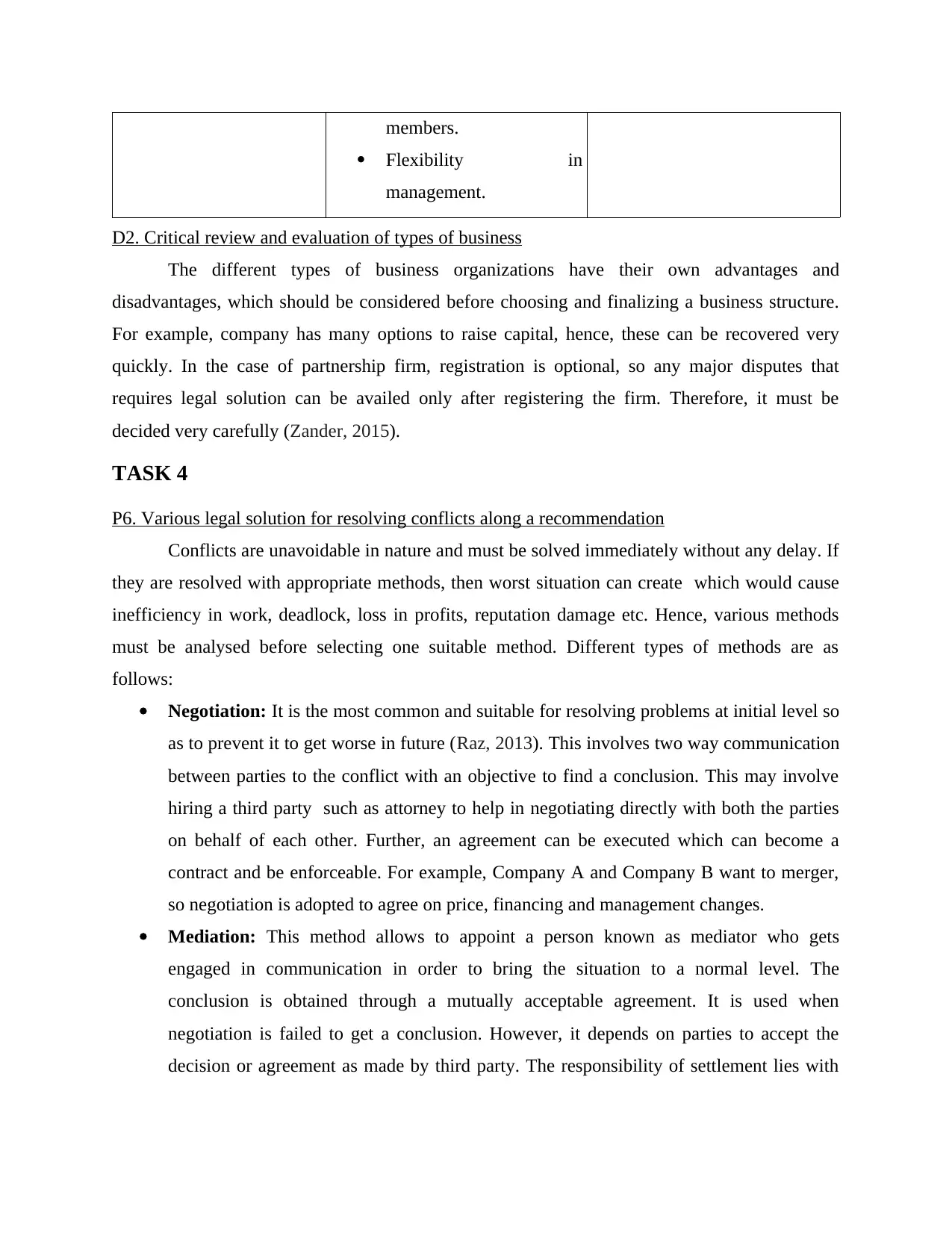
members.
Flexibility in
management.
D2. Critical review and evaluation of types of business
The different types of business organizations have their own advantages and
disadvantages, which should be considered before choosing and finalizing a business structure.
For example, company has many options to raise capital, hence, these can be recovered very
quickly. In the case of partnership firm, registration is optional, so any major disputes that
requires legal solution can be availed only after registering the firm. Therefore, it must be
decided very carefully (Zander, 2015).
TASK 4
P6. Various legal solution for resolving conflicts along a recommendation
Conflicts are unavoidable in nature and must be solved immediately without any delay. If
they are resolved with appropriate methods, then worst situation can create which would cause
inefficiency in work, deadlock, loss in profits, reputation damage etc. Hence, various methods
must be analysed before selecting one suitable method. Different types of methods are as
follows:
Negotiation: It is the most common and suitable for resolving problems at initial level so
as to prevent it to get worse in future (Raz, 2013). This involves two way communication
between parties to the conflict with an objective to find a conclusion. This may involve
hiring a third party such as attorney to help in negotiating directly with both the parties
on behalf of each other. Further, an agreement can be executed which can become a
contract and be enforceable. For example, Company A and Company B want to merger,
so negotiation is adopted to agree on price, financing and management changes.
Mediation: This method allows to appoint a person known as mediator who gets
engaged in communication in order to bring the situation to a normal level. The
conclusion is obtained through a mutually acceptable agreement. It is used when
negotiation is failed to get a conclusion. However, it depends on parties to accept the
decision or agreement as made by third party. The responsibility of settlement lies with
Flexibility in
management.
D2. Critical review and evaluation of types of business
The different types of business organizations have their own advantages and
disadvantages, which should be considered before choosing and finalizing a business structure.
For example, company has many options to raise capital, hence, these can be recovered very
quickly. In the case of partnership firm, registration is optional, so any major disputes that
requires legal solution can be availed only after registering the firm. Therefore, it must be
decided very carefully (Zander, 2015).
TASK 4
P6. Various legal solution for resolving conflicts along a recommendation
Conflicts are unavoidable in nature and must be solved immediately without any delay. If
they are resolved with appropriate methods, then worst situation can create which would cause
inefficiency in work, deadlock, loss in profits, reputation damage etc. Hence, various methods
must be analysed before selecting one suitable method. Different types of methods are as
follows:
Negotiation: It is the most common and suitable for resolving problems at initial level so
as to prevent it to get worse in future (Raz, 2013). This involves two way communication
between parties to the conflict with an objective to find a conclusion. This may involve
hiring a third party such as attorney to help in negotiating directly with both the parties
on behalf of each other. Further, an agreement can be executed which can become a
contract and be enforceable. For example, Company A and Company B want to merger,
so negotiation is adopted to agree on price, financing and management changes.
Mediation: This method allows to appoint a person known as mediator who gets
engaged in communication in order to bring the situation to a normal level. The
conclusion is obtained through a mutually acceptable agreement. It is used when
negotiation is failed to get a conclusion. However, it depends on parties to accept the
decision or agreement as made by third party. The responsibility of settlement lies with
⊘ This is a preview!⊘
Do you want full access?
Subscribe today to unlock all pages.
Trusted by 1+ million students worldwide

parties themselves. For instance, in case of divorce, couple may opt for this method to
resolve conflict regarding marital property.
Arbitration: It is an out of the court settlement of conflicts, which is cost-effective and
less time consuming. A third party, decided mutually, is appointed, who hears both
parties in order to reach a solution. The decision is taken on the basis of testimonies
presented before arbitrator. Further, the decision is of binding nature, however, it must be
accepted by both the parties to dispute. It is voluntary method, which is less formal and
arbitrator's award can be enforced in a court. For example, dispute between two
employees can be resolved with this method (Sheikh, 2013).
Litigation: In this method, the legal solution is obtained through courts and civil justice
system. This can be used to restrain opposing party from participating in case. This starts
with filing a lawsuit in a court, whereby, decision is obtained by following a set
procedure, discovery and production of evidence. Trial is the initial level of judicial
proceeding in which facts are submitted by the petitioner. For example, an employee has
killed another out of rage, hence, this can be presented in a case law form.
M4. Compare and contrast different sources of legal advice
There are many methods available through which conflicts can be resolved, but an
appropriate method must be chosen for prompt resolution. Arbitration is the best way to resolve
disputes. As it does involve high costs, the process takes less number of months. Along with this,
the decision of arbitrator have legal and final binding. Hence, a party aggrieved with the decision
may apply to court for its review.
CONCLUSION
From the above report, it can be concluded that business law is vital for carrying
activities without any hindrance. There are separate Acts for each sort of business organizations,
which govern them in order to protect against fraud. Further, rules and regulations must be
followed by every individual to maintain order and law in the country. Furthermore, the UK
parliament analyse various areas where laws can be implemented so as to provide more benefits
to one to which such legislations apply. The ultimate decision to enact laws is with UK
parliament. Furthermore, various advantages and disadvantages of each business structure must
be assessed before selecting one.
resolve conflict regarding marital property.
Arbitration: It is an out of the court settlement of conflicts, which is cost-effective and
less time consuming. A third party, decided mutually, is appointed, who hears both
parties in order to reach a solution. The decision is taken on the basis of testimonies
presented before arbitrator. Further, the decision is of binding nature, however, it must be
accepted by both the parties to dispute. It is voluntary method, which is less formal and
arbitrator's award can be enforced in a court. For example, dispute between two
employees can be resolved with this method (Sheikh, 2013).
Litigation: In this method, the legal solution is obtained through courts and civil justice
system. This can be used to restrain opposing party from participating in case. This starts
with filing a lawsuit in a court, whereby, decision is obtained by following a set
procedure, discovery and production of evidence. Trial is the initial level of judicial
proceeding in which facts are submitted by the petitioner. For example, an employee has
killed another out of rage, hence, this can be presented in a case law form.
M4. Compare and contrast different sources of legal advice
There are many methods available through which conflicts can be resolved, but an
appropriate method must be chosen for prompt resolution. Arbitration is the best way to resolve
disputes. As it does involve high costs, the process takes less number of months. Along with this,
the decision of arbitrator have legal and final binding. Hence, a party aggrieved with the decision
may apply to court for its review.
CONCLUSION
From the above report, it can be concluded that business law is vital for carrying
activities without any hindrance. There are separate Acts for each sort of business organizations,
which govern them in order to protect against fraud. Further, rules and regulations must be
followed by every individual to maintain order and law in the country. Furthermore, the UK
parliament analyse various areas where laws can be implemented so as to provide more benefits
to one to which such legislations apply. The ultimate decision to enact laws is with UK
parliament. Furthermore, various advantages and disadvantages of each business structure must
be assessed before selecting one.
Paraphrase This Document
Need a fresh take? Get an instant paraphrase of this document with our AI Paraphraser

REFERENCES
Books & Journals:
Baden-Fuller, C. and Mangematin, V., 2013. Business models: A challenging agenda. Strategic
Organization. 11(4). pp.418-427.
Besley, T., 2015. Law, regulation, and the business climate: The nature and influence of the
World Bank Doing Business project. Journal of Economic Perspectives. 29(3). pp.99-
120.
Chen-Wishart, M., 2012. Contract law. Oxford University Press.
Clarkson, K., Miller, R. and Cross, F., 2014. Business Law: Texts and Cases. Nelson Education.
Clough and et. al., 2015. Construction contracting: A practical guide to company management.
John Wiley & Sons.
Emir, A., 2018. Selwyn's law of employment. Oxford University Press.
Frank, J. and Bix, B.H., 2017. Law and the modern mind. Routledge.
Freedland and et. al., 2016. The contract of employment. Oxford University Press.
Grenig, J.E., 2014. After the Arbitration Award: Not Always Final and Binding. Marq. Sports L.
Rev. 25. p.65.
Newmark, C. and Hill, R., 2014. Can a mediated settlement become an enforceable arbitration
award?. Arbitration International. 16(1). pp.81-88.
Nolan-Haley, J., 2012. Mediation: The new arbitration. Harv. Negot. L. Rev. 17. p.61.
Raz, J., 2013. Legal positivism and the sources of law. Arguing About Law, 117.
Sheikh, S., 2013. A guide to the Companies Act 2006. Routledge-Cavendish.
Yingxiu, L., 2014. Judicial Solution to Conflicts of Rights [J]. Chinese Journal of Law, 2.
Zander, M., 2015. The law-making process. Bloomsbury Publishing.
Books & Journals:
Baden-Fuller, C. and Mangematin, V., 2013. Business models: A challenging agenda. Strategic
Organization. 11(4). pp.418-427.
Besley, T., 2015. Law, regulation, and the business climate: The nature and influence of the
World Bank Doing Business project. Journal of Economic Perspectives. 29(3). pp.99-
120.
Chen-Wishart, M., 2012. Contract law. Oxford University Press.
Clarkson, K., Miller, R. and Cross, F., 2014. Business Law: Texts and Cases. Nelson Education.
Clough and et. al., 2015. Construction contracting: A practical guide to company management.
John Wiley & Sons.
Emir, A., 2018. Selwyn's law of employment. Oxford University Press.
Frank, J. and Bix, B.H., 2017. Law and the modern mind. Routledge.
Freedland and et. al., 2016. The contract of employment. Oxford University Press.
Grenig, J.E., 2014. After the Arbitration Award: Not Always Final and Binding. Marq. Sports L.
Rev. 25. p.65.
Newmark, C. and Hill, R., 2014. Can a mediated settlement become an enforceable arbitration
award?. Arbitration International. 16(1). pp.81-88.
Nolan-Haley, J., 2012. Mediation: The new arbitration. Harv. Negot. L. Rev. 17. p.61.
Raz, J., 2013. Legal positivism and the sources of law. Arguing About Law, 117.
Sheikh, S., 2013. A guide to the Companies Act 2006. Routledge-Cavendish.
Yingxiu, L., 2014. Judicial Solution to Conflicts of Rights [J]. Chinese Journal of Law, 2.
Zander, M., 2015. The law-making process. Bloomsbury Publishing.

1 out of 11


Related Documents


Your All-in-One AI-Powered Toolkit for Academic Success.
+13062052269
info@desklib.com
Available 24*7 on WhatsApp / Email
![[object Object]](/_next/static/media/star-bottom.7253800d.svg)
Unlock your academic potential
Copyright © 2020–2026 A2Z Services. All Rights Reserved. Developed and managed by ZUCOL.