Legal Report: No Liability Companies, Internal Rules & Constitution
VerifiedAdded on 2023/03/31
|7
|1482
|155
Report
AI Summary
This report provides a detailed analysis of business law concerning no liability companies, focusing on the Corporation Act 2001. It examines the requirements for registering as a no liability company, including lodging an application with ASIC and adhering to specific sections of the Act. The report also explores internal management rules and how they are governed by the Corporation Act, emphasizing the importance of maintaining proper operational guidelines. Furthermore, it discusses the constitution of companies, particularly concerning public and proprietary entities, and the creation of redeemable preference shares under section 254A of the Corporation Act, outlining the conditions for issuing bonus shares, preference shares, and partly paid shares. The report concludes by highlighting the significance of following legal regulations to protect the interests of stakeholders and ensure effective business operations. Desklib provides access to a wealth of similar solved assignments and past papers for students.
Business Law
Paraphrase This Document
Need a fresh take? Get an instant paraphrase of this document with our AI Paraphraser

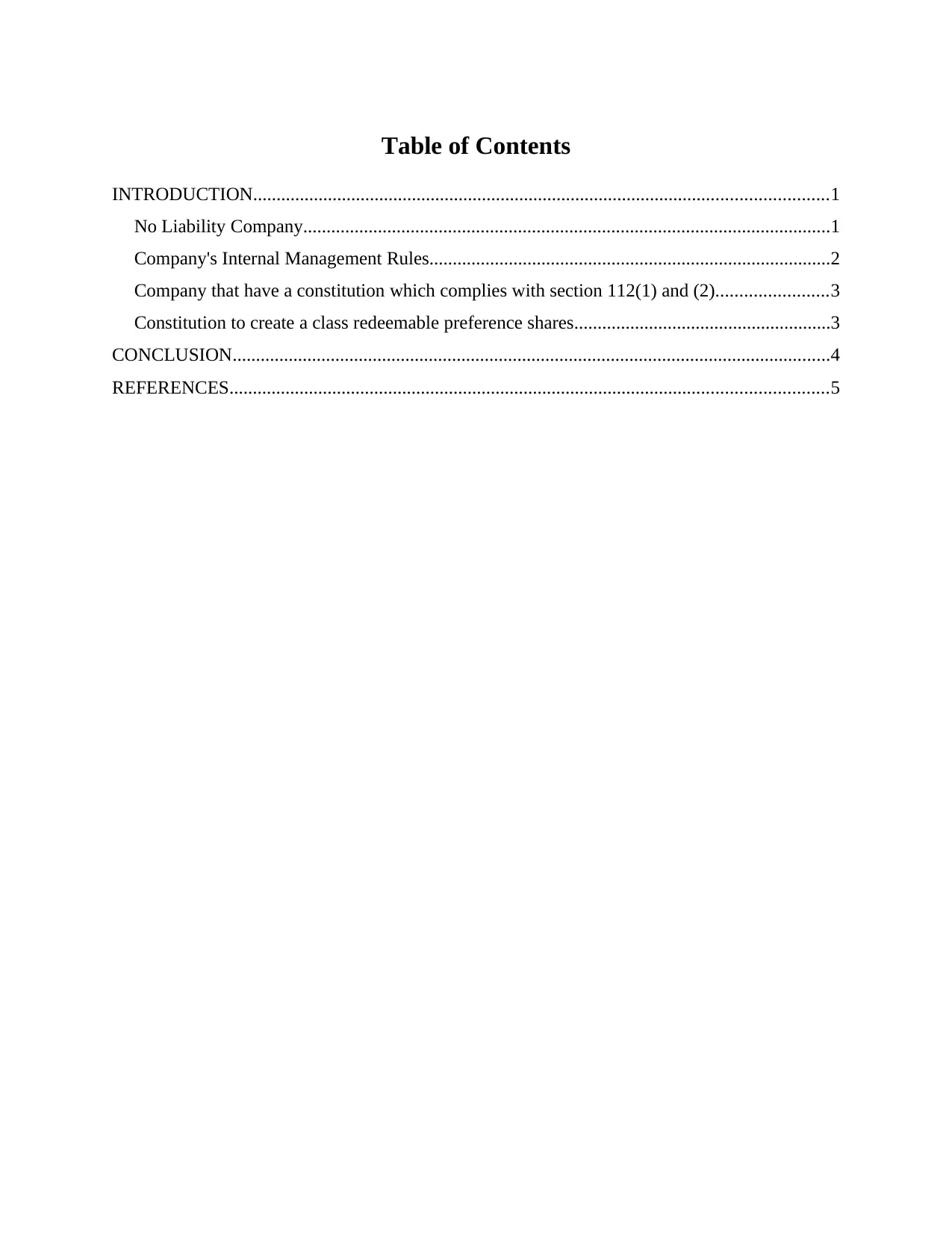
Table of Contents
INTRODUCTION...........................................................................................................................1
No Liability Company.................................................................................................................1
Company's Internal Management Rules......................................................................................2
Company that have a constitution which complies with section 112(1) and (2)........................3
Constitution to create a class redeemable preference shares.......................................................3
CONCLUSION................................................................................................................................4
REFERENCES................................................................................................................................5
INTRODUCTION...........................................................................................................................1
No Liability Company.................................................................................................................1
Company's Internal Management Rules......................................................................................2
Company that have a constitution which complies with section 112(1) and (2)........................3
Constitution to create a class redeemable preference shares.......................................................3
CONCLUSION................................................................................................................................4
REFERENCES................................................................................................................................5

INTRODUCTION
There are different type laws that are being followed within the organization. These are
followed in order to make sure that there is proper interest of stakeholders maintained. It is
essential for the companies to make sure that proper steps are taken in which all the laws and
policies within the organization are considered (Beatty and Samuelson, 2014 ). This report
covers different type of laws related to no liability company. Further, it covers, laws that are
followed in order to maintain the internal management rules within the company. Lastly, it also
laws related to constitution of redeemable preferences shares.
No Liability Company
For a company to register into no liability company, it is important to make sure that
there are certain set of laws that are being followed under Corporation Act 2001. This can be
determined as an act related with the Commonwealth of Australia (Appleman, Appleman and
Holmes, 2015 ). This law deals with business entities in cited country at interstate and federal
level. There are various type of sections which are included in this. These sections make sure that
the company is being registered under no liability company. Below given are the sections that are
included in this act :
SECT 117: For an company to register in no liability company, it is important for the
person to lodge an application with ASIC. Further, there are different type of applications that
need to be stated and they are as follows:
It is important to state that type of company that has to be registered.
It should include company's proposed name (Frankle, Gregory and Lyons, 2015) .
Address and name of all the members should be provided.
Detailed information of regarding family background should be provided each member
involved with the organization.
Address of companies registered office.
Opening hours of registered office
It should be a company limited by shares.
Further, it should be limited by guarantee (Crane and Matten, 2016 ).
In conditions in which, if the company is public and it need to be registered, then it is
important to provide copy of constitution that require to be lodged with the application.
1
There are different type laws that are being followed within the organization. These are
followed in order to make sure that there is proper interest of stakeholders maintained. It is
essential for the companies to make sure that proper steps are taken in which all the laws and
policies within the organization are considered (Beatty and Samuelson, 2014 ). This report
covers different type of laws related to no liability company. Further, it covers, laws that are
followed in order to maintain the internal management rules within the company. Lastly, it also
laws related to constitution of redeemable preferences shares.
No Liability Company
For a company to register into no liability company, it is important to make sure that
there are certain set of laws that are being followed under Corporation Act 2001. This can be
determined as an act related with the Commonwealth of Australia (Appleman, Appleman and
Holmes, 2015 ). This law deals with business entities in cited country at interstate and federal
level. There are various type of sections which are included in this. These sections make sure that
the company is being registered under no liability company. Below given are the sections that are
included in this act :
SECT 117: For an company to register in no liability company, it is important for the
person to lodge an application with ASIC. Further, there are different type of applications that
need to be stated and they are as follows:
It is important to state that type of company that has to be registered.
It should include company's proposed name (Frankle, Gregory and Lyons, 2015) .
Address and name of all the members should be provided.
Detailed information of regarding family background should be provided each member
involved with the organization.
Address of companies registered office.
Opening hours of registered office
It should be a company limited by shares.
Further, it should be limited by guarantee (Crane and Matten, 2016 ).
In conditions in which, if the company is public and it need to be registered, then it is
important to provide copy of constitution that require to be lodged with the application.
1
⊘ This is a preview!⊘
Do you want full access?
Subscribe today to unlock all pages.

Trusted by 1+ million students worldwide

SECT 201: In accordance with this section, there is a form that has to be filled up by
company in order to register themselves in to no liability company. There are different set of
points that needs to be filled and they are as follows:
Signature: It is important that this form to be signed by applicant or the person who has
consented to become a member of the organization (McAdams, Neslund and Neslund,
2015 ).
Company name need to be included and the type of company it is should also be included
in it.
Special purpose companies: The type of company need to be specified like Charity
purpose, Home unit company or Superannuation trustee company.
Share issued: The reason for which share is being provided should be included. The
reason includes for public companies or for proprietary companies.
Privacy: Personal information should be included in this form (Koehn and Elm, 2014).
Company's Internal Management Rules
Inn order to operate the business operation in an effective manner, it requires the
management to have proper internal management rules that will be helpful enough to perform the
operations effectively and efficiently (Picciotto and Mayne, 2016 ). The type of internal rules is
determined under Corporation act 2001. below given are the different section that has to be
considered in order to maintain proper rules within organization:
SECT 134: In order to manage the internal operations of the organization can be
governed with the help of Corporation act and this can be applied to the company as a
replacement rules by a combination of both or constitution. Further, there are many other internal
management rules in ordinary provision within this act and these are also included in common
law.
SECT 135: The replacement rule is not applied to all the organization but there are
certain types in which it is applied (Sackman, Van Brunt and Reskin, 2016 ). There are certain
considerations that has to be made. In this context, it includes: the companies that were
registered after 1998. It is not applied to any proprietary company. When replacement rules are
applied, then there are changes in the contract.
2
company in order to register themselves in to no liability company. There are different set of
points that needs to be filled and they are as follows:
Signature: It is important that this form to be signed by applicant or the person who has
consented to become a member of the organization (McAdams, Neslund and Neslund,
2015 ).
Company name need to be included and the type of company it is should also be included
in it.
Special purpose companies: The type of company need to be specified like Charity
purpose, Home unit company or Superannuation trustee company.
Share issued: The reason for which share is being provided should be included. The
reason includes for public companies or for proprietary companies.
Privacy: Personal information should be included in this form (Koehn and Elm, 2014).
Company's Internal Management Rules
Inn order to operate the business operation in an effective manner, it requires the
management to have proper internal management rules that will be helpful enough to perform the
operations effectively and efficiently (Picciotto and Mayne, 2016 ). The type of internal rules is
determined under Corporation act 2001. below given are the different section that has to be
considered in order to maintain proper rules within organization:
SECT 134: In order to manage the internal operations of the organization can be
governed with the help of Corporation act and this can be applied to the company as a
replacement rules by a combination of both or constitution. Further, there are many other internal
management rules in ordinary provision within this act and these are also included in common
law.
SECT 135: The replacement rule is not applied to all the organization but there are
certain types in which it is applied (Sackman, Van Brunt and Reskin, 2016 ). There are certain
considerations that has to be made. In this context, it includes: the companies that were
registered after 1998. It is not applied to any proprietary company. When replacement rules are
applied, then there are changes in the contract.
2
Paraphrase This Document
Need a fresh take? Get an instant paraphrase of this document with our AI Paraphraser

Company that have a constitution which complies with section 112(1) and (2)
In accordance with this section, there are different type of companies that are included
which are public companies and proprietary companies. Both these companies should be
registered under this act (Percival, Schroeder and Leape, 2013 ). All the companies can be
registered under no liability company when firm has a share capital, the constitution states that
their sole objective are mining purposes and firm should not have any contractual right. In
addition to this, it is important to make sure that the director of the no liability company should
not let the proportion or whole mine or to claim on the tribute. Further, they must no make any
type of contract for the working on any type of land on tribute. Moreover, there should not be
any letter that is made within the 2 years time.
Constitution to create a class redeemable preference shares
In order to create a class redeemable preference shares, it can be considered with the help
of Corporation act 2001 under the section 254A. In issue partly paid, bonus, redeemable share,
below given are the considerations that should be follows by the company :
The firm has the power of issue bonus shares, preference shares and partly paid shares
(Beatty and Samuelson, 2014 ).
When bonus is to be issued, there should not be any type of increase in company's share
capital. In case, there is increment, then it becomes issues for the firm in order to raise
their bonus and to provide it to their workers.
Further, preference share only be issued by company when the rights that are attached to
below given consideration which are as follows: capital should be replayed, through
voting, non cumulative dividends, profits, etc. (Appleman, Appleman and Holmes, 2015).
Redeemable shared can be determined as type of shares that are issued only on the
condition that the firm is able to redeem . There are different condition through they can
redeem: during a fixed time or in conditions when any type of event is taking place.
Further, it can redeem when company's option is taking place. Lastly, it takes place
during the time of shareholder's option (Frankle, Gregory and Lyons, 2015 ). Further, all
the operations related to redeemable preference shares are included in the section from
254 J to 254 L. it is important for the firm to make sure that all the conditions that are
listed down in this section should be covered.
3
In accordance with this section, there are different type of companies that are included
which are public companies and proprietary companies. Both these companies should be
registered under this act (Percival, Schroeder and Leape, 2013 ). All the companies can be
registered under no liability company when firm has a share capital, the constitution states that
their sole objective are mining purposes and firm should not have any contractual right. In
addition to this, it is important to make sure that the director of the no liability company should
not let the proportion or whole mine or to claim on the tribute. Further, they must no make any
type of contract for the working on any type of land on tribute. Moreover, there should not be
any letter that is made within the 2 years time.
Constitution to create a class redeemable preference shares
In order to create a class redeemable preference shares, it can be considered with the help
of Corporation act 2001 under the section 254A. In issue partly paid, bonus, redeemable share,
below given are the considerations that should be follows by the company :
The firm has the power of issue bonus shares, preference shares and partly paid shares
(Beatty and Samuelson, 2014 ).
When bonus is to be issued, there should not be any type of increase in company's share
capital. In case, there is increment, then it becomes issues for the firm in order to raise
their bonus and to provide it to their workers.
Further, preference share only be issued by company when the rights that are attached to
below given consideration which are as follows: capital should be replayed, through
voting, non cumulative dividends, profits, etc. (Appleman, Appleman and Holmes, 2015).
Redeemable shared can be determined as type of shares that are issued only on the
condition that the firm is able to redeem . There are different condition through they can
redeem: during a fixed time or in conditions when any type of event is taking place.
Further, it can redeem when company's option is taking place. Lastly, it takes place
during the time of shareholder's option (Frankle, Gregory and Lyons, 2015 ). Further, all
the operations related to redeemable preference shares are included in the section from
254 J to 254 L. it is important for the firm to make sure that all the conditions that are
listed down in this section should be covered.
3

CONCLUSION
From this report, it can be concluded that around the world, there are different type of
laws that are being followed. All the laws are for the maintaining the interest of members who
are involved in the operations of organization. All the rules are regulation that are given by the
government should be followed or else it will be enforceable by law . Further, all individuals
who own organization should have proper information about the type of laws that are included in
order to operate the business in effective manner. When they do not have adequate information,
then it affects the business and the operation may not work in the flow which they are willing to
make it work.
4
From this report, it can be concluded that around the world, there are different type of
laws that are being followed. All the laws are for the maintaining the interest of members who
are involved in the operations of organization. All the rules are regulation that are given by the
government should be followed or else it will be enforceable by law . Further, all individuals
who own organization should have proper information about the type of laws that are included in
order to operate the business in effective manner. When they do not have adequate information,
then it affects the business and the operation may not work in the flow which they are willing to
make it work.
4
⊘ This is a preview!⊘
Do you want full access?
Subscribe today to unlock all pages.

Trusted by 1+ million students worldwide

REFERENCES
Books and Journals
Appleman, J. A., Appleman, J. and Holmes, E. M., 2015. Excuses for Nonpayment and Defenses
to Actions for Premiums (Vol. 5). Appleman on Insurance Law and Practice.
Beatty, J. F. and Samuelson, S. S., 2014. Cengage Advantage Books: Essentials of Business Law.
Cengage Learning.
Crane, A. and Matten, D., 2016. Business ethics: Managing corporate citizenship and
sustainability in the age of globalization. Oxford University Press.
Frankle, D. H., Gregory, H. J. and Lyons, C. H., 2015. Law Forum: Director-Centric Governance
in the Golden Age of Shareholder Activism. Business Lawyer. 70.
Koehn, D. and Elm, D., 2014. Aesthetics and business ethics. Dordrecht: Springer.
McAdams, T., Neslund, N. and Neslund, K., 2015. Law, business, and society. McGraw-Hill
Education.
Percival, R. V., Schroeder, C. H., and Leape, J. P., 2013.Environmental regulation: Law,
science, and policy. Wolters Kluwer Law & Business.
Picciotto, S. and Mayne, R. eds., 2016. Regulating international business: beyond liberalization.
Springer.
Sackman, J., Van Brunt, R. and Reskin, M., 2016. Tax Issues in Condemnation Cases (Vol. 7).
Nichols on Eminent Domain.
5
Books and Journals
Appleman, J. A., Appleman, J. and Holmes, E. M., 2015. Excuses for Nonpayment and Defenses
to Actions for Premiums (Vol. 5). Appleman on Insurance Law and Practice.
Beatty, J. F. and Samuelson, S. S., 2014. Cengage Advantage Books: Essentials of Business Law.
Cengage Learning.
Crane, A. and Matten, D., 2016. Business ethics: Managing corporate citizenship and
sustainability in the age of globalization. Oxford University Press.
Frankle, D. H., Gregory, H. J. and Lyons, C. H., 2015. Law Forum: Director-Centric Governance
in the Golden Age of Shareholder Activism. Business Lawyer. 70.
Koehn, D. and Elm, D., 2014. Aesthetics and business ethics. Dordrecht: Springer.
McAdams, T., Neslund, N. and Neslund, K., 2015. Law, business, and society. McGraw-Hill
Education.
Percival, R. V., Schroeder, C. H., and Leape, J. P., 2013.Environmental regulation: Law,
science, and policy. Wolters Kluwer Law & Business.
Picciotto, S. and Mayne, R. eds., 2016. Regulating international business: beyond liberalization.
Springer.
Sackman, J., Van Brunt, R. and Reskin, M., 2016. Tax Issues in Condemnation Cases (Vol. 7).
Nichols on Eminent Domain.
5
1 out of 7
Related Documents
Your All-in-One AI-Powered Toolkit for Academic Success.
+13062052269
info@desklib.com
Available 24*7 on WhatsApp / Email
Unlock your academic potential
Copyright © 2020–2026 A2Z Services. All Rights Reserved. Developed and managed by ZUCOL.