Business Law Report: UK Business Law, Organizations and Legal Issues
VerifiedAdded on 2022/12/28
|11
|3767
|59
Report
AI Summary
This report provides a comprehensive overview of UK business law, encompassing various sources of law, including legislation, case law, and treaties, and the role of government in law-making processes, including the application of statutory and common law in justice courts. It delves into the impact of company, employment, and contract law on businesses, illustrating these impacts with specific examples. The report further explores the legal formation, management, and funding of different types of business organizations, such as sole proprietorships, partnerships, and limited liability companies, while also examining the legal solutions available for resolving a range of business disputes. The content provides a detailed analysis of legal frameworks and practical applications within the business context.
Business Law

Paraphrase This Document
Need a fresh take? Get an instant paraphrase of this document with our AI Paraphraser
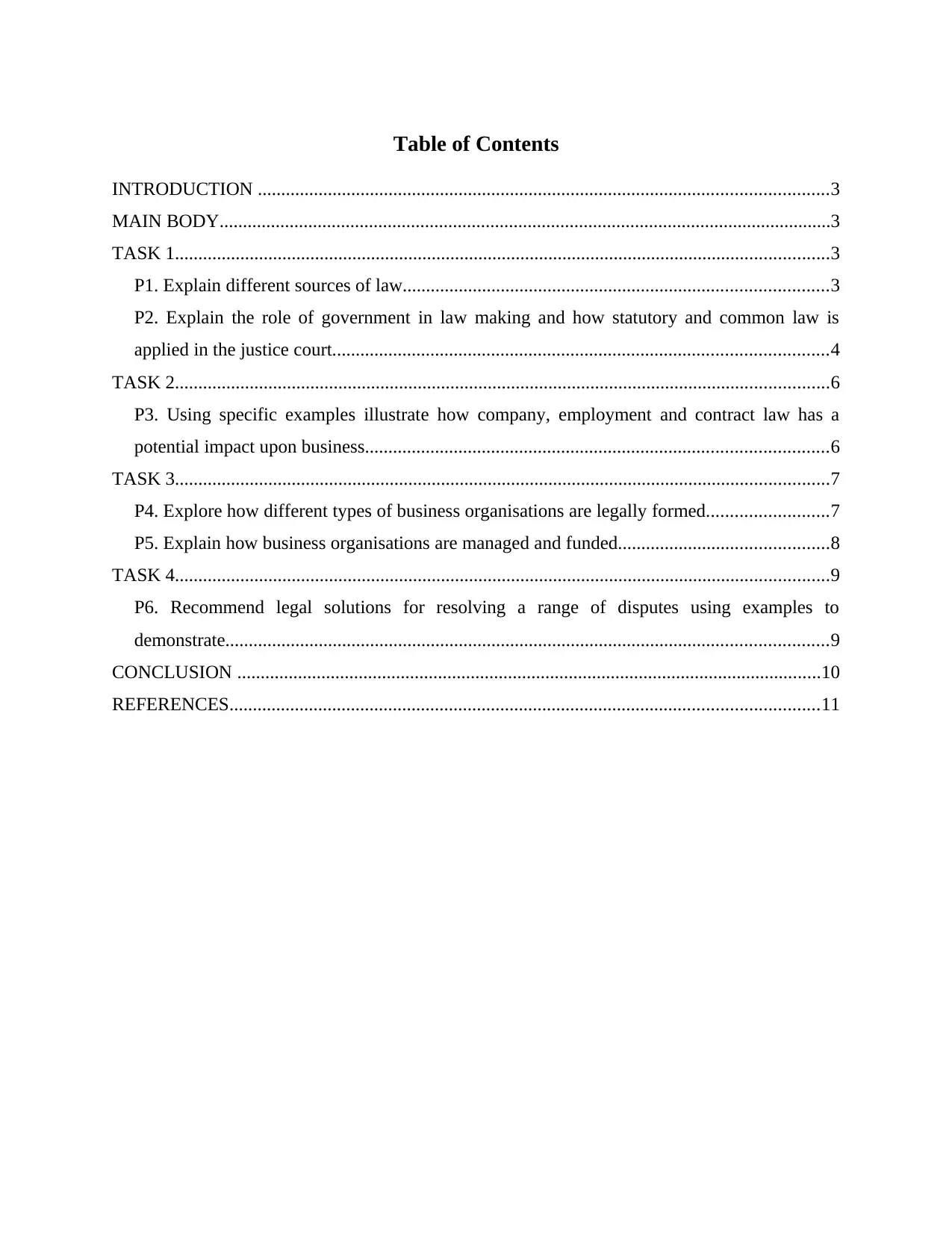
Table of Contents
INTRODUCTION ..........................................................................................................................3
MAIN BODY...................................................................................................................................3
TASK 1............................................................................................................................................3
P1. Explain different sources of law...........................................................................................3
P2. Explain the role of government in law making and how statutory and common law is
applied in the justice court..........................................................................................................4
TASK 2............................................................................................................................................6
P3. Using specific examples illustrate how company, employment and contract law has a
potential impact upon business...................................................................................................6
TASK 3............................................................................................................................................7
P4. Explore how different types of business organisations are legally formed..........................7
P5. Explain how business organisations are managed and funded.............................................8
TASK 4............................................................................................................................................9
P6. Recommend legal solutions for resolving a range of disputes using examples to
demonstrate.................................................................................................................................9
CONCLUSION .............................................................................................................................10
REFERENCES..............................................................................................................................11
INTRODUCTION ..........................................................................................................................3
MAIN BODY...................................................................................................................................3
TASK 1............................................................................................................................................3
P1. Explain different sources of law...........................................................................................3
P2. Explain the role of government in law making and how statutory and common law is
applied in the justice court..........................................................................................................4
TASK 2............................................................................................................................................6
P3. Using specific examples illustrate how company, employment and contract law has a
potential impact upon business...................................................................................................6
TASK 3............................................................................................................................................7
P4. Explore how different types of business organisations are legally formed..........................7
P5. Explain how business organisations are managed and funded.............................................8
TASK 4............................................................................................................................................9
P6. Recommend legal solutions for resolving a range of disputes using examples to
demonstrate.................................................................................................................................9
CONCLUSION .............................................................................................................................10
REFERENCES..............................................................................................................................11
INTRODUCTION
Business law is that branch of law that imposes various rules and regulations upon
businesses and the activities which are carried out by them. These rules and laws are imposed
under variety of other act names. They are: commercial law, contract law, negotiable instrument
act, etc. There are various laws that helps in the functioning and management of the business and
its activities. Those activities of a business which is related to the trading of merchandise refer to
commercial law which helps the business by providing rights and duties of all the individuals
involved (Broekaert, 2017). Contract law governs the contractual relations that exist after the
contract is formed. Company law frames rules that relates to functioning of the company starting
from its formation to its dissolution.
This report consist of various sources of laws and what exactly is the role of government
in making laws and regulations. This report also discusses on the fact that how a business is
impacted by the laws of contract, employment and company. The report also explains about the
management and funding of business organisation and the legal ways in which disputes are
settled by the business organisations.
MAIN BODY
TASK 1
P1. Explain different sources of law.
Laws are the rules and regulations which are made by the authorities in power to regulate
the actions and behaviour of the citizens. These rules have binding force over the citizens and the
contravention of such rules or regulations imposes liability and penalty upon the person
contravening them. Therefore it is important that the citizens follow such rules or laws that are
made for their governance. There are different sources of law from which the laws are either
made or interpreted (Rühl, 2019). These sources are divided into two categories. They are:
primary sources and secondary sources of law.
Primary Sources: Legislation: This is the primary source of law. This is the law which are made by the
legislature and it is considered as very import piece of legislature. The UK constitution is
unwritten and therefore the laws which are made by the parliament are considered as very
important source of law. This includes: acts of parliament, orders of councils, etc.
Business law is that branch of law that imposes various rules and regulations upon
businesses and the activities which are carried out by them. These rules and laws are imposed
under variety of other act names. They are: commercial law, contract law, negotiable instrument
act, etc. There are various laws that helps in the functioning and management of the business and
its activities. Those activities of a business which is related to the trading of merchandise refer to
commercial law which helps the business by providing rights and duties of all the individuals
involved (Broekaert, 2017). Contract law governs the contractual relations that exist after the
contract is formed. Company law frames rules that relates to functioning of the company starting
from its formation to its dissolution.
This report consist of various sources of laws and what exactly is the role of government
in making laws and regulations. This report also discusses on the fact that how a business is
impacted by the laws of contract, employment and company. The report also explains about the
management and funding of business organisation and the legal ways in which disputes are
settled by the business organisations.
MAIN BODY
TASK 1
P1. Explain different sources of law.
Laws are the rules and regulations which are made by the authorities in power to regulate
the actions and behaviour of the citizens. These rules have binding force over the citizens and the
contravention of such rules or regulations imposes liability and penalty upon the person
contravening them. Therefore it is important that the citizens follow such rules or laws that are
made for their governance. There are different sources of law from which the laws are either
made or interpreted (Rühl, 2019). These sources are divided into two categories. They are:
primary sources and secondary sources of law.
Primary Sources: Legislation: This is the primary source of law. This is the law which are made by the
legislature and it is considered as very import piece of legislature. The UK constitution is
unwritten and therefore the laws which are made by the parliament are considered as very
important source of law. This includes: acts of parliament, orders of councils, etc.
⊘ This is a preview!⊘
Do you want full access?
Subscribe today to unlock all pages.

Trusted by 1+ million students worldwide
Case Laws: This is the source of law which was made by referring to the decisions of the
court in legal matters. The development of any law rely upon the report which is made
upon the decisions given by the judiciary. The English legal system has a very unique
features called as “doctrine of precedents” which creates a binding effect on the court to
follow the decisions made by the court superior to them. Treaties: They are the agreements and the contracts which are signed by the countries
internationally. This is the primary source but also an international source of law.
Treaties creates a binding agreement or contract between the parties which is regulated
by the authorities at international level (Thompson, 2019). Treaties provides with the
laws and regulations which are to be implemented by the country in their domestic laws.
Secondary Sources: Textbook: They are the secondary sources of law which is written by the writers for the
reference purpose to make the law understanding better. It covers all the important topics
of the law and are explained in simplified form to create a better understanding of the
laws. Law Journal: The law journals are those which are written by the researchers or experts.
This is the secondary sources as these journals are sometimes considered by the
legislatures and the judges to understand and interpret various meanings a law can have.
This journal provide assistance to the law makers and the judges.
Directives: These are basically the acts which provides a goal that is to be achieved by all
the European union country. They only provide a country with the goal. But how to
achieve it and what implementation in the act or law is to be done is decided by the
country itself. The country have to only focus on making laws so that they can achieve
the goals provided by the European Union (Baker and Logue, 2017).
P2. Explain the role of government in law making and how statutory and common law is
applied in the justice court.
In UK, the structure of parliament comprises only of two houses i.e. the house of lords
and the house of commons.
House of lord: It is considered as the upper house. In this house membership is either
achieved through heredity or it is granted by the prime minister on consulting with other
members (Kamugisha, 2017).
court in legal matters. The development of any law rely upon the report which is made
upon the decisions given by the judiciary. The English legal system has a very unique
features called as “doctrine of precedents” which creates a binding effect on the court to
follow the decisions made by the court superior to them. Treaties: They are the agreements and the contracts which are signed by the countries
internationally. This is the primary source but also an international source of law.
Treaties creates a binding agreement or contract between the parties which is regulated
by the authorities at international level (Thompson, 2019). Treaties provides with the
laws and regulations which are to be implemented by the country in their domestic laws.
Secondary Sources: Textbook: They are the secondary sources of law which is written by the writers for the
reference purpose to make the law understanding better. It covers all the important topics
of the law and are explained in simplified form to create a better understanding of the
laws. Law Journal: The law journals are those which are written by the researchers or experts.
This is the secondary sources as these journals are sometimes considered by the
legislatures and the judges to understand and interpret various meanings a law can have.
This journal provide assistance to the law makers and the judges.
Directives: These are basically the acts which provides a goal that is to be achieved by all
the European union country. They only provide a country with the goal. But how to
achieve it and what implementation in the act or law is to be done is decided by the
country itself. The country have to only focus on making laws so that they can achieve
the goals provided by the European Union (Baker and Logue, 2017).
P2. Explain the role of government in law making and how statutory and common law is
applied in the justice court.
In UK, the structure of parliament comprises only of two houses i.e. the house of lords
and the house of commons.
House of lord: It is considered as the upper house. In this house membership is either
achieved through heredity or it is granted by the prime minister on consulting with other
members (Kamugisha, 2017).
Paraphrase This Document
Need a fresh take? Get an instant paraphrase of this document with our AI Paraphraser
House of common: It is the house in which members are elected. This form of parliament
deals with the governance of the law. It makes laws for the society which they shall follow.
Both the houses are involved in the process of making laws. The bill to become an act
have to go through several process before its enactment as a law. The process involved in
making of the law are as follows: First Reading: It is the most basic and the formal stage in which the name of the bill is
read and then the bill is published. Second reading: This is the stage in which there is discussion and debate on the general
principles which are involved in the bill in the house of commons. Committee Stage: This is the stage in which the examination of bill is done and then
accordingly amendments are made to it, if any. Report Stage: This is the stage in which if any amendments were made in the prior stage
the same is needed to be voted by the house of common. The speaker at the meeting may
debate on any amendments. Third Reading: This is the last stage in which the bill and its amendments are considered
by the house of law. This stage provides with a last opportunity to the members to vote
on the particular amendments proposed. Proceedings in the House of Law: This is the stage which starts just after the third
reading begins. In this stage if any new amendment is made by the lord then it again goes
to the house of common for its approval and then again if approved comes back to the
house of lord. This is the process which is termed as “ping-pong”
Royal Assent: This is the last stage of the making or a law or an act. In this stage the
approved bill from both the houses are sent to the Queen for Royal Assent. Once a bill
gets royal assent it becomes a law or an act of the parliament.
Application of common law and statutory law
Common laws are those which are based on the decisions given by the judges while
deciding cases and are commonly called as the Precedents (Moss, 2017). Statutory laws are
those which are made by the parliament. Both the laws have importance in the English legal
system as these laws creates binding effect on the court while deciding any matter in the
proceedings. Both the laws are very important to be considered but if any question arises where
deals with the governance of the law. It makes laws for the society which they shall follow.
Both the houses are involved in the process of making laws. The bill to become an act
have to go through several process before its enactment as a law. The process involved in
making of the law are as follows: First Reading: It is the most basic and the formal stage in which the name of the bill is
read and then the bill is published. Second reading: This is the stage in which there is discussion and debate on the general
principles which are involved in the bill in the house of commons. Committee Stage: This is the stage in which the examination of bill is done and then
accordingly amendments are made to it, if any. Report Stage: This is the stage in which if any amendments were made in the prior stage
the same is needed to be voted by the house of common. The speaker at the meeting may
debate on any amendments. Third Reading: This is the last stage in which the bill and its amendments are considered
by the house of law. This stage provides with a last opportunity to the members to vote
on the particular amendments proposed. Proceedings in the House of Law: This is the stage which starts just after the third
reading begins. In this stage if any new amendment is made by the lord then it again goes
to the house of common for its approval and then again if approved comes back to the
house of lord. This is the process which is termed as “ping-pong”
Royal Assent: This is the last stage of the making or a law or an act. In this stage the
approved bill from both the houses are sent to the Queen for Royal Assent. Once a bill
gets royal assent it becomes a law or an act of the parliament.
Application of common law and statutory law
Common laws are those which are based on the decisions given by the judges while
deciding cases and are commonly called as the Precedents (Moss, 2017). Statutory laws are
those which are made by the parliament. Both the laws have importance in the English legal
system as these laws creates binding effect on the court while deciding any matter in the
proceedings. Both the laws are very important to be considered but if any question arises where
there exist any conflict between both the laws then, the statutory laws made by the parliaments
will prevail.
TASK 2
P3. Using specific examples illustrate how company, employment and contract law has a
potential impact upon business.
All the laws that are related to the business and its activities have potential impact upon
an organisation. To run a business and carry out business activities, companies are required to
follow the procedure and the laws which are specifically given for this purpose. The potential
impact up on the business of contract company and employment laws are as follows: Company law: This laws provide the rules and regulations that are needed to be followed
by the company starting from its formation till when the company is dissolved. For e.g.
company law provides with the procedure which is given for the establishment of any
company. If any company do not contravene with its procedure, they are punished by the
law. Contract law: It is that law which helps in the regulations of the relationship that arises
between the parties when a contract is formed between them. It also lays down the
requirements which are essential in the formation of contract between the parties. For e.g.
Business while entering into any contract with other party refers to contract law and also
they refer when there is any breach of contract and accordingly the law imposes penalty
upon the parties.
Employment law: This is the law which helps in the protection of the rights of an employ
who is working in an organisation or at any company. The impact of this law is that the
people are now well aware of their rights and duties who are employed and working
under someone (Nica, Manole and Stan, 2018). For e.g. if any right of an employee is
breached by the employer, the law helps employee by imposing punishment on the
employer.
All the laws have different and varied potential impact on the organisations and thus are
proved to be very important and beneficial for the organisation and also for the people who are
directly or indirectly connected to that organisation. These laws works as a guide for the
organisation which explains the conduct and functions which an organisation is to perform.
will prevail.
TASK 2
P3. Using specific examples illustrate how company, employment and contract law has a
potential impact upon business.
All the laws that are related to the business and its activities have potential impact upon
an organisation. To run a business and carry out business activities, companies are required to
follow the procedure and the laws which are specifically given for this purpose. The potential
impact up on the business of contract company and employment laws are as follows: Company law: This laws provide the rules and regulations that are needed to be followed
by the company starting from its formation till when the company is dissolved. For e.g.
company law provides with the procedure which is given for the establishment of any
company. If any company do not contravene with its procedure, they are punished by the
law. Contract law: It is that law which helps in the regulations of the relationship that arises
between the parties when a contract is formed between them. It also lays down the
requirements which are essential in the formation of contract between the parties. For e.g.
Business while entering into any contract with other party refers to contract law and also
they refer when there is any breach of contract and accordingly the law imposes penalty
upon the parties.
Employment law: This is the law which helps in the protection of the rights of an employ
who is working in an organisation or at any company. The impact of this law is that the
people are now well aware of their rights and duties who are employed and working
under someone (Nica, Manole and Stan, 2018). For e.g. if any right of an employee is
breached by the employer, the law helps employee by imposing punishment on the
employer.
All the laws have different and varied potential impact on the organisations and thus are
proved to be very important and beneficial for the organisation and also for the people who are
directly or indirectly connected to that organisation. These laws works as a guide for the
organisation which explains the conduct and functions which an organisation is to perform.
⊘ This is a preview!⊘
Do you want full access?
Subscribe today to unlock all pages.
Trusted by 1+ million students worldwide
TASK 3
P4. Explore how different types of business organisations are legally formed.
There are many types of company and each company have different legal structure which
they follow. The type of a company which is formed affects the legal liability, cost of formation,
taxation liability, etc. Various factors are determined while forming any company by an
individual. There are mainly four types of business organisations. They are as follows: Sole Proprietor: It is the most common and very simple form of a business organisation.
This type of business is owned and carried out by single individual who works for his
own or self benefit (Sidorenko, Khisamova and Monastyrsky, 2021). The existence of
such a business organisation totally depends upon the decisions which are taken by the
owner of the company. So this is the type of business in which business dies with the
death of an owner. To start this type of business, a person is supposed to register with the
HM revenue. Partnership: It is a type of company in which the business is owned in partnership and
the partners have equal responsibilities towards the business. There are two type of
partnership which are based on amount of capital invested in the business. Investment
determines the liability of the partners in the business. All the partners have authority
under the partnership to make decisions for the company. This type is very easily formed
as all the resources required are shared between the partners and responsibilities upon
them are shared as well. Limited liability company: This is the type of company in which the owners have limited
liabilities towards the company. The liability of the individuals are only limited to the
amount that they have invested in the company. There is no burden on the individuals
who are part of the company to pay debts, loans, etc. The most important advantage of
forming this type of company is that there is no double tax liability on the same amount
(Garber, 2018). The profits which are generated by the company are not taxed again after
they are received by the shareholders like the case in corporation.
Corporation: It is the type of company which is considered as a separate legal entity.
They are also obliged by the law to pay taxes on the profits. The only disadvantage in this
type of company is that corporation have tax liability and also when the shareholders gain
profit from the corporation, the amount is taxed again on their income. The advantages of
P4. Explore how different types of business organisations are legally formed.
There are many types of company and each company have different legal structure which
they follow. The type of a company which is formed affects the legal liability, cost of formation,
taxation liability, etc. Various factors are determined while forming any company by an
individual. There are mainly four types of business organisations. They are as follows: Sole Proprietor: It is the most common and very simple form of a business organisation.
This type of business is owned and carried out by single individual who works for his
own or self benefit (Sidorenko, Khisamova and Monastyrsky, 2021). The existence of
such a business organisation totally depends upon the decisions which are taken by the
owner of the company. So this is the type of business in which business dies with the
death of an owner. To start this type of business, a person is supposed to register with the
HM revenue. Partnership: It is a type of company in which the business is owned in partnership and
the partners have equal responsibilities towards the business. There are two type of
partnership which are based on amount of capital invested in the business. Investment
determines the liability of the partners in the business. All the partners have authority
under the partnership to make decisions for the company. This type is very easily formed
as all the resources required are shared between the partners and responsibilities upon
them are shared as well. Limited liability company: This is the type of company in which the owners have limited
liabilities towards the company. The liability of the individuals are only limited to the
amount that they have invested in the company. There is no burden on the individuals
who are part of the company to pay debts, loans, etc. The most important advantage of
forming this type of company is that there is no double tax liability on the same amount
(Garber, 2018). The profits which are generated by the company are not taxed again after
they are received by the shareholders like the case in corporation.
Corporation: It is the type of company which is considered as a separate legal entity.
They are also obliged by the law to pay taxes on the profits. The only disadvantage in this
type of company is that corporation have tax liability and also when the shareholders gain
profit from the corporation, the amount is taxed again on their income. The advantages of
Paraphrase This Document
Need a fresh take? Get an instant paraphrase of this document with our AI Paraphraser
forming this type of company is that all the profits and losses belongs to the corporation
and the owners of the corporation have limited liability towards the debts and losses
(Lund-Thomsen, Hansen and Lindgreen, 2019). In this type of company, the assets which
belongs personally to the individuals or owners are not seized in the case when business
has to pay off its debts.
P5. Explain how business organisations are managed and funded.
After a company type is decided, the most important element which is taken into
consideration by any company is about the management and the funding through which a
company will run its business activities. The funding in an organisation is the responsibility of
the owners of the business. There are many types of company and all companies have varied
management strategies and funding preferences. They are: Sole Proprietor: This is the type of company in which the funds are raised either by the
sole individual running the company or by taking loans from the banks or from any other
financial institution. The management in this type of company is the sole responsibility
of the person who is the owner of the company. Partnership: The partners under the partnership company have equal rights and
responsibilities. They also have liabilities towards the company which are also equally
distributed between all the partners of the organisation. The funding in this type is done
by the contribution of capital made by all the partners or the partners can jointly apply
for loans on the name of company. This will create a joint liability on all the partners to
repay the loan amount. The management at this type of company is also equally
distributed between all the partners. While making decision, approval from all the
partners is taken before templating anything new to the business.
Limited Liability Company: The funds under this type of company are raised by the
investments done by the shareholders and directors into the company. The funds are
raised by the company by allotting shares to the public. Whenever a company needs to
raise it capital, they issue shares to the public. This type of companies are managed by
the directors and shareholders of the company. Every important decision to be taken by
the company are firstly discussed in the general meeting and then after the results of the
voting, such decision is implemented only if it gets the votes in majority (Rubino, Tenuta
and Cambrea, 2017).
and the owners of the corporation have limited liability towards the debts and losses
(Lund-Thomsen, Hansen and Lindgreen, 2019). In this type of company, the assets which
belongs personally to the individuals or owners are not seized in the case when business
has to pay off its debts.
P5. Explain how business organisations are managed and funded.
After a company type is decided, the most important element which is taken into
consideration by any company is about the management and the funding through which a
company will run its business activities. The funding in an organisation is the responsibility of
the owners of the business. There are many types of company and all companies have varied
management strategies and funding preferences. They are: Sole Proprietor: This is the type of company in which the funds are raised either by the
sole individual running the company or by taking loans from the banks or from any other
financial institution. The management in this type of company is the sole responsibility
of the person who is the owner of the company. Partnership: The partners under the partnership company have equal rights and
responsibilities. They also have liabilities towards the company which are also equally
distributed between all the partners of the organisation. The funding in this type is done
by the contribution of capital made by all the partners or the partners can jointly apply
for loans on the name of company. This will create a joint liability on all the partners to
repay the loan amount. The management at this type of company is also equally
distributed between all the partners. While making decision, approval from all the
partners is taken before templating anything new to the business.
Limited Liability Company: The funds under this type of company are raised by the
investments done by the shareholders and directors into the company. The funds are
raised by the company by allotting shares to the public. Whenever a company needs to
raise it capital, they issue shares to the public. This type of companies are managed by
the directors and shareholders of the company. Every important decision to be taken by
the company are firstly discussed in the general meeting and then after the results of the
voting, such decision is implemented only if it gets the votes in majority (Rubino, Tenuta
and Cambrea, 2017).
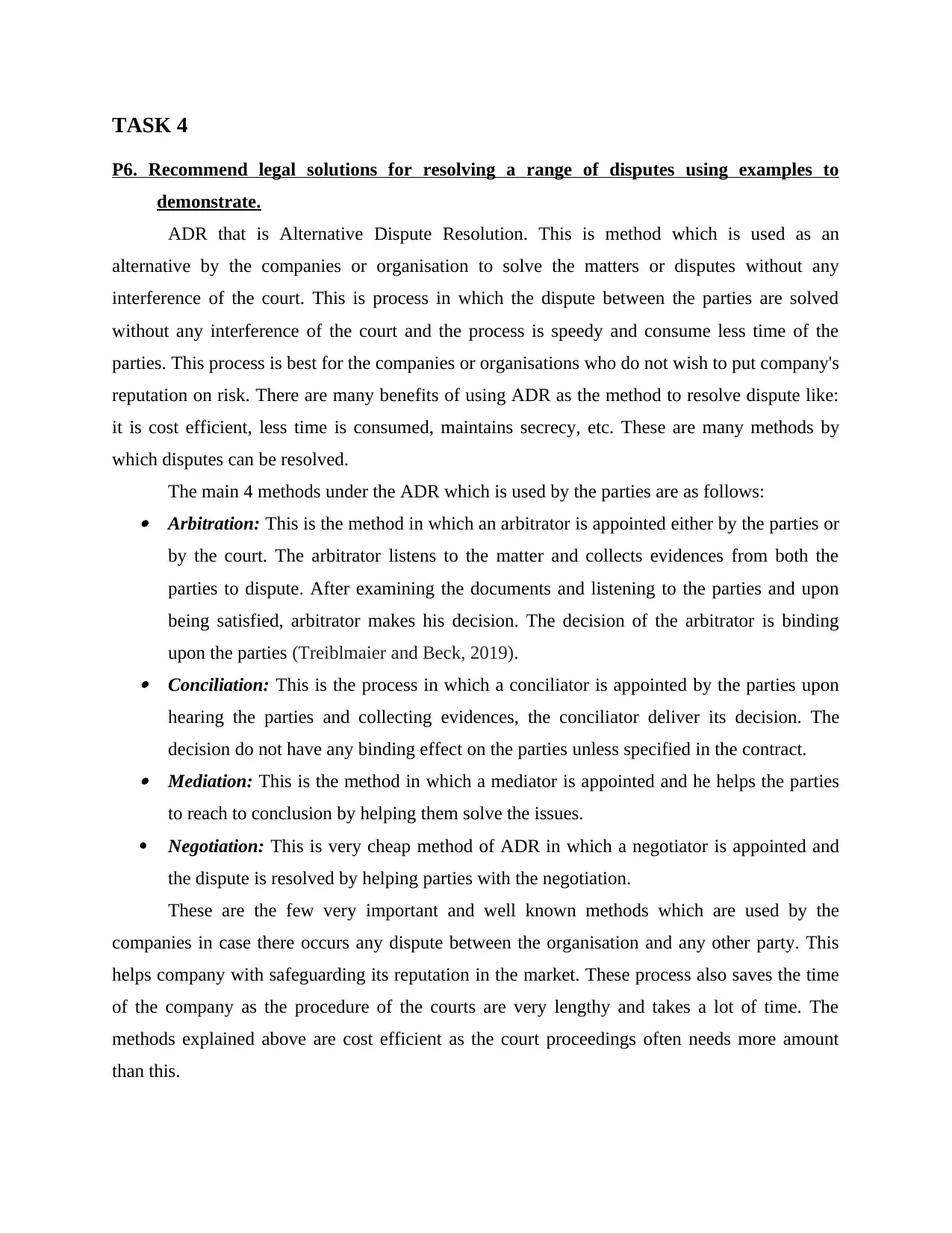
TASK 4
P6. Recommend legal solutions for resolving a range of disputes using examples to
demonstrate.
ADR that is Alternative Dispute Resolution. This is method which is used as an
alternative by the companies or organisation to solve the matters or disputes without any
interference of the court. This is process in which the dispute between the parties are solved
without any interference of the court and the process is speedy and consume less time of the
parties. This process is best for the companies or organisations who do not wish to put company's
reputation on risk. There are many benefits of using ADR as the method to resolve dispute like:
it is cost efficient, less time is consumed, maintains secrecy, etc. These are many methods by
which disputes can be resolved.
The main 4 methods under the ADR which is used by the parties are as follows: Arbitration: This is the method in which an arbitrator is appointed either by the parties or
by the court. The arbitrator listens to the matter and collects evidences from both the
parties to dispute. After examining the documents and listening to the parties and upon
being satisfied, arbitrator makes his decision. The decision of the arbitrator is binding
upon the parties (Treiblmaier and Beck, 2019). Conciliation: This is the process in which a conciliator is appointed by the parties upon
hearing the parties and collecting evidences, the conciliator deliver its decision. The
decision do not have any binding effect on the parties unless specified in the contract. Mediation: This is the method in which a mediator is appointed and he helps the parties
to reach to conclusion by helping them solve the issues.
Negotiation: This is very cheap method of ADR in which a negotiator is appointed and
the dispute is resolved by helping parties with the negotiation.
These are the few very important and well known methods which are used by the
companies in case there occurs any dispute between the organisation and any other party. This
helps company with safeguarding its reputation in the market. These process also saves the time
of the company as the procedure of the courts are very lengthy and takes a lot of time. The
methods explained above are cost efficient as the court proceedings often needs more amount
than this.
P6. Recommend legal solutions for resolving a range of disputes using examples to
demonstrate.
ADR that is Alternative Dispute Resolution. This is method which is used as an
alternative by the companies or organisation to solve the matters or disputes without any
interference of the court. This is process in which the dispute between the parties are solved
without any interference of the court and the process is speedy and consume less time of the
parties. This process is best for the companies or organisations who do not wish to put company's
reputation on risk. There are many benefits of using ADR as the method to resolve dispute like:
it is cost efficient, less time is consumed, maintains secrecy, etc. These are many methods by
which disputes can be resolved.
The main 4 methods under the ADR which is used by the parties are as follows: Arbitration: This is the method in which an arbitrator is appointed either by the parties or
by the court. The arbitrator listens to the matter and collects evidences from both the
parties to dispute. After examining the documents and listening to the parties and upon
being satisfied, arbitrator makes his decision. The decision of the arbitrator is binding
upon the parties (Treiblmaier and Beck, 2019). Conciliation: This is the process in which a conciliator is appointed by the parties upon
hearing the parties and collecting evidences, the conciliator deliver its decision. The
decision do not have any binding effect on the parties unless specified in the contract. Mediation: This is the method in which a mediator is appointed and he helps the parties
to reach to conclusion by helping them solve the issues.
Negotiation: This is very cheap method of ADR in which a negotiator is appointed and
the dispute is resolved by helping parties with the negotiation.
These are the few very important and well known methods which are used by the
companies in case there occurs any dispute between the organisation and any other party. This
helps company with safeguarding its reputation in the market. These process also saves the time
of the company as the procedure of the courts are very lengthy and takes a lot of time. The
methods explained above are cost efficient as the court proceedings often needs more amount
than this.
⊘ This is a preview!⊘
Do you want full access?
Subscribe today to unlock all pages.
Trusted by 1+ million students worldwide
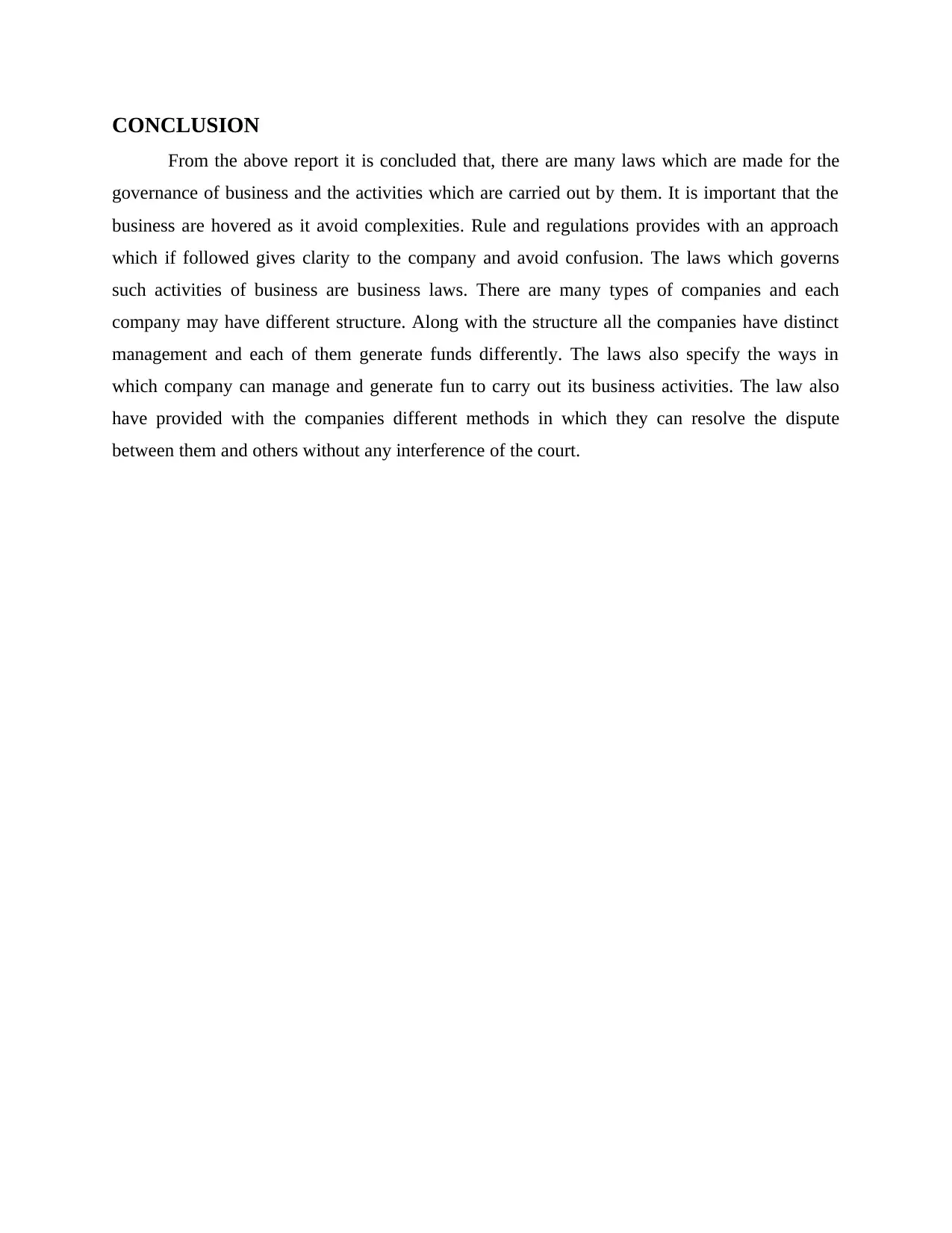
CONCLUSION
From the above report it is concluded that, there are many laws which are made for the
governance of business and the activities which are carried out by them. It is important that the
business are hovered as it avoid complexities. Rule and regulations provides with an approach
which if followed gives clarity to the company and avoid confusion. The laws which governs
such activities of business are business laws. There are many types of companies and each
company may have different structure. Along with the structure all the companies have distinct
management and each of them generate funds differently. The laws also specify the ways in
which company can manage and generate fun to carry out its business activities. The law also
have provided with the companies different methods in which they can resolve the dispute
between them and others without any interference of the court.
From the above report it is concluded that, there are many laws which are made for the
governance of business and the activities which are carried out by them. It is important that the
business are hovered as it avoid complexities. Rule and regulations provides with an approach
which if followed gives clarity to the company and avoid confusion. The laws which governs
such activities of business are business laws. There are many types of companies and each
company may have different structure. Along with the structure all the companies have distinct
management and each of them generate funds differently. The laws also specify the ways in
which company can manage and generate fun to carry out its business activities. The law also
have provided with the companies different methods in which they can resolve the dispute
between them and others without any interference of the court.
Paraphrase This Document
Need a fresh take? Get an instant paraphrase of this document with our AI Paraphraser
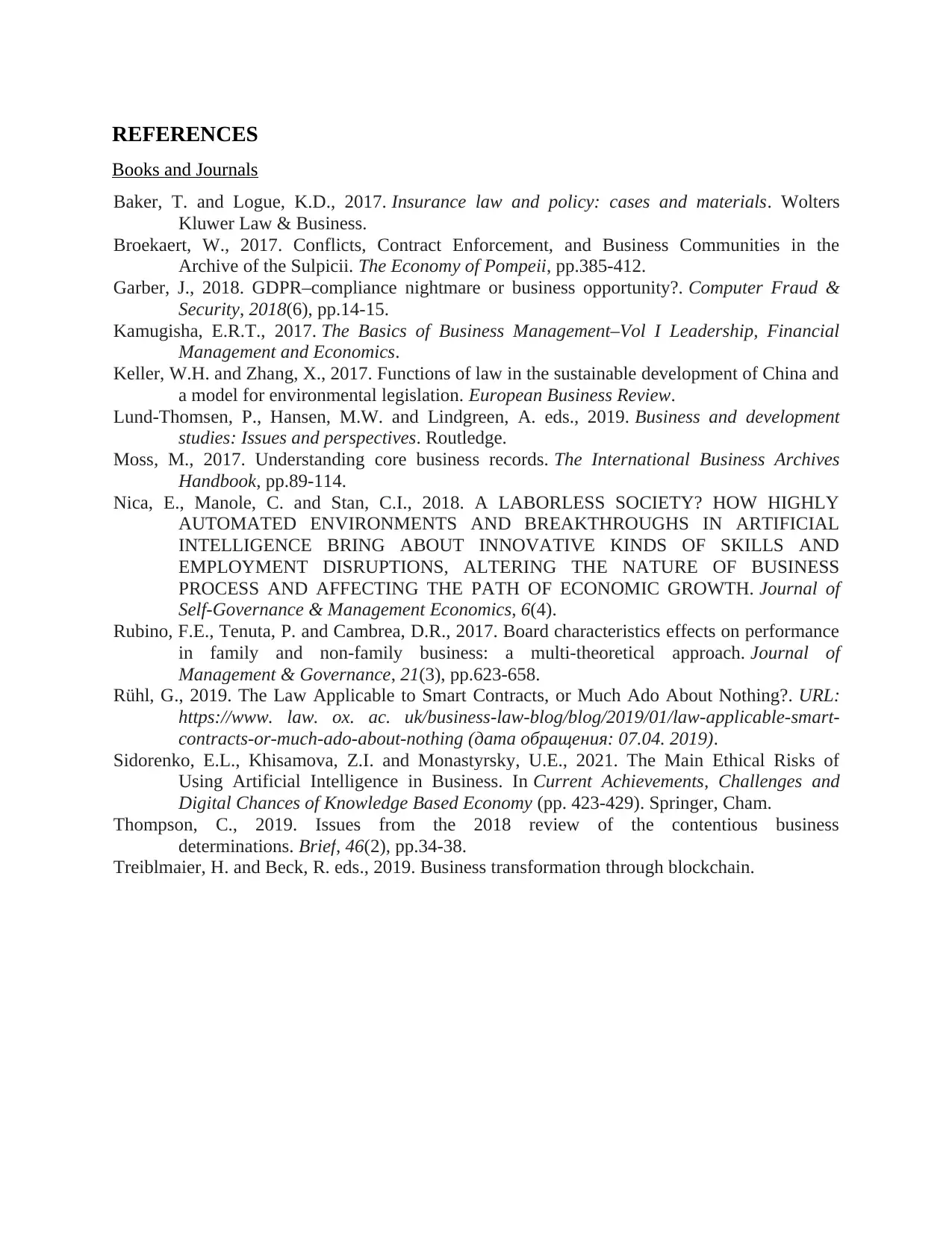
REFERENCES
Books and Journals
Baker, T. and Logue, K.D., 2017. Insurance law and policy: cases and materials. Wolters
Kluwer Law & Business.
Broekaert, W., 2017. Conflicts, Contract Enforcement, and Business Communities in the
Archive of the Sulpicii. The Economy of Pompeii, pp.385-412.
Garber, J., 2018. GDPR–compliance nightmare or business opportunity?. Computer Fraud &
Security, 2018(6), pp.14-15.
Kamugisha, E.R.T., 2017. The Basics of Business Management–Vol I Leadership, Financial
Management and Economics.
Keller, W.H. and Zhang, X., 2017. Functions of law in the sustainable development of China and
a model for environmental legislation. European Business Review.
Lund-Thomsen, P., Hansen, M.W. and Lindgreen, A. eds., 2019. Business and development
studies: Issues and perspectives. Routledge.
Moss, M., 2017. Understanding core business records. The International Business Archives
Handbook, pp.89-114.
Nica, E., Manole, C. and Stan, C.I., 2018. A LABORLESS SOCIETY? HOW HIGHLY
AUTOMATED ENVIRONMENTS AND BREAKTHROUGHS IN ARTIFICIAL
INTELLIGENCE BRING ABOUT INNOVATIVE KINDS OF SKILLS AND
EMPLOYMENT DISRUPTIONS, ALTERING THE NATURE OF BUSINESS
PROCESS AND AFFECTING THE PATH OF ECONOMIC GROWTH. Journal of
Self-Governance & Management Economics, 6(4).
Rubino, F.E., Tenuta, P. and Cambrea, D.R., 2017. Board characteristics effects on performance
in family and non-family business: a multi-theoretical approach. Journal of
Management & Governance, 21(3), pp.623-658.
Rühl, G., 2019. The Law Applicable to Smart Contracts, or Much Ado About Nothing?. URL:
https://www. law. ox. ac. uk/business-law-blog/blog/2019/01/law-applicable-smart-
contracts-or-much-ado-about-nothing (дата обращения: 07.04. 2019).
Sidorenko, E.L., Khisamova, Z.I. and Monastyrsky, U.E., 2021. The Main Ethical Risks of
Using Artificial Intelligence in Business. In Current Achievements, Challenges and
Digital Chances of Knowledge Based Economy (pp. 423-429). Springer, Cham.
Thompson, C., 2019. Issues from the 2018 review of the contentious business
determinations. Brief, 46(2), pp.34-38.
Treiblmaier, H. and Beck, R. eds., 2019. Business transformation through blockchain.
Books and Journals
Baker, T. and Logue, K.D., 2017. Insurance law and policy: cases and materials. Wolters
Kluwer Law & Business.
Broekaert, W., 2017. Conflicts, Contract Enforcement, and Business Communities in the
Archive of the Sulpicii. The Economy of Pompeii, pp.385-412.
Garber, J., 2018. GDPR–compliance nightmare or business opportunity?. Computer Fraud &
Security, 2018(6), pp.14-15.
Kamugisha, E.R.T., 2017. The Basics of Business Management–Vol I Leadership, Financial
Management and Economics.
Keller, W.H. and Zhang, X., 2017. Functions of law in the sustainable development of China and
a model for environmental legislation. European Business Review.
Lund-Thomsen, P., Hansen, M.W. and Lindgreen, A. eds., 2019. Business and development
studies: Issues and perspectives. Routledge.
Moss, M., 2017. Understanding core business records. The International Business Archives
Handbook, pp.89-114.
Nica, E., Manole, C. and Stan, C.I., 2018. A LABORLESS SOCIETY? HOW HIGHLY
AUTOMATED ENVIRONMENTS AND BREAKTHROUGHS IN ARTIFICIAL
INTELLIGENCE BRING ABOUT INNOVATIVE KINDS OF SKILLS AND
EMPLOYMENT DISRUPTIONS, ALTERING THE NATURE OF BUSINESS
PROCESS AND AFFECTING THE PATH OF ECONOMIC GROWTH. Journal of
Self-Governance & Management Economics, 6(4).
Rubino, F.E., Tenuta, P. and Cambrea, D.R., 2017. Board characteristics effects on performance
in family and non-family business: a multi-theoretical approach. Journal of
Management & Governance, 21(3), pp.623-658.
Rühl, G., 2019. The Law Applicable to Smart Contracts, or Much Ado About Nothing?. URL:
https://www. law. ox. ac. uk/business-law-blog/blog/2019/01/law-applicable-smart-
contracts-or-much-ado-about-nothing (дата обращения: 07.04. 2019).
Sidorenko, E.L., Khisamova, Z.I. and Monastyrsky, U.E., 2021. The Main Ethical Risks of
Using Artificial Intelligence in Business. In Current Achievements, Challenges and
Digital Chances of Knowledge Based Economy (pp. 423-429). Springer, Cham.
Thompson, C., 2019. Issues from the 2018 review of the contentious business
determinations. Brief, 46(2), pp.34-38.
Treiblmaier, H. and Beck, R. eds., 2019. Business transformation through blockchain.

1 out of 11


Related Documents


Your All-in-One AI-Powered Toolkit for Academic Success.
+13062052269
info@desklib.com
Available 24*7 on WhatsApp / Email
![[object Object]](/_next/static/media/star-bottom.7253800d.svg)
Unlock your academic potential
Copyright © 2020–2026 A2Z Services. All Rights Reserved. Developed and managed by ZUCOL.