Analysis of Business Law: Sources, Impact, and Legal Solutions
VerifiedAdded on 2024/05/20
|19
|3232
|76
Report
AI Summary
This report provides a comprehensive overview of business law, focusing on the sources of law in the United Kingdom, including primary sources like case laws and legislation, and secondary sources. It discusses the role of the government in law making, detailing the legislative process from the first reading to royal assent. The report evaluates the effectiveness of the legal system, considering the diversity of laws and potential problems arising from conflicting sources. It illustrates the impact of employment and contract law on business operations, differentiating between regulations, legislation, and standards. Furthermore, the report suggests appropriate solutions for business problems, such as company registration, and justifies the use of legal solutions in various scenarios, including cases of director misconduct. The report concludes by discussing the importance of understanding and adhering to business law for organizational success.
Business Law

Paraphrase This Document
Need a fresh take? Get an instant paraphrase of this document with our AI Paraphraser
Contents
Introduction........................................................................................................................3
LO1....................................................................................................................................4
P1 Explain the different sources of law that the organisation needs to comply with.....4
P2 Explain the role of government in law making. Explain how statutory and common
law are applied in the courts..........................................................................................5
M1 Evaluate the effectiveness of the legal system in terms of the diversity of its laws.
Discuss the problems with different sources of law.......................................................7
D1 Provide a coherent and critical evaluation of the legal system and law drawn from
a range of different relevant examples to support judgments.......................................8
LO2....................................................................................................................................9
P3 Use specific examples illustrate how employment law and contract law have a
potential impact on business..........................................................................................9
M2 Differentiate and analyse the potential impacts of regulations legislation and
standards......................................................................................................................10
LO3..................................................................................................................................11
P4 Suggest appropriate solution for a range of business problems............................11
P5 Provide justifications for the use of appropriate legal solutions.............................13
M3 Assess the positive and negative impacts of business solutions..........................14
D2 Critically review and evaluate the use of appropriate legal solutions in alternate
advice...........................................................................................................................15
LO4..................................................................................................................................16
P6 Recommend solutions based on a country’s legal system and/ or a different
framework.....................................................................................................................16
M4 Compare and contrast the effectiveness of these solutions..................................17
Conclusion.......................................................................................................................18
References.......................................................................................................................19
Introduction........................................................................................................................3
LO1....................................................................................................................................4
P1 Explain the different sources of law that the organisation needs to comply with.....4
P2 Explain the role of government in law making. Explain how statutory and common
law are applied in the courts..........................................................................................5
M1 Evaluate the effectiveness of the legal system in terms of the diversity of its laws.
Discuss the problems with different sources of law.......................................................7
D1 Provide a coherent and critical evaluation of the legal system and law drawn from
a range of different relevant examples to support judgments.......................................8
LO2....................................................................................................................................9
P3 Use specific examples illustrate how employment law and contract law have a
potential impact on business..........................................................................................9
M2 Differentiate and analyse the potential impacts of regulations legislation and
standards......................................................................................................................10
LO3..................................................................................................................................11
P4 Suggest appropriate solution for a range of business problems............................11
P5 Provide justifications for the use of appropriate legal solutions.............................13
M3 Assess the positive and negative impacts of business solutions..........................14
D2 Critically review and evaluate the use of appropriate legal solutions in alternate
advice...........................................................................................................................15
LO4..................................................................................................................................16
P6 Recommend solutions based on a country’s legal system and/ or a different
framework.....................................................................................................................16
M4 Compare and contrast the effectiveness of these solutions..................................17
Conclusion.......................................................................................................................18
References.......................................................................................................................19
Introduction
The report would be including information about the Business Law and the impacts of
Business Law over the organisation. The sources of law in the United Kingdom would
also be discussed in the report below. The role of government is also to be discussed
with the regards of developing laws in the country. Also, the discussion in the report
would consist of usage of Employment Law and Contract Law in an organisation.
Further, the incorporation of the company is to be discussed with the roles of directors
in it. In the last, the discussion would end with the discussion about the alternate legal
advice.
The report would be including information about the Business Law and the impacts of
Business Law over the organisation. The sources of law in the United Kingdom would
also be discussed in the report below. The role of government is also to be discussed
with the regards of developing laws in the country. Also, the discussion in the report
would consist of usage of Employment Law and Contract Law in an organisation.
Further, the incorporation of the company is to be discussed with the roles of directors
in it. In the last, the discussion would end with the discussion about the alternate legal
advice.
⊘ This is a preview!⊘
Do you want full access?
Subscribe today to unlock all pages.

Trusted by 1+ million students worldwide
LO1
P1 Explain the different sources of law that the organisation needs to comply
with.
There are different sources of law on which the organisation needs to comply with. The
sources of law can be divided into two parts:
a. Primary Sources: This source of law includes two of the important sources that
are case laws and legislation made by parliament. In the United Kingdom case
laws are considered as a very major source of law. It has been stated that
judgment given by the court in each case is recorded and if in future same kind of
case comes before the court then court can take the previous judgment as the
reference for the new case. Also the legislation is considered as an important
source of law where the law made by legislation are considered as supreme by
the courts. Courts use the law made by legislation to govern the case when it
comes before the court.
b. Secondary Sources: These sources of law are usually Law Journals, Law
Encyclopedia as well as the textbooks. Some of the laws are derived from the
secondary sources as well but they are not usually referred by the courts. But
secondary sources are also playing a role in developing laws in the United
Kingdom (Allman, 2018).
The organisations need to comply with the sources of laws which are described to run
the organisation smoothly and without any sort of discrepancy among the organisation.
If these sources are followed the organisation would be able to work lawfully in the
country.
P1 Explain the different sources of law that the organisation needs to comply
with.
There are different sources of law on which the organisation needs to comply with. The
sources of law can be divided into two parts:
a. Primary Sources: This source of law includes two of the important sources that
are case laws and legislation made by parliament. In the United Kingdom case
laws are considered as a very major source of law. It has been stated that
judgment given by the court in each case is recorded and if in future same kind of
case comes before the court then court can take the previous judgment as the
reference for the new case. Also the legislation is considered as an important
source of law where the law made by legislation are considered as supreme by
the courts. Courts use the law made by legislation to govern the case when it
comes before the court.
b. Secondary Sources: These sources of law are usually Law Journals, Law
Encyclopedia as well as the textbooks. Some of the laws are derived from the
secondary sources as well but they are not usually referred by the courts. But
secondary sources are also playing a role in developing laws in the United
Kingdom (Allman, 2018).
The organisations need to comply with the sources of laws which are described to run
the organisation smoothly and without any sort of discrepancy among the organisation.
If these sources are followed the organisation would be able to work lawfully in the
country.
Paraphrase This Document
Need a fresh take? Get an instant paraphrase of this document with our AI Paraphraser
P2 Explain the role of government in law making. Explain how statutory and
common law are applied in the courts.
Role of government is the most important role which is played during the law making
process. Law making is done in a systematic manner which follows few steps, they are
mentioned below:-
The law making process takes few readings in order to get the bill passed and convert
the bill into a new law. The readings which are done in order to make a new law are as
follows:
First Reading: In this reading the bill is presented in front of the authorities, which
is to be passed in future to make it a law.
Second Reading: This is the reading where the bill is discussed by the
authorities. The discussion includes: The purpose for which this law is to be
made in the country and the area where the bill would be majorly focusing on in
the country.
Committee Stage: This is the stage where amendments are done in the bill if
required. If in case the bill needs few changes to be done then those changes
take part in this stage.
Report Stage: in this stage the amendments or changes which are made in the
bill are further discussed and finalised that what needs to be done in the case.
Third Reading: If there are other amendments are to be done then this is the final
stage when it can be done for that particular bill.
Royal Assent: In this both the houses agrees upon the bill by voting. Then the bill
is further passed to queen for the final approval. Once the bill is approved by
queen, the bill would become the law (Lawmentor, 2018).
Once the bill is passed by both the houses and approved by the queen it becomes a law
and is applicable in all the courts of the United Kingdom. As it is known that common
law is the primary source of law in the United Kingdom, therefore it is to be made sure
that the new law should not be contradictory to the primary source of law. Also it is to be
common law are applied in the courts.
Role of government is the most important role which is played during the law making
process. Law making is done in a systematic manner which follows few steps, they are
mentioned below:-
The law making process takes few readings in order to get the bill passed and convert
the bill into a new law. The readings which are done in order to make a new law are as
follows:
First Reading: In this reading the bill is presented in front of the authorities, which
is to be passed in future to make it a law.
Second Reading: This is the reading where the bill is discussed by the
authorities. The discussion includes: The purpose for which this law is to be
made in the country and the area where the bill would be majorly focusing on in
the country.
Committee Stage: This is the stage where amendments are done in the bill if
required. If in case the bill needs few changes to be done then those changes
take part in this stage.
Report Stage: in this stage the amendments or changes which are made in the
bill are further discussed and finalised that what needs to be done in the case.
Third Reading: If there are other amendments are to be done then this is the final
stage when it can be done for that particular bill.
Royal Assent: In this both the houses agrees upon the bill by voting. Then the bill
is further passed to queen for the final approval. Once the bill is approved by
queen, the bill would become the law (Lawmentor, 2018).
Once the bill is passed by both the houses and approved by the queen it becomes a law
and is applicable in all the courts of the United Kingdom. As it is known that common
law is the primary source of law in the United Kingdom, therefore it is to be made sure
that the new law should not be contradictory to the primary source of law. Also it is to be

made sure that rights of the people in UK are not breached by the application of new
laws.
laws.
⊘ This is a preview!⊘
Do you want full access?
Subscribe today to unlock all pages.
Trusted by 1+ million students worldwide
M1 Evaluate the effectiveness of the legal system in terms of the diversity of its
laws. Discuss the problems with different sources of law.
The legal system in the United Kingdom is effective even after having the diversity in the
laws of the country. There are different laws for different offences in the country which
makes the laws of the country as effective on each and every offence. The problems
which can be suffered with the different sources of laws are that sometimes the laws
can be contradictory with one or the other source of law. For e.g. A law of the country
can be contradictory with the custom of the country so the custom would prevail over
the law and the problem could arise due to this.
laws. Discuss the problems with different sources of law.
The legal system in the United Kingdom is effective even after having the diversity in the
laws of the country. There are different laws for different offences in the country which
makes the laws of the country as effective on each and every offence. The problems
which can be suffered with the different sources of laws are that sometimes the laws
can be contradictory with one or the other source of law. For e.g. A law of the country
can be contradictory with the custom of the country so the custom would prevail over
the law and the problem could arise due to this.
Paraphrase This Document
Need a fresh take? Get an instant paraphrase of this document with our AI Paraphraser
D1 Provide a coherent and critical evaluation of the legal system and law drawn
from a range of different relevant examples to support judgments.
The legal system followed by the United Kingdom is the oldest of all systems and is
followed by most of the countries in the world. Usually the principles of common law are
applicable over the suits in the United Kingdom. The responsibility of passing a correct
and accurate judgment lies on the shoulders of a judge. The reason is that the judgment
can be used further in the same kind of case and the time of the court can be saved
while passing the judgment in similar case. The English Legal system is majorly based
upon the doctrine if stare decisis. This doctrine states that the judgment of higher courts
is applicable on lower as well as subordinate courts (Carter, 2005).
from a range of different relevant examples to support judgments.
The legal system followed by the United Kingdom is the oldest of all systems and is
followed by most of the countries in the world. Usually the principles of common law are
applicable over the suits in the United Kingdom. The responsibility of passing a correct
and accurate judgment lies on the shoulders of a judge. The reason is that the judgment
can be used further in the same kind of case and the time of the court can be saved
while passing the judgment in similar case. The English Legal system is majorly based
upon the doctrine if stare decisis. This doctrine states that the judgment of higher courts
is applicable on lower as well as subordinate courts (Carter, 2005).
LO2
P3 Use specific examples illustrate how employment law and contract law have a
potential impact on business.
Employment Law: It has an impact over the business in few manners for example: the
act defines the duty of an employer and an employee towards each other. To run a
business smoothly and lawfully both employer and employee has to follow the rules and
regulations defined for them in employment law. One of the duties of an employer is to
provide safe and healthy work environment for working of the employee. On the other
hand one of the duty of an employee is to work efficiently for the employer and
according to the procedure described to employee (The UK Rules, 2018).
Contract Law: This regulates the contract of agreements between the employee and the
employer. The terms and conditions which are mentioned in the contract both the
parties have to comply with them or else there would be breach of contract by them. For
example: A contract is signed between an employer and an employee about the
employment in the company. If any of the condition is broken by either of them, then
there would be breach of contract and the parties can sue the wrong doer in the court
(Westlaw, 2018).
P3 Use specific examples illustrate how employment law and contract law have a
potential impact on business.
Employment Law: It has an impact over the business in few manners for example: the
act defines the duty of an employer and an employee towards each other. To run a
business smoothly and lawfully both employer and employee has to follow the rules and
regulations defined for them in employment law. One of the duties of an employer is to
provide safe and healthy work environment for working of the employee. On the other
hand one of the duty of an employee is to work efficiently for the employer and
according to the procedure described to employee (The UK Rules, 2018).
Contract Law: This regulates the contract of agreements between the employee and the
employer. The terms and conditions which are mentioned in the contract both the
parties have to comply with them or else there would be breach of contract by them. For
example: A contract is signed between an employer and an employee about the
employment in the company. If any of the condition is broken by either of them, then
there would be breach of contract and the parties can sue the wrong doer in the court
(Westlaw, 2018).
⊘ This is a preview!⊘
Do you want full access?
Subscribe today to unlock all pages.
Trusted by 1+ million students worldwide
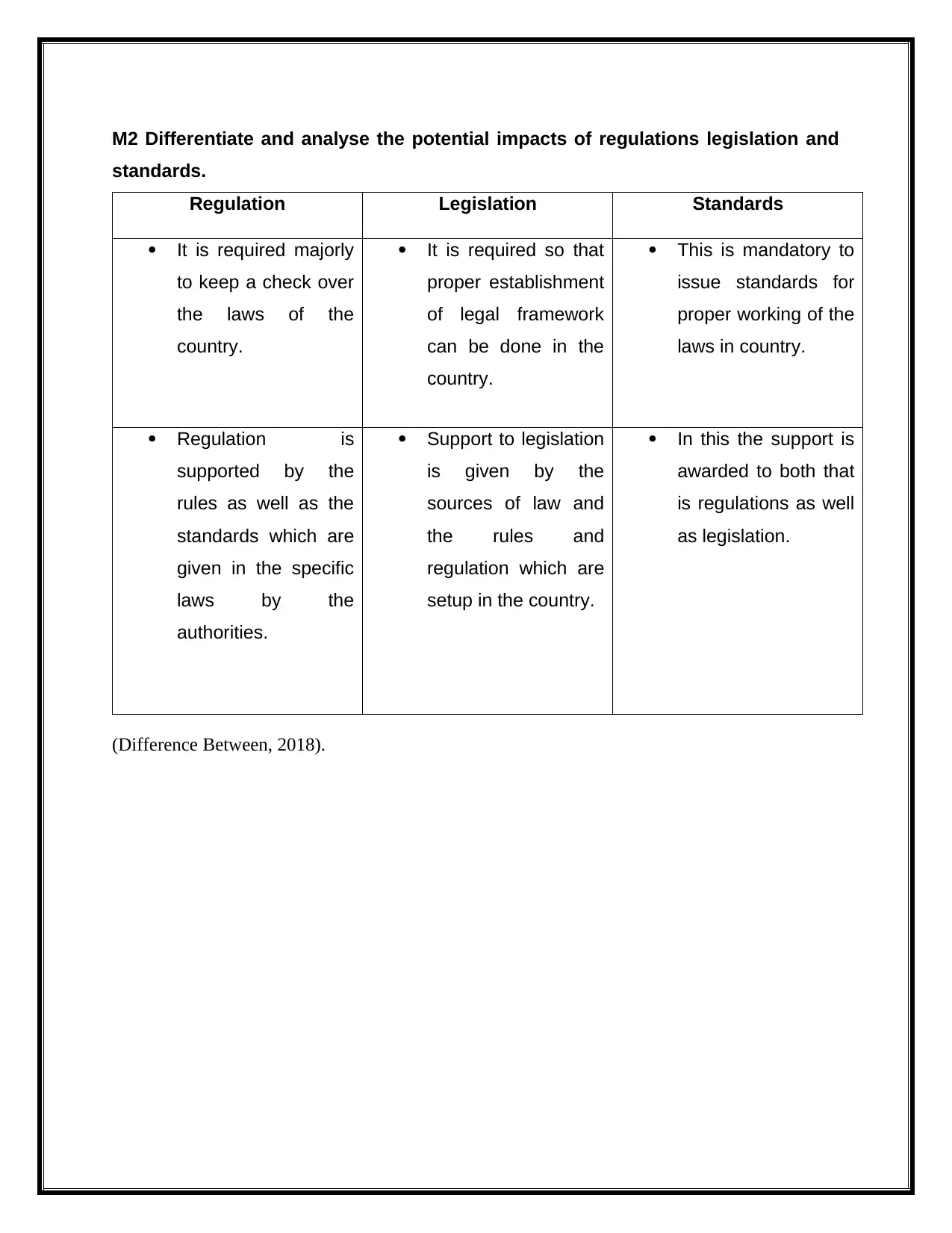
M2 Differentiate and analyse the potential impacts of regulations legislation and
standards.
Regulation Legislation Standards
It is required majorly
to keep a check over
the laws of the
country.
It is required so that
proper establishment
of legal framework
can be done in the
country.
This is mandatory to
issue standards for
proper working of the
laws in country.
Regulation is
supported by the
rules as well as the
standards which are
given in the specific
laws by the
authorities.
Support to legislation
is given by the
sources of law and
the rules and
regulation which are
setup in the country.
In this the support is
awarded to both that
is regulations as well
as legislation.
(Difference Between, 2018).
standards.
Regulation Legislation Standards
It is required majorly
to keep a check over
the laws of the
country.
It is required so that
proper establishment
of legal framework
can be done in the
country.
This is mandatory to
issue standards for
proper working of the
laws in country.
Regulation is
supported by the
rules as well as the
standards which are
given in the specific
laws by the
authorities.
Support to legislation
is given by the
sources of law and
the rules and
regulation which are
setup in the country.
In this the support is
awarded to both that
is regulations as well
as legislation.
(Difference Between, 2018).
Paraphrase This Document
Need a fresh take? Get an instant paraphrase of this document with our AI Paraphraser
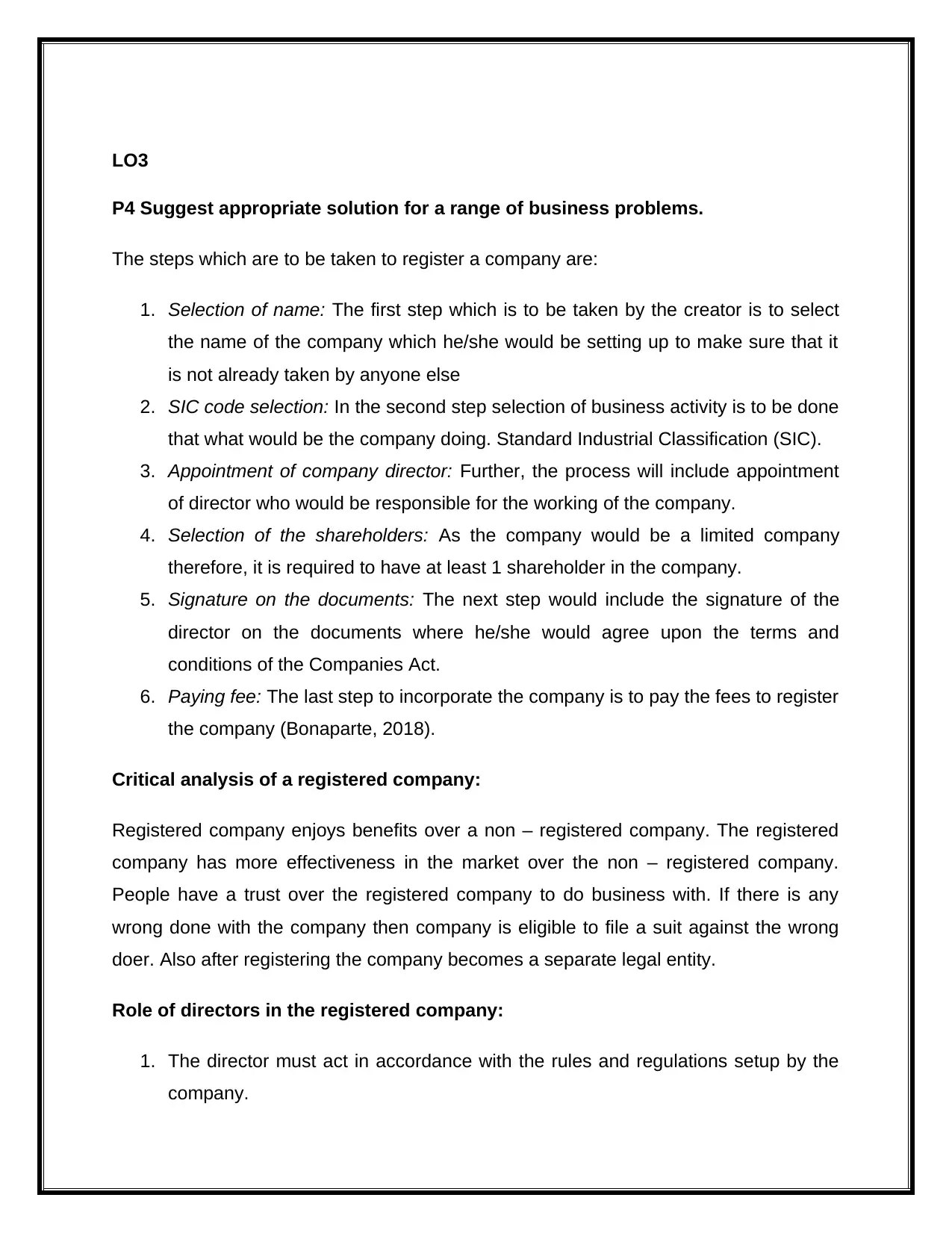
LO3
P4 Suggest appropriate solution for a range of business problems.
The steps which are to be taken to register a company are:
1. Selection of name: The first step which is to be taken by the creator is to select
the name of the company which he/she would be setting up to make sure that it
is not already taken by anyone else
2. SIC code selection: In the second step selection of business activity is to be done
that what would be the company doing. Standard Industrial Classification (SIC).
3. Appointment of company director: Further, the process will include appointment
of director who would be responsible for the working of the company.
4. Selection of the shareholders: As the company would be a limited company
therefore, it is required to have at least 1 shareholder in the company.
5. Signature on the documents: The next step would include the signature of the
director on the documents where he/she would agree upon the terms and
conditions of the Companies Act.
6. Paying fee: The last step to incorporate the company is to pay the fees to register
the company (Bonaparte, 2018).
Critical analysis of a registered company:
Registered company enjoys benefits over a non – registered company. The registered
company has more effectiveness in the market over the non – registered company.
People have a trust over the registered company to do business with. If there is any
wrong done with the company then company is eligible to file a suit against the wrong
doer. Also after registering the company becomes a separate legal entity.
Role of directors in the registered company:
1. The director must act in accordance with the rules and regulations setup by the
company.
P4 Suggest appropriate solution for a range of business problems.
The steps which are to be taken to register a company are:
1. Selection of name: The first step which is to be taken by the creator is to select
the name of the company which he/she would be setting up to make sure that it
is not already taken by anyone else
2. SIC code selection: In the second step selection of business activity is to be done
that what would be the company doing. Standard Industrial Classification (SIC).
3. Appointment of company director: Further, the process will include appointment
of director who would be responsible for the working of the company.
4. Selection of the shareholders: As the company would be a limited company
therefore, it is required to have at least 1 shareholder in the company.
5. Signature on the documents: The next step would include the signature of the
director on the documents where he/she would agree upon the terms and
conditions of the Companies Act.
6. Paying fee: The last step to incorporate the company is to pay the fees to register
the company (Bonaparte, 2018).
Critical analysis of a registered company:
Registered company enjoys benefits over a non – registered company. The registered
company has more effectiveness in the market over the non – registered company.
People have a trust over the registered company to do business with. If there is any
wrong done with the company then company is eligible to file a suit against the wrong
doer. Also after registering the company becomes a separate legal entity.
Role of directors in the registered company:
1. The director must act in accordance with the rules and regulations setup by the
company.
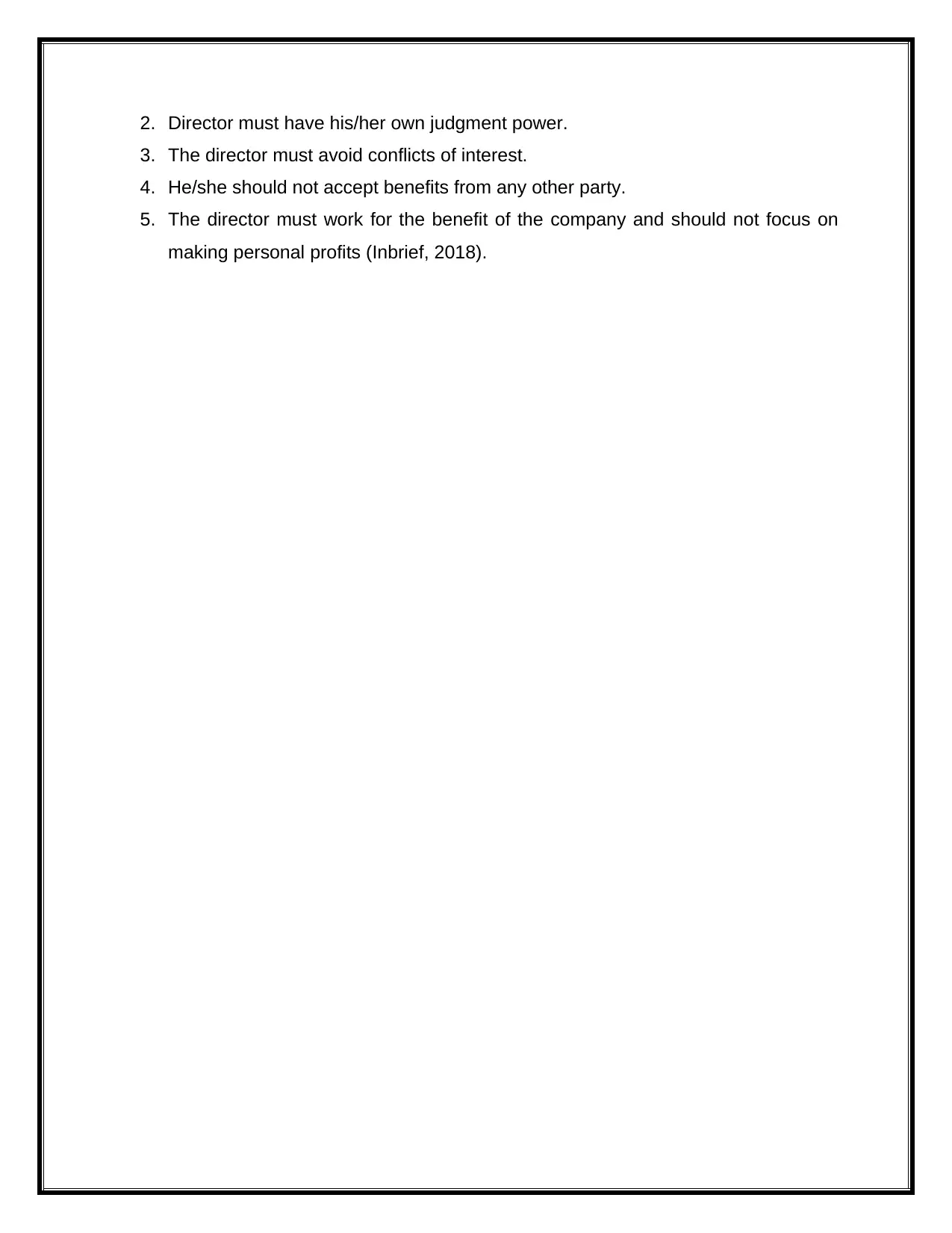
2. Director must have his/her own judgment power.
3. The director must avoid conflicts of interest.
4. He/she should not accept benefits from any other party.
5. The director must work for the benefit of the company and should not focus on
making personal profits (Inbrief, 2018).
3. The director must avoid conflicts of interest.
4. He/she should not accept benefits from any other party.
5. The director must work for the benefit of the company and should not focus on
making personal profits (Inbrief, 2018).
⊘ This is a preview!⊘
Do you want full access?
Subscribe today to unlock all pages.
Trusted by 1+ million students worldwide

1 out of 19


Related Documents


Your All-in-One AI-Powered Toolkit for Academic Success.
+13062052269
info@desklib.com
Available 24*7 on WhatsApp / Email
![[object Object]](/_next/static/media/star-bottom.7253800d.svg)
Unlock your academic potential
Copyright © 2020–2026 A2Z Services. All Rights Reserved. Developed and managed by ZUCOL.