Business Management Curriculum Design: Presentation Overview

Verified

Added on  2022/08/16

|14
|827
|19
Presentation
AI Summary
This presentation focuses on the design of a business management curriculum. It begins by defining the curriculum within the context of business management, outlining key subjects such as economics, marketing, and finance. The presentation then analyzes two relevant theories: Maslow's humanist theory, which emphasizes the fulfillment of needs for motivation, and Watson's humanist theory, which focuses on observable behavior. Tyler's model is then discussed as a framework for curriculum development, emphasizing the importance of defining educational purposes and measuring outcomes. The core principles of curriculum design, including relevance, coherence, challenge, and personalization, are explored. Finally, the presentation examines a diploma curriculum model and discusses how the curriculum meets the needs of learners, preparing them for successful careers in business management. The document highlights how the curriculum ensures students gain expertise and become confident professionals in their field.

Document Page
BUSINESS MANAGEMENT
CURRICULUM
NAME OF THE STUDENT
NAME OF THE UNIVERSITY
AUTHOR NOTE
tabler-icon-diamond-filled.svg

Paraphrase This Document

Need a fresh take? Get an instant paraphrase of this document with our AI Paraphraser
Document Page
DEFINITION OF CURRICULUM
The curriculum with respect to the business
management would constitute of numerous
subjects like economics, organizational
behavior, marketing, management information
systems, operations management, business
ethics and law, management, finance, strategic
management along with operations
management (Laguador and Ramos 2014).
These subjects would help the students in
gaining expertise in the field of business
management in a successful manner.
Document Page
ANALYSIS OF MASLOW’S HUMANIST
THEORY
According to Maslow, motivation
becomes the result of the attempt of
the person in fulfilling all his or her
respective demands and needs one
by one which comprises of
physiological, safety, social, esteem
along with self-actualization
(Hesselbarth and Schaltegger 2014).
An important role is played by each
of these elements as when these gets
satisfied, a person gets motivated.
Document Page
ANALYSIS OF WATSON’S HUMANIST
THEORY
It basically focuses on the both
internal as well as internal
behavior apart from that of
internal psychological and
emotional conditions of a
person. It is really true that the
behavior of any person gets
reflected on the basis of
physical responses made by
him or her.
tabler-icon-diamond-filled.svg

Paraphrase This Document

Need a fresh take? Get an instant paraphrase of this document with our AI Paraphraser
Document Page
ANALYSIS OF TYLER’S MODEL
An essential role was played by the
utilization of Tyler’s model in designing
the curriculum with respect to business
management as it helped with the initial
principles of instructions for developing
curriculum such that it becomes helpful
for the students. It focuses on planning
of several phase (Aithal 2016). It
involves the examination of the needs of
the learner by specifying several
instructional objectives.
Document Page
PRINCIPLES OF CURRICULUM DESIGN
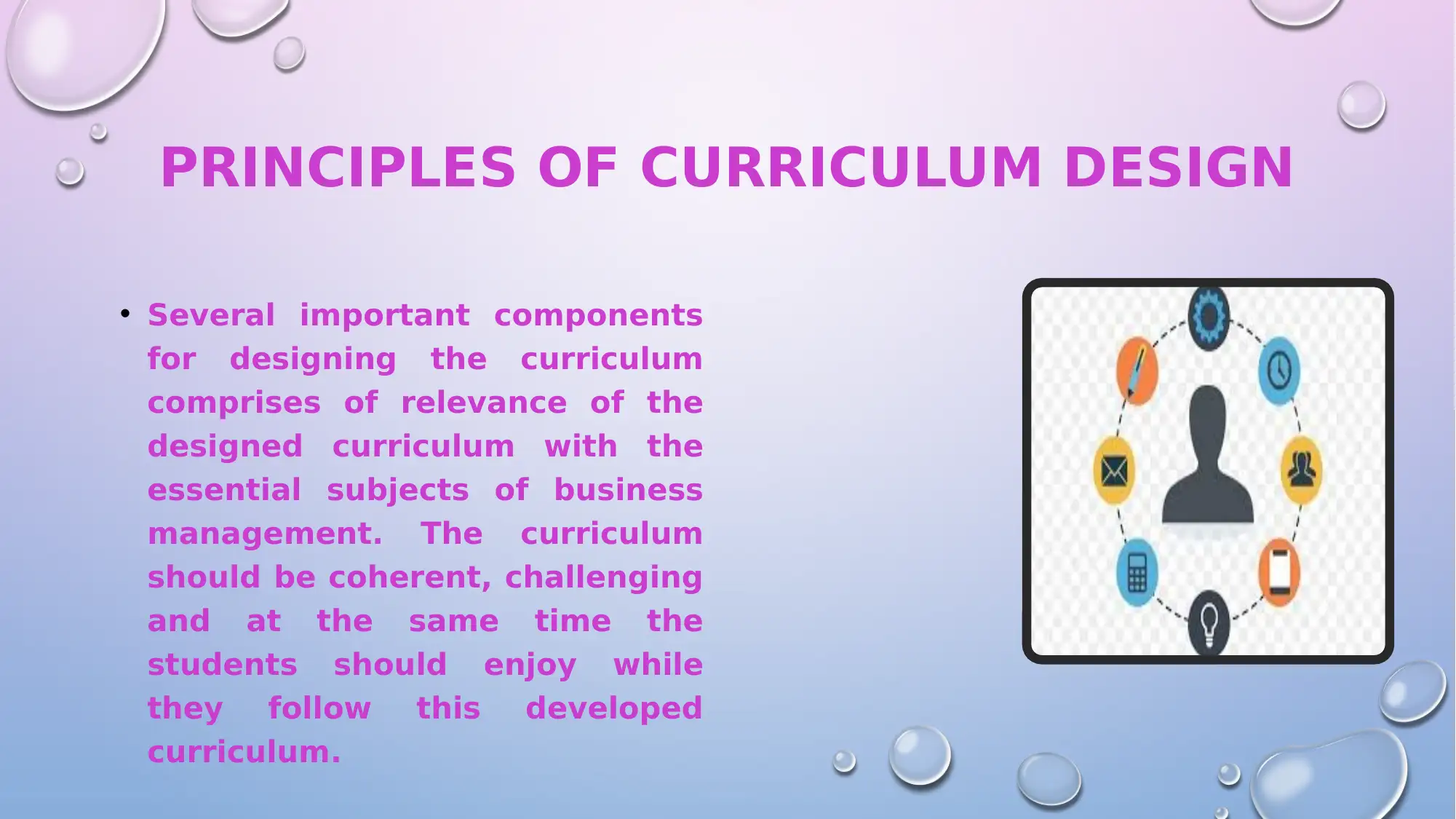
Several important components
for designing the curriculum
comprises of relevance of the
designed curriculum with the
essential subjects of business
management. The curriculum
should be coherent, challenging
and at the same time the
students should enjoy while
they follow this developed
curriculum.
Document Page
Contd….
The most essential component of
designing an effective curriculum also
involves several subjects which could
provide the students of business
management and also provide them
with the depth of understanding the
subjects (Caranana, Peris-Ortiz and
Rueda-Armengot 2016). The
curriculum should be progressive and
personalized such that the students
could progress with their curriculum.
tabler-icon-diamond-filled.svg

Paraphrase This Document

Need a fresh take? Get an instant paraphrase of this document with our AI Paraphraser
Document Page
MODEL OF CURRICULUM
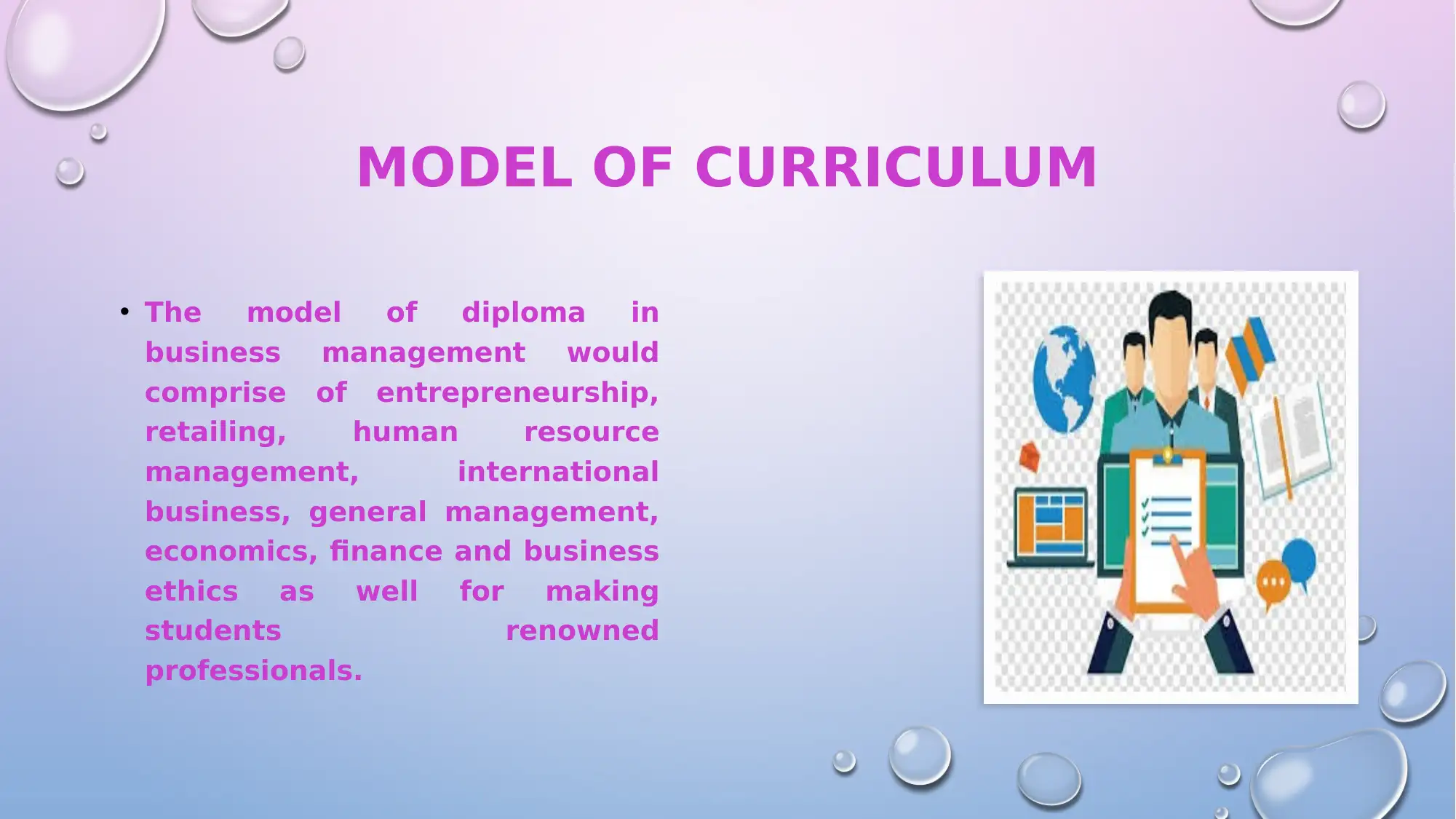
The model of diploma in
business management would
comprise of entrepreneurship,
retailing, human resource
management, international
business, general management,
economics, finance and business
ethics as well for making
students renowned
professionals.
Document Page
DIFFERENTIATION IN CURRICULUM
APPROACH
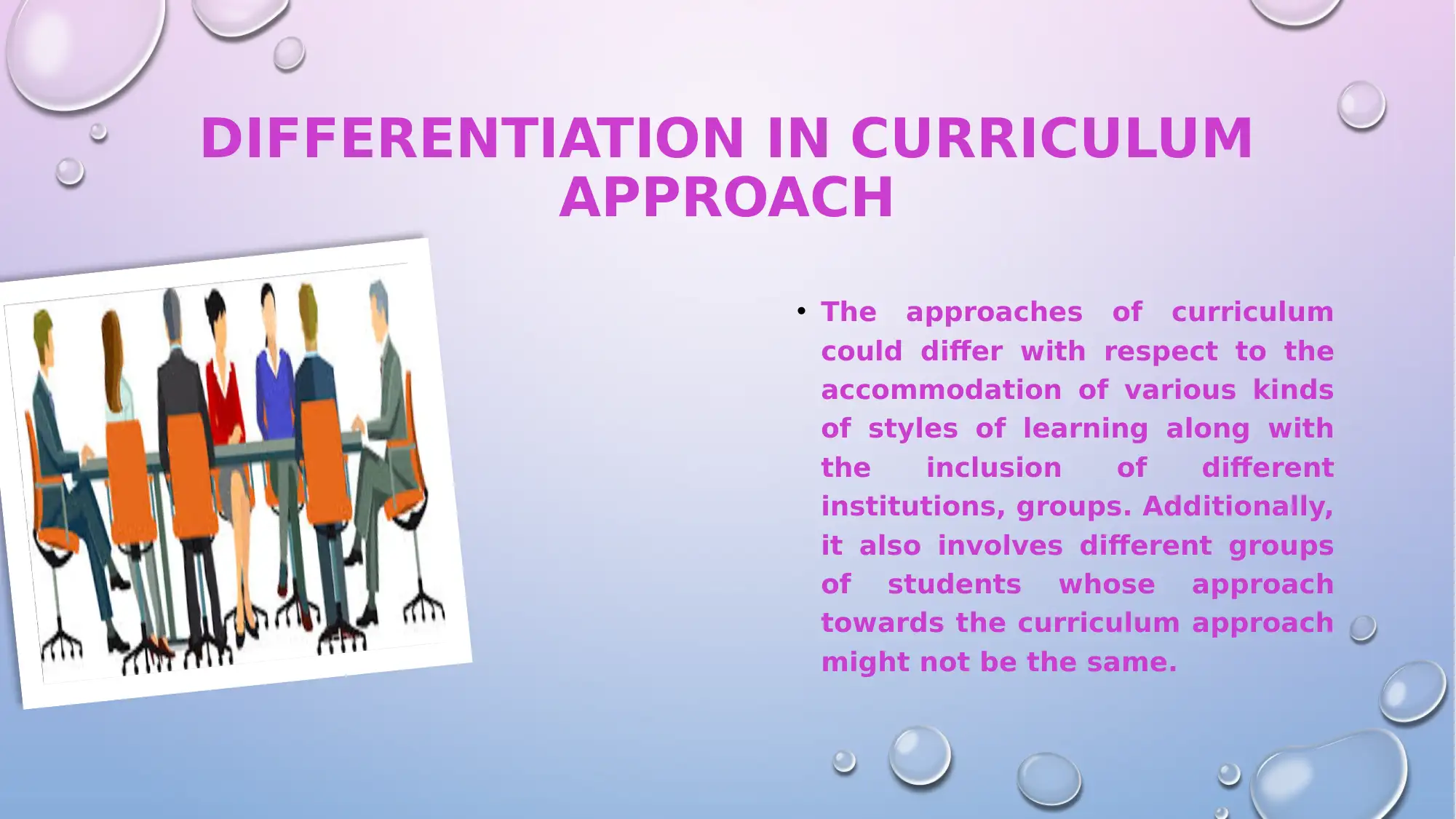
The approaches of curriculum
could differ with respect to the
accommodation of various kinds
of styles of learning along with
the inclusion of different
institutions, groups. Additionally,
it also involves different groups
of students whose approach
towards the curriculum approach
might not be the same.
Document Page
Contd…
There are various kinds of
approaches towards curriculum
which comprises of learner-
centered, problem-centered and
learner-centered as well. Different
groups of students would find the
subject-centered curriculum easy. At
the same time, several other
groups of students might wants a
learner-centered curriculum as well.
tabler-icon-diamond-filled.svg

Paraphrase This Document

Need a fresh take? Get an instant paraphrase of this document with our AI Paraphraser
Document Page
MEETING OF THE NEEDS OF THE
LEARNER
The designed curriculum would become
successful in meeting the needs of the
learners as the curriculum possesses all
the important subjects which would help
the students in becoming successful
professional who would become eligible
candidates for the renowned
organizations. This curriculum would
help the individual in becoming
confidant professionals with expertise in
the field of business management.
Document Page
SUMMARY
An essential role is played by the
curriculum design in the context of
fulfilling the needs of the learner such
that the learner could get satisfied with
a what all subjects have been
mentioned. If the curriculum gets
designed in a correct manner, it turns
helpful for the students but if the
curriculum gets designed in a wrong
manner, then it turns very problematic
for the students.
chevron_up_icon
1 out of 14
circle_padding
hide_on_mobile
zoom_out_icon
[object Object]