MITS5507 Business Process Management: ShutterCorp Photography
VerifiedAdded on 2023/03/30
|12
|1863
|228
Case Study
AI Summary
This case study provides an analysis of ShutterCorp Photography Company's current business processes (As-Is model) and recommends a future state (To-Be model) to improve efficiency and support growth. The report identifies waste in the existing processes, particularly related to customer service representative tasks, and proposes automation through a website implementation. The To-Be model outlines the customer booking and payment process via the website. A cost analysis estimates the expenses associated with implementing the website and upgrading photography equipment. The study aims to optimize ShutterCorp's operations, reduce costs, and enhance customer experience through strategic business process management.
Running head: BUSINESS PROCESS MANAGEMENT
BUSINESS PROCESS MANAGEMENT
Name of student
Name of university
Author’s note:
BUSINESS PROCESS MANAGEMENT
Name of student
Name of university
Author’s note:

Paraphrase This Document
Need a fresh take? Get an instant paraphrase of this document with our AI Paraphraser
1
BUSINESS PROCESS MANAGEMENT
Executive summary
ShutterCorp Photography Company is the photographer company that specialises in the
sectors of the family photography, the personal event photography, and the commercial
photography. With over 25 photo studios, the company is growing exponentially in the
present business conditions. The company requires the extensive analysis of the present
business model and then make the suitable changes within the business processes for gaining
significant growth. This report provides the overview of the present business model and then
recommend the To-Be business model for the company. Waste analysis has been executed in
this report for the As-Is model. The cost analysis for the To-Be model has been executed for
gaining the insight regarding the cost of the modifications that are to be done.
BUSINESS PROCESS MANAGEMENT
Executive summary
ShutterCorp Photography Company is the photographer company that specialises in the
sectors of the family photography, the personal event photography, and the commercial
photography. With over 25 photo studios, the company is growing exponentially in the
present business conditions. The company requires the extensive analysis of the present
business model and then make the suitable changes within the business processes for gaining
significant growth. This report provides the overview of the present business model and then
recommend the To-Be business model for the company. Waste analysis has been executed in
this report for the As-Is model. The cost analysis for the To-Be model has been executed for
gaining the insight regarding the cost of the modifications that are to be done.
2
BUSINESS PROCESS MANAGEMENT
Table of Contents
1.1 As-Is process........................................................................................................3
2.1 Waste analysis......................................................................................................4
3.1 Issues register.......................................................................................................4
4.1 Implemented changes...........................................................................................6
5.1 To-Be model.........................................................................................................7
6.1 Cost analysis.........................................................................................................8
7.1 Bibliography.........................................................................................................9
BUSINESS PROCESS MANAGEMENT
Table of Contents
1.1 As-Is process........................................................................................................3
2.1 Waste analysis......................................................................................................4
3.1 Issues register.......................................................................................................4
4.1 Implemented changes...........................................................................................6
5.1 To-Be model.........................................................................................................7
6.1 Cost analysis.........................................................................................................8
7.1 Bibliography.........................................................................................................9
⊘ This is a preview!⊘
Do you want full access?
Subscribe today to unlock all pages.

Trusted by 1+ million students worldwide
3
BUSINESS PROCESS MANAGEMENT
1.1As-Is process
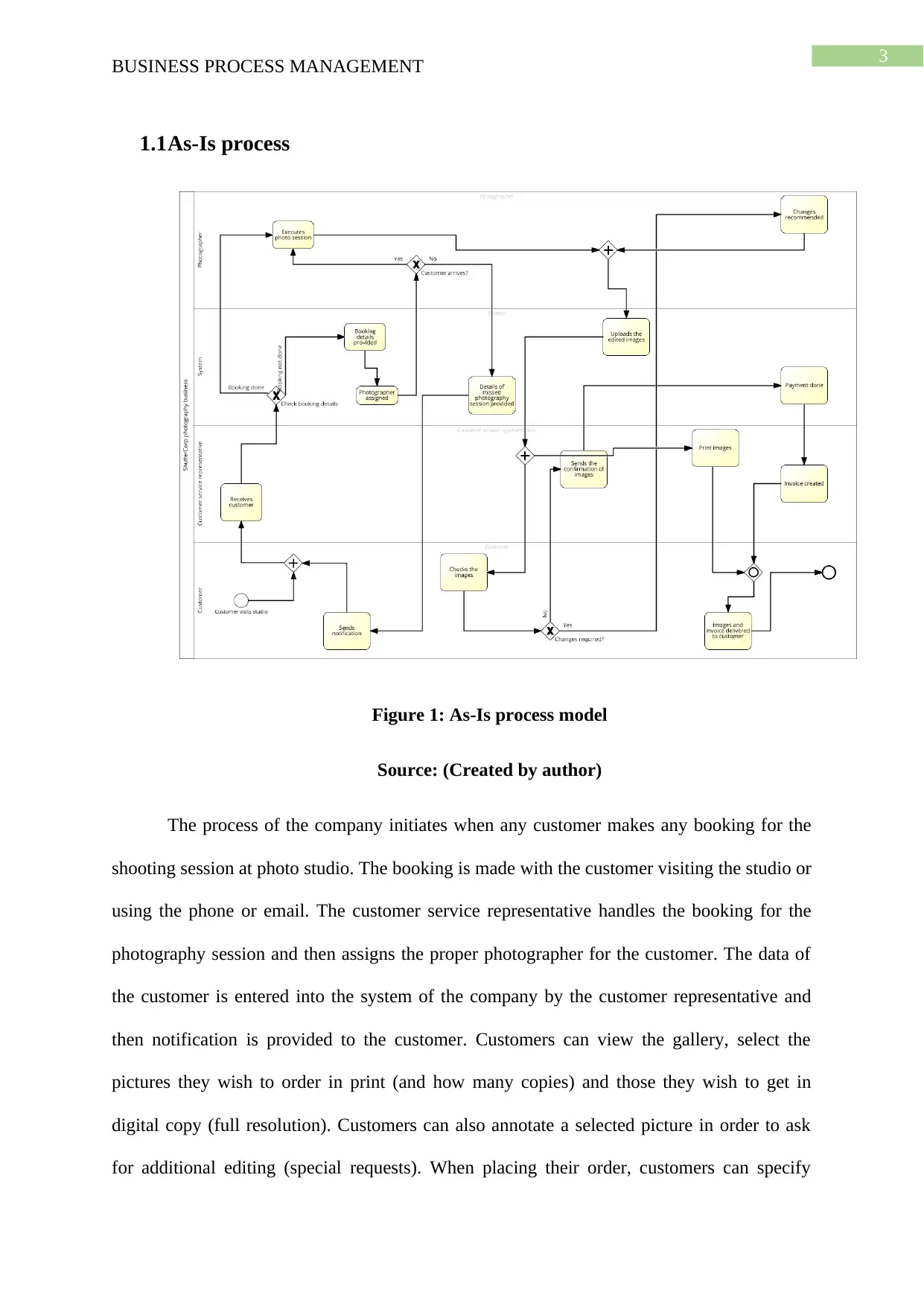
Figure 1: As-Is process model
Source: (Created by author)
The process of the company initiates when any customer makes any booking for the
shooting session at photo studio. The booking is made with the customer visiting the studio or
using the phone or email. The customer service representative handles the booking for the
photography session and then assigns the proper photographer for the customer. The data of
the customer is entered into the system of the company by the customer representative and
then notification is provided to the customer. Customers can view the gallery, select the
pictures they wish to order in print (and how many copies) and those they wish to get in
digital copy (full resolution). Customers can also annotate a selected picture in order to ask
for additional editing (special requests). When placing their order, customers can specify
BUSINESS PROCESS MANAGEMENT
1.1As-Is process
Figure 1: As-Is process model
Source: (Created by author)
The process of the company initiates when any customer makes any booking for the
shooting session at photo studio. The booking is made with the customer visiting the studio or
using the phone or email. The customer service representative handles the booking for the
photography session and then assigns the proper photographer for the customer. The data of
the customer is entered into the system of the company by the customer representative and
then notification is provided to the customer. Customers can view the gallery, select the
pictures they wish to order in print (and how many copies) and those they wish to get in
digital copy (full resolution). Customers can also annotate a selected picture in order to ask
for additional editing (special requests). When placing their order, customers can specify
Paraphrase This Document
Need a fresh take? Get an instant paraphrase of this document with our AI Paraphraser
4
BUSINESS PROCESS MANAGEMENT
whether they will pick-up the printed copies at the studio or have them delivered by post. In
the latter case, a shipment fee is added to the order. Once the customer has placed an order, a
technician performs additional editing (if required by the customer). In the case of special
requests, the technician may need to communicate with the customer by e-mails or phone to
clarify the request and to determine how to fulfill it, and whether the special request will
entail an additional fee and how much. If printouts are required, the technician prints them
out, puts them in an envelope and drops them in the studio's counter. Digital copies are
placed on a dropbox folder with the order number (but the link is only shared with the
customer after payment). Once the pictures are ready, a customer service representative
determines the amount to be invoiced (including additional fees for special requests),
produces the invoice and sends it to the customer. The customer can pay by bank transfer or
directly at the studio, for example when they come to pick up printed copies.
2.1 Waste analysis
The extra load of the tasks that are to be performed by the customer service
representative could be considered as the waste for the company. All the additional task of
the customer service representative could be eliminated with the automation of the processes
that are associated with the business. The additional cost of providing the extra payscale to
the customer service representative is not required with the automation of the processes.
3.1 Issues register
Issues priority
number
Issue name Description of
issue
Qualitative
impact
Quantitative
impact
1 Invalid order
placing
This is the issue
that arises when
the order that
has been asked
by the customer
is heard wrong
by the customer
service
Damage in the
customer base
Revenue lost
BUSINESS PROCESS MANAGEMENT
whether they will pick-up the printed copies at the studio or have them delivered by post. In
the latter case, a shipment fee is added to the order. Once the customer has placed an order, a
technician performs additional editing (if required by the customer). In the case of special
requests, the technician may need to communicate with the customer by e-mails or phone to
clarify the request and to determine how to fulfill it, and whether the special request will
entail an additional fee and how much. If printouts are required, the technician prints them
out, puts them in an envelope and drops them in the studio's counter. Digital copies are
placed on a dropbox folder with the order number (but the link is only shared with the
customer after payment). Once the pictures are ready, a customer service representative
determines the amount to be invoiced (including additional fees for special requests),
produces the invoice and sends it to the customer. The customer can pay by bank transfer or
directly at the studio, for example when they come to pick up printed copies.
2.1 Waste analysis
The extra load of the tasks that are to be performed by the customer service
representative could be considered as the waste for the company. All the additional task of
the customer service representative could be eliminated with the automation of the processes
that are associated with the business. The additional cost of providing the extra payscale to
the customer service representative is not required with the automation of the processes.
3.1 Issues register
Issues priority
number
Issue name Description of
issue
Qualitative
impact
Quantitative
impact
1 Invalid order
placing
This is the issue
that arises when
the order that
has been asked
by the customer
is heard wrong
by the customer
service
Damage in the
customer base
Revenue lost
5
BUSINESS PROCESS MANAGEMENT
representative
that leads to the
mismatch in the
order
specifications
2 Equipment
malfunctioning
This issue is
particularly
associated with
all the
equipment that
are required
during any
photography
session like
camera not
working
properly, light
facilities are
lacking
Reputation
damaged
Revenue lost
3 Customer not
present for
delivery
When the
photos and the
invoice is sent
to the customer,
it is observed
that the
customer is not
present at their
delivery
location that
leads to delivery
not reaching the
customer
appropriately.
Asset loss
4 Damage in file
server
The file server
of the company
comprises of all
the information
regarding the
photoshoot and
the delivery that
are awaited.
The main issue
that could
impact severely
is when the
server is
damaged or
corrupted, then
all the data of
the company
Reputation
damaged
Asset and
revenue lost
BUSINESS PROCESS MANAGEMENT
representative
that leads to the
mismatch in the
order
specifications
2 Equipment
malfunctioning
This issue is
particularly
associated with
all the
equipment that
are required
during any
photography
session like
camera not
working
properly, light
facilities are
lacking
Reputation
damaged
Revenue lost
3 Customer not
present for
delivery
When the
photos and the
invoice is sent
to the customer,
it is observed
that the
customer is not
present at their
delivery
location that
leads to delivery
not reaching the
customer
appropriately.
Asset loss
4 Damage in file
server
The file server
of the company
comprises of all
the information
regarding the
photoshoot and
the delivery that
are awaited.
The main issue
that could
impact severely
is when the
server is
damaged or
corrupted, then
all the data of
the company
Reputation
damaged
Asset and
revenue lost
⊘ This is a preview!⊘
Do you want full access?
Subscribe today to unlock all pages.
Trusted by 1+ million students worldwide
6
BUSINESS PROCESS MANAGEMENT
might be at
significant risk.
4.1 Implemented changes
The major modifications that could be made in the organisation is deployment of the
website that would significantly help the company in optimisation of the payment and the
booking process. When the website of the company is implemented, the customer could
directly place their respective orders using the online platform and it would eliminate the
hiring of the customer service representative for taking orders. The additional burden on the
customer service representative would be eliminated and the customers would achieve highly
optimised booking process for the various photography session. As soon as any customer logs
on the website of the company, the first option that is presented is the registering option. If
the customer is new to the website then they would have to create their account, then they
could browse the various features of the website. If the customer already possess the account
on the website, then they would access their account by providing the login details and view
the various options. The users are then taken to the next page where they could make the
appropriate booking of photographer based on their preference and convenience. As soon as
the booking is done, the payment options are presented to the customer who could view the
various options that are available for making the payment. The most two major payment
options are the online payment and cash on delivery. If the customer selects the cash on
delivery method, then it would confirm the booking of the customer with the invoice that has
been generated from the system. The customer would have to take the invoice with them to
the studio and present that invoice to the photographer for confirming the accurate booking
and the timing of the booking. The photographer would complete the photography session
and then they would execute the required changes by the customer and provide the final draft
to the customer for re-evaluation. When all the requirements of the customers are satisfied,
then they would provide the photos to the customer service representative who would print
BUSINESS PROCESS MANAGEMENT
might be at
significant risk.
4.1 Implemented changes
The major modifications that could be made in the organisation is deployment of the
website that would significantly help the company in optimisation of the payment and the
booking process. When the website of the company is implemented, the customer could
directly place their respective orders using the online platform and it would eliminate the
hiring of the customer service representative for taking orders. The additional burden on the
customer service representative would be eliminated and the customers would achieve highly
optimised booking process for the various photography session. As soon as any customer logs
on the website of the company, the first option that is presented is the registering option. If
the customer is new to the website then they would have to create their account, then they
could browse the various features of the website. If the customer already possess the account
on the website, then they would access their account by providing the login details and view
the various options. The users are then taken to the next page where they could make the
appropriate booking of photographer based on their preference and convenience. As soon as
the booking is done, the payment options are presented to the customer who could view the
various options that are available for making the payment. The most two major payment
options are the online payment and cash on delivery. If the customer selects the cash on
delivery method, then it would confirm the booking of the customer with the invoice that has
been generated from the system. The customer would have to take the invoice with them to
the studio and present that invoice to the photographer for confirming the accurate booking
and the timing of the booking. The photographer would complete the photography session
and then they would execute the required changes by the customer and provide the final draft
to the customer for re-evaluation. When all the requirements of the customers are satisfied,
then they would provide the photos to the customer service representative who would print
Paraphrase This Document
Need a fresh take? Get an instant paraphrase of this document with our AI Paraphraser
7
BUSINESS PROCESS MANAGEMENT
the photos and the invoice from the system and provide both these documents to the
customer.
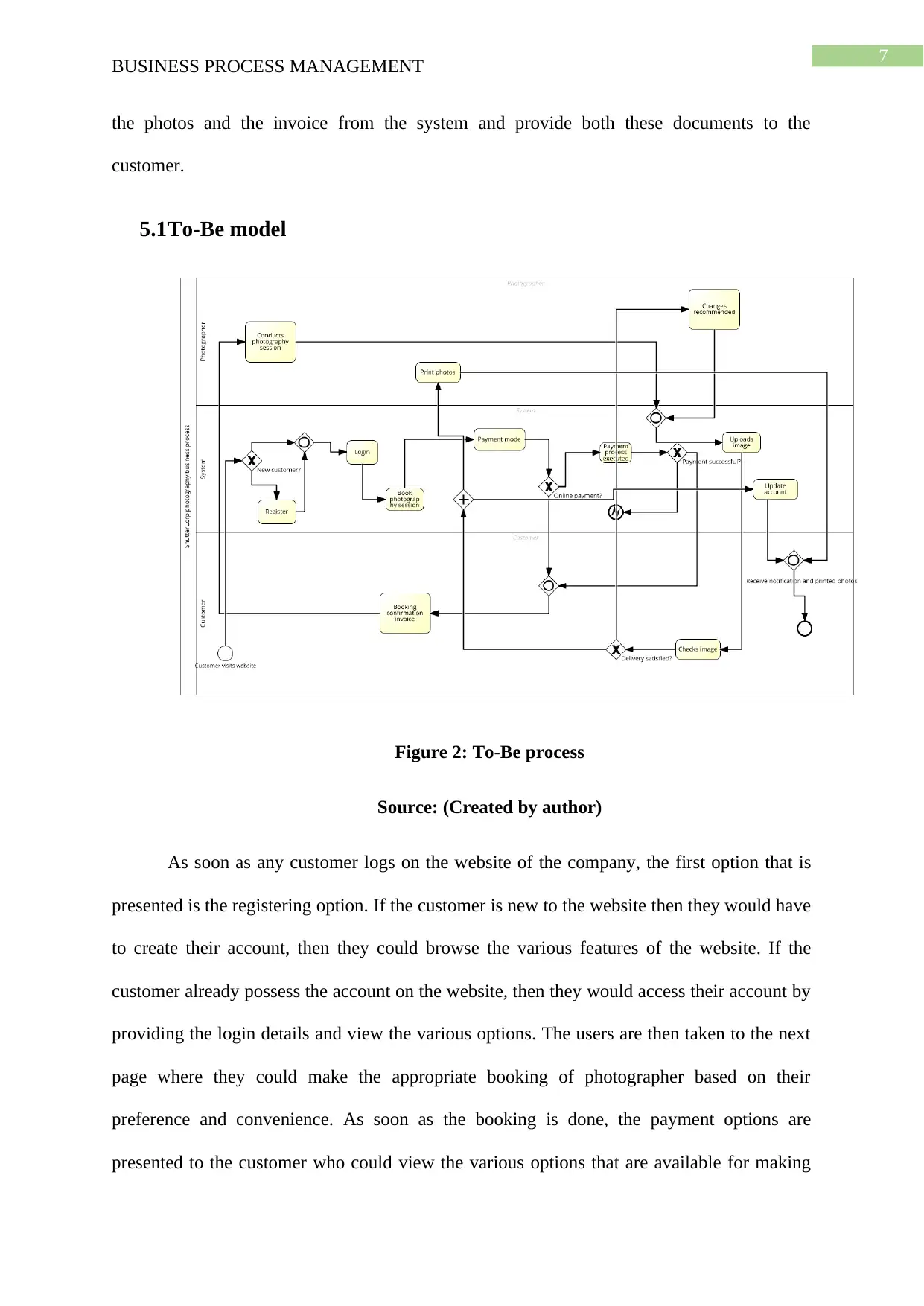
5.1To-Be model
Figure 2: To-Be process
Source: (Created by author)
As soon as any customer logs on the website of the company, the first option that is
presented is the registering option. If the customer is new to the website then they would have
to create their account, then they could browse the various features of the website. If the
customer already possess the account on the website, then they would access their account by
providing the login details and view the various options. The users are then taken to the next
page where they could make the appropriate booking of photographer based on their
preference and convenience. As soon as the booking is done, the payment options are
presented to the customer who could view the various options that are available for making
BUSINESS PROCESS MANAGEMENT
the photos and the invoice from the system and provide both these documents to the
customer.
5.1To-Be model
Figure 2: To-Be process
Source: (Created by author)
As soon as any customer logs on the website of the company, the first option that is
presented is the registering option. If the customer is new to the website then they would have
to create their account, then they could browse the various features of the website. If the
customer already possess the account on the website, then they would access their account by
providing the login details and view the various options. The users are then taken to the next
page where they could make the appropriate booking of photographer based on their
preference and convenience. As soon as the booking is done, the payment options are
presented to the customer who could view the various options that are available for making
8
BUSINESS PROCESS MANAGEMENT
the payment. The most two major payment options are the online payment and cash on
delivery. If the customer selects the cash on delivery method, then it would confirm the
booking of the customer with the invoice that has been generated from the system. The
customer would have to take the invoice with them to the studio and present that invoice to
the photographer for confirming the accurate booking and the timing of the booking.
6.1 Cost analysis
The cost of implementing the website is almost EUR 1500 and the cost of enhanced
products for the execution of modern era photography could be approximately EUR 2000.
With the implementation of the suggested processes, it could be observed that the cost of
performing business would decrease significantly.
BUSINESS PROCESS MANAGEMENT
the payment. The most two major payment options are the online payment and cash on
delivery. If the customer selects the cash on delivery method, then it would confirm the
booking of the customer with the invoice that has been generated from the system. The
customer would have to take the invoice with them to the studio and present that invoice to
the photographer for confirming the accurate booking and the timing of the booking.
6.1 Cost analysis
The cost of implementing the website is almost EUR 1500 and the cost of enhanced
products for the execution of modern era photography could be approximately EUR 2000.
With the implementation of the suggested processes, it could be observed that the cost of
performing business would decrease significantly.
⊘ This is a preview!⊘
Do you want full access?
Subscribe today to unlock all pages.
Trusted by 1+ million students worldwide
9
BUSINESS PROCESS MANAGEMENT
7.1 Bibliography
Alotaibi, Y., 2016. Business process modelling challenges and solutions: a literature
review. Journal of Intelligent Manufacturing, 27(4), pp.701-723.
Alpers, S., Becker, C., Oberweis, A. and Schuster, T., 2015, September. Microservice based
tool support for business process modelling. In 2015 IEEE 19th International Enterprise
Distributed Object Computing Workshop (pp. 71-78). IEEE.
Becker, J., Pfeiffer, D., Räckers, M., Falk, T. and Czerwonka, M., 2015. Semantic business
process modelling and analysis. In Handbook on Business Process Management 1 (pp. 187-
217). Springer, Berlin, Heidelberg.
Buh, B., Kovačič, A. and Indihar Štemberger, M., 2015. Critical success factors for different
stages of business process management adoption–a case study. Economic Research-
Ekonomska Istraživanja, 28(1), pp.243-257.
de Oca, I.M.M., Snoeck, M., Reijers, H.A. and Rodríguez-Morffi, A., 2015. A systematic
literature review of studies on business process modeling quality. Information and Software
Technology, 58, pp.187-205.
Di Francescomarino, C., Rospocher, M., Ghidini, C. and Valerio, A., 2014, September. The
role of semantic annotations in business process modelling. In 2014 IEEE 18th International
Enterprise Distributed Object Computing Conference (pp. 181-189). IEEE.
Dijkman, R., Vanderfeesten, I. and Reijers, H.A., 2016. Business process architectures:
overview, comparison and framework. Enterprise Information Systems, 10(2), pp.129-158.
Elgammal, A., Turetken, O., van den Heuvel, W.J. and Papazoglou, M., 2016. Formalizing
and appling compliance patterns for business process compliance. Software & Systems
Modeling, 15(1), pp.119-146.
BUSINESS PROCESS MANAGEMENT
7.1 Bibliography
Alotaibi, Y., 2016. Business process modelling challenges and solutions: a literature
review. Journal of Intelligent Manufacturing, 27(4), pp.701-723.
Alpers, S., Becker, C., Oberweis, A. and Schuster, T., 2015, September. Microservice based
tool support for business process modelling. In 2015 IEEE 19th International Enterprise
Distributed Object Computing Workshop (pp. 71-78). IEEE.
Becker, J., Pfeiffer, D., Räckers, M., Falk, T. and Czerwonka, M., 2015. Semantic business
process modelling and analysis. In Handbook on Business Process Management 1 (pp. 187-
217). Springer, Berlin, Heidelberg.
Buh, B., Kovačič, A. and Indihar Štemberger, M., 2015. Critical success factors for different
stages of business process management adoption–a case study. Economic Research-
Ekonomska Istraživanja, 28(1), pp.243-257.
de Oca, I.M.M., Snoeck, M., Reijers, H.A. and Rodríguez-Morffi, A., 2015. A systematic
literature review of studies on business process modeling quality. Information and Software
Technology, 58, pp.187-205.
Di Francescomarino, C., Rospocher, M., Ghidini, C. and Valerio, A., 2014, September. The
role of semantic annotations in business process modelling. In 2014 IEEE 18th International
Enterprise Distributed Object Computing Conference (pp. 181-189). IEEE.
Dijkman, R., Vanderfeesten, I. and Reijers, H.A., 2016. Business process architectures:
overview, comparison and framework. Enterprise Information Systems, 10(2), pp.129-158.
Elgammal, A., Turetken, O., van den Heuvel, W.J. and Papazoglou, M., 2016. Formalizing
and appling compliance patterns for business process compliance. Software & Systems
Modeling, 15(1), pp.119-146.
Paraphrase This Document
Need a fresh take? Get an instant paraphrase of this document with our AI Paraphraser
10
BUSINESS PROCESS MANAGEMENT
Fellmann, M. and Zasada, A., 2014. State-of-the-art of business process compliance
approaches.
Geissdoerfer, M., Bocken, N.M. and Hultink, E.J., 2016. Design thinking to enhance the
sustainable business modelling process–A workshop based on a value mapping
process. Journal of Cleaner Production, 135, pp.1218-1232.
Goedertier, S., Vanthienen, J. and Caron, F., 2015. Declarative business process modelling:
principles and modelling languages. Enterprise Information Systems, 9(2), pp.161-185.
Greasley, A., 2017. Simulation modelling for business. Routledge.
Hinkelmann, K., Gerber, A., Karagiannis, D., Thoenssen, B., Van der Merwe, A. and
Woitsch, R., 2016. A new paradigm for the continuous alignment of business and IT:
Combining enterprise architecture modelling and enterprise ontology. Computers in
Industry, 79, pp.77-86.
Kocbek, M., Jost, G., Hericko, M. and Polancic, G., 2015. Business process model and
notation: The current state of affairs. Comput. Sci. Inf. Syst., 12(2), pp.509-539.
Kohlborn, T., Mueller, O., Poeppelbuss, J. and Roeglinger, M., 2014. Interview with Michael
Rosemann on ambidextrous business process management. Business Process Management
Journal, 20(4), pp.634-638.
Looy, A.V., Backer, M.D. and Poels, G., 2014. A conceptual framework and classification of
capability areas for business process maturity. Enterprise Information Systems, 8(2), pp.188-
224.
Rospocher, M., Ghidini, C. and Serafini, L., 2014, September. An ontology for the Business
Process Modelling Notation. In FOIS (pp. 133-146).
BUSINESS PROCESS MANAGEMENT
Fellmann, M. and Zasada, A., 2014. State-of-the-art of business process compliance
approaches.
Geissdoerfer, M., Bocken, N.M. and Hultink, E.J., 2016. Design thinking to enhance the
sustainable business modelling process–A workshop based on a value mapping
process. Journal of Cleaner Production, 135, pp.1218-1232.
Goedertier, S., Vanthienen, J. and Caron, F., 2015. Declarative business process modelling:
principles and modelling languages. Enterprise Information Systems, 9(2), pp.161-185.
Greasley, A., 2017. Simulation modelling for business. Routledge.
Hinkelmann, K., Gerber, A., Karagiannis, D., Thoenssen, B., Van der Merwe, A. and
Woitsch, R., 2016. A new paradigm for the continuous alignment of business and IT:
Combining enterprise architecture modelling and enterprise ontology. Computers in
Industry, 79, pp.77-86.
Kocbek, M., Jost, G., Hericko, M. and Polancic, G., 2015. Business process model and
notation: The current state of affairs. Comput. Sci. Inf. Syst., 12(2), pp.509-539.
Kohlborn, T., Mueller, O., Poeppelbuss, J. and Roeglinger, M., 2014. Interview with Michael
Rosemann on ambidextrous business process management. Business Process Management
Journal, 20(4), pp.634-638.
Looy, A.V., Backer, M.D. and Poels, G., 2014. A conceptual framework and classification of
capability areas for business process maturity. Enterprise Information Systems, 8(2), pp.188-
224.
Rospocher, M., Ghidini, C. and Serafini, L., 2014, September. An ontology for the Business
Process Modelling Notation. In FOIS (pp. 133-146).

11
BUSINESS PROCESS MANAGEMENT
Sikdar, A. and Payyazhi, J., 2014. A process model of managing organizational change
during business process redesign. Business Process Management Journal, 20(6), pp.971-998.
BUSINESS PROCESS MANAGEMENT
Sikdar, A. and Payyazhi, J., 2014. A process model of managing organizational change
during business process redesign. Business Process Management Journal, 20(6), pp.971-998.
⊘ This is a preview!⊘
Do you want full access?
Subscribe today to unlock all pages.
Trusted by 1+ million students worldwide

1 out of 12


Related Documents


Your All-in-One AI-Powered Toolkit for Academic Success.
+13062052269
info@desklib.com
Available 24*7 on WhatsApp / Email
![[object Object]](/_next/static/media/star-bottom.7253800d.svg)
Unlock your academic potential
Copyright © 2020–2026 A2Z Services. All Rights Reserved. Developed and managed by ZUCOL.