E-Portfolio on Business Process Modelling - COIT20252, Term 1 2019

Verified

Added on  2023/03/17

|6
|833
|22
Portfolio
AI Summary
This e-portfolio provides an overview of business process modelling, covering key concepts such as process scoping diagrams, process hierarchies, business process symbols, and As-Is, Could-Be, and To-Be process diagrams. It also discusses BPMN process diagrams and includes a bibliography of resources used. The e-portfolio is structured to capture rich ideas and innovative practices around Business Process Management, aligning with the specified topics of Business Process Analysis and Business Process Modelling. The analysis includes understanding process flow problems, management problems, and the development of various diagrams to represent and improve business processes.
Document Page
Running head: E-PORTFOLIO
E-PORTFOLIO
Name of student
Name of university
Author’s note:
tabler-icon-diamond-filled.svg

Paraphrase This Document

Need a fresh take? Get an instant paraphrase of this document with our AI Paraphraser
Document Page
1
E-PORTFOLIO
Process scoping diagram
Bptrends.com. (2019). Scope Diagram (or Input-Guides-Outputs-Enablers – IGOE
Diagram) | BPTrends. [online] Available at:
https://www.bptrends.com/resources/glossary/scope-diagram-or-input-guides-outputs-
enablers-igoe-diagram/ [Accessed 9 May 2019].
The process scoping diagram could be described as the diagram that is utilised for
providing the team of the redesign with the initial, huge level overview of any process that is
being examined and all the problems that are associated with the process.
the process begins with the placing of the process in the scope in centre and then the
depicting all stakeholders as well as all the external processes using which the interaction
takes place with the process in scope.
In the making of the process diagram, the appropriate description is provided about
the aspects that are being exchanged. Finally it is noted whether the interaction has been
questionable, inadequate or acceptable.
Process hierarchy
https://www.gluu.biz/process-management-glossary/process-hierarchy/
The process hierarchy is the something like the architectural blueprint for any house.
Except instead of the beams and the rafters, the process hierarchy provides the idea of the
processes that are maintaining the positive condition of the business.
This is majorly considered as the supplement for the organisational chart. The
organisational chart provides the idea of the how the departments and the roles are associated
while process hierarchy displays how the activities are associated with the business.
Document Page
2
E-PORTFOLIO
The methods by which the processes delivers all the outcomes, which are required for
the attaining the goals of the organisation is also provided in the organisational chart. The
small aspects are mapped by the process hierarchy.
Different business process symbols
Lucidchart.com. (2019). [online] Available at: https://www.lucidchart.com/pages/bpmn-
symbols-explained [Accessed 9 May 2019].
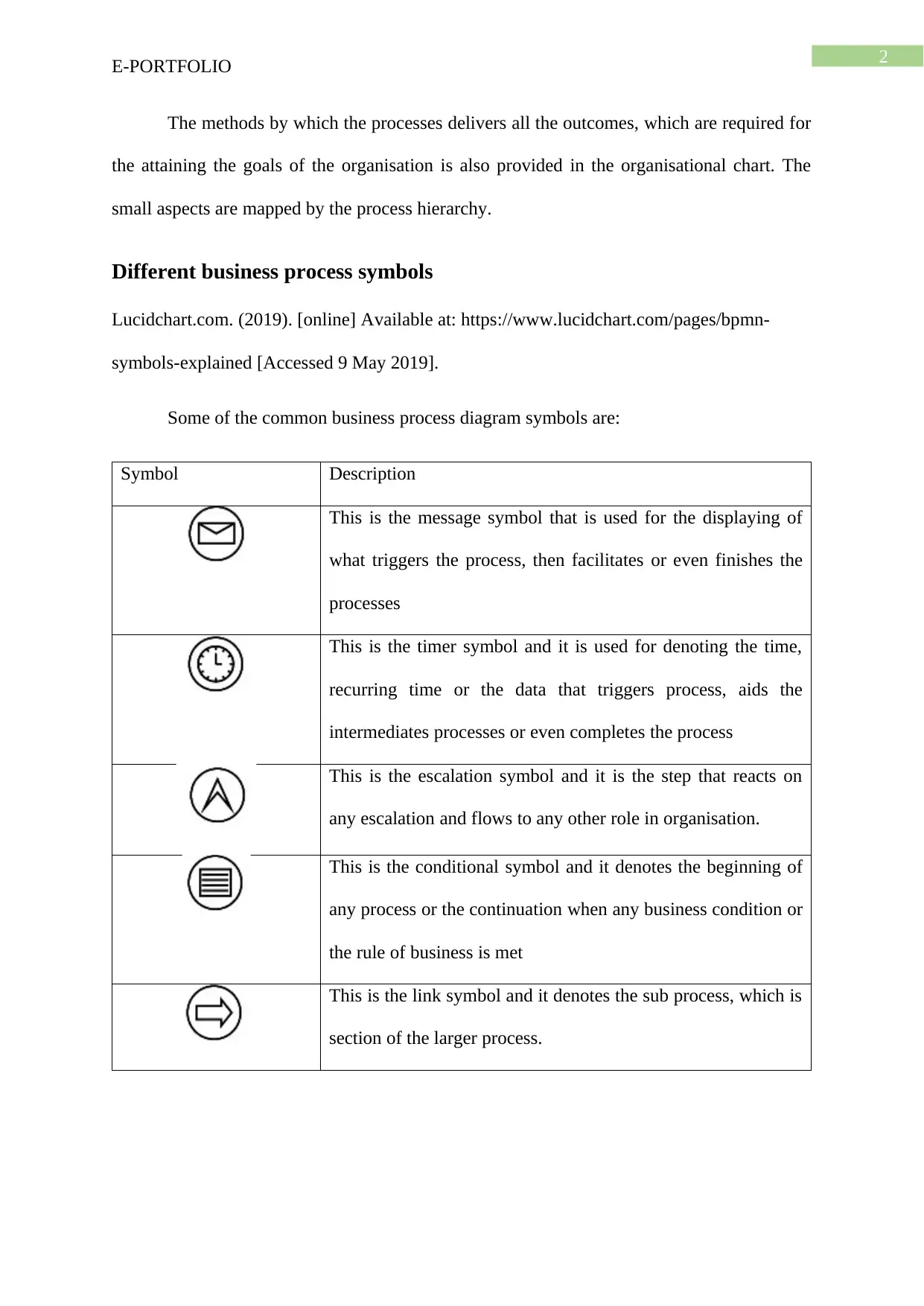
Some of the common business process diagram symbols are:
Symbol Description
This is the message symbol that is used for the displaying of
what triggers the process, then facilitates or even finishes the
processes
This is the timer symbol and it is used for denoting the time,
recurring time or the data that triggers process, aids the
intermediates processes or even completes the process
This is the escalation symbol and it is the step that reacts on
any escalation and flows to any other role in organisation.
This is the conditional symbol and it denotes the beginning of
any process or the continuation when any business condition or
the rule of business is met
This is the link symbol and it denotes the sub process, which is
section of the larger process.
Document Page
3
E-PORTFOLIO
As-is, Could-be, and To-be process diagrams
Lucidchart.com. (2019). The Basics of Documenting and Analyzing Your As-Is Process |
Lucidchart Blog. [online] Available at: https://www.lucidchart.com/blog/as-is-process-
analysis [Accessed 9 May 2019].
The As-Is process analysis or the present state analysis is the strategy of the process
management that helps in the identification and the evaluation of the current process of any
business.
The Could-Be process is the predicted process that could be gained with the
redesigning of the business processes. The To-Be process could be defined as the mapping of
the documents and what are required in the processes.
The To-Be process is the business process model that is used for determining of the
appropriate business processes of the organization after the reengineering has been executed
successfully.
BPMN process diagram
https://www.youtube.com/watch?v=iMHF1ZStOdE
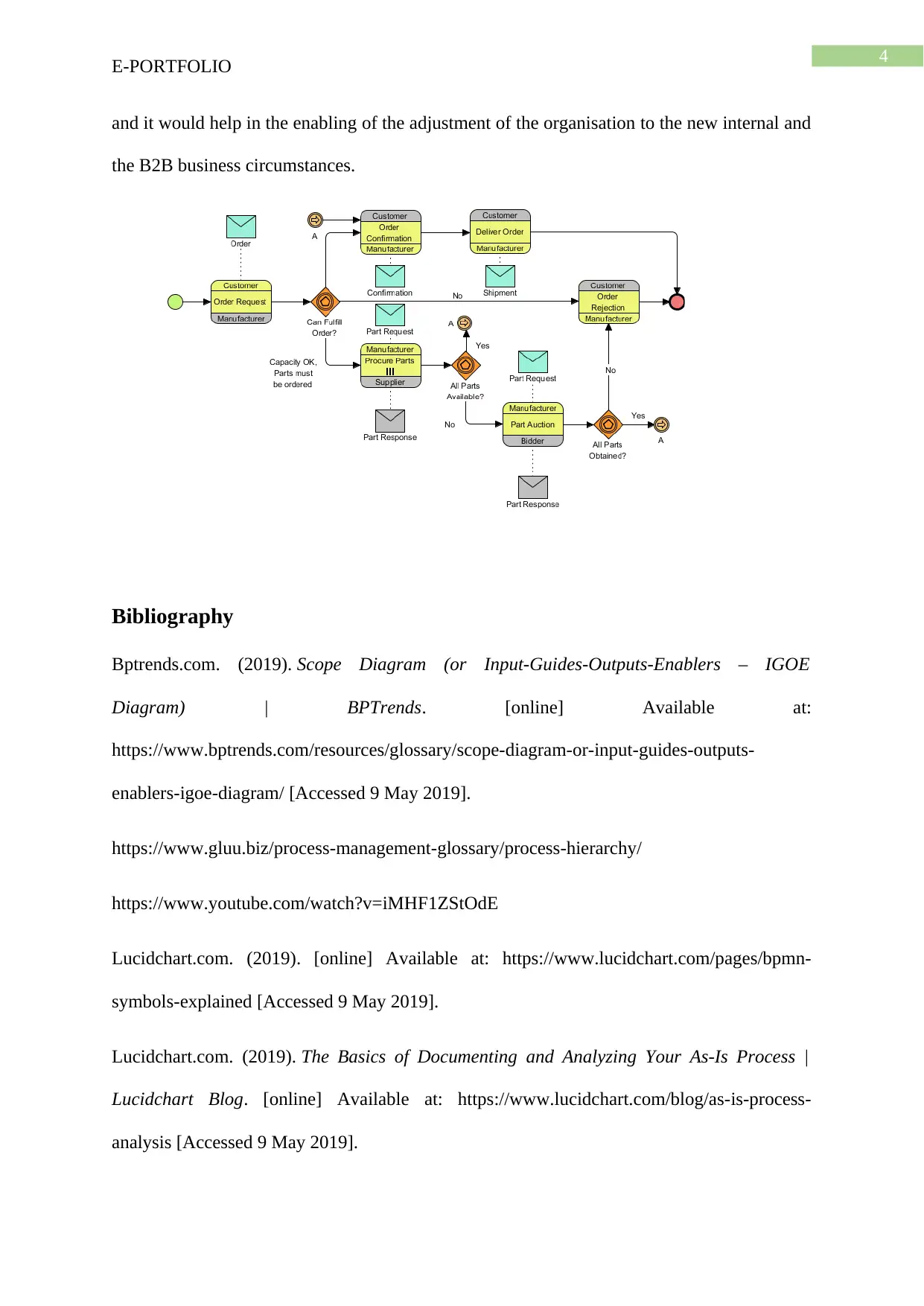
Any standard Business Process Model and Notation would offer the businesses with
extensive capability of the understanding of the internal procedures of the business in the
graphical notation and would provide organisations with the ability of the communicating
these specific procedures in the standard manner.
Moreover, the graphical notation would facilitate the understanding of performance
collaboration and the business transactions among the organisations. It would ensure that the
businesses would comprehend their respective business and the participants in the business
tabler-icon-diamond-filled.svg

Paraphrase This Document

Need a fresh take? Get an instant paraphrase of this document with our AI Paraphraser
Document Page
4
E-PORTFOLIO
and it would help in the enabling of the adjustment of the organisation to the new internal and
the B2B business circumstances.
Bibliography
Bptrends.com. (2019). Scope Diagram (or Input-Guides-Outputs-Enablers IGOE
Diagram) | BPTrends. [online] Available at:
https://www.bptrends.com/resources/glossary/scope-diagram-or-input-guides-outputs-
enablers-igoe-diagram/ [Accessed 9 May 2019].
https://www.gluu.biz/process-management-glossary/process-hierarchy/
https://www.youtube.com/watch?v=iMHF1ZStOdE
Lucidchart.com. (2019). [online] Available at: https://www.lucidchart.com/pages/bpmn-
symbols-explained [Accessed 9 May 2019].
Lucidchart.com. (2019). The Basics of Documenting and Analyzing Your As-Is Process |
Lucidchart Blog. [online] Available at: https://www.lucidchart.com/blog/as-is-process-
analysis [Accessed 9 May 2019].
Document Page
5
E-PORTFOLIO
chevron_up_icon
1 out of 6
circle_padding
hide_on_mobile
zoom_out_icon
[object Object]