Business Creativity Group Assessment & Individual Reflective Report
VerifiedAdded on 2020/05/11
|12
|3974
|52
Report
AI Summary
This report delves into the concepts of business models, creativity, and management, offering an individual reflective analysis of a group assessment. It explores the significance of creativity in fostering innovation and adapting to market dynamics, emphasizing techniques for generating business ideas and utilizing the business model canvas. The report examines various theories of creativity, including Grace, Accident, Association, Cognitive, and Personality, and applies the Six Thinking Hats model to facilitate idea generation and problem-solving. It provides insights into the problem-solving process, highlighting the importance of mental agility and decision-making skills. The report concludes with a summary of the module, emphasizing the practical application of learned concepts and the development of skills essential for entrepreneurial success.
Running Head: Business model and management
Business Creativity
Group assessment & Individual Reflective
Business Creativity
Group assessment & Individual Reflective

Paraphrase This Document
Need a fresh take? Get an instant paraphrase of this document with our AI Paraphraser
Business model and management
Table of Contents
Individual Reflective..................................................................................................................2
Evidence of creativity.............................................................................................................2
Theory of creativity............................................................................................................3
Six Thinking Hat Model.....................................................................................................4
Problem solving......................................................................................................................6
Summary of the module.........................................................................................................7
Overview of the group assessment experience.......................................................................8
Key areas that need to be developed......................................................................................8
References..................................................................................................................................9
1
Table of Contents
Individual Reflective..................................................................................................................2
Evidence of creativity.............................................................................................................2
Theory of creativity............................................................................................................3
Six Thinking Hat Model.....................................................................................................4
Problem solving......................................................................................................................6
Summary of the module.........................................................................................................7
Overview of the group assessment experience.......................................................................8
Key areas that need to be developed......................................................................................8
References..................................................................................................................................9
1
Business model and management
Individual Reflective
The coursework involves the study of creativity which depicts the innovation and
modification to support the business and provide customers with lot more varieties and
options to choose from. The creativity is also necessary to perform better than the
competitors and develop the position in the market. In order to be creative and launch
something better the techniques of generating business idea need to be adopted (Burns,
2010). The course also demonstrates business model canvas which involves the 9 building
blocks. Also, there are strategies to create the business start-ups or add on the modification to
the existing business units and framing it out as a new business unit. This could be done by
opening up the new outlets domestically or expand the business in overseas market. These
strategies once constructed could be reinterpreted using the business model lens. The
coursework also involves the understanding of business model design process. There are
various techniques that could be used to implement and manage creativity in the business
(Amoako & Nziku, 2014).
Evidence of creativity
I get to understand the real and deep meaning of creativity and the scope it involves.
Creativity is not defined in the definite terms; the general perspective has been explained.
The modules that were studied states that creativity is the striking up of the new idea.
Creativity involves the inculcation of weird things and application of the unique things to
introduce them out of the box techniques and ideas. This newness and modification over the
existing products lead to the better results and initiation of value to set the higher standards in
the market in order to fight the competition (Seebode, Jeanrenaud & Bessant, 2012).
Creativity benefits the individual, group, organization, and the society. It also helps in
changing the perspective of the managers as well as customers to see the things differently or
dealing it in another way around. The skills and abilities are been used and mind gets boosted
up with the origin of the fresh idea and to expand the business there is a need to implement
something different to arise the desire of customers. There are different theories of creativity
which clarify the doubt that whether the person is born creative or there are certain specific
people who are extraordinary and thinks differently (Teece, 2010). There are some people
who are highly creative and full of ideas and there exists the people who are creative but to an
2
Individual Reflective
The coursework involves the study of creativity which depicts the innovation and
modification to support the business and provide customers with lot more varieties and
options to choose from. The creativity is also necessary to perform better than the
competitors and develop the position in the market. In order to be creative and launch
something better the techniques of generating business idea need to be adopted (Burns,
2010). The course also demonstrates business model canvas which involves the 9 building
blocks. Also, there are strategies to create the business start-ups or add on the modification to
the existing business units and framing it out as a new business unit. This could be done by
opening up the new outlets domestically or expand the business in overseas market. These
strategies once constructed could be reinterpreted using the business model lens. The
coursework also involves the understanding of business model design process. There are
various techniques that could be used to implement and manage creativity in the business
(Amoako & Nziku, 2014).
Evidence of creativity
I get to understand the real and deep meaning of creativity and the scope it involves.
Creativity is not defined in the definite terms; the general perspective has been explained.
The modules that were studied states that creativity is the striking up of the new idea.
Creativity involves the inculcation of weird things and application of the unique things to
introduce them out of the box techniques and ideas. This newness and modification over the
existing products lead to the better results and initiation of value to set the higher standards in
the market in order to fight the competition (Seebode, Jeanrenaud & Bessant, 2012).
Creativity benefits the individual, group, organization, and the society. It also helps in
changing the perspective of the managers as well as customers to see the things differently or
dealing it in another way around. The skills and abilities are been used and mind gets boosted
up with the origin of the fresh idea and to expand the business there is a need to implement
something different to arise the desire of customers. There are different theories of creativity
which clarify the doubt that whether the person is born creative or there are certain specific
people who are extraordinary and thinks differently (Teece, 2010). There are some people
who are highly creative and full of ideas and there exists the people who are creative but to an
2
⊘ This is a preview!⊘
Do you want full access?
Subscribe today to unlock all pages.

Trusted by 1+ million students worldwide
Business model and management
extent. They do not always possess the good and cool ideas; they act as per the situation and
support the organization as and when needed. It is considered that creativity is God gift and
the studies suggest that every person has a creative corner some get focused to it and some
are less concentrated (Vermeer, 2016).
Theory of creativity
Grace: This theory states that creativity is the gift from God distributed in
various portions. It depicts intuition and illumination of creativity and
innovation. It is considered that creativity and modification are divine and
spiritual inspirations to the human. Even the individual cannot control this
natural energy either the person possesses the creative point or they will lack
it, they can’t forcefully adopt the creativity or practice being creative, though
the person having innovativeness should practice their talent to improve and
polish the quality for getting better results (Weinstein, 2017).
Accident: There are times when the creativity was not prevailing within the
person but due to certain accident or any situation or occurrence of any
circumstances the person gains interest in something or to get rid of the
situation they use various measures which increase the efficiency. The
accidental creativity is considered to be the serene and the symbol of good
fortune (Miller, 2017).
Association: Creativity also gets enhanced on using certain procedures and
techniques to build up the innovativeness and developing the crafting skills
within the person. These techniques are lateral thinking and brainstorming,
which is a popular theory. These theories tend to put pressure on the mind and
the better solution, ideas, opinion gets generated. The unbelievable and
unpredictable ideas get generated at the time of brainstorming session and
after that, the implementation steps are estimated and the plan is made and
accordingly, the procedures are followed to gain the better results and apply
these ideas to the business as per the nature of business (Langley & Tsoukas,
2016).
Cognitive: Another measure on which creativity is based on is recognition
program, logical reasoning, and development of understanding. The aim of
3
extent. They do not always possess the good and cool ideas; they act as per the situation and
support the organization as and when needed. It is considered that creativity is God gift and
the studies suggest that every person has a creative corner some get focused to it and some
are less concentrated (Vermeer, 2016).
Theory of creativity
Grace: This theory states that creativity is the gift from God distributed in
various portions. It depicts intuition and illumination of creativity and
innovation. It is considered that creativity and modification are divine and
spiritual inspirations to the human. Even the individual cannot control this
natural energy either the person possesses the creative point or they will lack
it, they can’t forcefully adopt the creativity or practice being creative, though
the person having innovativeness should practice their talent to improve and
polish the quality for getting better results (Weinstein, 2017).
Accident: There are times when the creativity was not prevailing within the
person but due to certain accident or any situation or occurrence of any
circumstances the person gains interest in something or to get rid of the
situation they use various measures which increase the efficiency. The
accidental creativity is considered to be the serene and the symbol of good
fortune (Miller, 2017).
Association: Creativity also gets enhanced on using certain procedures and
techniques to build up the innovativeness and developing the crafting skills
within the person. These techniques are lateral thinking and brainstorming,
which is a popular theory. These theories tend to put pressure on the mind and
the better solution, ideas, opinion gets generated. The unbelievable and
unpredictable ideas get generated at the time of brainstorming session and
after that, the implementation steps are estimated and the plan is made and
accordingly, the procedures are followed to gain the better results and apply
these ideas to the business as per the nature of business (Langley & Tsoukas,
2016).
Cognitive: Another measure on which creativity is based on is recognition
program, logical reasoning, and development of understanding. The aim of
3
Paraphrase This Document
Need a fresh take? Get an instant paraphrase of this document with our AI Paraphraser
Business model and management
this theory is to clarify the importance of hard work and the productivity of
resources (Schiering, 2012).
Personality: Personality is the result of the human behavior. It depends and changes
as per the nature of the person. It involves the thoughts, attitude, and behavior towards
the situation and how do they deal with these situations. It is the intrinsic part of the
human and depends upon their thinking, also personality helps in developing the
mental level by removing the barriers and increasing the level of creativity (Art of
living, 2017).
Six Thinking Hat Model
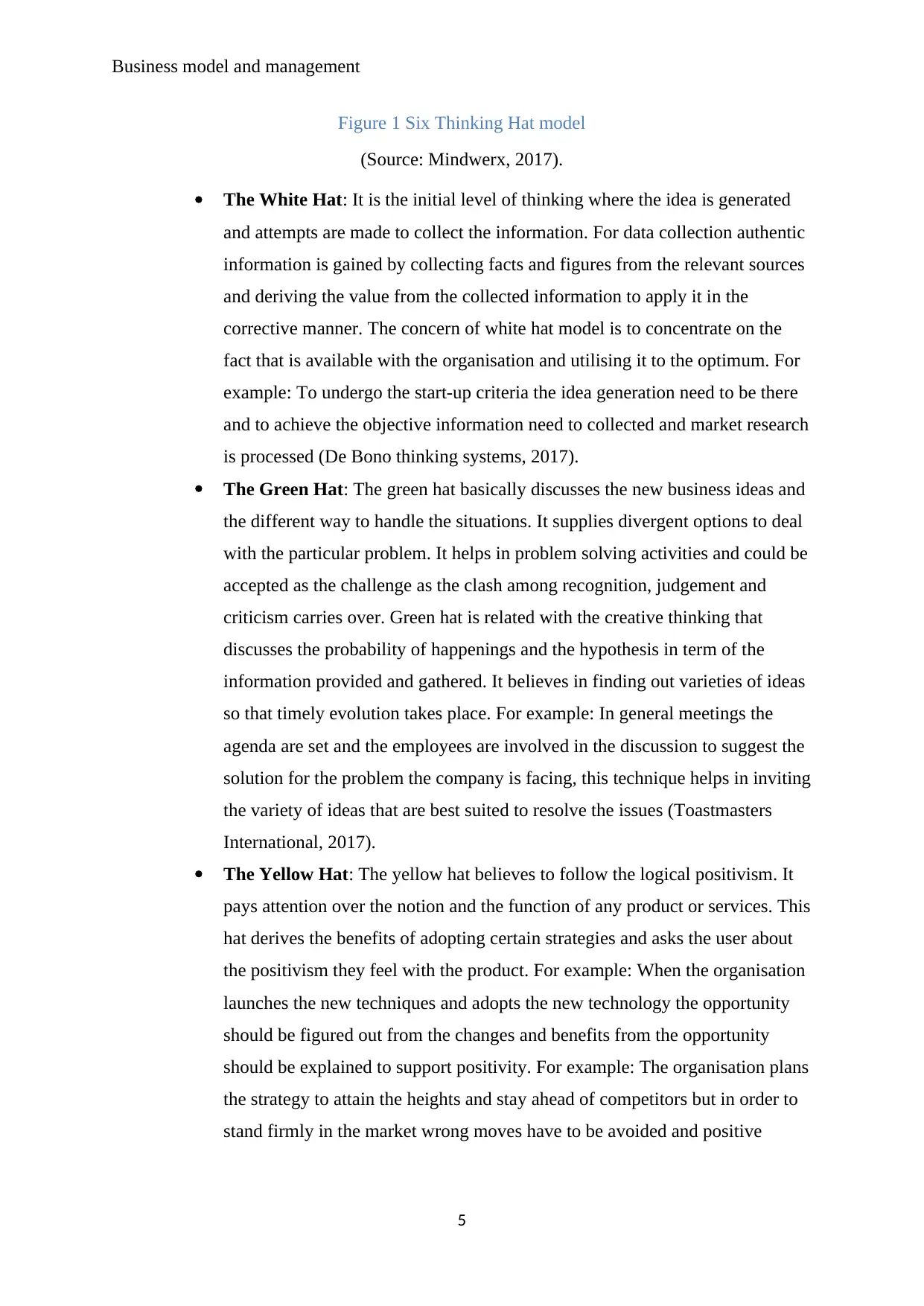
The Six Thinking Hats model was introduced by De Bono in the year 1995
with the view to carry six different perspectives of thoughts. It helps in idea
generation process by wearing each hat that performs distinct functions and play the
vital role. The big organisations and entrepreneur employ this method to generate the
new business idea for further development (De Bono Group, 2017).
4
this theory is to clarify the importance of hard work and the productivity of
resources (Schiering, 2012).
Personality: Personality is the result of the human behavior. It depends and changes
as per the nature of the person. It involves the thoughts, attitude, and behavior towards
the situation and how do they deal with these situations. It is the intrinsic part of the
human and depends upon their thinking, also personality helps in developing the
mental level by removing the barriers and increasing the level of creativity (Art of
living, 2017).
Six Thinking Hat Model
The Six Thinking Hats model was introduced by De Bono in the year 1995
with the view to carry six different perspectives of thoughts. It helps in idea
generation process by wearing each hat that performs distinct functions and play the
vital role. The big organisations and entrepreneur employ this method to generate the
new business idea for further development (De Bono Group, 2017).
4
Business model and management
Figure 1 Six Thinking Hat model
(Source: Mindwerx, 2017).
The White Hat: It is the initial level of thinking where the idea is generated
and attempts are made to collect the information. For data collection authentic
information is gained by collecting facts and figures from the relevant sources
and deriving the value from the collected information to apply it in the
corrective manner. The concern of white hat model is to concentrate on the
fact that is available with the organisation and utilising it to the optimum. For
example: To undergo the start-up criteria the idea generation need to be there
and to achieve the objective information need to collected and market research
is processed (De Bono thinking systems, 2017).
The Green Hat: The green hat basically discusses the new business ideas and
the different way to handle the situations. It supplies divergent options to deal
with the particular problem. It helps in problem solving activities and could be
accepted as the challenge as the clash among recognition, judgement and
criticism carries over. Green hat is related with the creative thinking that
discusses the probability of happenings and the hypothesis in term of the
information provided and gathered. It believes in finding out varieties of ideas
so that timely evolution takes place. For example: In general meetings the
agenda are set and the employees are involved in the discussion to suggest the
solution for the problem the company is facing, this technique helps in inviting
the variety of ideas that are best suited to resolve the issues (Toastmasters
International, 2017).
The Yellow Hat: The yellow hat believes to follow the logical positivism. It
pays attention over the notion and the function of any product or services. This
hat derives the benefits of adopting certain strategies and asks the user about
the positivism they feel with the product. For example: When the organisation
launches the new techniques and adopts the new technology the opportunity
should be figured out from the changes and benefits from the opportunity
should be explained to support positivity. For example: The organisation plans
the strategy to attain the heights and stay ahead of competitors but in order to
stand firmly in the market wrong moves have to be avoided and positive
5
Figure 1 Six Thinking Hat model
(Source: Mindwerx, 2017).
The White Hat: It is the initial level of thinking where the idea is generated
and attempts are made to collect the information. For data collection authentic
information is gained by collecting facts and figures from the relevant sources
and deriving the value from the collected information to apply it in the
corrective manner. The concern of white hat model is to concentrate on the
fact that is available with the organisation and utilising it to the optimum. For
example: To undergo the start-up criteria the idea generation need to be there
and to achieve the objective information need to collected and market research
is processed (De Bono thinking systems, 2017).
The Green Hat: The green hat basically discusses the new business ideas and
the different way to handle the situations. It supplies divergent options to deal
with the particular problem. It helps in problem solving activities and could be
accepted as the challenge as the clash among recognition, judgement and
criticism carries over. Green hat is related with the creative thinking that
discusses the probability of happenings and the hypothesis in term of the
information provided and gathered. It believes in finding out varieties of ideas
so that timely evolution takes place. For example: In general meetings the
agenda are set and the employees are involved in the discussion to suggest the
solution for the problem the company is facing, this technique helps in inviting
the variety of ideas that are best suited to resolve the issues (Toastmasters
International, 2017).
The Yellow Hat: The yellow hat believes to follow the logical positivism. It
pays attention over the notion and the function of any product or services. This
hat derives the benefits of adopting certain strategies and asks the user about
the positivism they feel with the product. For example: When the organisation
launches the new techniques and adopts the new technology the opportunity
should be figured out from the changes and benefits from the opportunity
should be explained to support positivity. For example: The organisation plans
the strategy to attain the heights and stay ahead of competitors but in order to
stand firmly in the market wrong moves have to be avoided and positive
5
⊘ This is a preview!⊘
Do you want full access?
Subscribe today to unlock all pages.
Trusted by 1+ million students worldwide
Business model and management
aspect are adopted to build better relationship between the competitor and
organisation (Labelle, 2017).
The Black Hat: It is the opposite of the yellow hat as it focuses on the
negative aspect of the concept and design of the product and services. This is
done to know the weak point of organisational process and thereafter the
corrective actions could be implemented. This hat is considered as the crucial
one as it identifies the mistake and solves it out using positivism. For example:
In the organisational process if the cost proposal is too expensive then the
measure are taken to cut the cost, the design selected for blueprint should be
practically applicable and not vague (Heart unlimited, 2017).
The Red Hat: The Red Hat depicts the feelings and emotions. When these
intuition and affection gets attached with the logic things become more
valuable indeed. The red hat helps in reflecting and revealing the feelings
openly without giving much thought to the process. For example: The gut-
feeling of getting success and taking the risk accordingly, the intuition that
deal will fix at the lower profit percent or the gain will not be much and things
need to be changed (Michelle ranaewild, 2012).
The Blue Hat: The blue hat technique helps to make though process upon the
thinking once again. It could be considered as the crux of above hats and
control the process. The thinking process has been focussed so that the fruitful
deal is extracted and the productivity is gained. The discussions made under
different hats are collected and the best advice is been considered. For
example: In the big organisation the agenda is thought about and data is
collected, analysed, evaluated, positive and negative aspects are counted and
conclusion is drawn. This is the entire blue hat aspect that summarises the
actions and the findings are discussed over (Goeke, 2016).
Problem solving
The problem solving is the crucial problem that every organization faces in general.
There is a set procedure to solve the problem. After studying the problem-solving technique I
could figure out that problem-solving helps in making a decision. According to me it
increases the mental level and develops the decision-making skills (Giampaoli et al, 2017).
For instance, if there is the employee's support problem then the part of the employee is been
heard and thereafter the analysis will be made as to why the employee is not able to connect
6
aspect are adopted to build better relationship between the competitor and
organisation (Labelle, 2017).
The Black Hat: It is the opposite of the yellow hat as it focuses on the
negative aspect of the concept and design of the product and services. This is
done to know the weak point of organisational process and thereafter the
corrective actions could be implemented. This hat is considered as the crucial
one as it identifies the mistake and solves it out using positivism. For example:
In the organisational process if the cost proposal is too expensive then the
measure are taken to cut the cost, the design selected for blueprint should be
practically applicable and not vague (Heart unlimited, 2017).
The Red Hat: The Red Hat depicts the feelings and emotions. When these
intuition and affection gets attached with the logic things become more
valuable indeed. The red hat helps in reflecting and revealing the feelings
openly without giving much thought to the process. For example: The gut-
feeling of getting success and taking the risk accordingly, the intuition that
deal will fix at the lower profit percent or the gain will not be much and things
need to be changed (Michelle ranaewild, 2012).
The Blue Hat: The blue hat technique helps to make though process upon the
thinking once again. It could be considered as the crux of above hats and
control the process. The thinking process has been focussed so that the fruitful
deal is extracted and the productivity is gained. The discussions made under
different hats are collected and the best advice is been considered. For
example: In the big organisation the agenda is thought about and data is
collected, analysed, evaluated, positive and negative aspects are counted and
conclusion is drawn. This is the entire blue hat aspect that summarises the
actions and the findings are discussed over (Goeke, 2016).
Problem solving
The problem solving is the crucial problem that every organization faces in general.
There is a set procedure to solve the problem. After studying the problem-solving technique I
could figure out that problem-solving helps in making a decision. According to me it
increases the mental level and develops the decision-making skills (Giampaoli et al, 2017).
For instance, if there is the employee's support problem then the part of the employee is been
heard and thereafter the analysis will be made as to why the employee is not able to connect
6
Paraphrase This Document
Need a fresh take? Get an instant paraphrase of this document with our AI Paraphraser
Business model and management
with the organization and make a commitment. The opportunity to the employer will also be
given to speak up their part so that mid-way is derived and the better relationships get build
up. On collecting the information cause of the problem is decided and thereby the possible
solutions are figured out (Beach & Lipshitz, 2017). The scrutinizing takes place to know that
best solution was selected and in future if a similar situation arises than resolution could be
adopted. At the end, problems need to be reviewed to note down that no loopholes remain
and in case if there is any patch left which might create a problem in future should be
immediately repaired to avoid future adversity. In finding the solutions creative thinking is
used and brainstorming session takes place where ideas from different minds are generated
and the list of possible solutions are maintained (Cotton, 2016).
Summary of the module
After studying the coursework understanding of each topic is gained. Each of the
topics will be explained in brief in the essay. The creativity has been covered earlier which is
the state of mind of the person. Using this creativity the person could become the successful
entrepreneur by adopting the theory of creativity and developing the human thinking and
evaluating the mindset of people. The business model canvas has been learned which states
about the values, beliefs that a business delivers. The business model is the tradition followed
by the organization. It explains the organizational culture and organizational structure which
depicts the framework of the company (Wolf, P. and Troxler, 2016). The business model
could be designed and redesigned for developing a better understanding and explore the
strategies of business, encourage innovation and enhance the better management. The
business model canvas is developed by gathering the nine building blocks. These first 4
building blocks are customer segments, value proposition, channels and customer
relationship; the remaining 5 building blocks that contribute to the organizational
advancement are revenue streams, cost structure, key resources, key activities and key
partners (Amabile & Pratt, 2016). The business model environment has also been learned and
importance is gained. The business model environment discusses the context, design drivers,
and constraints of how the environment affects the strategies of the organization. There are 4
main areas of the business model environment which is highly focussed upon, they are
market forces which involve the internal and external environment that affects the
functioning of the organization and helps in predicting the future dynamism that likely to
influence the development of organization (Moberg & Overa, 2016). Other than market
forces the remaining components are industry forces, key trends and macroeconomic forces
7
with the organization and make a commitment. The opportunity to the employer will also be
given to speak up their part so that mid-way is derived and the better relationships get build
up. On collecting the information cause of the problem is decided and thereby the possible
solutions are figured out (Beach & Lipshitz, 2017). The scrutinizing takes place to know that
best solution was selected and in future if a similar situation arises than resolution could be
adopted. At the end, problems need to be reviewed to note down that no loopholes remain
and in case if there is any patch left which might create a problem in future should be
immediately repaired to avoid future adversity. In finding the solutions creative thinking is
used and brainstorming session takes place where ideas from different minds are generated
and the list of possible solutions are maintained (Cotton, 2016).
Summary of the module
After studying the coursework understanding of each topic is gained. Each of the
topics will be explained in brief in the essay. The creativity has been covered earlier which is
the state of mind of the person. Using this creativity the person could become the successful
entrepreneur by adopting the theory of creativity and developing the human thinking and
evaluating the mindset of people. The business model canvas has been learned which states
about the values, beliefs that a business delivers. The business model is the tradition followed
by the organization. It explains the organizational culture and organizational structure which
depicts the framework of the company (Wolf, P. and Troxler, 2016). The business model
could be designed and redesigned for developing a better understanding and explore the
strategies of business, encourage innovation and enhance the better management. The
business model canvas is developed by gathering the nine building blocks. These first 4
building blocks are customer segments, value proposition, channels and customer
relationship; the remaining 5 building blocks that contribute to the organizational
advancement are revenue streams, cost structure, key resources, key activities and key
partners (Amabile & Pratt, 2016). The business model environment has also been learned and
importance is gained. The business model environment discusses the context, design drivers,
and constraints of how the environment affects the strategies of the organization. There are 4
main areas of the business model environment which is highly focussed upon, they are
market forces which involve the internal and external environment that affects the
functioning of the organization and helps in predicting the future dynamism that likely to
influence the development of organization (Moberg & Overa, 2016). Other than market
forces the remaining components are industry forces, key trends and macroeconomic forces
7
Business model and management
(Linan, Moriano & Jaen, 2016). The business model comprises of 5 main patterns which are
unbundling, the long tail, multi-sided platform, free and open models. The reinterpretation of
strategies is also been understood that how these strategies could be molded through the
business model lens. There is a set process of the business model process which involves the
context, motivation, challenges, and phrases that the business model design follows. The
business model design identifies drivers and constraints that the business faces; it helps in
understanding the elements of business model design. It contributes to enhancing the
knowledge, skills, and abilities to perform tasks adequately and boosting up the employees
(Pedersen, E.R.G., Gwozdz & Hvass, 2016). Lastly, the creativity and management learned
are been implemented in the business by undergoing the analysis and evaluation using the
competitive advantage tools like SWOT analysis, blue ocean strategy, the business model
canvas and Galbraith’s star model. The blue ocean strategy questions upon the value
proposition and customer relationship. It assists in rejuvenating the modified and newly
created techniques. The Blue ocean strategy inculcates 4 action frameworks that involve
elimination, reduction, raise and creation. The final Galbraith’s star model is also plotted on 5
key areas which are strategy, structure, process, reward, and people (Miterev, 2017).
Overview of the group assessment experience
The group assessment helped a lot in developing my personality. Through the group,
we can share our ideas and gain various views and opinions that could be implemented to get
wonderful results. This also prepared me to work in teams at the workplace and how to co-
operate and coordinate with the teammates. Not all the days are similar and in your favor,
there are times when the quarrel arises but this is also the portion to learn a lot and settle the
circumstances. The group working helps in developing the relations with the peers, superiors,
and subordinates along with developing the understanding of human behavior. My role in the
group was to collect the information from different sources and contacting the experienced
people to share their views on the topic. This role was exciting and let me gain lot more
knowledge in the practical aspect which would be a tough task to learn theoretically. It helps
in creating a clear understanding of the subject and getting command over the concepts
(Lopez, Sayers & Cleary, 2017).
Key areas that need to be developed
After analyzing summary of entire course and understanding concept of the topics the
area which should be developed for the betterment of the organization is the management
8
(Linan, Moriano & Jaen, 2016). The business model comprises of 5 main patterns which are
unbundling, the long tail, multi-sided platform, free and open models. The reinterpretation of
strategies is also been understood that how these strategies could be molded through the
business model lens. There is a set process of the business model process which involves the
context, motivation, challenges, and phrases that the business model design follows. The
business model design identifies drivers and constraints that the business faces; it helps in
understanding the elements of business model design. It contributes to enhancing the
knowledge, skills, and abilities to perform tasks adequately and boosting up the employees
(Pedersen, E.R.G., Gwozdz & Hvass, 2016). Lastly, the creativity and management learned
are been implemented in the business by undergoing the analysis and evaluation using the
competitive advantage tools like SWOT analysis, blue ocean strategy, the business model
canvas and Galbraith’s star model. The blue ocean strategy questions upon the value
proposition and customer relationship. It assists in rejuvenating the modified and newly
created techniques. The Blue ocean strategy inculcates 4 action frameworks that involve
elimination, reduction, raise and creation. The final Galbraith’s star model is also plotted on 5
key areas which are strategy, structure, process, reward, and people (Miterev, 2017).
Overview of the group assessment experience
The group assessment helped a lot in developing my personality. Through the group,
we can share our ideas and gain various views and opinions that could be implemented to get
wonderful results. This also prepared me to work in teams at the workplace and how to co-
operate and coordinate with the teammates. Not all the days are similar and in your favor,
there are times when the quarrel arises but this is also the portion to learn a lot and settle the
circumstances. The group working helps in developing the relations with the peers, superiors,
and subordinates along with developing the understanding of human behavior. My role in the
group was to collect the information from different sources and contacting the experienced
people to share their views on the topic. This role was exciting and let me gain lot more
knowledge in the practical aspect which would be a tough task to learn theoretically. It helps
in creating a clear understanding of the subject and getting command over the concepts
(Lopez, Sayers & Cleary, 2017).
Key areas that need to be developed
After analyzing summary of entire course and understanding concept of the topics the
area which should be developed for the betterment of the organization is the management
8
⊘ This is a preview!⊘
Do you want full access?
Subscribe today to unlock all pages.
Trusted by 1+ million students worldwide
Business model and management
skill. If the company is well organized and the things are well defined and processes to
handle machinery parts are previously demonstrated this will lead to perfection in the work.
Management skills involve the improvement in the leadership skill as well and it also focuses
on managing the internal relationship which automatically gets reflected in the working and
building up of customer base and thereby increasing the consumer loyalty. The time
management should also be learned to gain punctuality and achieve the objective within the
defined time and creating the unique and professional image among the stakeholders. The
better management always lead the organization towards the heights and keep a hold on the
employees, customer and other stakeholders in the healthy manner (Durkin, 2016).
References
Amabile, T.M. and Pratt, M.G., 2016. The dynamic componential model of creativity and
innovation in organizations: Making progress, making meaning. Research in Organizational
Behavior, 36, pp.157-183.
Amoako, I. & Nziku, D, 2014, Business Creativity, University of the west of Scotland,
Scotland.
Art of living, 2017, Personality development, viewed on 19th October 2017,
<https://www.artofliving.org/in-en/personality-development>.
Beach, L.R., and Lipshitz, R., 2017. Why classical decision theory is an inappropriate
standard for evaluating and aiding most human decision making. Decision Making in
Aviation, p.85.
Burns, P., 2010. Entrepreneurship and Small Business: Start-up. Growth and Maturity.
Palgrave Macmillan.
Cotton, D., 2016. The Smart Solution Book: 68 Tools for Brainstorming, Problem Solving,
and Decision Making. Pearson UK.
De Bono Group, 2017, Six thinking hats, viewed on 27th October 2017,
<http://www.debonogroup.com/six_thinking_hats.php>.
De Bono thinking systems, 2017, Six thinking hats, viewed on 27th October 2017,
<http://www.debonogroup.com/six_thinking_hats.php>.
9
skill. If the company is well organized and the things are well defined and processes to
handle machinery parts are previously demonstrated this will lead to perfection in the work.
Management skills involve the improvement in the leadership skill as well and it also focuses
on managing the internal relationship which automatically gets reflected in the working and
building up of customer base and thereby increasing the consumer loyalty. The time
management should also be learned to gain punctuality and achieve the objective within the
defined time and creating the unique and professional image among the stakeholders. The
better management always lead the organization towards the heights and keep a hold on the
employees, customer and other stakeholders in the healthy manner (Durkin, 2016).
References
Amabile, T.M. and Pratt, M.G., 2016. The dynamic componential model of creativity and
innovation in organizations: Making progress, making meaning. Research in Organizational
Behavior, 36, pp.157-183.
Amoako, I. & Nziku, D, 2014, Business Creativity, University of the west of Scotland,
Scotland.
Art of living, 2017, Personality development, viewed on 19th October 2017,
<https://www.artofliving.org/in-en/personality-development>.
Beach, L.R., and Lipshitz, R., 2017. Why classical decision theory is an inappropriate
standard for evaluating and aiding most human decision making. Decision Making in
Aviation, p.85.
Burns, P., 2010. Entrepreneurship and Small Business: Start-up. Growth and Maturity.
Palgrave Macmillan.
Cotton, D., 2016. The Smart Solution Book: 68 Tools for Brainstorming, Problem Solving,
and Decision Making. Pearson UK.
De Bono Group, 2017, Six thinking hats, viewed on 27th October 2017,
<http://www.debonogroup.com/six_thinking_hats.php>.
De Bono thinking systems, 2017, Six thinking hats, viewed on 27th October 2017,
<http://www.debonogroup.com/six_thinking_hats.php>.
9
Paraphrase This Document
Need a fresh take? Get an instant paraphrase of this document with our AI Paraphraser
Business model and management
Durkin, C., 2016. Social entrepreneurship: A skills approach. Policy Press.
Geldhof, G.J., Porter, T., Weiner, M.B., Malin, H., Bronk, K.C., Agans, J.P., Mueller, M.,
Damon, W. and Lerner, R.M., 2014. Fostering youth entrepreneurship: Preliminary findings
from the young entrepreneur's study. Journal of Research on Adolescence, 24(3), pp.431-446.
Giampaoli, D., Giampaoli, D., Ciambotti, M., Ciambotti, M., Bontis, N. and Bontis, N., 2017.
Knowledge management, problem solving and performance in top Italian firms. Journal of
Knowledge Management, 21(2), pp.355-375.
Goeke. N., 2016, Six thinking hat summary, viewed on 27th October 2017,
<http://fourminutebooks.com/six-thinking-hats-summary/>.
Heart unlimited, 2017, Edward De Bono’s Six thinking hats, viewed on 27th October 2017,
<http://www.heartsunlimited.net/happy-hearts-software/six-thinking-hats.html>.
Labelle. S., 2017, Six thinking hats, viewed on 27th October 2017,
<http://members.optusnet.com.au/charles57/Creative/Techniques/sixhats.htm>.
Langley, A. and Tsoukas, H. eds., 2016. The Sage handbook of process organization studies.
Sage.
Liñán, F., Moriano, J.A. and Jaén, I., 2016. Individualism and entrepreneurship: Does the
pattern depend on the social context?. International Small Business Journal, 34(6), pp.760-
776.
Lopez, V., Sayers, J.M. and Cleary, M., 2017. Competitiveness in the Workplace: Attributes
and Team Benefits. Issues in Mental Health Nursing, 38(6), pp.523-525.
Michelle ranaewild, 2012, Six thinking hats: the red hat, viewed on 27th October 2017,
<http://www.michelleranaewild.com/cl/6hats_red_hat.php>.
Miller. K., 2017, Creativity: accident or skill? Viewed on 19th October 2017, <https://digital-
photography-school.com/creativity-accident-or-skill/>.
Mills, A.J., 2017. Studying the Gendering of Organizational Culture over Time: Concerns,
Issues, and Strategies. In Insights and Research on the Study of Gender and Intersectionality
in International Airline Cultures (pp. 71-91). Emerald Publishing Limited.
10
Durkin, C., 2016. Social entrepreneurship: A skills approach. Policy Press.
Geldhof, G.J., Porter, T., Weiner, M.B., Malin, H., Bronk, K.C., Agans, J.P., Mueller, M.,
Damon, W. and Lerner, R.M., 2014. Fostering youth entrepreneurship: Preliminary findings
from the young entrepreneur's study. Journal of Research on Adolescence, 24(3), pp.431-446.
Giampaoli, D., Giampaoli, D., Ciambotti, M., Ciambotti, M., Bontis, N. and Bontis, N., 2017.
Knowledge management, problem solving and performance in top Italian firms. Journal of
Knowledge Management, 21(2), pp.355-375.
Goeke. N., 2016, Six thinking hat summary, viewed on 27th October 2017,
<http://fourminutebooks.com/six-thinking-hats-summary/>.
Heart unlimited, 2017, Edward De Bono’s Six thinking hats, viewed on 27th October 2017,
<http://www.heartsunlimited.net/happy-hearts-software/six-thinking-hats.html>.
Labelle. S., 2017, Six thinking hats, viewed on 27th October 2017,
<http://members.optusnet.com.au/charles57/Creative/Techniques/sixhats.htm>.
Langley, A. and Tsoukas, H. eds., 2016. The Sage handbook of process organization studies.
Sage.
Liñán, F., Moriano, J.A. and Jaén, I., 2016. Individualism and entrepreneurship: Does the
pattern depend on the social context?. International Small Business Journal, 34(6), pp.760-
776.
Lopez, V., Sayers, J.M. and Cleary, M., 2017. Competitiveness in the Workplace: Attributes
and Team Benefits. Issues in Mental Health Nursing, 38(6), pp.523-525.
Michelle ranaewild, 2012, Six thinking hats: the red hat, viewed on 27th October 2017,
<http://www.michelleranaewild.com/cl/6hats_red_hat.php>.
Miller. K., 2017, Creativity: accident or skill? Viewed on 19th October 2017, <https://digital-
photography-school.com/creativity-accident-or-skill/>.
Mills, A.J., 2017. Studying the Gendering of Organizational Culture over Time: Concerns,
Issues, and Strategies. In Insights and Research on the Study of Gender and Intersectionality
in International Airline Cultures (pp. 71-91). Emerald Publishing Limited.
10
Business model and management
Mindwrex, 2017, Six Thinking Hats Model, viewed on 27th October 2017,
<https://in.pinterest.com/pin/411938697141548730/>.
Miterev, M., Miterev, M., Turner, J.R., Turner, J.R., Mancini, M. and Mancini, M., 2017. The
organization design perspective on the project-based organization: a structured
review. International Journal of Managing Projects in Business, 10(3), pp.527-549.
Moberg, H. and Overa, T., 2016. How Perceptions of the Business Environment Affect
Business Model Innovation and How This Changes in an Economic Downturn (Master's
thesis, NTNU).
Pedersen, E.R.G., Gwozdz, W. and Hvass, K.K., 2016. Exploring the relationship between
business model innovation, corporate sustainability, and organisational values within the
fashion industry. Journal of Business Ethics, pp.1-18.
Schiering, M.S., 2012, Creativity cognition, viewed on 19th October 2017,
<http://brainworldmagazine.com/creative-cognition/>.
Seebode, D., Jeanrenaud, S. and Bessant, J., 2012. Managing innovation for
sustainability. R&D Management, 42(3), pp.195-206.
Teece, D.J., 2010. Business models, business strategy and innovation. Long range
planning, 43(2), pp.172-194.
Toastmasters International, 2017, Six thinking hats, viewed on 27th October 2017,
<https://www.toastmasters.org/~/media/e8118fa80fc04740a8d132be75f3eaca.ashx?la=en>.
Vermeer, T., 2016. The relationship between business models and firm performance as
measured through business model components (Bachelor's thesis, University of Twente).
Weinstein. S., 2017, Steel and the grace of creativity, viewed on 19th October 2017,
<https://www.psychologytoday.com/blog/what-do-i-do-now/200909/steel-and-the-grace-
creativity>.
Wolf, P. and Troxler, P., 2016. Community-based business models: Insights from an
emerging maker economy. Vol. 30, pp.75-94.
11
Mindwrex, 2017, Six Thinking Hats Model, viewed on 27th October 2017,
<https://in.pinterest.com/pin/411938697141548730/>.
Miterev, M., Miterev, M., Turner, J.R., Turner, J.R., Mancini, M. and Mancini, M., 2017. The
organization design perspective on the project-based organization: a structured
review. International Journal of Managing Projects in Business, 10(3), pp.527-549.
Moberg, H. and Overa, T., 2016. How Perceptions of the Business Environment Affect
Business Model Innovation and How This Changes in an Economic Downturn (Master's
thesis, NTNU).
Pedersen, E.R.G., Gwozdz, W. and Hvass, K.K., 2016. Exploring the relationship between
business model innovation, corporate sustainability, and organisational values within the
fashion industry. Journal of Business Ethics, pp.1-18.
Schiering, M.S., 2012, Creativity cognition, viewed on 19th October 2017,
<http://brainworldmagazine.com/creative-cognition/>.
Seebode, D., Jeanrenaud, S. and Bessant, J., 2012. Managing innovation for
sustainability. R&D Management, 42(3), pp.195-206.
Teece, D.J., 2010. Business models, business strategy and innovation. Long range
planning, 43(2), pp.172-194.
Toastmasters International, 2017, Six thinking hats, viewed on 27th October 2017,
<https://www.toastmasters.org/~/media/e8118fa80fc04740a8d132be75f3eaca.ashx?la=en>.
Vermeer, T., 2016. The relationship between business models and firm performance as
measured through business model components (Bachelor's thesis, University of Twente).
Weinstein. S., 2017, Steel and the grace of creativity, viewed on 19th October 2017,
<https://www.psychologytoday.com/blog/what-do-i-do-now/200909/steel-and-the-grace-
creativity>.
Wolf, P. and Troxler, P., 2016. Community-based business models: Insights from an
emerging maker economy. Vol. 30, pp.75-94.
11
⊘ This is a preview!⊘
Do you want full access?
Subscribe today to unlock all pages.
Trusted by 1+ million students worldwide

1 out of 12


Related Documents


Your All-in-One AI-Powered Toolkit for Academic Success.
+13062052269
info@desklib.com
Available 24*7 on WhatsApp / Email
![[object Object]](/_next/static/media/star-bottom.7253800d.svg)
Unlock your academic potential
Copyright © 2020–2026 A2Z Services. All Rights Reserved. Developed and managed by ZUCOL.